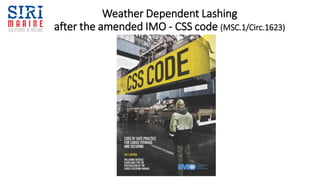
Weather Dependent Lashing
after the amended IMO - CSS code (MSC.1/Circ.1623)
Genesis & Evolution
(with a special thanks to Professor Captain Hermann Kaps)
• The CSS code is the international accepted
“lashing bible” for cargo vessels
• An IMO guideline, implemented by almost
all member states
• The basis for Cargo Securing Manuals and
cargo lashing principles for ALL vessel
(except container & wet/dry bulk vessels)
CSM’s are STATUTORY DOCUMENTS!
• First issued in the 1990’s, with a number of
amendments since then
• A calculation method for the “balance of
forces”: environmental induced vessel
motions / forces versus cargo lashing
capacities
- Basic acceleration matrix for UNRESTIRCTED
trades (read: Winter North Atlantic) , valid for a
ship of 100 meter length, 15 knots speed and a few
other conditions….
- Corrections to be made for different parameters
of length, speed, GM, etc.
- This matrix is the result of years of discussions,
bright minds and a lot of common sense!
The balance of forces !
Amendment to the CSS code (2020)
A Unified Interpretation of the Guidelines
(Published by IMO in December 2020 as MSC.1/Circ.1623)
• A complete re-write of Annex 13 (Methods to assess the efficiency of
securing arrangements for semi-standardized and non-standardized cargo)
• Specifically including Weather Dependent Lashing operations to
reduce the IMO accelerations. Input for the reduction factor is Hs
(Significant wave height) in the trading area
• The CSS code now also applies to heavy cargoes and towed transports
(heavy cargoes and tows were excluded before)
• A new Appendix 4 to addresses RoRo operations (Friction +
performance factor)
• IMO has requested all member states to implement these new
guidelines
How can IMO accelerations be reduced
during WDL operations (3 + 1 methods)
• 20 year return Hs on the trade route
• Forecasted Hs for voyages < 72 hours
• (this is the preferred method for short-sea)
• Seafastening design for a max Hs
• (This legalizes vessel routing!)
• Full scale monitoring results in irregular seas
• (This is the Siri Marine approach for RoRo / RoPax)
• Whenever WDL operations are carried out:
• Weather conditions must be monitored
• Vessel motions must be monitored & recorded
0.00
0.20
0.40
0.60
0.80
1.00
1.20
0 2 4 6 8 10 12 14
Comparision reduction curves
IMO reduction
IACS reduction
TDC code (Swedish reduction)
A “level playing field” for the RoRo /
RoPax industry
• After 15 or more years of discusions, finally a unified interpretation of
the CSS guidelines
• Applicable world-wide with only the significant wave height in the
trade area as input (Providing the implementation by your Flag-state of the
MSC.1/Circ.1623 amendment to the CSS Code)
• Clear instructions how a reduction to the IMO accelerations must be
applied
• A more realistic matrix of friction coefficients (For the RoRo / RoPax
only!) Increased to 0.45 for air-rubber tyres on a dry steel surface)
• And a “performance factor” specifically for RoRo / RoPax vessels
What can it do for you?
Heavy Lashing for Hs > 3,0 / 3,5 meter Light Lashing for Hs < 3,0 / 3,5 meter
How do you define the limiting wave
height for LIGHT lashing?
• The objective has been to allow 0 lashings for self-drivers and 2 lashings only for
trailers on traditional trestles
• Full scale measurements over the past 18 years on > 90 RoRo / RoPax vessels
have shown that a limiting wave height of approx. 3.0 meter Hs causes vessel
motions that allow for LIGHT lashing application (2.5 for very small RoRo vessels,
3.5 for the larger RoRo/RoPax vessels)
• Recorded motions / accelerations are used in the calculations and provide
sufficient safety margins
• Long term statistics show that Hs < 3.0 meter occurs in > 95% in Southern North
Sea, Irish Sea, Italian coastal waters, Balearic Sea
• The Central North Sea & Skagerrak score > 90%; Bay of Biscay scores around 80%,
but this is greatly influences by the winter months
• The percentages shown are all-year numbers
• To the best of my knowledge, cargo incidents have NOT occurred when LIGHT
lashing was practised!
Wave statistics examples
0
5
10
15
20
25
30
0.5 1 1.5 2 2.5 3 3.5 4 4.5 5 5.5 6 6.5 7
Distribution
Hs
All year distribution All year distribution
Central North Sea
lower upper Jan Feb Mar Apr May Jun Jul Aug Sep Oct Nov Dec
0 0.5 1.3 2 2.9 9.4 8 9.4 15.5 9.1 3.9 2.3 1.1 0.7
0.5 1 8.8 10.1 11.1 26.7 24.3 25.9 37.2 29.5 17.3 8.4 5.7 6.8
1 1.5 16.3 15 20 24.5 30.1 26.8 23.4 23.7 25.4 18.3 17 14.1
1.5 2 17.1 14.5 17.8 16.8 19.4 18.3 12.6 20.9 18.1 24.7 27.2 17.1
2 2.5 13.4 16.8 17.3 12 10.3 8.7 5.5 10.5 12.9 14.5 15.2 20.3
2.5 3 15.8 15 10.6 5.5 6.9 6.8 3.1 4.2 9 11.3 13.4 14
3 3.5 8.9 7.4 8.2 2.1 0.9 3.2 1.6 1.3 5.3 8.2 8.5 8.7
3.5 4 7.1 7.5 4.9 0.9 0.1 0.5 0.8 0.2 3.5 5.1 7 9.4
4 4.5 5.7 3.6 2.9 0.6 0 0.4 0.3 0.2 0.8 3.1 2.7 4.5
4.5 5 3.5 2.3 2.8 0.3 0 0.1 0 0.4 1.9 1.7 0.6 1.1
5 5.5 0.7 3.6 1.1 0.7 0 0 0 0 1.5 1 0.5 1.5
5.5 6 0.2 0.7 0.2 0.1 0 0 0 0 0.3 0.7 1.1 0.6
6 6.5 0.1 0.9 0 0.3 0 0 0 0 0 0.6 0 0.5
6.5 7 0.2 0.6 0 0 0 0 0 0 0 0.1 0 0.5
7 7.5 0.5 0 0 0 0 0 0 0 0 0 0 0
7.5 8 0.2 0 0 0 0 0 0 0 0 0 0 0
8 8.5 0 0 0 0 0 0 0 0 0 0 0 0
8.5 9 0.1 0 0 0 0 0 0 0 0 0 0 0
9 9.5 0 0 0 0 0 0 0 0 0 0 0 0
100 100 100 100 100 100 100 100 100 100 100 100
% > 3,0
meter 27.2 26.6 20.1 5 1 4.2 2.7 2.1 13.3 20.5 20.4 26.8
% > 3,5
meter 18.3 19.2 11.9 2.9 0.1 1 1.1 0.8 8 12.3 11.9 18.1
Monthly distribution of sign. wave height (m)
total
Copyright ARGOSS, January 2006
Southern North Sea
Golf of Genoa - 43.1N/8.6EE 10 & 100 year extreme: 5.6 & 6.8 m
Jan Feb Mar Apr May Jun Jul Aug Sep Oct Nov Dec All year Hs<3.0m
0-0.5 1.65% 1.63% 1.93% 2.15% 3.38% 3.54% 4.17% 4.50% 3.87% 2.88% 1.73% 1.55% 32.97% 32.97%
0.5-1 2.35% 2.26% 2.53% 2.64% 2.66% 2.36% 2.19% 2.11% 2.17% 2.42% 2.34% 2.08% 28.10% 28.10%
1-1.5 1.82% 1.71% 1.75% 1.59% 1.30% 1.16% 1.14% 0.99% 1.15% 1.57% 1.82% 1.91% 17.90% 17.90%
1.5-2 1.25% 1.03% 1.02% 0.91% 0.64% 0.65% 0.55% 0.49% 0.52% 0.74% 1.12% 1.30% 10.22% 10.22%
2-2.5 0.74% 0.54% 0.58% 0.51% 0.26% 0.32% 0.27% 0.25% 0.29% 0.44% 0.61% 0.74% 5.56% 5.56%
2.5-3 0.38% 0.27% 0.39% 0.27% 0.15% 0.12% 0.13% 0.11% 0.14% 0.23% 0.35% 0.42% 2.95% 2.95%
3-3.5 0.18% 0.15% 0.19% 0.11% 0.06% 0.05% 0.03% 0.04% 0.04% 0.13% 0.14% 0.29% 1.41%
3.5-4 0.07% 0.07% 0.07% 0.04% 0.02% 0.02% 0.01% 0.01% 0.02% 0.06% 0.07% 0.14% 0.59%
4-4.5 0.03% 0.05% 0.02% 0.01% 0.02% 0.02% 0.05% 0.20%
4.5-5 0.01% 0.02% 0.01% 0.01% 0.01% 0.07%
5-5.5 0.00%
5.5-6
6-6.5
6.5-7
99.96% 97.70%
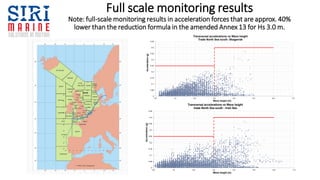
Full scale monitoring results
Note: full-scale monitoring results in acceleration forces that are approx. 40%
lower than the reduction formula in the amended Annex 13 for Hs 3.0 m.
0
0.05
0.1
0.15
0.2
0.25
0.3
0.35
0.4
0.45
0.0 1.0 2.0 3.0 4.0 5.0 6.0 7.0
Acceleration
(g)
Wave height (m)
Transversal accelerations vs Wave height
trade North Sea south - Irish Sea
0
0.05
0.1
0.15
0.2
0.25
0.3
0.35
0.4
0.45
0.0 1.0 2.0 3.0 4.0 5.0 6.0 7.0
Acceleration
(g)
Wave height (m)
Transversal accelerations vs Wave height
Trade North Sea south -Skagerrak
40
42
44
46
48
50
52
54
56
58
-10 -8 -6 -4 -2 0 2 4 6 8 10 12
Track
LIGHT vs HEAVY lashing
Your advantages
(The very obvious and the not-so obvious!)
(Does WDL contribute to sustainability in the maritime industry?)
• Significant reduction in external lashing costs / stevedores
• Significant work-load reduction for your crews
• Reduction in turn-around time in port
• On-time departure > close the ramp immediately after the last self-
driver is on board
• On-time departure > Fuel consumption / CO2 reduction
• On-time departure > happy clients
• No waiting time for self-drivers on arrival
• Reduction in equipment maintenance / replacement
• Sustainability is more than fuel & CO2 reduction alone
What can we do for you?
• Involved in vessel motion monitoring and cargo safety since 2003.
Launching Client in 2003: P&O Ferries on their North Sea routes
• A wealth of in-depth knowledge in WDL operations
• A huge data-base of vessel motions & weather data
• Provision of monitoring equipment & services
• Consultancy during start-up and implementation, optimize WDL
operations, reporting
• More than 90 RoRo / RoPax vessels worldwide have Siri systems & services
on board
• Assistance or writing of WDL documentation & approvals
• Training & instructions to on-shore and on-board staff
• Dedicated staff in a small transparent organisation
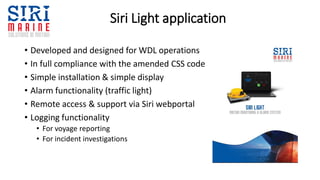
Siri Light application
• Developed and designed for WDL operations
• In full compliance with the amended CSS code
• Simple installation & simple display
• Alarm functionality (traffic light)
• Remote access & support via Siri webportal
• Logging functionality
• For voyage reporting
• For incident investigations
Work in progress
• Web application
• Vessel routing and statistical or forecasted weather on the routes
• Provision of reduction factors for the planned routes / trades
• Provision of the reduced acceleration matrix
• Calculation of seafastening / lashing of cargoes
• Until launched, all of the above can be provided by the Siri Marine
staff on request
• By the way: based on the same technology and born from our
practical knowledge, a new Siri TRIM optimization system has been
developed
Implementation
• WDL sensor systems do NOT replace common sense and good
seamanship
• Sensor systems, weather forecasting services, etc. are only tools to
the Master to enable him/her to make the right decisions at the right
time
• A word of caution:
• Plan the implementation of WDL operations carefully
• Get the on-board staff “on-board”. Changes are often seen as threats
• Start slowly, get feed-back, listen to concerns and react to questions
Thank you for your attention!
Questions? We have a stand in the exhibition area.
And this presentation plus all amended Annex 13
information can be emailed to you on request.

6-Speaker-3-Capt-Albert-Lanting Weather Dependent Lashing.pdf

  • 1.
    Weather Dependent Lashing afterthe amended IMO - CSS code (MSC.1/Circ.1623)
  • 2.
    Genesis & Evolution (witha special thanks to Professor Captain Hermann Kaps) • The CSS code is the international accepted “lashing bible” for cargo vessels • An IMO guideline, implemented by almost all member states • The basis for Cargo Securing Manuals and cargo lashing principles for ALL vessel (except container & wet/dry bulk vessels) CSM’s are STATUTORY DOCUMENTS! • First issued in the 1990’s, with a number of amendments since then • A calculation method for the “balance of forces”: environmental induced vessel motions / forces versus cargo lashing capacities - Basic acceleration matrix for UNRESTIRCTED trades (read: Winter North Atlantic) , valid for a ship of 100 meter length, 15 knots speed and a few other conditions…. - Corrections to be made for different parameters of length, speed, GM, etc. - This matrix is the result of years of discussions, bright minds and a lot of common sense!
  • 3.
  • 4.
    Amendment to theCSS code (2020) A Unified Interpretation of the Guidelines (Published by IMO in December 2020 as MSC.1/Circ.1623) • A complete re-write of Annex 13 (Methods to assess the efficiency of securing arrangements for semi-standardized and non-standardized cargo) • Specifically including Weather Dependent Lashing operations to reduce the IMO accelerations. Input for the reduction factor is Hs (Significant wave height) in the trading area • The CSS code now also applies to heavy cargoes and towed transports (heavy cargoes and tows were excluded before) • A new Appendix 4 to addresses RoRo operations (Friction + performance factor) • IMO has requested all member states to implement these new guidelines
  • 5.
    How can IMOaccelerations be reduced during WDL operations (3 + 1 methods) • 20 year return Hs on the trade route • Forecasted Hs for voyages < 72 hours • (this is the preferred method for short-sea) • Seafastening design for a max Hs • (This legalizes vessel routing!) • Full scale monitoring results in irregular seas • (This is the Siri Marine approach for RoRo / RoPax) • Whenever WDL operations are carried out: • Weather conditions must be monitored • Vessel motions must be monitored & recorded 0.00 0.20 0.40 0.60 0.80 1.00 1.20 0 2 4 6 8 10 12 14 Comparision reduction curves IMO reduction IACS reduction TDC code (Swedish reduction)
  • 6.
    A “level playingfield” for the RoRo / RoPax industry • After 15 or more years of discusions, finally a unified interpretation of the CSS guidelines • Applicable world-wide with only the significant wave height in the trade area as input (Providing the implementation by your Flag-state of the MSC.1/Circ.1623 amendment to the CSS Code) • Clear instructions how a reduction to the IMO accelerations must be applied • A more realistic matrix of friction coefficients (For the RoRo / RoPax only!) Increased to 0.45 for air-rubber tyres on a dry steel surface) • And a “performance factor” specifically for RoRo / RoPax vessels
  • 7.
    What can itdo for you? Heavy Lashing for Hs > 3,0 / 3,5 meter Light Lashing for Hs < 3,0 / 3,5 meter
  • 8.
    How do youdefine the limiting wave height for LIGHT lashing? • The objective has been to allow 0 lashings for self-drivers and 2 lashings only for trailers on traditional trestles • Full scale measurements over the past 18 years on > 90 RoRo / RoPax vessels have shown that a limiting wave height of approx. 3.0 meter Hs causes vessel motions that allow for LIGHT lashing application (2.5 for very small RoRo vessels, 3.5 for the larger RoRo/RoPax vessels) • Recorded motions / accelerations are used in the calculations and provide sufficient safety margins • Long term statistics show that Hs < 3.0 meter occurs in > 95% in Southern North Sea, Irish Sea, Italian coastal waters, Balearic Sea • The Central North Sea & Skagerrak score > 90%; Bay of Biscay scores around 80%, but this is greatly influences by the winter months • The percentages shown are all-year numbers • To the best of my knowledge, cargo incidents have NOT occurred when LIGHT lashing was practised!
  • 9.
    Wave statistics examples 0 5 10 15 20 25 30 0.51 1.5 2 2.5 3 3.5 4 4.5 5 5.5 6 6.5 7 Distribution Hs All year distribution All year distribution Central North Sea lower upper Jan Feb Mar Apr May Jun Jul Aug Sep Oct Nov Dec 0 0.5 1.3 2 2.9 9.4 8 9.4 15.5 9.1 3.9 2.3 1.1 0.7 0.5 1 8.8 10.1 11.1 26.7 24.3 25.9 37.2 29.5 17.3 8.4 5.7 6.8 1 1.5 16.3 15 20 24.5 30.1 26.8 23.4 23.7 25.4 18.3 17 14.1 1.5 2 17.1 14.5 17.8 16.8 19.4 18.3 12.6 20.9 18.1 24.7 27.2 17.1 2 2.5 13.4 16.8 17.3 12 10.3 8.7 5.5 10.5 12.9 14.5 15.2 20.3 2.5 3 15.8 15 10.6 5.5 6.9 6.8 3.1 4.2 9 11.3 13.4 14 3 3.5 8.9 7.4 8.2 2.1 0.9 3.2 1.6 1.3 5.3 8.2 8.5 8.7 3.5 4 7.1 7.5 4.9 0.9 0.1 0.5 0.8 0.2 3.5 5.1 7 9.4 4 4.5 5.7 3.6 2.9 0.6 0 0.4 0.3 0.2 0.8 3.1 2.7 4.5 4.5 5 3.5 2.3 2.8 0.3 0 0.1 0 0.4 1.9 1.7 0.6 1.1 5 5.5 0.7 3.6 1.1 0.7 0 0 0 0 1.5 1 0.5 1.5 5.5 6 0.2 0.7 0.2 0.1 0 0 0 0 0.3 0.7 1.1 0.6 6 6.5 0.1 0.9 0 0.3 0 0 0 0 0 0.6 0 0.5 6.5 7 0.2 0.6 0 0 0 0 0 0 0 0.1 0 0.5 7 7.5 0.5 0 0 0 0 0 0 0 0 0 0 0 7.5 8 0.2 0 0 0 0 0 0 0 0 0 0 0 8 8.5 0 0 0 0 0 0 0 0 0 0 0 0 8.5 9 0.1 0 0 0 0 0 0 0 0 0 0 0 9 9.5 0 0 0 0 0 0 0 0 0 0 0 0 100 100 100 100 100 100 100 100 100 100 100 100 % > 3,0 meter 27.2 26.6 20.1 5 1 4.2 2.7 2.1 13.3 20.5 20.4 26.8 % > 3,5 meter 18.3 19.2 11.9 2.9 0.1 1 1.1 0.8 8 12.3 11.9 18.1 Monthly distribution of sign. wave height (m) total Copyright ARGOSS, January 2006 Southern North Sea Golf of Genoa - 43.1N/8.6EE 10 & 100 year extreme: 5.6 & 6.8 m Jan Feb Mar Apr May Jun Jul Aug Sep Oct Nov Dec All year Hs<3.0m 0-0.5 1.65% 1.63% 1.93% 2.15% 3.38% 3.54% 4.17% 4.50% 3.87% 2.88% 1.73% 1.55% 32.97% 32.97% 0.5-1 2.35% 2.26% 2.53% 2.64% 2.66% 2.36% 2.19% 2.11% 2.17% 2.42% 2.34% 2.08% 28.10% 28.10% 1-1.5 1.82% 1.71% 1.75% 1.59% 1.30% 1.16% 1.14% 0.99% 1.15% 1.57% 1.82% 1.91% 17.90% 17.90% 1.5-2 1.25% 1.03% 1.02% 0.91% 0.64% 0.65% 0.55% 0.49% 0.52% 0.74% 1.12% 1.30% 10.22% 10.22% 2-2.5 0.74% 0.54% 0.58% 0.51% 0.26% 0.32% 0.27% 0.25% 0.29% 0.44% 0.61% 0.74% 5.56% 5.56% 2.5-3 0.38% 0.27% 0.39% 0.27% 0.15% 0.12% 0.13% 0.11% 0.14% 0.23% 0.35% 0.42% 2.95% 2.95% 3-3.5 0.18% 0.15% 0.19% 0.11% 0.06% 0.05% 0.03% 0.04% 0.04% 0.13% 0.14% 0.29% 1.41% 3.5-4 0.07% 0.07% 0.07% 0.04% 0.02% 0.02% 0.01% 0.01% 0.02% 0.06% 0.07% 0.14% 0.59% 4-4.5 0.03% 0.05% 0.02% 0.01% 0.02% 0.02% 0.05% 0.20% 4.5-5 0.01% 0.02% 0.01% 0.01% 0.01% 0.07% 5-5.5 0.00% 5.5-6 6-6.5 6.5-7 99.96% 97.70%
  • 10.
    Full scale monitoringresults Note: full-scale monitoring results in acceleration forces that are approx. 40% lower than the reduction formula in the amended Annex 13 for Hs 3.0 m. 0 0.05 0.1 0.15 0.2 0.25 0.3 0.35 0.4 0.45 0.0 1.0 2.0 3.0 4.0 5.0 6.0 7.0 Acceleration (g) Wave height (m) Transversal accelerations vs Wave height trade North Sea south - Irish Sea 0 0.05 0.1 0.15 0.2 0.25 0.3 0.35 0.4 0.45 0.0 1.0 2.0 3.0 4.0 5.0 6.0 7.0 Acceleration (g) Wave height (m) Transversal accelerations vs Wave height Trade North Sea south -Skagerrak 40 42 44 46 48 50 52 54 56 58 -10 -8 -6 -4 -2 0 2 4 6 8 10 12 Track
  • 11.
  • 12.
    Your advantages (The veryobvious and the not-so obvious!) (Does WDL contribute to sustainability in the maritime industry?) • Significant reduction in external lashing costs / stevedores • Significant work-load reduction for your crews • Reduction in turn-around time in port • On-time departure > close the ramp immediately after the last self- driver is on board • On-time departure > Fuel consumption / CO2 reduction • On-time departure > happy clients • No waiting time for self-drivers on arrival • Reduction in equipment maintenance / replacement • Sustainability is more than fuel & CO2 reduction alone
  • 13.
    What can wedo for you? • Involved in vessel motion monitoring and cargo safety since 2003. Launching Client in 2003: P&O Ferries on their North Sea routes • A wealth of in-depth knowledge in WDL operations • A huge data-base of vessel motions & weather data • Provision of monitoring equipment & services • Consultancy during start-up and implementation, optimize WDL operations, reporting • More than 90 RoRo / RoPax vessels worldwide have Siri systems & services on board • Assistance or writing of WDL documentation & approvals • Training & instructions to on-shore and on-board staff • Dedicated staff in a small transparent organisation
  • 14.
    Siri Light application •Developed and designed for WDL operations • In full compliance with the amended CSS code • Simple installation & simple display • Alarm functionality (traffic light) • Remote access & support via Siri webportal • Logging functionality • For voyage reporting • For incident investigations
  • 15.
    Work in progress •Web application • Vessel routing and statistical or forecasted weather on the routes • Provision of reduction factors for the planned routes / trades • Provision of the reduced acceleration matrix • Calculation of seafastening / lashing of cargoes • Until launched, all of the above can be provided by the Siri Marine staff on request • By the way: based on the same technology and born from our practical knowledge, a new Siri TRIM optimization system has been developed
  • 16.
    Implementation • WDL sensorsystems do NOT replace common sense and good seamanship • Sensor systems, weather forecasting services, etc. are only tools to the Master to enable him/her to make the right decisions at the right time • A word of caution: • Plan the implementation of WDL operations carefully • Get the on-board staff “on-board”. Changes are often seen as threats • Start slowly, get feed-back, listen to concerns and react to questions
  • 17.
    Thank you foryour attention! Questions? We have a stand in the exhibition area. And this presentation plus all amended Annex 13 information can be emailed to you on request.