Hearing Conservation Program
Purpose
The purpose of this plan is to establish a program and procedures for hearing conservation at the
Jubitz Truck Service Center. This program applies to all areas that have operations that produce
employee noise exposures equal to or in excess of 85 dBA, as an 8-hour time-weighted average.
The Occupational Safety and Health Administration Occupational Noise Exposure Standards 29
CFR 1910.95 (General Industry) and 29 CFR 1926.52 (Construction Industry) and the Mine
Safety and Health Administration Occupational Noise Exposure Standard 30 CFR Part 62 call for
the development, implementation, and maintenance of a hearing conservation program when
employee exposure to noise is equal to or exceeds an 8-hour TWA of 85 dBA. The written
hearing conservation program will include and address the following categories in order to satisfy
the minimum requirements of the applicable Occupational Noise Exposure Standard:
• Noise exposure monitoring (area and/or personal)
• Audiometric testing for exposed employees
• Hearing protection provided and utilized
• Employee training
• Record keeping
*For additional guidance visit www.osha.gov and review the occupational noise exposure regulations
1910.95.
1
Hearing Conservation Program Truck Service Center
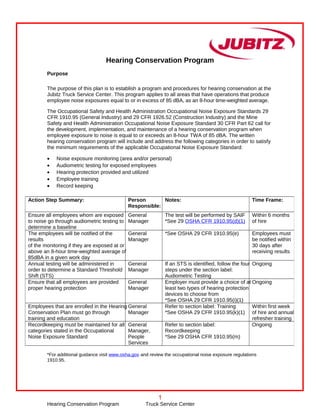
Action Step Summary: Person
Responsible:
Notes: Time Frame:
Ensure all employees whom are exposed
to noise go through audiometric testing to
determine a baseline
General
Manager
The test will be performed by SAIF
*See 29 OSHA CFR 1910.95(d)(1)
Within 6 months
of hire
The employees will be notified of the
results
of the monitoring if they are exposed at or
above an 8-hour time-weighted average of
85dBA in a given work day
General
Manager
*See OSHA 29 CFR 1910.95(e) Employees must
be notified within
30 days after
receiving results
Annual testing will be administered in
order to determine a Standard Threshold
Shift (STS)
General
Manager
If an STS is identified, follow the four
steps under the section label:
Audiometric Testing
Ongoing
Ensure that all employees are provided
proper hearing protection
General
Manager
Employer must provide a choice of at
least two types of hearing protection
devices to choose from
*See OSHA 29 CFR 1910.95(i)(1)
Ongoing
Employees that are enrolled in the Hearing
Conservation Plan must go through
training and education
General
Manager
Refer to section label: Training
*See OSHA 29 CFR 1910.95(k)(1)
Within first week
of hire and annual
refresher training
Recordkeeping must be maintained for all
categories stated in the Occupational
Noise Exposure Standard
General
Manager,
People
Services
Refer to section label:
Recordkeeping
*See 29 OSHA CFR 1910.95(m)
Ongoing
The hearing conservation program will include the following:
• Identification of personnel responsible for the program
• How noise levels and employee exposures will be measured
• How audiometric testing will be performed
• How hearing protection will be selected, provided, replaced and use enforced
• How training will be performed
• Procedures to evaluate and update the program
• How records will be maintained
Responsibilities
The general manager is responsible for administering the hearing conservation program.
The manager is also responsible for:
• Ensuring periodic noise via sound-level measurements or dosimetry in order to determine
employee exposure to noise
• Making available to employees copies of the applicable Occupational Noise Exposure
Standard and posting a copy of the standard in the workplace, such as on the employee
bulletin board
• Administering the audiometric testing program
• Providing annual training for employees
• Notifying employees of noise monitoring and audiometric testing results
• Maintaining noise exposure monitoring, audiometric testing and training records
• Reviewing the effectiveness of the hearing conservation program and making sure that it
satisfies the requirements of all applicable federal, state or local hearing conservation
requirements
• Enforcing the use of hearing protection by employees required to wear it
• Ensuring that the hearing protectors are in good condition and are fitted and used correctly
• Ensuring that hearing protectors provide adequate attenuation (i.e., the noise reduction rating
is adequate)
• Enforcing administrative and engineering controls within the department to reduce employee
noise exposure
• Proper care of hearing protection, including location of supply, and proper use and
replacement of hearing protection equipment
Employees are responsible for the following aspects of the hearing conservation program:
• Wearing hearing protection in work areas requiring it
• Knowledge and understanding of the consequences associated with not following company
policy concerning the proper use of hearing protection
• Proper care of hearing protection, including proper use, routine care and cleaning, storage,
and replacement
2
Hearing Conservation Program Truck Service Center
Determination of Sound Levels
To determine employee exposure, noise monitoring will be conducted and
repeated whenever there is a change in the work environment, such as changes in
production, process, equipment and/or controls.
Noise exposure monitoring will be conducted using the following methods:
• Area monitoring — Measuring the noise levels in an area by use of a sound-level meter.
• Personal monitoring — Measuring an employee’s noise exposure by use of a dosimeter. A
dosimeter is worn by an employee for a representative time frame in order to evaluate noise
levels that the employee is exposed to when doing his or her particular job.
Audiometric Testing
The purpose of audiometric testing is to determine each employee’s hearing threshold by
determining the employee’s response to noise at several frequencies. A baseline audiogram will
be conducted within six months of hire, or within one year if a mobile test van is used.
The initial audiogram will be used as a baseline measurement to which all subsequent
audiograms will be compared. Audiometric testing will be completed annually for all employees
whose exposures equal or exceed an 8-hour TWA of 85 dBA.
Audiometric testing will be performed by an accredited audiometric testing company and the
testing will be performed at no cost to the employee.
Employees who are to receive audiograms during a workday must wear hearing protection prior
to their tests or have been exempt from workplace noise for a period of 14 hours prior to the
testing procedures. During the 14 hours prior to the testing, the employees shall refrain from any
noisy non-work exposures such as listening to loud music, mowing the lawn, target practice and
woodworking.
The annual audiogram will be compared to the baseline audiogram to determine if the audiogram
is valid and if a standard threshold shift has occurred. An STS is defined as the average hearing
loss of 10 dB or more at the tested frequencies of 2,000, 3,000 and 4,000 Hz in either ear.
If an STS is identified, the following steps will be taken:
1. Employees will be notified of the results in writing within 21 days (minors
must be notified within 10 days) of the determination. Employees will also
be fitted and trained in the use of hearing protection equipment.
2. Employees already wearing hearing protection will be refitted and retrained in
the proper use of hearing protection. Hearing protection offering greater noise
reduction will be provided to the affected employees.
3. An employee may be referred for a clinical audiological evaluation or an
otological examination for additional testing.
4. The department manager will review the effectiveness
of any engineering and administrative controls to identify and correct any
deficiencies.
Evaluation of the results of the audiograms will be performed by SAIF Corporation. Jubitz will
follow all recommendations made for each employee by the tester. If the results of the audiogram
demonstrate an STS, the company reserves the right to conduct a second audiogram within 30
days and consider these results as the annual audiogram.
3
Hearing Conservation Program Truck Service Center
Hearing Protection
Employees included in the hearing conservation program will be provided
with hearing protection as follows:
• Hearing protection will be provided at no cost to employees
• Employees will be able to select their hearing protection from a variety of suitable hearing
protectors
• Employees will receive training in the use and care of hearing protection
• The use of hearing protection will be required for employees who have not yet had a baseline
audiogram, who have experienced an STS, or whose exposures exceed an 8-hour TWA of
85 dBA
Training:
Employees included in the hearing conservation program will receive the following annual
training:
• The effects of noise on the human ear and hearing
• The purpose of hearing protection, including the advantages and disadvantages of various
types of hearing protection
• The proper selection, fitting, use and care of hearing protection
• The purpose and value of noise exposure monitoring and audiometric testing and a summary
of the procedures
• The company’s and employees’ respective tasks for maintaining noise controls
Recordkeeping
The Service Center general manager and the People Services department will maintain records
pertaining to the hearing conservation program in a confidential manner. Any requests for records
should be directed to these two department managers. The following records will be kept on file:
• Noise exposure monitoring results
• Audiometric testing records
• Certificates of training
• Warnings issued to employees for not following the hearing conservation program
I, ____________________, have read the hearing conservation program and understand my role
at Jubitz.
___________________________________ Date: _________________
Employee Signature
___________________________________ Date: _________________
Lane Bibb
Service Center Manger
Safety Committee Representative
4
Hearing Conservation Program Truck Service Center
Revised: July 2016
5
Hearing Conservation Program Truck Service Center
Revised: July 2016
5
Hearing Conservation Program Truck Service Center

Hearing Conservation Plan

  • 1.
    Hearing Conservation Program Purpose Thepurpose of this plan is to establish a program and procedures for hearing conservation at the Jubitz Truck Service Center. This program applies to all areas that have operations that produce employee noise exposures equal to or in excess of 85 dBA, as an 8-hour time-weighted average. The Occupational Safety and Health Administration Occupational Noise Exposure Standards 29 CFR 1910.95 (General Industry) and 29 CFR 1926.52 (Construction Industry) and the Mine Safety and Health Administration Occupational Noise Exposure Standard 30 CFR Part 62 call for the development, implementation, and maintenance of a hearing conservation program when employee exposure to noise is equal to or exceeds an 8-hour TWA of 85 dBA. The written hearing conservation program will include and address the following categories in order to satisfy the minimum requirements of the applicable Occupational Noise Exposure Standard: • Noise exposure monitoring (area and/or personal) • Audiometric testing for exposed employees • Hearing protection provided and utilized • Employee training • Record keeping *For additional guidance visit www.osha.gov and review the occupational noise exposure regulations 1910.95. 1 Hearing Conservation Program Truck Service Center Action Step Summary: Person Responsible: Notes: Time Frame: Ensure all employees whom are exposed to noise go through audiometric testing to determine a baseline General Manager The test will be performed by SAIF *See 29 OSHA CFR 1910.95(d)(1) Within 6 months of hire The employees will be notified of the results of the monitoring if they are exposed at or above an 8-hour time-weighted average of 85dBA in a given work day General Manager *See OSHA 29 CFR 1910.95(e) Employees must be notified within 30 days after receiving results Annual testing will be administered in order to determine a Standard Threshold Shift (STS) General Manager If an STS is identified, follow the four steps under the section label: Audiometric Testing Ongoing Ensure that all employees are provided proper hearing protection General Manager Employer must provide a choice of at least two types of hearing protection devices to choose from *See OSHA 29 CFR 1910.95(i)(1) Ongoing Employees that are enrolled in the Hearing Conservation Plan must go through training and education General Manager Refer to section label: Training *See OSHA 29 CFR 1910.95(k)(1) Within first week of hire and annual refresher training Recordkeeping must be maintained for all categories stated in the Occupational Noise Exposure Standard General Manager, People Services Refer to section label: Recordkeeping *See 29 OSHA CFR 1910.95(m) Ongoing
  • 2.
    The hearing conservationprogram will include the following: • Identification of personnel responsible for the program • How noise levels and employee exposures will be measured • How audiometric testing will be performed • How hearing protection will be selected, provided, replaced and use enforced • How training will be performed • Procedures to evaluate and update the program • How records will be maintained Responsibilities The general manager is responsible for administering the hearing conservation program. The manager is also responsible for: • Ensuring periodic noise via sound-level measurements or dosimetry in order to determine employee exposure to noise • Making available to employees copies of the applicable Occupational Noise Exposure Standard and posting a copy of the standard in the workplace, such as on the employee bulletin board • Administering the audiometric testing program • Providing annual training for employees • Notifying employees of noise monitoring and audiometric testing results • Maintaining noise exposure monitoring, audiometric testing and training records • Reviewing the effectiveness of the hearing conservation program and making sure that it satisfies the requirements of all applicable federal, state or local hearing conservation requirements • Enforcing the use of hearing protection by employees required to wear it • Ensuring that the hearing protectors are in good condition and are fitted and used correctly • Ensuring that hearing protectors provide adequate attenuation (i.e., the noise reduction rating is adequate) • Enforcing administrative and engineering controls within the department to reduce employee noise exposure • Proper care of hearing protection, including location of supply, and proper use and replacement of hearing protection equipment Employees are responsible for the following aspects of the hearing conservation program: • Wearing hearing protection in work areas requiring it • Knowledge and understanding of the consequences associated with not following company policy concerning the proper use of hearing protection • Proper care of hearing protection, including proper use, routine care and cleaning, storage, and replacement 2 Hearing Conservation Program Truck Service Center
  • 3.
    Determination of SoundLevels To determine employee exposure, noise monitoring will be conducted and repeated whenever there is a change in the work environment, such as changes in production, process, equipment and/or controls. Noise exposure monitoring will be conducted using the following methods: • Area monitoring — Measuring the noise levels in an area by use of a sound-level meter. • Personal monitoring — Measuring an employee’s noise exposure by use of a dosimeter. A dosimeter is worn by an employee for a representative time frame in order to evaluate noise levels that the employee is exposed to when doing his or her particular job. Audiometric Testing The purpose of audiometric testing is to determine each employee’s hearing threshold by determining the employee’s response to noise at several frequencies. A baseline audiogram will be conducted within six months of hire, or within one year if a mobile test van is used. The initial audiogram will be used as a baseline measurement to which all subsequent audiograms will be compared. Audiometric testing will be completed annually for all employees whose exposures equal or exceed an 8-hour TWA of 85 dBA. Audiometric testing will be performed by an accredited audiometric testing company and the testing will be performed at no cost to the employee. Employees who are to receive audiograms during a workday must wear hearing protection prior to their tests or have been exempt from workplace noise for a period of 14 hours prior to the testing procedures. During the 14 hours prior to the testing, the employees shall refrain from any noisy non-work exposures such as listening to loud music, mowing the lawn, target practice and woodworking. The annual audiogram will be compared to the baseline audiogram to determine if the audiogram is valid and if a standard threshold shift has occurred. An STS is defined as the average hearing loss of 10 dB or more at the tested frequencies of 2,000, 3,000 and 4,000 Hz in either ear. If an STS is identified, the following steps will be taken: 1. Employees will be notified of the results in writing within 21 days (minors must be notified within 10 days) of the determination. Employees will also be fitted and trained in the use of hearing protection equipment. 2. Employees already wearing hearing protection will be refitted and retrained in the proper use of hearing protection. Hearing protection offering greater noise reduction will be provided to the affected employees. 3. An employee may be referred for a clinical audiological evaluation or an otological examination for additional testing. 4. The department manager will review the effectiveness of any engineering and administrative controls to identify and correct any deficiencies. Evaluation of the results of the audiograms will be performed by SAIF Corporation. Jubitz will follow all recommendations made for each employee by the tester. If the results of the audiogram demonstrate an STS, the company reserves the right to conduct a second audiogram within 30 days and consider these results as the annual audiogram. 3 Hearing Conservation Program Truck Service Center
  • 4.
    Hearing Protection Employees includedin the hearing conservation program will be provided with hearing protection as follows: • Hearing protection will be provided at no cost to employees • Employees will be able to select their hearing protection from a variety of suitable hearing protectors • Employees will receive training in the use and care of hearing protection • The use of hearing protection will be required for employees who have not yet had a baseline audiogram, who have experienced an STS, or whose exposures exceed an 8-hour TWA of 85 dBA Training: Employees included in the hearing conservation program will receive the following annual training: • The effects of noise on the human ear and hearing • The purpose of hearing protection, including the advantages and disadvantages of various types of hearing protection • The proper selection, fitting, use and care of hearing protection • The purpose and value of noise exposure monitoring and audiometric testing and a summary of the procedures • The company’s and employees’ respective tasks for maintaining noise controls Recordkeeping The Service Center general manager and the People Services department will maintain records pertaining to the hearing conservation program in a confidential manner. Any requests for records should be directed to these two department managers. The following records will be kept on file: • Noise exposure monitoring results • Audiometric testing records • Certificates of training • Warnings issued to employees for not following the hearing conservation program I, ____________________, have read the hearing conservation program and understand my role at Jubitz. ___________________________________ Date: _________________ Employee Signature ___________________________________ Date: _________________ Lane Bibb Service Center Manger Safety Committee Representative 4 Hearing Conservation Program Truck Service Center
  • 5.
    Revised: July 2016 5 HearingConservation Program Truck Service Center
  • 6.
    Revised: July 2016 5 HearingConservation Program Truck Service Center