Occlusion
part 2
By
Dr. Eman Hany
1) Dental arch formation and form.
2) Compensatory curves of dental arches.
3) Compensatory curves of individual teeth.
4) Angulations of individual teeth in relation to various planes.
5) Functional form of the teeth at their incisal and occlusal thirds.
6) Facial relation of each tooth in one arch to its antagonist in
centric occlusion.
7) Occlusal contact and intercuspation of all teeth of one arch with
those in the opposing arch in centric occlusion.
8) Occlusal contact and interaction of all teeth during various
functional movements.
Items of occlusion
7-Occlusal contact and intercusp Relations of all
Teeth in One Arch with those in the Opposing Arch
in Centric Occlusion.
Supporting cusps make contact at centric stops in the
opposing teeth
 Centric stops: areas of contact that a supporting cusp
makes with opposing teeth.
L cusps of max. post. teeth
 Supporting cusps like
B cusps of mand. Post. teeth
B cusps of max post. teeth
 Guiding cusps like
L cusps of mand. Post. teeth
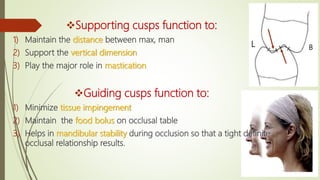
Supporting cusps function to:
1) Maintain the distance between max, man
2) Support the vertical dimension
3) Play the major role in mastication
Guiding cusps function to:
1) Minimize tissue impingement
2) Maintain the food bolus on occlusal table
3) Helps in mandibular stability during occlusion so that a tight definite
occlusal relationship results.
BL
The1st permanent maxillary molar followed by
mandibular one are the keys of occlusion. why??
1) 1st permanent tooth erupted in oral cavity
2) Largest in dental arch
3) Occupy a central position in the jaw (antro-posteriorly)
4) Guided to its position by the deciduous teeth preceding it.
5) Have no predecessors so their eruption is not disturbed.
 6 is considered more accurate than 6 as it is attached to a bone
fixed to the base of the skull.
In normal jaw relations, the MB cusp of the upper 6
occludes with the MB groove of the lower 6.
This normal relationship of these two teeth is called the key
of occlusion.
MB cusp of lower 7 is:
A. Supporting cusp
B. Guiding cusp
Angle’s Classification of occlusion
Angle’s Classification:
Class I:
Normal profile
Normal occlusion: MB cusp of 6 occludes in MB groove of 6
Class II
Retrognathic
Retruded profile
Deficient chin length
MB cusp of upper 6 occludes anterior to MB groove of
lower 6
Class III:
Prognathic
Protruded profile
Excessive chin length
MB cusp of upper 6 occludes posterior to MB groove of lower
6
The relation of the teeth in
centric occlusion
1) Centric Occlusion of Permanent Teeth
Each tooth in a dental arch occludes with two teeth in
the opposing arch , except lower central incisor and
upper third molar.
The median plane is coincident in the two jaws
Supporting (functional) cusps:
Buccal cusps of mandibular
posterior teeth.
Lingual cusps of maxillary posterior
teeth.
Maxillary teeth bears a buccal
relation to mandibular teeth.
BL
Central incisors share the same mesial contact area at
the midline.
Incisal ridges of upper incisors are free of contact.
Incisal ridges of lower incisors contact the lingual surface
of upper incisors at their incisal thirds.
Lower central incisor occludes with the mesial 2/3 of the
upper central incisor.
As for canines: cusps lie in the embrasures between
their 2 opposing teeth
Upper canine:
its cusp lies in the labial embrasure between lower 3
,4.
Lower canine:
its cusp lies in the lingual embrasure between upper
2, 3
B cusps of maxillary teeth are free of contact lying
buccal to the lower opposing teeth
L cusps of mandibular teeth lie free of contact,
lingual to the maxillary teeth
Cusps will contact either:
Central fossa marginal ridges in an embrasure
BL
Central fossa line
Central fossa line
 It is a continuous line drawn through the central developmental grooves of
maxillary and mandibular posterior teeth.
 Centric cusps of one arch contact CF line of opposing arch occluding in
central fossae or marginal ridges.
Mandibular buccal cusps central fossae or on marginal ridges of maxillary
posterior teeth
Maxillary lingual cusps central fossae or on marginal ridges of mandibular
posterior teeth
The mandibular first molar is positioned mesial to the maxillary
first molar
Buccal cusps of upper premolars lie free in the buccal
embrasure of the two lower opposing teeth
MB cusp of maxillary molars occludes above the buccal groove
of the opposing mandibular same tooth
DB cusp of maxillary 6 & 7 is free in the Buccal embrasure
between 2 opposing mandibular teeth.
ML cusp of each maxillary molar occludes in the central fossa of
the opposing mandibular molar.
Lingual view
DB cusp of each mandibular molar occludes in the central
fossa of the opposing maxillary molar.
MB cusp of each mandibular molar generally occludes on the
DMR & MMR of the opposing maxillary molars.
DMR of upper 8 is nearly even with DMR of lower 8
Let’s revise the
centric occlusion
2) Centric occlusion relation of
deciduous teeth
At age 3 years the child has centric
occlusion similar to permanent teeth
 At 3 years the deciduous teeth are all erupted and roots are almost
completed.
 Each tooth is in contact with 2 teeth except : Lower central (A)
Upper second molar
(E)
 Mesial outlines of upper and lower central incisors are in line with
each other at the midline.
 A A & the mesial third of B.
 B distal 2/3 of B and mesial part of C
 C D part of C and M 1/3 of D
 D D 2/3 of D and M 1/3 of E.
 E rest of E and it projects slightly over the D
margin of E.
occludes with
Rest position of the mandible
When the mandible is at rest
lower teeth are not in contact
with the upper teeth
there is a space of 2 mm in-
between the two arches
FREEWAY SPACE .
8-The Occlusal Contact and Intercusp
Relations of all the Teeth During
Eccentric mandibular movements.
Mandibular movements
Symmetrical bilateral
movements:
Depression
Elevation
Protrusion
Retrusion
Asymmetrical bilateral
movements:
Right lateral
Left lateral.
Functional relations of mandibular
movements
Protrusive occlusal relation.
Retrusive occlusal relation.
Right occlusal relation.
Left occlusal relation
1) Protrusive occlusal relation
The mandibular arch bears a forward,
anterior relation to its centric relation with
the maxillary arch.
Used for Biting or shearing food material
Incisal edges of Incisors get in contact.
Mesial cusp ridge of lower canine may get
in contact with the upper lateral
Posterior teeth are out of occlusion.
2)Retrusive occlusal relation:
 Mandibular teeth will have posterior relation to centric
occlusion with the maxillary arch.
 Very limited and non functional movement.
 Contacts occur on:
 Mesial inclines of maxillary teeth
 Distal inclines of mandibular teeth
3) Right and left lateral occlusal relation:
The mandibular dental arch is placed in a
right or left lateral relation to centric
occlusion with the maxillary arch.
Define each of the following:
1) Freeway space
2) Leeway space
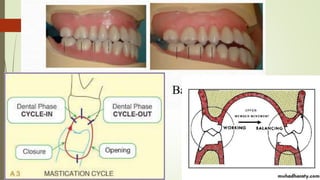
Masticatory cycle of teeth
The masticatory cycle of posterior teeth
Then both sides move
to centric occlusion
The working side
shows the buccal cusps
of maxillary and
mandibular teeth to be
in contact.
Alteration from one
side to the other
cycle.
The non-working
(balancing) side may have
no contact or may shows
contact of lingual cusps of
the maxillary teeth with
buccal cusps of mandibular
teeth.
B
L
B L
LB
The masticatory cycle of anterior teeth
The mandible then returns
upward & backward in a
retrusive movement to the
centric occlusion
Functioning side at the
anterior teeth
 labioIncisal ridges of lower
incisors are in contact with
linguoincisal ridges of
upper incisors
Alteration bet protrusive and
retrusive movements form
the masticatory cycle of
anterior teeth
Balancing side at the
posterior teeth
 Post teeth show anterior
relation of lower to the upper
with disocclusion of posterior
teeth
Factors determining
tooth position
1) Physiological muscular forces
As teeth erupt, they’re directed to a position
where opposing forces are in equilibrium.
This is called: Neutral space or position.
Forces originate from the surrounding
musculature.
Lips and cheeks lingual force on teeth
Tongue labial force
2) Large tongue and tongue thrust
If the tongue is unusually active or large
Greater forces are applied lingually
Neutral space is not lost but displaced
labially
Flaring of anterior teeth till reaching
equilibrium
Anterior open bite
3) Oral habits
Oral habits like thumb sucking, biting
on a pipe or musical instruments can
affect teeth position
These habits apply increased lingual
forces on the maxillary anterior teeth
Leading to
Flaring and anterior open bite
4) Forces on proximal surfaces
Wearing of proximal contacts of teeth
occur during mastication and function.
This is compensated by mesial drifting to
maintain contact between adjacent teeth.
This is most apparent when a tooth is
extracted the tooth distal to the
extraction site will drift mesially
5) Occlusal contact
Unopposed teeth may
supererupt until occlusal contact
is established.
Occlusal contact prevents
extrusion or supereruption of
teeth
thus maintaining arch stability
Topics covered today
Differentiate between supporting and guiding cusps
What’s the key of occlusion?
Angle’s classification of occlusion
Occlusal relation of all permanent teeth at centric occlusion
Occlusal relation of deciduous teeth at centric occlusion
Rest position of the mandible
Types of eccentric movements
Masticatory cycle of anterior and posterior teeth
Factors affecting teeth alignment
Any Questions?
Occlusion part 2 final

Occlusion part 2 final

  • 1.
  • 3.
    1) Dental archformation and form. 2) Compensatory curves of dental arches. 3) Compensatory curves of individual teeth. 4) Angulations of individual teeth in relation to various planes. 5) Functional form of the teeth at their incisal and occlusal thirds. 6) Facial relation of each tooth in one arch to its antagonist in centric occlusion. 7) Occlusal contact and intercuspation of all teeth of one arch with those in the opposing arch in centric occlusion. 8) Occlusal contact and interaction of all teeth during various functional movements. Items of occlusion
  • 4.
    7-Occlusal contact andintercusp Relations of all Teeth in One Arch with those in the Opposing Arch in Centric Occlusion.
  • 5.
    Supporting cusps makecontact at centric stops in the opposing teeth  Centric stops: areas of contact that a supporting cusp makes with opposing teeth. L cusps of max. post. teeth  Supporting cusps like B cusps of mand. Post. teeth B cusps of max post. teeth  Guiding cusps like L cusps of mand. Post. teeth
  • 6.
    Supporting cusps functionto: 1) Maintain the distance between max, man 2) Support the vertical dimension 3) Play the major role in mastication Guiding cusps function to: 1) Minimize tissue impingement 2) Maintain the food bolus on occlusal table 3) Helps in mandibular stability during occlusion so that a tight definite occlusal relationship results. BL
  • 7.
    The1st permanent maxillarymolar followed by mandibular one are the keys of occlusion. why?? 1) 1st permanent tooth erupted in oral cavity 2) Largest in dental arch 3) Occupy a central position in the jaw (antro-posteriorly) 4) Guided to its position by the deciduous teeth preceding it. 5) Have no predecessors so their eruption is not disturbed.  6 is considered more accurate than 6 as it is attached to a bone fixed to the base of the skull.
  • 8.
    In normal jawrelations, the MB cusp of the upper 6 occludes with the MB groove of the lower 6. This normal relationship of these two teeth is called the key of occlusion.
  • 9.
    MB cusp oflower 7 is: A. Supporting cusp B. Guiding cusp
  • 10.
  • 11.
    Angle’s Classification: Class I: Normalprofile Normal occlusion: MB cusp of 6 occludes in MB groove of 6
  • 12.
    Class II Retrognathic Retruded profile Deficientchin length MB cusp of upper 6 occludes anterior to MB groove of lower 6
  • 13.
    Class III: Prognathic Protruded profile Excessivechin length MB cusp of upper 6 occludes posterior to MB groove of lower 6
  • 15.
    The relation ofthe teeth in centric occlusion
  • 16.
    1) Centric Occlusionof Permanent Teeth Each tooth in a dental arch occludes with two teeth in the opposing arch , except lower central incisor and upper third molar. The median plane is coincident in the two jaws
  • 17.
    Supporting (functional) cusps: Buccalcusps of mandibular posterior teeth. Lingual cusps of maxillary posterior teeth. Maxillary teeth bears a buccal relation to mandibular teeth. BL
  • 19.
    Central incisors sharethe same mesial contact area at the midline. Incisal ridges of upper incisors are free of contact. Incisal ridges of lower incisors contact the lingual surface of upper incisors at their incisal thirds. Lower central incisor occludes with the mesial 2/3 of the upper central incisor.
  • 21.
    As for canines:cusps lie in the embrasures between their 2 opposing teeth Upper canine: its cusp lies in the labial embrasure between lower 3 ,4. Lower canine: its cusp lies in the lingual embrasure between upper 2, 3
  • 23.
    B cusps ofmaxillary teeth are free of contact lying buccal to the lower opposing teeth L cusps of mandibular teeth lie free of contact, lingual to the maxillary teeth Cusps will contact either: Central fossa marginal ridges in an embrasure BL
  • 24.
  • 25.
    Central fossa line It is a continuous line drawn through the central developmental grooves of maxillary and mandibular posterior teeth.  Centric cusps of one arch contact CF line of opposing arch occluding in central fossae or marginal ridges. Mandibular buccal cusps central fossae or on marginal ridges of maxillary posterior teeth Maxillary lingual cusps central fossae or on marginal ridges of mandibular posterior teeth
  • 26.
    The mandibular firstmolar is positioned mesial to the maxillary first molar Buccal cusps of upper premolars lie free in the buccal embrasure of the two lower opposing teeth MB cusp of maxillary molars occludes above the buccal groove of the opposing mandibular same tooth DB cusp of maxillary 6 & 7 is free in the Buccal embrasure between 2 opposing mandibular teeth. ML cusp of each maxillary molar occludes in the central fossa of the opposing mandibular molar. Lingual view
  • 27.
    DB cusp ofeach mandibular molar occludes in the central fossa of the opposing maxillary molar. MB cusp of each mandibular molar generally occludes on the DMR & MMR of the opposing maxillary molars. DMR of upper 8 is nearly even with DMR of lower 8
  • 28.
  • 29.
    2) Centric occlusionrelation of deciduous teeth
  • 31.
    At age 3years the child has centric occlusion similar to permanent teeth  At 3 years the deciduous teeth are all erupted and roots are almost completed.  Each tooth is in contact with 2 teeth except : Lower central (A) Upper second molar (E)  Mesial outlines of upper and lower central incisors are in line with each other at the midline.
  • 32.
     A A& the mesial third of B.  B distal 2/3 of B and mesial part of C  C D part of C and M 1/3 of D  D D 2/3 of D and M 1/3 of E.  E rest of E and it projects slightly over the D margin of E. occludes with
  • 33.
    Rest position ofthe mandible When the mandible is at rest lower teeth are not in contact with the upper teeth there is a space of 2 mm in- between the two arches FREEWAY SPACE .
  • 34.
    8-The Occlusal Contactand Intercusp Relations of all the Teeth During Eccentric mandibular movements.
  • 35.
  • 36.
    Functional relations ofmandibular movements Protrusive occlusal relation. Retrusive occlusal relation. Right occlusal relation. Left occlusal relation
  • 37.
    1) Protrusive occlusalrelation The mandibular arch bears a forward, anterior relation to its centric relation with the maxillary arch. Used for Biting or shearing food material Incisal edges of Incisors get in contact. Mesial cusp ridge of lower canine may get in contact with the upper lateral Posterior teeth are out of occlusion.
  • 38.
    2)Retrusive occlusal relation: Mandibular teeth will have posterior relation to centric occlusion with the maxillary arch.  Very limited and non functional movement.  Contacts occur on:  Mesial inclines of maxillary teeth  Distal inclines of mandibular teeth
  • 39.
    3) Right andleft lateral occlusal relation: The mandibular dental arch is placed in a right or left lateral relation to centric occlusion with the maxillary arch.
  • 40.
    Define each ofthe following: 1) Freeway space 2) Leeway space
  • 41.
  • 42.
    The masticatory cycleof posterior teeth Then both sides move to centric occlusion The working side shows the buccal cusps of maxillary and mandibular teeth to be in contact. Alteration from one side to the other cycle. The non-working (balancing) side may have no contact or may shows contact of lingual cusps of the maxillary teeth with buccal cusps of mandibular teeth. B L B L LB
  • 44.
    The masticatory cycleof anterior teeth The mandible then returns upward & backward in a retrusive movement to the centric occlusion Functioning side at the anterior teeth  labioIncisal ridges of lower incisors are in contact with linguoincisal ridges of upper incisors Alteration bet protrusive and retrusive movements form the masticatory cycle of anterior teeth Balancing side at the posterior teeth  Post teeth show anterior relation of lower to the upper with disocclusion of posterior teeth
  • 45.
  • 46.
    1) Physiological muscularforces As teeth erupt, they’re directed to a position where opposing forces are in equilibrium. This is called: Neutral space or position. Forces originate from the surrounding musculature. Lips and cheeks lingual force on teeth Tongue labial force
  • 47.
    2) Large tongueand tongue thrust If the tongue is unusually active or large Greater forces are applied lingually Neutral space is not lost but displaced labially Flaring of anterior teeth till reaching equilibrium Anterior open bite
  • 48.
    3) Oral habits Oralhabits like thumb sucking, biting on a pipe or musical instruments can affect teeth position These habits apply increased lingual forces on the maxillary anterior teeth Leading to Flaring and anterior open bite
  • 49.
    4) Forces onproximal surfaces Wearing of proximal contacts of teeth occur during mastication and function. This is compensated by mesial drifting to maintain contact between adjacent teeth. This is most apparent when a tooth is extracted the tooth distal to the extraction site will drift mesially
  • 50.
    5) Occlusal contact Unopposedteeth may supererupt until occlusal contact is established. Occlusal contact prevents extrusion or supereruption of teeth thus maintaining arch stability
  • 51.
    Topics covered today Differentiatebetween supporting and guiding cusps What’s the key of occlusion? Angle’s classification of occlusion Occlusal relation of all permanent teeth at centric occlusion Occlusal relation of deciduous teeth at centric occlusion Rest position of the mandible Types of eccentric movements Masticatory cycle of anterior and posterior teeth Factors affecting teeth alignment
  • 52.

Editor's Notes

  • #5 نبوزلندا
  • #11 Miracle garden dubai