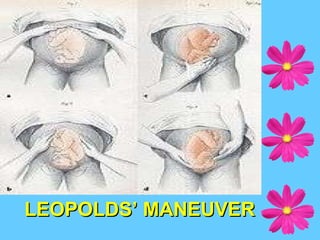
LEOPOLDS’ MANEUVER
At the end of the lecture, the students will be able to: Identify the steps in performing Leopolds’ Maneuver. Identify Nursing considerations in performing Leopolds’ maneuver.
are a common and systematic way to determine the position of a  fetus   inside the woman's  uterus . are important because they help determine the position and presentation of the  fetus . Named after the gynecologist  Christian Gerhard Leopold .
Maneuver is preferably performed after  24 weeks gestation  when fetal outline can be already palpated. The maneuvers are not truly  diagnostic . Actual position can only be determined by  ultrasound  performed by a competent  technician  or  professional .
Difficult to perform in obese women. Women with hydramios. Women with full bladder.
Nursing   Considerations Instruct woman to empty her bladder first.  Place woman in dorsal recumbent position, supine with  knees slightly flexed.  Place a small pillow under the head for comfort.  Drape properly to maintain privacy.  Explain procedure to the patient.  Warm hands by rubbing together.  Use the palm for palpation not the fingers .
While facing the woman,  palpate  the woman's upper abdomen with both hands. Often determine the size, consistency, shape, and mobility of the form that is felt.  The  fetal  head is hard, firm, round, and moves independently of the  trunk . The  buttocks  feels softer, is  symmetric , and has small bony prominences; it moves with the  trunk .
What lies at the fundus?
The maneuver attempts to determine the location of the fetal back.  Facing the woman, the health care provider palpates each side of the abdomen with gentle but deep pressure using the tips of his or her  hands . The fetal back is firm and smooth, hard, resistant surface. Fetal  extremities  feels like small irregularities and protrusions.
Where is the fetal back?
Determine what fetal part is lying above the inlet, or lower abdomen. The individual performing the maneuver first grasps the lower portion of the abdomen just above the  symphysis  pubis  with the  thumb  and  fingers  of the right hand.
What is in the inlet?
The health care provider faces the woman's  feet , as he or she will attempt to locate the fetus'  brow . To determine the degree of flexion of the fetal head.   The fingers of both hands are moved gently down the sides of the  uterus  towards the  pubis .
What is the attitude?
Good attitude If brow correspond to the side that contained the elbows and knees.
Poor attitude If examining fingers will meet an obstruction on the same side as fetal back.
Thank you  all !!!

Leopolds’ maneuver

  • 1.
  • 2.
    At the endof the lecture, the students will be able to: Identify the steps in performing Leopolds’ Maneuver. Identify Nursing considerations in performing Leopolds’ maneuver.
  • 3.
    are a commonand systematic way to determine the position of a fetus inside the woman's uterus . are important because they help determine the position and presentation of the fetus . Named after the gynecologist Christian Gerhard Leopold .
  • 4.
    Maneuver is preferablyperformed after 24 weeks gestation when fetal outline can be already palpated. The maneuvers are not truly diagnostic . Actual position can only be determined by ultrasound performed by a competent technician or professional .
  • 5.
    Difficult to performin obese women. Women with hydramios. Women with full bladder.
  • 6.
    Nursing Considerations Instruct woman to empty her bladder first. Place woman in dorsal recumbent position, supine with knees slightly flexed. Place a small pillow under the head for comfort. Drape properly to maintain privacy. Explain procedure to the patient. Warm hands by rubbing together. Use the palm for palpation not the fingers .
  • 7.
    While facing thewoman, palpate the woman's upper abdomen with both hands. Often determine the size, consistency, shape, and mobility of the form that is felt. The fetal head is hard, firm, round, and moves independently of the trunk . The buttocks feels softer, is symmetric , and has small bony prominences; it moves with the trunk .
  • 8.
    What lies atthe fundus?
  • 9.
    The maneuver attemptsto determine the location of the fetal back. Facing the woman, the health care provider palpates each side of the abdomen with gentle but deep pressure using the tips of his or her hands . The fetal back is firm and smooth, hard, resistant surface. Fetal extremities feels like small irregularities and protrusions.
  • 10.
    Where is thefetal back?
  • 11.
    Determine what fetalpart is lying above the inlet, or lower abdomen. The individual performing the maneuver first grasps the lower portion of the abdomen just above the symphysis pubis with the thumb and fingers of the right hand.
  • 12.
    What is inthe inlet?
  • 13.
    The health careprovider faces the woman's feet , as he or she will attempt to locate the fetus' brow . To determine the degree of flexion of the fetal head. The fingers of both hands are moved gently down the sides of the uterus towards the pubis .
  • 14.
    What is theattitude?
  • 15.
    Good attitude Ifbrow correspond to the side that contained the elbows and knees.
  • 16.
    Poor attitude Ifexamining fingers will meet an obstruction on the same side as fetal back.
  • 17.
    Thank you all !!!