History & Physical
Examination in
OBSTETRICS
and Gynecology
Dr Daniel T.(Ass prof in OB/GYN)
Trimesters of pregnancy
 First Tx – 1 to 13 6/7
 Second Tx – 14 0/7 to 27 6/7
 Third Tx – 28 0/7 to 40 completed
weeks
Presumptive evidence of pregnancy
 Subjective
symptoms
- nausea +/- vomiting
- disturbances in
urination
- fatigue
- the perceptions of fetal
movements
 Presumptive signs
- cessation of menses
- changes in the breast
- changes in the cervical
mucus
- discoloration of the vaginal
mucosa
- increased skin pigmentation
and development of
abdominal striae
- does the woman believe that
she is pregnant?
Probable evidence of
pregnancy
 Enlargement of the abdomen
 Changes in the shape, size and consistency of the
uterus
 Anatomical changes in the cervix
 Braxton-Hicks contractions
 Ballottement
 Physical outlining of the fetus
 Presence of β-hCG in serum or urine
Positive signs of
pregnancy
 Identification of fetal heart activity separately
and distinctly (from mother)
 Perception of fetal movements by the
examiner
 Recognition of the embryo / the fetus
throughout imagistic methods (ultrasound)
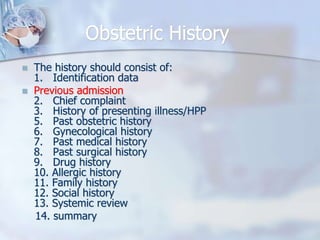
Obstetric History
 The history should consist of:
1. Identification data
 Previous admission
2. Chief complaint
3. History of presenting illness/HPP
5. Past obstetric history
6. Gynecological history
7. Past medical history
8. Past surgical history
9. Drug history
10. Allergic history
11. Family history
12. Social history
13. Systemic review
14. summary
1. Identification:
 Name
 Age
 Address
 Occupation
 Religion
 Marital Status
 Date of admission
 Ward/bed no
 Source of Hx/referal
2. Chief Complaint:
 The one or more symptoms or concerns causing
the patient to seek care
Common Obstetrics C/C are:-
 Vaginal bleeding
 Leakage of liquor
 Pushing down pain
 Decreased/ absent fetal movement
 headache, blurring of vision, etc.
 If >1 chief complaint, arrange in a chronological
order
 Pt may come for routine ANC-patient may have
no specific complaints,
should include the following infos.
 Gravidity =
 total number of pregnancy regardless of its
outcome including present one ie. be it
abortion, ectopic, stillbirth, live birth etc.
 Ex. G 5 means she had previous 4
pregnancies, now she is pregnant
for the 5th time.
3. HPP(History of present
pregnancy):-
 Parity =
 Number of births delivered after age of viability (i.e.
28wks in our country) regardless of the outcome
(stillbirth or live birth)
 Twin/triplet/quadriplet …. delivery is considered as
one parity.
 Abortion-
 number pregnancies terminated below the age of
viability, ie <28 weeks
- it could be induced or spontaneous.
 Ectopic pregnancies:
 number of past extra uterine pregnancies, if there was
any.
3. HPP(History of present pregnancy):-
 Then calculate the gestational age of the current
pregnancy in weeks from the last normal menstrual
period- LNMP
LNMP:
 Is the first day of last normal menstrual period.
 Normal period means the usual monthly period, but
not any bleeding.
EDD(EDC):
 Is expected date of delivery (confinement)
 is 40 weeks (280 days) from LNMP.
GA:
 Is gestational age in weeks from LNMP on
the day it is calculated.
3. HPP(History of present pregnancy):-
To calculate EDD:
Neagle’s rule: for European calander
o Add 7 days to LMP, subtract 3 months from the
month or
o Add 7 days from LMP and add 9 months to the
month.
o examples
LMP : 26/01/09
EDD (LMP+7days+9months) : 03/11/09
3. HPP(History of present pregnancy):-
Ethiopian calendar: b/c of Pagume:
Calculate as follows:-
 If EDD will not cross that year ie LNMP in 1st,2nd
or 1st 25 days of 3rd month
 add 9 to the month of LNMP add 10 to the day of
LNMP i.e 40 completed weeks or 280 days
Ex LNMP 10/1/07
EDD will be on 20/10/07
LNMP 24/3/07
EDD will be on 4/13/07
3. HPP(History of present pregnancy):-
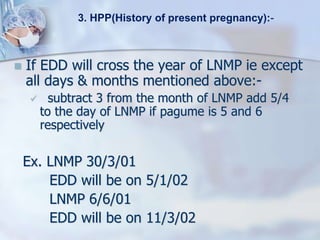
 If EDD will cross the year of LNMP ie except
all days & months mentioned above:-
 subtract 3 from the month of LNMP add 5/4
to the day of LNMP if pagume is 5 and 6
respectively
Ex. LNMP 30/3/01
EDD will be on 5/1/02
LNMP 6/6/01
EDD will be on 11/3/02
3. HPP(History of present pregnancy):-
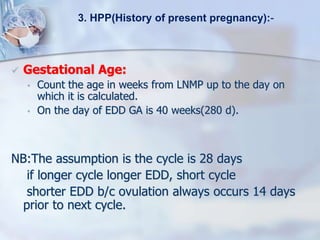
 Gestational Age:
• Count the age in weeks from LNMP up to the day on
which it is calculated.
• On the day of EDD GA is 40 weeks(280 d).
NB:The assumption is the cycle is 28 days
if longer cycle longer EDD, short cycle
shorter EDD b/c ovulation always occurs 14 days
prior to next cycle.
3. HPP(History of present pregnancy):-
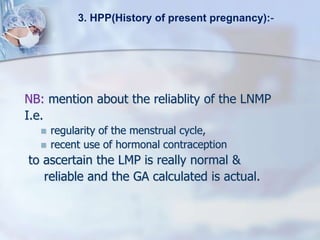
NB: mention about the reliablity of the LNMP
I.e.
 regularity of the menstrual cycle,
 recent use of hormonal contraception
to ascertain the LMP is really normal &
reliable and the GA calculated is actual.
3. HPP(History of present pregnancy):-
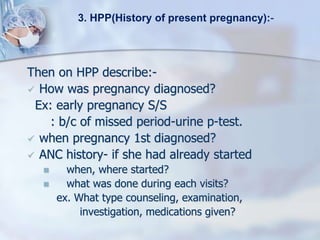
Then on HPP describe:-
 How was pregnancy diagnosed?
Ex: early pregnancy S/S
: b/c of missed period-urine p-test.
 when pregnancy 1st diagnosed?
 ANC history- if she had already started
 when, where started?
 what was done during each visits?
ex. What type counseling, examination,
investigation, medications given?
3. HPP(History of present pregnancy):-
Then, quickening- the date/month if possible (not the
month of pregnancy), the type, the progress in
fetal movement, etc.
knowing Quickening(1st fetal movt) helps to
estimate GA in case of unreliable LNMP.
 Primigravida, starts to feel fetal movement
at~20(18-20) wks
 Multigravida, at ~16 wks (16-18). Then add wks
passed since-=GA
3. HPP(History of present pregnancy):-
 mention Nutritional history-
 type of meal, amount, appetite, etc
 Calory needed~2600KCal/d
( ie. calculate based on the daily requirement of
Calorie & other nutrients during pregnancy)
 Events in the 1st, 2nd, 3rd trimester----
 Elaborate on the C/C if there is any----
3. HPP(History of present pregnancy):-
 Each principal symptom should be well characterized,
and should include the seven attributes of a symptom:
(1) location;
(2) quality;
(3) quantity or severity;
(4) timing, including onset, duration, and frequency;
(5) the setting in which it occurs;
(6) factors that have aggravated or relieved the
symptom;and
 (7) associated manifestations
3. HPP(History of present pregnancy):-
 Assess Danger signs and negative plus
positive statements according to patients-
complaint-----
Obstetrical: ex bleeding, leakage of liqour,
headache, decreased fetal movt
Medical: HTN, DM, etc
Others:
 Is the pregnancy planned,wanted, supported?
 Whether birth planning discussed- place of
birth, route of birth, transport, money
prepared, etc.
3. HPP(History of present pregnancy):-
if there were previous deliveries mention by their chronologic order
 Year
 GA
 Place of birth
 Route of delivery
 Length of labor
 Fetal outome
 Birth weight
 sex
 Antepartum, intrapartum and post partum complications
Ex
year, GA, Place, Rout, labor Outcome, Wt, Ante/post P.Comp.
1st 1996, Term, TAH SVD, 8hr L/B 3kg none
2nd 1999 Post T GMH C/S 17hrs S/B 4.5kg GDM/PPH
4.Past Obstetric History
A. Menstrual History:
 Age at first menstrual period (menarche)
 cycle length (interval b/n periods)
 Number of bleed days (duration of flow)
 Describe the amount of menstrual flow (light / moderate / heavy)
ask presence of clots or number of tampons or pads she use
 Describe character of the blood
 Describe the amount of menstrual discomfort / mild / moderate /
severe
 Ask if she bleeds in between periods
 Ask if bleeding after intercourse
 If she stopped menstruating, at what age did she stop?
 Ask if she had bleeding or spotting since her periods stopped?
5.Gynecologic
History(including abortion):
 Normal menstrual cycle:
 21-36 days cycle length (avg 28 days)
 1-8 days of flow (avg 5 days)
 10-80 ml amount of blood flow (avg 50ml)
 Dark non clotted blood
 Clotting of menstrual blood , higher number
of pads used and anemia indicate pathology
5.Gynecologic
History(including abortion):
B. contraception:
 Ask use or need for any type of
contraceptive
 Contraceptive being used currently
 Contraceptive used previously
 Why she changed the contraceptive
 If she is not using any form of contraceptive
ask the reason
5.Gynecologic
History(including abortion):
C. Sexual history
 Is she sexually active? (having sex currently) If not,
ask if she ever been sexually active?
 Does she currently have a partner?
 Ask sexual orientation
 Ask How long she have been in this relationship?
 Number of lifetime sexual partners
 age of first intercourse?
 any sexual problems? Any problems with sexual
drive, pain during intercourse or orgasm?
 Any hx of STD
5.Gynecologic
History(including abortion):
D. Other components of gynecologic Hx
 Hx of gynaecologic operations including traditional
ones Eg. myemectomy, MVA FGM….
 Hx of vaccination Eg. for Human Papilloma Virus
(HPV) – Gardasil
 Hx of Pap Smear done with the result
 Hx of Mammogram done with the result
 Hx of hormone therapy (estrogen /progesterone)
5.Gynecologic
History(including abortion):
 Medical disorders may affect outcome of Px or
physiological changes of Px may aggravate the
disorder
 Any Past history of pre‐existing diseases :
• Hypertension,
• diabetes mellitus,
• asthma, COPD,
• heart disease,
• epilepsy,
• renal dss,
• venous thromboembolic dss,
• HIV infection, etc.
6. Past Medical History:
Mention:
 the year of diagnosis,
 what was done,
 the outcome and
 current status of the condition
 Did she have any problems with
anesthesia?
 Did she required blood transfusion
7. Past Surgical history
(non gynecologic)
 To have complete picture of the pt as a
person and to interpret his disease in the
light of his social background
 Early development
 Education
 Social activities
 work record
 Environment and living condition
 Habits- dietary, alcohol, tobaco, drugs herbs....
 Marital status
8. Personal history and
social history
Provides
 the health status of the parents and siblings,
 Hereditary or familial diseases
 Emotional difficulties w/c may be the cause of
symptoms or maladjustment of the pt
9. Family history
 Father and mother
 List with ages
 Mention Health status
 Date and cause of death
 Siblings- mention as above
 ANY Family diseases Eg. DM, HTN….
 Ask if she is using Prescribed drugs
 Name, Dose, Duration or what is it for, what color,
how many times a day, how long.
 Any Herbal or complementary therapy
 Any History of allergies to drugs
 Name of the drugs, what actually happens
when patient took the drugs Rashes, swelling
of face & difficulty breathing are important
allergic reactions. Nausea, vomiting or
diarrhea are not necessarily allergic reactions
 Allergy to certain food?
10. history of drug and allergy
11. Systemic Review:
 Detailed account of signs and symptoms
referable to each system of the body
12. summary:
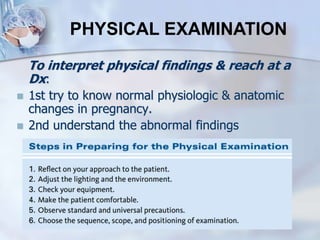
To interpret physical findings & reach at a
Dx:
 1st try to know normal physiologic & anatomic
changes in pregnancy.
 2nd understand the abnormal findings
PHYSICAL EXAMINATION
 General appearance:
V/S- Bp IN mmHg, Rt arm, LLP,
- PR------
- RR-------
- T-------
- Wt-----
- Ht-------
- BMI
PHYSICAL EXAMINATION
HEENT----
LGS -LN, Breast, Thyroid
Chest----------
CVS----------
Abd- General- insp, ausc, palp, perc,
Obstetric- Leopold maneuver 1,2,3,4
auscultation FHB count/min Best
heard at--
GUS- Urinary & Genital
Ext---------
CNS
Leopold 1:
 Fundal height
 What occupies the fundus
Leopold 2:
 Lie
 Side of the back
Leopold 3:
 Presentation
 descent
 Attitude
 Leopold 4:
 Descent
 presentation
If the mother is in labor, additional P/E
Uterine contraction:
 frequency/10min
 intensity(mild, moderate, severe),
 duration in seconds.
Pelvic exam.
 Speculum-for PROM, APH(no pv)
 PV: Cx. Dilatation in cm, effacement(%), presentation,
position, station, caput,moulding
 color of liqour if membrane is ruptured.
a) Inspection of genitalia
b) Speculum Examination:
-to the vagina, cervix
c) Digital vaginal examination(PV)
d)Bimanual Examination
 To palpate Vaginal wall, cervix, uterus(size in
weeks),
 To palpate adenexal structures:
 ovary, tubes,para metrium
 for mass,
 for tenderness
Pelvic Examination
 To palpate pouch of Douglas:
-for fullness,
tenderness etc.
e)Rectovaginal examination
 THANK YOU

Ob-Gy hx & P-E DANY.pptx

  • 1.
    History & Physical Examinationin OBSTETRICS and Gynecology Dr Daniel T.(Ass prof in OB/GYN)
  • 2.
    Trimesters of pregnancy First Tx – 1 to 13 6/7  Second Tx – 14 0/7 to 27 6/7  Third Tx – 28 0/7 to 40 completed weeks
  • 3.
    Presumptive evidence ofpregnancy  Subjective symptoms - nausea +/- vomiting - disturbances in urination - fatigue - the perceptions of fetal movements  Presumptive signs - cessation of menses - changes in the breast - changes in the cervical mucus - discoloration of the vaginal mucosa - increased skin pigmentation and development of abdominal striae - does the woman believe that she is pregnant?
  • 4.
    Probable evidence of pregnancy Enlargement of the abdomen  Changes in the shape, size and consistency of the uterus  Anatomical changes in the cervix  Braxton-Hicks contractions  Ballottement  Physical outlining of the fetus  Presence of β-hCG in serum or urine
  • 5.
    Positive signs of pregnancy Identification of fetal heart activity separately and distinctly (from mother)  Perception of fetal movements by the examiner  Recognition of the embryo / the fetus throughout imagistic methods (ultrasound)
  • 6.
    Obstetric History  Thehistory should consist of: 1. Identification data  Previous admission 2. Chief complaint 3. History of presenting illness/HPP 5. Past obstetric history 6. Gynecological history 7. Past medical history 8. Past surgical history 9. Drug history 10. Allergic history 11. Family history 12. Social history 13. Systemic review 14. summary
  • 7.
    1. Identification:  Name Age  Address  Occupation  Religion  Marital Status  Date of admission  Ward/bed no  Source of Hx/referal
  • 8.
    2. Chief Complaint: The one or more symptoms or concerns causing the patient to seek care Common Obstetrics C/C are:-  Vaginal bleeding  Leakage of liquor  Pushing down pain  Decreased/ absent fetal movement  headache, blurring of vision, etc.  If >1 chief complaint, arrange in a chronological order  Pt may come for routine ANC-patient may have no specific complaints,
  • 9.
    should include thefollowing infos.  Gravidity =  total number of pregnancy regardless of its outcome including present one ie. be it abortion, ectopic, stillbirth, live birth etc.  Ex. G 5 means she had previous 4 pregnancies, now she is pregnant for the 5th time. 3. HPP(History of present pregnancy):-
  • 10.
     Parity = Number of births delivered after age of viability (i.e. 28wks in our country) regardless of the outcome (stillbirth or live birth)  Twin/triplet/quadriplet …. delivery is considered as one parity.  Abortion-  number pregnancies terminated below the age of viability, ie <28 weeks - it could be induced or spontaneous.  Ectopic pregnancies:  number of past extra uterine pregnancies, if there was any. 3. HPP(History of present pregnancy):-
  • 11.
     Then calculatethe gestational age of the current pregnancy in weeks from the last normal menstrual period- LNMP LNMP:  Is the first day of last normal menstrual period.  Normal period means the usual monthly period, but not any bleeding. EDD(EDC):  Is expected date of delivery (confinement)  is 40 weeks (280 days) from LNMP. GA:  Is gestational age in weeks from LNMP on the day it is calculated. 3. HPP(History of present pregnancy):-
  • 12.
    To calculate EDD: Neagle’srule: for European calander o Add 7 days to LMP, subtract 3 months from the month or o Add 7 days from LMP and add 9 months to the month. o examples LMP : 26/01/09 EDD (LMP+7days+9months) : 03/11/09 3. HPP(History of present pregnancy):-
  • 13.
    Ethiopian calendar: b/cof Pagume: Calculate as follows:-  If EDD will not cross that year ie LNMP in 1st,2nd or 1st 25 days of 3rd month  add 9 to the month of LNMP add 10 to the day of LNMP i.e 40 completed weeks or 280 days Ex LNMP 10/1/07 EDD will be on 20/10/07 LNMP 24/3/07 EDD will be on 4/13/07 3. HPP(History of present pregnancy):-
  • 14.
     If EDDwill cross the year of LNMP ie except all days & months mentioned above:-  subtract 3 from the month of LNMP add 5/4 to the day of LNMP if pagume is 5 and 6 respectively Ex. LNMP 30/3/01 EDD will be on 5/1/02 LNMP 6/6/01 EDD will be on 11/3/02 3. HPP(History of present pregnancy):-
  • 15.
     Gestational Age: •Count the age in weeks from LNMP up to the day on which it is calculated. • On the day of EDD GA is 40 weeks(280 d). NB:The assumption is the cycle is 28 days if longer cycle longer EDD, short cycle shorter EDD b/c ovulation always occurs 14 days prior to next cycle. 3. HPP(History of present pregnancy):-
  • 16.
    NB: mention aboutthe reliablity of the LNMP I.e.  regularity of the menstrual cycle,  recent use of hormonal contraception to ascertain the LMP is really normal & reliable and the GA calculated is actual. 3. HPP(History of present pregnancy):-
  • 17.
    Then on HPPdescribe:-  How was pregnancy diagnosed? Ex: early pregnancy S/S : b/c of missed period-urine p-test.  when pregnancy 1st diagnosed?  ANC history- if she had already started  when, where started?  what was done during each visits? ex. What type counseling, examination, investigation, medications given? 3. HPP(History of present pregnancy):-
  • 18.
    Then, quickening- thedate/month if possible (not the month of pregnancy), the type, the progress in fetal movement, etc. knowing Quickening(1st fetal movt) helps to estimate GA in case of unreliable LNMP.  Primigravida, starts to feel fetal movement at~20(18-20) wks  Multigravida, at ~16 wks (16-18). Then add wks passed since-=GA 3. HPP(History of present pregnancy):-
  • 19.
     mention Nutritionalhistory-  type of meal, amount, appetite, etc  Calory needed~2600KCal/d ( ie. calculate based on the daily requirement of Calorie & other nutrients during pregnancy)  Events in the 1st, 2nd, 3rd trimester----  Elaborate on the C/C if there is any---- 3. HPP(History of present pregnancy):-
  • 20.
     Each principalsymptom should be well characterized, and should include the seven attributes of a symptom: (1) location; (2) quality; (3) quantity or severity; (4) timing, including onset, duration, and frequency; (5) the setting in which it occurs; (6) factors that have aggravated or relieved the symptom;and  (7) associated manifestations 3. HPP(History of present pregnancy):-
  • 21.
     Assess Dangersigns and negative plus positive statements according to patients- complaint----- Obstetrical: ex bleeding, leakage of liqour, headache, decreased fetal movt Medical: HTN, DM, etc Others:  Is the pregnancy planned,wanted, supported?  Whether birth planning discussed- place of birth, route of birth, transport, money prepared, etc. 3. HPP(History of present pregnancy):-
  • 22.
    if there wereprevious deliveries mention by their chronologic order  Year  GA  Place of birth  Route of delivery  Length of labor  Fetal outome  Birth weight  sex  Antepartum, intrapartum and post partum complications Ex year, GA, Place, Rout, labor Outcome, Wt, Ante/post P.Comp. 1st 1996, Term, TAH SVD, 8hr L/B 3kg none 2nd 1999 Post T GMH C/S 17hrs S/B 4.5kg GDM/PPH 4.Past Obstetric History
  • 23.
    A. Menstrual History: Age at first menstrual period (menarche)  cycle length (interval b/n periods)  Number of bleed days (duration of flow)  Describe the amount of menstrual flow (light / moderate / heavy) ask presence of clots or number of tampons or pads she use  Describe character of the blood  Describe the amount of menstrual discomfort / mild / moderate / severe  Ask if she bleeds in between periods  Ask if bleeding after intercourse  If she stopped menstruating, at what age did she stop?  Ask if she had bleeding or spotting since her periods stopped? 5.Gynecologic History(including abortion):
  • 24.
     Normal menstrualcycle:  21-36 days cycle length (avg 28 days)  1-8 days of flow (avg 5 days)  10-80 ml amount of blood flow (avg 50ml)  Dark non clotted blood  Clotting of menstrual blood , higher number of pads used and anemia indicate pathology 5.Gynecologic History(including abortion):
  • 25.
    B. contraception:  Askuse or need for any type of contraceptive  Contraceptive being used currently  Contraceptive used previously  Why she changed the contraceptive  If she is not using any form of contraceptive ask the reason 5.Gynecologic History(including abortion):
  • 26.
    C. Sexual history Is she sexually active? (having sex currently) If not, ask if she ever been sexually active?  Does she currently have a partner?  Ask sexual orientation  Ask How long she have been in this relationship?  Number of lifetime sexual partners  age of first intercourse?  any sexual problems? Any problems with sexual drive, pain during intercourse or orgasm?  Any hx of STD 5.Gynecologic History(including abortion):
  • 27.
    D. Other componentsof gynecologic Hx  Hx of gynaecologic operations including traditional ones Eg. myemectomy, MVA FGM….  Hx of vaccination Eg. for Human Papilloma Virus (HPV) – Gardasil  Hx of Pap Smear done with the result  Hx of Mammogram done with the result  Hx of hormone therapy (estrogen /progesterone) 5.Gynecologic History(including abortion):
  • 28.
     Medical disordersmay affect outcome of Px or physiological changes of Px may aggravate the disorder  Any Past history of pre‐existing diseases : • Hypertension, • diabetes mellitus, • asthma, COPD, • heart disease, • epilepsy, • renal dss, • venous thromboembolic dss, • HIV infection, etc. 6. Past Medical History:
  • 29.
    Mention:  the yearof diagnosis,  what was done,  the outcome and  current status of the condition  Did she have any problems with anesthesia?  Did she required blood transfusion 7. Past Surgical history (non gynecologic)
  • 30.
     To havecomplete picture of the pt as a person and to interpret his disease in the light of his social background  Early development  Education  Social activities  work record  Environment and living condition  Habits- dietary, alcohol, tobaco, drugs herbs....  Marital status 8. Personal history and social history
  • 31.
    Provides  the healthstatus of the parents and siblings,  Hereditary or familial diseases  Emotional difficulties w/c may be the cause of symptoms or maladjustment of the pt 9. Family history  Father and mother  List with ages  Mention Health status  Date and cause of death  Siblings- mention as above  ANY Family diseases Eg. DM, HTN….
  • 32.
     Ask ifshe is using Prescribed drugs  Name, Dose, Duration or what is it for, what color, how many times a day, how long.  Any Herbal or complementary therapy  Any History of allergies to drugs  Name of the drugs, what actually happens when patient took the drugs Rashes, swelling of face & difficulty breathing are important allergic reactions. Nausea, vomiting or diarrhea are not necessarily allergic reactions  Allergy to certain food? 10. history of drug and allergy
  • 33.
    11. Systemic Review: Detailed account of signs and symptoms referable to each system of the body 12. summary:
  • 34.
    To interpret physicalfindings & reach at a Dx:  1st try to know normal physiologic & anatomic changes in pregnancy.  2nd understand the abnormal findings PHYSICAL EXAMINATION
  • 35.
     General appearance: V/S-Bp IN mmHg, Rt arm, LLP, - PR------ - RR------- - T------- - Wt----- - Ht------- - BMI PHYSICAL EXAMINATION
  • 36.
    HEENT---- LGS -LN, Breast,Thyroid Chest---------- CVS---------- Abd- General- insp, ausc, palp, perc, Obstetric- Leopold maneuver 1,2,3,4 auscultation FHB count/min Best heard at-- GUS- Urinary & Genital Ext--------- CNS
  • 37.
    Leopold 1:  Fundalheight  What occupies the fundus Leopold 2:  Lie  Side of the back Leopold 3:  Presentation  descent  Attitude  Leopold 4:  Descent  presentation
  • 39.
    If the motheris in labor, additional P/E Uterine contraction:  frequency/10min  intensity(mild, moderate, severe),  duration in seconds. Pelvic exam.  Speculum-for PROM, APH(no pv)  PV: Cx. Dilatation in cm, effacement(%), presentation, position, station, caput,moulding  color of liqour if membrane is ruptured.
  • 40.
    a) Inspection ofgenitalia b) Speculum Examination: -to the vagina, cervix c) Digital vaginal examination(PV) d)Bimanual Examination  To palpate Vaginal wall, cervix, uterus(size in weeks),  To palpate adenexal structures:  ovary, tubes,para metrium  for mass,  for tenderness Pelvic Examination
  • 41.
     To palpatepouch of Douglas: -for fullness, tenderness etc. e)Rectovaginal examination
  • 42.