HISTORY & PHYSICAL
EXAM IN OB/GYN
Dr Olana Terefa(MD, Lecturer)
What is Obstetrics?
 The word obstetrics is derived from the
Latin obstetrix, meaning midwife.
 The word also is connected with the
verb obstare—to stand by or in front of.
 The rationale for this derivation is that
the midwife stood by or in front of the
parturient.
HISTORY & PHYSICAL EXAM
IN OB/GYN
 COMPONENTS OF OBSTETRIC HISTORY:
 Identification
 Chief complaint (C/C)
 Hx of present pregnancy (HPP)
 Past Obstetric Hx
 Past Gynecologic Hx
 Past Medical & Surgical Hx
 Personal & Social
 Family Hx
 Systemic Review
COMPONENTS OF OBSTETRIC
P/E
 General Appearance (GA)
 Vital Sign (V/S)
 HEENT
 Lympho- glandular system (LGS)
 Respiratory System (RS)
 Cardiovascular system (CVS)
 ABDOMEN (GIT)
 Genito – Urinary System (GUS)
 Integumantary System
 Musculoskeletal System (MSS)
 Nervous System (NS)
 SUMMARY OF Hx & P/E
 ASSESSMENT/ or DIAGNOSIS /or IMPRESSION
 DIFFERENTIAL DIAGNOSIS (DDx)
 INVESTIGATIONS
 TREATMENT PLAN
OBSTETRIC HISTORY
1. IDENTIFICATION: - Emphasize on
- Name
- Age: <18 yrs or > 35 yrs = > high risk group.
- Marital status:
=> Unmarried & unsupported are high risk group.
- Address, Religion, Ethnicity
- Occupation
- Date of admission, Ward, bed number
- Previous history of admission,
- How the patient was brought to the hospital
- Source of information, language of communication
- Source of referral
NB: Objective of identification:
To know/identify the patient
To identify risk factor for current pts compliant
To make follow up arrangements
2. CHIEF COMPLAINT (c/c):
- Patients might have come for scheduled ANC follow up
or
- May have a specific complaint e.g. nausea and
Vomiting, Vaginal bleeding etc.
3. HISTORY OF PRESENT PREGNANCY (HPP):
It should include the following information:
Gravidity – all previous pregnancies
– Term live birth, still births, abortions, ectopic
pregnancy or hydatidiform mole.
Parity – Pregnancies that have extended beyond fetal
viability whether the fetus is delivered alive or dead.
> 28 weeks: - UK and Ethiopia
> 20 weeks for WHO
Abortion(s); number, induced or spontaneous
Hx OF PRESENT PREGNANCY (HPP)…
 LNMP: - 1st day of normal period. To be considered as reliable if:
- Menstrual cycle has been regular
- No use of hormonal contraceptives for at least 3 months prior
to LNMP or regular cycles
- If lactating, should have seen at least 3 regular cycles
 Calculate the EDD: – 40 weeks or 280 days after LMP
– 5% of pregnant women deliver on this day.
Term pregnancy: 37 – 42 completed weeks.
Preterm pregnancy: < 37 completed weeks.
Post term pregnancy: > 42 ›› ››
 Naegle’s rule: LNMP – 3 months + 7 days (for the European C.).
 For the Ethiopian calendar:
EDD = LNMP + 9 months + 10 days if Pagume is not crossed, or
EDD = LNMP – 3months + (5 or 4 days if Pagume is 5 or 6 days
respectively), If Pagume is passed or crossed.
 Calculate gestational age in completed weeks and days.
HPP…
 Quickening: - 1st time the mother felt fetal movement or kick
- used to calculate the date of the pregnancy if LMP is unknown.
= > for Primigravidas: b/n 18 – 20 weeks.
= > for Multigravidas: b/n 16 – 18 weeks( because of experience)
 ANC status should be documented & if not followed, the reason
should be sought.
 Elaborate the chief complaint
 Any complaints during the present pregnancy- eventful or
uneventful
 Ask for danger signs: - Vaginal bleeding, leakage of liquor,
abdominal pain, fever, … etc.
 Fetal movements decreased or increased? It is useful to assess
fetal well being.
 Other negative and positive statements should be asked according
to the patient’s complaints e.g. Headache, blurring of vision,
epigastric pain or convulsion in hypertensive disorders of
pregnancy etc
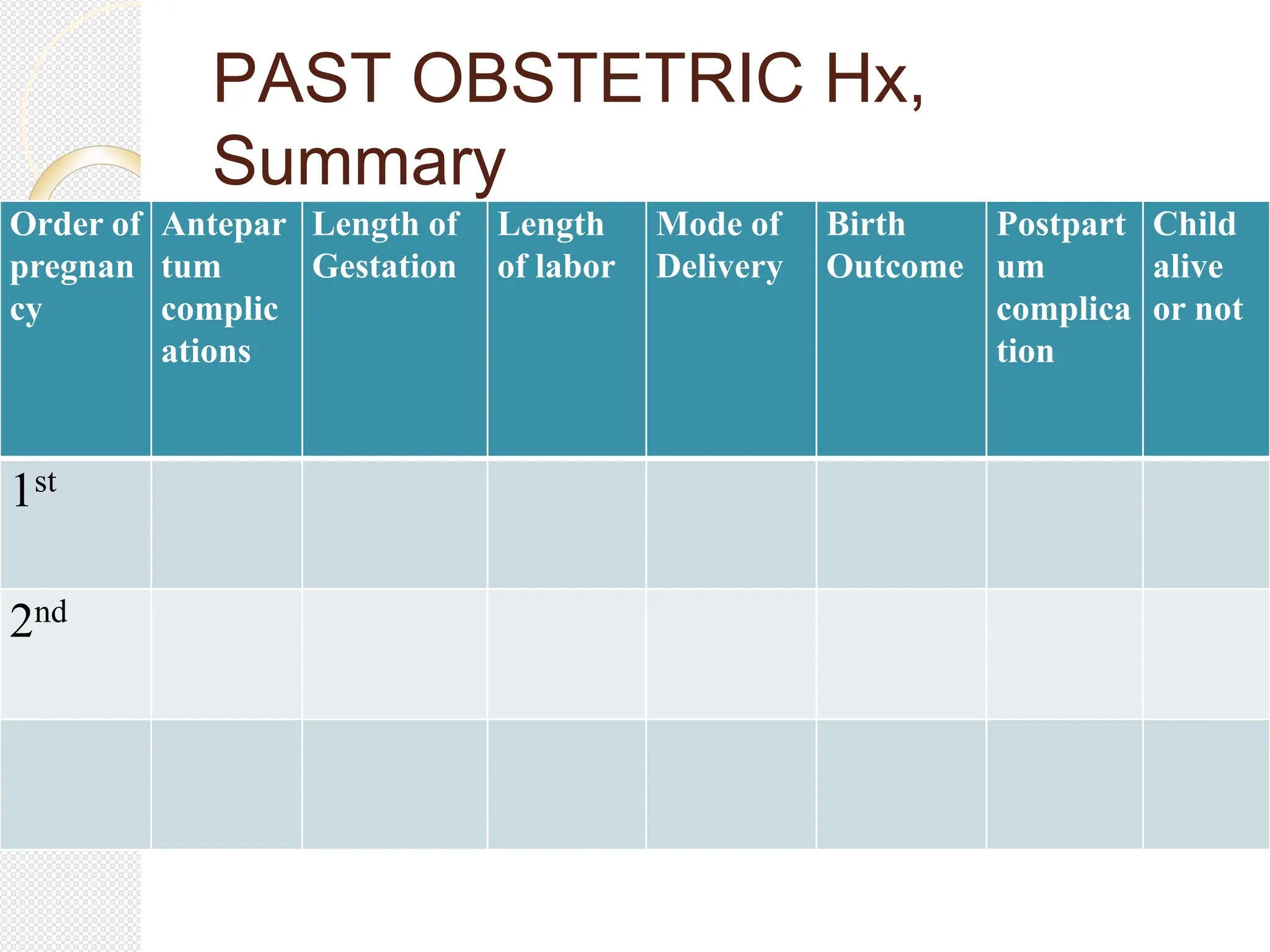
4. PAST OBSTETRIC HISTORY…
=> Document all previous pregnancies in a
chronological order.
 Year of gestation, Length of gestation, birth
weight, fetal outcome, length of labor, fetal
presentation, mode of delivery,
 Complications: - Ante partum, intrapartum &
post partum.
 Important because most obstetric problems are
recurrent and have a chance of recurring in the
current pregnancy e.g. APH, PPH, PROM,
GDM, PIH, C/S, Ectopic pregnancy & abortion.
PAST OBSTETRIC Hx,
Summary
Order of
pregnan
cy
Antepar
tum
complic
ations
Length of
Gestation
Length
of labor
Mode of
Delivery
Birth
Outcome
Postpart
um
complica
tion
Child
alive
or not
1st
2nd
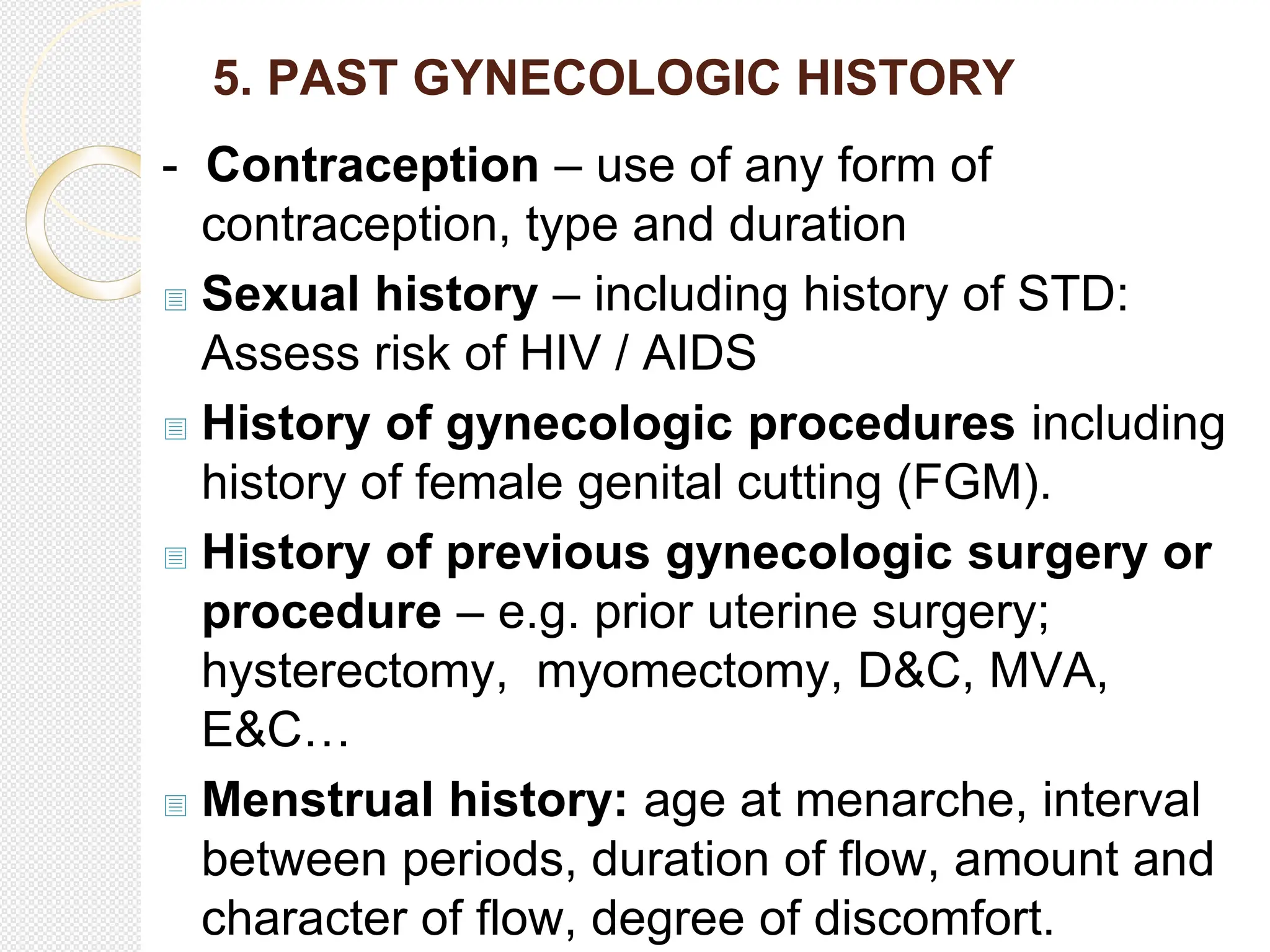
5. PAST GYNECOLOGIC HISTORY
- Contraception – use of any form of
contraception, type and duration
 Sexual history – including history of STD:
Assess risk of HIV / AIDS
 History of gynecologic procedures including
history of female genital cutting (FGM).
 History of previous gynecologic surgery or
procedure – e.g. prior uterine surgery;
hysterectomy, myomectomy, D&C, MVA,
E&C…
 Menstrual history: age at menarche, interval
between periods, duration of flow, amount and
character of flow, degree of discomfort.
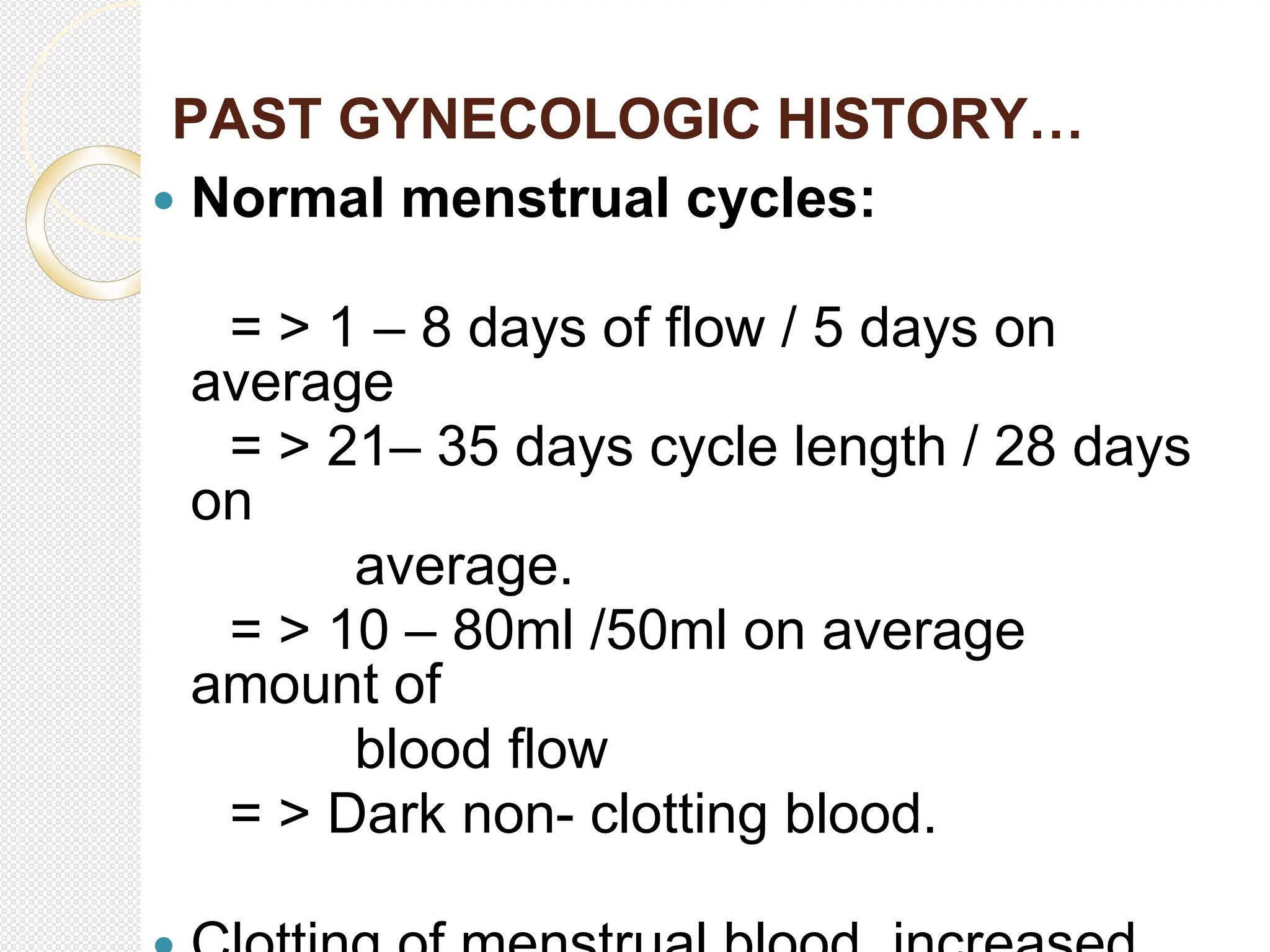
PAST GYNECOLOGIC HISTORY…
 Normal menstrual cycles:
= > 1 – 8 days of flow / 5 days on
average
= > 21– 35 days cycle length / 28 days
on
average.
= > 10 – 80ml /50ml on average
amount of
blood flow
= > Dark non- clotting blood.
6. PAST MEDICAL AND SURGICAL Hx:
 Medical disorders may affect the outcome of
pregnancy and the physiological changes of
pregnancy may aggravate the medical disorder.
e.g. Diabetes mellitus, Hypertension,
Thyrotoxicosis or Hypothyroidism, Tb, etc
 Previous blood transfusion – may be related to
hemolytic disease of the newborn.
 Hypersensitivity to drugs should be asked.
 History of maternal infection during pregnancy
should be asked – e.g. STD, rubella, malaria,
etc.
 Previous hx of surgery: eg, appendectomy,
cholecystectomy, thyroidectomy ….etc
7. PERSONAL & SOCIAL HISTORY (+ FAMILY
HISTORY)
 Early childhood history, number of
siblings, whether parents and siblings
are alive or not. If dead, reason for
death should be mentioned to uncover
familial reasons.
 Educational status
 Habits – smoking, alcohol and drug use
may have a deleterious effect on
pregnancy.
e.g. fetal alcohol syndrome.
 Occupation and family income – Low
socio economic status is associated with
pregnancy complication. e.g. pre-
8. FAMILY HISTORY
 Family history of – Diabetes mellitus,
Hypertension, Tuberculosis, Twinning,
Hereditary diseases, chromosomal
anomalies, allergies, and mental
disorders-running in the family.
9. SYSTEMIC REVIEW / FUNCTIONAL
ENQUIRY
 A check list for the health professional
in all the systems
B. PHYSICAL EXAMINATION (P/E)
 P/E should be conducted in an environment that is
aesthetically pleasing to the patient.
 A female assistant (chaperone) should be present whenever
possible.
 Adequate gowning and draping is necessary to avoid
embarrassment.
 Warm instruments, reassurance and adequate lighting should
be used.
 General physical examination covering all the systems should
be conducted thoroughly.
1. GENERAL APPEARANCE:
- Acutely or chronically sick looking, well looking,
- Mood of the patient,
- Body morphism (nutritional status)
PHYSICAL EXAMINATION (P/E)…
2. VITAL SIGNS:
 Blood pressure: – should be measured in the sitting
position or 30 degree left lateral tilt to avoid supine
hypotension syndrome due to vena caval
compression. DBP is taken at the point of
disappearance (5th Korotkoff’s) point.
 Pulse: 10 – 15 beats / minute increase in pulse rate
during pregnancy.
 RR: 1 – 4 breathes / minute increase during
pregnancy
 Temperature
 Weight: - ideal body weight found by using Broca’s
formula = Height in cms – 100
 +/- 20% this is the cut off point for the normal range.
 Weight gain > 1Kg / wk is abnormal
3. HEENT EXAMINATION
 -Emphasize on head, ear, eye (conjunctiva,
sclera), nose and throat or teeth
4. LYMPHO-GLANDULAR SYSTEM (LGS):
- All superficial lymphatic system should be
evaluated.
- Glands:- Thyroid
- Breast:- detailed examination
- Nipple retraction:– should be treated
during pregnancy so that it will not interfere
with breast feeding.
5. RESPIRATORY SYSTEM / Chest – same as
non- pregnant.
6. CARDIO-VASCULAR SYSTEM
 Same as non – pregnant
- PMI may be deviated to the left.
- S3 gallop may be heard normally.
- Functional systolic murmur < III/VI
grade may be heard.
7. ABDOMEN
 a) Inspection:
 Distension – site of distension, uniformity, shape
and peristalytic movement
 Symmetry: symmetrical or asymmetrical - tilted
to the right or to the left
 Linea nigra- midline hyperpigmentaion due to
increased Melanocyte Stimulating Hormone
(MSH) during pregnancy
 Stria gravidarum – purplish mark on the
abdomen, thighs & breasts due to the distension.
(primigravida)
 New Stria gravidarum are few in number, thick
and purplish to dark in color.
 Old Stria gravidarum (Stria albicantes) are
whitish, much thinner and numerous in numbers
7. ABDOMEN…
Inspection…
 Umbilicus - flat, inverted or everted.
 Scars: - surgical or non- surgical
 Surgical:
- sub umbilical midline or
- Pfannensteil - suprapubic transverse
scar
 Distended veins
 Flanks – full or not
 Pulsatile mass
7. ABDOMEN…
b. Palpation:
i. Superficial palpation-
Look for rigidity, tenderness, superficial
mass, characterizes mass, abdominal wall
defect.
ii. Deep Palpation
Look for mass, organomegally, tenderness
Characterize mass (size, organ, mobility,
tenderness, shape, and contour)
iii. Obstetric palpation:
Leopold I: – Fundal palpation.
- Has 2 purposes:
1) Determination of fundal height, and
OBSTETRIC PALPATION…
Leopold I: – Fundal palpation…
 Fundal height (fh) measurement -
should be after correcting for
dextrorotation.
There are 2 methods of measuring the fh:
1. Finger method:
- below the umbilicus, 1 finger = 1 week
- Above the umbilicus, 1 finger = 2
weeks
OBSTETRIC PALPATION…
 Body marks:
- Uterus at symphysis pubis = 12 weeks
- At the umbilicus = 20 weeks
- At Xiphisternum = 38 weeks
- Midways b/n symphysis & umbilicus =
16wks
- Midways b/n umbilicus & Xiphisternum
= 28wks
OBSTETRIC PALPATION…
2. Tape measurement:
 Symphysis to fundal height measurement
in cms with tape meter.
 At 18 – 34 weeks of gestation, tape
measurement is accurate to +2 weeks of
actual Gestational age.
 McDonald rule & Johnson formula for GA
& Fetal weight estimation.

 What occupies the fundus?
 Soft irregular bulky mass - the breech
 Hard round ballotable mass – Head
OBSTETRIC PALPATION…
Leopold II: – Lateral palpation
Has 2 purposes: 1) To know the lie
2) To determine side of the back
1. Lie: - is the longitudinal axis of the fetus in
relation to the longitudinal axis of the mother.
- It can be longitudinal, transverse or oblique.
2. Side of the back – to auscultate the FHR on
that side.
 FHR can be auscultated at 20 weeks by using
the De Lee /Pinard stethoscope or at 10 - 12
weeks using Doppler Ultrasound.
OBSTETRIC PALPATION…
 Leopold III – pelvic palpation
– It has three purposes; to know the
1) Presentation
2) Descent of presenting part.
3) Attitude of the fetal head.
 Presentation: – is the part of the fetus that
occupies the lower uterine pole.
E.g. Cephalic, breech & shoulder
presentation
 Descent is measured after identifying the
anterior shoulder with rule of 5th in fingers above
pelvic brim.
th
OBSTETRIC PALPATION…
 Attitude: is the relationship of the fetal parts to
each other particularly the fetal head to its trunk.
- Cephalic prominence on the side of the back.
Extended attitude = > abnormal
 Cephalic prominence opposite to the side of the
back
 Flexed attitude = > normal
 Military Attitude: - neither flexed nor extended
 Leopold IV – Pawlik’s grip: – It has two
purposes.
To know the 1) Presentation and
2) Descent or mobility of the fetal
head
7. ABDOMEN…
c. Percussion: – Shifting & flank dullness and
fluid thrill – as in ascites & polyhydramnios
d. Auscultation: - FHB first heard at the 20th
week – On the side of the back.
 Below the umbilicus in cephalic
presentation
 Above the umbilicus in breech presentation
 At flanks in OP position
8. GENITOURINARY SYSTEM
 Pelvic assessment (PV Exam):
 - Done at two times during pregnancy unless otherwise indicated
due to complications and in labor
1. Early – During the 1st trimester as early as possible.
Purposes: - To diagnose pregnancy
- To date pregnancy by measuring uterine size
- To diagnose pelvic problems like ovarian cyst and uterine
anomalies & Vaginal congenital anomalies like septum as early as
possible.
2. Late in pregnancy (>37 Weeks).
Purposes: - for soft tissues assessment
 For pelvic assessment to diagnose contracted pelvis/ bony pelvis
assessment
= > to assess the pelvic inlet, mid cavity & outlet.
9. INTEGUMANTARY SYSTEM…
 INTEGUMANTARY SYSTEM : - as in
Gynecologic history
10. MUSCULOSKELETAL SYSTEM:
 Extremities - Look for edema – pretibial, ankle
& pedal (dependent edema)
= > 80% of normal pregnant women can have
dependent leg edema.
 Other areas to look for pathological (Non-
dependent edema.)
= > Facial edema.
= > Tightening of rings (finger)
= > Sacral edema
= > Abdominal wall edema
11. NERVOUS SYSTEM (NS):
Nervous System: - see Gynecologic P/E
part
- Reflex
- Consciousness
- Gross neurological deficit
12. Summary of Hx & P/E
13. Assessment Or Diagnosis Or
Impression
14. Differential Diagnosis (DDx)
15. Investigations
16. Treatment plan
INTRODUCTION TO
GYNECOLOGY
 What is Gynecology?
 Gynecology, spelled gynaecology, is defined
by the Oxford English Dictionary as a
department of medical science which treats of
the functions and diseases peculiar to women.
 The word was first used as such in the middle
of the 19th century. In 1867, gynecology
represented the physiology and pathology of
the non pregnant state.
GYNECOLOGIC Hx & P/E
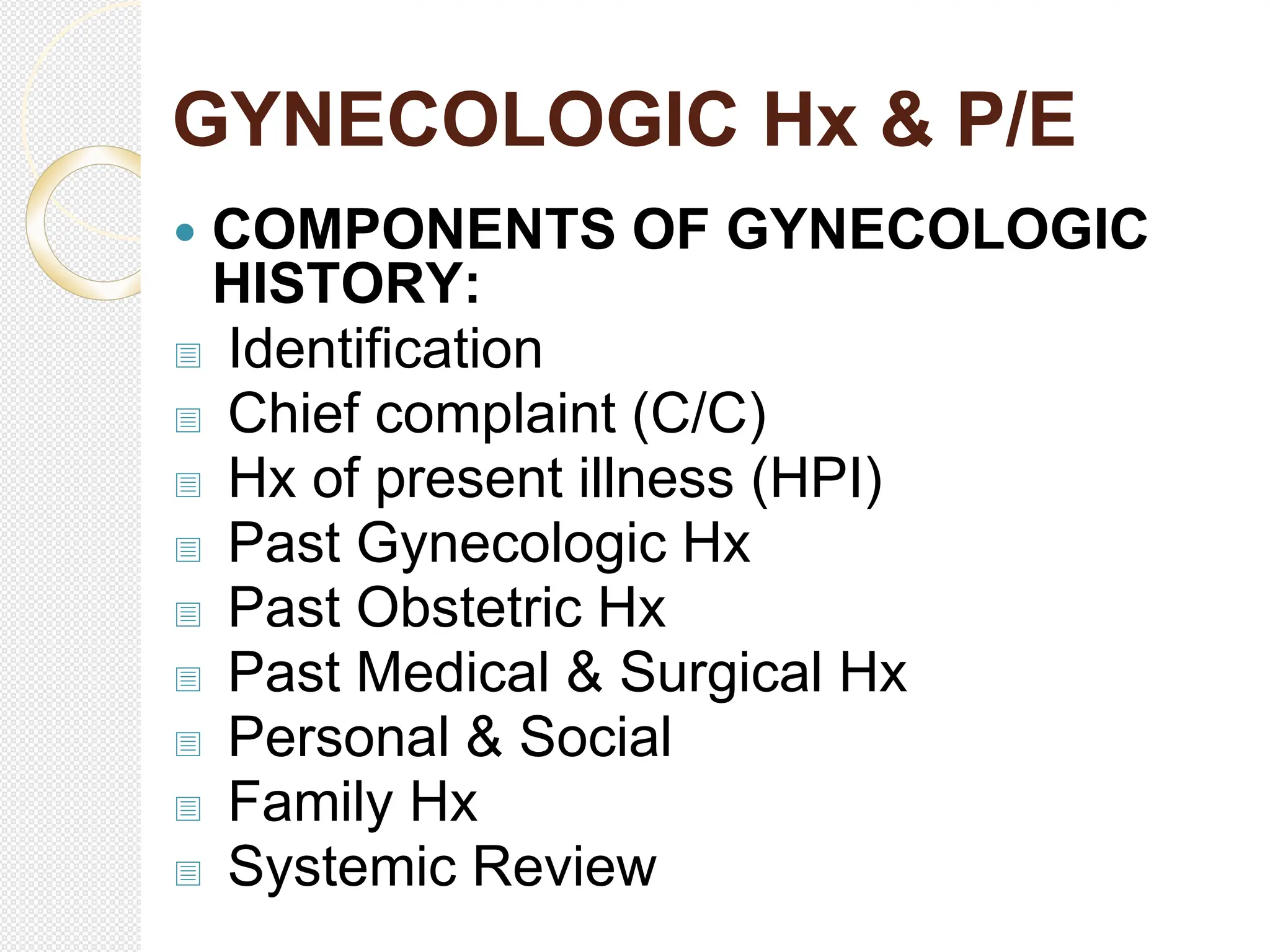
 COMPONENTS OF GYNECOLOGIC
HISTORY:
 Identification
 Chief complaint (C/C)
 Hx of present illness (HPI)
 Past Gynecologic Hx
 Past Obstetric Hx
 Past Medical & Surgical Hx
 Personal & Social
 Family Hx
 Systemic Review
GYNECOLOGIC HISTORY
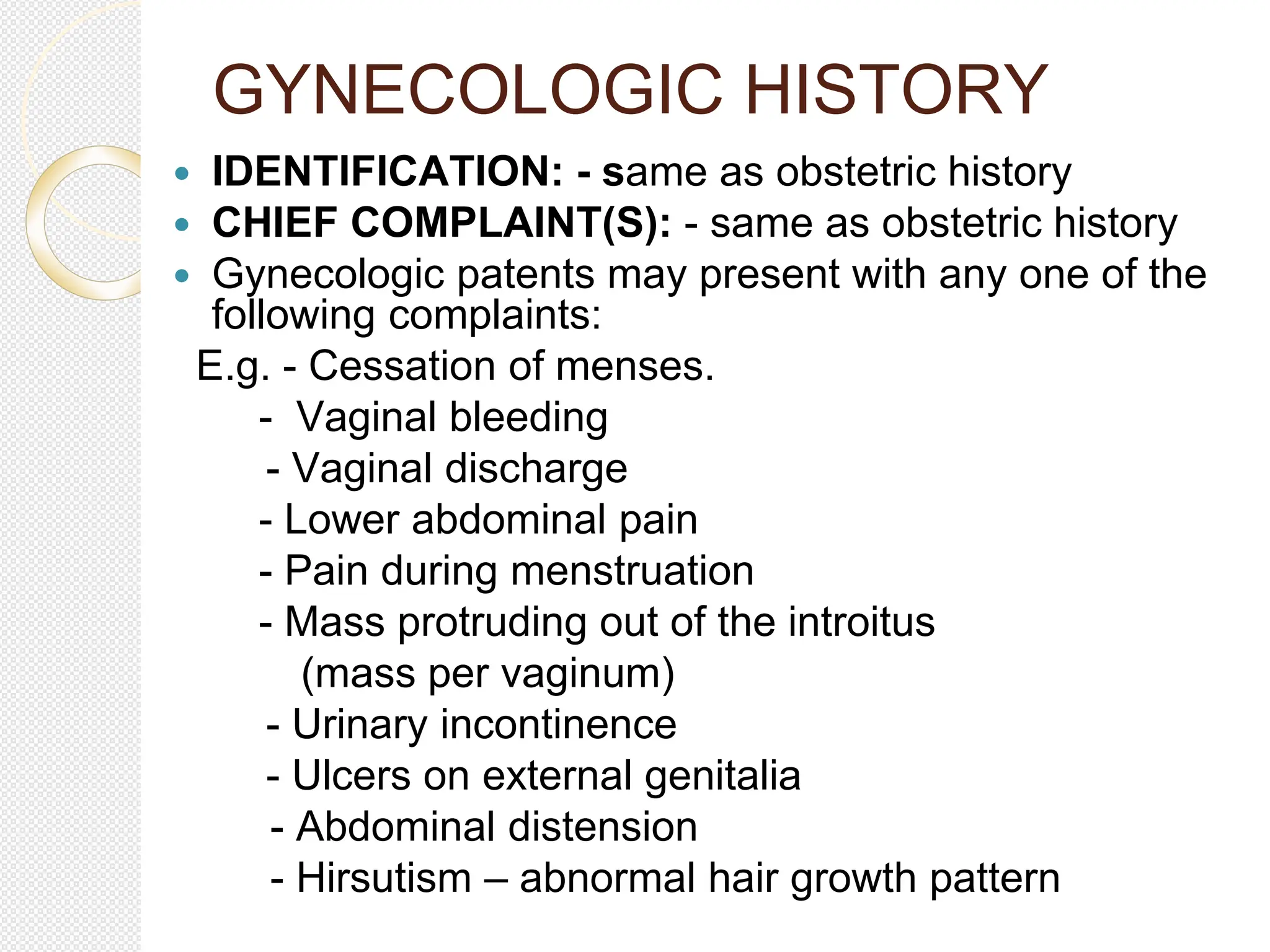
 IDENTIFICATION: - same as obstetric history
 CHIEF COMPLAINT(S): - same as obstetric history
 Gynecologic patents may present with any one of the
following complaints:
E.g. - Cessation of menses.
- Vaginal bleeding
- Vaginal discharge
- Lower abdominal pain
- Pain during menstruation
- Mass protruding out of the introitus
(mass per vaginum)
- Urinary incontinence
- Ulcers on external genitalia
- Abdominal distension
- Hirsutism – abnormal hair growth pattern
HISTORY OF PRESENT ILLNESS (HPI)
 Reproductive history- Gravidity, Parity, Abortions,
Ectopic pregnancy
 Each complaint should be discussed in detail.
 Each problem – where exactly is it occurring?
 Date and time of onset
 Aggravating or relieving factors
 Duration when they occur, Example,
 Abnormal uterine bleeding (AUB): - Describe
clearly onset, duration of flow, amount- indicated by
number of pads used per day, clotting of menstrual
blood. Describe relation of AUB to menstrual cycle &
LNMP.
 LNMP should be included in the HPI??? Menstrual
history in detail can be included in the HPI or
elsewhere if not pertinent to the present complaints.
HPI…
 Vaginal discharge:
- Color, odor, amount, Viscosity.
- Timing in relation to menstrual cycle
- Associated with abnormal vaginal bleeding- may
indicate malignancy
- Itching – indicates infection
 Abdominal pain: – PQRST
- Location (position)
- Quality
- Radiation
- Severity
- Timing - intermittent, constant, etc
- Especially relationship to menstrual cycle
- Pain during menstruation could be primary or
secondary dysmenorrhea.
HPI…
 Contraceptive history, sexual history and
menstrual history should be included in the HPI
if pertinent to the present complaints other wise
can be included in the past gynecologic history.
 Negative – positive statements pertinent to the
presenting complaints should be discussed in
detail.
 Menstrual history: - Age at menarche, interval
between periods, duration of flow, amount and
character of flow, degree of discomfort and age
at menopause.
HPI…
 PAST GYNECOLOGIC HISTORY: - As in obstetrics
history
 PAST OBSTETRIC HISTORY: - As in obstetrics history
 PAST MEDICAL AND SURGICAL HISTORY: - As in
obstetrics history
 PERSONAL & SOCIAL HISTORY: - As in obstetrics
history
 FAMILY HISTORY: - As in obstetric history
 SYSTEMIC REVIEW / FUNCTIONAL ENQUIRY:
GYNECOLOGIC PHYSICAL
EXAMINATION
A. GENERAL APPEARANCE: - as in
obstetrics
B. VITAL SIGNS: - as is done for any
patient
 Weight: – obesity is a risk factor for
certain gynecologic illnesses: e.g.
Endometrial Ca, Ovarian Ca, Amenorrhea.
 Height: – especially important in
postmenopausal patients to document
loss of height from osteoporosis and
vertebral fractures.
 C. HEENT: - as in obstetrics
D. LYMPHOGLANDULAR SYSTEM:
 Breast examination:
 Inspection: - with patient’s hands pressing on
her hips and arms above the head respectively
- Symmetry, dimpling, peau-de- orange, nipple
retraction, ulceration & eczematous nipple
lesions should be documented
 Palpation: – all four quadrants, axillary’s tail,
nipples area for discharge.
- Axillary, supraclavicular and cervical lymph
nodes should be palpated with detailed
description of a mass.
GYN P/E…
 E. RS: - as in any other patient
 F. CVS: - as in any other patient
 G. ABDOMINAL EXAMINATION
- Inspection: – as usual as is done for any
patient.
- Auscultation: - Bruie over a mass &
bowel sound
- Palpation: - Superficial
- Deep
ABDOMINAL EXAMINATION…
 Abdominal Mass: – Describe Size,
origin, consistency, mobility, tenderness
and contour
 Size: - in weeks of pregnant uterus size
- 12 weeks at symphysis pubis
- 20 weeks at umbilicus
- 38 weeks at xiphisternum
 Origin: - pelvic - abdominal mass arising
from the pelvis or an abdomen can be
differentiated by identifying if one can go
below the mass in to the pelvic cavity or
ABDOMINAL EXAMINATION…
 Mobility: - fixation may indicate adhesions or
malignancy
 Tenderness
 Surface contour: - smooth, irregular or nodular
 Check for Organomegally: – liver, spleen,
Kidneys.
Percussion: - Shifting dullness, fluid thrill to
detect ascites
 Differentiation of a large ovarian tumor versus
ascites: - Large ovarian tumor has central
dullness with tympanicity at the flanks as
H. GENITOURINARY SYSTEM:
 = > CVA and suprapubic tenderness
 = > Pelvic Examination
 Pelvic examination: – has 5 components
- Examination of external genitalia
- Speculum examination
- Digital vaginal examination
- Bimanual pelvic examination
and
- Rectovaginal examination
Pelvic Examination…
A. Examination of external genitalia: -
Inspection and palpation
- Pubic hair pattern: - Masculine-diamond shaped
- Feminine-inverted triangle.
- Infected hair follicles etc.
 Skin of vulva, mons pubis and perineal area
inspected for dermatitis or discoloration
e.g. whitish discoloration in vulvar
dystrophies.
 Ulcers or swelling E.g. sebaceous cysts or
tumors
 Labia majora and minora:
 Ulcers, swelling or tumors such as Condyloma
accuminata could be found.
Pelvic Examination…
 Urethral orifice: - should be of the same
color as surrounding
- Milk for discharge
- Urethral caruncle or tumor if any
 Area of Bartholin’s gland: - at 5 & 7
o’clock position
- Inspection & palpation for swelling and
tenderness
 Discharge or bleeding from the introitus –
should be noted.
Pelvic Examination…
 Hymen: - Unruptured, many forms – annular,
crescentic, or fimbriated.
- Imperforated hymen is pathological
- Ruptured - especially after the birth of many
children
- remnants of ruptured hymen is called
carunculae myrtiformis.
- Examination of hymen is important in cases
of sexual assault.
- Check perineal support: – open the labia with
2 fingers and ask patient to strain to document
genital prolapse.
Pelvic Examination…
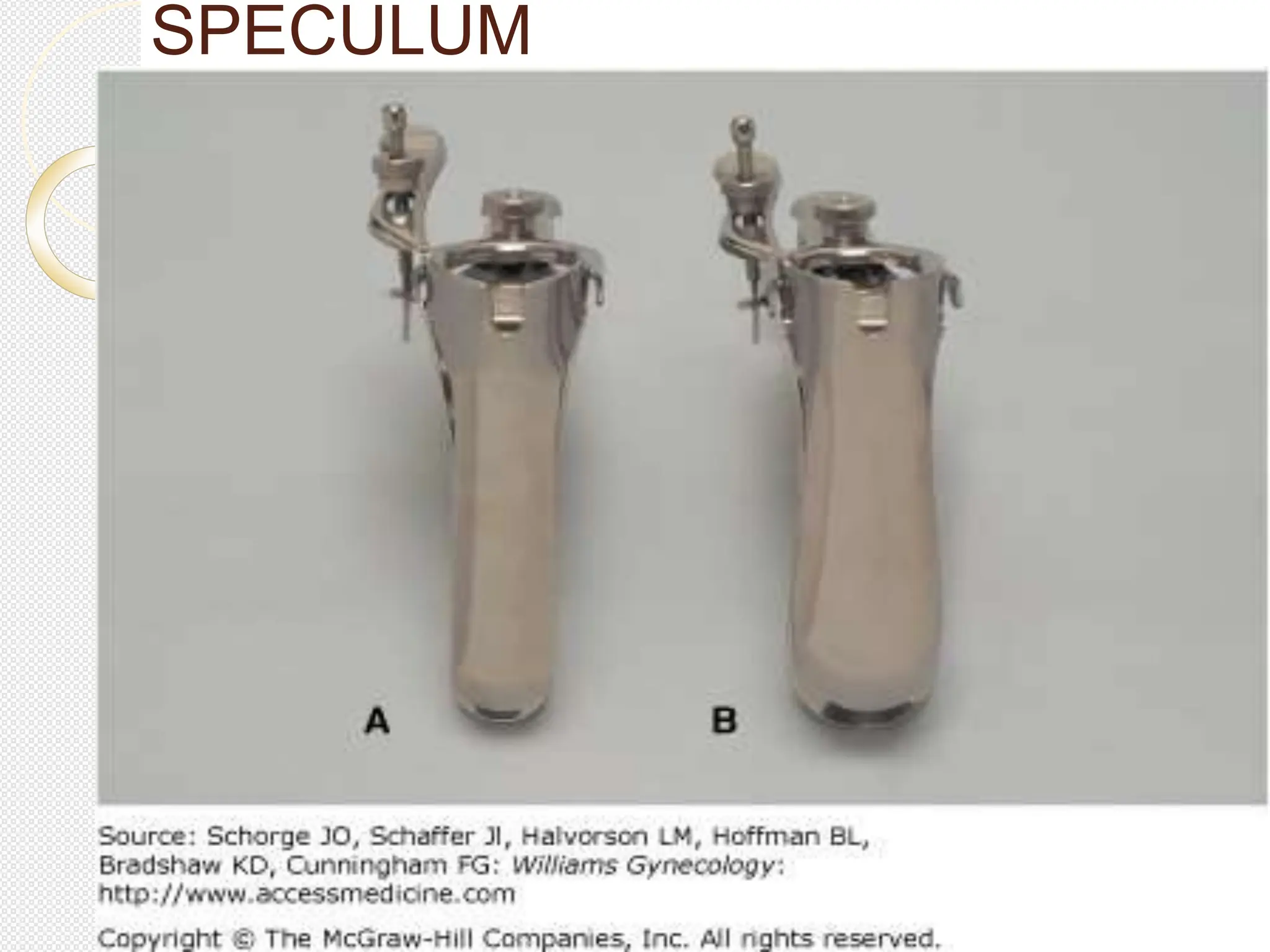
B. Speculum examination
- Speculum – Dampened with warm water but
not lubricants
- Types: - Cusco’s (Graves): bivalve
speculum.
- Sims speculum: monovalve
speculum
- Choice of several sizes depending on age
etc.
 The following should be documented.
 Vagina: - Color- pink, whitened, inflamed
- Congenital anomalies like vaginal septum.
- Fornices: - formed, flattened, bulging
Pelvic Examination…
 Cervix: - Os: – Nulliparous – pinpointed.
- Multiparious – slit-like
- Erosions, scars, lacerations, ulcer,
mass,
- Nabothian cysts, discharge or bleeding
- Effacement, dilatation,
- Any mass or polyp from Os or from the surface
 Papanicoulau’s (Pap) smear should be taken at
this time from the exocervix and endocervix
using Ayre’s spatula and an endocervical brush
respectively.
SPECULUM
Pelvic Examination…
C. Digital vaginal examination: - Note the following
 The patient should have voided just prior to
examination to avoid difficulty in examining the uterus
and adnexa by the distended bladder.
 Vaginal: - masses, tenderness or stenosis
 Fornices: - formed or obliterated
- Bulging especially posterior fornix (cul-de-sac)
- Tenderness
 Cervix: – consistency: – Tip of nose – normal
- Hard in malignancies.
- Excitation (motion) tenderness
- Effacement, position & dilation
Pelvic Examination…
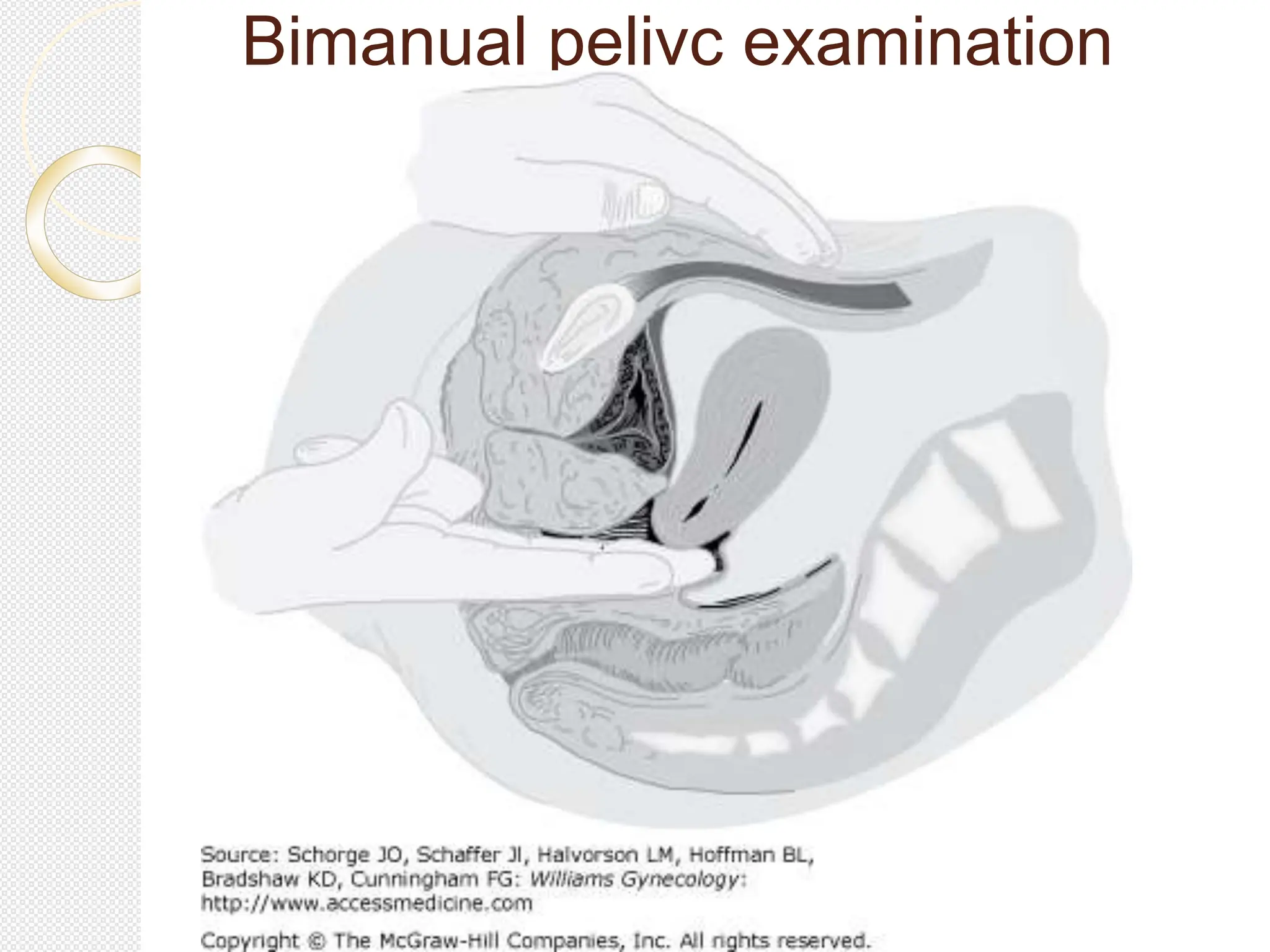
 D. Bimanual pelvic examination:
- To delineate the uterus and adnexa between
the 2 fingers in the vagina and the palm of the
other hand on the lower abdominal wall.
- Note the following:
a. Cervix: - 3- 4 cms in diameter/length, round,
tip of the nose consistency
- External os is usually closed
- Smooth surface normally
- Can be moved 2- 4 cms in any direction
without discomfort.
Pelvic Examination…
b. Uterus: - Dimensions of normal uterus =
9 cms in length, 7 cms in width, 70 - 90
grams in weight.
 Assess the following regarding the uterus:
 Position: – Anteverted – normally
- Ante flexed – body of the uterus flexed
at cervix
- Retroverted & retroflexed normally in
20% of cases
 Tenderness: – normally non- tender
organ
Pelvic Examination…
b. Uterus…
 Mobility: – mobile in all directions normally.
 Fixation: – may be due to cancer /
neoplasia or inflammation.
 Size: – described in pregnant uterus size;
in weeks
 Surface contour: - smooth normally
 Consistency: – firm normally
Pelvic Examination…
c. Adnexa: - Refers to the –Tubes, ovaries,
broad ligament and parametrium
 Ovaries: - 3cm x2cm x l cms in size.
= > May be palpable in thin women with
soft abdominal walls.
= > Tender normally.
 Tubes diameter = 7 mms at its greatest
diameter
 Description of adnexal mass: in a similar
way to uterine mass
Bimanual pelivc examination
Pelvic Examination…
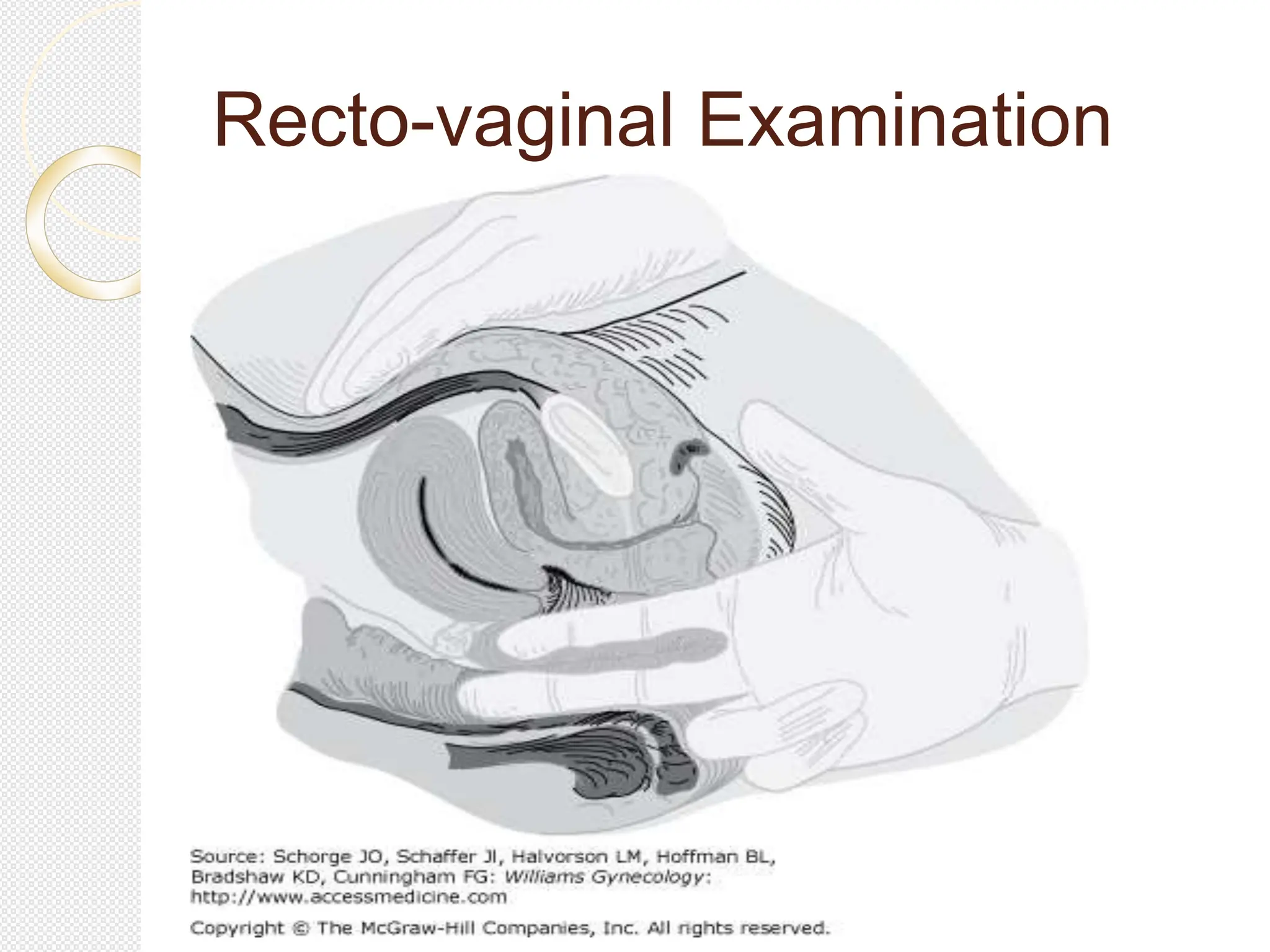
E. Recto vaginal examination:
 It is performed with the index finger in the
vagina and the middle finger in the rectum.
 The structures that lie in between the two
fingers include the rectovaginal septum or
structures that may dissect it.
 A cul-de-sac abscess may dissect the septum
and be detected on rectovaginal exam.
 A cervical carcinoma may also infiltrate the
septum.
 Rectovaginal exam is also useful in
differentiating a rectocele from an enterocele.
An enterocele is felt descending in between the
Recto-vaginal Examination
I.INTEGUMANTARY SYSTEM:
 The skin is examined for texture, dryness
or moisture, temperature, purpura, rashes,
urticaria, ulcers and hypo or
hyperpigmentations.
 The hair is examined for sparseness,
baldness, alopecia and texture.
 The color, shape (clubbing, spooning),
texture, capillary refill and presence of
splinter hemorrhages are noted on
examining the nails.
 Presence or absence of Hirsutism and its
J. MUSKULOSKELETAL SYSTEM:
 Presence of muscle tenderness or spasm
is noted.
 The spine is examined for tenderness on
percussion or pressure, kyphosis,
scoliosis, lordosis, malformation, gibbus
and limitation of movement.
 Joints are evaluated for swelling,
tenderness, redness, heat, crepitus,
limitation of movement on active or
passive motions, effusion, masses,
dislocation and deformity.
 On the examination of bones mention is
made of fractures, deformity, tumor,
periosteal thickening and tenderness.
K. NERVOUS SYSTEM:
 It includes assessment of:
- Central as well as peripheral nervous system
functions.
 Mental status: - orientation to time, place &
person.
- long and short term memory
- level of consciousness
- intelligence, mood, attention, speech,
hallucinations and delusions
- level of education & cooperation with the
examiner.
 The 12 cranial nerves for their specific
functions
NERVOUS SYSTEM…
 Motor functions (muscle volume, tone, power,
fasciculation & involuntary movements).
 Sensory functions:
- Superficial: - light touch, pain, and
temperature.
- Deep: - position, deep pain, vibration,
Romberg’s sign & ataxia gait.
 Superficial and Deep tendon reflexes:
- Superficial: - includes corneal, abdominal,
cremasteric and plantar reflexes.
- Deep: - biceps, triceps, supinators, patellar
and ankle reflexes.
 Meningeal signs (nuchal rigidity, Kerning’s sign
L. Summary of Hx & P/E
M. Assessment / Diagnosis
N. Differential diagnosis
O. Investigations
P. Treatment plan
……………………….. The End !
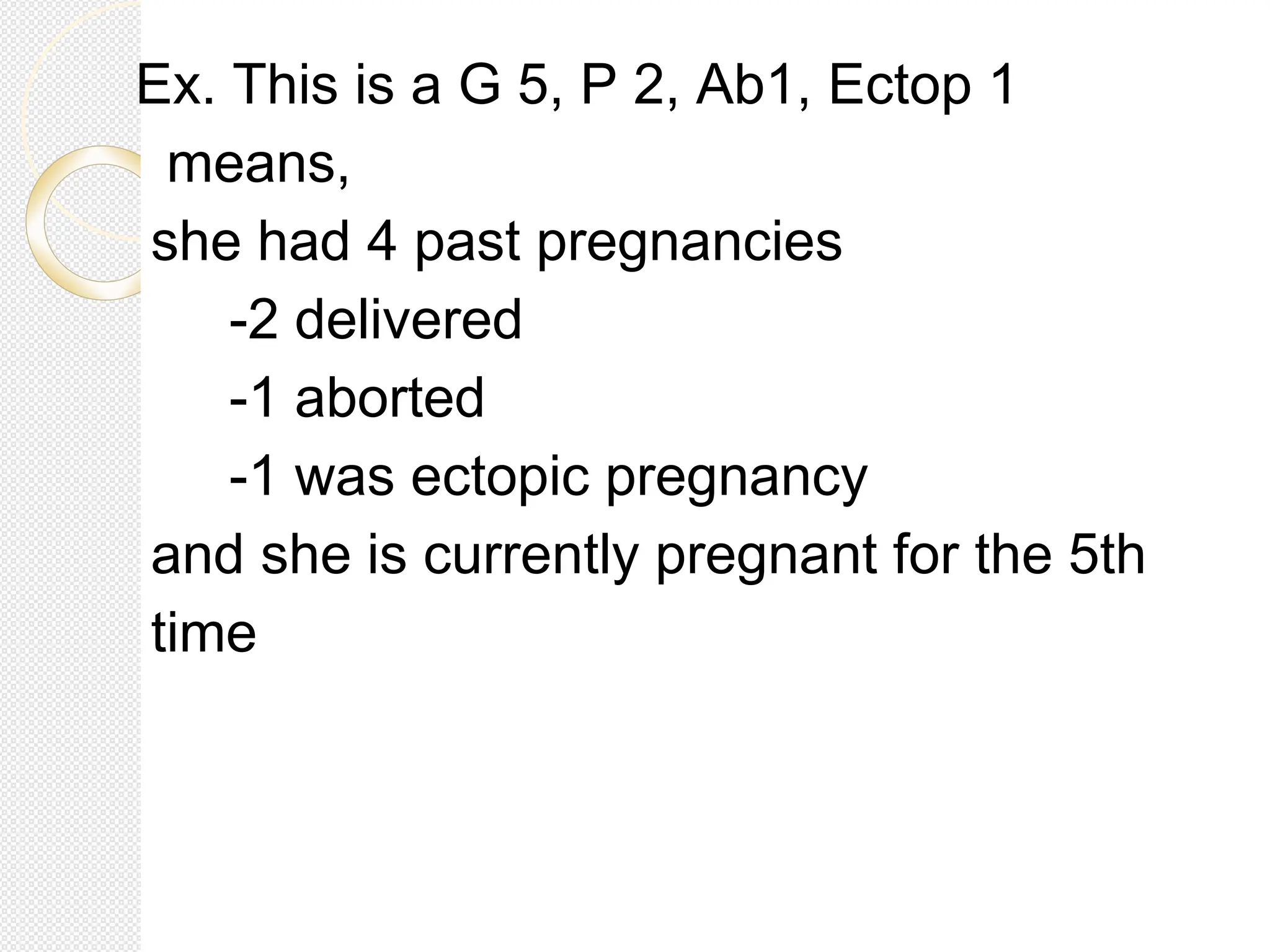
Ex. This is a G 5, P 2, Ab1, Ectop 1
means,
she had 4 past pregnancies
-2 delivered
-1 aborted
-1 was ectopic pregnancy
and she is currently pregnant for the 5th
time
7/11/2024
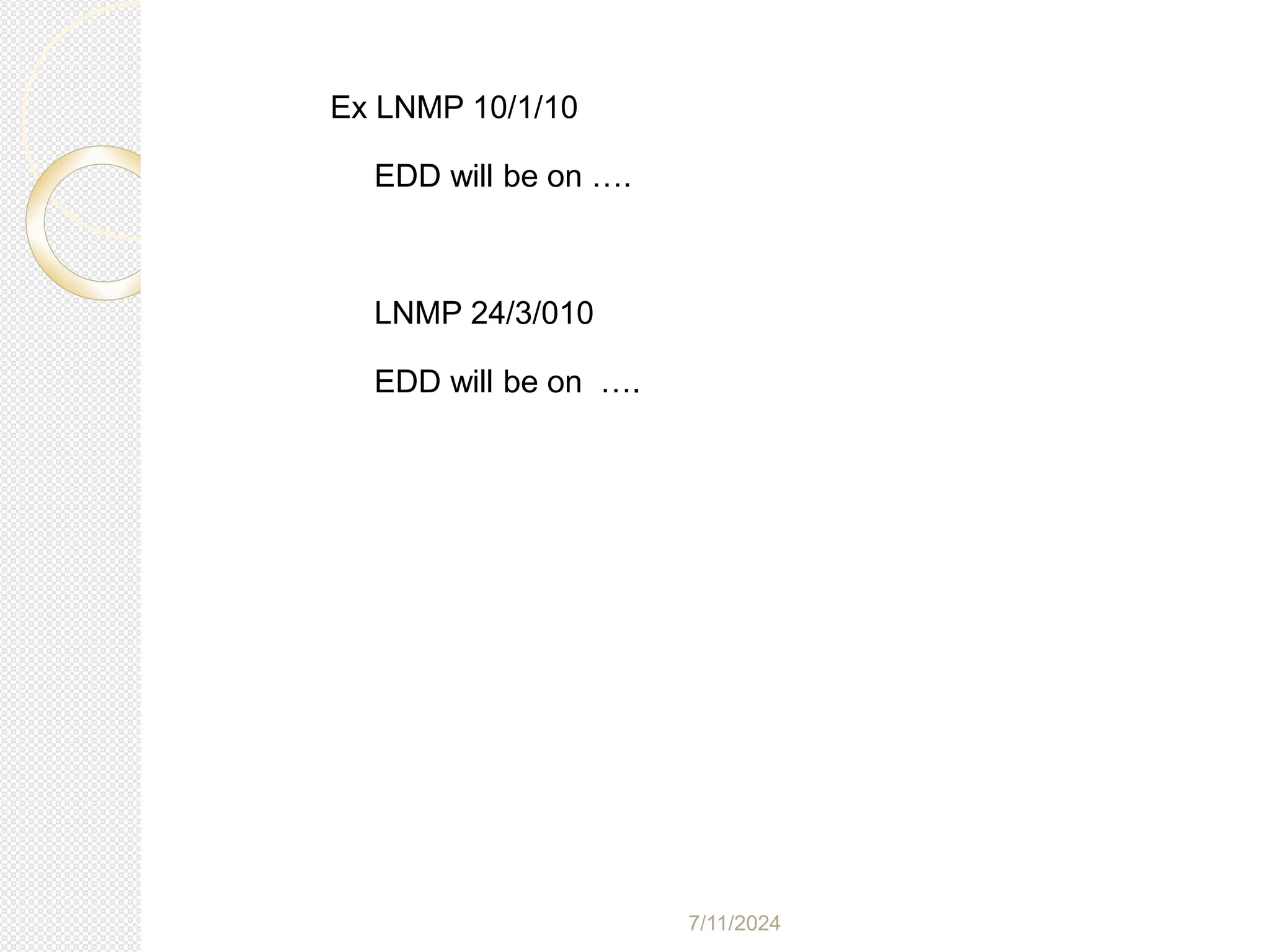
Ex LNMP 10/1/10
EDD will be on ….
LNMP 24/3/010
EDD will be on ….

1. HISTORY & PHYSICAL EXAM IN OBGYN(0).ppt

  • 1.
    HISTORY & PHYSICAL EXAMIN OB/GYN Dr Olana Terefa(MD, Lecturer)
  • 2.
    What is Obstetrics? The word obstetrics is derived from the Latin obstetrix, meaning midwife.  The word also is connected with the verb obstare—to stand by or in front of.  The rationale for this derivation is that the midwife stood by or in front of the parturient.
  • 3.
    HISTORY & PHYSICALEXAM IN OB/GYN  COMPONENTS OF OBSTETRIC HISTORY:  Identification  Chief complaint (C/C)  Hx of present pregnancy (HPP)  Past Obstetric Hx  Past Gynecologic Hx  Past Medical & Surgical Hx  Personal & Social  Family Hx  Systemic Review
  • 4.
    COMPONENTS OF OBSTETRIC P/E General Appearance (GA)  Vital Sign (V/S)  HEENT  Lympho- glandular system (LGS)  Respiratory System (RS)  Cardiovascular system (CVS)  ABDOMEN (GIT)  Genito – Urinary System (GUS)  Integumantary System  Musculoskeletal System (MSS)  Nervous System (NS)  SUMMARY OF Hx & P/E  ASSESSMENT/ or DIAGNOSIS /or IMPRESSION  DIFFERENTIAL DIAGNOSIS (DDx)  INVESTIGATIONS  TREATMENT PLAN
  • 5.
    OBSTETRIC HISTORY 1. IDENTIFICATION:- Emphasize on - Name - Age: <18 yrs or > 35 yrs = > high risk group. - Marital status: => Unmarried & unsupported are high risk group. - Address, Religion, Ethnicity - Occupation - Date of admission, Ward, bed number - Previous history of admission, - How the patient was brought to the hospital - Source of information, language of communication - Source of referral NB: Objective of identification: To know/identify the patient To identify risk factor for current pts compliant To make follow up arrangements
  • 6.
    2. CHIEF COMPLAINT(c/c): - Patients might have come for scheduled ANC follow up or - May have a specific complaint e.g. nausea and Vomiting, Vaginal bleeding etc. 3. HISTORY OF PRESENT PREGNANCY (HPP): It should include the following information: Gravidity – all previous pregnancies – Term live birth, still births, abortions, ectopic pregnancy or hydatidiform mole. Parity – Pregnancies that have extended beyond fetal viability whether the fetus is delivered alive or dead. > 28 weeks: - UK and Ethiopia > 20 weeks for WHO Abortion(s); number, induced or spontaneous
  • 7.
    Hx OF PRESENTPREGNANCY (HPP)…  LNMP: - 1st day of normal period. To be considered as reliable if: - Menstrual cycle has been regular - No use of hormonal contraceptives for at least 3 months prior to LNMP or regular cycles - If lactating, should have seen at least 3 regular cycles  Calculate the EDD: – 40 weeks or 280 days after LMP – 5% of pregnant women deliver on this day. Term pregnancy: 37 – 42 completed weeks. Preterm pregnancy: < 37 completed weeks. Post term pregnancy: > 42 ›› ››  Naegle’s rule: LNMP – 3 months + 7 days (for the European C.).  For the Ethiopian calendar: EDD = LNMP + 9 months + 10 days if Pagume is not crossed, or EDD = LNMP – 3months + (5 or 4 days if Pagume is 5 or 6 days respectively), If Pagume is passed or crossed.  Calculate gestational age in completed weeks and days.
  • 8.
    HPP…  Quickening: -1st time the mother felt fetal movement or kick - used to calculate the date of the pregnancy if LMP is unknown. = > for Primigravidas: b/n 18 – 20 weeks. = > for Multigravidas: b/n 16 – 18 weeks( because of experience)  ANC status should be documented & if not followed, the reason should be sought.  Elaborate the chief complaint  Any complaints during the present pregnancy- eventful or uneventful  Ask for danger signs: - Vaginal bleeding, leakage of liquor, abdominal pain, fever, … etc.  Fetal movements decreased or increased? It is useful to assess fetal well being.  Other negative and positive statements should be asked according to the patient’s complaints e.g. Headache, blurring of vision, epigastric pain or convulsion in hypertensive disorders of pregnancy etc
  • 9.
    4. PAST OBSTETRICHISTORY… => Document all previous pregnancies in a chronological order.  Year of gestation, Length of gestation, birth weight, fetal outcome, length of labor, fetal presentation, mode of delivery,  Complications: - Ante partum, intrapartum & post partum.  Important because most obstetric problems are recurrent and have a chance of recurring in the current pregnancy e.g. APH, PPH, PROM, GDM, PIH, C/S, Ectopic pregnancy & abortion.
  • 10.
    PAST OBSTETRIC Hx, Summary Orderof pregnan cy Antepar tum complic ations Length of Gestation Length of labor Mode of Delivery Birth Outcome Postpart um complica tion Child alive or not 1st 2nd
  • 11.
    5. PAST GYNECOLOGICHISTORY - Contraception – use of any form of contraception, type and duration  Sexual history – including history of STD: Assess risk of HIV / AIDS  History of gynecologic procedures including history of female genital cutting (FGM).  History of previous gynecologic surgery or procedure – e.g. prior uterine surgery; hysterectomy, myomectomy, D&C, MVA, E&C…  Menstrual history: age at menarche, interval between periods, duration of flow, amount and character of flow, degree of discomfort.
  • 12.
    PAST GYNECOLOGIC HISTORY… Normal menstrual cycles: = > 1 – 8 days of flow / 5 days on average = > 21– 35 days cycle length / 28 days on average. = > 10 – 80ml /50ml on average amount of blood flow = > Dark non- clotting blood.
  • 13.
    6. PAST MEDICALAND SURGICAL Hx:  Medical disorders may affect the outcome of pregnancy and the physiological changes of pregnancy may aggravate the medical disorder. e.g. Diabetes mellitus, Hypertension, Thyrotoxicosis or Hypothyroidism, Tb, etc  Previous blood transfusion – may be related to hemolytic disease of the newborn.  Hypersensitivity to drugs should be asked.  History of maternal infection during pregnancy should be asked – e.g. STD, rubella, malaria, etc.  Previous hx of surgery: eg, appendectomy, cholecystectomy, thyroidectomy ….etc
  • 14.
    7. PERSONAL &SOCIAL HISTORY (+ FAMILY HISTORY)  Early childhood history, number of siblings, whether parents and siblings are alive or not. If dead, reason for death should be mentioned to uncover familial reasons.  Educational status  Habits – smoking, alcohol and drug use may have a deleterious effect on pregnancy. e.g. fetal alcohol syndrome.  Occupation and family income – Low socio economic status is associated with pregnancy complication. e.g. pre-
  • 15.
    8. FAMILY HISTORY Family history of – Diabetes mellitus, Hypertension, Tuberculosis, Twinning, Hereditary diseases, chromosomal anomalies, allergies, and mental disorders-running in the family. 9. SYSTEMIC REVIEW / FUNCTIONAL ENQUIRY  A check list for the health professional in all the systems
  • 16.
    B. PHYSICAL EXAMINATION(P/E)  P/E should be conducted in an environment that is aesthetically pleasing to the patient.  A female assistant (chaperone) should be present whenever possible.  Adequate gowning and draping is necessary to avoid embarrassment.  Warm instruments, reassurance and adequate lighting should be used.  General physical examination covering all the systems should be conducted thoroughly. 1. GENERAL APPEARANCE: - Acutely or chronically sick looking, well looking, - Mood of the patient, - Body morphism (nutritional status)
  • 17.
    PHYSICAL EXAMINATION (P/E)… 2.VITAL SIGNS:  Blood pressure: – should be measured in the sitting position or 30 degree left lateral tilt to avoid supine hypotension syndrome due to vena caval compression. DBP is taken at the point of disappearance (5th Korotkoff’s) point.  Pulse: 10 – 15 beats / minute increase in pulse rate during pregnancy.  RR: 1 – 4 breathes / minute increase during pregnancy  Temperature  Weight: - ideal body weight found by using Broca’s formula = Height in cms – 100  +/- 20% this is the cut off point for the normal range.  Weight gain > 1Kg / wk is abnormal
  • 18.
    3. HEENT EXAMINATION -Emphasize on head, ear, eye (conjunctiva, sclera), nose and throat or teeth 4. LYMPHO-GLANDULAR SYSTEM (LGS): - All superficial lymphatic system should be evaluated. - Glands:- Thyroid - Breast:- detailed examination - Nipple retraction:– should be treated during pregnancy so that it will not interfere with breast feeding. 5. RESPIRATORY SYSTEM / Chest – same as non- pregnant.
  • 19.
    6. CARDIO-VASCULAR SYSTEM Same as non – pregnant - PMI may be deviated to the left. - S3 gallop may be heard normally. - Functional systolic murmur < III/VI grade may be heard.
  • 20.
    7. ABDOMEN  a)Inspection:  Distension – site of distension, uniformity, shape and peristalytic movement  Symmetry: symmetrical or asymmetrical - tilted to the right or to the left  Linea nigra- midline hyperpigmentaion due to increased Melanocyte Stimulating Hormone (MSH) during pregnancy  Stria gravidarum – purplish mark on the abdomen, thighs & breasts due to the distension. (primigravida)  New Stria gravidarum are few in number, thick and purplish to dark in color.  Old Stria gravidarum (Stria albicantes) are whitish, much thinner and numerous in numbers
  • 21.
    7. ABDOMEN… Inspection…  Umbilicus- flat, inverted or everted.  Scars: - surgical or non- surgical  Surgical: - sub umbilical midline or - Pfannensteil - suprapubic transverse scar  Distended veins  Flanks – full or not  Pulsatile mass
  • 22.
    7. ABDOMEN… b. Palpation: i.Superficial palpation- Look for rigidity, tenderness, superficial mass, characterizes mass, abdominal wall defect. ii. Deep Palpation Look for mass, organomegally, tenderness Characterize mass (size, organ, mobility, tenderness, shape, and contour) iii. Obstetric palpation: Leopold I: – Fundal palpation. - Has 2 purposes: 1) Determination of fundal height, and
  • 23.
    OBSTETRIC PALPATION… Leopold I:– Fundal palpation…  Fundal height (fh) measurement - should be after correcting for dextrorotation. There are 2 methods of measuring the fh: 1. Finger method: - below the umbilicus, 1 finger = 1 week - Above the umbilicus, 1 finger = 2 weeks
  • 24.
    OBSTETRIC PALPATION…  Bodymarks: - Uterus at symphysis pubis = 12 weeks - At the umbilicus = 20 weeks - At Xiphisternum = 38 weeks - Midways b/n symphysis & umbilicus = 16wks - Midways b/n umbilicus & Xiphisternum = 28wks
  • 25.
    OBSTETRIC PALPATION… 2. Tapemeasurement:  Symphysis to fundal height measurement in cms with tape meter.  At 18 – 34 weeks of gestation, tape measurement is accurate to +2 weeks of actual Gestational age.  McDonald rule & Johnson formula for GA & Fetal weight estimation.  What occupies the fundus?  Soft irregular bulky mass - the breech  Hard round ballotable mass – Head
  • 26.
    OBSTETRIC PALPATION… Leopold II:– Lateral palpation Has 2 purposes: 1) To know the lie 2) To determine side of the back 1. Lie: - is the longitudinal axis of the fetus in relation to the longitudinal axis of the mother. - It can be longitudinal, transverse or oblique. 2. Side of the back – to auscultate the FHR on that side.  FHR can be auscultated at 20 weeks by using the De Lee /Pinard stethoscope or at 10 - 12 weeks using Doppler Ultrasound.
  • 27.
    OBSTETRIC PALPATION…  LeopoldIII – pelvic palpation – It has three purposes; to know the 1) Presentation 2) Descent of presenting part. 3) Attitude of the fetal head.  Presentation: – is the part of the fetus that occupies the lower uterine pole. E.g. Cephalic, breech & shoulder presentation  Descent is measured after identifying the anterior shoulder with rule of 5th in fingers above pelvic brim. th
  • 28.
    OBSTETRIC PALPATION…  Attitude:is the relationship of the fetal parts to each other particularly the fetal head to its trunk. - Cephalic prominence on the side of the back. Extended attitude = > abnormal  Cephalic prominence opposite to the side of the back  Flexed attitude = > normal  Military Attitude: - neither flexed nor extended  Leopold IV – Pawlik’s grip: – It has two purposes. To know the 1) Presentation and 2) Descent or mobility of the fetal head
  • 29.
    7. ABDOMEN… c. Percussion:– Shifting & flank dullness and fluid thrill – as in ascites & polyhydramnios d. Auscultation: - FHB first heard at the 20th week – On the side of the back.  Below the umbilicus in cephalic presentation  Above the umbilicus in breech presentation  At flanks in OP position
  • 30.
    8. GENITOURINARY SYSTEM Pelvic assessment (PV Exam):  - Done at two times during pregnancy unless otherwise indicated due to complications and in labor 1. Early – During the 1st trimester as early as possible. Purposes: - To diagnose pregnancy - To date pregnancy by measuring uterine size - To diagnose pelvic problems like ovarian cyst and uterine anomalies & Vaginal congenital anomalies like septum as early as possible. 2. Late in pregnancy (>37 Weeks). Purposes: - for soft tissues assessment  For pelvic assessment to diagnose contracted pelvis/ bony pelvis assessment = > to assess the pelvic inlet, mid cavity & outlet.
  • 31.
    9. INTEGUMANTARY SYSTEM… INTEGUMANTARY SYSTEM : - as in Gynecologic history 10. MUSCULOSKELETAL SYSTEM:  Extremities - Look for edema – pretibial, ankle & pedal (dependent edema) = > 80% of normal pregnant women can have dependent leg edema.  Other areas to look for pathological (Non- dependent edema.) = > Facial edema. = > Tightening of rings (finger) = > Sacral edema = > Abdominal wall edema
  • 32.
    11. NERVOUS SYSTEM(NS): Nervous System: - see Gynecologic P/E part - Reflex - Consciousness - Gross neurological deficit 12. Summary of Hx & P/E 13. Assessment Or Diagnosis Or Impression 14. Differential Diagnosis (DDx) 15. Investigations 16. Treatment plan
  • 33.
    INTRODUCTION TO GYNECOLOGY  Whatis Gynecology?  Gynecology, spelled gynaecology, is defined by the Oxford English Dictionary as a department of medical science which treats of the functions and diseases peculiar to women.  The word was first used as such in the middle of the 19th century. In 1867, gynecology represented the physiology and pathology of the non pregnant state.
  • 34.
    GYNECOLOGIC Hx &P/E  COMPONENTS OF GYNECOLOGIC HISTORY:  Identification  Chief complaint (C/C)  Hx of present illness (HPI)  Past Gynecologic Hx  Past Obstetric Hx  Past Medical & Surgical Hx  Personal & Social  Family Hx  Systemic Review
  • 35.
    GYNECOLOGIC HISTORY  IDENTIFICATION:- same as obstetric history  CHIEF COMPLAINT(S): - same as obstetric history  Gynecologic patents may present with any one of the following complaints: E.g. - Cessation of menses. - Vaginal bleeding - Vaginal discharge - Lower abdominal pain - Pain during menstruation - Mass protruding out of the introitus (mass per vaginum) - Urinary incontinence - Ulcers on external genitalia - Abdominal distension - Hirsutism – abnormal hair growth pattern
  • 36.
    HISTORY OF PRESENTILLNESS (HPI)  Reproductive history- Gravidity, Parity, Abortions, Ectopic pregnancy  Each complaint should be discussed in detail.  Each problem – where exactly is it occurring?  Date and time of onset  Aggravating or relieving factors  Duration when they occur, Example,  Abnormal uterine bleeding (AUB): - Describe clearly onset, duration of flow, amount- indicated by number of pads used per day, clotting of menstrual blood. Describe relation of AUB to menstrual cycle & LNMP.  LNMP should be included in the HPI??? Menstrual history in detail can be included in the HPI or elsewhere if not pertinent to the present complaints.
  • 37.
    HPI…  Vaginal discharge: -Color, odor, amount, Viscosity. - Timing in relation to menstrual cycle - Associated with abnormal vaginal bleeding- may indicate malignancy - Itching – indicates infection  Abdominal pain: – PQRST - Location (position) - Quality - Radiation - Severity - Timing - intermittent, constant, etc - Especially relationship to menstrual cycle - Pain during menstruation could be primary or secondary dysmenorrhea.
  • 38.
    HPI…  Contraceptive history,sexual history and menstrual history should be included in the HPI if pertinent to the present complaints other wise can be included in the past gynecologic history.  Negative – positive statements pertinent to the presenting complaints should be discussed in detail.  Menstrual history: - Age at menarche, interval between periods, duration of flow, amount and character of flow, degree of discomfort and age at menopause.
  • 39.
    HPI…  PAST GYNECOLOGICHISTORY: - As in obstetrics history  PAST OBSTETRIC HISTORY: - As in obstetrics history  PAST MEDICAL AND SURGICAL HISTORY: - As in obstetrics history  PERSONAL & SOCIAL HISTORY: - As in obstetrics history  FAMILY HISTORY: - As in obstetric history  SYSTEMIC REVIEW / FUNCTIONAL ENQUIRY:
  • 40.
    GYNECOLOGIC PHYSICAL EXAMINATION A. GENERALAPPEARANCE: - as in obstetrics B. VITAL SIGNS: - as is done for any patient  Weight: – obesity is a risk factor for certain gynecologic illnesses: e.g. Endometrial Ca, Ovarian Ca, Amenorrhea.  Height: – especially important in postmenopausal patients to document loss of height from osteoporosis and vertebral fractures.  C. HEENT: - as in obstetrics
  • 41.
    D. LYMPHOGLANDULAR SYSTEM: Breast examination:  Inspection: - with patient’s hands pressing on her hips and arms above the head respectively - Symmetry, dimpling, peau-de- orange, nipple retraction, ulceration & eczematous nipple lesions should be documented  Palpation: – all four quadrants, axillary’s tail, nipples area for discharge. - Axillary, supraclavicular and cervical lymph nodes should be palpated with detailed description of a mass.
  • 42.
    GYN P/E…  E.RS: - as in any other patient  F. CVS: - as in any other patient  G. ABDOMINAL EXAMINATION - Inspection: – as usual as is done for any patient. - Auscultation: - Bruie over a mass & bowel sound - Palpation: - Superficial - Deep
  • 43.
    ABDOMINAL EXAMINATION…  AbdominalMass: – Describe Size, origin, consistency, mobility, tenderness and contour  Size: - in weeks of pregnant uterus size - 12 weeks at symphysis pubis - 20 weeks at umbilicus - 38 weeks at xiphisternum  Origin: - pelvic - abdominal mass arising from the pelvis or an abdomen can be differentiated by identifying if one can go below the mass in to the pelvic cavity or
  • 44.
    ABDOMINAL EXAMINATION…  Mobility:- fixation may indicate adhesions or malignancy  Tenderness  Surface contour: - smooth, irregular or nodular  Check for Organomegally: – liver, spleen, Kidneys. Percussion: - Shifting dullness, fluid thrill to detect ascites  Differentiation of a large ovarian tumor versus ascites: - Large ovarian tumor has central dullness with tympanicity at the flanks as
  • 45.
    H. GENITOURINARY SYSTEM: = > CVA and suprapubic tenderness  = > Pelvic Examination  Pelvic examination: – has 5 components - Examination of external genitalia - Speculum examination - Digital vaginal examination - Bimanual pelvic examination and - Rectovaginal examination
  • 46.
    Pelvic Examination… A. Examinationof external genitalia: - Inspection and palpation - Pubic hair pattern: - Masculine-diamond shaped - Feminine-inverted triangle. - Infected hair follicles etc.  Skin of vulva, mons pubis and perineal area inspected for dermatitis or discoloration e.g. whitish discoloration in vulvar dystrophies.  Ulcers or swelling E.g. sebaceous cysts or tumors  Labia majora and minora:  Ulcers, swelling or tumors such as Condyloma accuminata could be found.
  • 47.
    Pelvic Examination…  Urethralorifice: - should be of the same color as surrounding - Milk for discharge - Urethral caruncle or tumor if any  Area of Bartholin’s gland: - at 5 & 7 o’clock position - Inspection & palpation for swelling and tenderness  Discharge or bleeding from the introitus – should be noted.
  • 48.
    Pelvic Examination…  Hymen:- Unruptured, many forms – annular, crescentic, or fimbriated. - Imperforated hymen is pathological - Ruptured - especially after the birth of many children - remnants of ruptured hymen is called carunculae myrtiformis. - Examination of hymen is important in cases of sexual assault. - Check perineal support: – open the labia with 2 fingers and ask patient to strain to document genital prolapse.
  • 49.
    Pelvic Examination… B. Speculumexamination - Speculum – Dampened with warm water but not lubricants - Types: - Cusco’s (Graves): bivalve speculum. - Sims speculum: monovalve speculum - Choice of several sizes depending on age etc.  The following should be documented.  Vagina: - Color- pink, whitened, inflamed - Congenital anomalies like vaginal septum. - Fornices: - formed, flattened, bulging
  • 50.
    Pelvic Examination…  Cervix:- Os: – Nulliparous – pinpointed. - Multiparious – slit-like - Erosions, scars, lacerations, ulcer, mass, - Nabothian cysts, discharge or bleeding - Effacement, dilatation, - Any mass or polyp from Os or from the surface  Papanicoulau’s (Pap) smear should be taken at this time from the exocervix and endocervix using Ayre’s spatula and an endocervical brush respectively.
  • 51.
  • 52.
    Pelvic Examination… C. Digitalvaginal examination: - Note the following  The patient should have voided just prior to examination to avoid difficulty in examining the uterus and adnexa by the distended bladder.  Vaginal: - masses, tenderness or stenosis  Fornices: - formed or obliterated - Bulging especially posterior fornix (cul-de-sac) - Tenderness  Cervix: – consistency: – Tip of nose – normal - Hard in malignancies. - Excitation (motion) tenderness - Effacement, position & dilation
  • 53.
    Pelvic Examination…  D.Bimanual pelvic examination: - To delineate the uterus and adnexa between the 2 fingers in the vagina and the palm of the other hand on the lower abdominal wall. - Note the following: a. Cervix: - 3- 4 cms in diameter/length, round, tip of the nose consistency - External os is usually closed - Smooth surface normally - Can be moved 2- 4 cms in any direction without discomfort.
  • 54.
    Pelvic Examination… b. Uterus:- Dimensions of normal uterus = 9 cms in length, 7 cms in width, 70 - 90 grams in weight.  Assess the following regarding the uterus:  Position: – Anteverted – normally - Ante flexed – body of the uterus flexed at cervix - Retroverted & retroflexed normally in 20% of cases  Tenderness: – normally non- tender organ
  • 55.
    Pelvic Examination… b. Uterus… Mobility: – mobile in all directions normally.  Fixation: – may be due to cancer / neoplasia or inflammation.  Size: – described in pregnant uterus size; in weeks  Surface contour: - smooth normally  Consistency: – firm normally
  • 56.
    Pelvic Examination… c. Adnexa:- Refers to the –Tubes, ovaries, broad ligament and parametrium  Ovaries: - 3cm x2cm x l cms in size. = > May be palpable in thin women with soft abdominal walls. = > Tender normally.  Tubes diameter = 7 mms at its greatest diameter  Description of adnexal mass: in a similar way to uterine mass
  • 57.
  • 58.
    Pelvic Examination… E. Rectovaginal examination:  It is performed with the index finger in the vagina and the middle finger in the rectum.  The structures that lie in between the two fingers include the rectovaginal septum or structures that may dissect it.  A cul-de-sac abscess may dissect the septum and be detected on rectovaginal exam.  A cervical carcinoma may also infiltrate the septum.  Rectovaginal exam is also useful in differentiating a rectocele from an enterocele. An enterocele is felt descending in between the
  • 59.
  • 60.
    I.INTEGUMANTARY SYSTEM:  Theskin is examined for texture, dryness or moisture, temperature, purpura, rashes, urticaria, ulcers and hypo or hyperpigmentations.  The hair is examined for sparseness, baldness, alopecia and texture.  The color, shape (clubbing, spooning), texture, capillary refill and presence of splinter hemorrhages are noted on examining the nails.  Presence or absence of Hirsutism and its
  • 61.
    J. MUSKULOSKELETAL SYSTEM: Presence of muscle tenderness or spasm is noted.  The spine is examined for tenderness on percussion or pressure, kyphosis, scoliosis, lordosis, malformation, gibbus and limitation of movement.  Joints are evaluated for swelling, tenderness, redness, heat, crepitus, limitation of movement on active or passive motions, effusion, masses, dislocation and deformity.  On the examination of bones mention is made of fractures, deformity, tumor, periosteal thickening and tenderness.
  • 62.
    K. NERVOUS SYSTEM: It includes assessment of: - Central as well as peripheral nervous system functions.  Mental status: - orientation to time, place & person. - long and short term memory - level of consciousness - intelligence, mood, attention, speech, hallucinations and delusions - level of education & cooperation with the examiner.  The 12 cranial nerves for their specific functions
  • 63.
    NERVOUS SYSTEM…  Motorfunctions (muscle volume, tone, power, fasciculation & involuntary movements).  Sensory functions: - Superficial: - light touch, pain, and temperature. - Deep: - position, deep pain, vibration, Romberg’s sign & ataxia gait.  Superficial and Deep tendon reflexes: - Superficial: - includes corneal, abdominal, cremasteric and plantar reflexes. - Deep: - biceps, triceps, supinators, patellar and ankle reflexes.  Meningeal signs (nuchal rigidity, Kerning’s sign
  • 64.
    L. Summary ofHx & P/E M. Assessment / Diagnosis N. Differential diagnosis O. Investigations P. Treatment plan ……………………….. The End !
  • 65.
    Ex. This isa G 5, P 2, Ab1, Ectop 1 means, she had 4 past pregnancies -2 delivered -1 aborted -1 was ectopic pregnancy and she is currently pregnant for the 5th time
  • 66.
    7/11/2024 Ex LNMP 10/1/10 EDDwill be on …. LNMP 24/3/010 EDD will be on ….