Corn grains
Topics under discussion
• Introduction
• Nutritional profile
• Production/yeild
• Inclusion level in different animal species
• Last year production
• Antinutritional factors
• Price per kg
Introduction
• Popular food throughout world in different forms
• Corn kernels are fruit of maize
• One ear of corn contains roughly 800 kernels in 16 rows
• Kernels of maize consist of pericarp fused to form seed coat
,this type of fruit in grasses are called a caryopsis
• Maize kernels are frequently and incorrectly reffered as
seed
• Kernels are about the size of peas adhere in regular rows
around a white pithy substance which form ears
Varieties
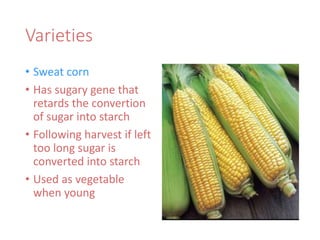
• Sweat corn
• Has sugary gene that
retards the convertion
of sugar into starch
• Following harvest if left
too long sugar is
converted into starch
• Used as vegetable
when young
Varieties
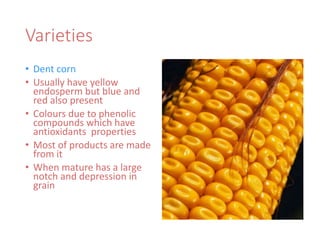
• Dent corn
• Usually have yellow
endosperm but blue and
red also present
• Colours due to phenolic
compounds which have
antioxidants properties
• Most of products are made
from it
• When mature has a large
notch and depression in
grain
Varieties
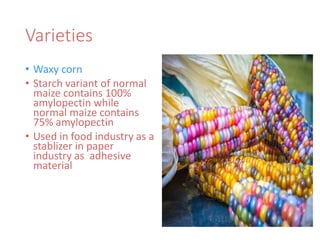
• Waxy corn
• Starch variant of normal
maize contains 100%
amylopectin while
normal maize contains
75% amylopectin
• Used in food industry as a
stablizer in paper
industry as adhesive
material
Varieties
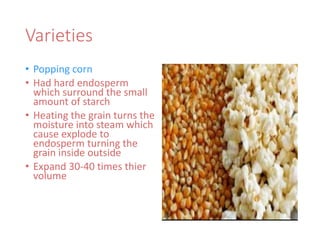
• Popping corn
• Had hard endosperm
which surround the small
amount of starch
• Heating the grain turns the
moisture into steam which
cause explode to
endosperm turning the
grain inside outside
• Expand 30-40 times thier
volume
Varieties
• Flour corn
• Endosperm is made up
of soft starch with thin
pericarp
• Crusty corn
• Hard endosperm with
smooth hard seed coat
• Yellow crusty corn has
more protein and beta
carotene
• Vitamin A is in more
amount
Nutritional attributes
• Palatable and suitable for livestock
• High starch contents about 65% 4% oil and low fiber
content 10% NDF
• Less readily fermentable than cereal starches
• Protein in maize are mainly zein and glutelin present in
endosperm and germ respectively
• Zein most important is deficient in lysine and tryptophan
so amino acid supplement are needed
• Opaque or floura-2 have been designed to have better
amino acid profile
Nutritional attributes
• Maize is low in Ca and P and supplement are
required
• Yellow maize has a higher vitamin A content than
white maize
• Vitamin A deficiency little importance in ruminants
but it has deleterious effects in pig and poultry
• Yellow maize is best for monogastrics
Nutritional profile
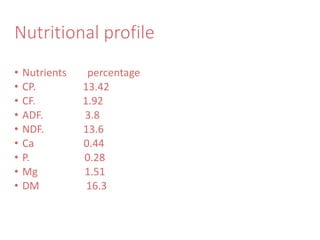
• Nutrients percentage
• CP. 13.42
• CF. 1.92
• ADF. 3.8
• NDF. 13.6
• Ca 0.44
• P. 0.28
• Mg 1.51
• DM 16.3
Inclusion level in different animals
species
• In ruminants
• A valued energy source
• Support high milk because of its high starch contents
• Promote rumen bacterial growth and enhancing
forage digestibility, rumen cycling and subsequent
feed intake
• Slowly degrading starch and help in glucose
absorption in small intestine
Inclusion level
• Less proteins in it
• Used with low quality forages(hay) and high quality
forages for protein source(soyabean meal)
• Concentrate,highly digestible and more palatable
• Improve milk yield and milk protein
Inclusion level
In poultry
• Appreciated for its highly digestible starch, low fiber
and relatively high oil content
• High metabolizable energy values
• Feed at high level in broiler and laying hens
• Maize oil is a good source of polyunsaturated fatty
acid (linoleic acid)
• In poultry white and yellow maize has same nutritive
value
• Yellow maize contains more carotene and
cryptoxanthine which are beneficial to yolk
pigmentation
Inclusion level
• Birds are attracted to yellow colour
• Maize can be ground ,medium size or fine for inclusion
in pelleted diet
• In hot calimate ,maize is replaced by less expensive
diet
• Barley can totally relplace maize in broiler diet
otherwise sorghum grain and broken rice could be
used
• Inclusion level is 750g per kg of diet
Inclusion level
In fishes
• Ground to make meal or pellet
• Digestible energy of maize meal is rather low for
rainbow trout while it is high for carp
• Digestible energy can be increased by gelatinization
of maize starch
• Increased performance of rainbow trout
Antinutritional factors
• Acidosis
• Feeding ruminants with high starch feed may cause
acidosis
• Fermentation of large amount of starch in the rumen
lower the pH
• Causes rumen stasis ,a decrease in forage digestion
diarrhoea and dehydration
• Maize starch is not as readily fermentable as the starch
of other grains such as barley and wheat
• Less incidence of acidosis
Antinutritional factors
• Mycotoxins
• Maize is susceptible to various moulds producing
myotoxins
• Deleterious effects on animal health
• Grain quality must be assesed before feeding
livestock and test exist to measure myotoxins
Antinutritional factors
• Aflatoxins
• Produced by Aspergillus flavus which invade maize
when drought
• Reduce growth and feed efficiency
• Causes liver disorder and abortion
• Contaminate milk from cows fed on damaged maize
• Ochratoxin
• Occur when high moisture maize is infested by
aspergillus or penicillin
Antinutritional factors
• Causes renal disorder in pig and decrease growth
• Decrease egg shell quality and egg production in
poultry
• Adding ascorbic acid may alleviate toxicosis in
laying hens
• Fumonisins
• Are typical of maize and are produced by other
species of fusarium
Antinutritional factors
• Carcinogenic in pigs and human and causes
pulmonary oedema in pig
• In horses cause induce leukoencephalomalacia(lower
intake ,lameness oral and facial paralysis ,seizure and
eventual death
• Phytic acid
• Antinutritional factor in plant seeds
• Mak insoluble compounds with many minerals and
reduce availability
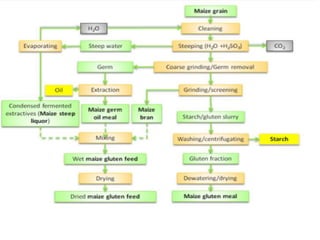
Corn gluten
• Corn gluten meal is obtained whenever maize is
used for starch extraction
• Obtained as by product during wet milling process
• Corn gluten meal is protein rich containing about
65% crude protein
• Also used as energy and pigment for livestock
species including fishes
Corn gluten
• Corn gluten should not be mistaken with corn
gluten feed which contain 22% protein rather than
65%
• In USA and corn gluten meal is used as fertilizer and
weed killer
• Price per kg
• Rs 50 per kg
• Yield
• Average yield in the world is 3.6t/ha highest yield is
7-10t/ha

Corn grains

  • 1.
  • 2.
    Topics under discussion •Introduction • Nutritional profile • Production/yeild • Inclusion level in different animal species • Last year production • Antinutritional factors • Price per kg
  • 3.
    Introduction • Popular foodthroughout world in different forms • Corn kernels are fruit of maize • One ear of corn contains roughly 800 kernels in 16 rows • Kernels of maize consist of pericarp fused to form seed coat ,this type of fruit in grasses are called a caryopsis • Maize kernels are frequently and incorrectly reffered as seed • Kernels are about the size of peas adhere in regular rows around a white pithy substance which form ears
  • 4.
    Varieties • Sweat corn •Has sugary gene that retards the convertion of sugar into starch • Following harvest if left too long sugar is converted into starch • Used as vegetable when young
  • 5.
    Varieties • Dent corn •Usually have yellow endosperm but blue and red also present • Colours due to phenolic compounds which have antioxidants properties • Most of products are made from it • When mature has a large notch and depression in grain
  • 6.
    Varieties • Waxy corn •Starch variant of normal maize contains 100% amylopectin while normal maize contains 75% amylopectin • Used in food industry as a stablizer in paper industry as adhesive material
  • 7.
    Varieties • Popping corn •Had hard endosperm which surround the small amount of starch • Heating the grain turns the moisture into steam which cause explode to endosperm turning the grain inside outside • Expand 30-40 times thier volume
  • 8.
    Varieties • Flour corn •Endosperm is made up of soft starch with thin pericarp • Crusty corn • Hard endosperm with smooth hard seed coat • Yellow crusty corn has more protein and beta carotene • Vitamin A is in more amount
  • 9.
    Nutritional attributes • Palatableand suitable for livestock • High starch contents about 65% 4% oil and low fiber content 10% NDF • Less readily fermentable than cereal starches • Protein in maize are mainly zein and glutelin present in endosperm and germ respectively • Zein most important is deficient in lysine and tryptophan so amino acid supplement are needed • Opaque or floura-2 have been designed to have better amino acid profile
  • 10.
    Nutritional attributes • Maizeis low in Ca and P and supplement are required • Yellow maize has a higher vitamin A content than white maize • Vitamin A deficiency little importance in ruminants but it has deleterious effects in pig and poultry • Yellow maize is best for monogastrics
  • 11.
    Nutritional profile • Nutrientspercentage • CP. 13.42 • CF. 1.92 • ADF. 3.8 • NDF. 13.6 • Ca 0.44 • P. 0.28 • Mg 1.51 • DM 16.3
  • 12.
    Inclusion level indifferent animals species • In ruminants • A valued energy source • Support high milk because of its high starch contents • Promote rumen bacterial growth and enhancing forage digestibility, rumen cycling and subsequent feed intake • Slowly degrading starch and help in glucose absorption in small intestine
  • 13.
    Inclusion level • Lessproteins in it • Used with low quality forages(hay) and high quality forages for protein source(soyabean meal) • Concentrate,highly digestible and more palatable • Improve milk yield and milk protein
  • 14.
    Inclusion level In poultry •Appreciated for its highly digestible starch, low fiber and relatively high oil content • High metabolizable energy values • Feed at high level in broiler and laying hens • Maize oil is a good source of polyunsaturated fatty acid (linoleic acid) • In poultry white and yellow maize has same nutritive value • Yellow maize contains more carotene and cryptoxanthine which are beneficial to yolk pigmentation
  • 15.
    Inclusion level • Birdsare attracted to yellow colour • Maize can be ground ,medium size or fine for inclusion in pelleted diet • In hot calimate ,maize is replaced by less expensive diet • Barley can totally relplace maize in broiler diet otherwise sorghum grain and broken rice could be used • Inclusion level is 750g per kg of diet
  • 16.
    Inclusion level In fishes •Ground to make meal or pellet • Digestible energy of maize meal is rather low for rainbow trout while it is high for carp • Digestible energy can be increased by gelatinization of maize starch • Increased performance of rainbow trout
  • 17.
    Antinutritional factors • Acidosis •Feeding ruminants with high starch feed may cause acidosis • Fermentation of large amount of starch in the rumen lower the pH • Causes rumen stasis ,a decrease in forage digestion diarrhoea and dehydration • Maize starch is not as readily fermentable as the starch of other grains such as barley and wheat • Less incidence of acidosis
  • 18.
    Antinutritional factors • Mycotoxins •Maize is susceptible to various moulds producing myotoxins • Deleterious effects on animal health • Grain quality must be assesed before feeding livestock and test exist to measure myotoxins
  • 19.
    Antinutritional factors • Aflatoxins •Produced by Aspergillus flavus which invade maize when drought • Reduce growth and feed efficiency • Causes liver disorder and abortion • Contaminate milk from cows fed on damaged maize • Ochratoxin • Occur when high moisture maize is infested by aspergillus or penicillin
  • 20.
    Antinutritional factors • Causesrenal disorder in pig and decrease growth • Decrease egg shell quality and egg production in poultry • Adding ascorbic acid may alleviate toxicosis in laying hens • Fumonisins • Are typical of maize and are produced by other species of fusarium
  • 21.
    Antinutritional factors • Carcinogenicin pigs and human and causes pulmonary oedema in pig • In horses cause induce leukoencephalomalacia(lower intake ,lameness oral and facial paralysis ,seizure and eventual death • Phytic acid • Antinutritional factor in plant seeds • Mak insoluble compounds with many minerals and reduce availability
  • 22.
    Corn gluten • Corngluten meal is obtained whenever maize is used for starch extraction • Obtained as by product during wet milling process • Corn gluten meal is protein rich containing about 65% crude protein • Also used as energy and pigment for livestock species including fishes
  • 23.
    Corn gluten • Corngluten should not be mistaken with corn gluten feed which contain 22% protein rather than 65% • In USA and corn gluten meal is used as fertilizer and weed killer
  • 25.
    • Price perkg • Rs 50 per kg • Yield • Average yield in the world is 3.6t/ha highest yield is 7-10t/ha