Int. Journal of Engineering Research and Applications www.ijera.com 
ISSN : 2248-9622, Vol. 4, Issue 8( Version 3), August 2014, pp.98-105 
www.ijera.com 98 | P a g e 
Control the Stability and Steady State When the Elevator Reached the Requested Level (PLC (LOGO) Control for4-level elevator system) Abstract This paper presenta project on design and implementation of a PLC-based controller for a 4-level elevator Feedback system. The PLC used is a Siemens with 24 inputs and 16 outputs. The design incorporates an intelligent controller that solving the stability and balance, based on algorithm and PID software solution. Some farthersuggestions on how to extend the program for control the system are offered. Keywords: Elevator control; PLC control; Siemens LOGO; Feedback elevator system. 
I. Introduction 
Many industrialproducts and systems including elevator systemsare nowadays controlledby (PLCs) programmable logic controllers.Due to PLCs reliability and efficiency the industriesare reliance on implementing these PLCs in their systems. This paperdiscusseda design and implementation forfour- level elevator system controlled by a small PLC. The PLC may be considered as a special-purpose computer with a basic architecturesimilar to that of any other known computer such as a central processing unit(CPU). It is based on a memory and a number of input and output terminals. Theladder diagram is one choice of special programming language softwaremethodsthat could be used for a running the PLC system. The ladder diagram is an easy software programming language since it is based on Boolean logic functions. This makes the task of modifying any systemmuch easier and more cost- effective. 
The size of the PLC is one of the factors that should be consideredwhen it is selected to control a process or a machine. PLCs come in a variety of sizes anddifferent capabilities; the sizes range from small controllers with limited inputs andoutputs used for controlling small processes, to very large ones with more inputsand outputs provided which are used to control much larger processes and operations.The required number of inputs and outputs could identify based on analysing the process or operation to be controlled.The PLC has many advantages over other control systems. It is known for its flexibility,lower cost, operational speed, reliability, ease of programming, security, andit is easy in implementing changes and correcting errors (Warnock,1988;Webb,19898) . Elevator control systems are one of the PLCs applications. A simulation of such control was successfullytested in a diploma-project control course in the Electrical Power Departmentat Kuwait High Institute of Power, where anSiemens…..-input and ….-outputLOGO PLC was used. This paper presentsboth the hardware and software aspects of the successful design and operationof this PLC-based controller. 
II. Objectives of the project 
The objective of the project is to design and implementa 4-level elevatorsystem control by a Siemens LOGO (PLC) Programmable Logic Controller and to solve the problem of the stability and the steady state when the elevator reached the needed level. The design waslimited to 4-levels due to the design of the system provided by the Feedback elevator; more details on this will begiven in the section ‘Software design’.Some suggestions are given later as to how to expand the elevatorsystem to more than oneelevator. 
III. Hardware design 
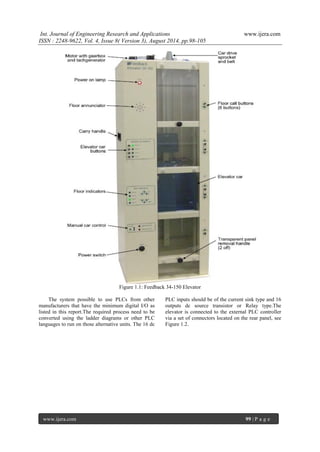
The Elevator is dispatched from the factory with the counter balance weight for the car, at the rear panel an IEC mains input connector is provided that will require a suitable power lead for the available supply outlet. Using the LOGO-PLC Siemens with modules (………) with Feedback 34-150 Elevator see Figure 1.1 included an advanced application. 
RESEARCH ARTICLE OPEN ACCESS
Int. Journal of Engineering Research and Applications www.ijera.com 
ISSN : 2248-9622, Vol. 4, Issue 8( Version 3), August 2014, pp.98-105 
www.ijera.com 99 | P a g e 
Figure 1.1: Feedback 34-150 Elevator 
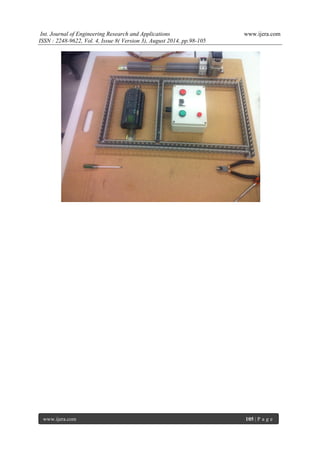
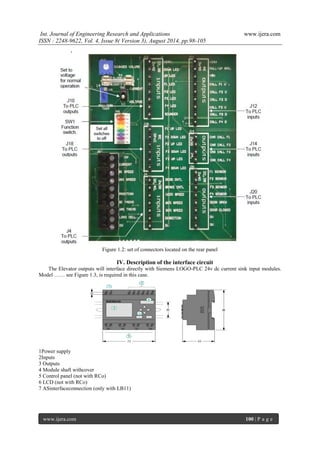
The system possible to use PLCs from other manufacturers that have the minimum digital I/O as listed in this report.The required process need to be converted using the ladder diagrams or other PLC languages to run on those alternative units. The 16 dc PLC inputs should be of the current sink type and 16 outputs dc source transistor or Relay type.The elevator is connected to the external PLC controller via a set of connectors located on the rear panel, see Figure 1.2.
Int. Journal of Engineering Research and Applications www.ijera.com 
ISSN : 2248-9622, Vol. 4, Issue 8( Version 3), August 2014, pp.98-105 
www.ijera.com 100 | P a g e 
Figure 1.2: set of connectors located on the rear panel 
IV. Description of the interface circuit 
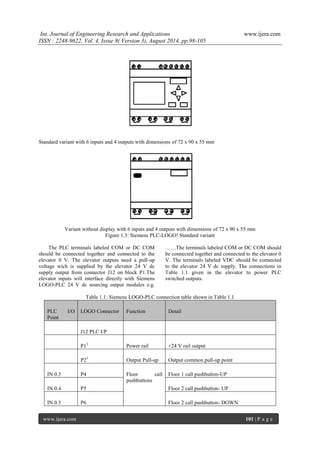
The Elevator outputs will interface directly with Siemens LOGO-PLC 24v dc current sink input modules. Model …… see Figure 1.3, is required in this case. 
1Power supply 2Inputs 3 Outputs 4 Module shaft withcover 5 Control panel (not with RCo) 6 LCD (not with RCo) 7 ASinterfaceconnection (only with LB11)
Int. Journal of Engineering Research and Applications www.ijera.com 
ISSN : 2248-9622, Vol. 4, Issue 8( Version 3), August 2014, pp.98-105 
www.ijera.com 101 | P a g e 
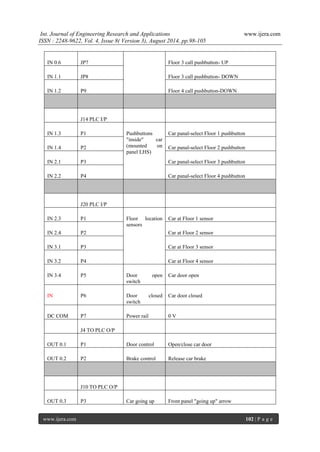
Standard variant with 6 inputs and 4 outputs with dimensions of 72 x 90 x 55 mm 
Variant without display with 6 inputs and 4 outputs with dimensions of 72 x 90 x 55 mm Figure 1.3: Siemens PLC-LOGO! Standard variant 
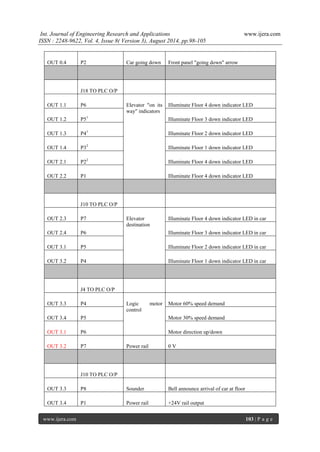
The PLC terminals labeled COM or DC COM should be connected together and connected to the elevator 0 V. The elevator outputs need a pull-up voltage wich is supplied by the elevator 24 V dc supply output from connector J12 on block P1.The elevator inputs will interface directly with Siemens LOGO-PLC 24 V dc sourcing output modules e.g. ……The terminals labeled COM or DC COM should be connected together and connected to the elevator 0 V. The terminals labeled VDC should be connected to the elevator 24 V dc supply. The connections in Table 1.1 given in the elevator to power PLC switched outputs. Table 1.1: Siemens LOGO-PLC connection table shown in Table 1.1 PLC I/O Point LOGO Connector Function Detail 
J12 PLC I/P 
P13 
Power rail 
+24 V rail output 
P23 
Output Pull-up 
Output common pull-up point 
IN 0.3 
P4 
Floor call pushbuttons 
Floor 1 call pushbutton-UP 
IN 0.4 
P5 
Floor 2 call pushbutton- UP 
IN 0.5 
P6 
Floor 2 call pushbutton- DOWN
Int. Journal of Engineering Research and Applications www.ijera.com 
ISSN : 2248-9622, Vol. 4, Issue 8( Version 3), August 2014, pp.98-105 
www.ijera.com 102 | P a g e 
IN 0.6 
JP7 
Floor 3 call pushbutton- UP 
IN 1.1 
JP8 
Floor 3 call pushbutton- DOWN 
IN 1.2 
P9 
Floor 4 call pushbutton-DOWN 
J14 PLC I/P 
IN 1.3 
P1 
Pushbuttons "inside" car (mounted on panel LHS) 
Car panal-select Floor 1 pushbutton 
IN 1.4 
P2 
Car panal-select Floor 2 pushbutton 
IN 2.1 
P3 
Car panal-select Floor 3 pushbutton 
IN 2.2 
P4 
Car panal-select Floor 4 pushbutton 
J20 PLC I/P 
IN 2.3 
P1 
Floor location sensors 
Car at Floor 1 sensor 
IN 2.4 
P2 
Car at Floor 2 sensor 
IN 3.1 
P3 
Car at Floor 3 sensor 
IN 3.2 
P4 
Car at Floor 4 sensor 
IN 3.4 
P5 
Door open switch 
Car door open 
IN 
P6 
Door closed switch 
Car door closed 
DC COM 
P7 
Power rail 
0 V 
J4 TO PLC O/P 
OUT 0.1 
P1 
Door control 
Open/close car door 
OUT 0.2 
P2 
Brake control 
Release car brake 
J10 TO PLC O/P 
OUT 0.3 
P3 
Car going up 
Front panel "going up" arrow
Int. Journal of Engineering Research and Applications www.ijera.com 
ISSN : 2248-9622, Vol. 4, Issue 8( Version 3), August 2014, pp.98-105 
www.ijera.com 103 | P a g e 
OUT 0.4 
P2 
Car going down 
Front panel "going down" arrow 
J18 TO PLC O/P 
OUT 1.1 
P6 
Elevator "on its way" indicators 
Illuminate Floor 4 down indicator LED 
OUT 1.2 
P51 
Illuminate Floor 3 down indicator LED 
OUT 1.3 
P41 
Illuminate Floor 2 down indicator LED 
OUT 1.4 
P32 
Illuminate Floor 1 down indicator LED 
OUT 2.1 
P22 
Illuminate Floor 4 down indicator LED 
OUT 2.2 
P1 
Illuminate Floor 4 down indicator LED 
J10 TO PLC O/P 
OUT 2.3 
P7 
Elevator destination 
Illuminate Floor 4 down indicator LED in car 
OUT 2.4 
P6 
Illuminate Floor 3 down indicator LED in car 
OUT 3.1 
P5 
Illuminate Floor 2 down indicator LED in car 
OUT 3.2 
P4 
Illuminate Floor 1 down indicator LED in car 
J4 TO PLC O/P 
OUT 3.3 
P4 
Logic motor control 
Motor 60% speed demand 
OUT 3.4 
P5 
Motor 30% speed demand 
OUT 3.1 
P6 
Motor direction up/down 
OUT 3.2 
P7 
Power rail 
0 V 
J10 TO PLC O/P 
OUT 3.3 
P8 
Sounder 
Bell announce arrival of car at floor 
OUT 3.4 
P1 
Power rail 
+24V rail output
Int. Journal of Engineering Research and Applications www.ijera.com 
ISSN : 2248-9622, Vol. 4, Issue 8( Version 3), August 2014, pp.98-105 
www.ijera.com 104 | P a g e 
Notes: P31,P42 etc. refers to 1,2 etc. 1. Link together to common Floor 3 indicator LEDs. 2.Link together to common Floor 2 indicator LEDs. 3. Link together to connect the elevator output pull- up rail to the +24 V supply terminal on the elevator. 
V. Software design 
The elevator system may run in different control modes, In order to achieve the complete design, all possible transitions and stages the elevator system has to go through were considered and a complete flowchart was drawn for this. Description of the operation of the elevator 
VI. Expanding the projects 
The researcher could starting with progress to more complex control involving the elevator speed control, car direction and floor arrival and departure management. In addition to that achieve more advanced programming sequence involving two or more elevators working in sequence. 
VII. Conclusion 
In this paper, the successful design and implementation of the smart controlof a 4-level elevator system using only a Siemens PLC-LOGO was discussed. Thedesign includes a program forsolving the steady state/stability for elevator. Some suggestionsas to how to expand the design to handle a larger number of PLCs werealso given. Finally, it is hoped that this work has explain and demonstrated the using of PLC-LOGO, totacklesome industrial control system operations in a smart and clever way. References 
[1] 3 I. Warnock, Programmable Controllers (Prentice Hall, Englewood Cliffs, 1988). 
[2] 4 J. W. Webb, Programmable Logic Controllers: Principles and Applications (Macmillan, New York, 1988).
Int. Journal of Engineering Research and Applications www.ijera.com 
ISSN : 2248-9622, Vol. 4, Issue 8( Version 3), August 2014, pp.98-105 
www.ijera.com 105 | P a g e

Control the Stability and Steady State When the Elevator Reached the Requested Level (PLC (LOGO) Control for4-level elevator system)

  • 1.
    Int. Journal ofEngineering Research and Applications www.ijera.com ISSN : 2248-9622, Vol. 4, Issue 8( Version 3), August 2014, pp.98-105 www.ijera.com 98 | P a g e Control the Stability and Steady State When the Elevator Reached the Requested Level (PLC (LOGO) Control for4-level elevator system) Abstract This paper presenta project on design and implementation of a PLC-based controller for a 4-level elevator Feedback system. The PLC used is a Siemens with 24 inputs and 16 outputs. The design incorporates an intelligent controller that solving the stability and balance, based on algorithm and PID software solution. Some farthersuggestions on how to extend the program for control the system are offered. Keywords: Elevator control; PLC control; Siemens LOGO; Feedback elevator system. I. Introduction Many industrialproducts and systems including elevator systemsare nowadays controlledby (PLCs) programmable logic controllers.Due to PLCs reliability and efficiency the industriesare reliance on implementing these PLCs in their systems. This paperdiscusseda design and implementation forfour- level elevator system controlled by a small PLC. The PLC may be considered as a special-purpose computer with a basic architecturesimilar to that of any other known computer such as a central processing unit(CPU). It is based on a memory and a number of input and output terminals. Theladder diagram is one choice of special programming language softwaremethodsthat could be used for a running the PLC system. The ladder diagram is an easy software programming language since it is based on Boolean logic functions. This makes the task of modifying any systemmuch easier and more cost- effective. The size of the PLC is one of the factors that should be consideredwhen it is selected to control a process or a machine. PLCs come in a variety of sizes anddifferent capabilities; the sizes range from small controllers with limited inputs andoutputs used for controlling small processes, to very large ones with more inputsand outputs provided which are used to control much larger processes and operations.The required number of inputs and outputs could identify based on analysing the process or operation to be controlled.The PLC has many advantages over other control systems. It is known for its flexibility,lower cost, operational speed, reliability, ease of programming, security, andit is easy in implementing changes and correcting errors (Warnock,1988;Webb,19898) . Elevator control systems are one of the PLCs applications. A simulation of such control was successfullytested in a diploma-project control course in the Electrical Power Departmentat Kuwait High Institute of Power, where anSiemens…..-input and ….-outputLOGO PLC was used. This paper presentsboth the hardware and software aspects of the successful design and operationof this PLC-based controller. II. Objectives of the project The objective of the project is to design and implementa 4-level elevatorsystem control by a Siemens LOGO (PLC) Programmable Logic Controller and to solve the problem of the stability and the steady state when the elevator reached the needed level. The design waslimited to 4-levels due to the design of the system provided by the Feedback elevator; more details on this will begiven in the section ‘Software design’.Some suggestions are given later as to how to expand the elevatorsystem to more than oneelevator. III. Hardware design The Elevator is dispatched from the factory with the counter balance weight for the car, at the rear panel an IEC mains input connector is provided that will require a suitable power lead for the available supply outlet. Using the LOGO-PLC Siemens with modules (………) with Feedback 34-150 Elevator see Figure 1.1 included an advanced application. RESEARCH ARTICLE OPEN ACCESS
  • 2.
    Int. Journal ofEngineering Research and Applications www.ijera.com ISSN : 2248-9622, Vol. 4, Issue 8( Version 3), August 2014, pp.98-105 www.ijera.com 99 | P a g e Figure 1.1: Feedback 34-150 Elevator The system possible to use PLCs from other manufacturers that have the minimum digital I/O as listed in this report.The required process need to be converted using the ladder diagrams or other PLC languages to run on those alternative units. The 16 dc PLC inputs should be of the current sink type and 16 outputs dc source transistor or Relay type.The elevator is connected to the external PLC controller via a set of connectors located on the rear panel, see Figure 1.2.
  • 3.
    Int. Journal ofEngineering Research and Applications www.ijera.com ISSN : 2248-9622, Vol. 4, Issue 8( Version 3), August 2014, pp.98-105 www.ijera.com 100 | P a g e Figure 1.2: set of connectors located on the rear panel IV. Description of the interface circuit The Elevator outputs will interface directly with Siemens LOGO-PLC 24v dc current sink input modules. Model …… see Figure 1.3, is required in this case. 1Power supply 2Inputs 3 Outputs 4 Module shaft withcover 5 Control panel (not with RCo) 6 LCD (not with RCo) 7 ASinterfaceconnection (only with LB11)
  • 4.
    Int. Journal ofEngineering Research and Applications www.ijera.com ISSN : 2248-9622, Vol. 4, Issue 8( Version 3), August 2014, pp.98-105 www.ijera.com 101 | P a g e Standard variant with 6 inputs and 4 outputs with dimensions of 72 x 90 x 55 mm Variant without display with 6 inputs and 4 outputs with dimensions of 72 x 90 x 55 mm Figure 1.3: Siemens PLC-LOGO! Standard variant The PLC terminals labeled COM or DC COM should be connected together and connected to the elevator 0 V. The elevator outputs need a pull-up voltage wich is supplied by the elevator 24 V dc supply output from connector J12 on block P1.The elevator inputs will interface directly with Siemens LOGO-PLC 24 V dc sourcing output modules e.g. ……The terminals labeled COM or DC COM should be connected together and connected to the elevator 0 V. The terminals labeled VDC should be connected to the elevator 24 V dc supply. The connections in Table 1.1 given in the elevator to power PLC switched outputs. Table 1.1: Siemens LOGO-PLC connection table shown in Table 1.1 PLC I/O Point LOGO Connector Function Detail J12 PLC I/P P13 Power rail +24 V rail output P23 Output Pull-up Output common pull-up point IN 0.3 P4 Floor call pushbuttons Floor 1 call pushbutton-UP IN 0.4 P5 Floor 2 call pushbutton- UP IN 0.5 P6 Floor 2 call pushbutton- DOWN
  • 5.
    Int. Journal ofEngineering Research and Applications www.ijera.com ISSN : 2248-9622, Vol. 4, Issue 8( Version 3), August 2014, pp.98-105 www.ijera.com 102 | P a g e IN 0.6 JP7 Floor 3 call pushbutton- UP IN 1.1 JP8 Floor 3 call pushbutton- DOWN IN 1.2 P9 Floor 4 call pushbutton-DOWN J14 PLC I/P IN 1.3 P1 Pushbuttons "inside" car (mounted on panel LHS) Car panal-select Floor 1 pushbutton IN 1.4 P2 Car panal-select Floor 2 pushbutton IN 2.1 P3 Car panal-select Floor 3 pushbutton IN 2.2 P4 Car panal-select Floor 4 pushbutton J20 PLC I/P IN 2.3 P1 Floor location sensors Car at Floor 1 sensor IN 2.4 P2 Car at Floor 2 sensor IN 3.1 P3 Car at Floor 3 sensor IN 3.2 P4 Car at Floor 4 sensor IN 3.4 P5 Door open switch Car door open IN P6 Door closed switch Car door closed DC COM P7 Power rail 0 V J4 TO PLC O/P OUT 0.1 P1 Door control Open/close car door OUT 0.2 P2 Brake control Release car brake J10 TO PLC O/P OUT 0.3 P3 Car going up Front panel "going up" arrow
  • 6.
    Int. Journal ofEngineering Research and Applications www.ijera.com ISSN : 2248-9622, Vol. 4, Issue 8( Version 3), August 2014, pp.98-105 www.ijera.com 103 | P a g e OUT 0.4 P2 Car going down Front panel "going down" arrow J18 TO PLC O/P OUT 1.1 P6 Elevator "on its way" indicators Illuminate Floor 4 down indicator LED OUT 1.2 P51 Illuminate Floor 3 down indicator LED OUT 1.3 P41 Illuminate Floor 2 down indicator LED OUT 1.4 P32 Illuminate Floor 1 down indicator LED OUT 2.1 P22 Illuminate Floor 4 down indicator LED OUT 2.2 P1 Illuminate Floor 4 down indicator LED J10 TO PLC O/P OUT 2.3 P7 Elevator destination Illuminate Floor 4 down indicator LED in car OUT 2.4 P6 Illuminate Floor 3 down indicator LED in car OUT 3.1 P5 Illuminate Floor 2 down indicator LED in car OUT 3.2 P4 Illuminate Floor 1 down indicator LED in car J4 TO PLC O/P OUT 3.3 P4 Logic motor control Motor 60% speed demand OUT 3.4 P5 Motor 30% speed demand OUT 3.1 P6 Motor direction up/down OUT 3.2 P7 Power rail 0 V J10 TO PLC O/P OUT 3.3 P8 Sounder Bell announce arrival of car at floor OUT 3.4 P1 Power rail +24V rail output
  • 7.
    Int. Journal ofEngineering Research and Applications www.ijera.com ISSN : 2248-9622, Vol. 4, Issue 8( Version 3), August 2014, pp.98-105 www.ijera.com 104 | P a g e Notes: P31,P42 etc. refers to 1,2 etc. 1. Link together to common Floor 3 indicator LEDs. 2.Link together to common Floor 2 indicator LEDs. 3. Link together to connect the elevator output pull- up rail to the +24 V supply terminal on the elevator. V. Software design The elevator system may run in different control modes, In order to achieve the complete design, all possible transitions and stages the elevator system has to go through were considered and a complete flowchart was drawn for this. Description of the operation of the elevator VI. Expanding the projects The researcher could starting with progress to more complex control involving the elevator speed control, car direction and floor arrival and departure management. In addition to that achieve more advanced programming sequence involving two or more elevators working in sequence. VII. Conclusion In this paper, the successful design and implementation of the smart controlof a 4-level elevator system using only a Siemens PLC-LOGO was discussed. Thedesign includes a program forsolving the steady state/stability for elevator. Some suggestionsas to how to expand the design to handle a larger number of PLCs werealso given. Finally, it is hoped that this work has explain and demonstrated the using of PLC-LOGO, totacklesome industrial control system operations in a smart and clever way. References [1] 3 I. Warnock, Programmable Controllers (Prentice Hall, Englewood Cliffs, 1988). [2] 4 J. W. Webb, Programmable Logic Controllers: Principles and Applications (Macmillan, New York, 1988).
  • 8.
    Int. Journal ofEngineering Research and Applications www.ijera.com ISSN : 2248-9622, Vol. 4, Issue 8( Version 3), August 2014, pp.98-105 www.ijera.com 105 | P a g e