Our digestive system
Food eaten gives energy
But I do think ,
Is their any magic that
converts food into energy,
Or something that crushes it.
I asked my teacher all this ,
So do you know what she told
me??-
Nutrition
Nutrition is the process by which all living organisms obtain and
use food.
The food that we consume cannot be utilized by our body as it is .
Our body breaks it down into simpler form so that it can be
utilized by our body. This work of digesting the food by breaking it
down into simpler form is done by our Digestive system.
The process of nutrition
occurs in five stages -
Ingestion
Digestion
Absorption
Assimilation
Egestion
• Ingestion-food is taken into
the mouth .
• Digestion – the complex food
taken in through the mouth is
broken down into a simpler
form by the actions of
enzymes.
• Absorption - The digested
food is absorbed into the
blood stream.
• Assimilation – The digested
food is utilized by the blood or
stored for future use.
• Egestoin-The undigested
insoluble part is excreted in
the form of faeces.
Digestive system
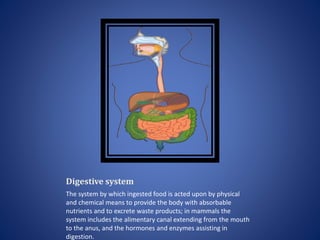
The system by which ingested food is acted upon by physical
and chemical means to provide the body with absorbable
nutrients and to excrete waste products; in mammals the
system includes the alimentary canal extending from the mouth
to the anus, and the hormones and enzymes assisting in
digestion.
There are mainly two parts in a
digestive system.
• Alimentary canal
It is a long tube like
muscular structure that
runs from the mouth to
the anus. It consists of
mouth, pharynx,
esophagus , stomach ,
small intestine, large
intestine, rectum and
anus.
• Digestive glands
The digestive system
associated with the
alimentary canal are the
salivary glands , liver and
pancreas.
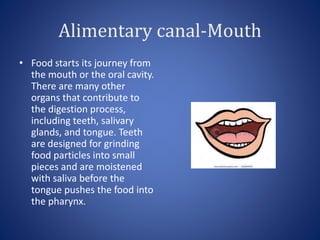
Alimentary canal-Mouth
• Food starts its journey from
the mouth or the oral cavity.
There are many other
organs that contribute to
the digestion process,
including teeth, salivary
glands, and tongue. Teeth
are designed for grinding
food particles into small
pieces and are moistened
with saliva before the
tongue pushes the food into
the pharynx.
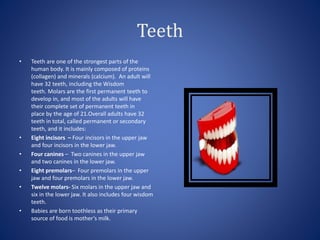
Teeth
• Teeth are one of the strongest parts of the
human body. It is mainly composed of proteins
(collagen) and minerals (calcium). An adult will
have 32 teeth, including the Wisdom
teeth. Molars are the first permanent teeth to
develop in, and most of the adults will have
their complete set of permanent teeth in
place by the age of 21.Overall adults have 32
teeth in total, called permanent or secondary
teeth, and it includes:
• Eight incisors – Four incisors in the upper jaw
and four incisors in the lower jaw.
• Four canines – Two canines in the upper jaw
and two canines in the lower jaw.
• Eight premolars– Four premolars in the upper
jaw and four premolars in the lower jaw.
• Twelve molars- Six molars in the upper jaw and
six in the lower jaw. It also includes four wisdom
teeth.
• Babies are born toothless as their primary
source of food is mother’s milk.
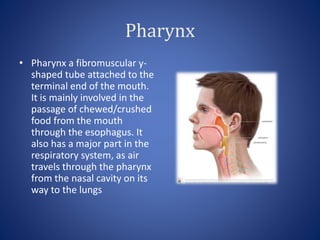
Pharynx
• Pharynx a fibromuscular y-
shaped tube attached to the
terminal end of the mouth.
It is mainly involved in the
passage of chewed/crushed
food from the mouth
through the esophagus. It
also has a major part in the
respiratory system, as air
travels through the pharynx
from the nasal cavity on its
way to the lungs
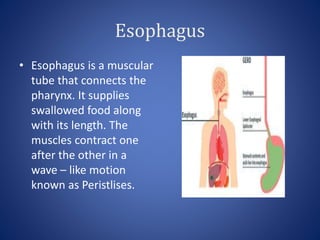
Esophagus
• Esophagus is a muscular
tube that connects the
pharynx. It supplies
swallowed food along
with its length. The
muscles contract one
after the other in a
wave – like motion
known as Peristlises.
Stomach
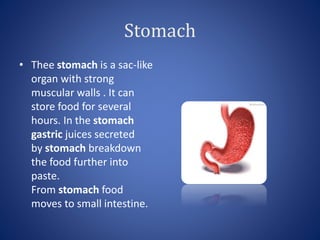
• Thee stomach is a sac-like
organ with strong
muscular walls . It can
store food for several
hours. In the stomach
gastric juices secreted
by stomach breakdown
the food further into
paste.
From stomach food
moves to small intestine.
Small Intestines
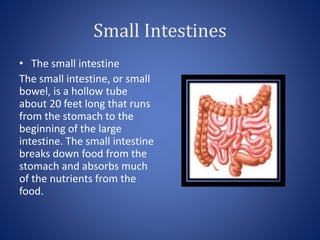
• The small intestine
The small intestine, or small
bowel, is a hollow tube
about 20 feet long that runs
from the stomach to the
beginning of the large
intestine. The small intestine
breaks down food from the
stomach and absorbs much
of the nutrients from the
food.
Large intestine
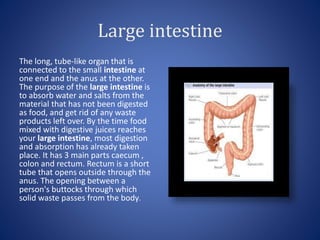
The long, tube-like organ that is
connected to the small intestine at
one end and the anus at the other.
The purpose of the large intestine is
to absorb water and salts from the
material that has not been digested
as food, and get rid of any waste
products left over. By the time food
mixed with digestive juices reaches
your large intestine, most digestion
and absorption has already taken
place. It has 3 main parts caecum ,
colon and rectum. Rectum is a short
tube that opens outside through the
anus. The opening between a
person's buttocks through which
solid waste passes from the body.
Digestive glands- Salivary glands
There are three types of salivary
glands that open in our mouth.
Saliva helps with swallowing and
chewing. It can also help prevent
infections from developing in your
mouth or throat.
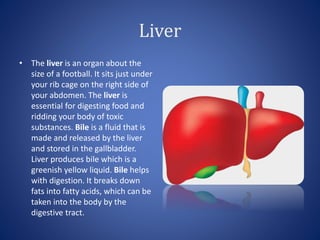
Liver
• The liver is an organ about the
size of a football. It sits just under
your rib cage on the right side of
your abdomen. The liver is
essential for digesting food and
ridding your body of toxic
substances. Bile is a fluid that is
made and released by the liver
and stored in the gallbladder.
Liver produces bile which is a
greenish yellow liquid. Bile helps
with digestion. It breaks down
fats into fatty acids, which can be
taken into the body by the
digestive tract.
Pancreas
The pancreas makes panc
reatic juices and
hormones. The pancreatic
juices contain enzymes
that help digest food in
the small intestine

Our digestive system

  • 1.
    Our digestive system Foodeaten gives energy But I do think , Is their any magic that converts food into energy, Or something that crushes it. I asked my teacher all this , So do you know what she told me??-
  • 2.
    Nutrition Nutrition is theprocess by which all living organisms obtain and use food. The food that we consume cannot be utilized by our body as it is . Our body breaks it down into simpler form so that it can be utilized by our body. This work of digesting the food by breaking it down into simpler form is done by our Digestive system.
  • 3.
    The process ofnutrition occurs in five stages - Ingestion Digestion Absorption Assimilation Egestion • Ingestion-food is taken into the mouth . • Digestion – the complex food taken in through the mouth is broken down into a simpler form by the actions of enzymes. • Absorption - The digested food is absorbed into the blood stream. • Assimilation – The digested food is utilized by the blood or stored for future use. • Egestoin-The undigested insoluble part is excreted in the form of faeces.
  • 4.
    Digestive system The systemby which ingested food is acted upon by physical and chemical means to provide the body with absorbable nutrients and to excrete waste products; in mammals the system includes the alimentary canal extending from the mouth to the anus, and the hormones and enzymes assisting in digestion.
  • 5.
    There are mainlytwo parts in a digestive system. • Alimentary canal It is a long tube like muscular structure that runs from the mouth to the anus. It consists of mouth, pharynx, esophagus , stomach , small intestine, large intestine, rectum and anus. • Digestive glands The digestive system associated with the alimentary canal are the salivary glands , liver and pancreas.
  • 6.
    Alimentary canal-Mouth • Foodstarts its journey from the mouth or the oral cavity. There are many other organs that contribute to the digestion process, including teeth, salivary glands, and tongue. Teeth are designed for grinding food particles into small pieces and are moistened with saliva before the tongue pushes the food into the pharynx.
  • 7.
    Teeth • Teeth areone of the strongest parts of the human body. It is mainly composed of proteins (collagen) and minerals (calcium). An adult will have 32 teeth, including the Wisdom teeth. Molars are the first permanent teeth to develop in, and most of the adults will have their complete set of permanent teeth in place by the age of 21.Overall adults have 32 teeth in total, called permanent or secondary teeth, and it includes: • Eight incisors – Four incisors in the upper jaw and four incisors in the lower jaw. • Four canines – Two canines in the upper jaw and two canines in the lower jaw. • Eight premolars– Four premolars in the upper jaw and four premolars in the lower jaw. • Twelve molars- Six molars in the upper jaw and six in the lower jaw. It also includes four wisdom teeth. • Babies are born toothless as their primary source of food is mother’s milk.
  • 8.
    Pharynx • Pharynx afibromuscular y- shaped tube attached to the terminal end of the mouth. It is mainly involved in the passage of chewed/crushed food from the mouth through the esophagus. It also has a major part in the respiratory system, as air travels through the pharynx from the nasal cavity on its way to the lungs
  • 9.
    Esophagus • Esophagus isa muscular tube that connects the pharynx. It supplies swallowed food along with its length. The muscles contract one after the other in a wave – like motion known as Peristlises.
  • 10.
    Stomach • Thee stomachis a sac-like organ with strong muscular walls . It can store food for several hours. In the stomach gastric juices secreted by stomach breakdown the food further into paste. From stomach food moves to small intestine.
  • 11.
    Small Intestines • Thesmall intestine The small intestine, or small bowel, is a hollow tube about 20 feet long that runs from the stomach to the beginning of the large intestine. The small intestine breaks down food from the stomach and absorbs much of the nutrients from the food.
  • 12.
    Large intestine The long,tube-like organ that is connected to the small intestine at one end and the anus at the other. The purpose of the large intestine is to absorb water and salts from the material that has not been digested as food, and get rid of any waste products left over. By the time food mixed with digestive juices reaches your large intestine, most digestion and absorption has already taken place. It has 3 main parts caecum , colon and rectum. Rectum is a short tube that opens outside through the anus. The opening between a person's buttocks through which solid waste passes from the body.
  • 13.
    Digestive glands- Salivaryglands There are three types of salivary glands that open in our mouth. Saliva helps with swallowing and chewing. It can also help prevent infections from developing in your mouth or throat.
  • 14.
    Liver • The liveris an organ about the size of a football. It sits just under your rib cage on the right side of your abdomen. The liver is essential for digesting food and ridding your body of toxic substances. Bile is a fluid that is made and released by the liver and stored in the gallbladder. Liver produces bile which is a greenish yellow liquid. Bile helps with digestion. It breaks down fats into fatty acids, which can be taken into the body by the digestive tract.
  • 15.
    Pancreas The pancreas makespanc reatic juices and hormones. The pancreatic juices contain enzymes that help digest food in the small intestine