© 2017 National University of Singapore. All Rights Reserved
#ISSlearn
© 2017 National University of Singapore. All Rights Reserved
FUTURE SKILLS FOR PROJECT
MANAGERS
DIGITAL CAPABILITY NEEDED, DEADLINE
YESTERDAY!
11 August / TAN LIONG CHOON
1
© 2017 National University of Singapore. All Rights Reserved#ISSlearn © 2017 National University of Singapore. All Rights Reserved 2
© 2017 National University of Singapore. All Rights Reserved#ISSlearn © 2017 National University of Singapore. All Rights Reserved
OUTLINE
• The Changing Business & IT Landscape
• Future of Project Management & Skills to
meet the Challenges of the Future
3
© 2017 National University of Singapore. All Rights Reserved#ISSlearn © 2017 National University of Singapore. All Rights Reserved 4
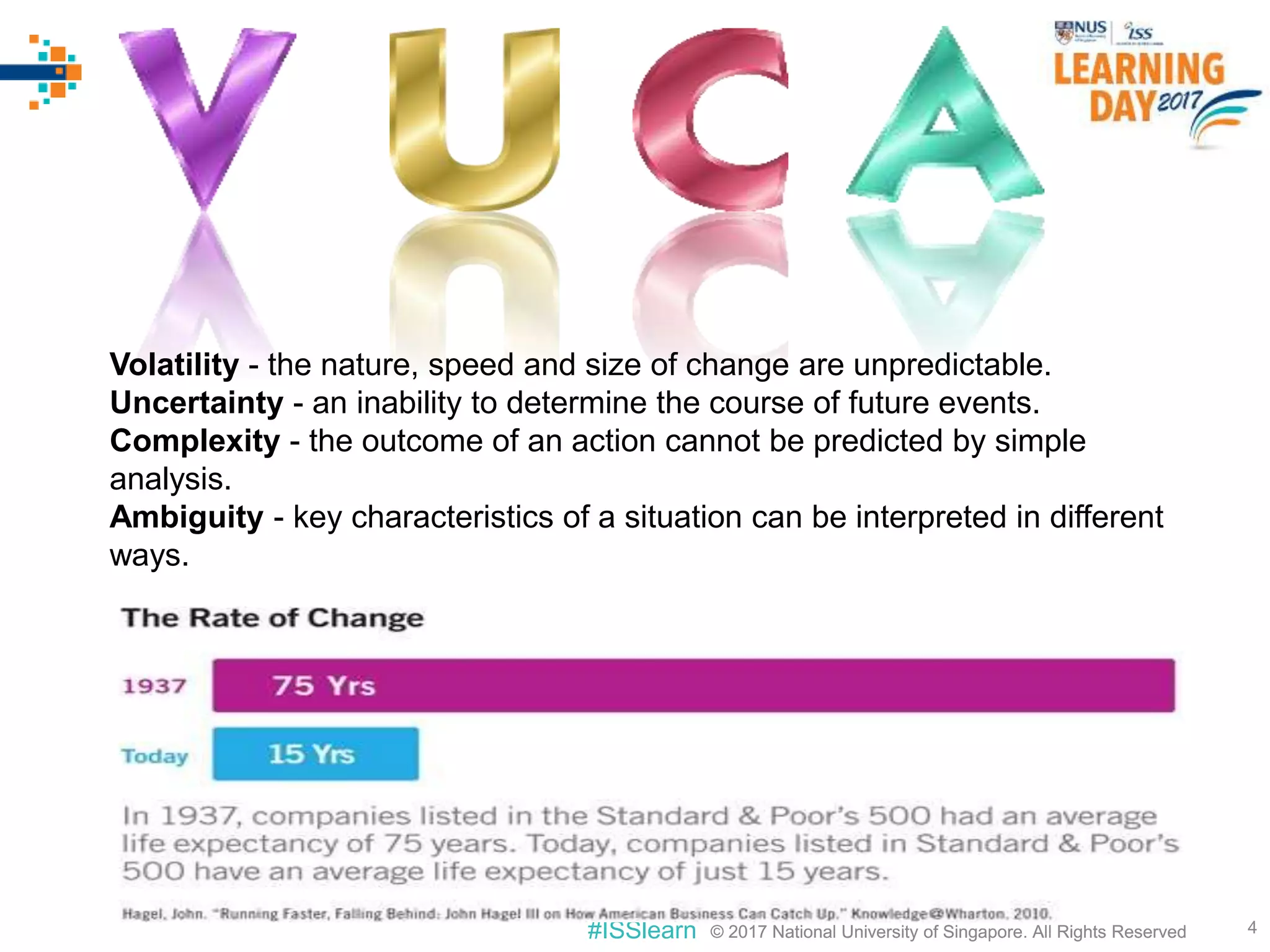
Volatility - the nature, speed and size of change are unpredictable.
Uncertainty - an inability to determine the course of future events.
Complexity - the outcome of an action cannot be predicted by simple
analysis.
Ambiguity - key characteristics of a situation can be interpreted in different
ways.
© 2017 National University of Singapore. All Rights Reserved#ISSlearn © 2017 National University of Singapore. All Rights Reserved
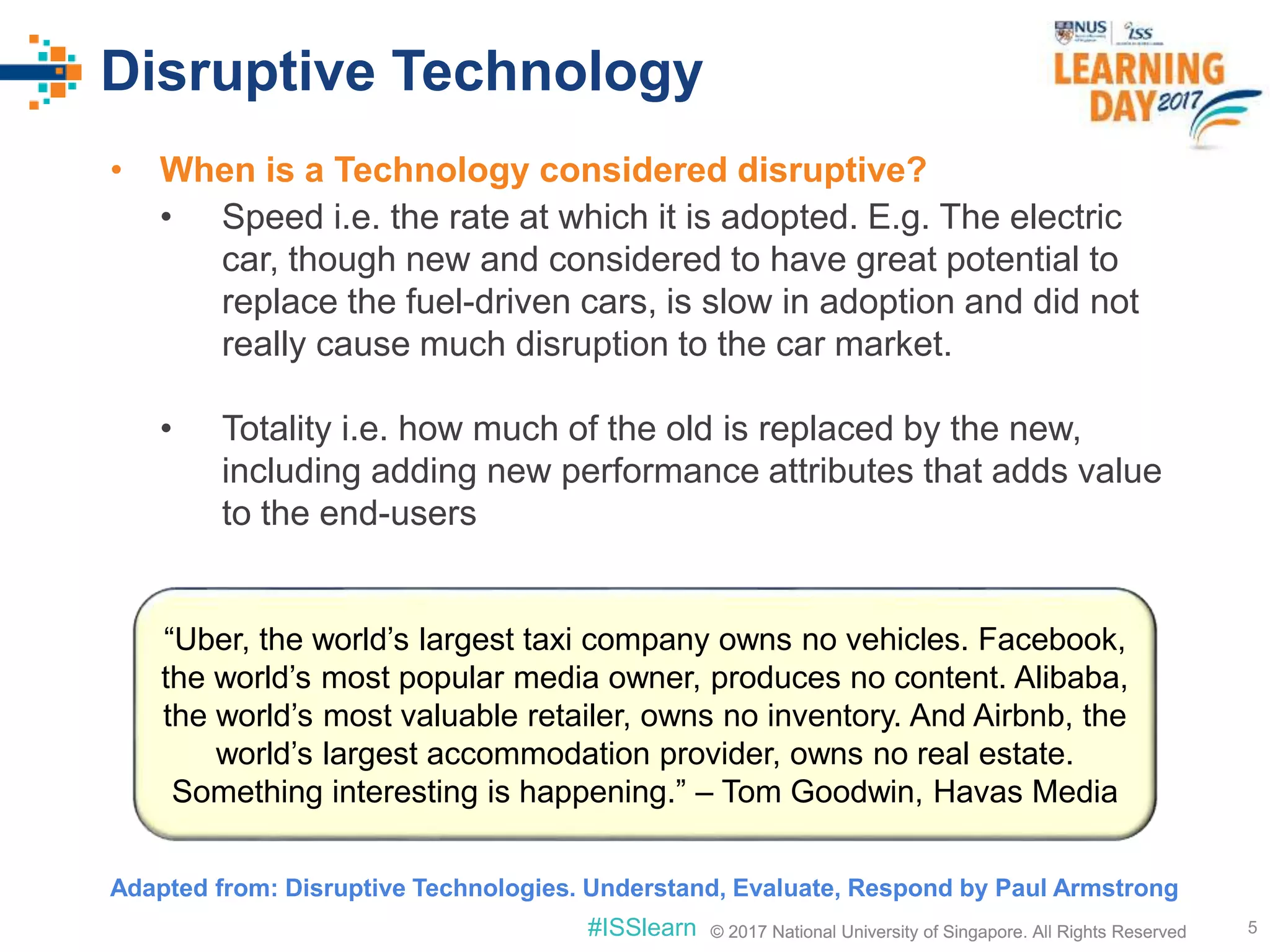
Disruptive Technology
• When is a Technology considered disruptive?
• Speed i.e. the rate at which it is adopted. E.g. The electric
car, though new and considered to have great potential to
replace the fuel-driven cars, is slow in adoption and did not
really cause much disruption to the car market.
• Totality i.e. how much of the old is replaced by the new,
including adding new performance attributes that adds value
to the end-users
5
“Uber, the world’s largest taxi company owns no vehicles. Facebook,
the world’s most popular media owner, produces no content. Alibaba,
the world’s most valuable retailer, owns no inventory. And Airbnb, the
world’s largest accommodation provider, owns no real estate.
Something interesting is happening.” – Tom Goodwin, Havas Media
Adapted from: Disruptive Technologies. Understand, Evaluate, Respond by Paul Armstrong
© 2017 National University of Singapore. All Rights Reserved#ISSlearn © 2017 National University of Singapore. All Rights Reserved
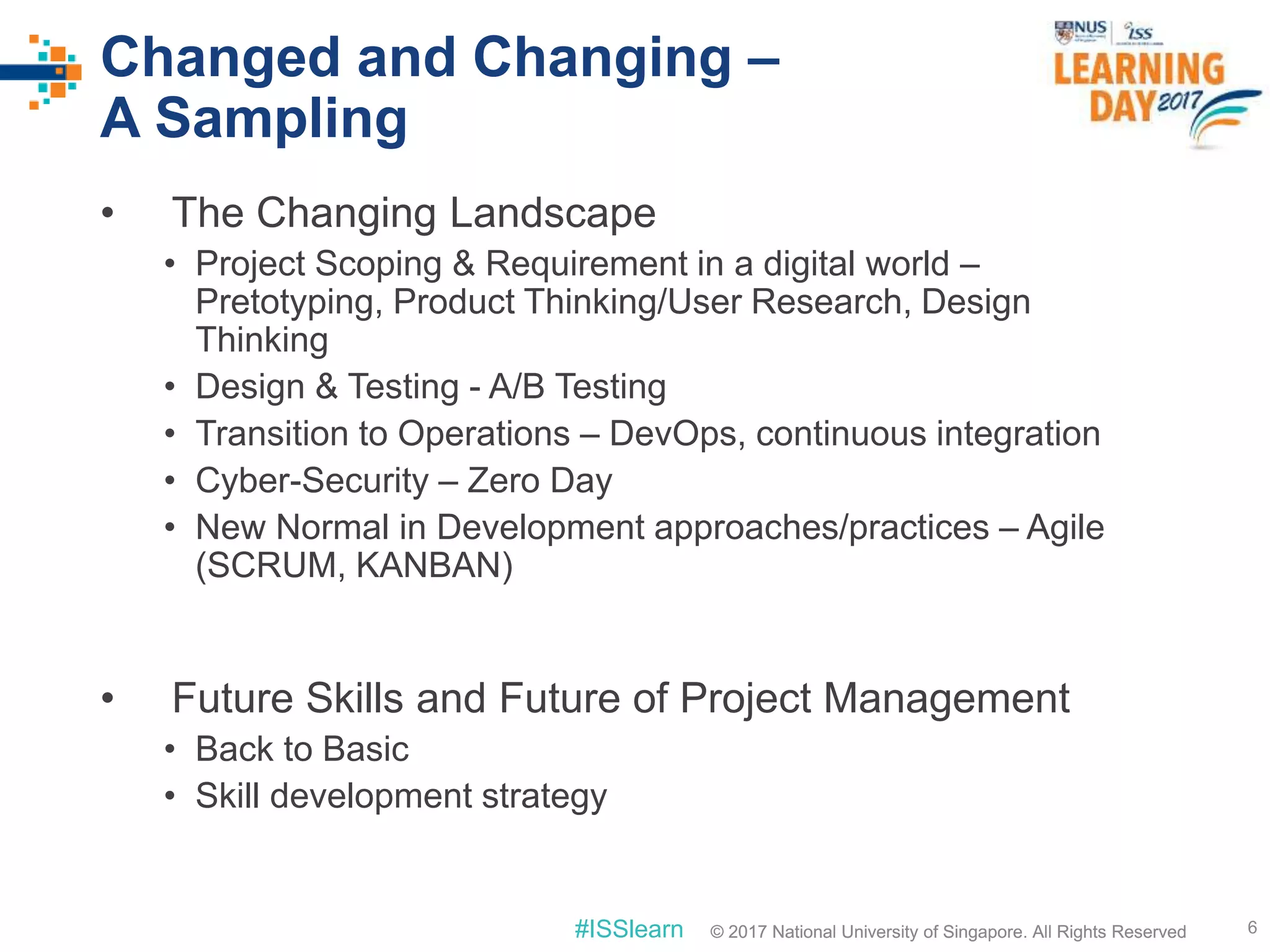
Changed and Changing –
A Sampling
• The Changing Landscape
• Project Scoping & Requirement in a digital world –
Pretotyping, Product Thinking/User Research, Design
Thinking
• Design & Testing - A/B Testing
• Transition to Operations – DevOps, continuous integration
• Cyber-Security – Zero Day
• New Normal in Development approaches/practices – Agile
(SCRUM, KANBAN)
6
• Future Skills and Future of Project Management
• Back to Basic
• Skill development strategy
© 2017 National University of Singapore. All Rights Reserved#ISSlearn © 2017 National University of Singapore. All Rights Reserved
PROJECT SCOPING & REQUIREMENT IN
AN INCREASINGLY DIGITIZED WORLD
PRETOTYPING, PRODUCT THINKING/ USER
RESEARCH, DESIGN THINKING …
7
© 2017 National University of Singapore. All Rights Reserved#ISSlearn © 2017 National University of Singapore. All Rights Reserved
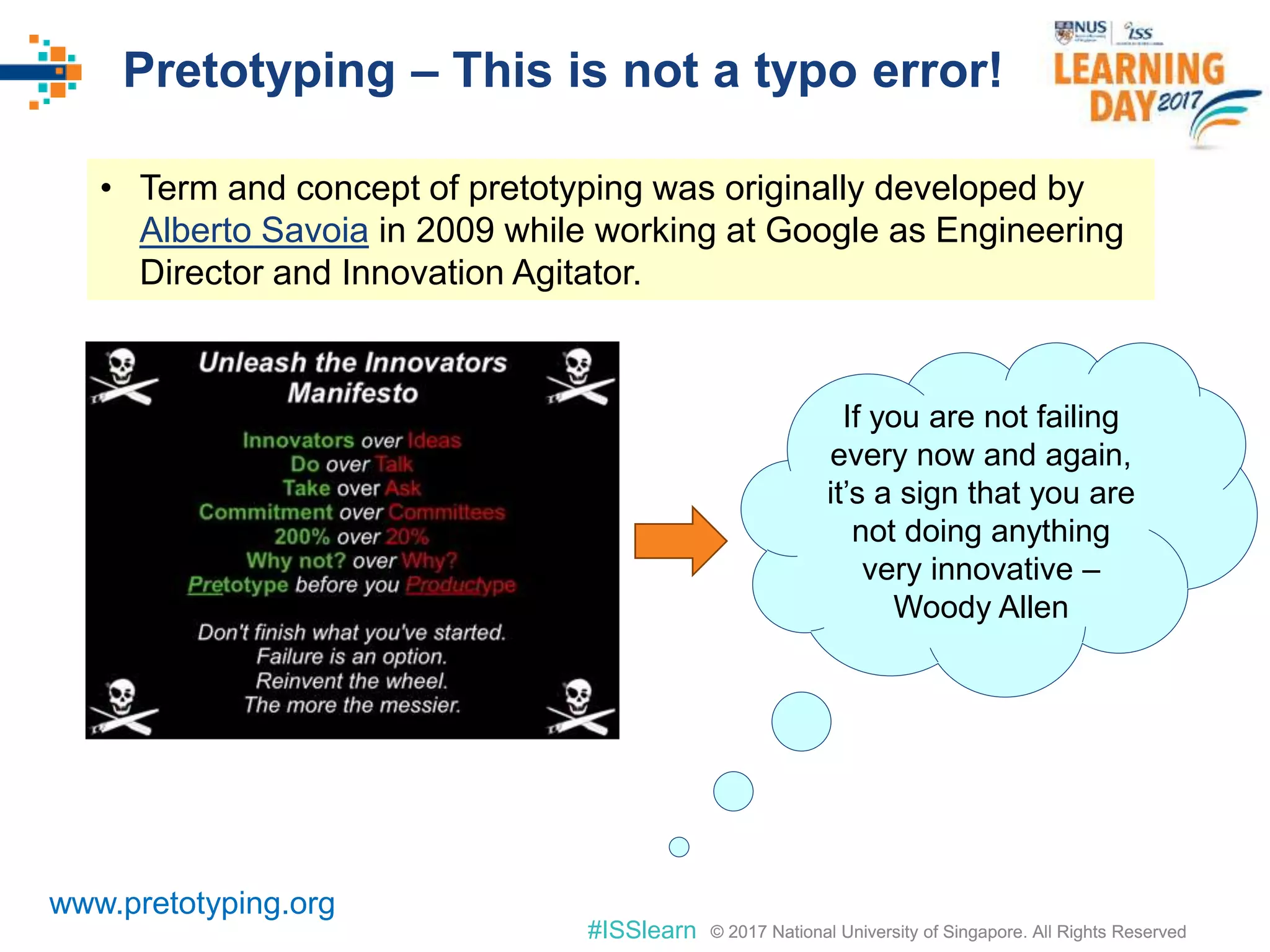
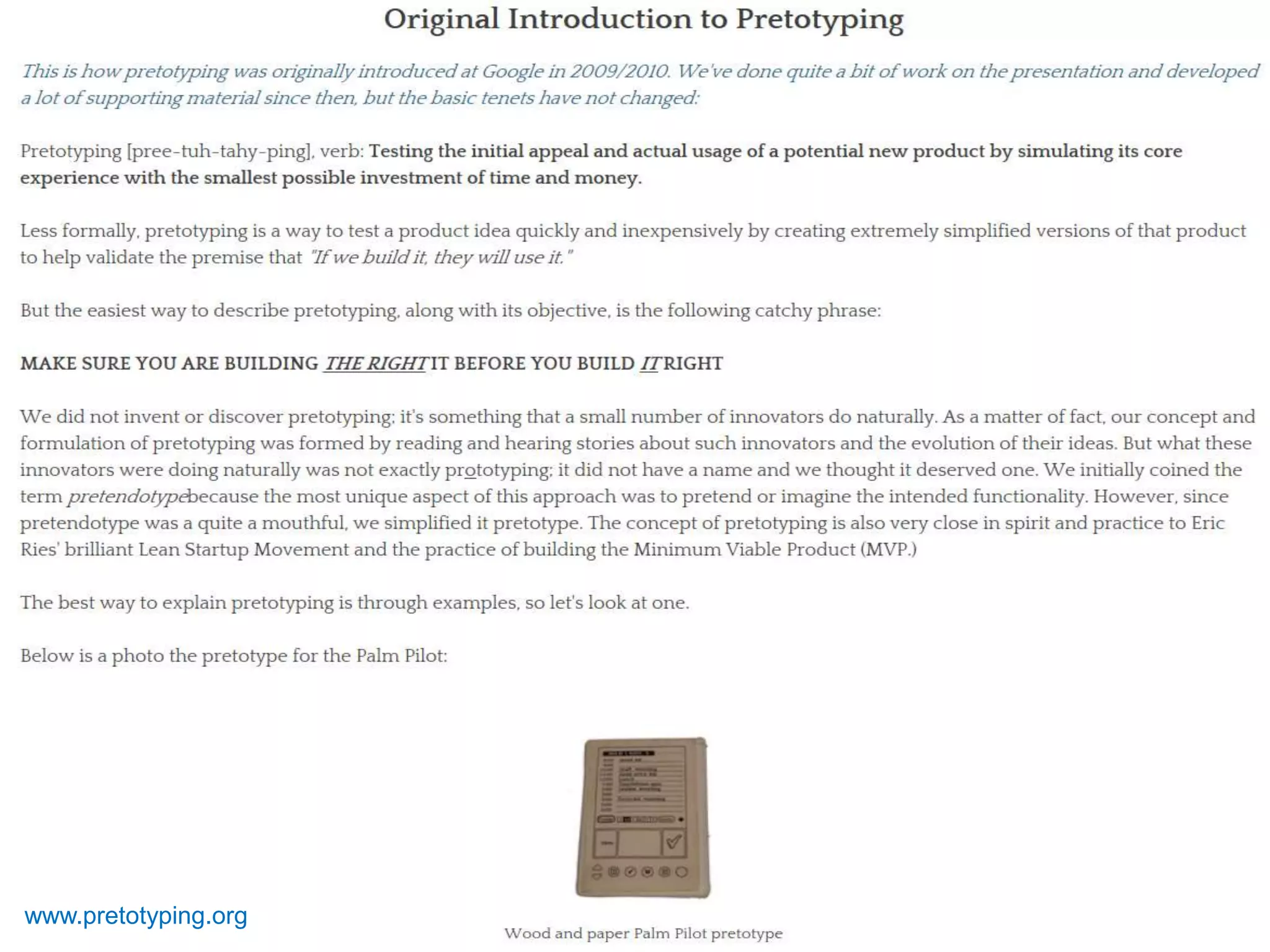
Pretotyping – This is not a typo error!
• Term and concept of pretotyping was originally developed by
Alberto Savoia in 2009 while working at Google as Engineering
Director and Innovation Agitator.
www.pretotyping.org
If you are not failing
every now and again,
it’s a sign that you are
not doing anything
very innovative –
Woody Allen
© 2017 National University of Singapore. All Rights Reserved#ISSlearn © 2017 National University of Singapore. All Rights Reserved
www.pretotyping.org
© 2017 National University of Singapore. All Rights Reserved#ISSlearn © 2017 National University of Singapore. All Rights Reserved
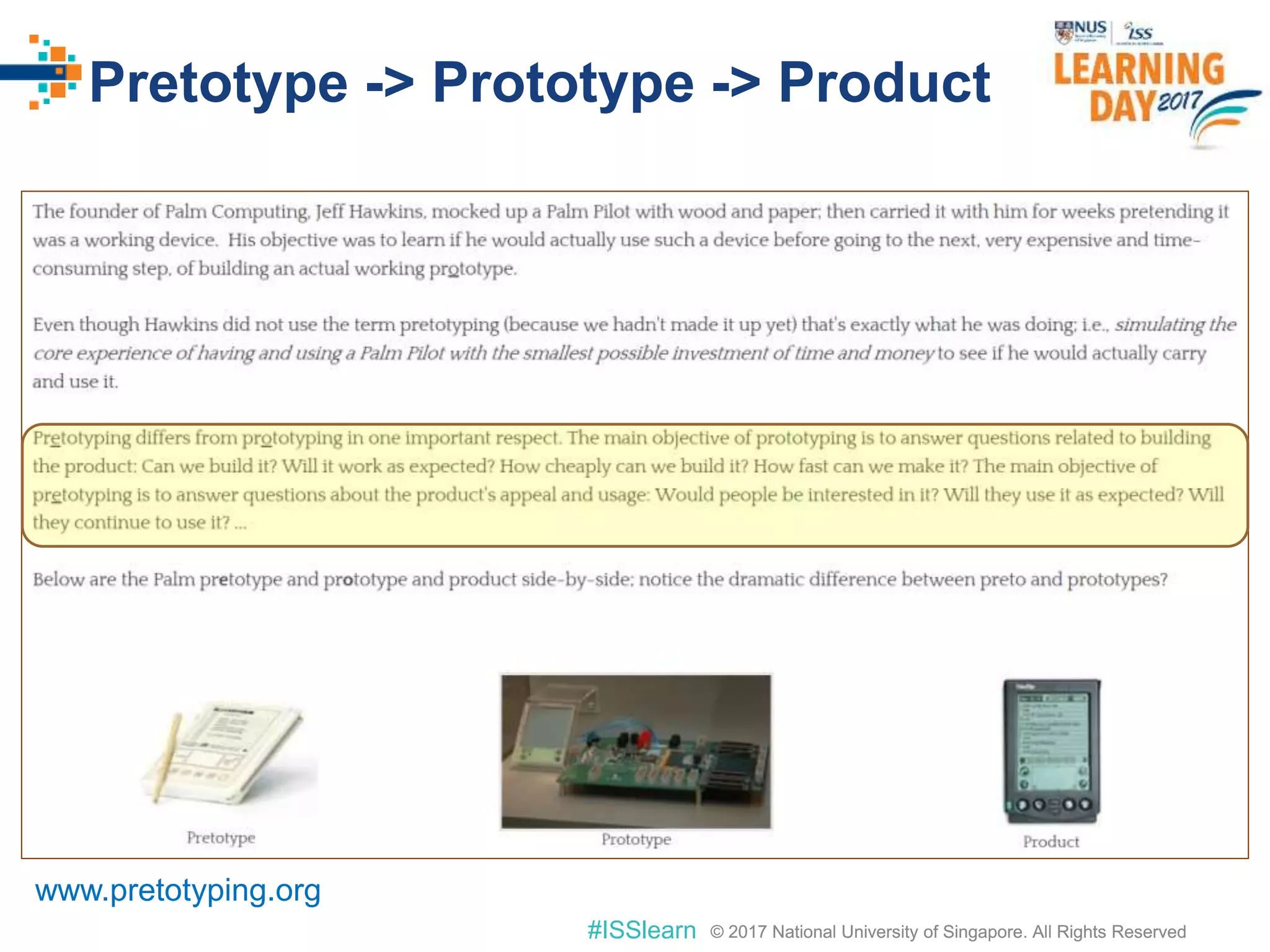
Pretotype -> Prototype -> Product
www.pretotyping.org
© 2017 National University of Singapore. All Rights Reserved#ISSlearn © 2017 National University of Singapore. All Rights Reserved
Product Thinking - Do People
Want the Product?
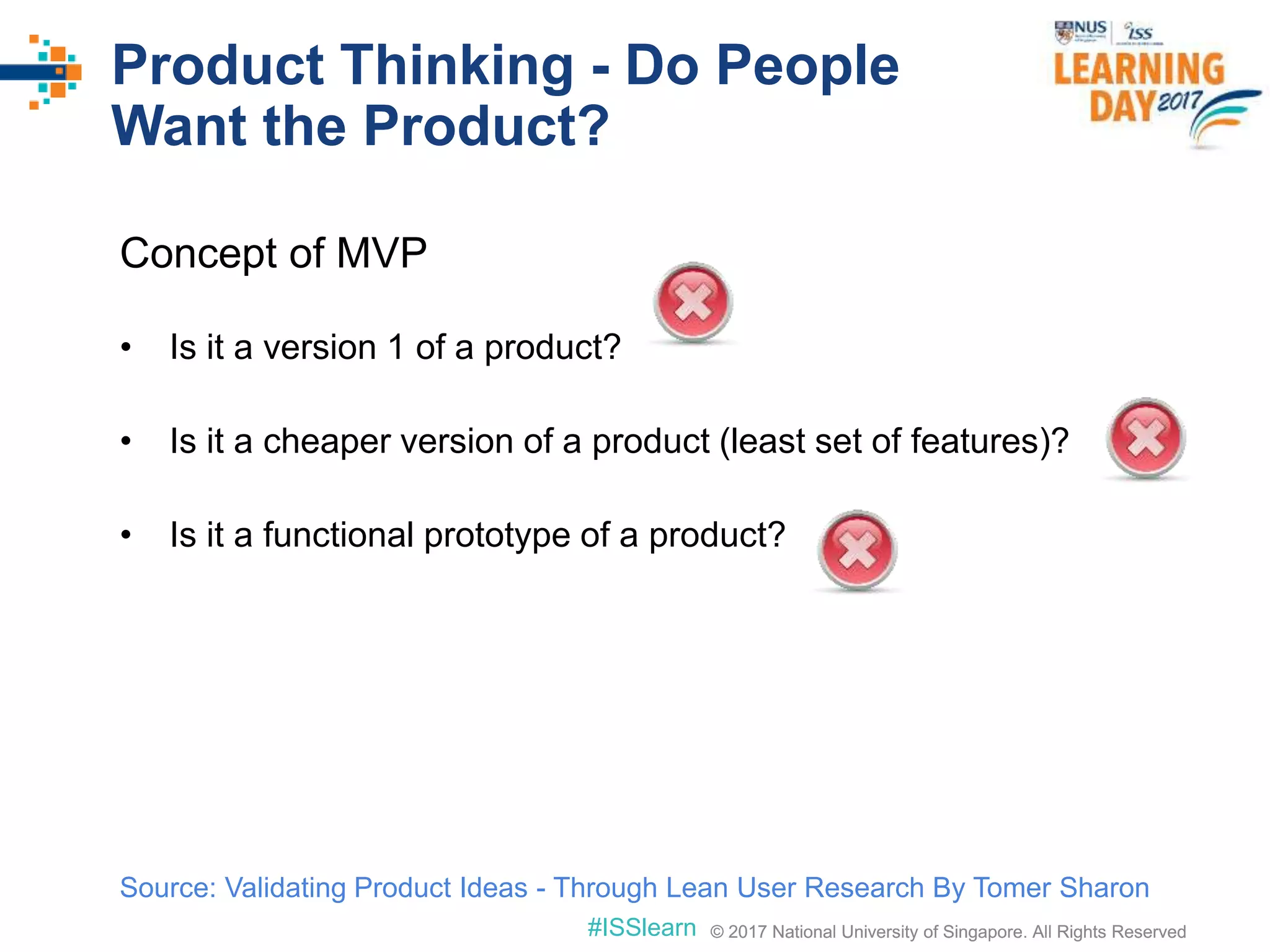
Concept of MVP
• Is it a version 1 of a product?
• Is it a cheaper version of a product (least set of features)?
• Is it a functional prototype of a product?
Source: Validating Product Ideas - Through Lean User Research By Tomer Sharon
© 2017 National University of Singapore. All Rights Reserved#ISSlearn © 2017 National University of Singapore. All Rights Reserved
Product Thinking - Do People
Want the Product?
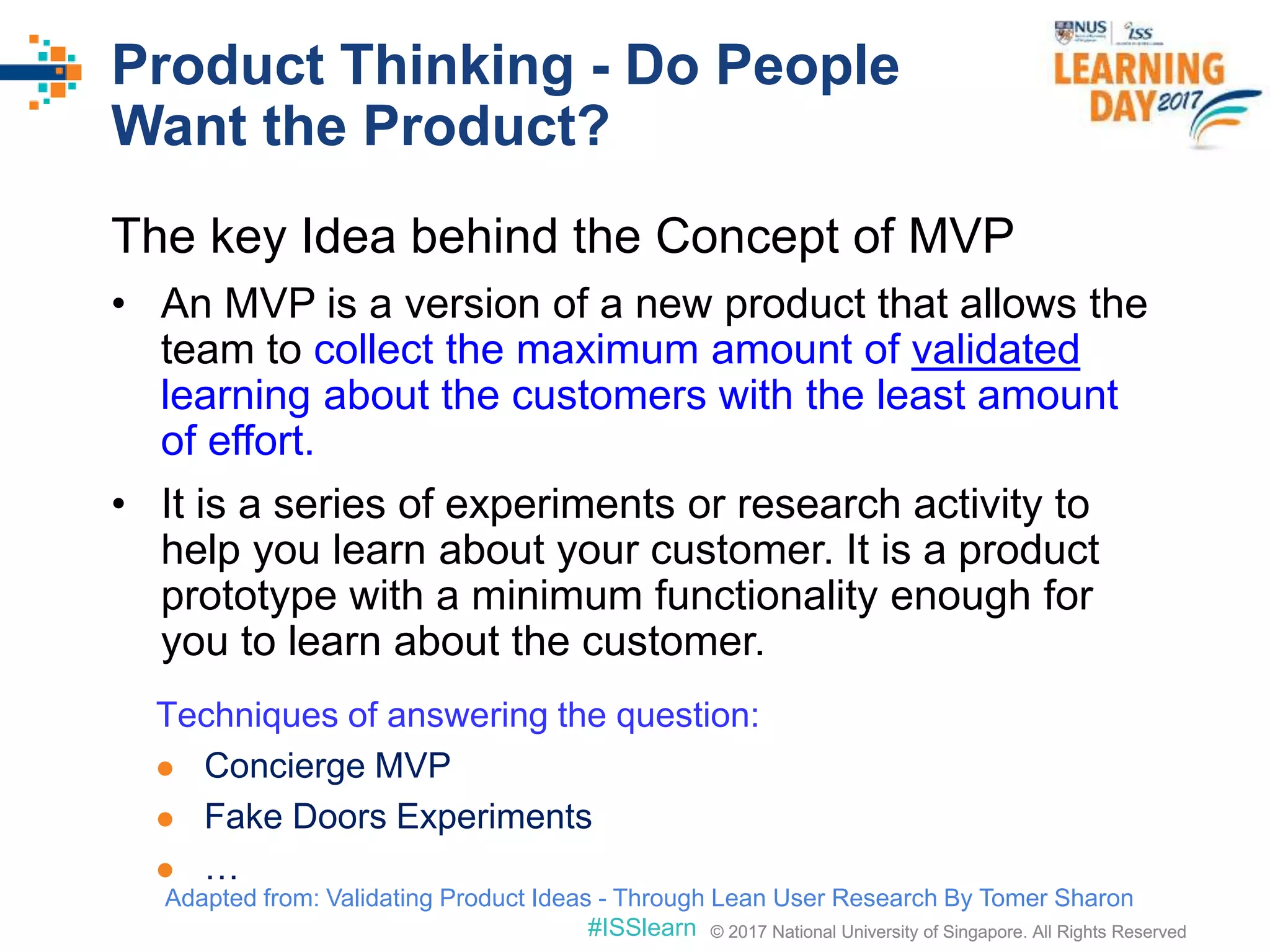
The key Idea behind the Concept of MVP
• An MVP is a version of a new product that allows the
team to collect the maximum amount of validated
learning about the customers with the least amount
of effort.
• It is a series of experiments or research activity to
help you learn about your customer. It is a product
prototype with a minimum functionality enough for
you to learn about the customer.
Techniques of answering the question:
 Concierge MVP
 Fake Doors Experiments
 …
Adapted from: Validating Product Ideas - Through Lean User Research By Tomer Sharon
© 2017 National University of Singapore. All Rights Reserved#ISSlearn © 2017 National University of Singapore. All Rights Reserved
Product Thinking – Concierge
MVP
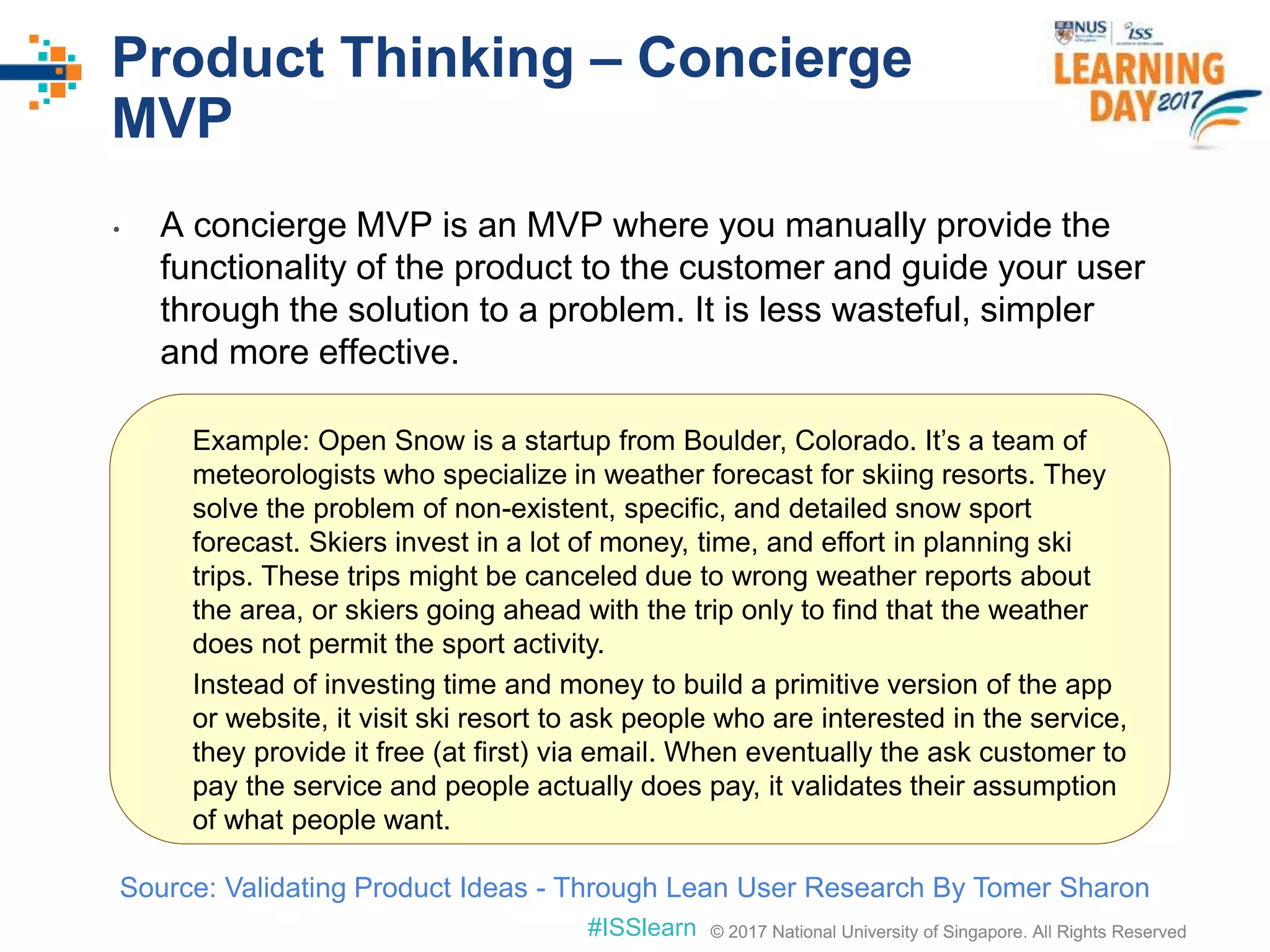
• A concierge MVP is an MVP where you manually provide the
functionality of the product to the customer and guide your user
through the solution to a problem. It is less wasteful, simpler
and more effective.
Example: Open Snow is a startup from Boulder, Colorado. It’s a team of
meteorologists who specialize in weather forecast for skiing resorts. They
solve the problem of non-existent, specific, and detailed snow sport
forecast. Skiers invest in a lot of money, time, and effort in planning ski
trips. These trips might be canceled due to wrong weather reports about
the area, or skiers going ahead with the trip only to find that the weather
does not permit the sport activity.
Instead of investing time and money to build a primitive version of the app
or website, it visit ski resort to ask people who are interested in the service,
they provide it free (at first) via email. When eventually the ask customer to
pay the service and people actually does pay, it validates their assumption
of what people want.
Source: Validating Product Ideas - Through Lean User Research By Tomer Sharon
© 2017 National University of Singapore. All Rights Reserved#ISSlearn © 2017 National University of Singapore. All Rights Reserved
Product Thinking – Fake Door
Experiment
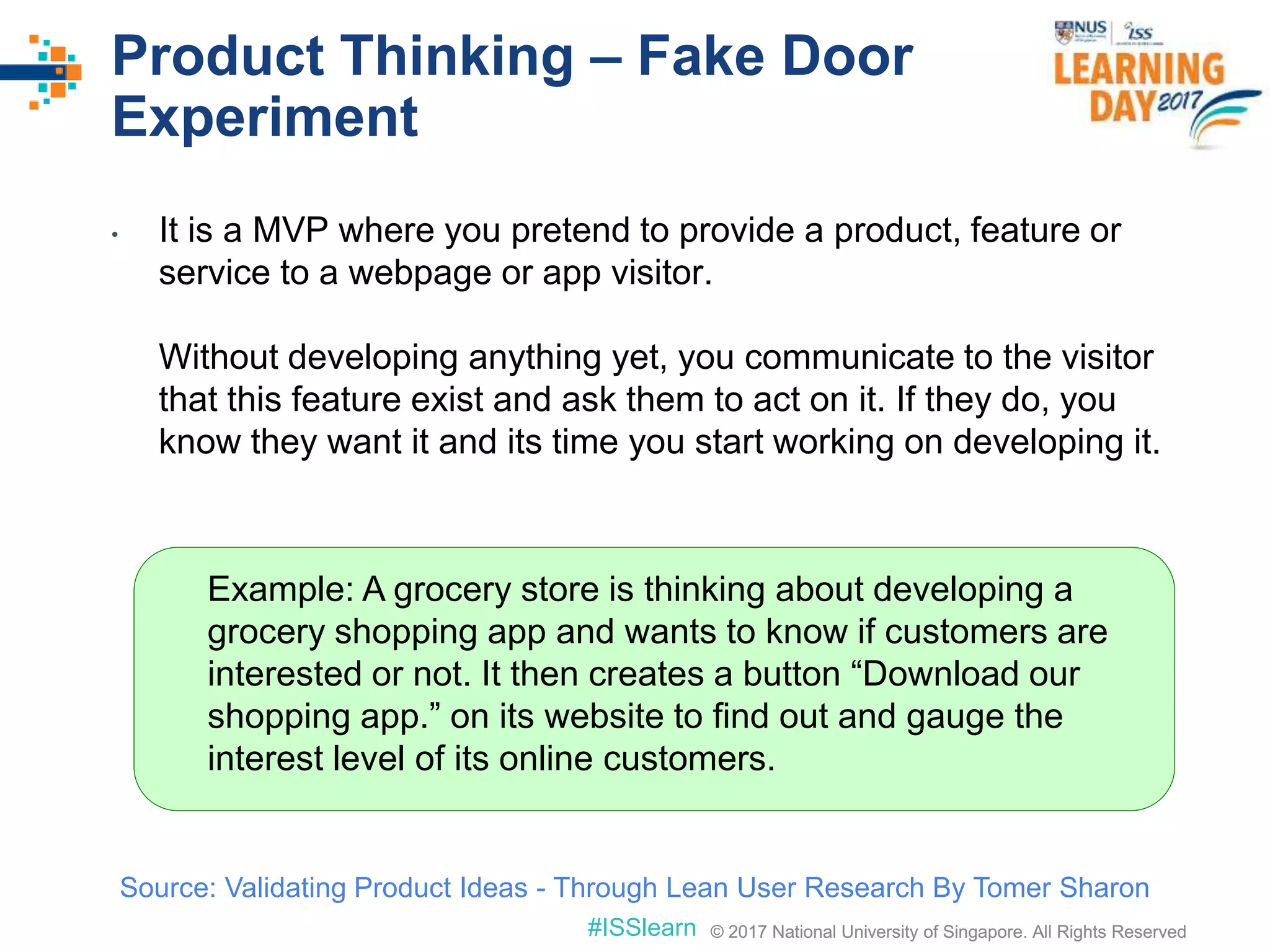
• It is a MVP where you pretend to provide a product, feature or
service to a webpage or app visitor.
Without developing anything yet, you communicate to the visitor
that this feature exist and ask them to act on it. If they do, you
know they want it and its time you start working on developing it.
Example: A grocery store is thinking about developing a
grocery shopping app and wants to know if customers are
interested or not. It then creates a button “Download our
shopping app.” on its website to find out and gauge the
interest level of its online customers.
Source: Validating Product Ideas - Through Lean User Research By Tomer Sharon
© 2017 National University of Singapore. All Rights Reserved#ISSlearn © 2017 National University of Singapore. All Rights Reserved
Product Design – A complaint
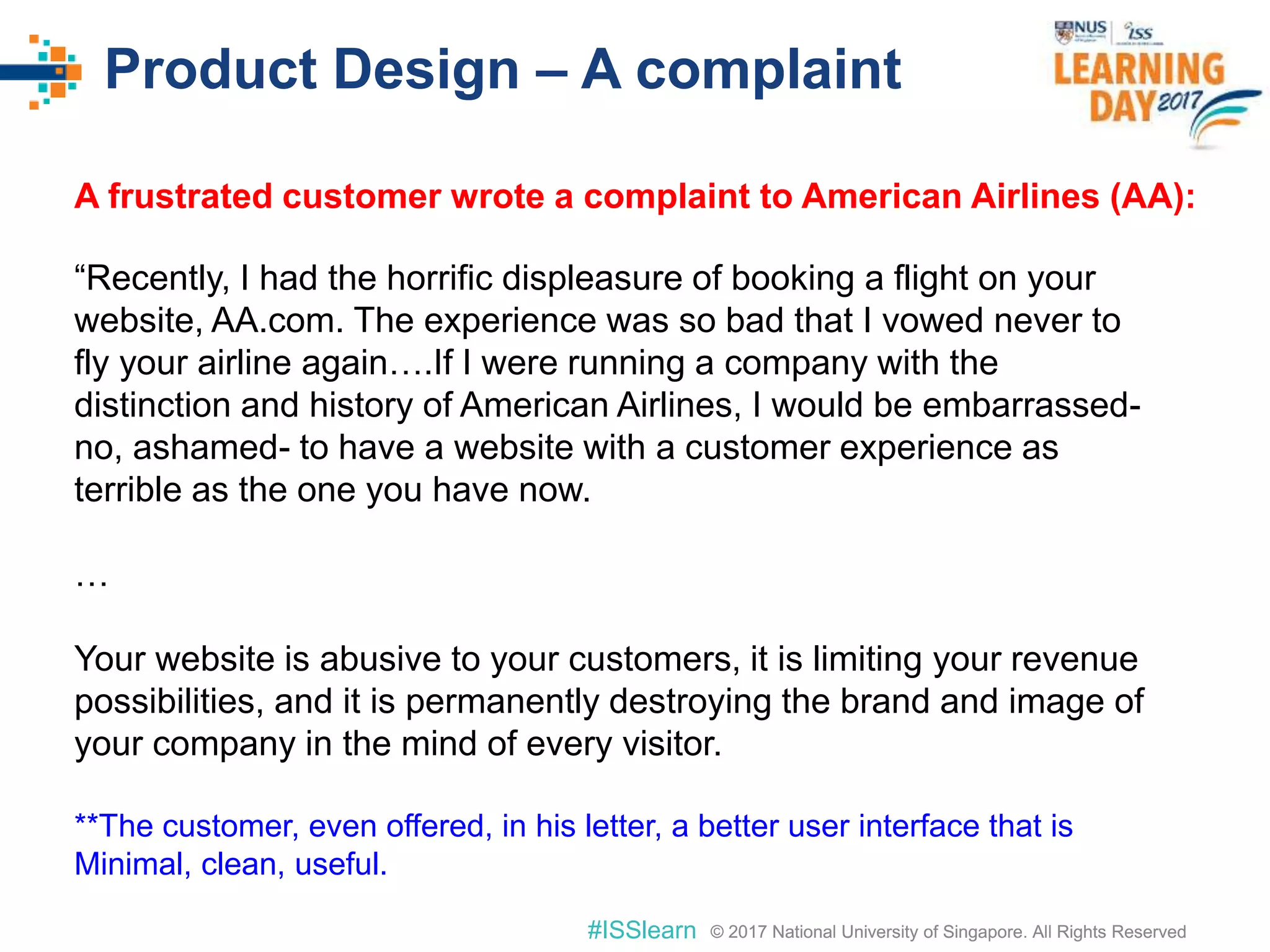
“Recently, I had the horrific displeasure of booking a flight on your
website, AA.com. The experience was so bad that I vowed never to
fly your airline again….If I were running a company with the
distinction and history of American Airlines, I would be embarrassed-
no, ashamed- to have a website with a customer experience as
terrible as the one you have now.
…
Your website is abusive to your customers, it is limiting your revenue
possibilities, and it is permanently destroying the brand and image of
your company in the mind of every visitor.
**The customer, even offered, in his letter, a better user interface that is
Minimal, clean, useful.
A frustrated customer wrote a complaint to American Airlines (AA):
© 2017 National University of Singapore. All Rights Reserved
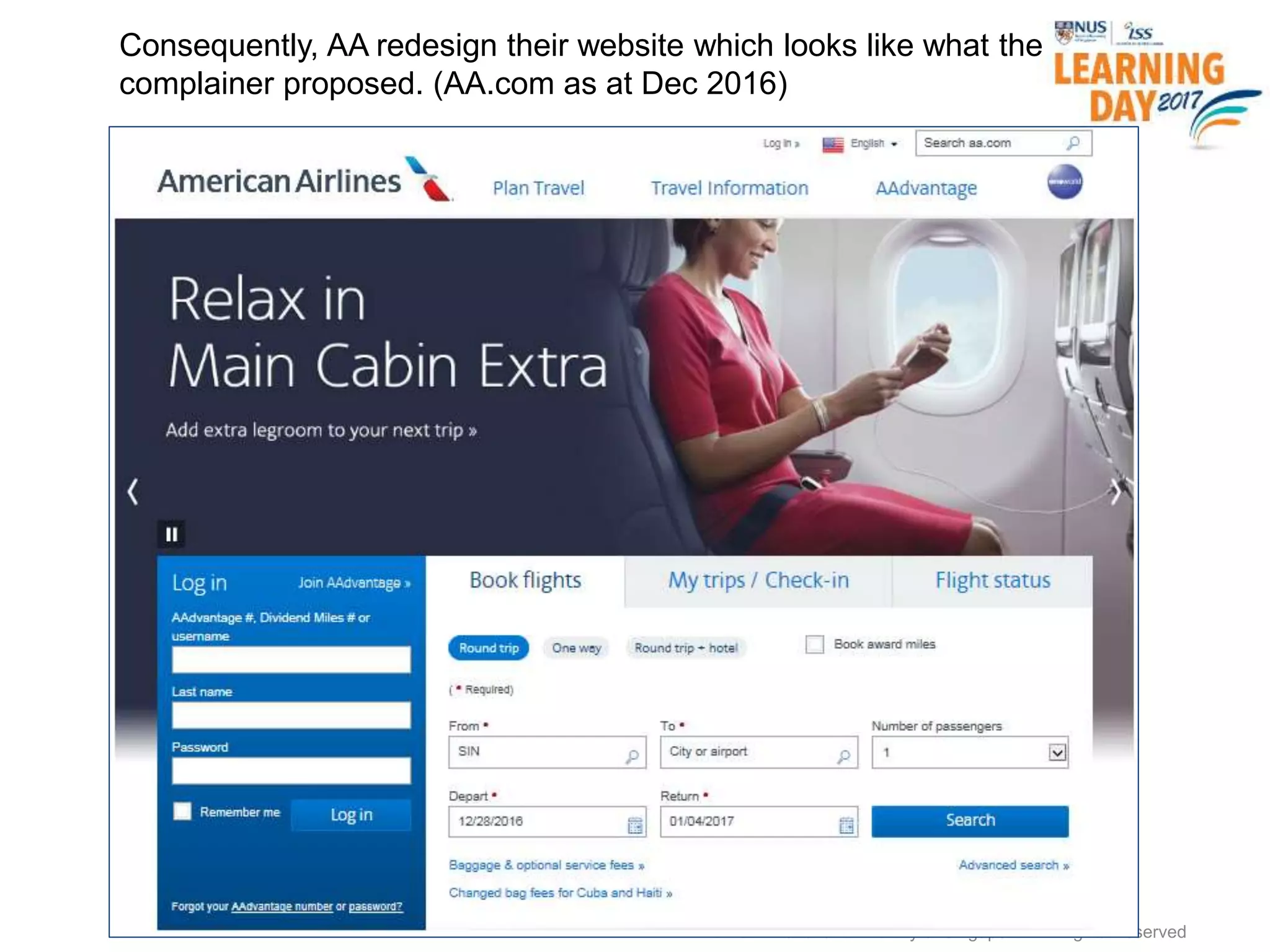
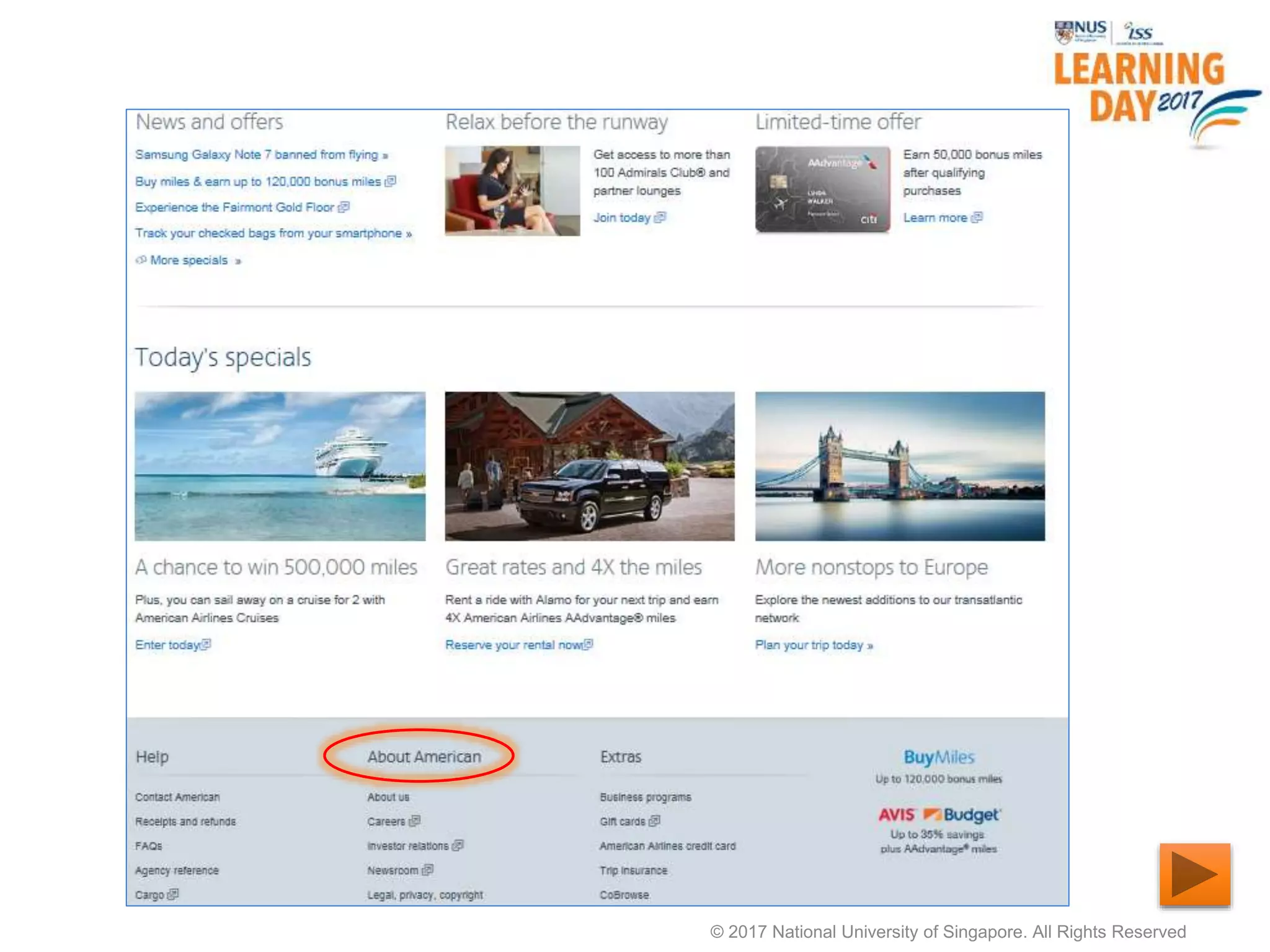
Consequently, AA redesign their website which looks like what the
complainer proposed. (AA.com as at Dec 2016)
© 2017 National University of Singapore. All Rights Reserved
© 2017 National University of Singapore. All Rights Reserved#ISSlearn © 2017 National University of Singapore. All Rights Reserved
Design Thinking
• No common and fixed definition
• Think of it as an approach to solving problem
involving:
• Use of market research info that is user-driven with
emphasis on user experience
• Expanded boundaries of both problem definition
and solution
• Engaging partners in co-creation
• Involves conduct of real-world experience as
opposed to analysis of historical data
© 2017 National University of Singapore. All Rights Reserved#ISSlearn © 2017 National University of Singapore. All Rights Reserved
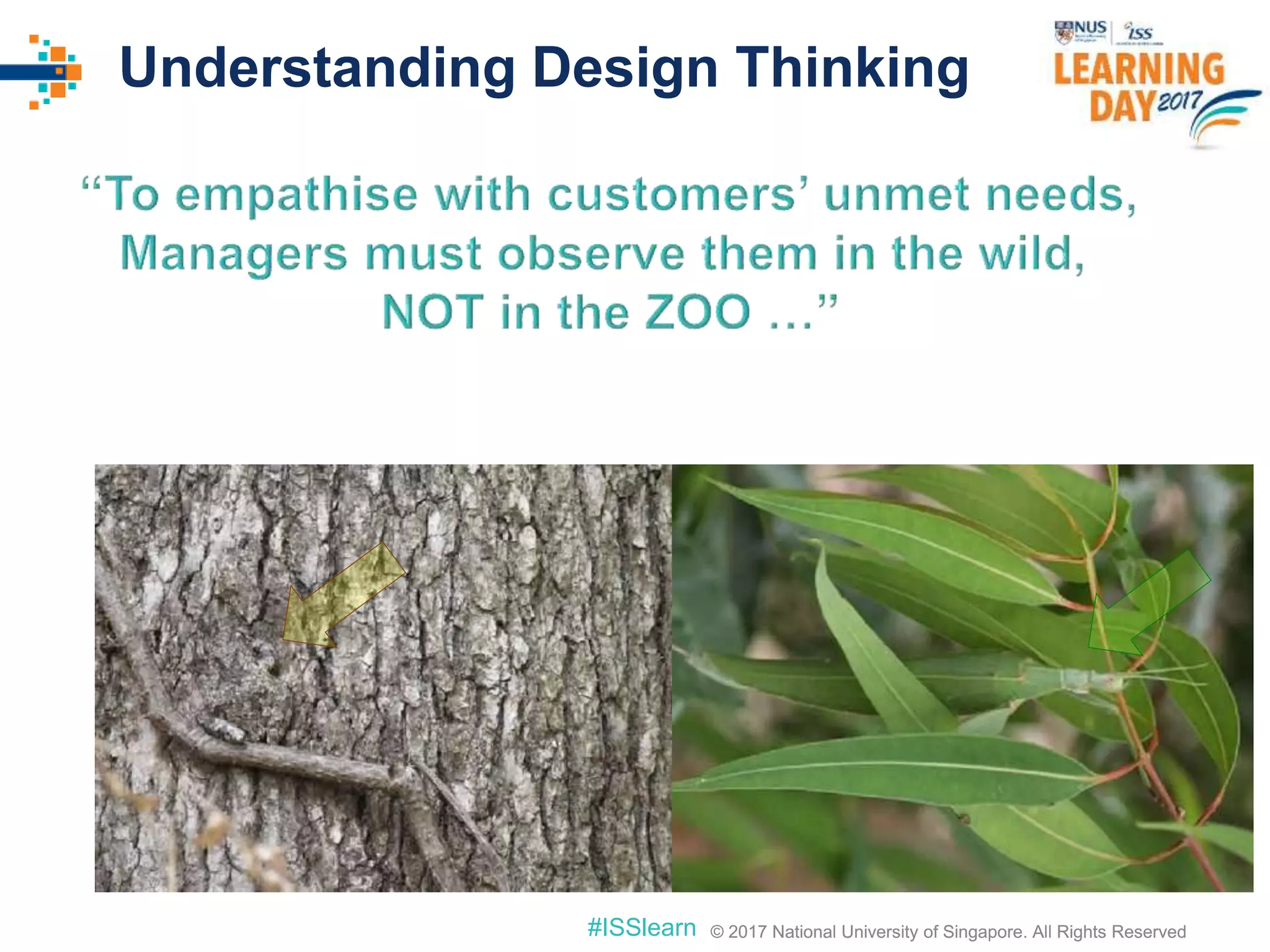
Understanding Design Thinking
© 2017 National University of Singapore. All Rights Reserved#ISSlearn © 2017 National University of Singapore. All Rights Reserved
E.g. “Desired Paths” and Design
20
If you don’t offer “low friction” in your designs,
someone else will.
A college campus that let people walk where they want – their
“desire paths” – and then used that to smartly pave those
locations that were the “low friction” routes that people
wanted to take.
Similarly, in product design, you should live like your
customer, observe them in the real world, and then learn from
what they actually do.
- Tom Hulme at TED conference 2016
© 2017 National University of Singapore. All Rights Reserved#ISSlearn © 2017 National University of Singapore. All Rights Reserved
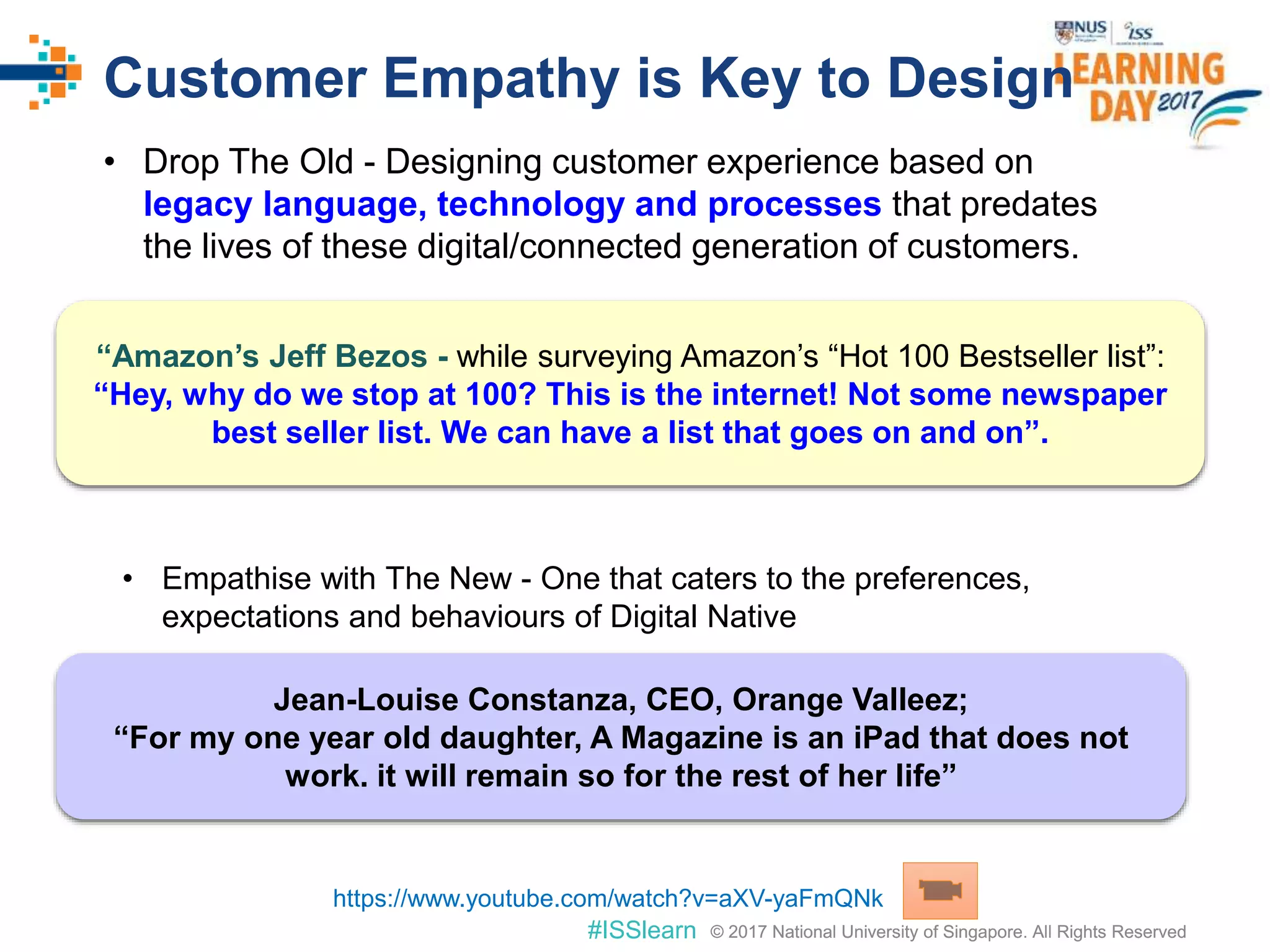
Customer Empathy is Key to Design
• Drop The Old - Designing customer experience based on
legacy language, technology and processes that predates
the lives of these digital/connected generation of customers.
• Empathise with The New - One that caters to the preferences,
expectations and behaviours of Digital Native
“Amazon’s Jeff Bezos - while surveying Amazon’s “Hot 100 Bestseller list”:
“Hey, why do we stop at 100? This is the internet! Not some newspaper
best seller list. We can have a list that goes on and on”.
Jean-Louise Constanza, CEO, Orange Valleez;
“For my one year old daughter, A Magazine is an iPad that does not
work. it will remain so for the rest of her life”
https://www.youtube.com/watch?v=aXV-yaFmQNk
© 2017 National University of Singapore. All Rights Reserved#ISSlearn © 2017 National University of Singapore. All Rights Reserved
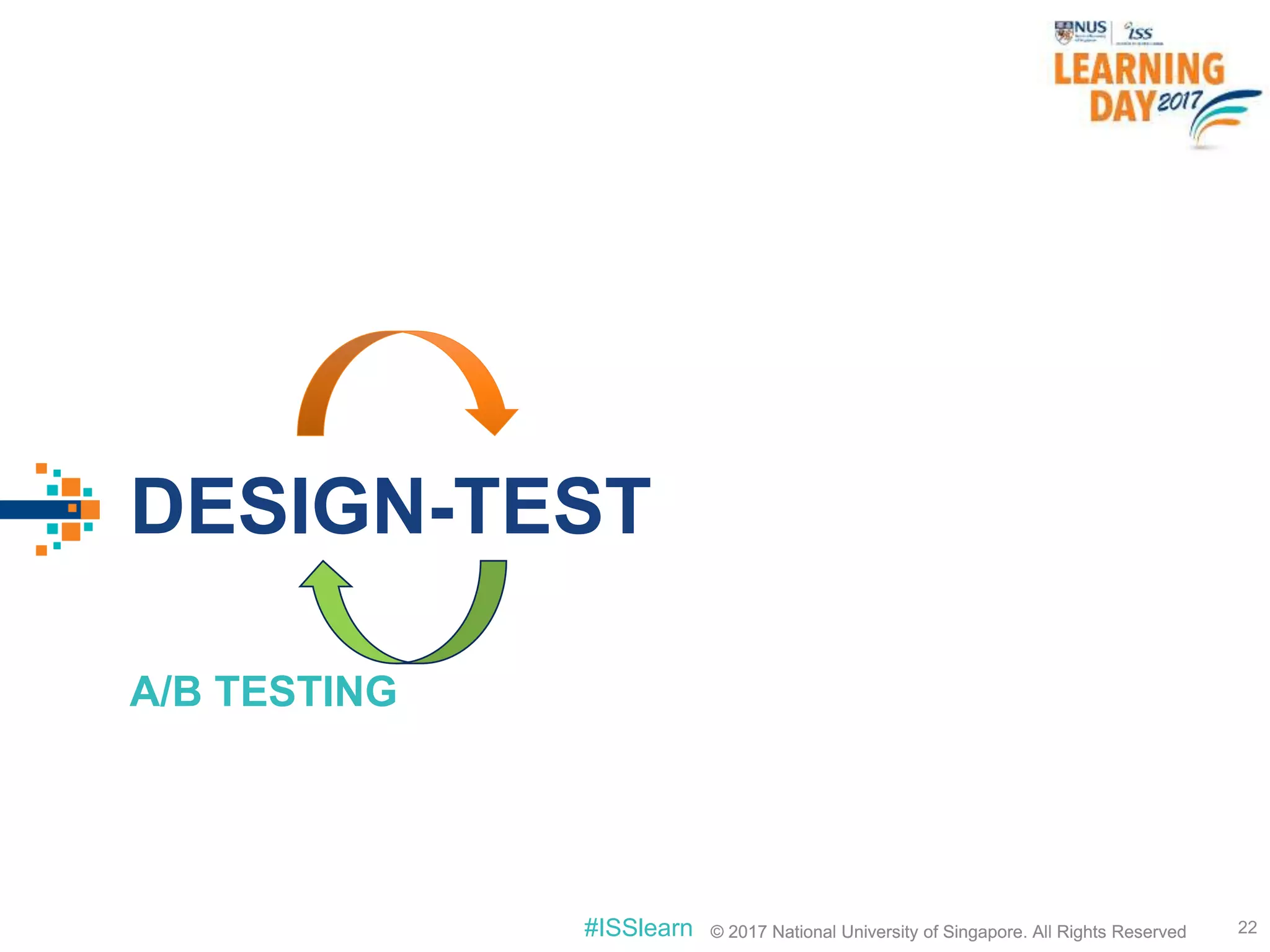
DESIGN-TEST
A/B TESTING
22
© 2017 National University of Singapore. All Rights Reserved#ISSlearn © 2017 National University of Singapore. All Rights Reserved
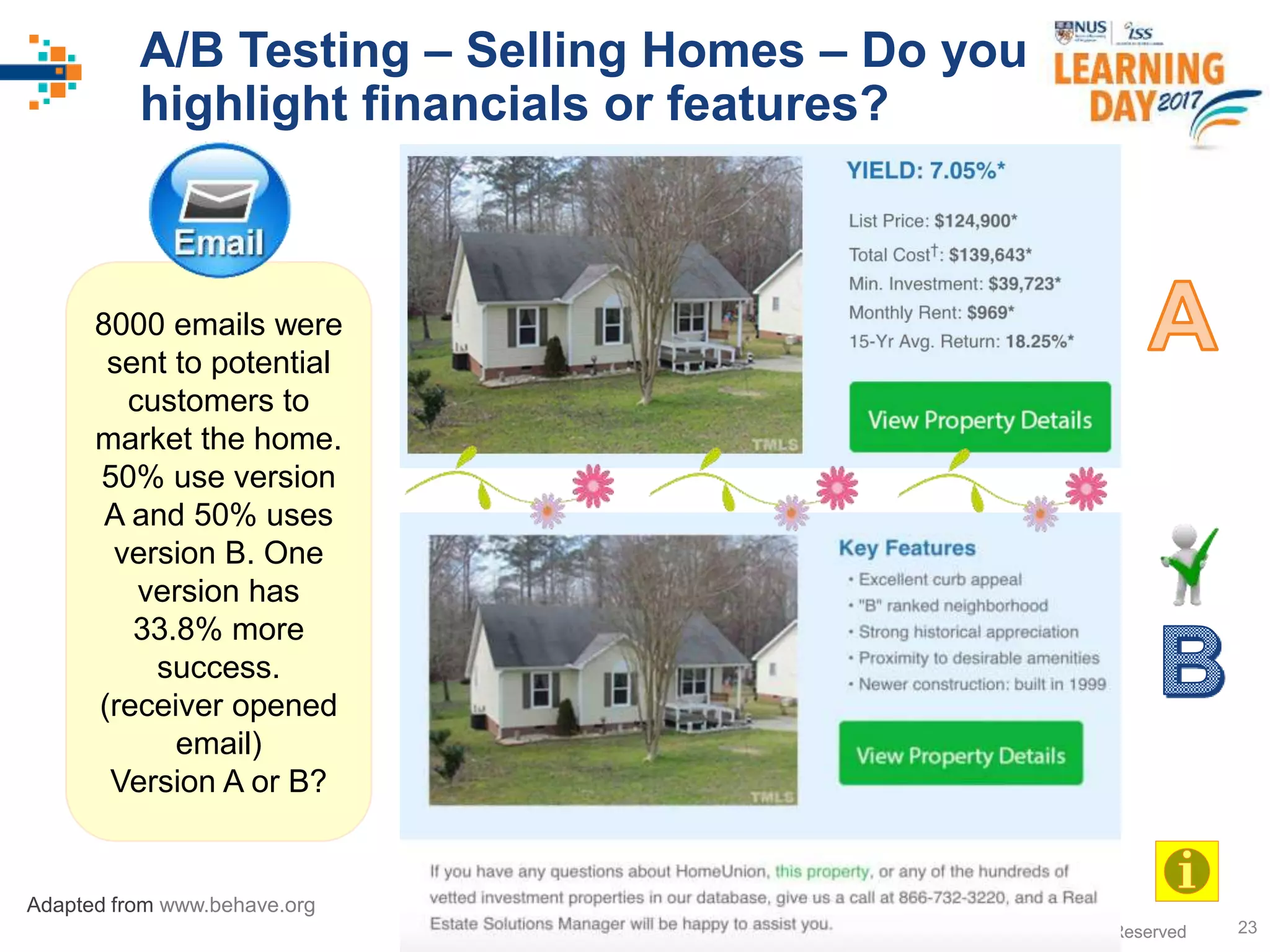
A/B Testing – Selling Homes – Do you
highlight financials or features?
23
8000 emails were
sent to potential
customers to
market the home.
50% use version
A and 50% uses
version B. One
version has
33.8% more
success.
(receiver opened
email)
Version A or B?
Adapted from www.behave.org
© 2017 National University of Singapore. All Rights Reserved#ISSlearn © 2017 National University of Singapore. All Rights Reserved
TRANSITION TO OPERATIONS
DEVOPS
24
© 2017 National University of Singapore. All Rights Reserved#ISSlearn © 2017 National University of Singapore. All Rights Reserved 25
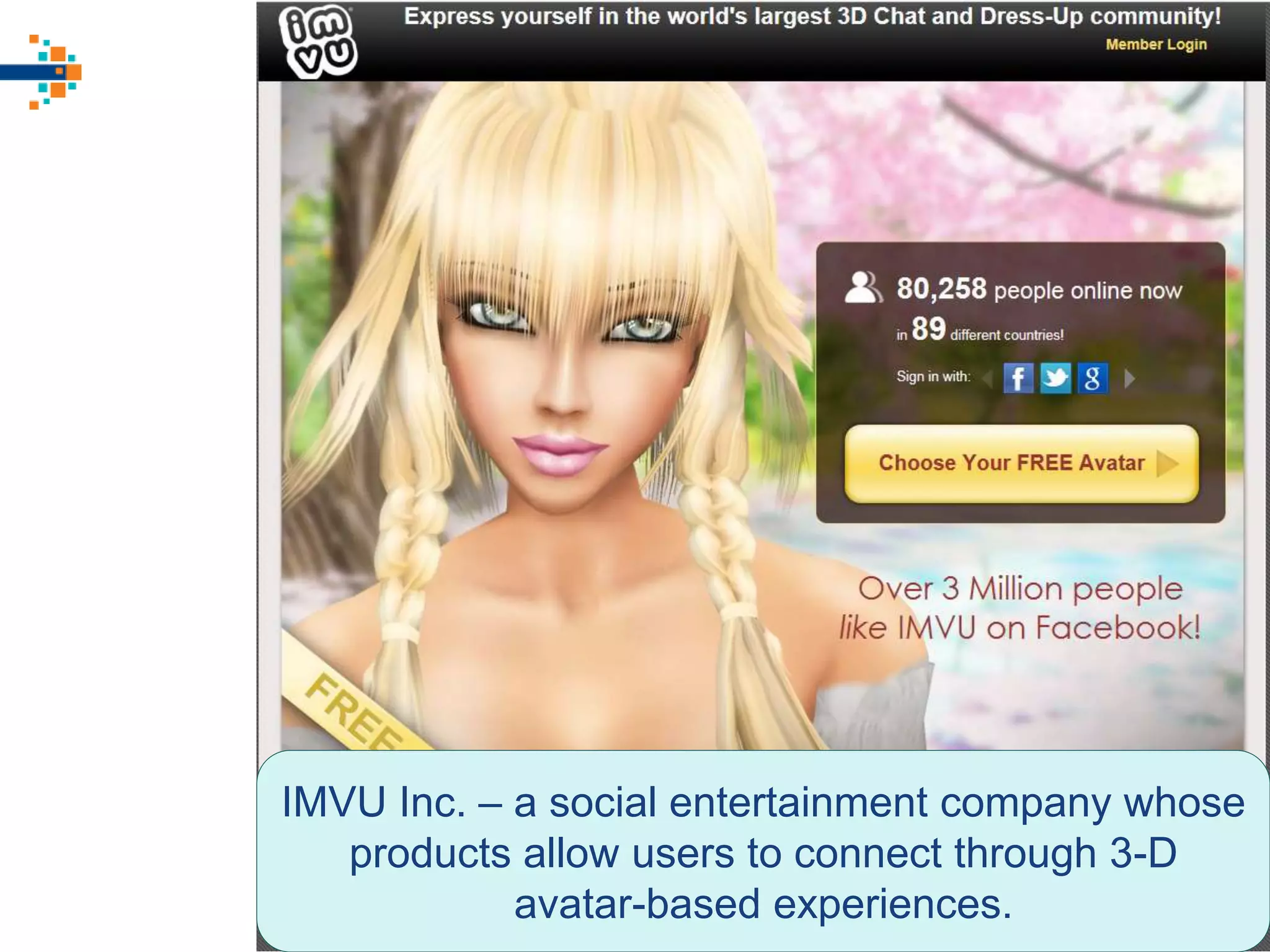
IMVU Inc. – a social entertainment company whose
products allow users to connect through 3-D
avatar-based experiences.
© 2017 National University of Singapore. All Rights Reserved#ISSlearn © 2017 National University of Singapore. All Rights Reserved
Coping with Rollout Frequency
Demand of Today & the Future
How often does IMVU Inc. deploy new software?
• Quarterly?
• Monthly?
• Weekly?
• Daily?
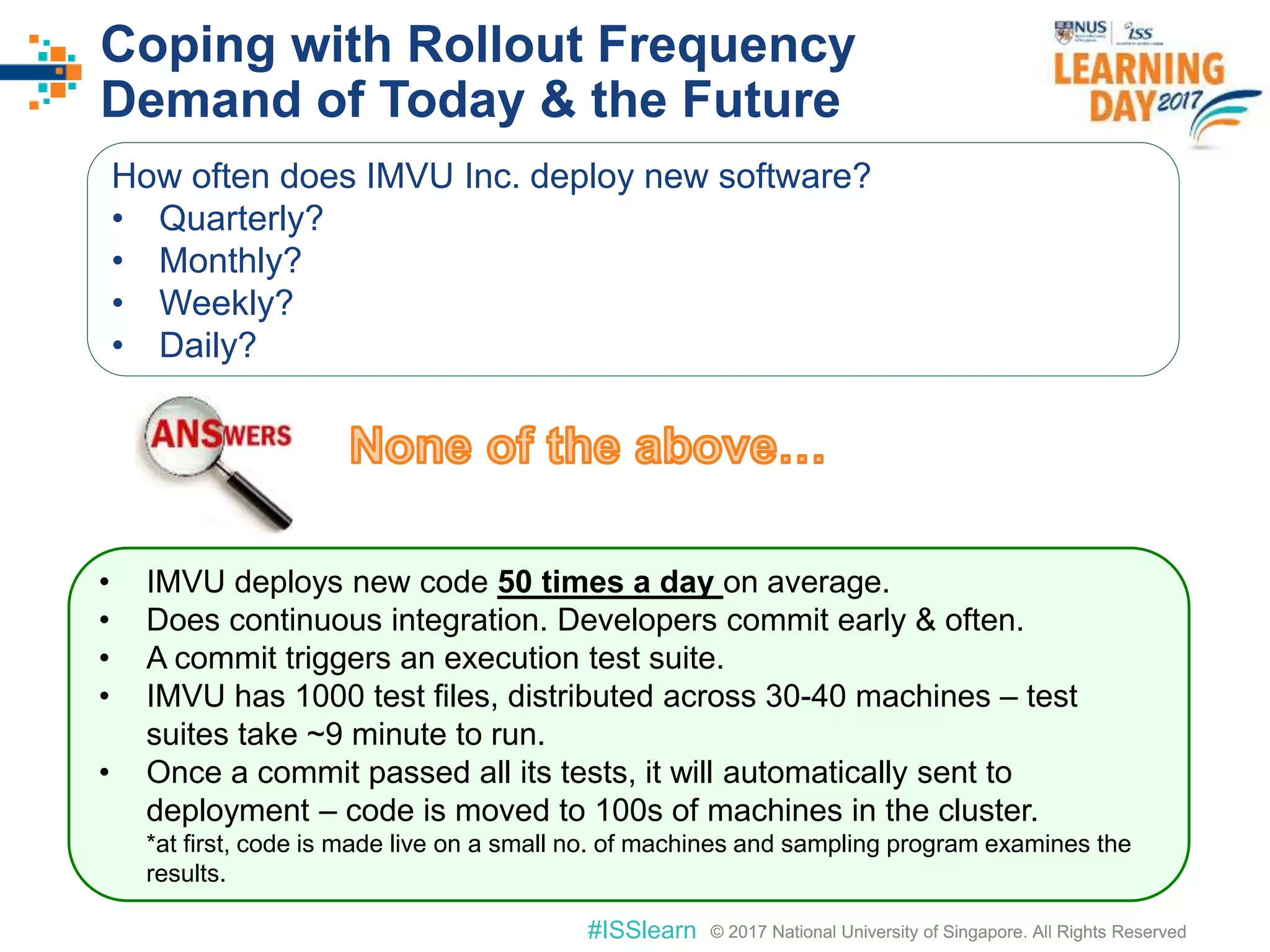
• IMVU deploys new code 50 times a day on average.
• Does continuous integration. Developers commit early & often.
• A commit triggers an execution test suite.
• IMVU has 1000 test files, distributed across 30-40 machines – test
suites take ~9 minute to run.
• Once a commit passed all its tests, it will automatically sent to
deployment – code is moved to 100s of machines in the cluster.
*at first, code is made live on a small no. of machines and sampling program examines the
results.
© 2017 National University of Singapore. All Rights Reserved#ISSlearn © 2017 National University of Singapore. All Rights Reserved
One Definition of DevOps
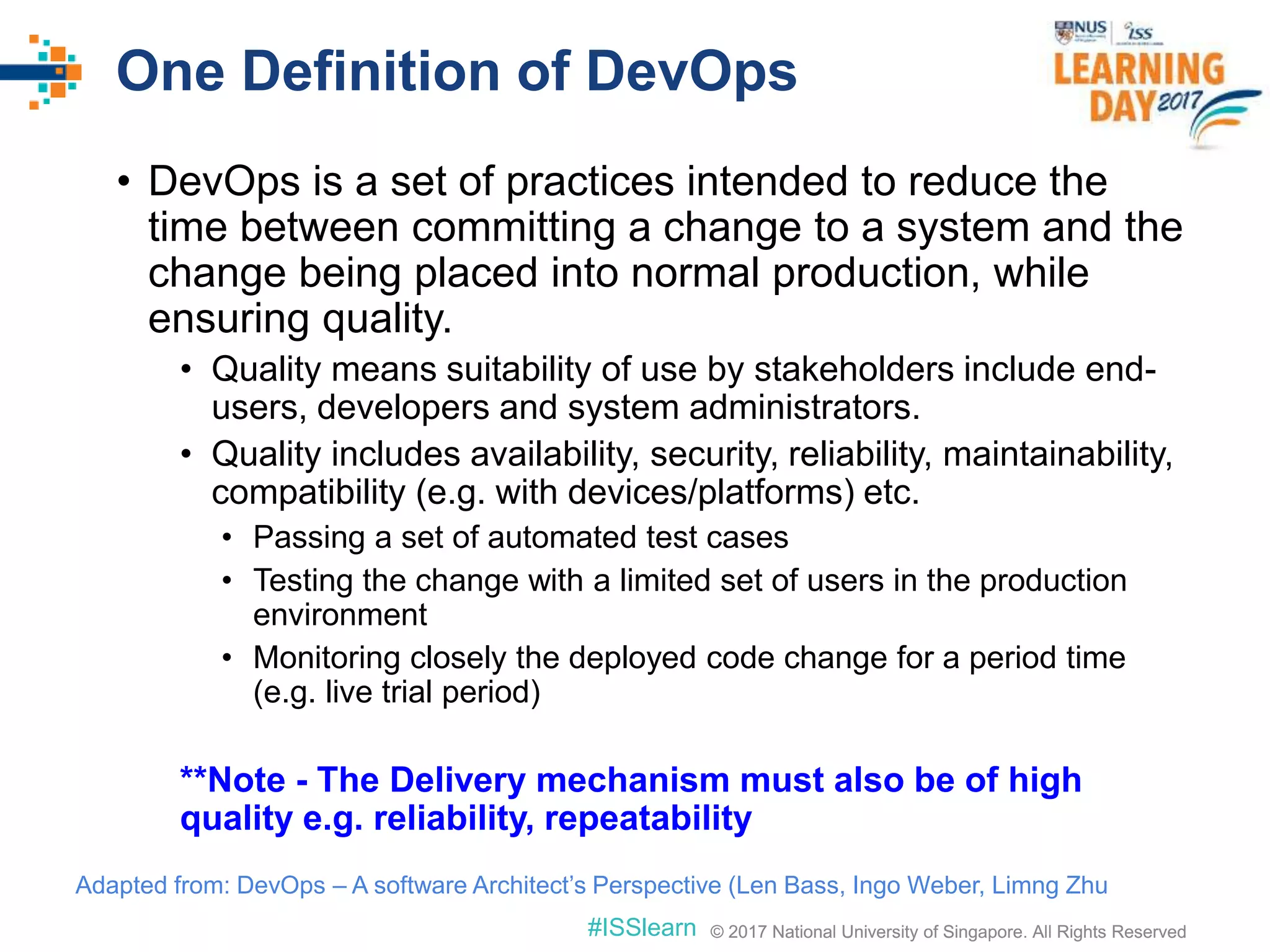
• DevOps is a set of practices intended to reduce the
time between committing a change to a system and the
change being placed into normal production, while
ensuring quality.
• Quality means suitability of use by stakeholders include end-
users, developers and system administrators.
• Quality includes availability, security, reliability, maintainability,
compatibility (e.g. with devices/platforms) etc.
• Passing a set of automated test cases
• Testing the change with a limited set of users in the production
environment
• Monitoring closely the deployed code change for a period time
(e.g. live trial period)
**Note - The Delivery mechanism must also be of high
quality e.g. reliability, repeatability
Adapted from: DevOps – A software Architect’s Perspective (Len Bass, Ingo Weber, Limng Zhu
© 2017 National University of Singapore. All Rights Reserved#ISSlearn © 2017 National University of Singapore. All Rights Reserved
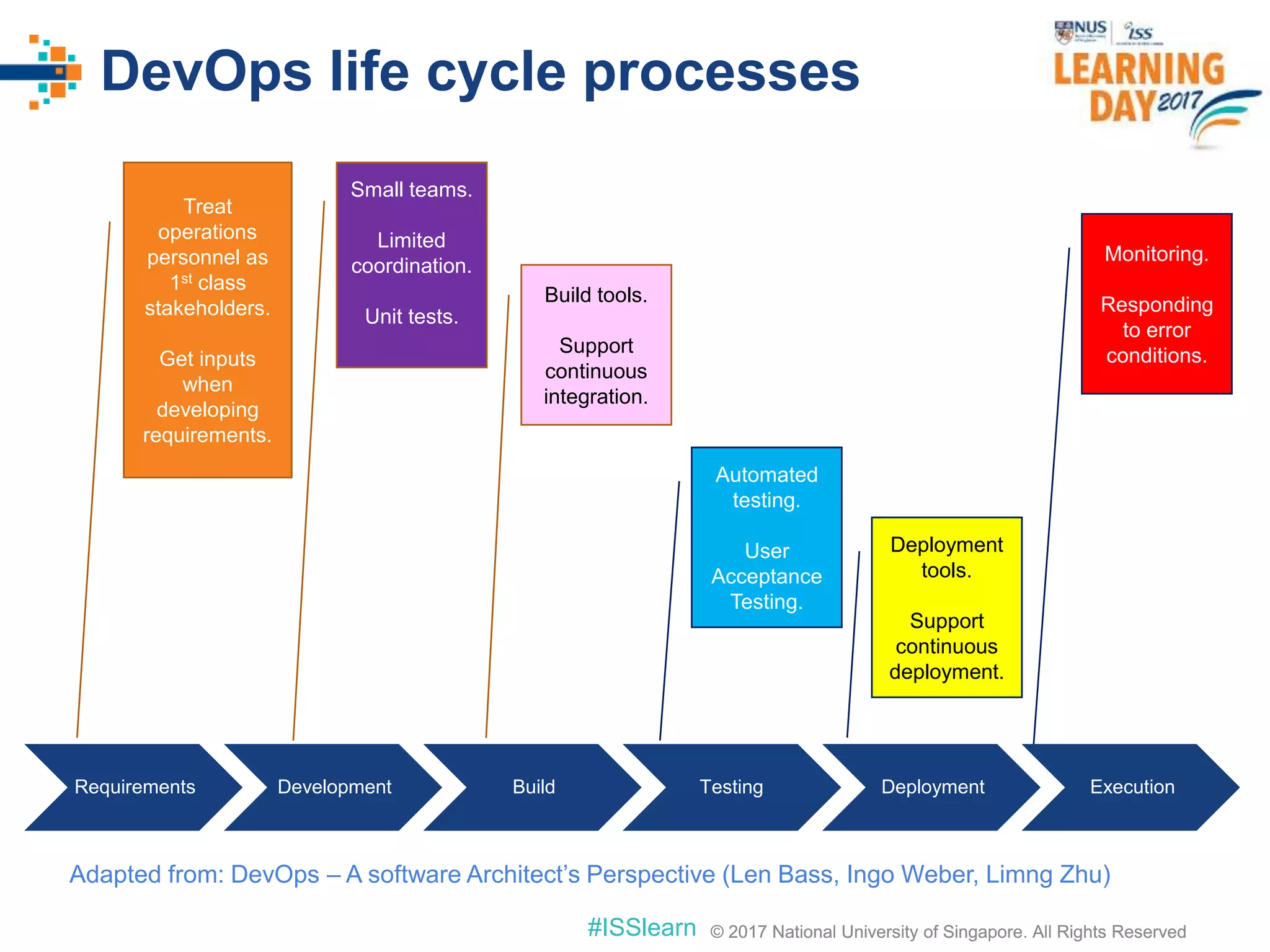
DevOps life cycle processes
Requirements Development Build Testing Deployment Execution
Treat
operations
personnel as
1st class
stakeholders.
Get inputs
when
developing
requirements.
Small teams.
Limited
coordination.
Unit tests.
Build tools.
Support
continuous
integration.
Automated
testing.
User
Acceptance
Testing.
Deployment
tools.
Support
continuous
deployment.
Monitoring.
Responding
to error
conditions.
Adapted from: DevOps – A software Architect’s Perspective (Len Bass, Ingo Weber, Limng Zhu)
© 2017 National University of Singapore. All Rights Reserved#ISSlearn © 2017 National University of Singapore. All Rights Reserved
CYBER-SECURITY
ZERO DAY
29
© 2017 National University of Singapore. All Rights Reserved#ISSlearn © 2017 National University of Singapore. All Rights Reserved 30
© 2017 National University of Singapore. All Rights Reserved#ISSlearn © 2017 National University of Singapore. All Rights Reserved
© 2016 National University of
Singapore. All Rights Reserved
31
In Space, No One can Hear You Scream
© 2017 National University of Singapore. All Rights Reserved#ISSlearn © 2017 National University of Singapore. All Rights Reserved 32
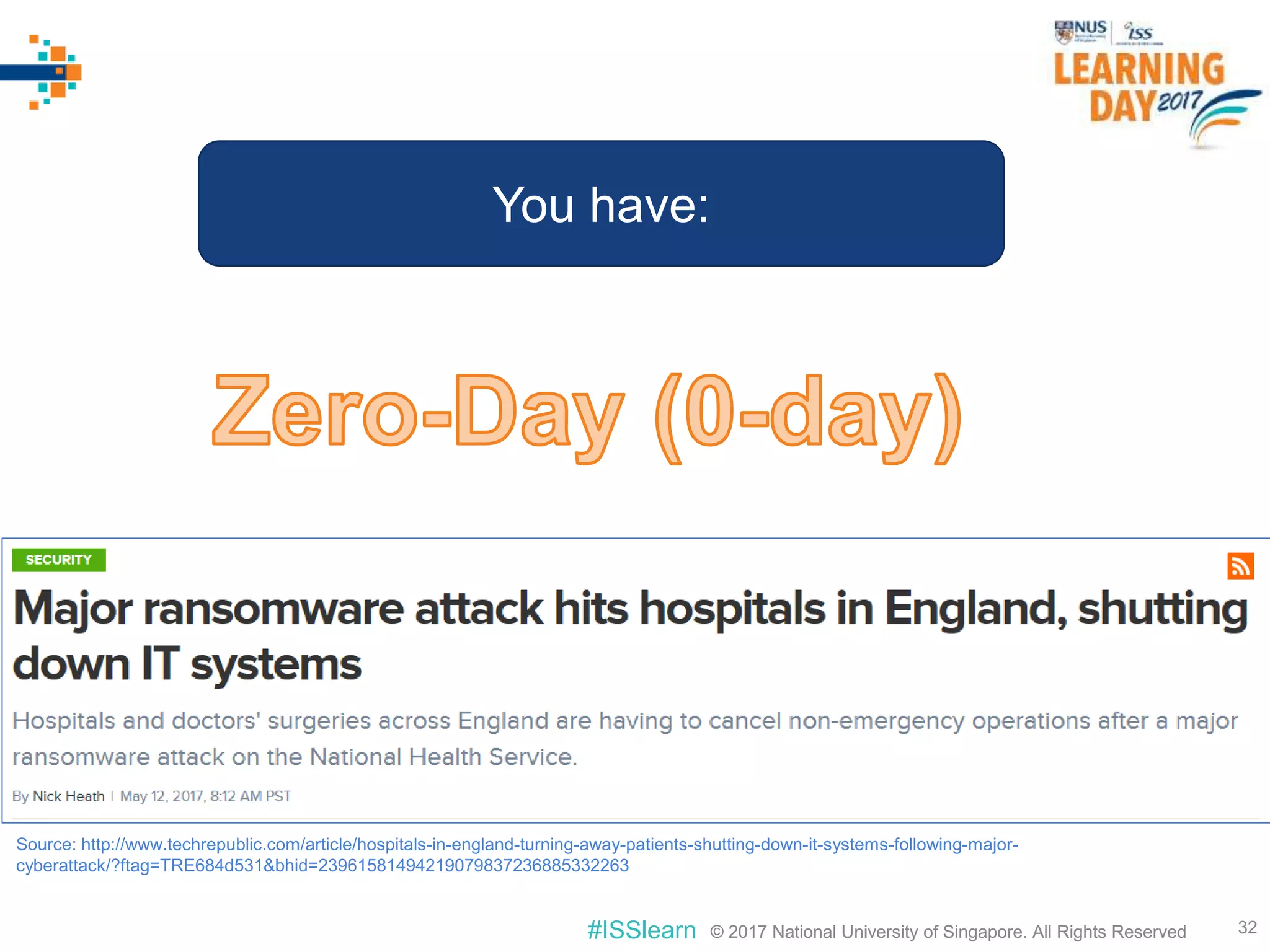
You have:
Source: http://www.techrepublic.com/article/hospitals-in-england-turning-away-patients-shutting-down-it-systems-following-major-
cyberattack/?ftag=TRE684d531&bhid=23961581494219079837236885332263
© 2017 National University of Singapore. All Rights Reserved#ISSlearn © 2017 National University of Singapore. All Rights Reserved
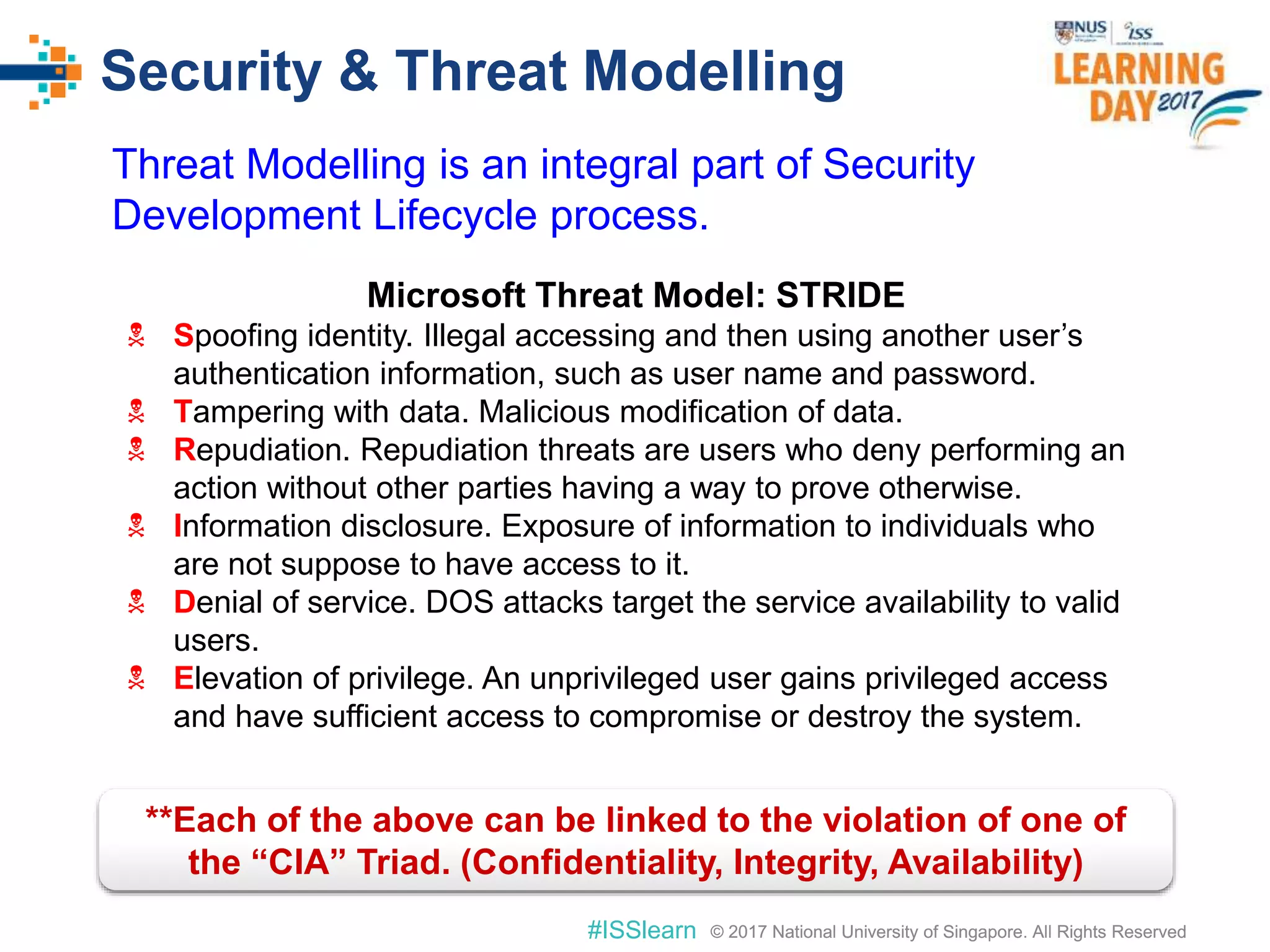
Security & Threat Modelling
Microsoft Threat Model: STRIDE
 Spoofing identity. Illegal accessing and then using another user’s
authentication information, such as user name and password.
 Tampering with data. Malicious modification of data.
 Repudiation. Repudiation threats are users who deny performing an
action without other parties having a way to prove otherwise.
 Information disclosure. Exposure of information to individuals who
are not suppose to have access to it.
 Denial of service. DOS attacks target the service availability to valid
users.
 Elevation of privilege. An unprivileged user gains privileged access
and have sufficient access to compromise or destroy the system.
**Each of the above can be linked to the violation of one of
the “CIA” Triad. (Confidentiality, Integrity, Availability)
Threat Modelling is an integral part of Security
Development Lifecycle process.
© 2017 National University of Singapore. All Rights Reserved#ISSlearn © 2017 National University of Singapore. All Rights Reserved
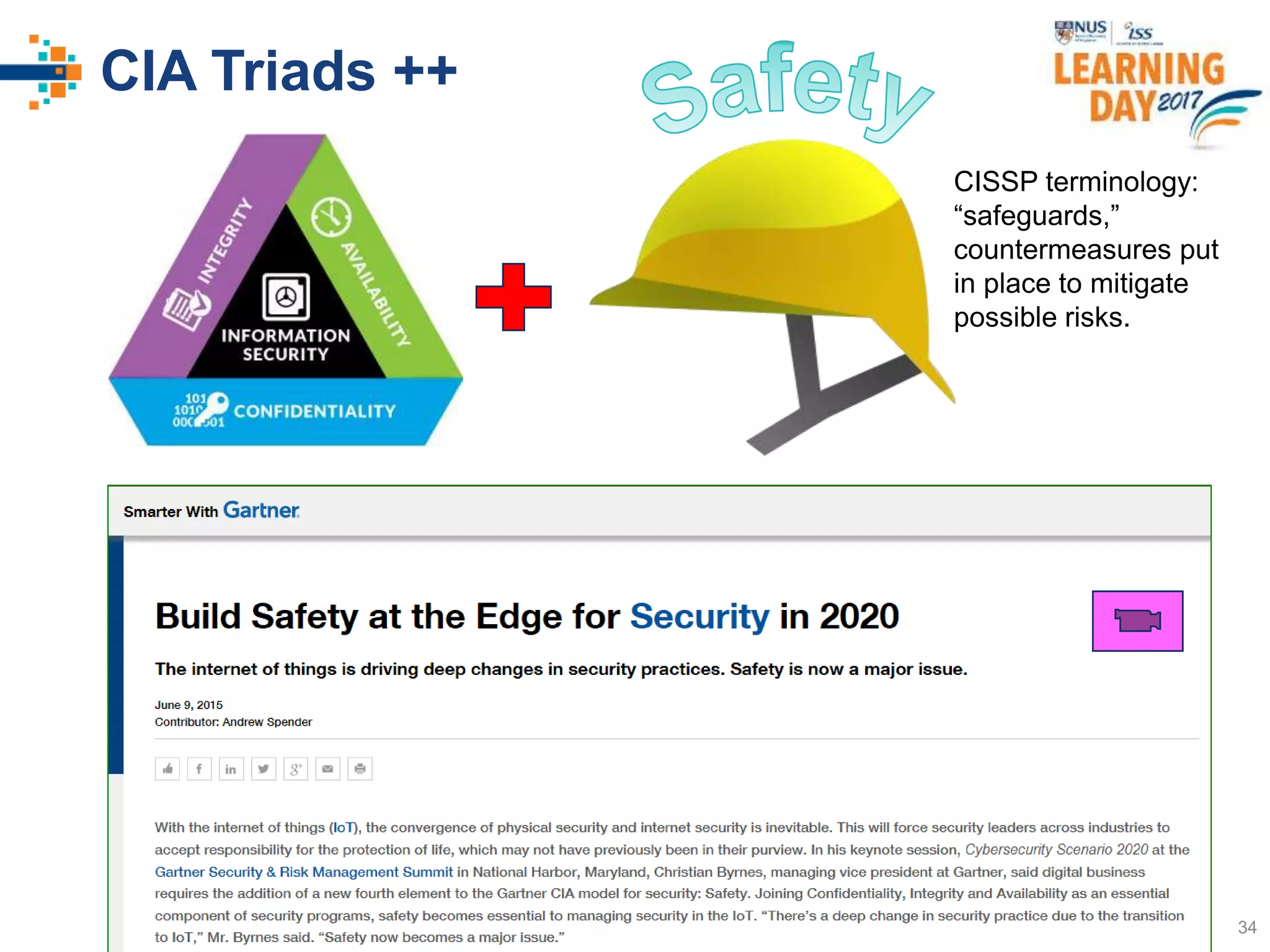
CIA Triads ++
© 2016 National University of
Singapore. All Rights Reserved
34
CISSP terminology:
“safeguards,”
countermeasures put
in place to mitigate
possible risks.
© 2017 National University of Singapore. All Rights Reserved#ISSlearn © 2017 National University of Singapore. All Rights Reserved
NEW NORMAL IN PROJECT
APPROACHES
AGILE, SCRUM, KANBAN …
35
© 2017 National University of Singapore. All Rights Reserved#ISSlearn © 2017 National University of Singapore. All Rights Reserved 36
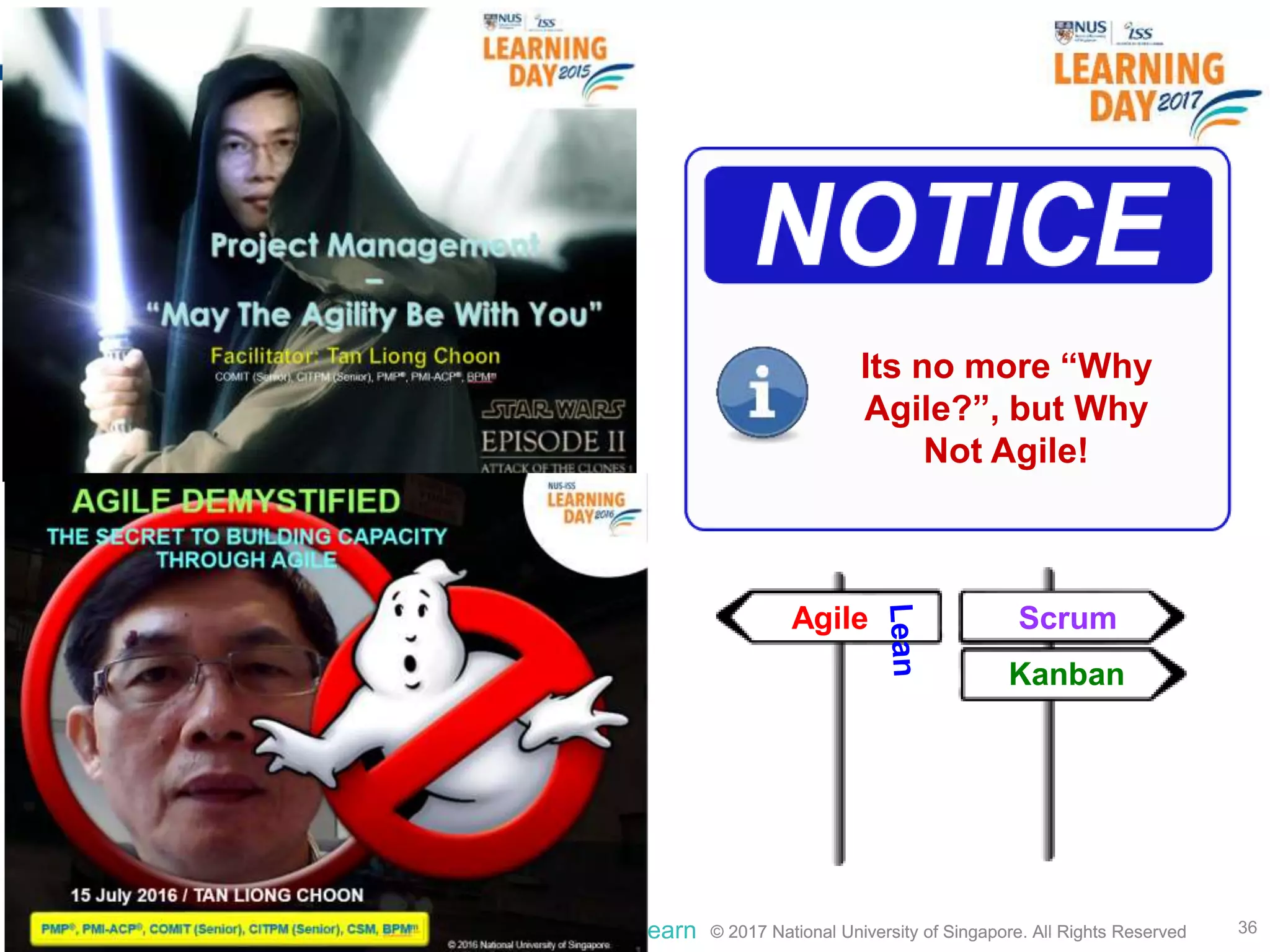
Agile Scrum
Kanban
Its no more “Why
Agile?”, but Why
Not Agile!
© 2017 National University of Singapore. All Rights Reserved#ISSlearn © 2017 National University of Singapore. All Rights Reserved
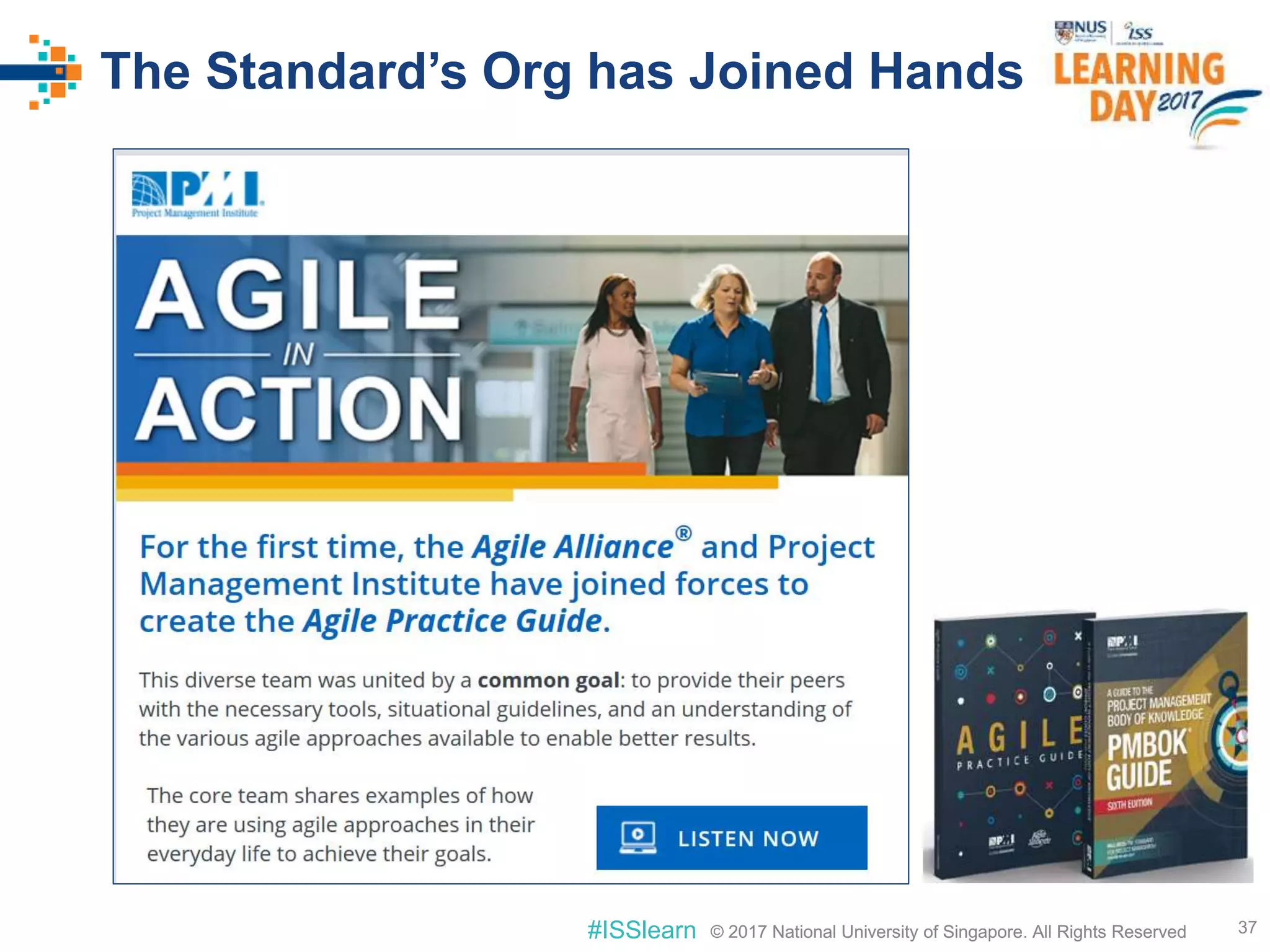
The Standard’s Org has Joined Hands
37
© 2017 National University of Singapore. All Rights Reserved
#ISSlearn
© 2017 National University of Singapore. All Rights Reserved
IS TRADITIONAL PROJECT
MANAGEMENT STILL RELEVANT?
BACK TO BASICS
38
© 2017 National University of Singapore. All Rights Reserved#ISSlearn © 2017 National University of Singapore. All Rights Reserved
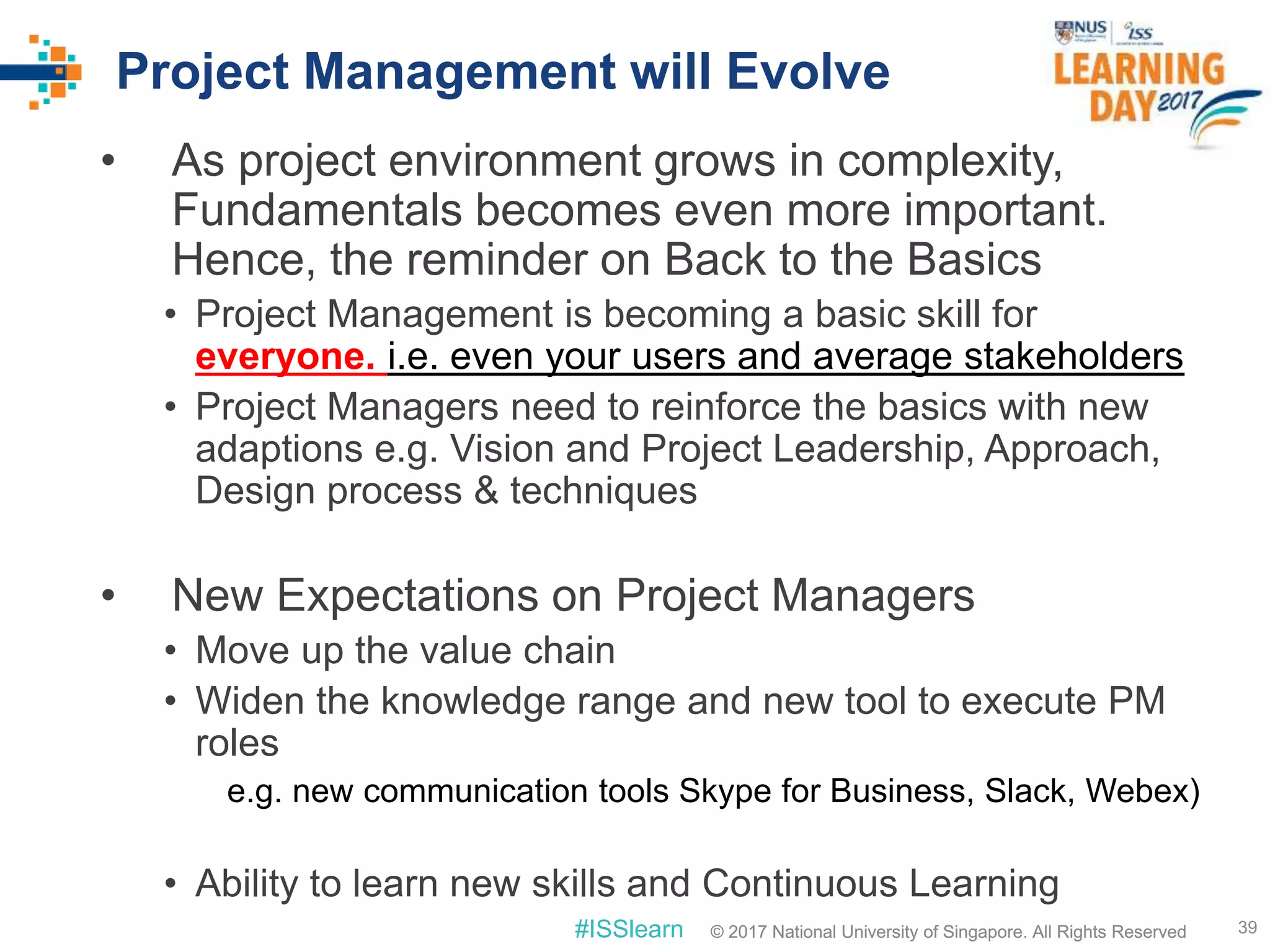
Project Management will Evolve
• As project environment grows in complexity,
Fundamentals becomes even more important.
Hence, the reminder on Back to the Basics
• Project Management is becoming a basic skill for
everyone. i.e. even your users and average stakeholders
• Project Managers need to reinforce the basics with new
adaptions e.g. Vision and Project Leadership, Approach,
Design process & techniques
• New Expectations on Project Managers
• Move up the value chain
• Widen the knowledge range and new tool to execute PM
roles
e.g. new communication tools Skype for Business, Slack, Webex)
• Ability to learn new skills and Continuous Learning
39
© 2017 National University of Singapore. All Rights Reserved#ISSlearn © 2017 National University of Singapore. All Rights Reserved
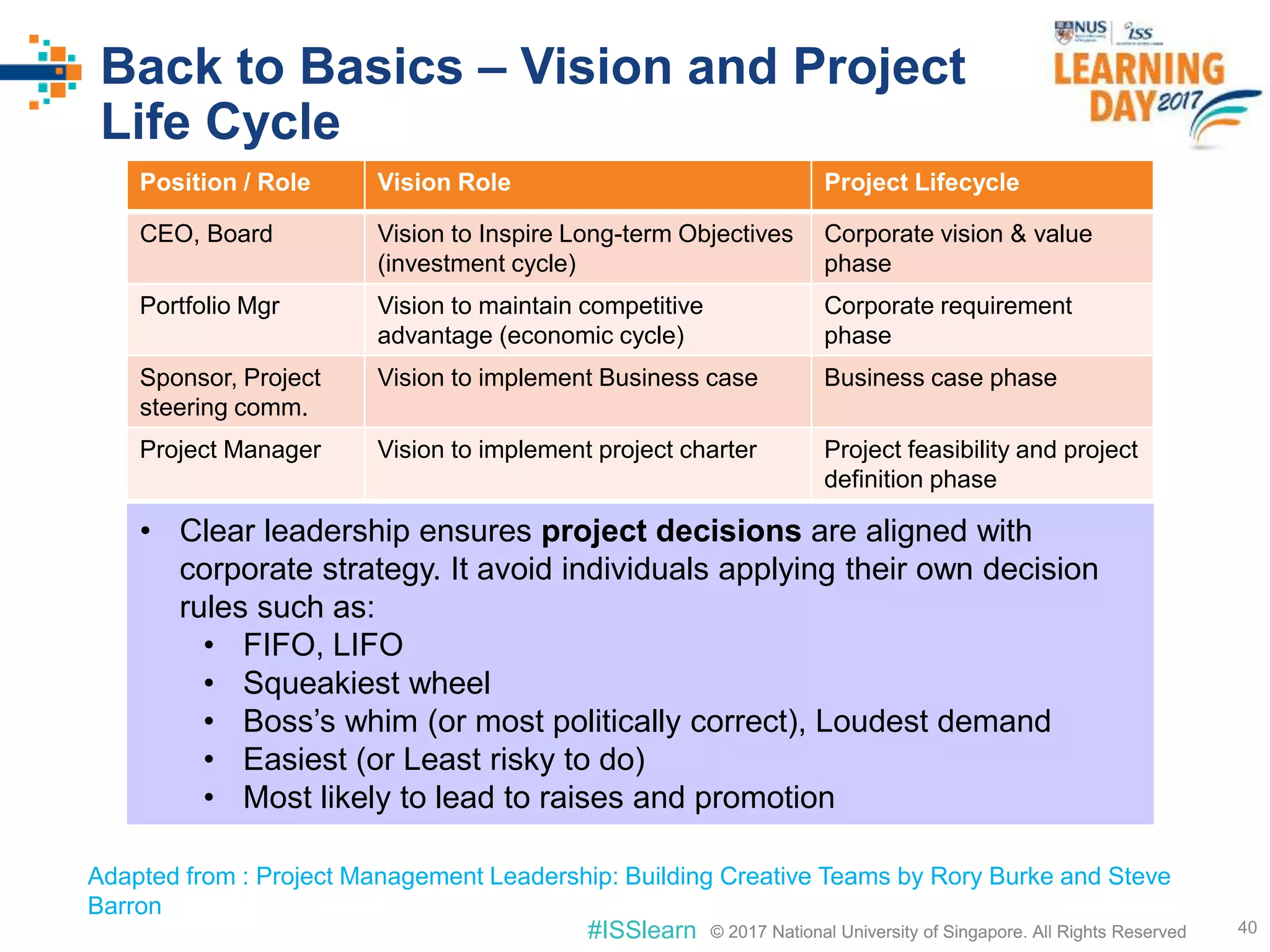
Back to Basics – Vision and Project
Life Cycle
40
Position / Role Vision Role Project Lifecycle
CEO, Board Vision to Inspire Long-term Objectives
(investment cycle)
Corporate vision & value
phase
Portfolio Mgr Vision to maintain competitive
advantage (economic cycle)
Corporate requirement
phase
Sponsor, Project
steering comm.
Vision to implement Business case Business case phase
Project Manager Vision to implement project charter Project feasibility and project
definition phase
• Clear leadership ensures project decisions are aligned with
corporate strategy. It avoid individuals applying their own decision
rules such as:
• FIFO, LIFO
• Squeakiest wheel
• Boss’s whim (or most politically correct), Loudest demand
• Easiest (or Least risky to do)
• Most likely to lead to raises and promotion
Adapted from : Project Management Leadership: Building Creative Teams by Rory Burke and Steve
Barron
© 2017 National University of Singapore. All Rights Reserved#ISSlearn © 2017 National University of Singapore. All Rights Reserved
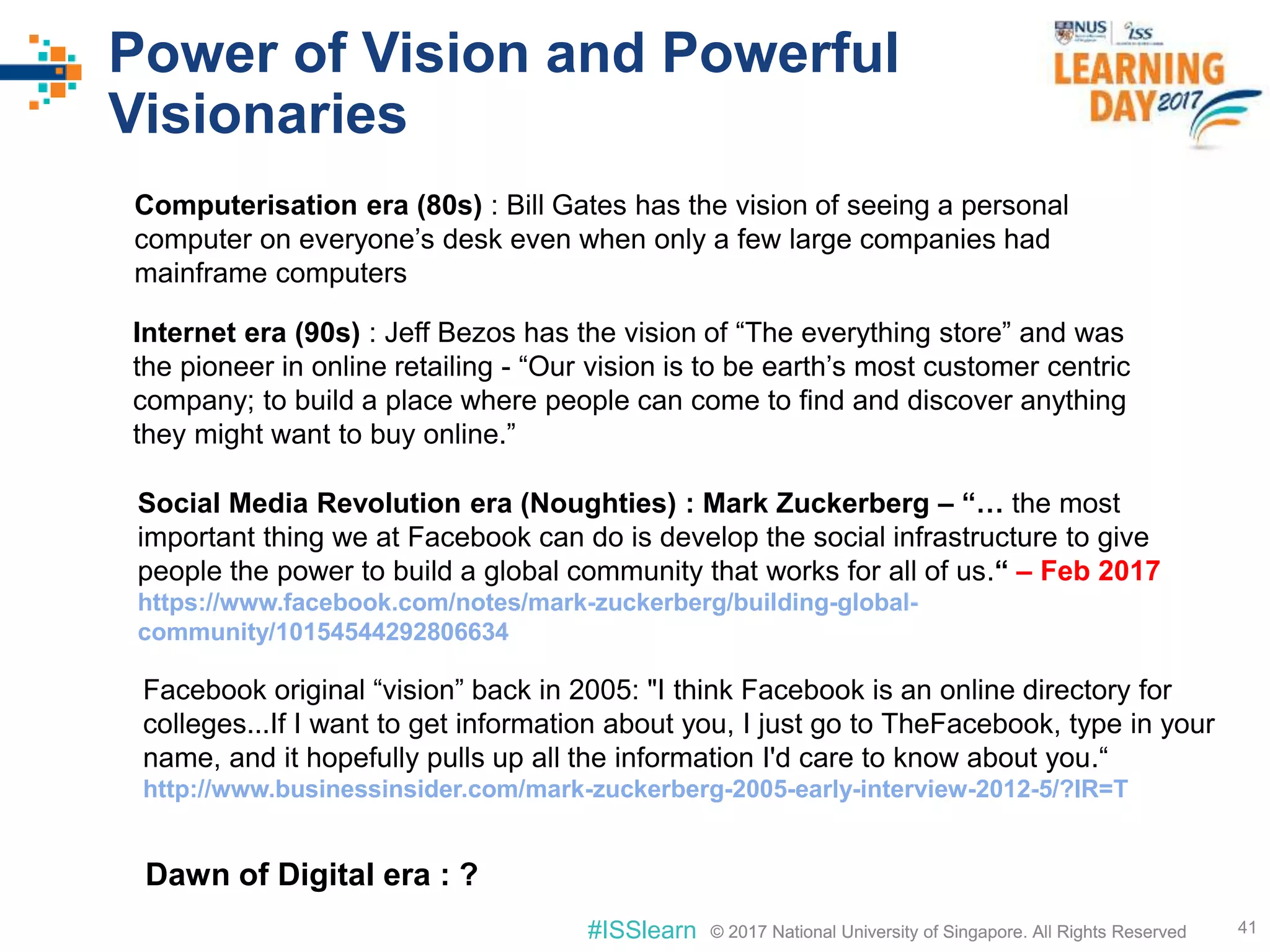
Power of Vision and Powerful
Visionaries
41
Computerisation era (80s) : Bill Gates has the vision of seeing a personal
computer on everyone’s desk even when only a few large companies had
mainframe computers
Internet era (90s) : Jeff Bezos has the vision of “The everything store” and was
the pioneer in online retailing - “Our vision is to be earth’s most customer centric
company; to build a place where people can come to find and discover anything
they might want to buy online.”
Social Media Revolution era (Noughties) : Mark Zuckerberg – “… the most
important thing we at Facebook can do is develop the social infrastructure to give
people the power to build a global community that works for all of us.“ – Feb 2017
https://www.facebook.com/notes/mark-zuckerberg/building-global-
community/10154544292806634
Dawn of Digital era : ?
Facebook original “vision” back in 2005: "I think Facebook is an online directory for
colleges...If I want to get information about you, I just go to TheFacebook, type in your
name, and it hopefully pulls up all the information I'd care to know about you.“
http://www.businessinsider.com/mark-zuckerberg-2005-early-interview-2012-5/?IR=T
© 2017 National University of Singapore. All Rights Reserved#ISSlearn © 2017 National University of Singapore. All Rights Reserved
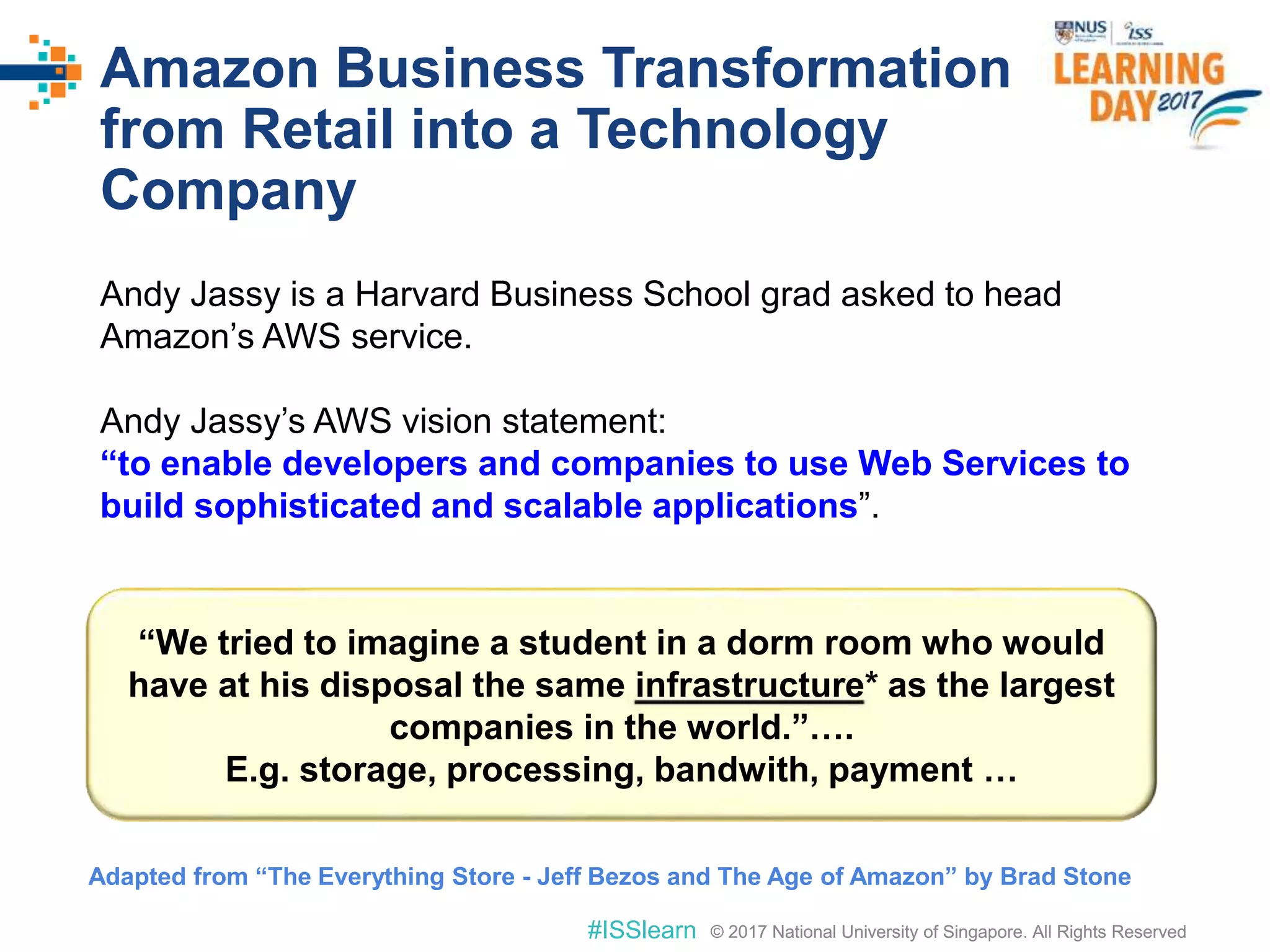
Amazon Business Transformation
from Retail into a Technology
Company
Andy Jassy is a Harvard Business School grad asked to head
Amazon’s AWS service.
Andy Jassy’s AWS vision statement:
“to enable developers and companies to use Web Services to
build sophisticated and scalable applications”.
“We tried to imagine a student in a dorm room who would
have at his disposal the same infrastructure* as the largest
companies in the world.”….
E.g. storage, processing, bandwith, payment …
Adapted from “The Everything Store - Jeff Bezos and The Age of Amazon” by Brad Stone
© 2017 National University of Singapore. All Rights Reserved#ISSlearn © 2017 National University of Singapore. All Rights Reserved
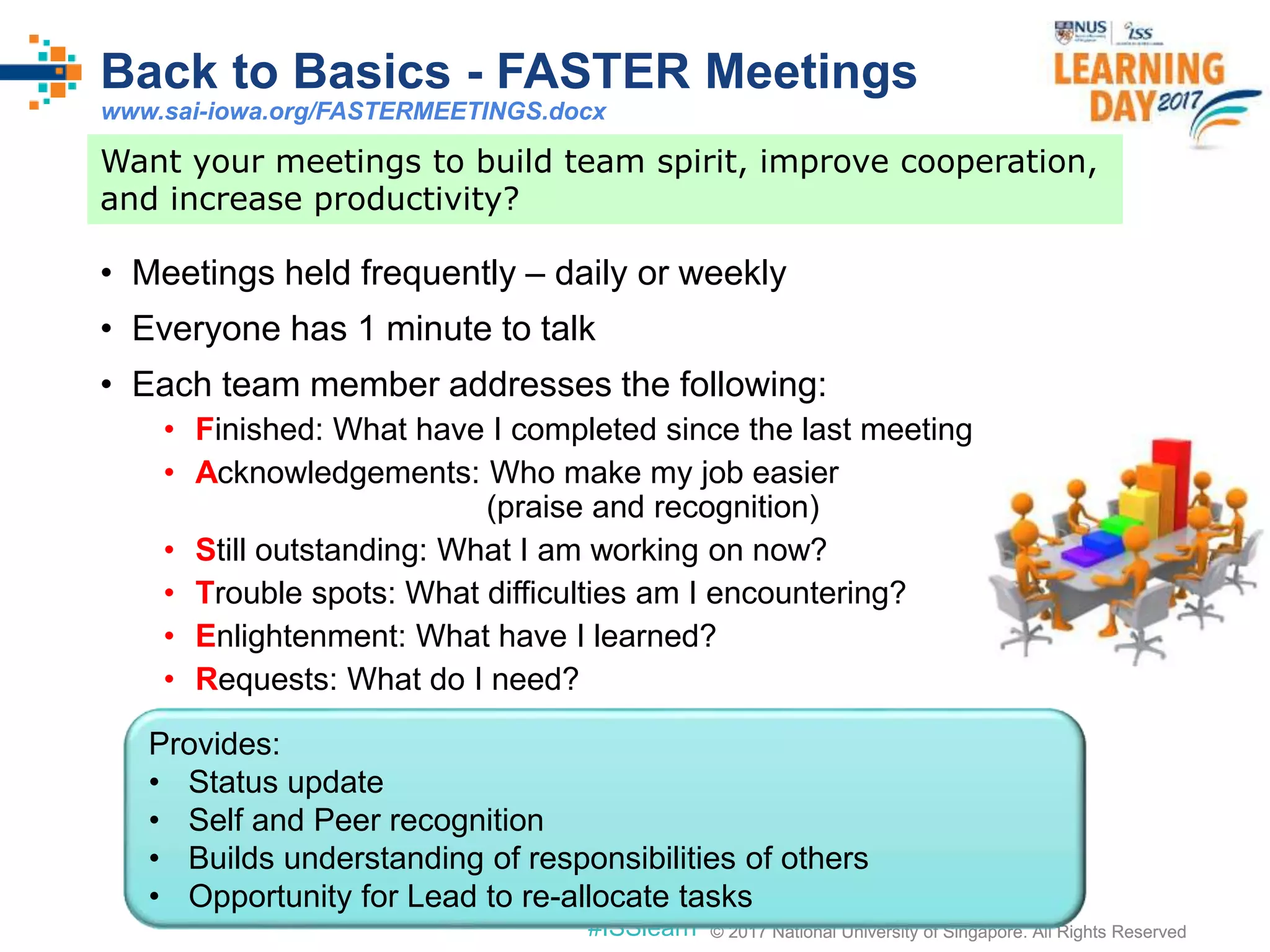
• Meetings held frequently – daily or weekly
• Everyone has 1 minute to talk
• Each team member addresses the following:
• Finished: What have I completed since the last meeting
• Acknowledgements: Who make my job easier
(praise and recognition)
• Still outstanding: What I am working on now?
• Trouble spots: What difficulties am I encountering?
• Enlightenment: What have I learned?
• Requests: What do I need?
Back to Basics - FASTER Meetings
Provides:
• Status update
• Self and Peer recognition
• Builds understanding of responsibilities of others
• Opportunity for Lead to re-allocate tasks
www.sai-iowa.org/FASTERMEETINGS.docx
Want your meetings to build team spirit, improve cooperation,
and increase productivity?
© 2017 National University of Singapore. All Rights Reserved#ISSlearn © 2017 National University of Singapore. All Rights Reserved
Back to Basics - Risk Management &
Problem Solving
44
Known Unknown
Known Not really a problem e.g.
Scope creep & changes.
Solution: consider AGILE
approach, setup Change
Control Board, ,,,
Technical Design Activity
e.g. Accepted User interface
design Options: wireframe/
prototyping, A/B testing, etc
Unknown Methods & Procedure.
e.g. software defects
Solution: Conduct testings –
unit-testing, integration/
system testing, UAT, agile
continuous integration, …
Consider User Research,
Pretotype, POC, pilot trial,
Ethnography,
then design solution
e.g. Technical feasibility,
benchmarking performance
targets
Solution
Risk/Problem
© 2017 National University of Singapore. All Rights Reserved#ISSlearn © 2017 National University of Singapore. All Rights Reserved(Total Slides=8) T:S-ITSM-FOMModule 1 v3.pptx © 2016 National University of
Singapore. All Rights Reserved
45
© 2017 National University of Singapore. All Rights Reserved
#ISSlearn
© 2017 National University of Singapore. All Rights Reserved
CONCLUSION
CALL TO ACTION
46
© 2017 National University of Singapore. All Rights Reserved#ISSlearn © 2017 National University of Singapore. All Rights Reserved
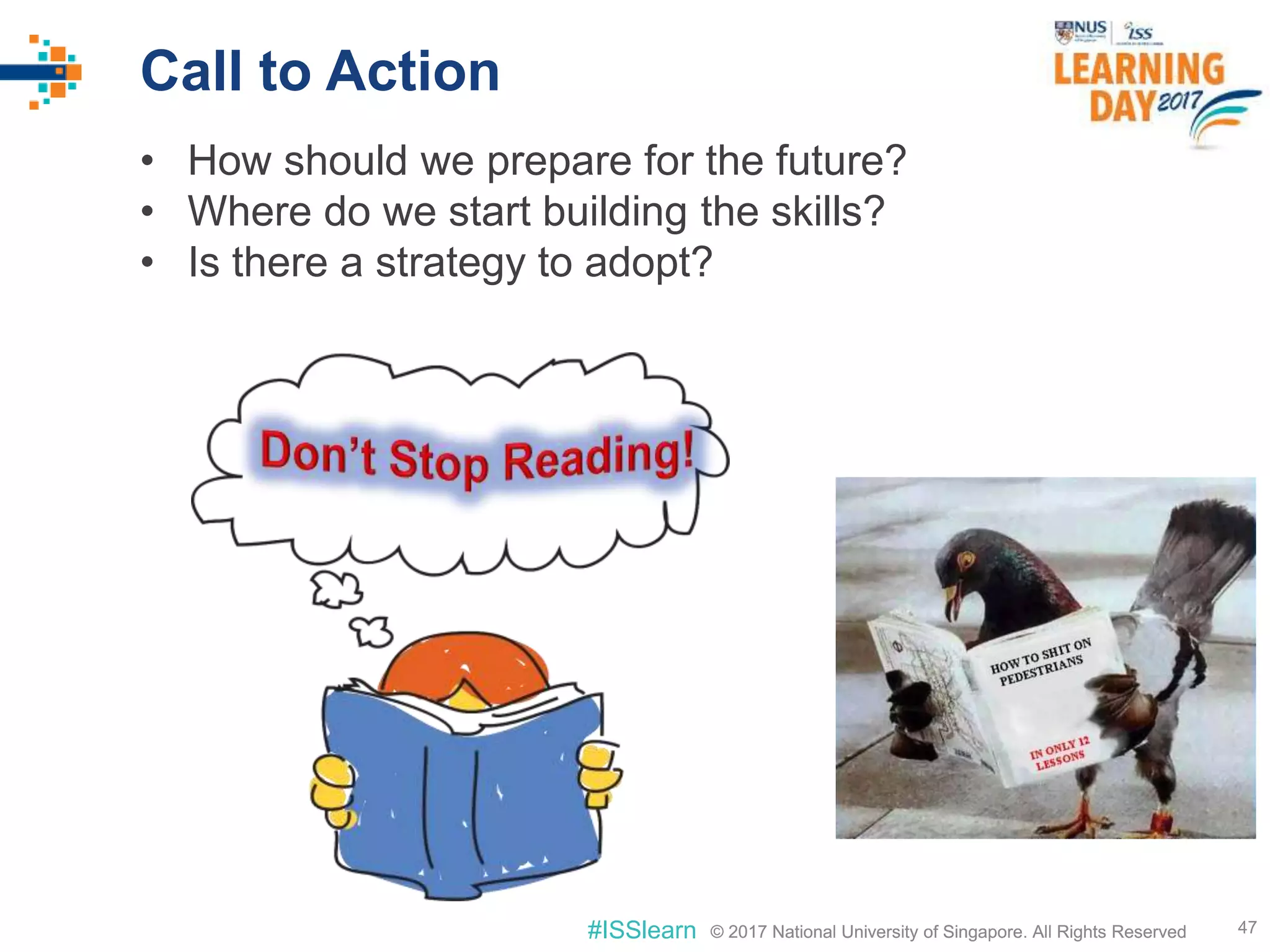
Call to Action
47
• How should we prepare for the future?
• Where do we start building the skills?
• Is there a strategy to adopt?
© 2017 National University of Singapore. All Rights Reserved#ISSlearn © 2017 National University of Singapore. All Rights Reserved
Amazon Transformation Revisited
48
How did Amazon morphed from a Retail Store (selling books)
into a radically different seller of high tech infrastructure?
• Sometime in 2003: Bezos come to know of a book “Creation” by Steve
Grand. (a developer of video game Creatures where players guide and
nurture intelligent organism on computer screens).
• Steve Grand’s book highlight that the approach to creating intelligent life
is “to focus on designing simple computational building block, called
primitives, and then sit back and watch surprising behavior emerge.”
Adapted from: The Everything Store - Jeff Bezos and The Age of Amazon by Brad Stone
• From this “building block” idea, Amazon started creating “computing”
primitives by breaking down their tech infrastructure into the smallest,
simplest atomic components and allow developers to freely access them
with as much flexibility as possible. E.g. storage, bandwidth, processing,
payment… and the S3 and AWS was borned.
© 2017 National University of Singapore. All Rights Reserved#ISSlearn © 2017 National University of Singapore. All Rights Reserved
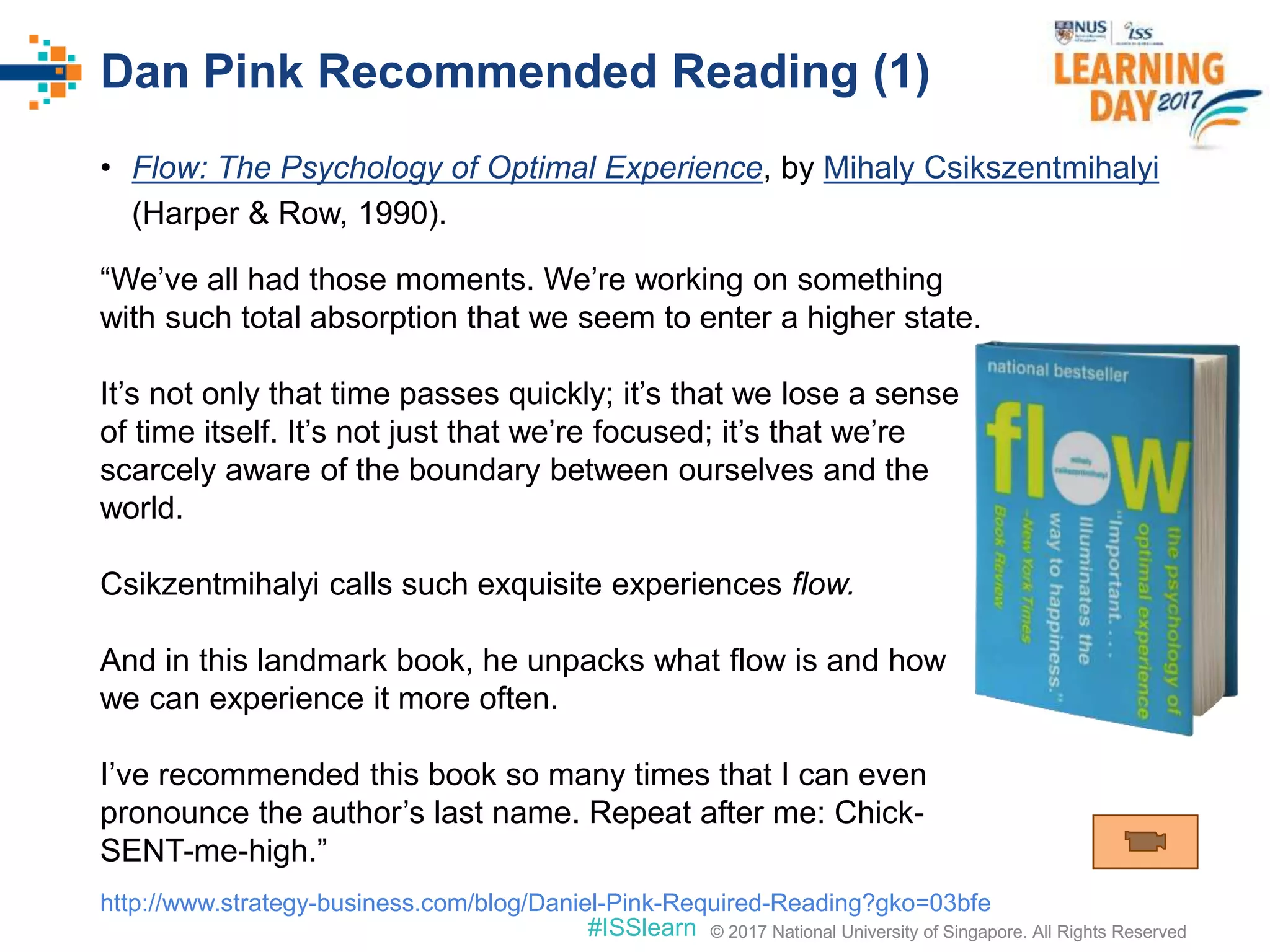
• Flow: The Psychology of Optimal Experience, by Mihaly Csikszentmihalyi
(Harper & Row, 1990).
Dan Pink Recommended Reading (1)
“We’ve all had those moments. We’re working on something
with such total absorption that we seem to enter a higher state.
It’s not only that time passes quickly; it’s that we lose a sense
of time itself. It’s not just that we’re focused; it’s that we’re
scarcely aware of the boundary between ourselves and the
world.
Csikzentmihalyi calls such exquisite experiences flow.
And in this landmark book, he unpacks what flow is and how
we can experience it more often.
I’ve recommended this book so many times that I can even
pronounce the author’s last name. Repeat after me: Chick-
SENT-me-high.”
http://www.strategy-business.com/blog/Daniel-Pink-Required-Reading?gko=03bfe
© 2017 National University of Singapore. All Rights Reserved#ISSlearn © 2017 National University of Singapore. All Rights Reserved
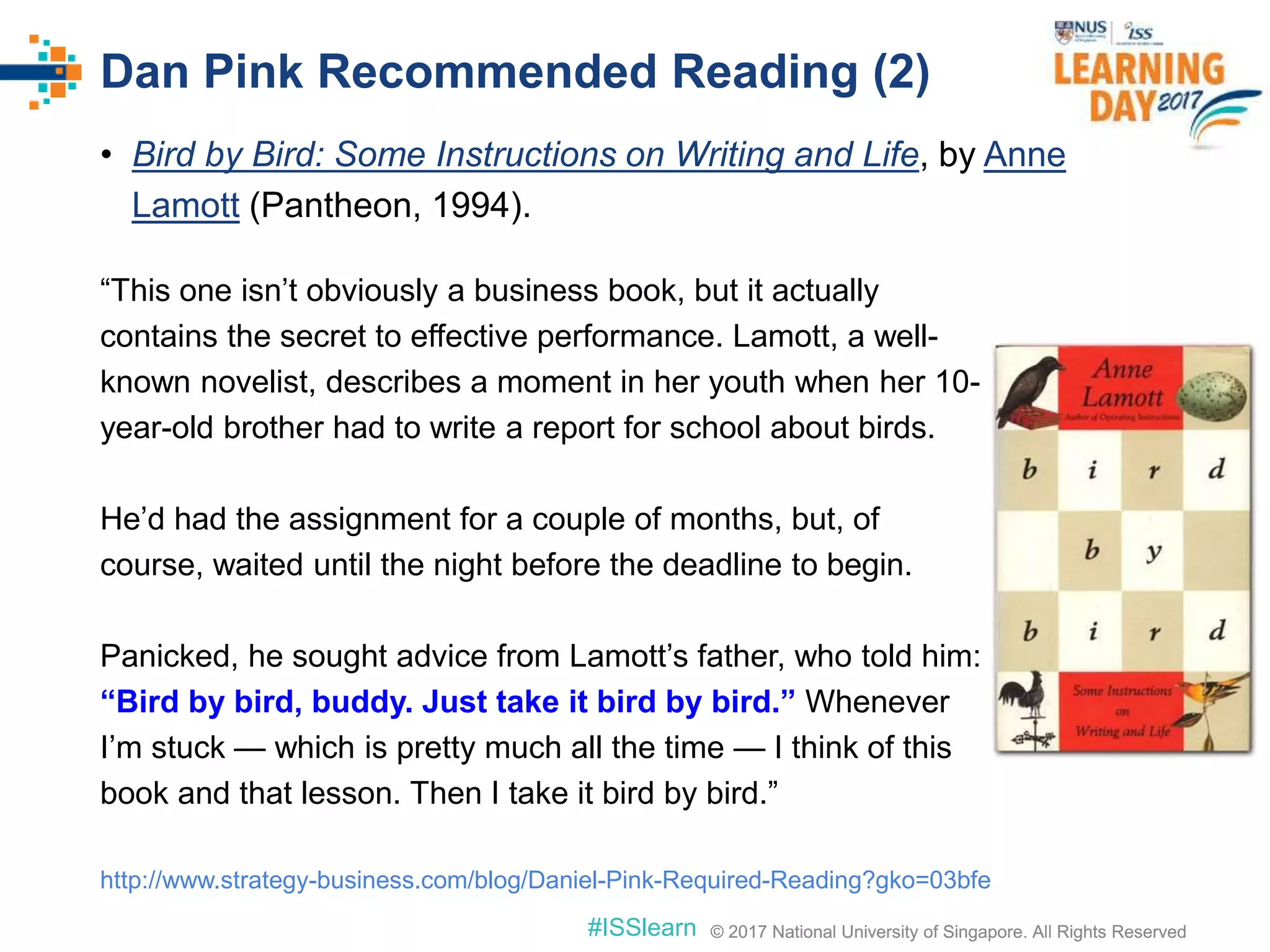
• Bird by Bird: Some Instructions on Writing and Life, by Anne
Lamott (Pantheon, 1994).
Dan Pink Recommended Reading (2)
“This one isn’t obviously a business book, but it actually
contains the secret to effective performance. Lamott, a well-
known novelist, describes a moment in her youth when her 10-
year-old brother had to write a report for school about birds.
He’d had the assignment for a couple of months, but, of
course, waited until the night before the deadline to begin.
Panicked, he sought advice from Lamott’s father, who told him:
“Bird by bird, buddy. Just take it bird by bird.” Whenever
I’m stuck — which is pretty much all the time — I think of this
book and that lesson. Then I take it bird by bird.”
http://www.strategy-business.com/blog/Daniel-Pink-Required-Reading?gko=03bfe
© 2017 National University of Singapore. All Rights Reserved#ISSlearn © 2017 National University of Singapore. All Rights Reserved
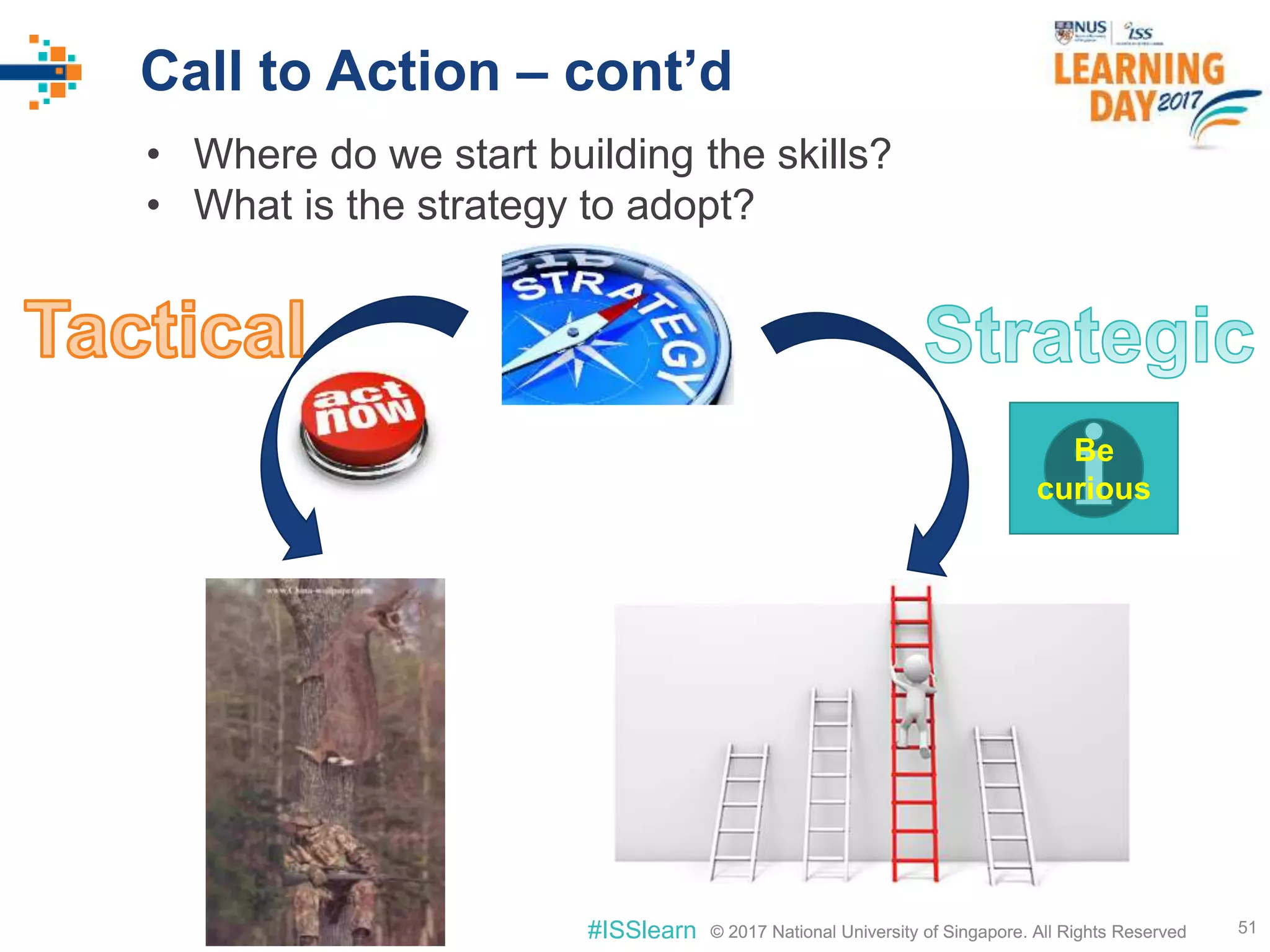
Call to Action – cont’d
51
• Where do we start building the skills?
• What is the strategy to adopt?
Be
curious
© 2017 National University of Singapore. All Rights Reserved#ISSlearn © 2017 National University of Singapore. All Rights Reserved
THANK YOU 
ISSTLC@nus.edu.sg
52
Breaking News
© 2017 National University of Singapore. All Rights Reserved#ISSlearn © 2017 National University of Singapore. All Rights Reserved
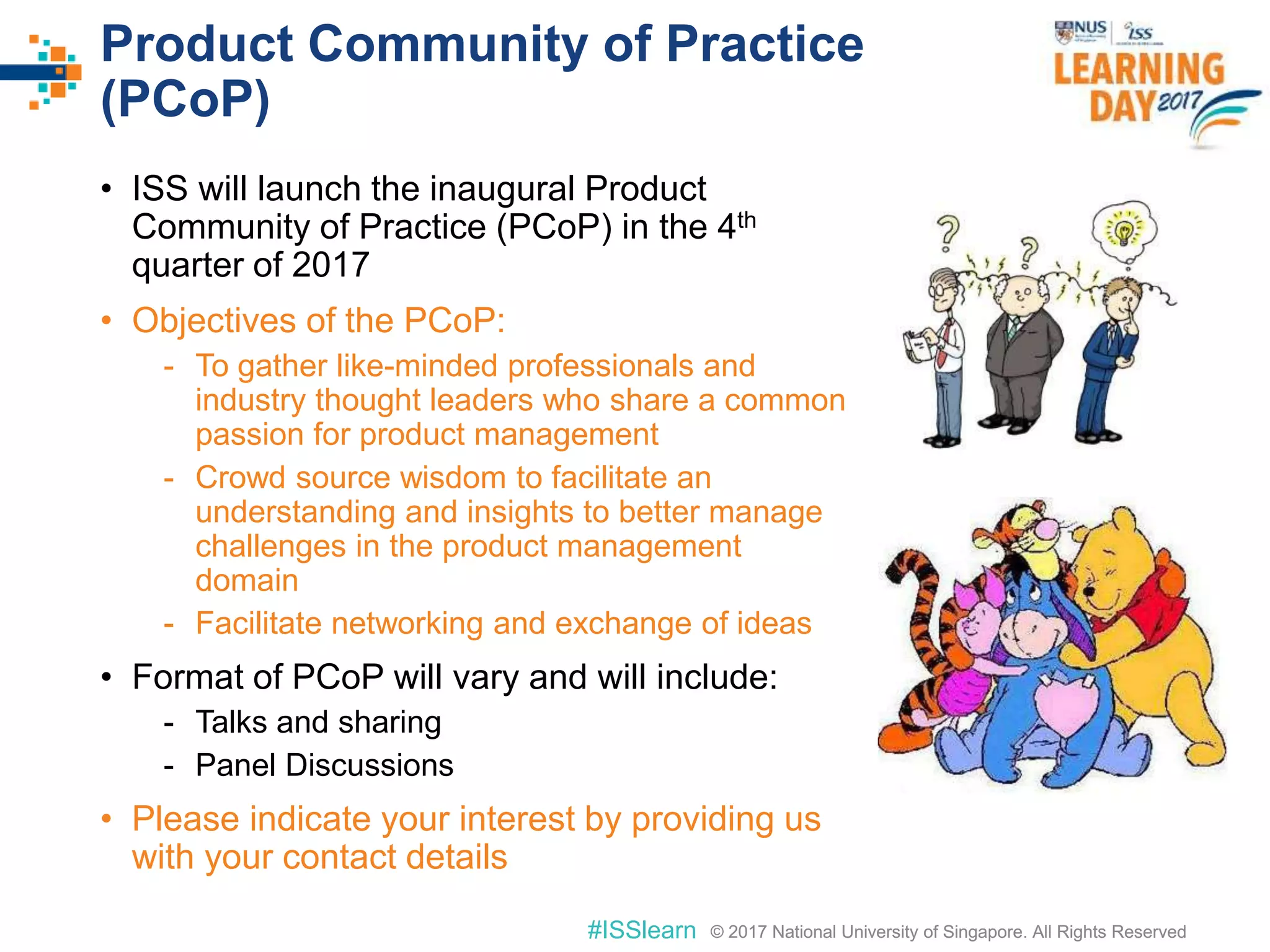
Product Community of Practice
(PCoP)
• ISS will launch the inaugural Product
Community of Practice (PCoP) in the 4th
quarter of 2017
• Objectives of the PCoP:
- To gather like-minded professionals and
industry thought leaders who share a common
passion for product management
- Crowd source wisdom to facilitate an
understanding and insights to better manage
challenges in the product management
domain
- Facilitate networking and exchange of ideas
• Format of PCoP will vary and will include:
- Talks and sharing
- Panel Discussions
• Please indicate your interest by providing us
with your contact details
© 2017 National University of Singapore. All Rights Reserved#ISSlearn © 2017 National University of Singapore. All Rights Reserved
Poor Design – The IT Response
“I like to think I’m decent at what I do, and I know the others I work with
here are all pretty good. The problem with the design of AA.com, however,
lies less in our competency (or lack thereof as you point out in your post)
and more with the culture and processes employed here at American
Airlines.
The group running AA.com consists of at least 200 people spread out
among many different groups, including, for example, QA, product
planning, business analysis, code development, site operations, project
planning, and user experience. We have a lot of people touching the site,
and a lot more with their own vested interests in how the site presents its
content and functionality….
It only takes a few hours to put together a really good-looking one, as
you demonstrated in your post. But doing the design isn’t the hard part,
and I think that is what a lot of outsiders don’t really get, probably
because many of them actually do belong to small, just-get-it-done
organisations….
© 2017 National University of Singapore. All Rights Reserved#ISSlearn © 2017 National University of Singapore. All Rights Reserved
Business Meets Design – The
Response cont’d
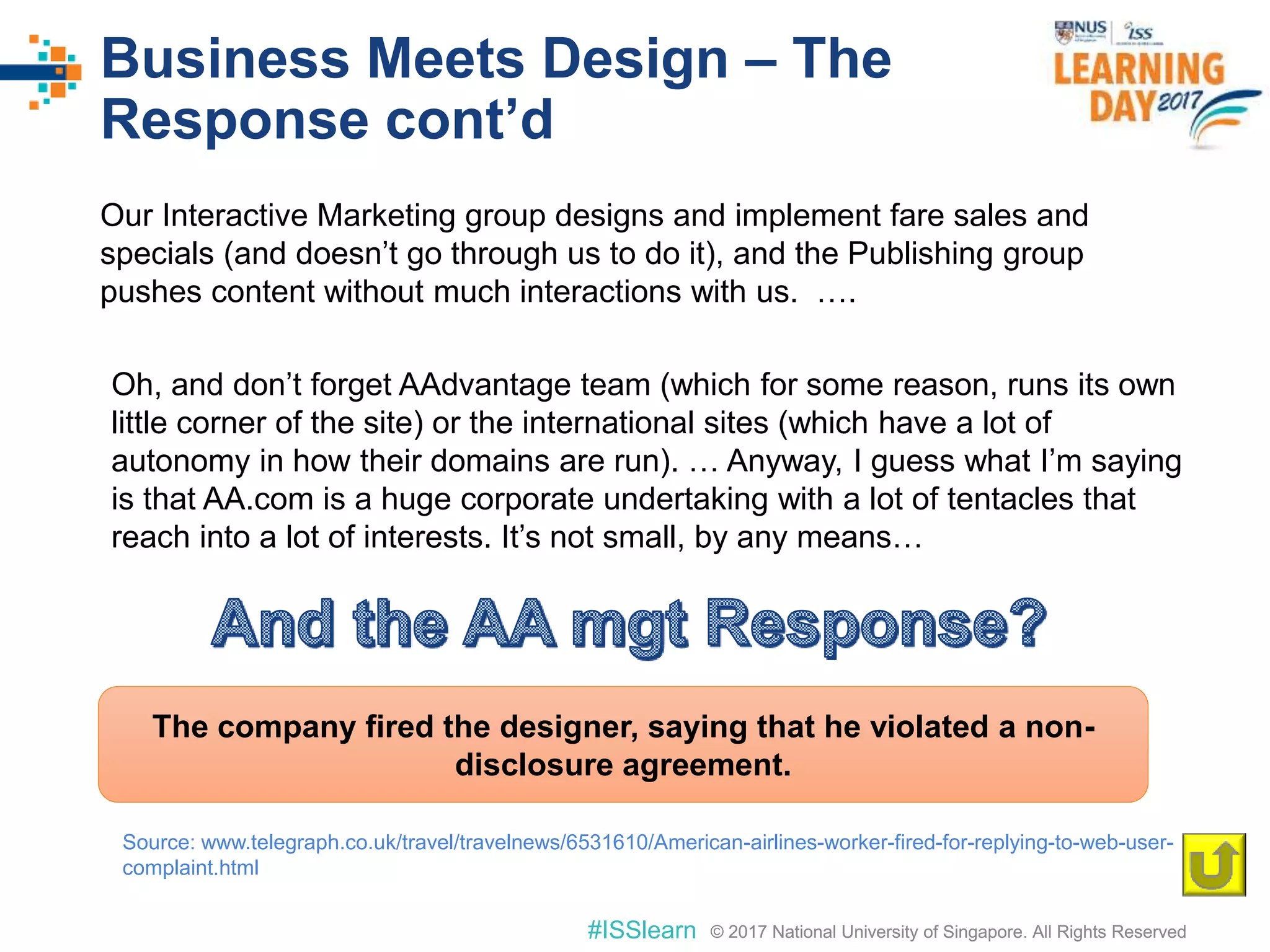
Our Interactive Marketing group designs and implement fare sales and
specials (and doesn’t go through us to do it), and the Publishing group
pushes content without much interactions with us. ….
The company fired the designer, saying that he violated a non-
disclosure agreement.
Source: www.telegraph.co.uk/travel/travelnews/6531610/American-airlines-worker-fired-for-replying-to-web-user-
complaint.html
Oh, and don’t forget AAdvantage team (which for some reason, runs its own
little corner of the site) or the international sites (which have a lot of
autonomy in how their domains are run). … Anyway, I guess what I’m saying
is that AA.com is a huge corporate undertaking with a lot of tentacles that
reach into a lot of interests. It’s not small, by any means…
© 2017 National University of Singapore. All Rights Reserved#ISSlearn © 2017 National University of Singapore. All Rights Reserved
Additional Reference slides
56
© 2017 National University of Singapore. All Rights Reserved#ISSlearn © 2017 National University of Singapore. All Rights Reserved(Total Slides=8) T:S-ITSM-FOMModule 1 v3.pptx 57
© 2017 National University of Singapore. All Rights Reserved#ISSlearn © 2017 National University of Singapore. All Rights Reserved
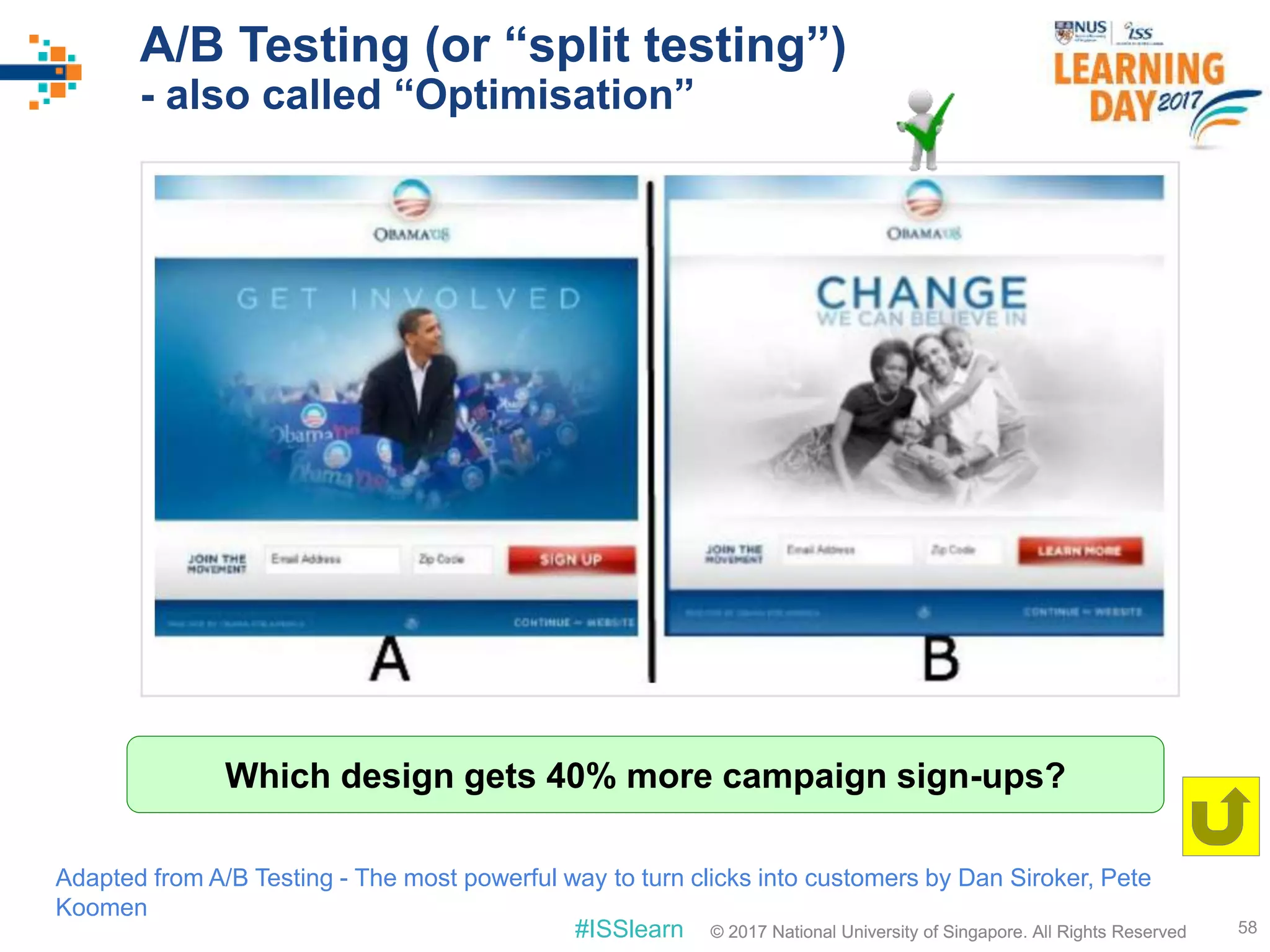
A/B Testing (or “split testing”)
- also called “Optimisation”
58
Which design gets 40% more campaign sign-ups?
Adapted from A/B Testing - The most powerful way to turn clicks into customers by Dan Siroker, Pete
Koomen

NUS-ISS Learning Day 2017 - Future Skills for Project Managers

  • 1.
    © 2017 NationalUniversity of Singapore. All Rights Reserved #ISSlearn © 2017 National University of Singapore. All Rights Reserved FUTURE SKILLS FOR PROJECT MANAGERS DIGITAL CAPABILITY NEEDED, DEADLINE YESTERDAY! 11 August / TAN LIONG CHOON 1
  • 2.
    © 2017 NationalUniversity of Singapore. All Rights Reserved#ISSlearn © 2017 National University of Singapore. All Rights Reserved 2
  • 3.
    © 2017 NationalUniversity of Singapore. All Rights Reserved#ISSlearn © 2017 National University of Singapore. All Rights Reserved OUTLINE • The Changing Business & IT Landscape • Future of Project Management & Skills to meet the Challenges of the Future 3
  • 4.
    © 2017 NationalUniversity of Singapore. All Rights Reserved#ISSlearn © 2017 National University of Singapore. All Rights Reserved 4 Volatility - the nature, speed and size of change are unpredictable. Uncertainty - an inability to determine the course of future events. Complexity - the outcome of an action cannot be predicted by simple analysis. Ambiguity - key characteristics of a situation can be interpreted in different ways.
  • 5.
    © 2017 NationalUniversity of Singapore. All Rights Reserved#ISSlearn © 2017 National University of Singapore. All Rights Reserved Disruptive Technology • When is a Technology considered disruptive? • Speed i.e. the rate at which it is adopted. E.g. The electric car, though new and considered to have great potential to replace the fuel-driven cars, is slow in adoption and did not really cause much disruption to the car market. • Totality i.e. how much of the old is replaced by the new, including adding new performance attributes that adds value to the end-users 5 “Uber, the world’s largest taxi company owns no vehicles. Facebook, the world’s most popular media owner, produces no content. Alibaba, the world’s most valuable retailer, owns no inventory. And Airbnb, the world’s largest accommodation provider, owns no real estate. Something interesting is happening.” – Tom Goodwin, Havas Media Adapted from: Disruptive Technologies. Understand, Evaluate, Respond by Paul Armstrong
  • 6.
    © 2017 NationalUniversity of Singapore. All Rights Reserved#ISSlearn © 2017 National University of Singapore. All Rights Reserved Changed and Changing – A Sampling • The Changing Landscape • Project Scoping & Requirement in a digital world – Pretotyping, Product Thinking/User Research, Design Thinking • Design & Testing - A/B Testing • Transition to Operations – DevOps, continuous integration • Cyber-Security – Zero Day • New Normal in Development approaches/practices – Agile (SCRUM, KANBAN) 6 • Future Skills and Future of Project Management • Back to Basic • Skill development strategy
  • 7.
    © 2017 NationalUniversity of Singapore. All Rights Reserved#ISSlearn © 2017 National University of Singapore. All Rights Reserved PROJECT SCOPING & REQUIREMENT IN AN INCREASINGLY DIGITIZED WORLD PRETOTYPING, PRODUCT THINKING/ USER RESEARCH, DESIGN THINKING … 7
  • 8.
    © 2017 NationalUniversity of Singapore. All Rights Reserved#ISSlearn © 2017 National University of Singapore. All Rights Reserved Pretotyping – This is not a typo error! • Term and concept of pretotyping was originally developed by Alberto Savoia in 2009 while working at Google as Engineering Director and Innovation Agitator. www.pretotyping.org If you are not failing every now and again, it’s a sign that you are not doing anything very innovative – Woody Allen
  • 9.
    © 2017 NationalUniversity of Singapore. All Rights Reserved#ISSlearn © 2017 National University of Singapore. All Rights Reserved www.pretotyping.org
  • 10.
    © 2017 NationalUniversity of Singapore. All Rights Reserved#ISSlearn © 2017 National University of Singapore. All Rights Reserved Pretotype -> Prototype -> Product www.pretotyping.org
  • 11.
    © 2017 NationalUniversity of Singapore. All Rights Reserved#ISSlearn © 2017 National University of Singapore. All Rights Reserved Product Thinking - Do People Want the Product? Concept of MVP • Is it a version 1 of a product? • Is it a cheaper version of a product (least set of features)? • Is it a functional prototype of a product? Source: Validating Product Ideas - Through Lean User Research By Tomer Sharon
  • 12.
    © 2017 NationalUniversity of Singapore. All Rights Reserved#ISSlearn © 2017 National University of Singapore. All Rights Reserved Product Thinking - Do People Want the Product? The key Idea behind the Concept of MVP • An MVP is a version of a new product that allows the team to collect the maximum amount of validated learning about the customers with the least amount of effort. • It is a series of experiments or research activity to help you learn about your customer. It is a product prototype with a minimum functionality enough for you to learn about the customer. Techniques of answering the question:  Concierge MVP  Fake Doors Experiments  … Adapted from: Validating Product Ideas - Through Lean User Research By Tomer Sharon
  • 13.
    © 2017 NationalUniversity of Singapore. All Rights Reserved#ISSlearn © 2017 National University of Singapore. All Rights Reserved Product Thinking – Concierge MVP • A concierge MVP is an MVP where you manually provide the functionality of the product to the customer and guide your user through the solution to a problem. It is less wasteful, simpler and more effective. Example: Open Snow is a startup from Boulder, Colorado. It’s a team of meteorologists who specialize in weather forecast for skiing resorts. They solve the problem of non-existent, specific, and detailed snow sport forecast. Skiers invest in a lot of money, time, and effort in planning ski trips. These trips might be canceled due to wrong weather reports about the area, or skiers going ahead with the trip only to find that the weather does not permit the sport activity. Instead of investing time and money to build a primitive version of the app or website, it visit ski resort to ask people who are interested in the service, they provide it free (at first) via email. When eventually the ask customer to pay the service and people actually does pay, it validates their assumption of what people want. Source: Validating Product Ideas - Through Lean User Research By Tomer Sharon
  • 14.
    © 2017 NationalUniversity of Singapore. All Rights Reserved#ISSlearn © 2017 National University of Singapore. All Rights Reserved Product Thinking – Fake Door Experiment • It is a MVP where you pretend to provide a product, feature or service to a webpage or app visitor. Without developing anything yet, you communicate to the visitor that this feature exist and ask them to act on it. If they do, you know they want it and its time you start working on developing it. Example: A grocery store is thinking about developing a grocery shopping app and wants to know if customers are interested or not. It then creates a button “Download our shopping app.” on its website to find out and gauge the interest level of its online customers. Source: Validating Product Ideas - Through Lean User Research By Tomer Sharon
  • 15.
    © 2017 NationalUniversity of Singapore. All Rights Reserved#ISSlearn © 2017 National University of Singapore. All Rights Reserved Product Design – A complaint “Recently, I had the horrific displeasure of booking a flight on your website, AA.com. The experience was so bad that I vowed never to fly your airline again….If I were running a company with the distinction and history of American Airlines, I would be embarrassed- no, ashamed- to have a website with a customer experience as terrible as the one you have now. … Your website is abusive to your customers, it is limiting your revenue possibilities, and it is permanently destroying the brand and image of your company in the mind of every visitor. **The customer, even offered, in his letter, a better user interface that is Minimal, clean, useful. A frustrated customer wrote a complaint to American Airlines (AA):
  • 16.
    © 2017 NationalUniversity of Singapore. All Rights Reserved Consequently, AA redesign their website which looks like what the complainer proposed. (AA.com as at Dec 2016)
  • 17.
    © 2017 NationalUniversity of Singapore. All Rights Reserved
  • 18.
    © 2017 NationalUniversity of Singapore. All Rights Reserved#ISSlearn © 2017 National University of Singapore. All Rights Reserved Design Thinking • No common and fixed definition • Think of it as an approach to solving problem involving: • Use of market research info that is user-driven with emphasis on user experience • Expanded boundaries of both problem definition and solution • Engaging partners in co-creation • Involves conduct of real-world experience as opposed to analysis of historical data
  • 19.
    © 2017 NationalUniversity of Singapore. All Rights Reserved#ISSlearn © 2017 National University of Singapore. All Rights Reserved Understanding Design Thinking
  • 20.
    © 2017 NationalUniversity of Singapore. All Rights Reserved#ISSlearn © 2017 National University of Singapore. All Rights Reserved E.g. “Desired Paths” and Design 20 If you don’t offer “low friction” in your designs, someone else will. A college campus that let people walk where they want – their “desire paths” – and then used that to smartly pave those locations that were the “low friction” routes that people wanted to take. Similarly, in product design, you should live like your customer, observe them in the real world, and then learn from what they actually do. - Tom Hulme at TED conference 2016
  • 21.
    © 2017 NationalUniversity of Singapore. All Rights Reserved#ISSlearn © 2017 National University of Singapore. All Rights Reserved Customer Empathy is Key to Design • Drop The Old - Designing customer experience based on legacy language, technology and processes that predates the lives of these digital/connected generation of customers. • Empathise with The New - One that caters to the preferences, expectations and behaviours of Digital Native “Amazon’s Jeff Bezos - while surveying Amazon’s “Hot 100 Bestseller list”: “Hey, why do we stop at 100? This is the internet! Not some newspaper best seller list. We can have a list that goes on and on”. Jean-Louise Constanza, CEO, Orange Valleez; “For my one year old daughter, A Magazine is an iPad that does not work. it will remain so for the rest of her life” https://www.youtube.com/watch?v=aXV-yaFmQNk
  • 22.
    © 2017 NationalUniversity of Singapore. All Rights Reserved#ISSlearn © 2017 National University of Singapore. All Rights Reserved DESIGN-TEST A/B TESTING 22
  • 23.
    © 2017 NationalUniversity of Singapore. All Rights Reserved#ISSlearn © 2017 National University of Singapore. All Rights Reserved A/B Testing – Selling Homes – Do you highlight financials or features? 23 8000 emails were sent to potential customers to market the home. 50% use version A and 50% uses version B. One version has 33.8% more success. (receiver opened email) Version A or B? Adapted from www.behave.org
  • 24.
    © 2017 NationalUniversity of Singapore. All Rights Reserved#ISSlearn © 2017 National University of Singapore. All Rights Reserved TRANSITION TO OPERATIONS DEVOPS 24
  • 25.
    © 2017 NationalUniversity of Singapore. All Rights Reserved#ISSlearn © 2017 National University of Singapore. All Rights Reserved 25 IMVU Inc. – a social entertainment company whose products allow users to connect through 3-D avatar-based experiences.
  • 26.
    © 2017 NationalUniversity of Singapore. All Rights Reserved#ISSlearn © 2017 National University of Singapore. All Rights Reserved Coping with Rollout Frequency Demand of Today & the Future How often does IMVU Inc. deploy new software? • Quarterly? • Monthly? • Weekly? • Daily? • IMVU deploys new code 50 times a day on average. • Does continuous integration. Developers commit early & often. • A commit triggers an execution test suite. • IMVU has 1000 test files, distributed across 30-40 machines – test suites take ~9 minute to run. • Once a commit passed all its tests, it will automatically sent to deployment – code is moved to 100s of machines in the cluster. *at first, code is made live on a small no. of machines and sampling program examines the results.
  • 27.
    © 2017 NationalUniversity of Singapore. All Rights Reserved#ISSlearn © 2017 National University of Singapore. All Rights Reserved One Definition of DevOps • DevOps is a set of practices intended to reduce the time between committing a change to a system and the change being placed into normal production, while ensuring quality. • Quality means suitability of use by stakeholders include end- users, developers and system administrators. • Quality includes availability, security, reliability, maintainability, compatibility (e.g. with devices/platforms) etc. • Passing a set of automated test cases • Testing the change with a limited set of users in the production environment • Monitoring closely the deployed code change for a period time (e.g. live trial period) **Note - The Delivery mechanism must also be of high quality e.g. reliability, repeatability Adapted from: DevOps – A software Architect’s Perspective (Len Bass, Ingo Weber, Limng Zhu
  • 28.
    © 2017 NationalUniversity of Singapore. All Rights Reserved#ISSlearn © 2017 National University of Singapore. All Rights Reserved DevOps life cycle processes Requirements Development Build Testing Deployment Execution Treat operations personnel as 1st class stakeholders. Get inputs when developing requirements. Small teams. Limited coordination. Unit tests. Build tools. Support continuous integration. Automated testing. User Acceptance Testing. Deployment tools. Support continuous deployment. Monitoring. Responding to error conditions. Adapted from: DevOps – A software Architect’s Perspective (Len Bass, Ingo Weber, Limng Zhu)
  • 29.
    © 2017 NationalUniversity of Singapore. All Rights Reserved#ISSlearn © 2017 National University of Singapore. All Rights Reserved CYBER-SECURITY ZERO DAY 29
  • 30.
    © 2017 NationalUniversity of Singapore. All Rights Reserved#ISSlearn © 2017 National University of Singapore. All Rights Reserved 30
  • 31.
    © 2017 NationalUniversity of Singapore. All Rights Reserved#ISSlearn © 2017 National University of Singapore. All Rights Reserved © 2016 National University of Singapore. All Rights Reserved 31 In Space, No One can Hear You Scream
  • 32.
    © 2017 NationalUniversity of Singapore. All Rights Reserved#ISSlearn © 2017 National University of Singapore. All Rights Reserved 32 You have: Source: http://www.techrepublic.com/article/hospitals-in-england-turning-away-patients-shutting-down-it-systems-following-major- cyberattack/?ftag=TRE684d531&bhid=23961581494219079837236885332263
  • 33.
    © 2017 NationalUniversity of Singapore. All Rights Reserved#ISSlearn © 2017 National University of Singapore. All Rights Reserved Security & Threat Modelling Microsoft Threat Model: STRIDE  Spoofing identity. Illegal accessing and then using another user’s authentication information, such as user name and password.  Tampering with data. Malicious modification of data.  Repudiation. Repudiation threats are users who deny performing an action without other parties having a way to prove otherwise.  Information disclosure. Exposure of information to individuals who are not suppose to have access to it.  Denial of service. DOS attacks target the service availability to valid users.  Elevation of privilege. An unprivileged user gains privileged access and have sufficient access to compromise or destroy the system. **Each of the above can be linked to the violation of one of the “CIA” Triad. (Confidentiality, Integrity, Availability) Threat Modelling is an integral part of Security Development Lifecycle process.
  • 34.
    © 2017 NationalUniversity of Singapore. All Rights Reserved#ISSlearn © 2017 National University of Singapore. All Rights Reserved CIA Triads ++ © 2016 National University of Singapore. All Rights Reserved 34 CISSP terminology: “safeguards,” countermeasures put in place to mitigate possible risks.
  • 35.
    © 2017 NationalUniversity of Singapore. All Rights Reserved#ISSlearn © 2017 National University of Singapore. All Rights Reserved NEW NORMAL IN PROJECT APPROACHES AGILE, SCRUM, KANBAN … 35
  • 36.
    © 2017 NationalUniversity of Singapore. All Rights Reserved#ISSlearn © 2017 National University of Singapore. All Rights Reserved 36 Agile Scrum Kanban Its no more “Why Agile?”, but Why Not Agile!
  • 37.
    © 2017 NationalUniversity of Singapore. All Rights Reserved#ISSlearn © 2017 National University of Singapore. All Rights Reserved The Standard’s Org has Joined Hands 37
  • 38.
    © 2017 NationalUniversity of Singapore. All Rights Reserved #ISSlearn © 2017 National University of Singapore. All Rights Reserved IS TRADITIONAL PROJECT MANAGEMENT STILL RELEVANT? BACK TO BASICS 38
  • 39.
    © 2017 NationalUniversity of Singapore. All Rights Reserved#ISSlearn © 2017 National University of Singapore. All Rights Reserved Project Management will Evolve • As project environment grows in complexity, Fundamentals becomes even more important. Hence, the reminder on Back to the Basics • Project Management is becoming a basic skill for everyone. i.e. even your users and average stakeholders • Project Managers need to reinforce the basics with new adaptions e.g. Vision and Project Leadership, Approach, Design process & techniques • New Expectations on Project Managers • Move up the value chain • Widen the knowledge range and new tool to execute PM roles e.g. new communication tools Skype for Business, Slack, Webex) • Ability to learn new skills and Continuous Learning 39
  • 40.
    © 2017 NationalUniversity of Singapore. All Rights Reserved#ISSlearn © 2017 National University of Singapore. All Rights Reserved Back to Basics – Vision and Project Life Cycle 40 Position / Role Vision Role Project Lifecycle CEO, Board Vision to Inspire Long-term Objectives (investment cycle) Corporate vision & value phase Portfolio Mgr Vision to maintain competitive advantage (economic cycle) Corporate requirement phase Sponsor, Project steering comm. Vision to implement Business case Business case phase Project Manager Vision to implement project charter Project feasibility and project definition phase • Clear leadership ensures project decisions are aligned with corporate strategy. It avoid individuals applying their own decision rules such as: • FIFO, LIFO • Squeakiest wheel • Boss’s whim (or most politically correct), Loudest demand • Easiest (or Least risky to do) • Most likely to lead to raises and promotion Adapted from : Project Management Leadership: Building Creative Teams by Rory Burke and Steve Barron
  • 41.
    © 2017 NationalUniversity of Singapore. All Rights Reserved#ISSlearn © 2017 National University of Singapore. All Rights Reserved Power of Vision and Powerful Visionaries 41 Computerisation era (80s) : Bill Gates has the vision of seeing a personal computer on everyone’s desk even when only a few large companies had mainframe computers Internet era (90s) : Jeff Bezos has the vision of “The everything store” and was the pioneer in online retailing - “Our vision is to be earth’s most customer centric company; to build a place where people can come to find and discover anything they might want to buy online.” Social Media Revolution era (Noughties) : Mark Zuckerberg – “… the most important thing we at Facebook can do is develop the social infrastructure to give people the power to build a global community that works for all of us.“ – Feb 2017 https://www.facebook.com/notes/mark-zuckerberg/building-global- community/10154544292806634 Dawn of Digital era : ? Facebook original “vision” back in 2005: "I think Facebook is an online directory for colleges...If I want to get information about you, I just go to TheFacebook, type in your name, and it hopefully pulls up all the information I'd care to know about you.“ http://www.businessinsider.com/mark-zuckerberg-2005-early-interview-2012-5/?IR=T
  • 42.
    © 2017 NationalUniversity of Singapore. All Rights Reserved#ISSlearn © 2017 National University of Singapore. All Rights Reserved Amazon Business Transformation from Retail into a Technology Company Andy Jassy is a Harvard Business School grad asked to head Amazon’s AWS service. Andy Jassy’s AWS vision statement: “to enable developers and companies to use Web Services to build sophisticated and scalable applications”. “We tried to imagine a student in a dorm room who would have at his disposal the same infrastructure* as the largest companies in the world.”…. E.g. storage, processing, bandwith, payment … Adapted from “The Everything Store - Jeff Bezos and The Age of Amazon” by Brad Stone
  • 43.
    © 2017 NationalUniversity of Singapore. All Rights Reserved#ISSlearn © 2017 National University of Singapore. All Rights Reserved • Meetings held frequently – daily or weekly • Everyone has 1 minute to talk • Each team member addresses the following: • Finished: What have I completed since the last meeting • Acknowledgements: Who make my job easier (praise and recognition) • Still outstanding: What I am working on now? • Trouble spots: What difficulties am I encountering? • Enlightenment: What have I learned? • Requests: What do I need? Back to Basics - FASTER Meetings Provides: • Status update • Self and Peer recognition • Builds understanding of responsibilities of others • Opportunity for Lead to re-allocate tasks www.sai-iowa.org/FASTERMEETINGS.docx Want your meetings to build team spirit, improve cooperation, and increase productivity?
  • 44.
    © 2017 NationalUniversity of Singapore. All Rights Reserved#ISSlearn © 2017 National University of Singapore. All Rights Reserved Back to Basics - Risk Management & Problem Solving 44 Known Unknown Known Not really a problem e.g. Scope creep & changes. Solution: consider AGILE approach, setup Change Control Board, ,,, Technical Design Activity e.g. Accepted User interface design Options: wireframe/ prototyping, A/B testing, etc Unknown Methods & Procedure. e.g. software defects Solution: Conduct testings – unit-testing, integration/ system testing, UAT, agile continuous integration, … Consider User Research, Pretotype, POC, pilot trial, Ethnography, then design solution e.g. Technical feasibility, benchmarking performance targets Solution Risk/Problem
  • 45.
    © 2017 NationalUniversity of Singapore. All Rights Reserved#ISSlearn © 2017 National University of Singapore. All Rights Reserved(Total Slides=8) T:S-ITSM-FOMModule 1 v3.pptx © 2016 National University of Singapore. All Rights Reserved 45
  • 46.
    © 2017 NationalUniversity of Singapore. All Rights Reserved #ISSlearn © 2017 National University of Singapore. All Rights Reserved CONCLUSION CALL TO ACTION 46
  • 47.
    © 2017 NationalUniversity of Singapore. All Rights Reserved#ISSlearn © 2017 National University of Singapore. All Rights Reserved Call to Action 47 • How should we prepare for the future? • Where do we start building the skills? • Is there a strategy to adopt?
  • 48.
    © 2017 NationalUniversity of Singapore. All Rights Reserved#ISSlearn © 2017 National University of Singapore. All Rights Reserved Amazon Transformation Revisited 48 How did Amazon morphed from a Retail Store (selling books) into a radically different seller of high tech infrastructure? • Sometime in 2003: Bezos come to know of a book “Creation” by Steve Grand. (a developer of video game Creatures where players guide and nurture intelligent organism on computer screens). • Steve Grand’s book highlight that the approach to creating intelligent life is “to focus on designing simple computational building block, called primitives, and then sit back and watch surprising behavior emerge.” Adapted from: The Everything Store - Jeff Bezos and The Age of Amazon by Brad Stone • From this “building block” idea, Amazon started creating “computing” primitives by breaking down their tech infrastructure into the smallest, simplest atomic components and allow developers to freely access them with as much flexibility as possible. E.g. storage, bandwidth, processing, payment… and the S3 and AWS was borned.
  • 49.
    © 2017 NationalUniversity of Singapore. All Rights Reserved#ISSlearn © 2017 National University of Singapore. All Rights Reserved • Flow: The Psychology of Optimal Experience, by Mihaly Csikszentmihalyi (Harper & Row, 1990). Dan Pink Recommended Reading (1) “We’ve all had those moments. We’re working on something with such total absorption that we seem to enter a higher state. It’s not only that time passes quickly; it’s that we lose a sense of time itself. It’s not just that we’re focused; it’s that we’re scarcely aware of the boundary between ourselves and the world. Csikzentmihalyi calls such exquisite experiences flow. And in this landmark book, he unpacks what flow is and how we can experience it more often. I’ve recommended this book so many times that I can even pronounce the author’s last name. Repeat after me: Chick- SENT-me-high.” http://www.strategy-business.com/blog/Daniel-Pink-Required-Reading?gko=03bfe
  • 50.
    © 2017 NationalUniversity of Singapore. All Rights Reserved#ISSlearn © 2017 National University of Singapore. All Rights Reserved • Bird by Bird: Some Instructions on Writing and Life, by Anne Lamott (Pantheon, 1994). Dan Pink Recommended Reading (2) “This one isn’t obviously a business book, but it actually contains the secret to effective performance. Lamott, a well- known novelist, describes a moment in her youth when her 10- year-old brother had to write a report for school about birds. He’d had the assignment for a couple of months, but, of course, waited until the night before the deadline to begin. Panicked, he sought advice from Lamott’s father, who told him: “Bird by bird, buddy. Just take it bird by bird.” Whenever I’m stuck — which is pretty much all the time — I think of this book and that lesson. Then I take it bird by bird.” http://www.strategy-business.com/blog/Daniel-Pink-Required-Reading?gko=03bfe
  • 51.
    © 2017 NationalUniversity of Singapore. All Rights Reserved#ISSlearn © 2017 National University of Singapore. All Rights Reserved Call to Action – cont’d 51 • Where do we start building the skills? • What is the strategy to adopt? Be curious
  • 52.
    © 2017 NationalUniversity of Singapore. All Rights Reserved#ISSlearn © 2017 National University of Singapore. All Rights Reserved THANK YOU  ISSTLC@nus.edu.sg 52 Breaking News
  • 53.
    © 2017 NationalUniversity of Singapore. All Rights Reserved#ISSlearn © 2017 National University of Singapore. All Rights Reserved Product Community of Practice (PCoP) • ISS will launch the inaugural Product Community of Practice (PCoP) in the 4th quarter of 2017 • Objectives of the PCoP: - To gather like-minded professionals and industry thought leaders who share a common passion for product management - Crowd source wisdom to facilitate an understanding and insights to better manage challenges in the product management domain - Facilitate networking and exchange of ideas • Format of PCoP will vary and will include: - Talks and sharing - Panel Discussions • Please indicate your interest by providing us with your contact details
  • 54.
    © 2017 NationalUniversity of Singapore. All Rights Reserved#ISSlearn © 2017 National University of Singapore. All Rights Reserved Poor Design – The IT Response “I like to think I’m decent at what I do, and I know the others I work with here are all pretty good. The problem with the design of AA.com, however, lies less in our competency (or lack thereof as you point out in your post) and more with the culture and processes employed here at American Airlines. The group running AA.com consists of at least 200 people spread out among many different groups, including, for example, QA, product planning, business analysis, code development, site operations, project planning, and user experience. We have a lot of people touching the site, and a lot more with their own vested interests in how the site presents its content and functionality…. It only takes a few hours to put together a really good-looking one, as you demonstrated in your post. But doing the design isn’t the hard part, and I think that is what a lot of outsiders don’t really get, probably because many of them actually do belong to small, just-get-it-done organisations….
  • 55.
    © 2017 NationalUniversity of Singapore. All Rights Reserved#ISSlearn © 2017 National University of Singapore. All Rights Reserved Business Meets Design – The Response cont’d Our Interactive Marketing group designs and implement fare sales and specials (and doesn’t go through us to do it), and the Publishing group pushes content without much interactions with us. …. The company fired the designer, saying that he violated a non- disclosure agreement. Source: www.telegraph.co.uk/travel/travelnews/6531610/American-airlines-worker-fired-for-replying-to-web-user- complaint.html Oh, and don’t forget AAdvantage team (which for some reason, runs its own little corner of the site) or the international sites (which have a lot of autonomy in how their domains are run). … Anyway, I guess what I’m saying is that AA.com is a huge corporate undertaking with a lot of tentacles that reach into a lot of interests. It’s not small, by any means…
  • 56.
    © 2017 NationalUniversity of Singapore. All Rights Reserved#ISSlearn © 2017 National University of Singapore. All Rights Reserved Additional Reference slides 56
  • 57.
    © 2017 NationalUniversity of Singapore. All Rights Reserved#ISSlearn © 2017 National University of Singapore. All Rights Reserved(Total Slides=8) T:S-ITSM-FOMModule 1 v3.pptx 57
  • 58.
    © 2017 NationalUniversity of Singapore. All Rights Reserved#ISSlearn © 2017 National University of Singapore. All Rights Reserved A/B Testing (or “split testing”) - also called “Optimisation” 58 Which design gets 40% more campaign sign-ups? Adapted from A/B Testing - The most powerful way to turn clicks into customers by Dan Siroker, Pete Koomen

Editor's Notes

  • #2 www.aconvert.com/video/split
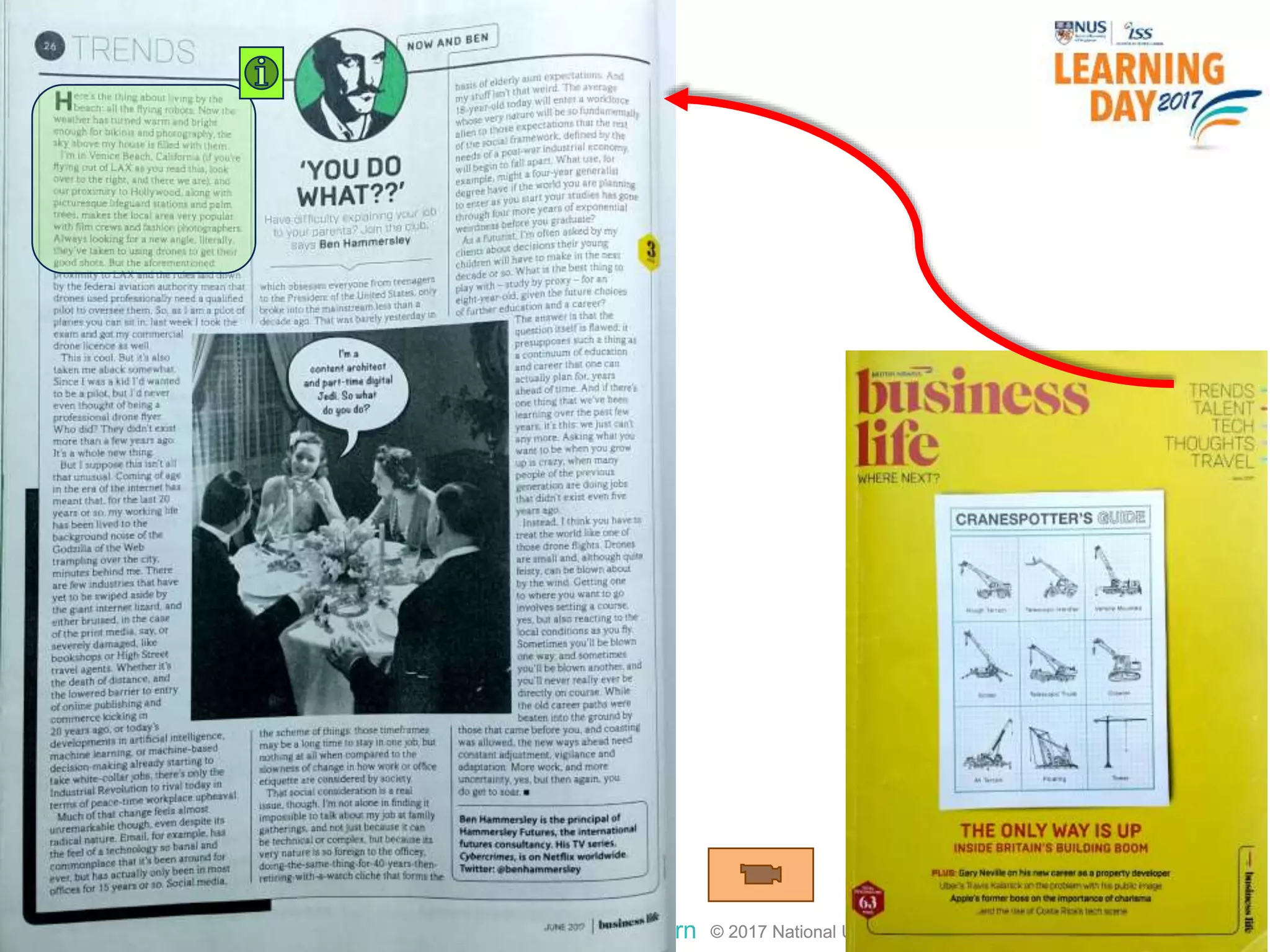
  • #3 Good morning everyone. Welcome to the ISS learning day 2017. My name is Tan Liong Choon and my focus area in ISS is in Product and Project Management Practice. Let me start by sharing with you a story. A few weeks ago, I was on a BA flight in July. It was a regional flight, a.k.a Budget flight, so there was nothing to do and was bored. I happen to browse thru the inflight magazine and came across this article on job trends. In a certain way, the topic actually relates to my talk this morning. – the future job landscape.
  • #4 The outline of my talk is as follows:
  • #5 For those who may have notice the synopsis of this talk, First, a word on the term VUCA. VUCA is a notion introduced by the early 90s by the U.S. Army War College to describe the more volatile, uncertain, complex and ambiguous multilateral world following the end of the Cold War. It has since been used to relate to all sectors of to the commercial world and especially in terms of strategic leadership to deal with and manage the challenges faced by organisations characterised by VUCA. For example, take volatility, the nature, speed and size of change The case of volatility is best illustrated comparing the rate of change in org today. In 1937, org can expect to have a average life expectancy of 75 yrs. Today, we are seeing new companies emerging overnight or within days and others disappear in short span of 15 years.
  • #6 In fact, much of the symptoms of VUCA can be narrow down to one key factor – disruptive technology and speed of technology change. Organisations are seeing Competitors appearing overnight and customers expecting new product innovation every month. E.g. iphone
  • #9 This is not a typo error! (even if Microsoft keep trying to auto-correct it) It is characteristics of a startup environment and mindset. Just like the Agile movement, there is a innovators Manifesto. The key is in doing – experiment and failing is normal. Just like what Woody Allen says … if you are not failing……
  • #10 One example that best illustrate “pretotype”
  • #27 How often do you think IMVU deploy new or incremental software? quarterly? Monthly? … The answer is = Non of the above. IMVU deploy software twice every hour on average.
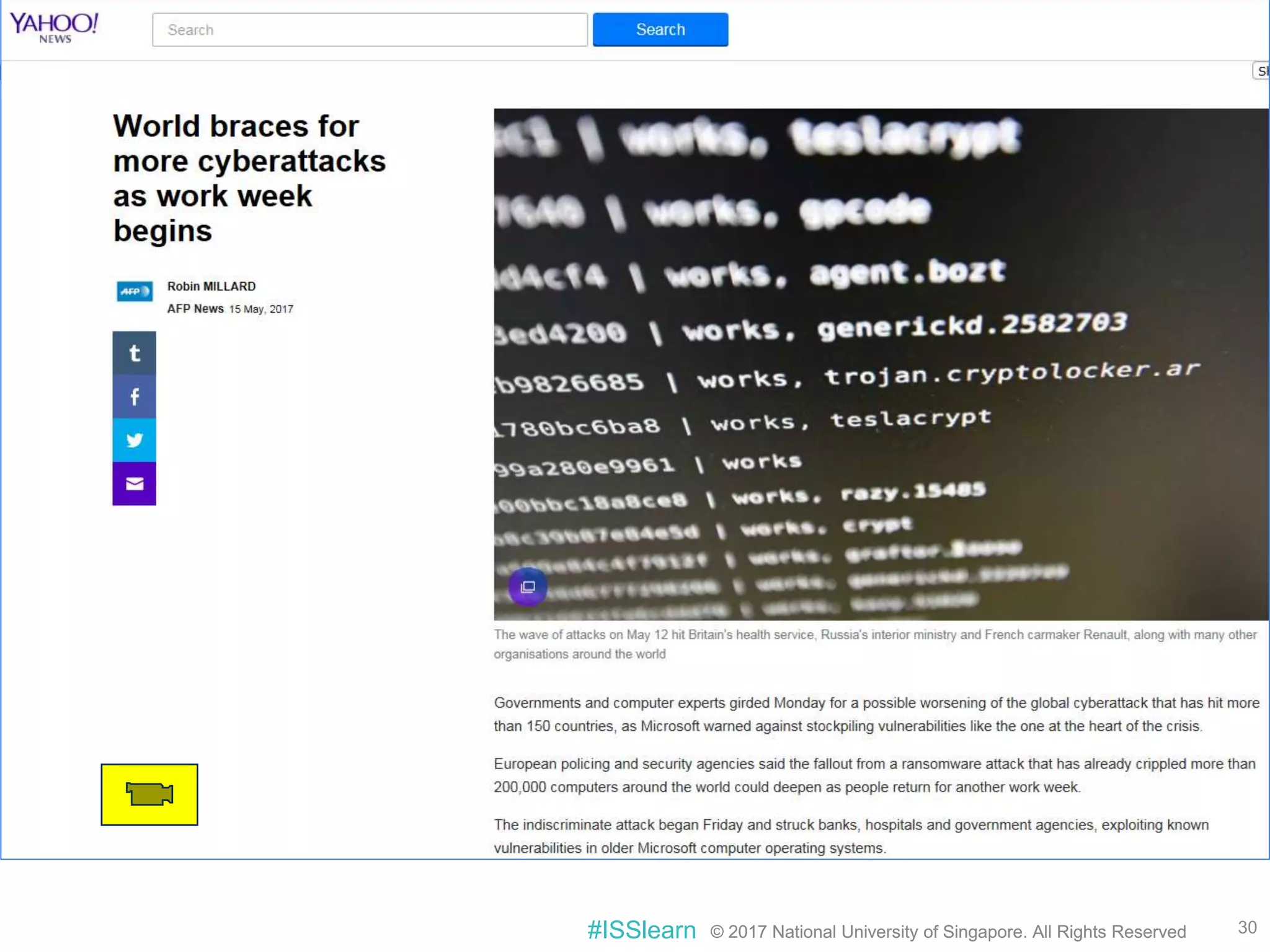
  • #30 We can’t talk about future skills without mentioning cybersecurity. This term is now everywhere. Not a week past without something about cybersecurity hit the news. And it could be right at your workplace.
  • #31 Cyber attacks and security incidents are happening with increasing frequency and virality.
  • #32 What file is that? Gravity What is the tag line?
  • #33 So what is Zero Day? Zero day is the term used to describe the situation whereby the black hats discovered a security flaw or loophole and exploit it. It is called zero day because the time the exploit happen, the software vendor is unaware and has no known or existing patch and the potential victim has no way nor time to implement defensive measures. Anti-malware tools also has no ability to even detect it i.e. there is zero day to react or fix it. Platinium group – famously exploited a Microsoft security flaw for 7 long years before it was found out.
  • #34 How do we define security threats? This is Microsoft’s security Threat model – STRIDE. Each of the above can be summed in what the security community commonly refer to as CIA, Condentiality, Integrity and Availability. Today and beyond, this is not going to be enough. We need to consider (faced with) wider and more complex threat scenarios
  • #35 A new dimension to the long held CIA threat model is starting to emerge. Gartner recently added an “S” to CIA. Anyone know or can guess what “S” stands for? Gartner term it “Safety”. The driving factor is the spread of IoT where everything can become a computer. Think Driverless car, thinking fridge. Because the security threats of the future can impose physical and bodily harm. Dick Cheney, the former US vice president, has pace-maker implanted. Guess what concerns does he has given the technology advancements? He is concerned that someone can wirelessly take control of his pace-maker to inflict harm. So he has deliberately disabled all blue-tooth/wireless capability of his pace-maker device There is a trade-off. It means that if he need to configure/tune he device, the doctors will need to cut open his body!
  • #37 For those who may have been to ISS past 2 learning days in 2015 & 2016 may be aware that I spoke about Agile in both of the events. But over the last 2 years, the trends is the Agile has gone main-stream. In the past, we may still hear people talking about agile in some explorational tone and whether to consider agile. Today, it is not about why agile, it is Why not Agile. I have know of organisations that has mandated the use of agile.
  • #38 Even the Most renowned project management standards institute, PMI has join hands with Agile Alliance and is developing a Agile Practice Guide. (A practice guide may become a standard in future)
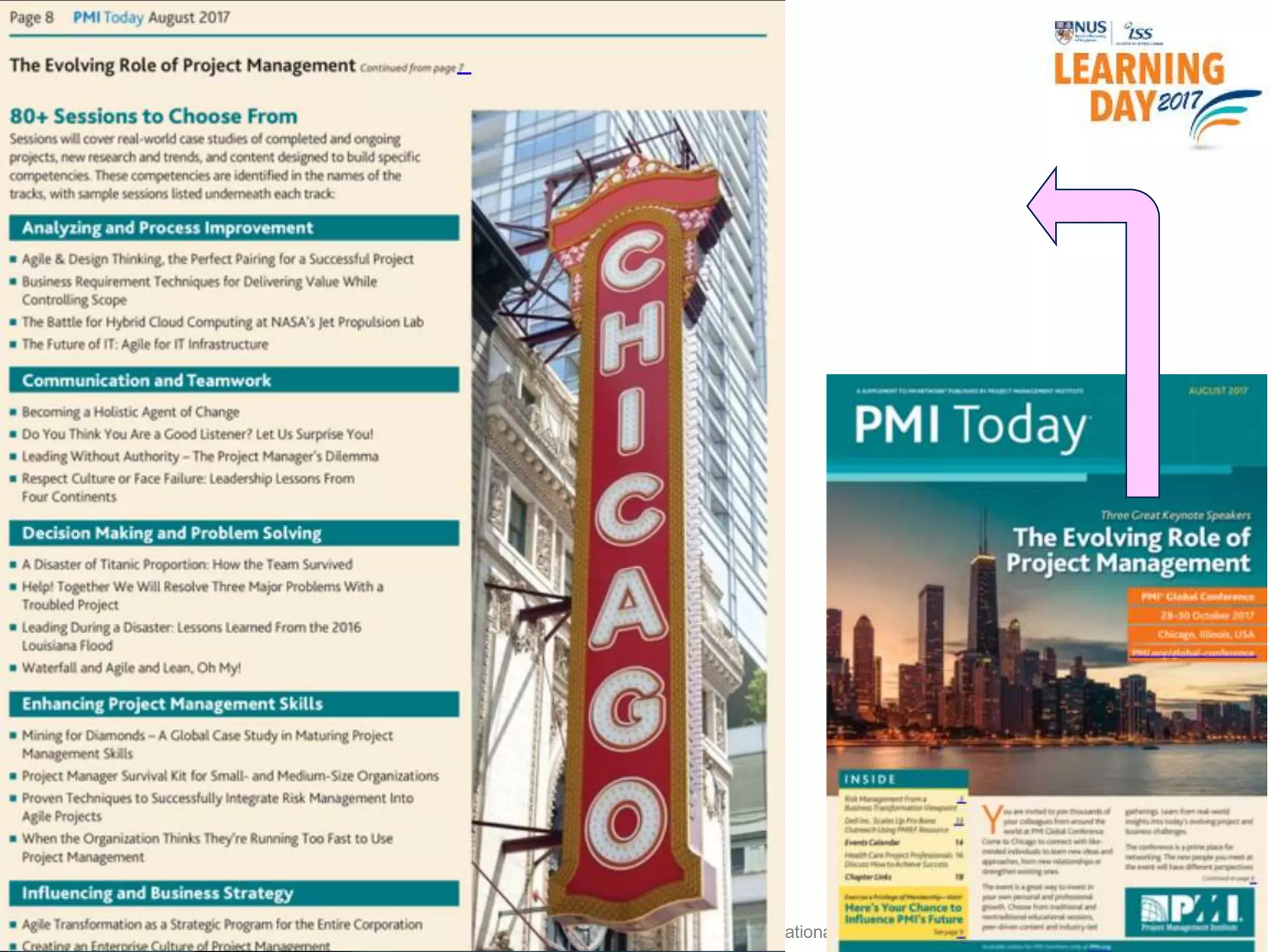
  • #40 The latest edition of PMI today highlighted “The Evolving Role of Project Management.”
  • #41 Why is this important? Because strong and good project vision helps ensure good project decisions.
  • #45 With increasing complexity, uncertainty, it is even more important for the PM to increase focus on risk management. There is also need to be aware of changing and evolving risk landscape. Many of project management risks may have now become what is termed “known-known”. E.g. agile approach to managing changing requirements so the PM needs to apply Risk mgt more carefully to uncover the unknown-unknowns, and proactively deal with it.
  • #46 Interestingly, just last week, while finalizing my presentation materials, I got this in my mailbox. Guess, what, the theme for the PMI Global conference scheduled for Oct in Chicago, is “The Evolving Role of Project Management”. I leave to you to explore and read further.
  • #48 As Stephen Covey, author of the “7 habits of highly effective people” advised: First thing first. Before we talk about continuous learning, I would say, the first thing to remind ourselves is Don’t stop reading. There are a lot of readily available resources out there.
  • #49 Back to Amazon. The idea of AWS is actually inspired in some way, by a book. <slide reading…> Guess what are some the Tech “creatures” that evolved from AWS? – think of the tech giants today – Facebook, Google
  • #51 Bird by Bird – what comes to mind? Agile iterations, sprint by sprint
  • #53 I hope in this short 1 hour or so, I have given you some interesting food for thought and guide on how to navigate the challenges of the future. The points presented here is by no means an exhaustive. Due to constraint of time, I have to leave out some others aspects e.g. HR, etc. But do feel free to continue with the discussion. Drop me a note if you like to discuss or have questions. I wish all the fruitful learning day ahead.
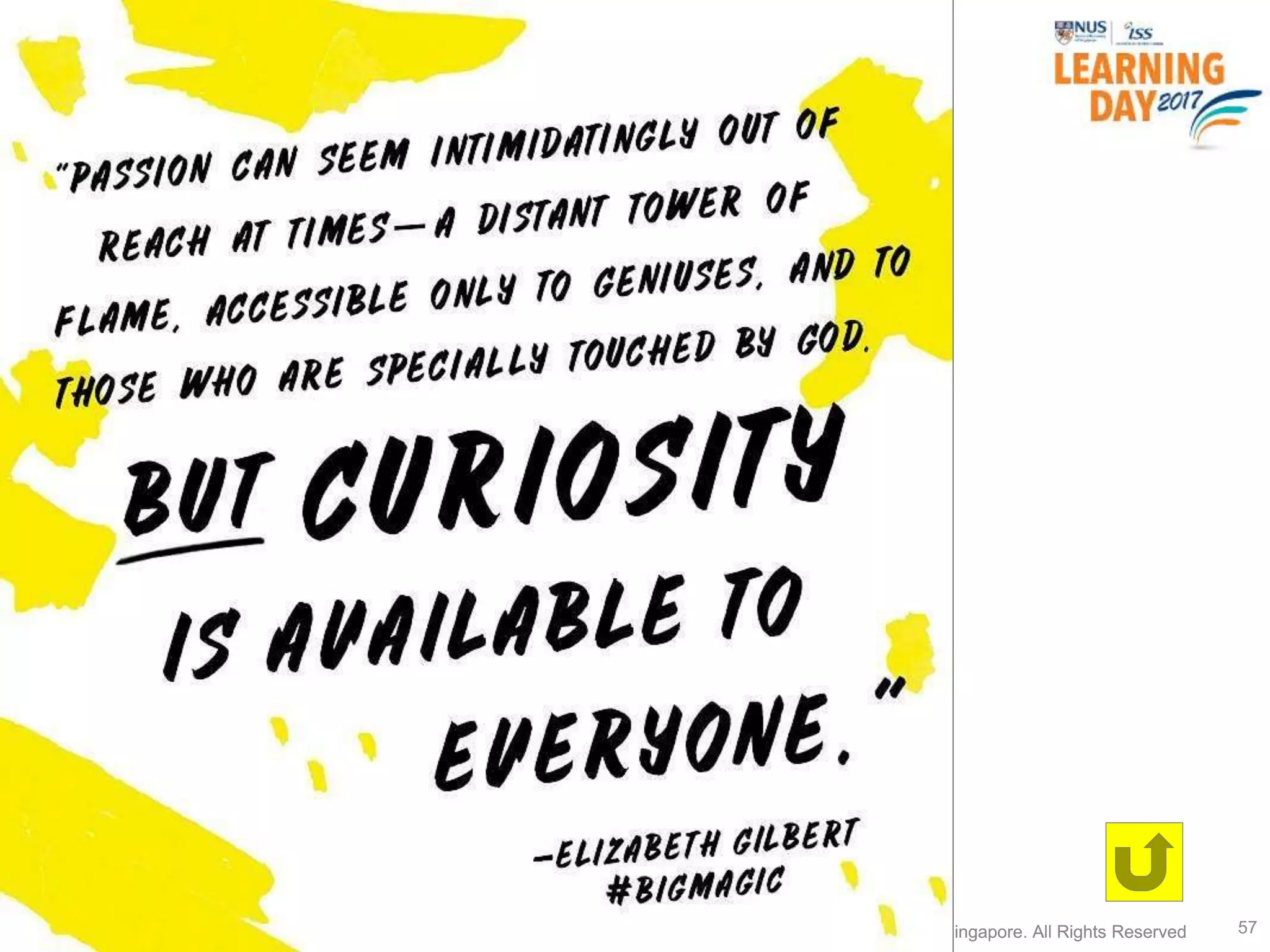
  • #58 Anyone familiar with the name “Elizabeth Gilbert”? Yes, she is the author of the book “Eat, Pray, Love”. She was frequently asked “how she come to acquire her creativity” to be an successful author and if creativity is something that one is endowed with and can never be nurtured. Her answer? Everyone has the ability to be creative. The key to creativity starts with curiosity. Somehow, as one grows up, they lose this sense of curousity that exist in every child. Think Steve Job. He was curious about Chinese calligraphy and fonts.