Open source contribution
policies that don’t suck!
Tobie Langel, Principal, UnlockOpen
@tobie
tobie@unlockopen.com
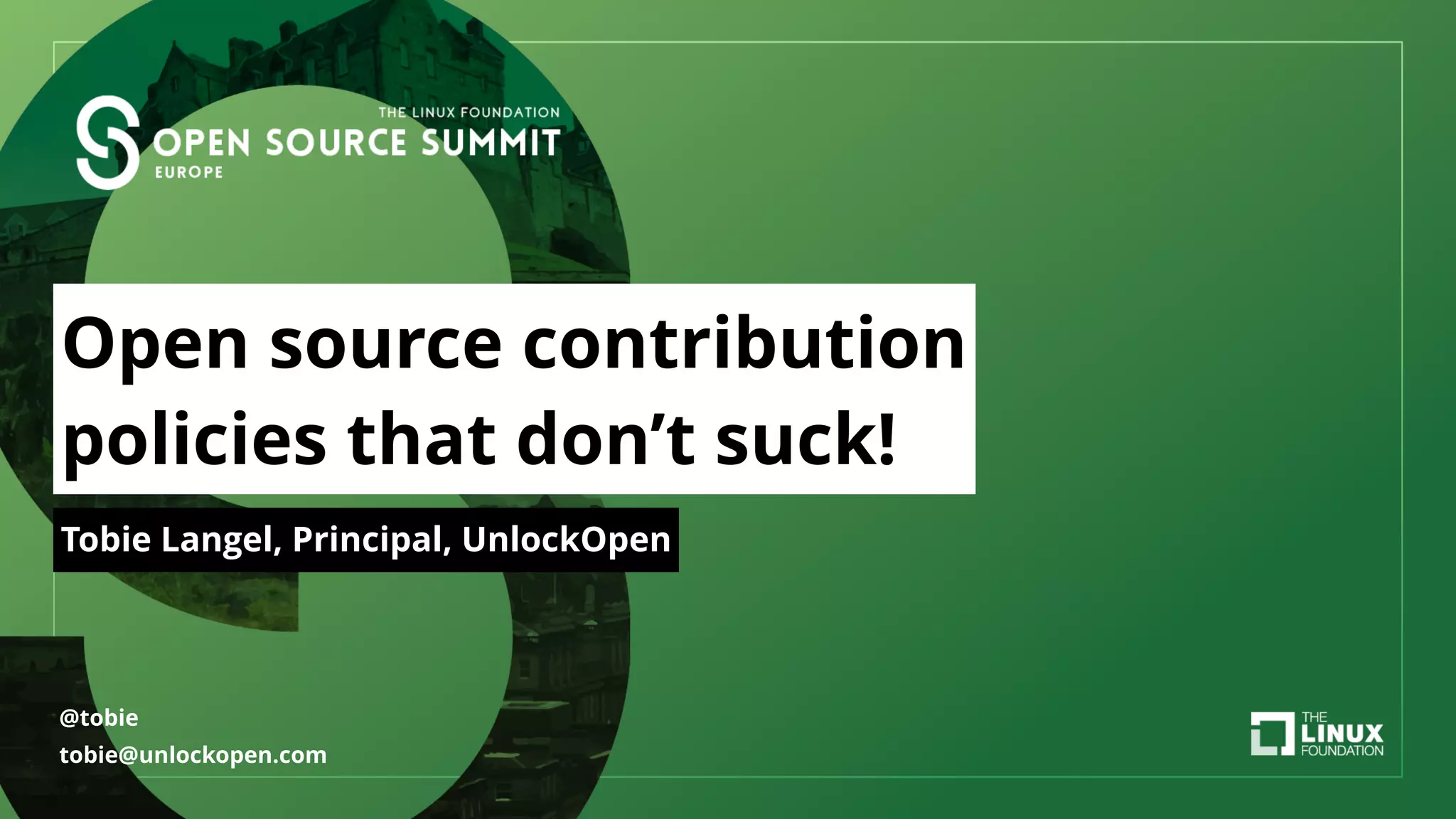
Do you have an open source policy?
No
48%
Don't know
13%
Yes
39%
< 250 employees
61%
11%
28%
> 10,000 employees
25%
10%
65%
Source: The New Stack & Linux Foundation/TODO
Group 2018 Open Source Program Management
Survey (https://github.com/todogroup/survey)
Remember this is a biased sample!
What does not having a policy mean?
Contrary to popular belief, it does not mean that you don’t have an open
source policy at all.
It means that you don’t have a written one.
You have a policy, whether it is written
down or not. It could range from “no open
source at all” to “anything goes.” 
—Heather J. Meeker, Open Source Licensing Specialist,
author of Open Source for Business.
So what does not having a written open source
policy mean?
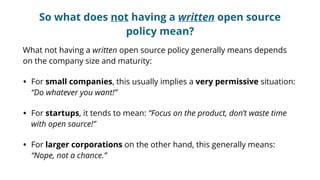
What not having a written open source policy generally means depends
on the company size and maturity:
• For small companies, this usually implies a very permissive situation:
“Do whatever you want!”
• For startups, it tends to mean: “Focus on the product, don’t waste time
with open source!”
• For larger corporations on the other hand, this generally means:
“Nope, not a chance.”
What does having a policy mean?
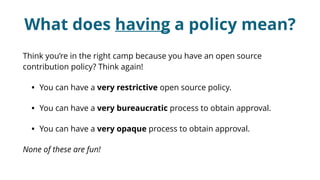
Think you’re in the right camp because you have an open source
contribution policy? Think again!
• You can have a very restrictive open source policy.
• You can have a very bureaucratic process to obtain approval.
• You can have a very opaque process to obtain approval.
None of these are fun!
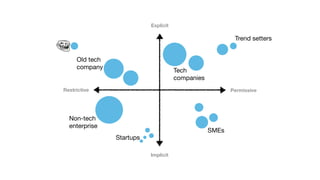
PermissiveRestrictive
Implicit
Explicit
Startups
SMEs
Non-tech
enterprise
Old tech
company
Trend setters
Tech
companies
What is a policy that doesn’t suck?
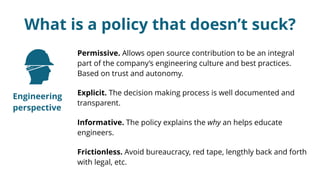
Permissive. Allows open source contribution to be an integral
part of the company’s engineering culture and best practices.
Based on trust and autonomy.
Explicit. The decision making process is well documented and
transparent.
Informative. The policy explains the why an helps educate
engineers.
Frictionless. Avoid bureaucracy, red tape, lengthly back and forth
with legal, etc.
Engineering
perspective
What is a policy that doesn’t suck?
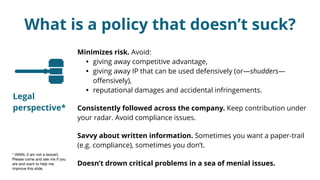
Minimizes risk. Avoid:
• giving away competitive advantage,
• giving away IP that can be used defensively (or—shudders—
offensively),
• reputational damages and accidental infringements.
Consistently followed across the company. Keep contribution under
your radar. Avoid compliance issues.
Savvy about written information. Sometimes you want a paper-trail
(e.g. compliance), sometimes you don’t.
Doesn’t drown critical problems in a sea of menial issues.
Legal
perspective*
* IANAL (I am not a lawyer).
Please come and see me if you
are and want to help me
improve this slide.
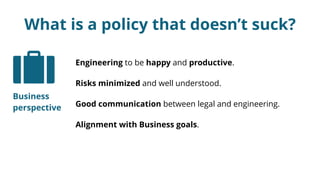
What is a policy that doesn’t suck?
Engineering to be happy and productive.
Risks minimized and well understood.
Good communication between legal and engineering.
Alignment with Business goals.
Business
perspective
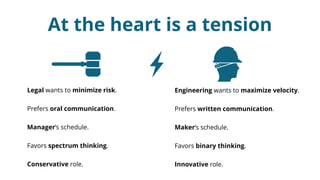
At the heart is a tension
Legal wants to minimize risk.
Prefers oral communication.
Manager’s schedule.
Favors spectrum thinking.
Conservative role.
Engineering wants to maximize velocity.
Prefers written communication.
Maker’s schedule.
Favors binary thinking.
Innovative role.
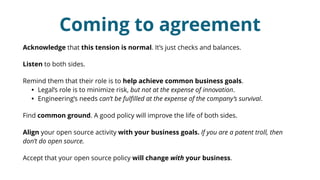
Coming to agreement
Acknowledge that this tension is normal. It’s just checks and balances.
Listen to both sides.
Remind them that their role is to help achieve common business goals.
• Legal’s role is to minimize risk, but not at the expense of innovation.
• Engineering’s needs can’t be fulfilled at the expense of the company’s survival.
Find common ground. A good policy will improve the life of both sides.
Align your open source activity with your business goals. If you are a patent troll, then
don’t do open source.
Accept that your open source policy will change with your business.
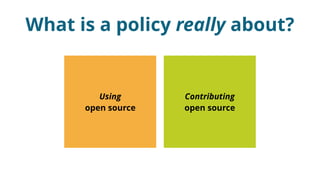
Contributing
open source
What is a policy really about?
Using
open source
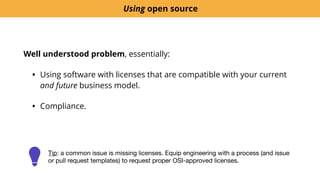
Well understood problem, essentially:
• Using software with licenses that are compatible with your current
and future business model.
• Compliance.
Using open source
Tip: a common issue is missing licenses. Equip engineering with a process (and issue
or pull request templates) to request proper OSI-approved licenses.
Contributing
open source
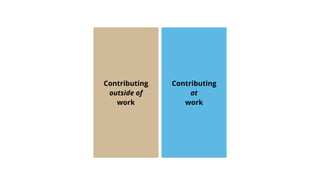
Contributing
at
work
Contributing
outside of
work
Other
4%
Don't know
37%
Must ask
12%
Yes!
47%
“How does your employer's IP agreement/policy affect your free-
time contributions to open source unrelated to your work?”
“Respondents were sampled randomly from traffic and qualifying activity
to licensed open source repositories on GitHub.com and invited to
complete the survey through a dialog box. A smaller sample was recruited
from open source communities sourced outside of GitHub, […]”
Contributing outside of work
Source: GitHub 2017 open source survey
(http://opensourcesurvey.org/2017/).
But again… this is a highly biased sample.
Contributing outside of work
Why so much confusion?
• Depends on the jurisdiction, but not uncommon, especially in the USA,
for companies to own employees’ production 24/7.
• Sometimes, extra criteria apply. For example, in California, IP
developed with company equipment—even outside of work—belongs
to the employer.
• This prevents employees from contributing to open source, unless
they ask for, and are granted permission to do so.
Contributing outside of work
The common solution: ask for permission
• Most companies have a process for this.
• Tends to focus on releasing open source or working on a limited set of
pre-approved projects.
• Breaks down when there’s a high number of dependencies (such as for
Node.js projects).
Contributing outside of work
The better solution: BEIPA
• Balanced Employee IP Agreement
• https://github.com/github/balanced-employee-ip-agreement
• Project created by GitHub, based on its own IP agreement.
• BEIPA only claims control of creations made for or relating to the
company's business.
Contributing
at
work
Patching
Releasing
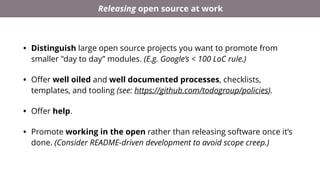
Releasing open source at work
• Distinguish large open source projects you want to promote from
smaller "day to day” modules. (E.g. Google’s < 100 LoC rule.)
• Offer well oiled and well documented processes, checklists,
templates, and tooling (see: https://github.com/todogroup/policies).
• Offer help.
• Promote working in the open rather than releasing software once it’s
done. (Consider README-driven development to avoid scope creep.)
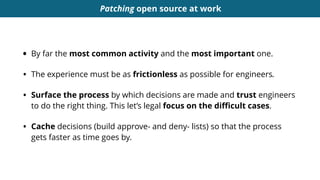
Patching open source at work
• By far the most common activity and the most important one.
• The experience must be as frictionless as possible for engineers.
• Surface the process by which decisions are made and trust engineers
to do the right thing. This let’s legal focus on the difficult cases.
• Cache decisions (build approve- and deny- lists) so that the process
gets faster as time goes by.
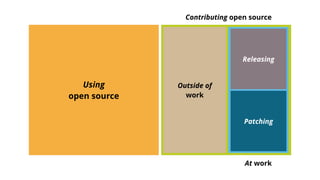
Outside of
work
Patching
Using
open source
Releasing
At work
Contributing open source
Turn your policy into an app!
• Automatically approve requests that meet pre-established
requirements (e.g. patch an MIT-licensed open source project on
GitHub).
• Automatically reject requests that don’t meet your criteria (but allow
motivated appeals).
• Manually handle other requests and cache the decision so more gets
automated over time.
Using such a system, Adobe was able to shorten it’s review time from
4.6 days to 4.6 hours.
But there’s more. The data collected can help:
• understand your open source activity,
• promote it,
• connect engineers unknowingly contributing to the same projects,
• etc.
Turn your policy into an app!
Thank you!
Tobie Langel (@tobie)
Principal, UnlockOpen
tobie@unlockopen.com

Open Source Contribution Policies That Don't Suck

  • 1.
    Open source contribution policiesthat don’t suck! Tobie Langel, Principal, UnlockOpen @tobie tobie@unlockopen.com
  • 2.
    Do you havean open source policy? No 48% Don't know 13% Yes 39% < 250 employees 61% 11% 28% > 10,000 employees 25% 10% 65% Source: The New Stack & Linux Foundation/TODO Group 2018 Open Source Program Management Survey (https://github.com/todogroup/survey) Remember this is a biased sample!
  • 3.
    What does nothaving a policy mean? Contrary to popular belief, it does not mean that you don’t have an open source policy at all. It means that you don’t have a written one. You have a policy, whether it is written down or not. It could range from “no open source at all” to “anything goes.”  —Heather J. Meeker, Open Source Licensing Specialist, author of Open Source for Business.
  • 4.
    So what doesnot having a written open source policy mean? What not having a written open source policy generally means depends on the company size and maturity: • For small companies, this usually implies a very permissive situation: “Do whatever you want!” • For startups, it tends to mean: “Focus on the product, don’t waste time with open source!” • For larger corporations on the other hand, this generally means: “Nope, not a chance.”
  • 5.
    What does havinga policy mean? Think you’re in the right camp because you have an open source contribution policy? Think again! • You can have a very restrictive open source policy. • You can have a very bureaucratic process to obtain approval. • You can have a very opaque process to obtain approval. None of these are fun!
  • 6.
  • 7.
    What is apolicy that doesn’t suck? Permissive. Allows open source contribution to be an integral part of the company’s engineering culture and best practices. Based on trust and autonomy. Explicit. The decision making process is well documented and transparent. Informative. The policy explains the why an helps educate engineers. Frictionless. Avoid bureaucracy, red tape, lengthly back and forth with legal, etc. Engineering perspective
  • 8.
    What is apolicy that doesn’t suck? Minimizes risk. Avoid: • giving away competitive advantage, • giving away IP that can be used defensively (or—shudders— offensively), • reputational damages and accidental infringements. Consistently followed across the company. Keep contribution under your radar. Avoid compliance issues. Savvy about written information. Sometimes you want a paper-trail (e.g. compliance), sometimes you don’t. Doesn’t drown critical problems in a sea of menial issues. Legal perspective* * IANAL (I am not a lawyer). Please come and see me if you are and want to help me improve this slide.
  • 9.
    What is apolicy that doesn’t suck? Engineering to be happy and productive. Risks minimized and well understood. Good communication between legal and engineering. Alignment with Business goals. Business perspective
  • 10.
    At the heartis a tension Legal wants to minimize risk. Prefers oral communication. Manager’s schedule. Favors spectrum thinking. Conservative role. Engineering wants to maximize velocity. Prefers written communication. Maker’s schedule. Favors binary thinking. Innovative role.
  • 11.
    Coming to agreement Acknowledgethat this tension is normal. It’s just checks and balances. Listen to both sides. Remind them that their role is to help achieve common business goals. • Legal’s role is to minimize risk, but not at the expense of innovation. • Engineering’s needs can’t be fulfilled at the expense of the company’s survival. Find common ground. A good policy will improve the life of both sides. Align your open source activity with your business goals. If you are a patent troll, then don’t do open source. Accept that your open source policy will change with your business.
  • 12.
    Contributing open source What isa policy really about? Using open source
  • 13.
    Well understood problem,essentially: • Using software with licenses that are compatible with your current and future business model. • Compliance. Using open source Tip: a common issue is missing licenses. Equip engineering with a process (and issue or pull request templates) to request proper OSI-approved licenses.
  • 14.
  • 15.
  • 16.
    Other 4% Don't know 37% Must ask 12% Yes! 47% “Howdoes your employer's IP agreement/policy affect your free- time contributions to open source unrelated to your work?” “Respondents were sampled randomly from traffic and qualifying activity to licensed open source repositories on GitHub.com and invited to complete the survey through a dialog box. A smaller sample was recruited from open source communities sourced outside of GitHub, […]” Contributing outside of work Source: GitHub 2017 open source survey (http://opensourcesurvey.org/2017/). But again… this is a highly biased sample.
  • 17.
    Contributing outside ofwork Why so much confusion? • Depends on the jurisdiction, but not uncommon, especially in the USA, for companies to own employees’ production 24/7. • Sometimes, extra criteria apply. For example, in California, IP developed with company equipment—even outside of work—belongs to the employer. • This prevents employees from contributing to open source, unless they ask for, and are granted permission to do so.
  • 18.
    Contributing outside ofwork The common solution: ask for permission • Most companies have a process for this. • Tends to focus on releasing open source or working on a limited set of pre-approved projects. • Breaks down when there’s a high number of dependencies (such as for Node.js projects).
  • 19.
    Contributing outside ofwork The better solution: BEIPA • Balanced Employee IP Agreement • https://github.com/github/balanced-employee-ip-agreement • Project created by GitHub, based on its own IP agreement. • BEIPA only claims control of creations made for or relating to the company's business.
  • 20.
  • 21.
  • 22.
    Releasing open sourceat work • Distinguish large open source projects you want to promote from smaller "day to day” modules. (E.g. Google’s < 100 LoC rule.) • Offer well oiled and well documented processes, checklists, templates, and tooling (see: https://github.com/todogroup/policies). • Offer help. • Promote working in the open rather than releasing software once it’s done. (Consider README-driven development to avoid scope creep.)
  • 23.
    Patching open sourceat work • By far the most common activity and the most important one. • The experience must be as frictionless as possible for engineers. • Surface the process by which decisions are made and trust engineers to do the right thing. This let’s legal focus on the difficult cases. • Cache decisions (build approve- and deny- lists) so that the process gets faster as time goes by.
  • 24.
  • 25.
    Turn your policyinto an app! • Automatically approve requests that meet pre-established requirements (e.g. patch an MIT-licensed open source project on GitHub). • Automatically reject requests that don’t meet your criteria (but allow motivated appeals). • Manually handle other requests and cache the decision so more gets automated over time.
  • 26.
    Using such asystem, Adobe was able to shorten it’s review time from 4.6 days to 4.6 hours. But there’s more. The data collected can help: • understand your open source activity, • promote it, • connect engineers unknowingly contributing to the same projects, • etc. Turn your policy into an app!
  • 27.
    Thank you! Tobie Langel(@tobie) Principal, UnlockOpen tobie@unlockopen.com