Learning innovation and the individual-community nexus: Intercultural applicability of social networking tools in open and distance education CNIE Reaching new heights: Learning innovation Banff, April 27-30 2008
Previously … Community formation … Across semesters Across cultures From novice to expert From receiver to reflector From learner to practitioner to mentor
Experiences of pedagogy Experiential learning Task/project-based learning Collaborative learning Community of mutually-supportive reflective inquirers Extended community of experts-novices Community of learner-practitioners
Social constructivism & teacher change Self-reflection on beliefs & values Exposure to choice Experience of affordances Consciousness of conflict/dysjuncture Exposure to modelling of effective uses of technology Experience & practice in a range of applications  facilitating change in attitudes/beliefs (Richardson & Placier, 2001; King, 2002; Bird & Rosaen, 2005; Brook & Oliver, 2005; Hughes, 2005)
Attitudes towards technology & effective use of it entwined with teacher learning, comprising: subject matter knowledge pedagogical knowledge, and  pedagogical content knowledge In other words …  teachers will only embrace change and innovation when they can see positive benefits in terms of: direct relevance to their content area usefulness from a practical task perspective, and increased effectiveness for their day to day classroom teaching. (Hughes, 2005)
Tools used Webquests using SDSU portal <http://www.webquest.org/> Dreamweaver + online media & resources Hot Potatoes + various other online templating tools + media Social communication/networking: Wiki – MediaWiki hosted on university server (www-viewable) Individual blogs – Blogger (www-viewable) IM Discussion forum Chat e-Portfolios
Expectations vs Use of SN Tools 1 .../2   Expectations Wiki for internal-remote collaboration ownership easily accessible from everywhere (where my students were located) Blogs ownership reflective space flexible (& re-purpose-able) space extensible outside timelines of course Uses Wiki Experimenting with the interface Group organization: sharing & collaboration Hints & tips (Q & A, quick fixes) Interesting articles/sites Posting projects Blogs Reflection self-reflection peer evaluation Communication mutual support & feedback Community formation & maintenance Interaction Among members of single cohort Across continents & oceans  Across semesters Across cultural & social dysjunctures
Expectations vs Use of SN Tools 2 .../2   Expectations IM for quick changes of plan to check if online  Discussion forum formal course-related theoretical Qs & responses Chat synchronous local & international coordination e-Portfolios formal annotated electronic record of program documents, artefacts, achievements Uses IM Notification of:  Lateness chat entry new posts Discussion Forum Formal course evaluation Formal comments on the course & projects …  in response to instructor’s postings Chat synchronous remote/ internal communication on:  Discussion catch-up Socializing course-related transactions E-Portfolios Created but hardly (yet) used Possibly because of formal nature cf digital stories
Course outcomes: Processes Self-reflection Self-evaluation Self-efficacy Independent inquiry Self-initiation Self-motivation Peer evaluation Realization of usefulness of formation of community network Products Webquests Online media-supported teaching module Wiki sites Blogs Course-related Personal Travel Post-course/ practitioner
Social presence: effective interaction & learning community formation  No. & frequency of interactions initiated No. & frequency of responses to others Cultural effects on interactions **  Types of communication actions **
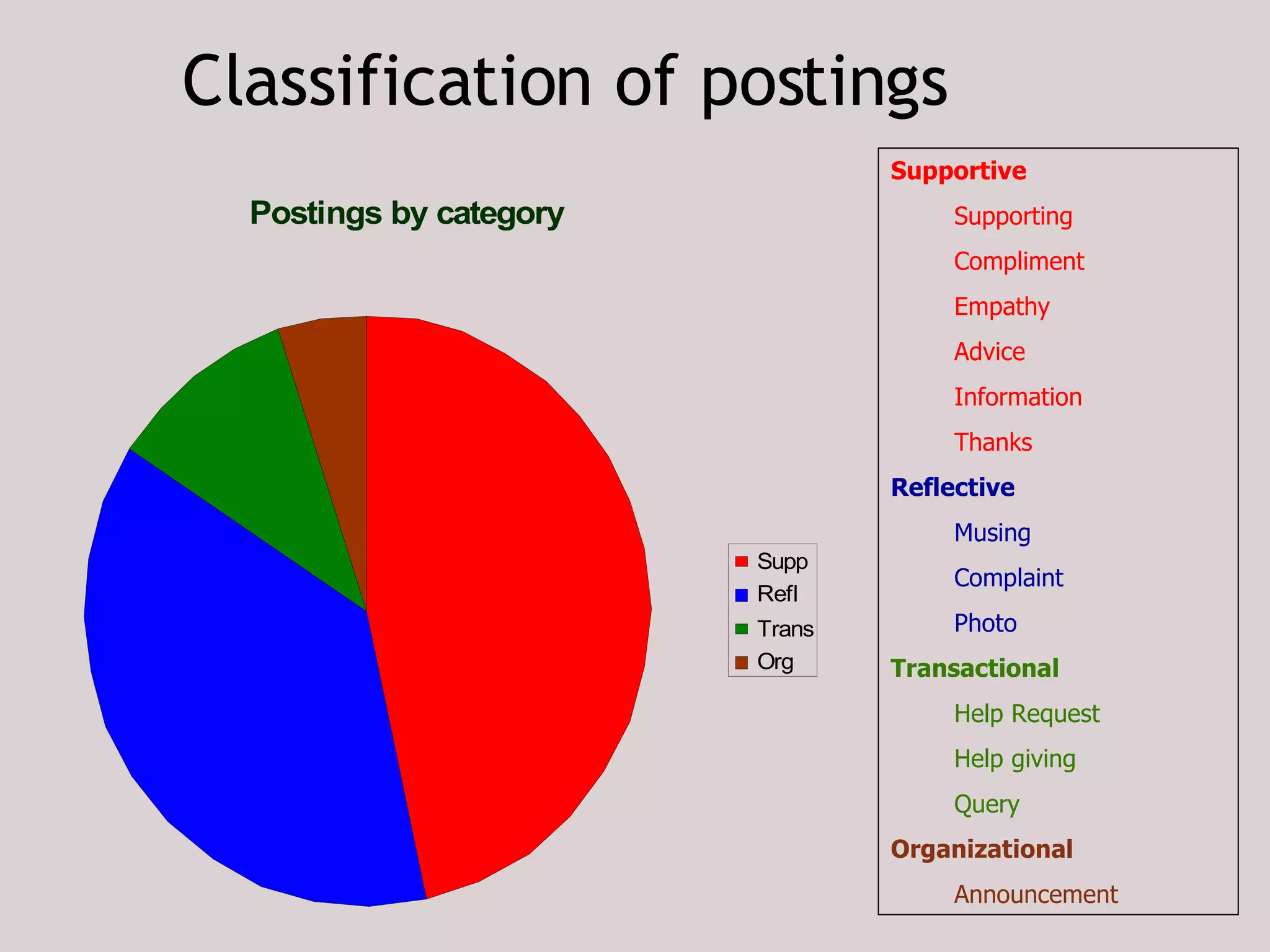
Classification of postings Supportive Supporting Compliment Empathy Advice Information Thanks Reflective Musing Complaint Photo Transactional Help Request Help giving Query Organizational Announcement
Features emerging from classification High incidence of supportive comments (1/3): Complimenting, supporting, giving advice, thanking, empathizing High incidence of reflective comments: Musing, photographs, complaints Much less transactional: Asking & answering Qs, requesting & receiving help Smallest category: organizational
Persistence of post-course blog use All but 1 posted on their blogs post-course >50% maintained & expanded theirs, creating others, & using with own classes >30% maintained blog contact & mentored subsequent cohorts Similar patterns across subsequent  semesters have shown Experience of being mentored seems to engender willingness to mentor Experience of becoming reflective, independent & interdependent members of a community promotes willingness to support emerging independence
And now the story continues … In fully online mode …  - or is it a different story??
New context, similar approach In transition from f2f CALL Teacher Ed to … Blended/hybrid CALL Teacher Ed to … Fully online mix of CALL & general DE to … Fully online DE Teacher Education
Online constraints & considerations Intercultural aspects Geography & access Timezones Appropriate technology
Tools made available 1 … /2 Synchronous & asynchronous CMC: Moodle: Discussion forums IM near-synchronous chat Wikis Blogs (not used) Email VoIP (Skype) Elluminate Live Elluminate vRooms
Tools made available 2 … /2 Instructional technologies Discovery/exploratory technologies Community-facilitating technologies (Facebook, Me2U, Flickr, tagging applications, RSS etc)
Beginning with a tale of 2 wikis   … & 2 Moodles … Exploratory learning - using the available tools for purposes that seem appropriate … Learning together …
Choices & constraints 1 …/2 Individual vs community “ traditional” personality of DE students Role of academic dialogue at Masters level Facilitation in DE environment?
Choices & constraints 2 …/2 Mismatch between: Requirements Expectations (teacher & learners) Teaching & learning approaches (including intercultural aspects) Assessment criteria Assessment process (in transition) What constitutes PARTICIPATION??
Collaborative Moodle wiki sites CDE Moodle & wiki Internal to course Password protected Locked down by university admin Unable to add guests or students
CDE Moodle wiki site
Collaborative Moodle & wiki sites Education University of Iceland Open Moodle Password protected Guests & students added manually http://moodle.khi.is/course/category.php?id=8  Wikispaces sites for student-student, student-teacher & teacher-teacher collaboration http: //athabascakhi . wikispaces .com/Athabasca
Communications Technologies Elluminate Live http://www. elluminate .com/ Elluminate vRooms http://www. elluminate .com/vroom/ Skype
Changing roles Reflective practice Openness Collaboration Negotiation Changing assessment practices: e-Portfolios
Some advice from my students
Critical differences in DE 1 …/2 a necessity for lifelong learning “ green”-er (x4) Accessibility & openness (x5) centrality of CMC Flexibility  importance for lifestyle & commitments freedom to design your own program & courses according to interest Accessibility, breaking down barriers & reaching remote locations autonomy in experience & direction (x4) Of both experience of learner & direction of studies i.e. Self-motivation Self-designed courses & program Keeping up with advancements in technology (x3)
Critical differences in DE 2 …/2 multi-modal techniques to cultivate engagement (x2) Move from “compensation model” to “celebration model” (x3) DRAGONS: Diverse (many and different; distinct and unalike) Requisites (anything indispensable) Accessing (obtain or retrieve from a storage device like information on a computer Global (not limited or provincial in scope Opportunities (a possibility due to a favourable combination of circumstances) Non-traditionally (not conforming or in accord with the considered norm) Sustained (supply with necessities and support)
Questions? Comments? Suggestions? Advice?
Debra Hoven Centre for Distance Education, Athabasca University http://cde.athabascau.ca/faculty/debrah.php   http://deincanada.blogspot.com/ http://lifentheuniverse.blogspot.com [email_address]

Hoven Cnie 08

  • 1.
    Learning innovation andthe individual-community nexus: Intercultural applicability of social networking tools in open and distance education CNIE Reaching new heights: Learning innovation Banff, April 27-30 2008
  • 2.
    Previously … Communityformation … Across semesters Across cultures From novice to expert From receiver to reflector From learner to practitioner to mentor
  • 3.
    Experiences of pedagogyExperiential learning Task/project-based learning Collaborative learning Community of mutually-supportive reflective inquirers Extended community of experts-novices Community of learner-practitioners
  • 4.
    Social constructivism &teacher change Self-reflection on beliefs & values Exposure to choice Experience of affordances Consciousness of conflict/dysjuncture Exposure to modelling of effective uses of technology Experience & practice in a range of applications facilitating change in attitudes/beliefs (Richardson & Placier, 2001; King, 2002; Bird & Rosaen, 2005; Brook & Oliver, 2005; Hughes, 2005)
  • 5.
    Attitudes towards technology& effective use of it entwined with teacher learning, comprising: subject matter knowledge pedagogical knowledge, and pedagogical content knowledge In other words … teachers will only embrace change and innovation when they can see positive benefits in terms of: direct relevance to their content area usefulness from a practical task perspective, and increased effectiveness for their day to day classroom teaching. (Hughes, 2005)
  • 6.
    Tools used Webquestsusing SDSU portal <http://www.webquest.org/> Dreamweaver + online media & resources Hot Potatoes + various other online templating tools + media Social communication/networking: Wiki – MediaWiki hosted on university server (www-viewable) Individual blogs – Blogger (www-viewable) IM Discussion forum Chat e-Portfolios
  • 7.
    Expectations vs Useof SN Tools 1 .../2 Expectations Wiki for internal-remote collaboration ownership easily accessible from everywhere (where my students were located) Blogs ownership reflective space flexible (& re-purpose-able) space extensible outside timelines of course Uses Wiki Experimenting with the interface Group organization: sharing & collaboration Hints & tips (Q & A, quick fixes) Interesting articles/sites Posting projects Blogs Reflection self-reflection peer evaluation Communication mutual support & feedback Community formation & maintenance Interaction Among members of single cohort Across continents & oceans Across semesters Across cultural & social dysjunctures
  • 8.
    Expectations vs Useof SN Tools 2 .../2 Expectations IM for quick changes of plan to check if online Discussion forum formal course-related theoretical Qs & responses Chat synchronous local & international coordination e-Portfolios formal annotated electronic record of program documents, artefacts, achievements Uses IM Notification of: Lateness chat entry new posts Discussion Forum Formal course evaluation Formal comments on the course & projects … in response to instructor’s postings Chat synchronous remote/ internal communication on: Discussion catch-up Socializing course-related transactions E-Portfolios Created but hardly (yet) used Possibly because of formal nature cf digital stories
  • 9.
    Course outcomes: ProcessesSelf-reflection Self-evaluation Self-efficacy Independent inquiry Self-initiation Self-motivation Peer evaluation Realization of usefulness of formation of community network Products Webquests Online media-supported teaching module Wiki sites Blogs Course-related Personal Travel Post-course/ practitioner
  • 10.
    Social presence: effectiveinteraction & learning community formation No. & frequency of interactions initiated No. & frequency of responses to others Cultural effects on interactions ** Types of communication actions **
  • 11.
    Classification of postingsSupportive Supporting Compliment Empathy Advice Information Thanks Reflective Musing Complaint Photo Transactional Help Request Help giving Query Organizational Announcement
  • 12.
    Features emerging fromclassification High incidence of supportive comments (1/3): Complimenting, supporting, giving advice, thanking, empathizing High incidence of reflective comments: Musing, photographs, complaints Much less transactional: Asking & answering Qs, requesting & receiving help Smallest category: organizational
  • 13.
    Persistence of post-courseblog use All but 1 posted on their blogs post-course >50% maintained & expanded theirs, creating others, & using with own classes >30% maintained blog contact & mentored subsequent cohorts Similar patterns across subsequent semesters have shown Experience of being mentored seems to engender willingness to mentor Experience of becoming reflective, independent & interdependent members of a community promotes willingness to support emerging independence
  • 14.
    And now thestory continues … In fully online mode … - or is it a different story??
  • 15.
    New context, similarapproach In transition from f2f CALL Teacher Ed to … Blended/hybrid CALL Teacher Ed to … Fully online mix of CALL & general DE to … Fully online DE Teacher Education
  • 16.
    Online constraints &considerations Intercultural aspects Geography & access Timezones Appropriate technology
  • 17.
    Tools made available1 … /2 Synchronous & asynchronous CMC: Moodle: Discussion forums IM near-synchronous chat Wikis Blogs (not used) Email VoIP (Skype) Elluminate Live Elluminate vRooms
  • 18.
    Tools made available2 … /2 Instructional technologies Discovery/exploratory technologies Community-facilitating technologies (Facebook, Me2U, Flickr, tagging applications, RSS etc)
  • 19.
    Beginning with atale of 2 wikis … & 2 Moodles … Exploratory learning - using the available tools for purposes that seem appropriate … Learning together …
  • 20.
    Choices & constraints1 …/2 Individual vs community “ traditional” personality of DE students Role of academic dialogue at Masters level Facilitation in DE environment?
  • 21.
    Choices & constraints2 …/2 Mismatch between: Requirements Expectations (teacher & learners) Teaching & learning approaches (including intercultural aspects) Assessment criteria Assessment process (in transition) What constitutes PARTICIPATION??
  • 22.
    Collaborative Moodle wikisites CDE Moodle & wiki Internal to course Password protected Locked down by university admin Unable to add guests or students
  • 23.
  • 24.
  • 25.
    Collaborative Moodle &wiki sites Education University of Iceland Open Moodle Password protected Guests & students added manually http://moodle.khi.is/course/category.php?id=8 Wikispaces sites for student-student, student-teacher & teacher-teacher collaboration http: //athabascakhi . wikispaces .com/Athabasca
  • 26.
    Communications Technologies ElluminateLive http://www. elluminate .com/ Elluminate vRooms http://www. elluminate .com/vroom/ Skype
  • 27.
    Changing roles Reflectivepractice Openness Collaboration Negotiation Changing assessment practices: e-Portfolios
  • 28.
    Some advice frommy students
  • 29.
    Critical differences inDE 1 …/2 a necessity for lifelong learning “ green”-er (x4) Accessibility & openness (x5) centrality of CMC Flexibility importance for lifestyle & commitments freedom to design your own program & courses according to interest Accessibility, breaking down barriers & reaching remote locations autonomy in experience & direction (x4) Of both experience of learner & direction of studies i.e. Self-motivation Self-designed courses & program Keeping up with advancements in technology (x3)
  • 30.
    Critical differences inDE 2 …/2 multi-modal techniques to cultivate engagement (x2) Move from “compensation model” to “celebration model” (x3) DRAGONS: Diverse (many and different; distinct and unalike) Requisites (anything indispensable) Accessing (obtain or retrieve from a storage device like information on a computer Global (not limited or provincial in scope Opportunities (a possibility due to a favourable combination of circumstances) Non-traditionally (not conforming or in accord with the considered norm) Sustained (supply with necessities and support)
  • 31.
  • 32.
    Debra Hoven Centrefor Distance Education, Athabasca University http://cde.athabascau.ca/faculty/debrah.php http://deincanada.blogspot.com/ http://lifentheuniverse.blogspot.com [email_address]