OBJECTIVES
GENERAL OBJECTIVES:
By theend of class, the students will be able to gain in-depth knowledge regarding the history of development
nursing profession, characteristics, Criteria of Profession, perspective of nursing profession in national and global
wide. Code of ethics (INC), Code of professional Conduct (INC), autonomy and accountability, assertiveness,
visibility of nurses, legal Considerations.
SPECIFIC OBJECTIVES: By the end of class students will be able to
Discuss historical factors and nursing leaders of development of nursing.
Discuss the evolution of nursing education and entry into professional nursing practice.
Define nursing profession
Enlist the characteristic of a professional nurse describe the criteria of the nursing profession
Explain about the national and global perspectives about nursing profession
Know about Code of ethics (INC).
Know the code of professional Conduct (IND)
Explain about the legal considerations in nursing profession.
To introduce the
topic
1mint INTRODUCTION:
Nursing today is for different from nursing as it was
practiced yours ago, and is expected to continue changing
during the 21st Century. Nursing is one of the oldest arts
and is an essential modern occupation.
It began with the need to provide care and Comfort to
those suffering from illness and injury. Survival of human
race is an intertwined with development of nursing.
Knowledge of general history is necessary as a basis to
understand and interpret the changes which have taken
place in nursing.
Knowledge of the profession's history increases the nurses
awareness and promotes an understanding of the Social
and intellectual origin of the discipline. From its earliest
history nursing was a form of Community Service to
protect and preserve the family. Historically men and
women held the role of nurse.
Lecture cum
discussion
-
5.
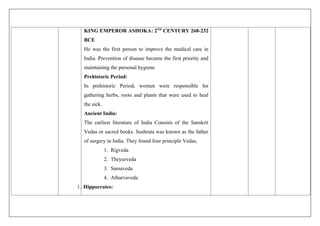
KING EMPEROR ASHOKA:2ND
CENTURY 268-232
BCE
He was the first person to improve the medical care in
India. Prevention of disease became the first priority and
maintaining the personal hygiene
Prehistoric Period:
In prehistoric Period, women were responsible for
gathering herbs, roots and plants that were used to heal
the sick.
Ancient India:
The earliest literature of India Consists of the Sanskrit
Vedas or sacred books. Sushruta was known as the father
of surgery in India. They found four principle Vedas,
1. Rigveda
2. Theyurveda
3. Samaveda
4. Atharvaveda
1. Hippocrates:
6.
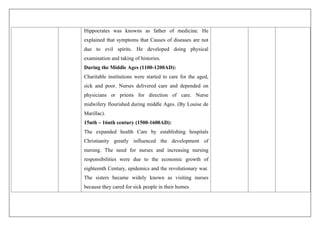
Hippocrates was knownsas father of medicine. He
explained that symptoms that Causes of diseases are not
due to evil spirits. He developed doing physical
examination and taking of histories.
During the Middle Ages (1100-1200AD):
Charitable institutions were started to care for the aged,
sick and poor. Nurses delivered care and depended on
physicians or priests for direction of care. Nurse
midwifery flourished during middle Ages. (By Louise de
Marillac).
15nth – 16nth century (1500-1600AD):
The expanded health Care by establishing hospitals
Christianity greatly influenced the development of
nursing. The need for nurses and increasing nursing
responsibilities were due to the economic growth of
eighteenth Century, epidemics and the revolutionary war.
The sisters became widely known as visiting nurses
because they cared for sick people in their homes
7.
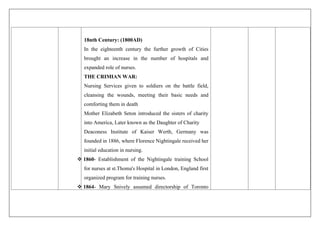
18nth Century: (1800AD)
Inthe eighteenth century the further growth of Cities
brought an increase in the number of hospitals and
expanded role of nurses.
THE CRIMIAN WAR:
Nursing Services given to soldiers on the battle field,
cleansing the wounds, meeting their basic needs and
comforting them in death
Mother Elizabeth Seton introduced the sisters of charity
into America, Later known as the Daughter of Charity
Deaconess Institute of Kaiser Werth, Germany was
founded in 1886, where Florence Nightingale received her
initial education in nursing.
1860- Establishment of the Nightingale training School
for nurses at st.Thoma's Hospital in London, England first
organized program for training nurses.
1864- Mary Snively assumed directorship of Toronto
8.
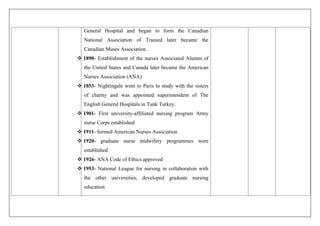
General Hospital andbegan to form the Canadian
National Association of Trained later became the
Canadian Muses Association.
1890- Establishment of the nurses Associated Alumni of
the United States and Canada later became the American
Nurses Association (ANA)
1853- Nightingale went to Paris to study with the sisters
of charity and was appointed superintendent of The
English General Hospitals in Tank Turkey.
1901- First university-affiliated nursing program Army
nurse Corps established
1911- formed American Nurses Association
1920- graduate nurse midwifery programmes were
established
1926- ANA Code of Ethics approved
1953- National League for nursing in collaboration with
the other universities, developed graduate nursing
education
9.
1985- IGNOU,established
1992- post basic programme IGNOU
20eth Century:
In the early twentieth century, a movement toward a
scientific, research-based defined body of nursing
knowledge and practice was seen. Nurses began to
assume expanded and advance practice roles.
Today, the profusion is faced with multiple challenges.
Nurses and nurse Educators are revising nursing practice
and curricula to meeting the ever changing needs of
society.
FLORENCE NIGHTINGALE (The lady with the
lamp)
Founded many Schools of nursing with theoretical and
practical basis in the care of the sick
First to stress on aseptic precautions while caring for the
patent
Her favorite dictum “Do the patient no harm”.
10.
The founder ofmodern nursing, Florence Nightingale,
established the first nursing philosophy based on health
maintenance and restoration in Notes of nursing: What it
is and what it is not
Widows:
They assisted deaconess in home Visiting. Freedom from
responsibilities at home was a necessity
Virgins:
They were younger women, assisted in caring for church
vestments and in giving alms to poor. They lived in their
own homes, and received no pay except when necessary.
Order of virgins was created when church felt that
virginity was essential purity of life.
Nursing in India: 1664: the East India Company started
a hospital for Soldiers
1935: Onwards-site-wire Councils started developing
1947-Indian Nursing Council (INC) Act passed by the
parliament, Now India has 23 state Nursing councils
11.
College of nursingstarted in Delhi (1946) and Vellore
(1947).
Nursing Educations in the Country integrated into the
system of higher education.
1908- TNAI formed to uphold dignity and honor of
nursing profession
IGNOU-1985
NURSING PROFESSION
DEFINITION
1. A vocation requiring advanced training and usually
involving mental rather than manual work, as teaching,
engineering, especially medicine, law"
-Webster- 1989.
2. The unique function of the nurse is to assist the
individual, sick of well in the performance of those
activities contributing to health or Its recovery (or to a
peaceful death) that he would perform unaided if he
had the necessary strength, will or knowledge; and to
12.
do this inSuch a way as to help them gain
independence rapidly as possible
-Virginia Henderson-1973
3. The act of utilizing the environment of the patient to
assist him in the recovery"
-Florence nightingale, 1973
4. It is the diagnosis and treatment of human responses to
actual or potential health problems.
-ANA (1980)
5. "Nursing encompasses autonomous and collaborative
Care of individuals of all ages, families, groups and
Community, sick of well and in all settings. Nursing
includes, the promotion of health, prevention of illness
and the Care of ill, disabled and dying people.
Advocacy, promotion of a safe environment, research,
participation in Shaping health policy and inpatient and
healthy Systems, management and education are also
13.
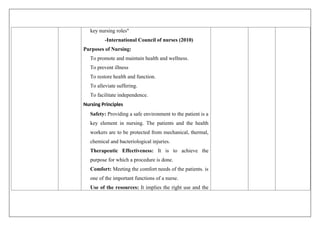
key nursing roles"
-InternationalCouncil of nurses (2010)
Purposes of Nursing:
To promote and maintain health and wellness.
To prevent illness
To restore health and function.
To alleviate suffering.
To facilitate independence.
Nursing Principles
Safety: Providing a safe environment to the patient is a
key element in nursing. The patients and the health
workers are to be protected from mechanical, thermal,
chemical and bacteriological injuries.
Therapeutic Effectiveness: It is to achieve the
purpose for which a procedure is done.
Comfort: Meeting the comfort needs of the patients. is
one of the important functions of a nurse.
Use of the resources: It implies the right use and the
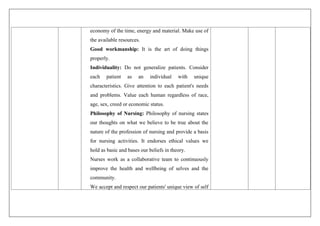
14.
economy of thetime, energy and material. Make use of
the available resources.
Good workmanship: It is the art of doing things
properly.
Individuality: Do not generalize patients. Consider
each patient as an individual with unique
characteristics. Give attention to each patient's needs
and problems. Value each human regardless of race,
age, sex, creed or economic status.
Philosophy of Nursing: Philosophy of nursing states
our thoughts on what we believe to be true about the
nature of the profession of nursing and provide a basis
for nursing activities. It endorses ethical values we
hold as basic and bases our beliefs in theory.
Nurses work as a collaborative team to continuously
improve the health and wellbeing of selves and the
community.
We accept and respect our patients' unique view of self
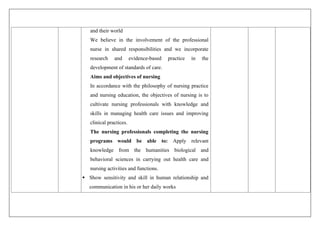
15.
and their world
Webelieve in the involvement of the professional
nurse in shared responsibilities and we incorporate
research and evidence-based practice in the
development of standards of care.
Aims and objectives of nursing
In accordance with the philosophy of nursing practice
and nursing education, the objectives of nursing is to
cultivate nursing professionals with knowledge and
skills in managing health care issues and improving
clinical practices.
The nursing professionals completing the nursing
programs would be able to: Apply relevant
knowledge from the humanities biological and
behavioral sciences in carrying out health care and
nursing activities and functions.
Show sensitivity and skill in human relationship and
communication in his or her daily works
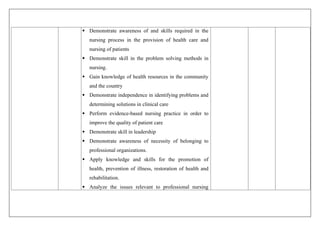
16.
Demonstrate awarenessof and skills required in the
nursing process in the provision of health care and
nursing of patients
Demonstrate skill in the problem solving methods in
nursing.
Gain knowledge of health resources in the community
and the country
Demonstrate independence in identifying problems and
determining solutions in clinical care
Perform evidence-based nursing practice in order to
improve the quality of patient care
Demonstrate skill in leadership
Demonstrate awareness of necessity of belonging to
professional organizations.
Apply knowledge and skills for the promotion of
health, prevention of illness, restoration of health and
rehabilitation.
Analyze the issues relevant to professional nursing
17.
development and explorepossible solutions.
scientifically.
Perform self-directed learning and continually aspire to
improve individual professional skills.
SCOPE OF NURSING
Nurse practitioner: Nurse practitioner is a nurse who
has an advanced education and is a graduate of a nurse
practitioner program. They usually deal with non-
emergency acute or chronic illness and provide
primary ambulatory care.
Clinical Nurse Specialist: A nurse who has an
advanced degree or expertise is considered to be an
expert in that specialized area of practice, eg: oncology
nurse. The nurse provides client care, educates others,
consults, conducts research and manages care.
Nurse Anesthetist: There are accredited programs in
anesthesiology for nurses. These nurses carry out
preoperative tests and assessments under the
18.
supervision of aphysician.
Nurse Midwife: Nurse Midwife is an RN who has
completed a program in midwifery and is certified by
the university as Nurse Midwife. The nurse gives
prenatal and postnatal care and manages deliveries in
normal pregnancies.
Nurse Researcher: Nurse Researchers investigate
nursing problems to improve nursing care and to refine
and expand nursing knowledge.
Nurse Administrator: Manages client care including
the delivery of nursing service. The administrator may
have a middle management position such as head nurse
or supervisor or a more senior management position
such as Director of Nursing Services.
Nurse-educator: Nurse-educators are employed in
nursing programs at educational institutions
Occupational/Industrial Nurse: Nurses work in
occupational health settings
19.
Health Advocate: Manynurses also work in the health
advocacy and patient advocacy fields at companies.
Nurse Consultants: Nurses act as advisers and
consultants to the health care and insurance industries.
FUNCTIONS OF A NURSE
The roles/functions required at a specific time depend
on the needs of the client and aspects of the particular
environment. Nurses practice in a wide range of
settings but generally nursing is divided depending on
the needs of the person being nursed.
Care Giver: It includes the activities that assist the
client physically and psychologically while preserving
the client's dignity. The required nursing
Communicator: Effective communication can initiate
changes that promote health. Nurses communicate with
the client, support persons, other health professionals
and people in the community to establish a trusting
relationship. Nurses identify client's problems and
20.
communicate these verballyand/ or in writing to other
members of the health team. It prevents many legal
problems in practice.
Teacher: As a teacher, the nurse helps clients learn
about the health and health care procedures they need
to perform to restore or to maintain health. The nurse
determines the client's learning needs and readiness to
learn, sets specific learning goals and teaching
strategies, enacts teaching strategies and measures
learning.
Client Advocate: A client advocate acts to protect the
client. In this role the nurse may represent the client's
need and wishes to other health professionals. such as
relaying the client's wishes for information to the
physician.
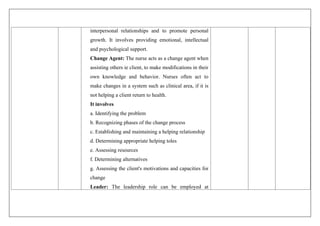
Counselor: Counseling is the process of helping a
client to recognize and cope with stressful
psychological or social problems to develop improved
21.
interpersonal relationships andto promote personal
growth. It involves providing emotional, intellectual
and psychological support.
Change Agent: The nurse acts as a change agent when
assisting others ie client, to make modifications in their
own knowledge and behavior. Nurses often act to
make changes in a system such as clinical area, if it is
not helping a client return to health.
It involves
a. Identifying the problem
b. Recognizing phases of the change process
c. Establishing and maintaining a helping relationship
d. Determining appropriate helping toles
e. Assessing resources
f. Determining alternatives
g. Assessing the client's motivations and capacities for
change
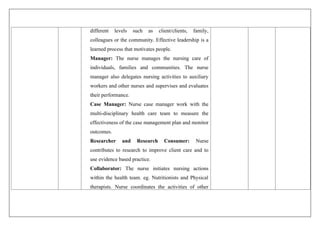
Leader: The leadership role can be employed at
22.
different levels suchas client/clients, family,
colleagues or the community. Effective leadership is a
learned process that motivates people.
Manager: The nurse manages the nursing care of
individuals, families and communities. The nurse
manager also delegates nursing activities to auxiliary
workers and other nurses and supervises and evaluates
their performance.
Case Manager: Nurse case manager work with the
multi-disciplinary health care team to measure the
effectiveness of the case management plan and monitor
outcomes.
Researcher and Research Consumer: Nurse
contributes to research to improve client care and to
use evidence based practice.
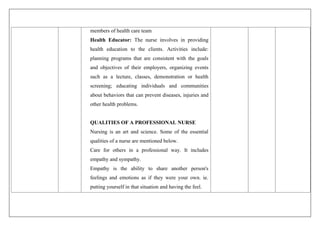
Collaborator: The nurse initiates nursing actions
within the health team. eg. Nutritionists and Physical
therapists. Nurse coordinates the activities of other
23.
members of healthcare team
Health Educator: The nurse involves in providing
health education to the clients. Activities include:
planning programs that are consistent with the goals
and objectives of their employers, organizing events
such as a lecture, classes, demonstration or health
screening; educating individuals and communities
about behaviors that can prevent diseases, injuries and
other health problems.
QUALITIES OF A PROFESSIONAL NURSE
Nursing is an art and science. Some of the essential
qualities of a nurse are mentioned below.
Care for others in a professional way. It includes
empathy and sympathy.
Empathy is the ability to share another person's
feelings and emotions as if they were your own. ie.
putting yourself in that situation and having the feel.
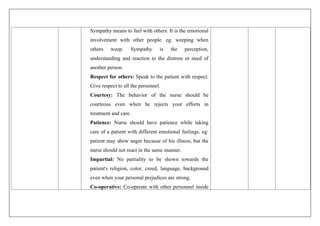
24.
Sympathy means tofeel with others. It is the emotional
involvement with other people. eg. weeping when
others weep. Sympathy is the perception,
understanding and reaction to the distress or need of
another person.
Respect for others: Speak to the patient with respect.
Give respect to all the personnel.
Courtesy: The behavior of the nurse should be
courteous even when he rejects your efforts in
treatment and care.
Patience: Nurse should have patience while taking
care of a patient with different emotional feelings. eg:
patient may show anger because of his illness, but the
nurse should not react in the same manner.
Impartial: No partiality to be shown towards the
patient's religion, color, creed, language, background
even when your personal prejudices are strong.
Co-operative: Co-operate with other personnel inside
25.
and outside thedepartment in an effort to give good
nursing care even when there is conflict or
misunderstanding.
Commitment: Putting service above personal gain.
Poise: Be stable and well balanced. Nurse should be
able to control the emotions.
Self-discipline: Following certain accepted rules and
regulations for the way in which you live and work.
Honesty: being truthful, sincere and fair.
Courage: It means to be brave. A commitment to the
profession and confidence in one's own knowledge and
ability to practice nursing often will help to give
courage when it is needed. The professional nurse must
be brave enough to face any situation, eg: while
dealing a mass casualty.
Personal Appearance: Personal appearance will have
a strong influence upon the work and relationships. A
neat, clean and pleasant appearance should always be
26.
practiced.
Health: The nurse'sphysical, mental and spiritual
health will influence everything she/he does.
Loyalty: Showing loyalty by not talking bad about
Institution or organization in which you are working
VALUES IN NURSING
Introduction
Nurses, as one of the health service providers and
members in health system, are responsible for giving
care to the clients and patients based on ethical issues.
Nursing is a earing profession Caring is best
demonstrated by a nurse's ability to embody the core
values of professional nursing. The values of nursing
arise from a concern with human. flourishing. The
caring professional nurse integrates these values in
clinical practice
TYPES OF VALUES
Professional values
27.
Personal values
Ethical values
Professional, personal and ethical values essential to
nurses include human dignity and respect, equality and
justice, altruism, autonomy in decision making,
Goodness or rightness, precision and accuracy in
caring, integrity. responsibility and intelligence, human
relationship. individual and professional competency,
sympathy, trust, diversity, Excellence, professionalism,
nursing knowledge. student centered learning,
communication and collaboration, confidentiality
among patients, honesty, ambition, prevention of
suffering, health promotion and nursing research.
Human dignity and respect:
Respect to individuals including the persons, their
families and the society is an important nursing ethical
value. Dignity and respect is defined as the
consideration of human innate values, respecting
28.
patient's beliefs andpreservation of privacy during
clinical procedures
Equality and justice
Justice is an ethical value suggested in nursing
literatures. This refers to equality of distribution.
Social justice focuses on equal access to health
services and the right of being fairly treated and cared
free of economic, social and cultural status. It is a fair
distribution of resources and provision of individuals'
equal treatment and care.
Altruism
Altruism is a common nursing value. It focuses on
helping others and provision of the utmost health and
welfare for the clients, their families and the society,
selflessness and self-devotion. Therefore, altruism is
defined as focusing on clients as a human and
struggling to preserve their health and well-being.
Nurses should have spirit of selflessness and
29.
helpfulness toward others.
Autonomyin decision making:
Independency in decision making is a nursing ethical
value. It is the right of independency in decision
making, right to accept or reject suggested treatments,
interventions or care.
Goodness or rightness: Individuals should promote
goodness over badness, cause no harm or badness and
prevent badness or harm,
Precision and accuracy in caring: Precise and
accurate care has been indicated as a nursing ethical
value Caring is a fundamental part of the nursing
profession which characterizes our concern,
commitment and consideration for the whole person. It
is characterized by supportive, protective quality care
in all dimensions of the individual including physical,
emotional, mental and spiritual. This sort of care is a
precise, safe, appropriate, multidimensional and kind
30.
care given tothe patients by nurses.
Integrity
It is a quality that encompasses honesty, truthfulness,
and indicative of a person who displays morality and
good character
Responsibility and intelligence
Having responsibility on clients is a nursing ethical
value. It is a feeling of being responsible for the duties
towards patients and respecting the patients' rights for
decision making. Based on this definition, nurses are
responsible for giving evidence-based care with
commitment and are accountable for their actions and
duties. Nurses are responsible for promotion of
patients' well-being, having a holistic approach toward
them and completing their duties:
Human relationship
Human relationship has been indicated as a nursing
ethical value with traits of mutual respect, trust and
31.
reliance which areaccompanied by patients'
confidentiality and privacy. It can be verbal or non-
verbal and defined through having honesty in words
and practice, sympathy and mutual understanding,
courtesy and friendliness.
Individual and professional competency
Individual and professional competency as a nursing
ethical value has been defined as a struggle to make
nursing as a profession, feeling the need to grow and
develop. Personal and professional competency results
in acquiring up-to-date knowledge and promotion of
clinical skills and practical abilities. It helps to give
more holistic and comprehensive care.
Sympathy: Sympathy has been indicated as a nursing
ethical value with traits of understanding patients and
their family's needs and giving care based on making a
fair communication.
Trust
32.
Trust is anursing ethical value and is defined by traits
of honesty in words and practice. Nurses should gain
patients', their family's and society's trust through
understanding patient's situation. Based on this
definition, gaining clients' trust comes true when
nurses are honest in their words and practice and gain
individuals' trust by doing their duties appropriately.
Diversity: affirming the uniqueness of and differences
among persons, ideas, values and ethnicities.
Excellence: A culture of excellence reflects a
commitment to continuous growth, improvement and
understanding. It is reflected in evidence-based
teaching and learning achieved by both faculty and
students where exemplary scholarship, service,
teaching and practice are valued
Professionalism: It is inclusive of attributes, beliefs
and communication that are characterized by respect
for others, integrity, responsibility, accountability,
33.
courage, humility, advocacyand an innovative spirit
which demonstrate the caring nature of a nurse.
Nursing Knowledge: It is a total of the philosophies,
theories, research and practice wisdom of the
discipline. As a professional discipline this knowledge
is important for guiding the safe practice of nursing.
Student-centered learning: Student-centered learning
includes multiple learning experiences and
instructional approaches which shift the focus from the
instructor to the student. Instructors guide learning
which is designed to address student learning needs,
interests, goals, cultural differences and career
aspirations while effecting desired program outcomes.
Student-centered learning allows the individual student
to have an active role in the teaching learning
relationship.
Communication and Collaboration: It consists of
collaborative relationships and community partnerships
34.
among students, faculty,patients and others to
facilitate the delivery of coordinated patient-centered
care. Effective communication is an essential
component of professional teamwork and
collaboration.
CODE OF ETHICS:
Ethics includes personal behavior’s and issues of
character e.g. kindness, tolerance and generosity. Ethic
is derived from the word ETHOS-ethos as defined by
Bernard Harding compromises distinction attitudes,
which characterize the cultural outlook of professional
group. Ethics are the distinction between right and
wrong, based on a body of knowledge, not just based
on opinions. Ethics in nursing is a set of moral codes of
professional behaviors towards holistic care. The
ethical code is a set of guidelines formulated by the
members of profession with the help of specialists in
the field of nursing leaders, advocate lawyers at times
35.
members from thesociety.
Purposes of Code of Ethics in Nursing:
a. Standards for the behaviors of nurse and provide
general guidelines for nursing action in ethical
dilemmas.
b. The code helps to distinguish between right and wrong
at a given time, especially, when alternatives appear
just as satisfactory.
c. The code enables a correct decision and a uniform
d. Decision within the groups. Helps to protect rights of
individuals, families and community and also the right
of the nurse.
Ethical Principles
1) Ethical principles of respect and autonomy:
Respect for a person involves: level of understanding
of another person or empathy and reducing
exploitation
36.
Autonomy: person's independence,self-determining
action allow the patient to make decision.
2) Principle of beneficence
Activity seeking benefits, promotion of good. The duty
to do balance between benefits and harms, Paternalism
is an undesirable outcome of beneficence, in which the
health care provider decides what is best for the client
and attempt to encourage the clients to act against his
or her own choices.
3) Principle of justice:
Basic principle is that each person has equal right to
the liberty available to everyone. Justice is based on
the assumption that society has a responsibility to treat
people fairly. Justice can be further split into three
categories: fair distribution of scarce resources
(distributive practice), respect for people's rights
(rights-based justice) and respect for morally-
acceptable laws (legal justice), Society confirms
37.
concepts of justicein its legal frameworks. There is an
interrelationship between law and justice, which means
that one does not automatically override the other.
Laws are modified over time as they are applied and
this increases justice in society. Different health
circumstances may require different resource
allocation or entitlement to achieve equity
4) Principle of veracity:
The obligation to tell the truth. Veracity occurs when
actions, speech and behavior ensure communications
between individuals and/or groups are honest and
truthful.
5) Principle of fidelity: The duty to do what one has
promised. Fidelity means the obligation to remain
faithful to one's commitments to others, particularly
promises and when information is given in confidence.
6) Principle of Non-maleficence :
It is the avoidance of harm, the prevention of future
38.
harm, and minimizingharm in situations where it is
unavoidable. The meaning and value of harm can vary
according to context and this can influence what we
think and do when considering maleficence
Ethical dilemma
o An ethical dilemma occurs when there is conflict
between two or more ethical principles
o No correct decision exists.
o The nurse must make a choice between two
alternatives that are equally unsatisfactory.
o Such dilemmas may occur as a result of differences in
cultural or religious beliefs.
o Ethical reasoning is the process of thinking through
what one ought to do in an orderly and systematic
manner to provide justification for actions based on
principles
INTERNATIONAL CODE OF NURSING ETHICS
The international code of ethics for nurses was first
39.
adopted by theInternational Council of Nurses (ICN)
in 1953
The fundamental responsibility of the nurse is four fold
that is to promote health, to prevent illness, to restore
health, and to alleviate sufferings. The need for nursing
is usually universal. It is unrestricted by considerations
of nationality, race, creed, color, age, sex, politics or
social status.
The introduction to the code gives a general
description of
1. What the nurse does the fourfold responsibility of
promoting health, preventing illness, restoring health
and alleviating sufferings.
2. How nursing service should be given unrestricted by
nationality, race, creed, color, age, sex, politics etc.
3. To whom the service are given the individual, family
and community.
40.
The body ofcode is divided into 5 sections.
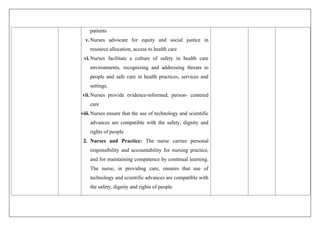
1. Nurses and People
Code directs the nurses to respect as person's
value, customs and religious beliefs. The nurse is
expected to learn the accepted patterns of the behavior
of the community and not acceptable to them. All
personal information entrusted to the nurse must be
held in confidence or shared only with careful
judgment.
i."Patients' or 'people requiring care".
ii.Human rights, values, customs, religious and spiritual
beliefs of the individual, families and communities
should be respected.
iii.Nurses ensure that the individual and family receive
understandable, accurate, sufficient information.
iv.Nurses hold in confidence personal information and
respect the privacy, confidentiality and interests of
41.
patients
v.Nurses advocate forequity and social justice in
resource allocation, access to health care
vi.Nurses facilitate a culture of safety in health care
environments, recognizing and addressing threats to
people and safe care in health practices, services and
settings.
vii.Nurses provide evidence-informed, person- centered
care
viii.Nurses ensure that the use of technology and scientific
advances are compatible with the safety, dignity and
rights of people
2. Nurses and Practice: The nurse carries personal
responsibility and accountability for nursing practice,
and for maintaining competence by continual learning.
The nurse, in providing care, ensures that use of
technology and scientific advances are compatible with
the safety, dignity and rights of people
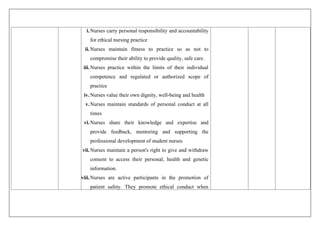
42.
i.Nurses carry personalresponsibility and accountability
for ethical nursing practice
ii.Nurses maintain fitness to practice so as not to
compromise their ability to provide quality, safe care.
iii.Nurses practice within the limits of their individual
competence and regulated or authorized scope of
practice
iv.Nurses value their own dignity, well-being and health
v.Nurses maintain standards of personal conduct at all
times
vi.Nurses share their knowledge and expertise and
provide feedback, mentoring and supporting the
professional development of student nurses
vii.Nurses maintain a person's right to give and withdraw
consent to access their personal, health and genetic
information.
viii.Nurses are active participants in the promotion of
patient safety. They promote ethical conduct when
43.
errors or nearmisses occur
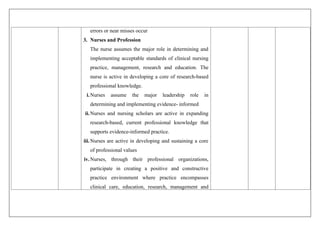
3. Nurses and Profession
The nurse assumes the major role in determining and
implementing acceptable standards of clinical nursing
practice, management, research and education. The
nurse is active in developing a core of research-based
professional knowledge.
i.Nurses assume the major leadership role in
determining and implementing evidence- informed
ii.Nurses and nursing scholars are active in expanding
research-based, current professional knowledge that
supports evidence-informed practice.
iii.Nurses are active in developing and sustaining a core
of professional values
iv.Nurses, through their professional organizations,
participate in creating a positive and constructive
practice environment where practice encompasses
clinical care, education, research, management and
44.
leadership
v.Nurses contribute topositive and ethical organizational
environments and challenge unethical practices and
settings.
vi.Nurses engage in the creation, dissemination and
application of research that improves outcomes for
individuals, families and communities.
vii.Nurses prepare for and respond to emergencies,
disasters, conflicts, epidemics, pandemics, social crises
and conditions of scarce resources.
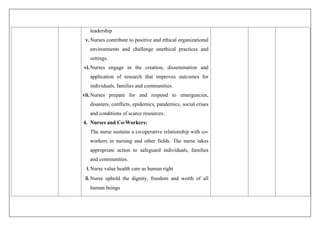
4. Nurses and Co-Workers:
The nurse sustains a co-operative relationship with co-
workers in nursing and other fields. The nurse takes
appropriate action to safeguard individuals, families
and communities.
i.Nurse value health care as human right
ii.Nurse uphold the dignity, freedom and worth of all
human beings
45.
iii.Nurse lead orcontribute to sound health policy
iv.Nurses contribute to population health and work
towards the achievement of the United Nations
Sustainable Development Goals (SDGs)
v.Nurses recognize the significance of the social
determinants of health.
vi.Nurses collaborate and practice to preserve, sustain and
protect the natural environment and are aware of the
health consequences of environmental degradation
vii.Nurses collaborate across countries to develop and
maintain global health and to ensure policies and
principles for this.
5. Nurse and Society
A nurse should participate and share
responsibility with other citizens and other health
professionals in promoting effects to meet the health
needs of public local, state, national and international.
She could recognize and perform the duties of
46.
citizenship and bewell aware of laws and regulations
which affect the practice of medicine and nursing.
CODE OF ETHICS FOR NURSES IN INDIA
The nurse respects the uniqueness of individual in
provision of care.
The nurse respects the rights of individuals as partners
in care and help in making informed choices,
The nurse respects individual's right to privacy
maintains confidentiality and shares information
judiciously,
Nursing maintains competence in order to render
quality nursing care.
The nurse is obliged to practice within framework of
ethical, professional, legal boundaries.
Nurse is obliged to work harmoniously with members
of the health team.
Nurse is obliged to reciprocate the trust invested in
nursing profession by society.
47.
SUMMARY
Till now wehave discussed about historical development
in nursing in prehistoric periods and in ancient India.
Code of ethics in nursing and code of professional conduct
in nursing.
CONCLUSION
Future of nursing is of great scope. The nurses can make
use of the great scope for their professional advancements
and to safeguard their lives. Nursing careers are in more
demand than ever before. Nursing careers are extremely
versatile and very flexible. The advancement and
progression of the nurses is a priority nowadays. Staffs
who display fervor and potential in taking on a larger role
in nursing may be upgraded through a number of
pathways. Nursing is an important major because nurses
must maintain a good sense of character and responsibility
in a variety of environments while caring for their
patients.
48.
BIBLIOGRAPHY
NAVDEEP KAUR BRARAND HC RAWAT, TEXT
BOOK OF ADVANCED NURSING PRACTICE, 5th
edition, jaypeebrothers publications - Page No-1-110.
ADVANCED NURSING PRACTICE, 6th edition, PV
publications- Page No-1-62.
SHABEER.P.BASHEER AND S. YASEEN KHAN,
TEXT BOOK OF ADVANCED NURSING PRACTICE,
3rd
edition, emmess publications- Page No-1-74.
WEBSITES:
WWW.CIMT.org/. com.
WWW. SLIDESHARE.COM.
WIKIPEDIA.
WWW.MEDLINE.COM

 Most read

 Most read