ME4010 Computational Methods for
Mechanical Engineering
Chapter 4 Solution of system of equations
Instructor: Nikolai V. Priezjev
Office: 430 Russ Engineering Center
Phone: 937-775-3214
Email: nikolai.priezjev@wright.edu
The course is adopted from Prof. Huang at WSU
 
 
)(
2)(
2
23332
2
3
1222322
2
2
111212
2
1
xxkgmx
dt
d
m
xxkgmxxkx
dt
d
m
kxgmxxkx
dt
d
m



1 2 1
1 2 3 2
2 3 3
3 2 0
2 3
0
kx kx m g
kx kx kx m g
kx kx m g
  
   
  
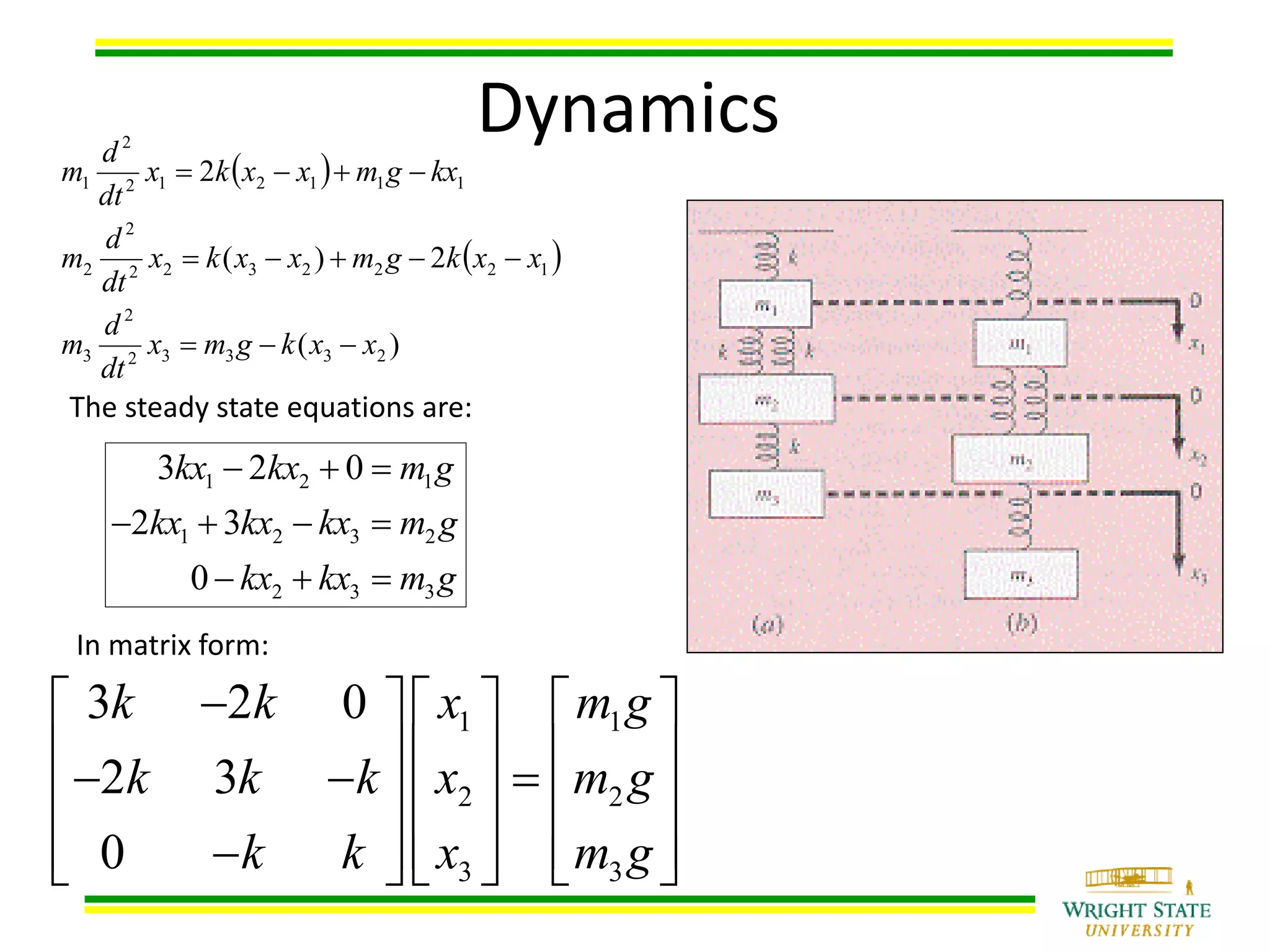
The steady state equations are:
1 1
2 2
3 3
3 2 0
2 3
0
k k x m g
k k k x m g
k k x m g
     
            
          
In matrix form:
Dynamics
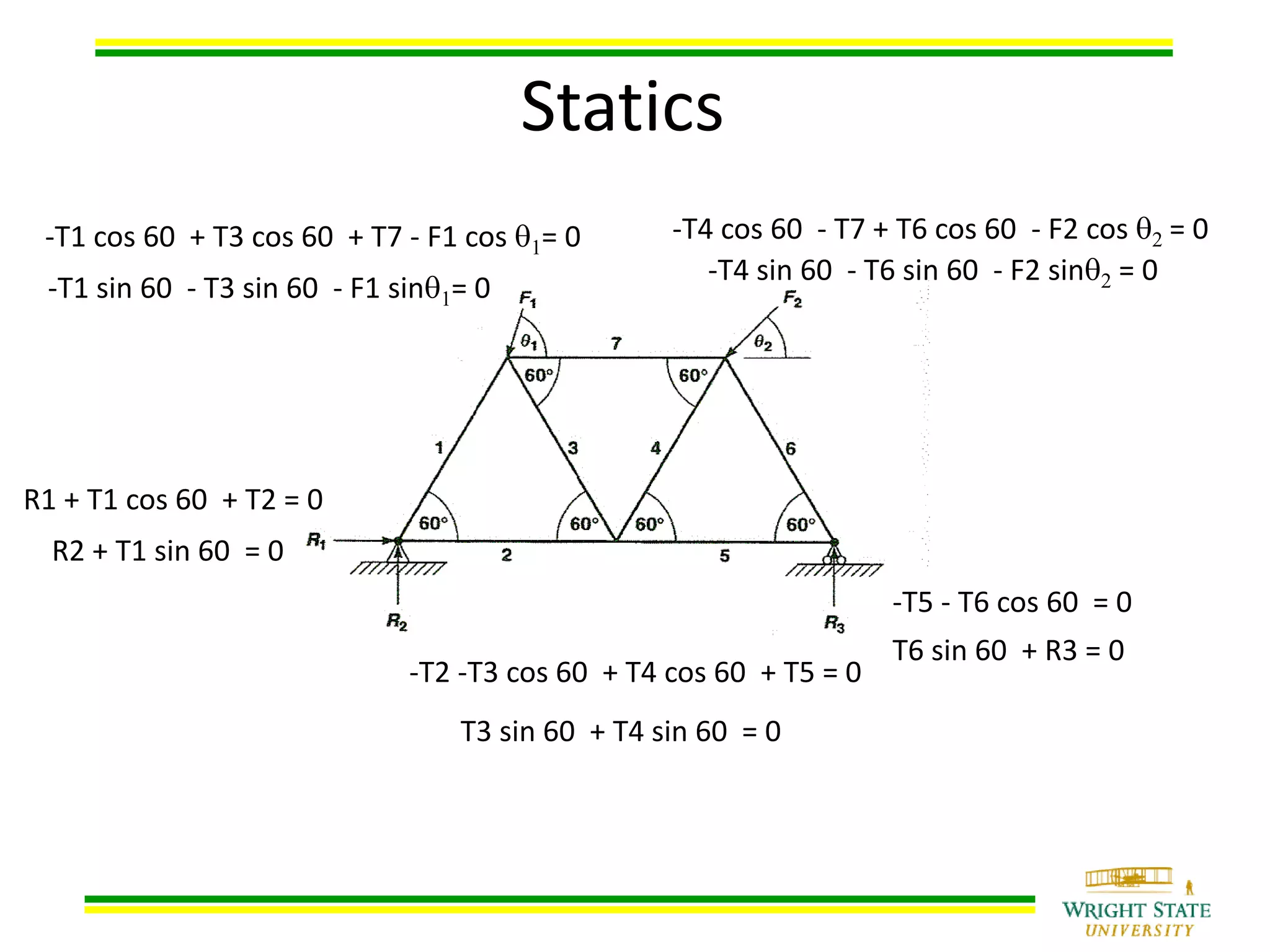
Statics
R1 + T1 cos 60 + T2 = 0
R2 + T1 sin 60 = 0
-T2 -T3 cos 60 + T4 cos 60 + T5 = 0
T3 sin 60 + T4 sin 60 = 0
-T5 - T6 cos 60 = 0
T6 sin 60 + R3 = 0
-T1 cos 60 + T3 cos 60 + T7 - F1 cos = 0
-T1 sin 60 - T3 sin 60 - F1 sin= 0
-T4 cos 60 - T7 + T6 cos 60 - F2 cos  = 0
-T4 sin 60 - T6 sin 60 - F2 sin = 0
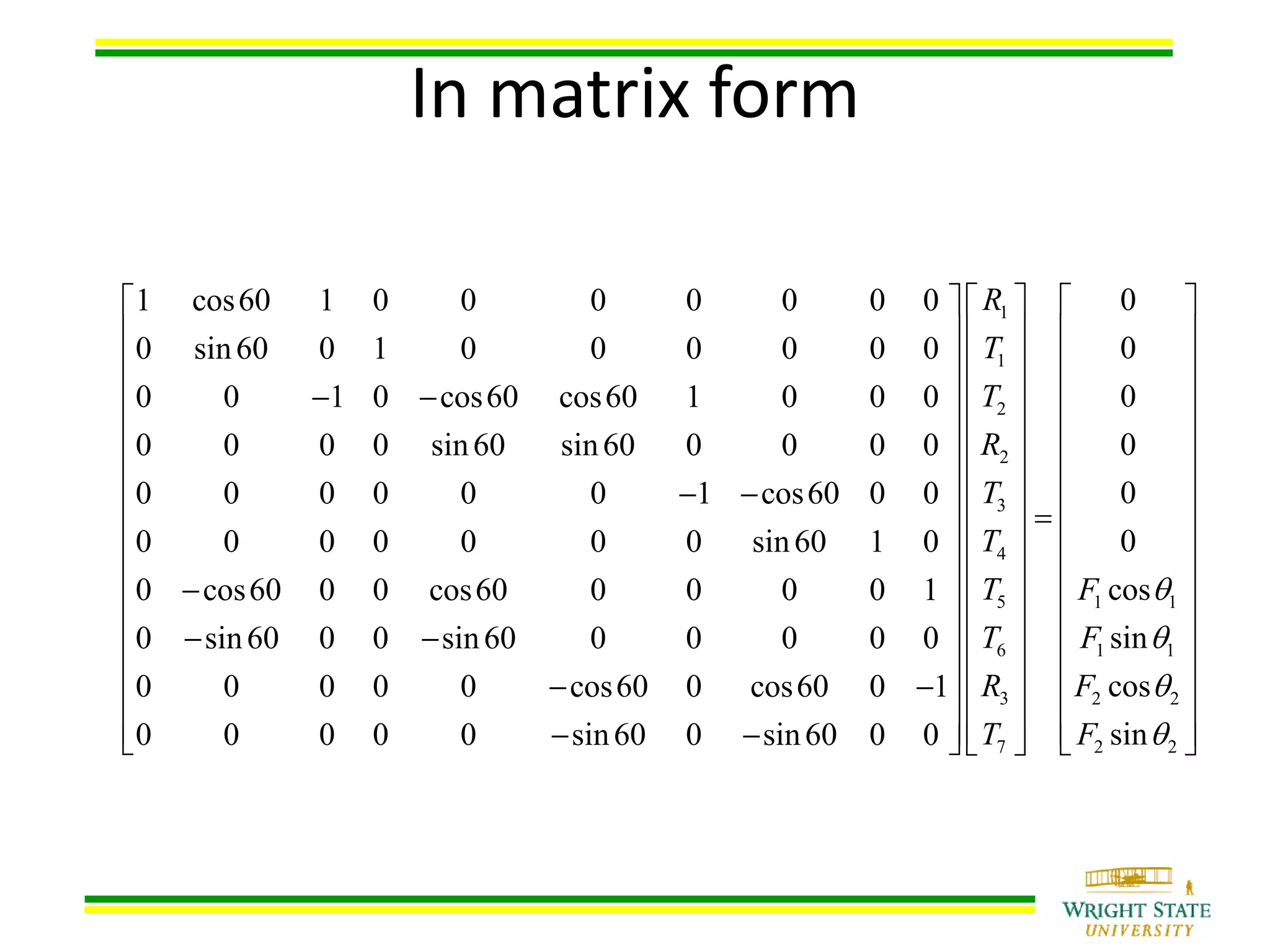
In matrix form
1 cos60 1 0 0 0 0 0 0 0
0 sin60 0 1 0 0 0 0 0 0
0 0 1 0 cos60 cos60 1 0 0 0
0 0 0 0 sin60 sin60 0 0 0 0
0 0 0 0 0 0 1 cos60 0 0
0 0 0 0 0 0 0 sin60 1 0
0 cos60 0 0 cos60 0 0 0 0 1
0 sin60 0 0 sin60 0 0 0 0 0
0 0 0 0 0 cos60 0 cos60 0 1
0 0 0 0 0 sin60 0 sin60 0 0
 
 
 
  
 
 
  
 

 

 
  
   
1
1
2
2
3
4
5 1 1
6 1 1
3 2 2
7 2 2
0
0
0
0
0
0
cos
sin
cos
sin
R
T
T
R
T
T
T F
T F
R F
T F




   
   
   
   
   
   
   
    
   
   
   
   
   
   
      
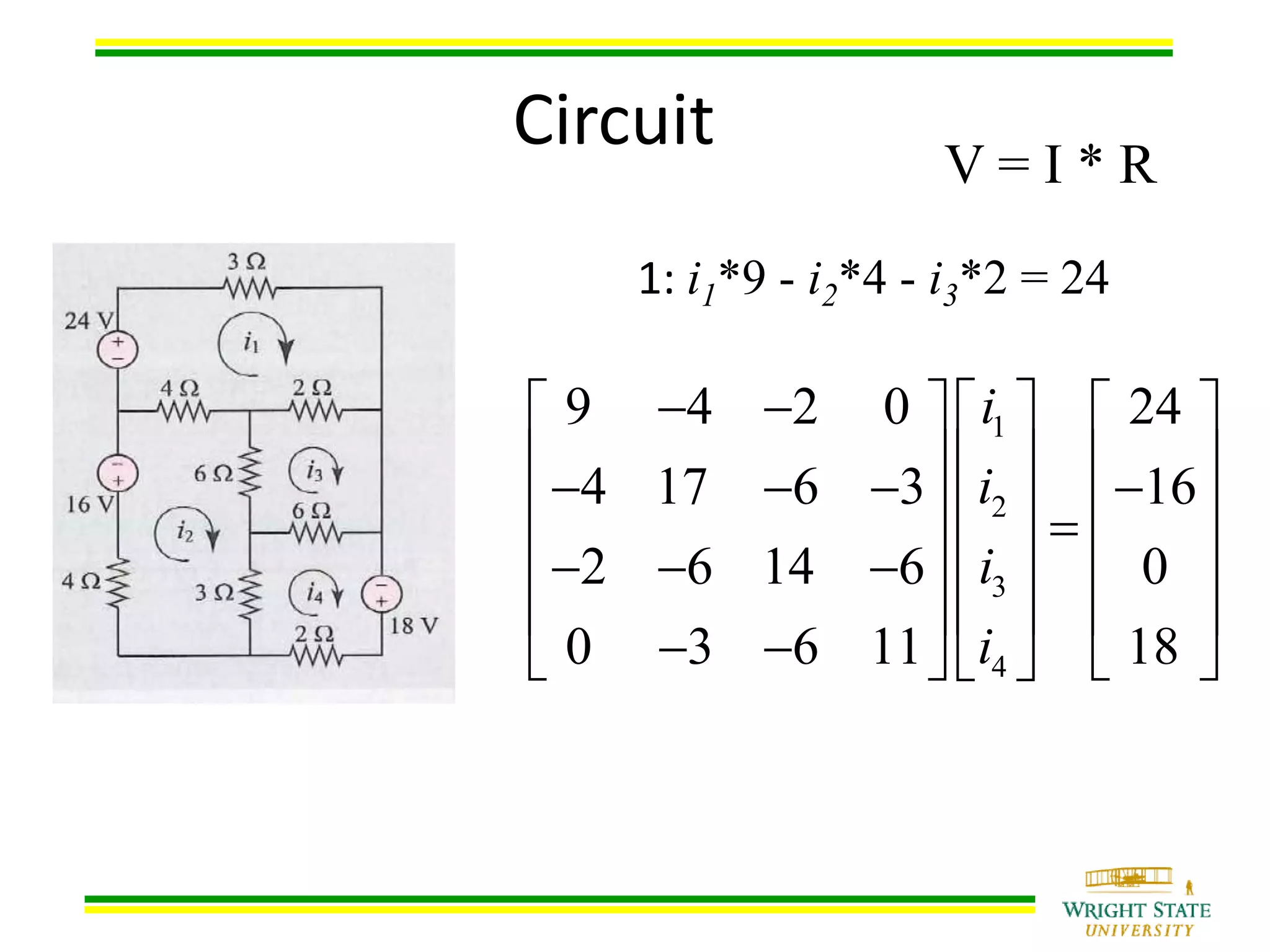
Circuit
1
2
3
4
9 4 2 0 24
4 17 6 3 16
2 6 14 6 0
0 3 6 11 18
i
i
i
i
      
           
      
    
     
V = I * R
1: i1*9 - i2*4 - i3*2 = 24
Method
[A] = [L][U]
where
[L] = lower triangular matrix
[U] = upper triangular matrix
LU Decomposition
Given [A][X] = [B]
1. Decompose [A] into [L] and [U]
2. Solve [L][Z] = [B] for [Z]
3. Solve [U][X] = [Z] for [X]
Method: [A] Decomposes to [L] and [U]
    





















33
2322
131211
3231
21
00
0
1
01
001
u
uu
uuu
ULA


[U] is the same as the coefficient matrix at the end of the forward elimination step.
[L] is obtained using the multipliers that were used in the forward elimination process
Finding the [U] matrix
Using the Forward Elimination Procedure of Gauss Elimination
112144
1864
1525










 
112144
56.18.40
1525
56.212;56.2
25
64










 RowRow
 
76.48.160
56.18.40
1525
76.513;76.5
25
144











 RowRow
Step 1:
Finding the [U] Matrix
Step 2:












76.48.160
56.18.40
1525
 
7.000
56.18.40
1525
5.323;5.3
8.4
8.16













RowRow
 











7.000
56.18.40
1525
U
Matrix after Step 1:
Finding the [L] matrix
Using the multipliers used during the Forward Elimination Procedure










1
01
001
3231
21


56.2
25
64
11
21
21 
a
a

76.5
25
144
11
31
31 
a
a

From the first step
of forward
elimination
112144
1864
1525










Finding the [L] Matrix
 











15.376.5
0156.2
001
L
From the second
step of forward
elimination












76.48.160
56.18.40
1525
5.3
8.4
8.16
22
32
32 



a
a

Does [L][U] = [A]?
   






















7.000
56.18.40
1525
15.376.5
0156.2
001
UL
?
112144
1864
1525










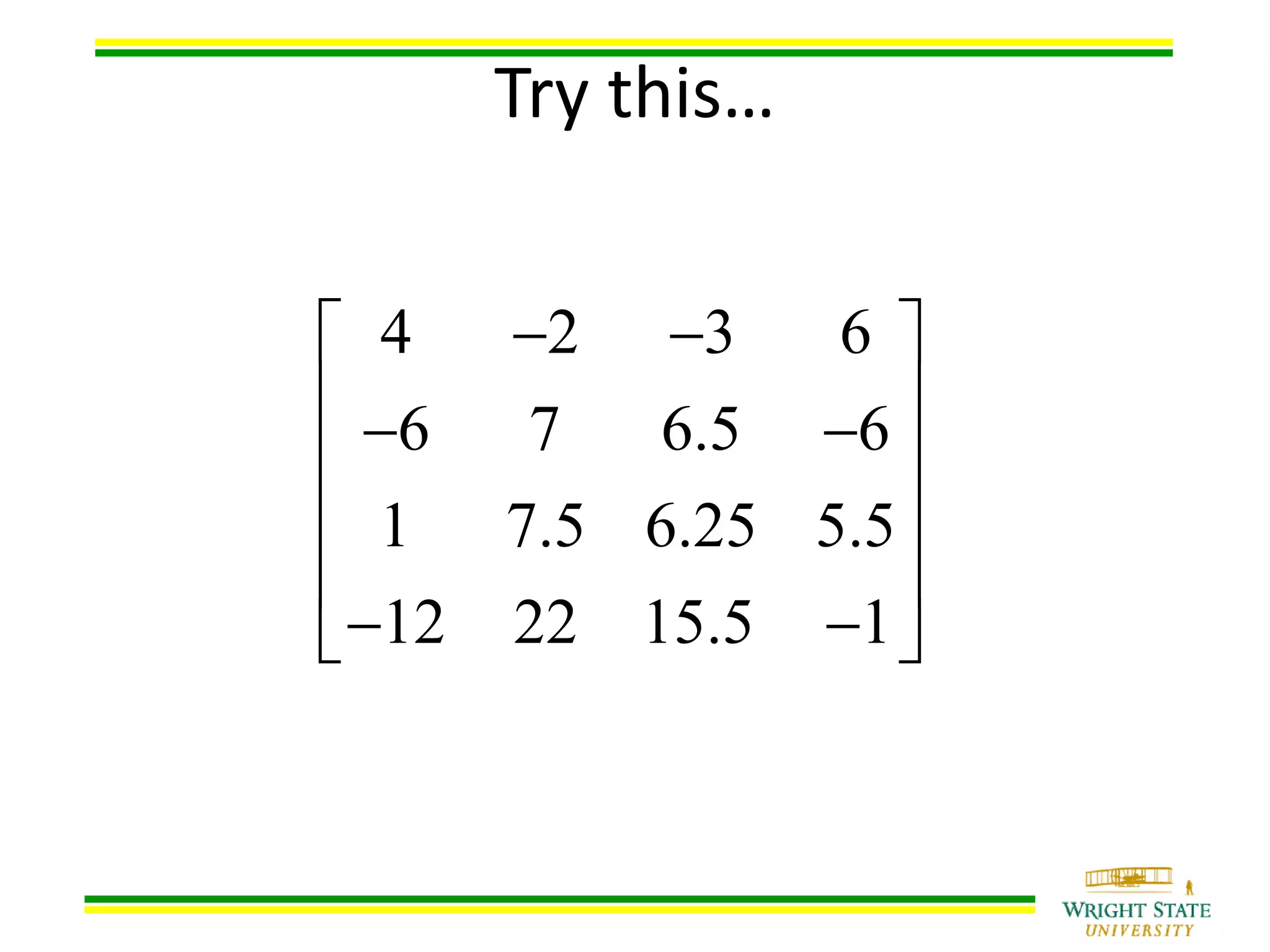
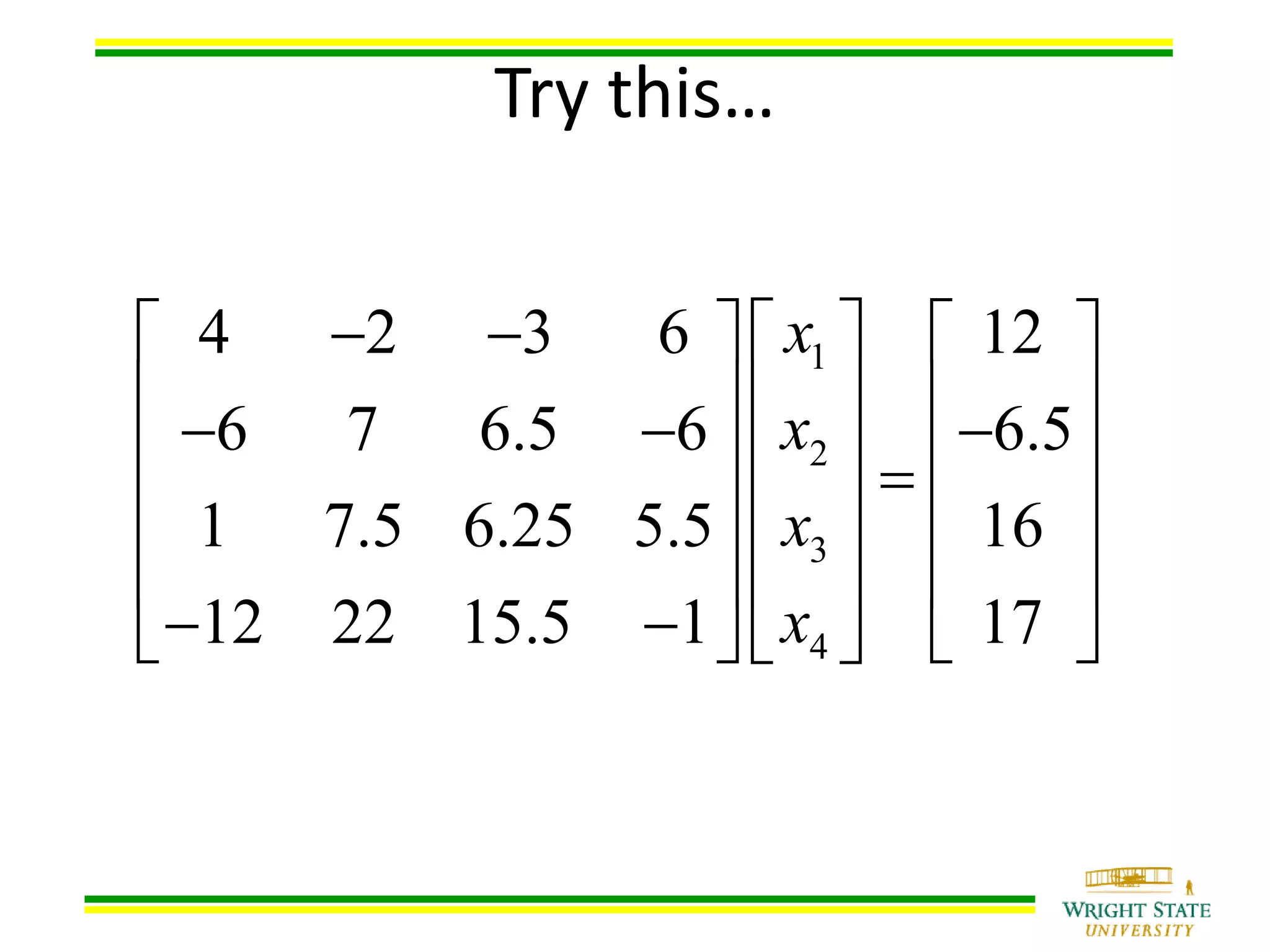
Try this…
4 2 3 6
6 7 6.5 6
1 7.5 6.25 5.5
12 22 15.5 1
  
   
 
 
  
Using LU Decomposition to solve SLEs
Solve the following set of
linear equations using LU
Decomposition































2279
2177
8106
112144
1864
1525
3
2
1
.
.
.
x
x
x
Using the procedure for finding the [L] and [U] matrices
    






















7.000
56.18.40
1525
15.376.5
0156.2
001
ULA
Example
Set [L][Z] = [B]
Solve for [Z]































2.279
2.177
8.106
15.376.5
0156.2
001
3
2
1
z
z
z
1
1 2
1 2 3
106.8
2.56 177.2
5.76 3.5 279.2
z
z z
z z z

 
  
Example
Complete the forward substitution to solve for [Z]
 
   
735.0
21.965.38.10676.52.279
5.376.52.279
2.96
8.10656.22.177
56.22.177
8.106
213
12
1







zzz
zz
z
 






















735.0
21.96
8.106
3
2
1
z
z
z
Z
Example
Set [U][X] = [Z]
Solve for [X] The 3 equations become
































7350
2196
8106
7.000
56.18.40
1525
3
2
1
.
.
.
x
x
x
1 2 3
2 3
3
25 5 106.8
4.8 1.56 96.21
0.7 0.735
x x x
x x
x
  
   

Example
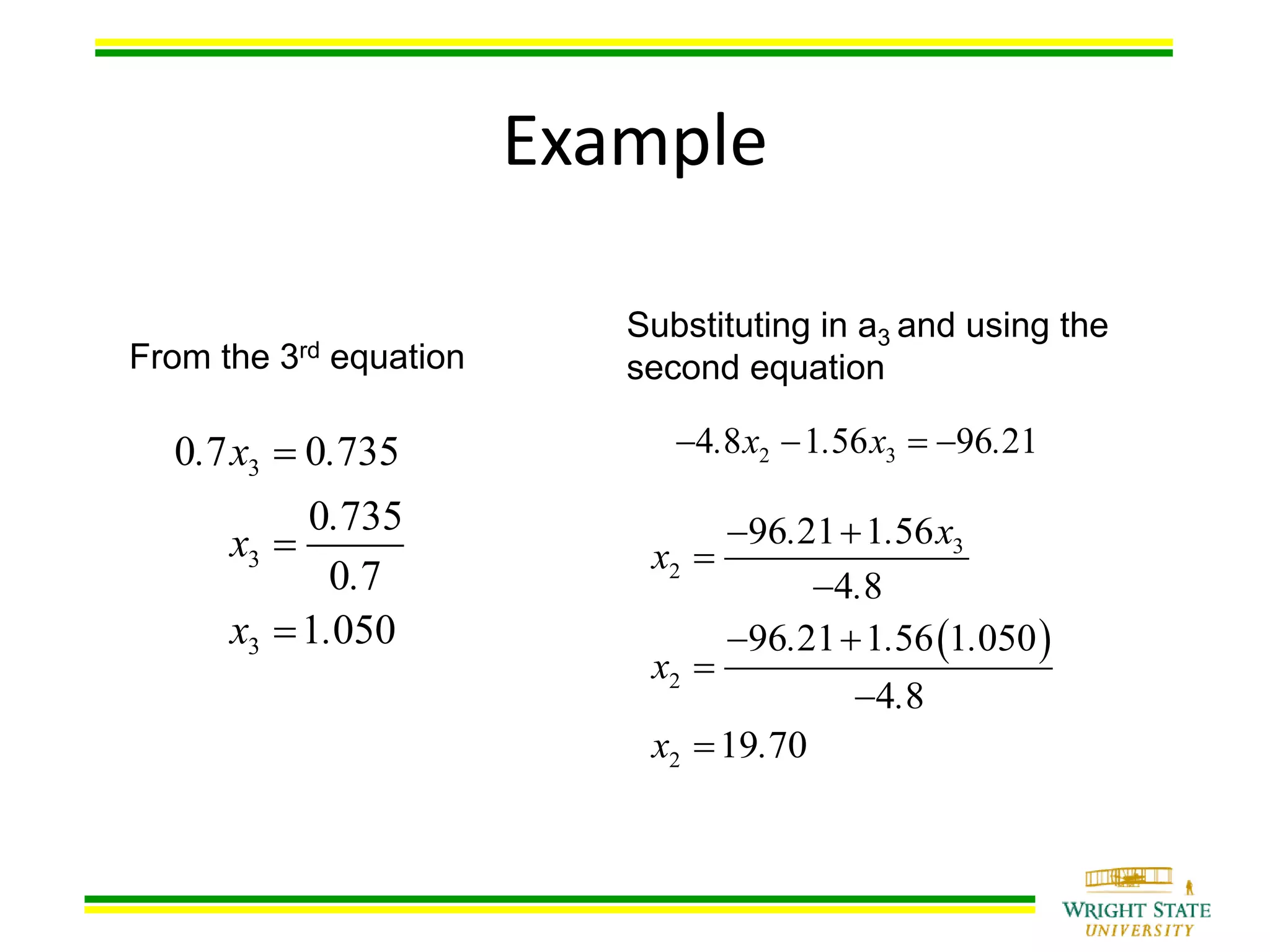
From the 3rd equation
3
3
3
0 7 0 735
0 735
0 7
1 050
. x .
.
x
.
x .



Substituting in a3 and using the
second equation
2 34 8 1 56 96 21. x . x .   
 
3
2
2
2
96 21 1 56
4 8
96 21 1 56 1 050
4 8
19 70
. . x
x
.
. . .
x
.
x .
 


 



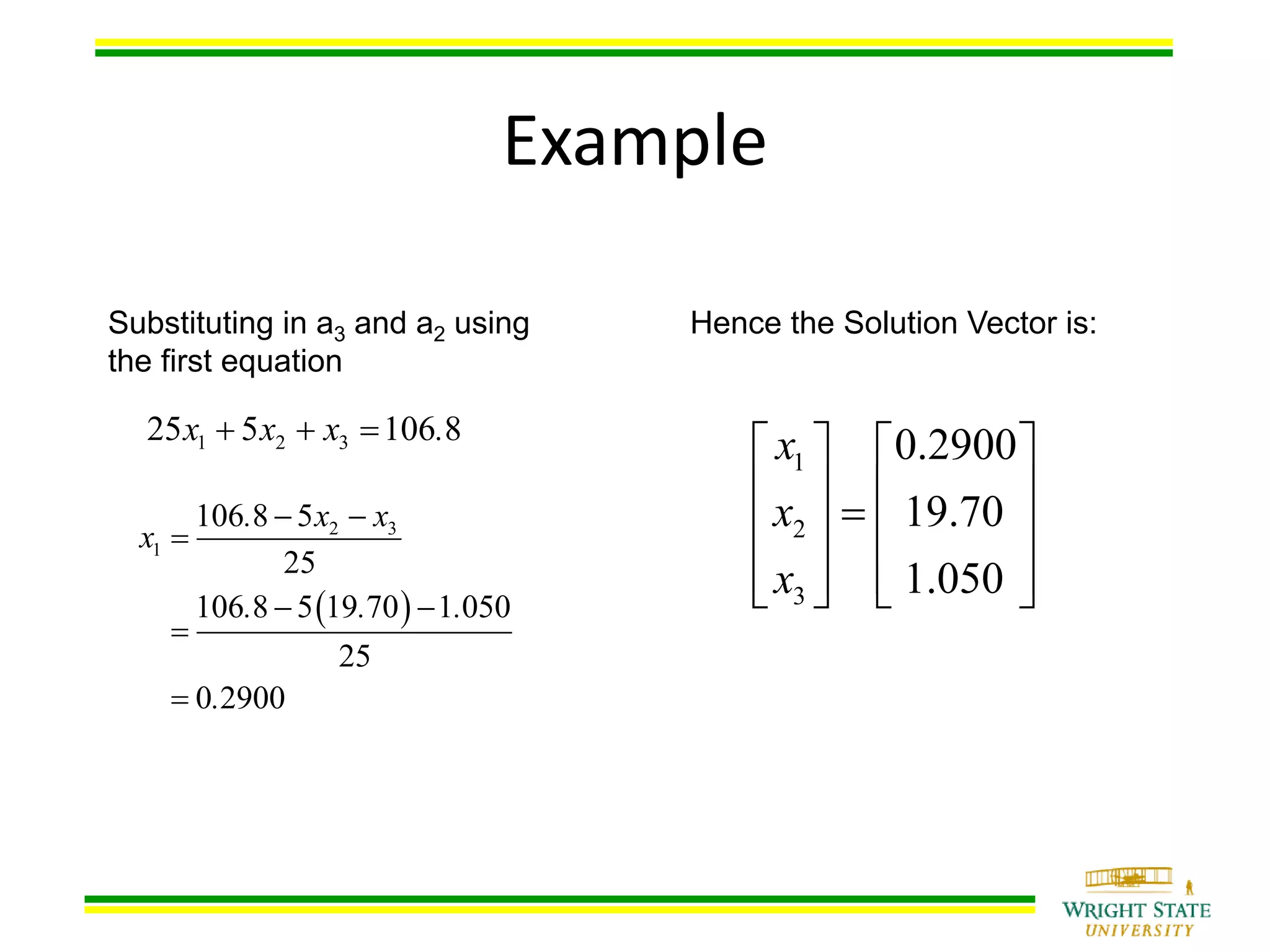
Example
Substituting in a3 and a2 using
the first equation
1 2 325 5 106 8x x x .  
Hence the Solution Vector is:
1
2
3
0.2900
19.70
1.050
x
x
x
   
      
       
2 3
1
106 8 5
25
106 8 5 19 70 1 050
25
0 2900
. x x
x
. . .
.
 

 


Try this…
1
2
3
4
4 2 3 6 12
6 7 6.5 6 6.5
1 7.5 6.25 5.5 16
12 22 15.5 1 17
x
x
x
x
      
          
    
    
     
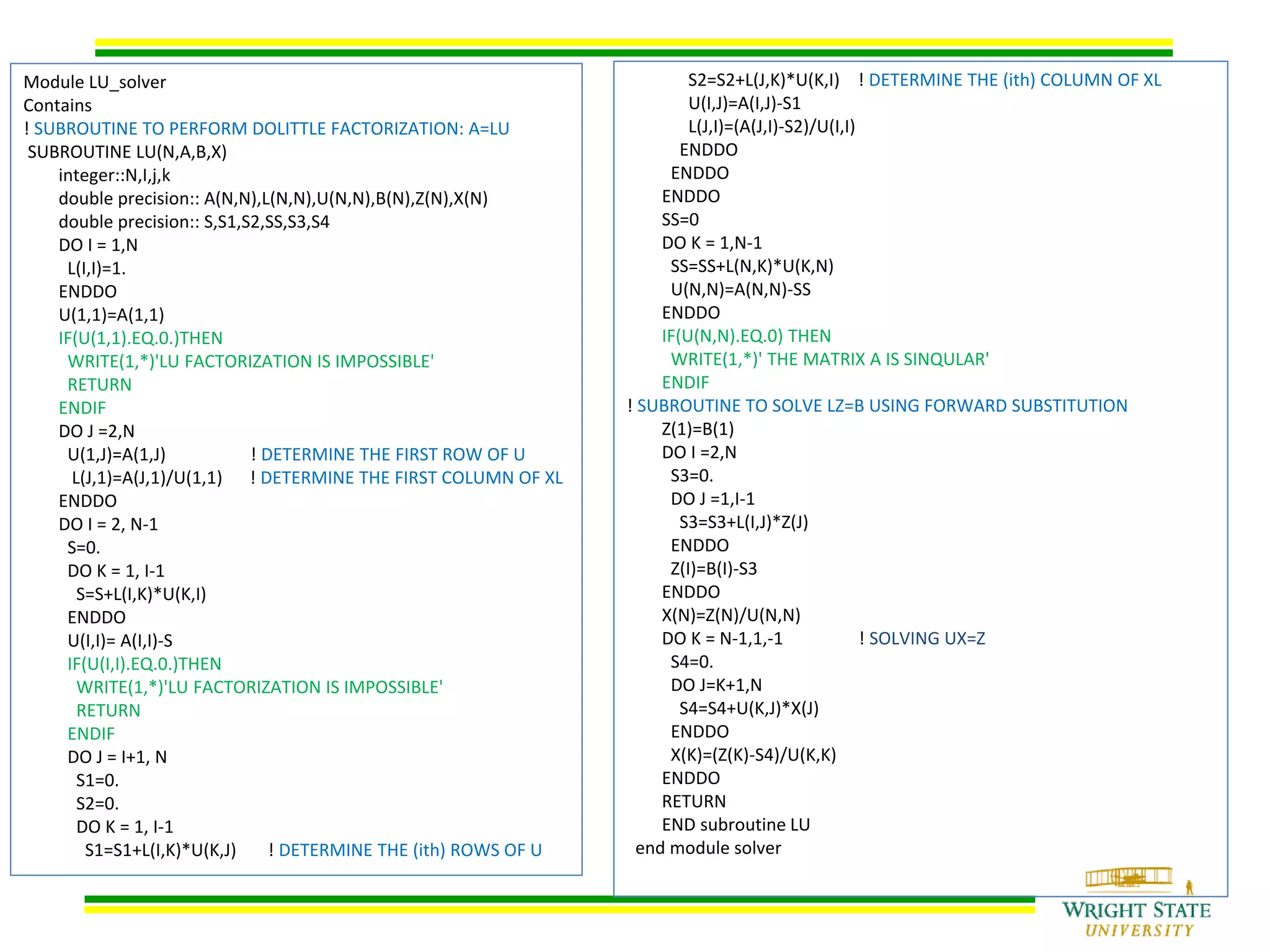
Module LU_solver
Contains
! SUBROUTINE TO PERFORM DOLITTLE FACTORIZATION: A=LU
SUBROUTINE LU(N,A,B,X)
integer::N,I,j,k
double precision:: A(N,N),L(N,N),U(N,N),B(N),Z(N),X(N)
double precision:: S,S1,S2,SS,S3,S4
DO I = 1,N
L(I,I)=1.
ENDDO
U(1,1)=A(1,1)
IF(U(1,1).EQ.0.)THEN
WRITE(1,*)'LU FACTORIZATION IS IMPOSSIBLE'
RETURN
ENDIF
DO J =2,N
U(1,J)=A(1,J) ! DETERMINE THE FIRST ROW OF U
L(J,1)=A(J,1)/U(1,1) ! DETERMINE THE FIRST COLUMN OF XL
ENDDO
DO I = 2, N-1
S=0.
DO K = 1, I-1
S=S+L(I,K)*U(K,I)
ENDDO
U(I,I)= A(I,I)-S
IF(U(I,I).EQ.0.)THEN
WRITE(1,*)'LU FACTORIZATION IS IMPOSSIBLE'
RETURN
ENDIF
DO J = I+1, N
S1=0.
S2=0.
DO K = 1, I-1
S1=S1+L(I,K)*U(K,J) ! DETERMINE THE (ith) ROWS OF U
S2=S2+L(J,K)*U(K,I) ! DETERMINE THE (ith) COLUMN OF XL
U(I,J)=A(I,J)-S1
L(J,I)=(A(J,I)-S2)/U(I,I)
ENDDO
ENDDO
ENDDO
SS=0
DO K = 1,N-1
SS=SS+L(N,K)*U(K,N)
U(N,N)=A(N,N)-SS
ENDDO
IF(U(N,N).EQ.0) THEN
WRITE(1,*)' THE MATRIX A IS SINQULAR'
ENDIF
! SUBROUTINE TO SOLVE LZ=B USING FORWARD SUBSTITUTION
Z(1)=B(1)
DO I =2,N
S3=0.
DO J =1,I-1
S3=S3+L(I,J)*Z(J)
ENDDO
Z(I)=B(I)-S3
ENDDO
X(N)=Z(N)/U(N,N)
DO K = N-1,1,-1 ! SOLVING UX=Z
S4=0.
DO J=K+1,N
S4=S4+U(K,J)*X(J)
ENDDO
X(K)=(Z(K)-S4)/U(K,K)
ENDDO
RETURN
END subroutine LU
end module solver
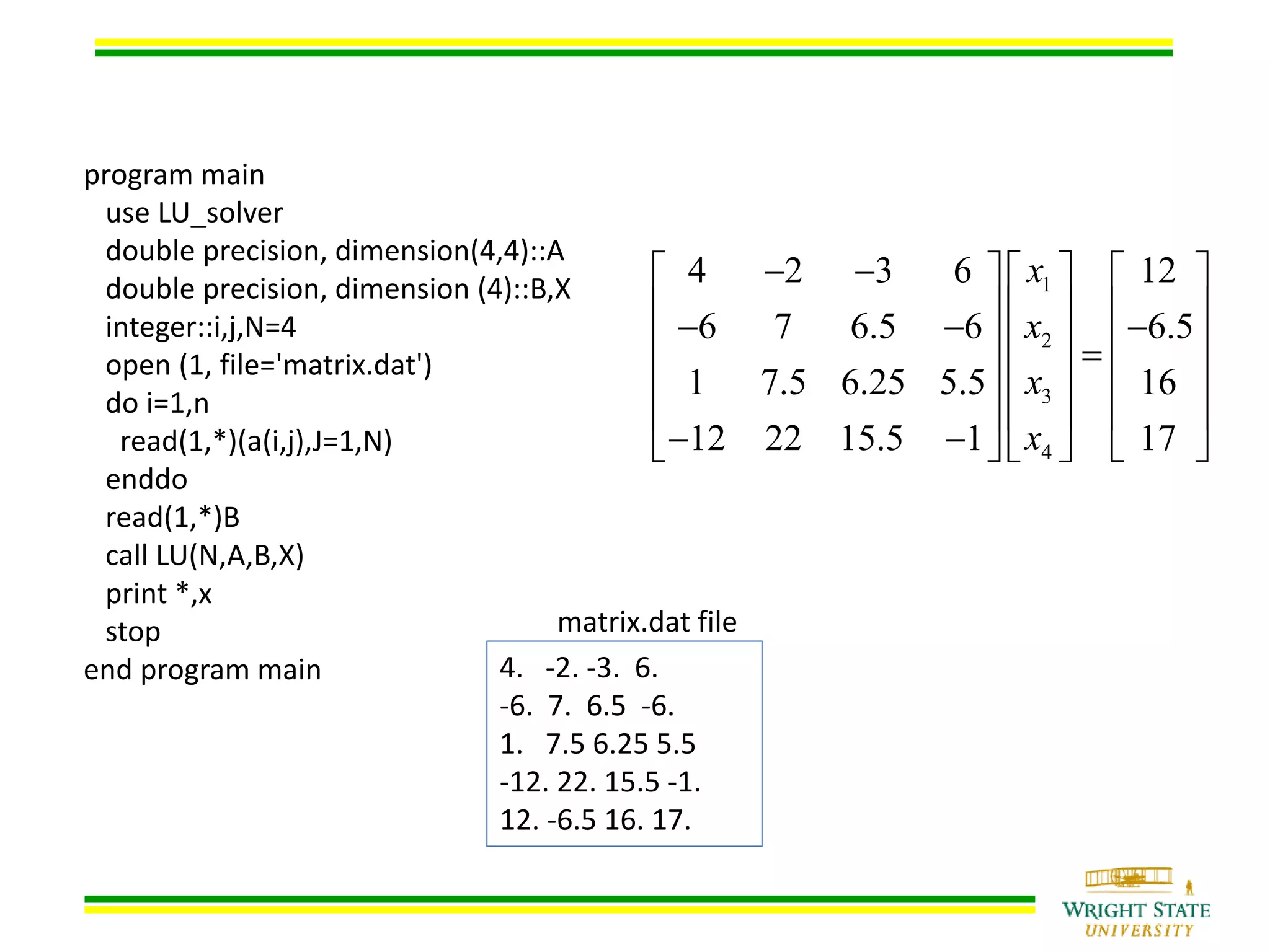
program main
use LU_solver
double precision, dimension(4,4)::A
double precision, dimension (4)::B,X
integer::i,j,N=4
open (1, file='matrix.dat')
do i=1,n
read(1,*)(a(i,j),J=1,N)
enddo
read(1,*)B
call LU(N,A,B,X)
print *,x
stop
end program main 4. -2. -3. 6.
-6. 7. 6.5 -6.
1. 7.5 6.25 5.5
-12. 22. 15.5 -1.
12. -6.5 16. 17.
matrix.dat file
1
2
3
4
4 2 3 6 12
6 7 6.5 6 6.5
1 7.5 6.25 5.5 16
12 22 15.5 1 17
x
x
x
x
      
          
    
    
     

Numerical Methods: Solution of system of equations

  • 1.
    ME4010 Computational Methodsfor Mechanical Engineering Chapter 4 Solution of system of equations Instructor: Nikolai V. Priezjev Office: 430 Russ Engineering Center Phone: 937-775-3214 Email: nikolai.priezjev@wright.edu The course is adopted from Prof. Huang at WSU
  • 2.
        )( 2)( 2 23332 2 3 1222322 2 2 111212 2 1 xxkgmx dt d m xxkgmxxkx dt d m kxgmxxkx dt d m    12 1 1 2 3 2 2 3 3 3 2 0 2 3 0 kx kx m g kx kx kx m g kx kx m g           The steady state equations are: 1 1 2 2 3 3 3 2 0 2 3 0 k k x m g k k k x m g k k x m g                               In matrix form: Dynamics
  • 3.
    Statics R1 + T1cos 60 + T2 = 0 R2 + T1 sin 60 = 0 -T2 -T3 cos 60 + T4 cos 60 + T5 = 0 T3 sin 60 + T4 sin 60 = 0 -T5 - T6 cos 60 = 0 T6 sin 60 + R3 = 0 -T1 cos 60 + T3 cos 60 + T7 - F1 cos = 0 -T1 sin 60 - T3 sin 60 - F1 sin= 0 -T4 cos 60 - T7 + T6 cos 60 - F2 cos  = 0 -T4 sin 60 - T6 sin 60 - F2 sin = 0
  • 4.
    In matrix form 1cos60 1 0 0 0 0 0 0 0 0 sin60 0 1 0 0 0 0 0 0 0 0 1 0 cos60 cos60 1 0 0 0 0 0 0 0 sin60 sin60 0 0 0 0 0 0 0 0 0 0 1 cos60 0 0 0 0 0 0 0 0 0 sin60 1 0 0 cos60 0 0 cos60 0 0 0 0 1 0 sin60 0 0 sin60 0 0 0 0 0 0 0 0 0 0 cos60 0 cos60 0 1 0 0 0 0 0 sin60 0 sin60 0 0                                1 1 2 2 3 4 5 1 1 6 1 1 3 2 2 7 2 2 0 0 0 0 0 0 cos sin cos sin R T T R T T T F T F R F T F                                                                    
  • 5.
    Circuit 1 2 3 4 9 4 20 24 4 17 6 3 16 2 6 14 6 0 0 3 6 11 18 i i i i                                      V = I * R 1: i1*9 - i2*4 - i3*2 = 24
  • 6.
    Method [A] = [L][U] where [L]= lower triangular matrix [U] = upper triangular matrix LU Decomposition Given [A][X] = [B] 1. Decompose [A] into [L] and [U] 2. Solve [L][Z] = [B] for [Z] 3. Solve [U][X] = [Z] for [X]
  • 7.
    Method: [A] Decomposesto [L] and [U]                           33 2322 131211 3231 21 00 0 1 01 001 u uu uuu ULA   [U] is the same as the coefficient matrix at the end of the forward elimination step. [L] is obtained using the multipliers that were used in the forward elimination process
  • 8.
    Finding the [U]matrix Using the Forward Elimination Procedure of Gauss Elimination 112144 1864 1525             112144 56.18.40 1525 56.212;56.2 25 64            RowRow   76.48.160 56.18.40 1525 76.513;76.5 25 144             RowRow Step 1:
  • 9.
    Finding the [U]Matrix Step 2:             76.48.160 56.18.40 1525   7.000 56.18.40 1525 5.323;5.3 8.4 8.16              RowRow              7.000 56.18.40 1525 U Matrix after Step 1:
  • 10.
    Finding the [L]matrix Using the multipliers used during the Forward Elimination Procedure           1 01 001 3231 21   56.2 25 64 11 21 21  a a  76.5 25 144 11 31 31  a a  From the first step of forward elimination 112144 1864 1525          
  • 11.
    Finding the [L]Matrix              15.376.5 0156.2 001 L From the second step of forward elimination             76.48.160 56.18.40 1525 5.3 8.4 8.16 22 32 32     a a 
  • 12.
    Does [L][U] =[A]?                           7.000 56.18.40 1525 15.376.5 0156.2 001 UL ? 112144 1864 1525          
  • 13.
    Try this… 4 23 6 6 7 6.5 6 1 7.5 6.25 5.5 12 22 15.5 1              
  • 14.
    Using LU Decompositionto solve SLEs Solve the following set of linear equations using LU Decomposition                                2279 2177 8106 112144 1864 1525 3 2 1 . . . x x x Using the procedure for finding the [L] and [U] matrices                            7.000 56.18.40 1525 15.376.5 0156.2 001 ULA
  • 15.
    Example Set [L][Z] =[B] Solve for [Z]                                2.279 2.177 8.106 15.376.5 0156.2 001 3 2 1 z z z 1 1 2 1 2 3 106.8 2.56 177.2 5.76 3.5 279.2 z z z z z z      
  • 16.
    Example Complete the forwardsubstitution to solve for [Z]       735.0 21.965.38.10676.52.279 5.376.52.279 2.96 8.10656.22.177 56.22.177 8.106 213 12 1        zzz zz z                         735.0 21.96 8.106 3 2 1 z z z Z
  • 17.
    Example Set [U][X] =[Z] Solve for [X] The 3 equations become                                 7350 2196 8106 7.000 56.18.40 1525 3 2 1 . . . x x x 1 2 3 2 3 3 25 5 106.8 4.8 1.56 96.21 0.7 0.735 x x x x x x        
  • 18.
    Example From the 3rdequation 3 3 3 0 7 0 735 0 735 0 7 1 050 . x . . x . x .    Substituting in a3 and using the second equation 2 34 8 1 56 96 21. x . x .      3 2 2 2 96 21 1 56 4 8 96 21 1 56 1 050 4 8 19 70 . . x x . . . . x . x .         
  • 19.
    Example Substituting in a3and a2 using the first equation 1 2 325 5 106 8x x x .   Hence the Solution Vector is: 1 2 3 0.2900 19.70 1.050 x x x                    2 3 1 106 8 5 25 106 8 5 19 70 1 050 25 0 2900 . x x x . . . .       
  • 20.
    Try this… 1 2 3 4 4 23 6 12 6 7 6.5 6 6.5 1 7.5 6.25 5.5 16 12 22 15.5 1 17 x x x x                                  
  • 21.
    Module LU_solver Contains ! SUBROUTINETO PERFORM DOLITTLE FACTORIZATION: A=LU SUBROUTINE LU(N,A,B,X) integer::N,I,j,k double precision:: A(N,N),L(N,N),U(N,N),B(N),Z(N),X(N) double precision:: S,S1,S2,SS,S3,S4 DO I = 1,N L(I,I)=1. ENDDO U(1,1)=A(1,1) IF(U(1,1).EQ.0.)THEN WRITE(1,*)'LU FACTORIZATION IS IMPOSSIBLE' RETURN ENDIF DO J =2,N U(1,J)=A(1,J) ! DETERMINE THE FIRST ROW OF U L(J,1)=A(J,1)/U(1,1) ! DETERMINE THE FIRST COLUMN OF XL ENDDO DO I = 2, N-1 S=0. DO K = 1, I-1 S=S+L(I,K)*U(K,I) ENDDO U(I,I)= A(I,I)-S IF(U(I,I).EQ.0.)THEN WRITE(1,*)'LU FACTORIZATION IS IMPOSSIBLE' RETURN ENDIF DO J = I+1, N S1=0. S2=0. DO K = 1, I-1 S1=S1+L(I,K)*U(K,J) ! DETERMINE THE (ith) ROWS OF U S2=S2+L(J,K)*U(K,I) ! DETERMINE THE (ith) COLUMN OF XL U(I,J)=A(I,J)-S1 L(J,I)=(A(J,I)-S2)/U(I,I) ENDDO ENDDO ENDDO SS=0 DO K = 1,N-1 SS=SS+L(N,K)*U(K,N) U(N,N)=A(N,N)-SS ENDDO IF(U(N,N).EQ.0) THEN WRITE(1,*)' THE MATRIX A IS SINQULAR' ENDIF ! SUBROUTINE TO SOLVE LZ=B USING FORWARD SUBSTITUTION Z(1)=B(1) DO I =2,N S3=0. DO J =1,I-1 S3=S3+L(I,J)*Z(J) ENDDO Z(I)=B(I)-S3 ENDDO X(N)=Z(N)/U(N,N) DO K = N-1,1,-1 ! SOLVING UX=Z S4=0. DO J=K+1,N S4=S4+U(K,J)*X(J) ENDDO X(K)=(Z(K)-S4)/U(K,K) ENDDO RETURN END subroutine LU end module solver
  • 22.
    program main use LU_solver doubleprecision, dimension(4,4)::A double precision, dimension (4)::B,X integer::i,j,N=4 open (1, file='matrix.dat') do i=1,n read(1,*)(a(i,j),J=1,N) enddo read(1,*)B call LU(N,A,B,X) print *,x stop end program main 4. -2. -3. 6. -6. 7. 6.5 -6. 1. 7.5 6.25 5.5 -12. 22. 15.5 -1. 12. -6.5 16. 17. matrix.dat file 1 2 3 4 4 2 3 6 12 6 7 6.5 6 6.5 1 7.5 6.25 5.5 16 12 22 15.5 1 17 x x x x                                  