METABOLISM OF PURINE AND
PYRIMIDINE NUCLEOTIDES
Dr Bakhtawar farooq
Nishter Medical university
Biochemistry,
Biosynthesis of purine nucleotides:
• The three processes that contribute to
purine nucleotide biosynthesis are.
1. Synthesis from amphibolic intermediates
( synthesis de novo ).
2. Phosphoribosylation of purines.
3. Phosphorylation of purine nucleosides.
Purines are synthesized by most of the tissues ,the
major site is liver.Subcellular site -- cytoplasm
• Denovo synthesis:Major pathway
Synthesis of purine nucleotides from
various small molecules derived as
intermediates of many metabolic pathways
in the body.
• Salvage pathway: Minor pathway
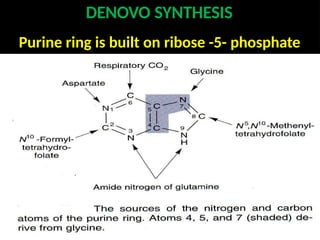
DENOVO SYNTHESIS
Purine ring is built on ribose -5- phosphate
• Parent purine nucliotide first synthesised is
INOSINE MONO PHOSPHATE (IMP)
It is a nucleotide composed of (HYPOXANTHINE +
RIBOSE + PHOSPHATE )
• From IMP other purine nucleotides are
synthesized, like
• AMP(adenosine mono phosphate)
• GMP(guanosine mono phosphate)
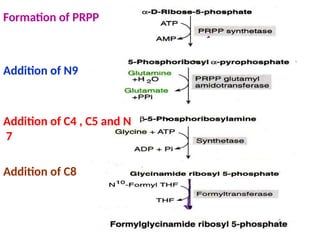
Formation of PRPP
Addition of N9
Addition of C4 , C5 and N
7
Addition of C8
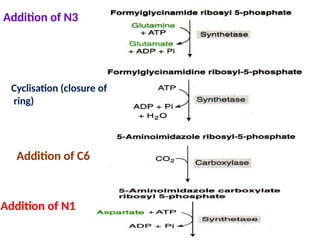
Addition of N3
Cyclisation (closure of
ring)
Addition of C6
Addition of N1
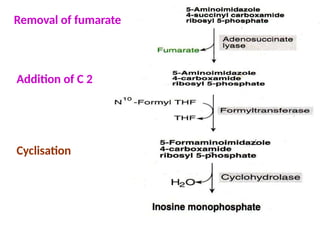
Removal of fumarate
Addition of C 2
Cyclisation
Biosynthesis of Purine Ribonucleotides
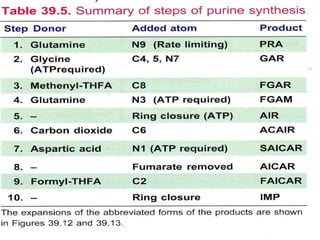
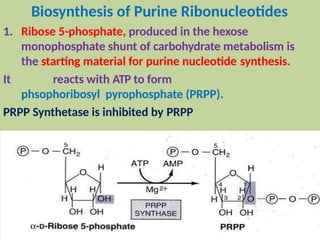
1. Ribose 5-phosphate, produced in the hexose
monophosphate shunt of carbohydrate metabolism is
the starting material for purine nucleotide synthesis.
It reacts with ATP to form
phsophoribosyl pyrophosphate (PRPP).
PRPP Synthetase is inhibited by PRPP
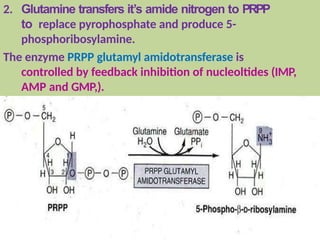
2. Glutamine transfers it’s amide nitrogen to PRPP
to replace pyrophosphate and produce 5-
phosphoribosylamine.
The enzyme PRPP glutamyl amidotransferase is
controlled by feedback inhibition of nucleoltides (IMP,
AMP and GMP,).
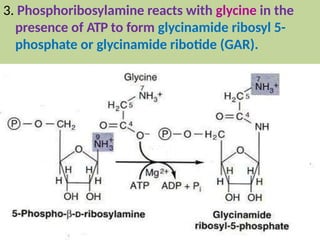
3. Phosphoribosylamine reacts with glycine in the
presence of ATP to form glycinamide ribosyl 5-
phosphate or glycinamide ribotide (GAR).
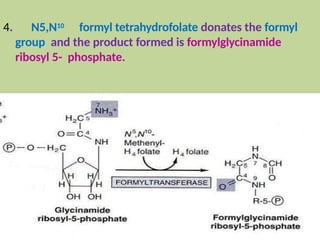
4. N5,N10 formyl tetrahydrofolate donates the formyl
group and the product formed is formylglycinamide
ribosyl 5- phosphate.
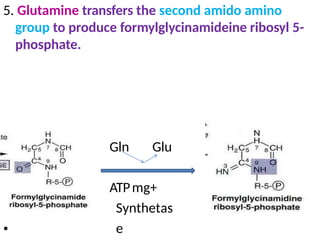
5. Glutamine transfers the second amido amino
group to produce formylglycinamideine ribosyl 5-
phosphate.
Gln Glu
ATPmg+
Synthetas
e
•
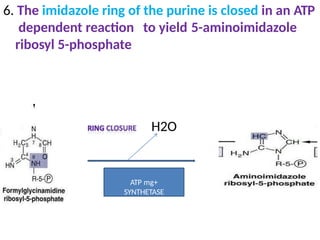
6. The imidazole ring of the purine is closed in an ATP
dependent reaction to yield 5-aminoimidazole
ribosyl 5-phosphate
H2O
ATP mg+
SYNTHETASE
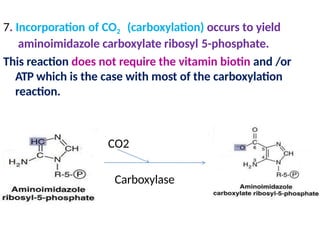
7. Incorporation of CO2 (carboxylation) occurs to yield
aminoimidazole carboxylate ribosyl 5-phosphate.
This reaction does not require the vitamin biotin and /or
ATP which is the case with most of the carboxylation
reaction.
CO2
8. Carboxylase
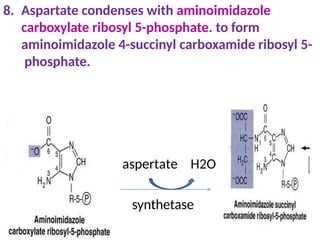
8. Aspartate condenses with aminoimidazole
carboxylate ribosyl 5-phosphate. to form
aminoimidazole 4-succinyl carboxamide ribosyl 5-
phosphate.
aspertate H2O
synthetase
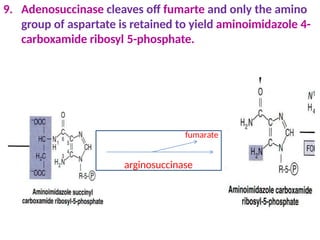
9. Adenosuccinase cleaves off fumarte and only the amino
group of aspartate is retained to yield aminoimidazole 4-
carboxamide ribosyl 5-phosphate.
9. f
fumarate
arginosuccinase
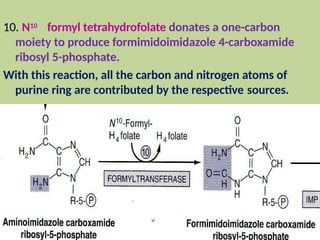
10. N10 formyl tetrahydrofolate donates a one-carbon
moiety to produce formimidoimidazole 4-carboxamide
ribosyl 5-phosphate.
With this reaction, all the carbon and nitrogen atoms of
purine ring are contributed by the respective sources.
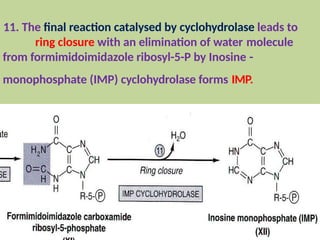
11. The final reaction catalysed by cyclohydrolase leads to
ring closure with an elimination of water molecule
from formimidoimidazole ribosyl-5-P by Inosine -
monophosphate (IMP) cyclohydrolase forms IMP.
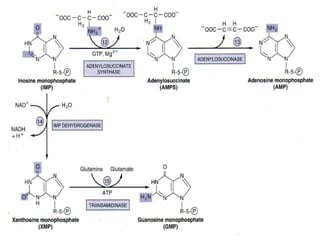
Synthesis of AMP and GMP from IMP
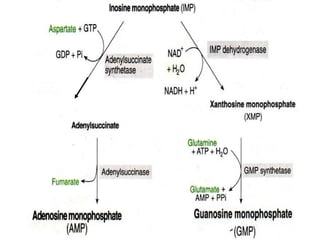
• Inosine monophosphate is the immediate precursor for
the formation of AMP & GMP
• Aspertate condences with IMP in the presence of GTP to
produce sdenylosuccinate which on cleavage forms AMP.
• For the synthesis of GMP, IMP undergoes
NAD+ dependent dehydrogenation to form Xanthosine
monophosphate ( XMP). Glutamine then transfers amide
nitrogen to XMP to produce GMP.
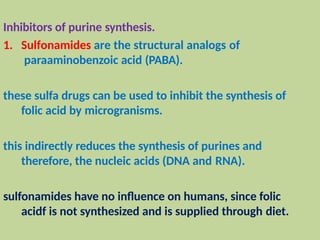
Inhibitors of purine synthesis.
1. Sulfonamides are the structural analogs of
paraaminobenzoic acid (PABA).
these sulfa drugs can be used to inhibit the synthesis of
folic acid by microgranisms.
this indirectly reduces the synthesis of purines and
therefore, the nucleic acids (DNA and RNA).
sulfonamides have no influence on humans, since folic
acidf is not synthesized and is supplied through diet.
The structural analogs of folic acid (eg: methotrexate) are
widely used to control cancer.
They inhibit the synthesis of purine nucleotides and thus
nucleic acids.
These inhibitors also affect the proliferation of normally
growing cells.
This causes many side-effects including
anemia, baldness, scaly skin etc.
SALVAGE PATHWAY FOR PURINES
• The free purines ( adenine, guanine & hypoxanthine ) are
formed in the normal turnover of nucleic acids & also
obtained from the dietary sources.
• The purines can also be converted to corresponding
nucleotides, & this process is known as ‘salvage
pathway’.
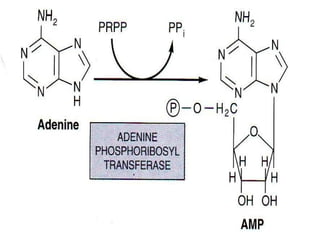
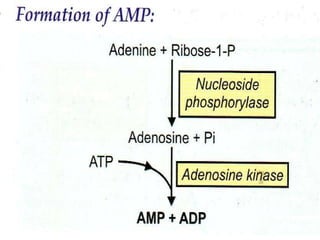
• Adenine phosphoribosyl transferase catalyses the
formation of AMP from adenine.
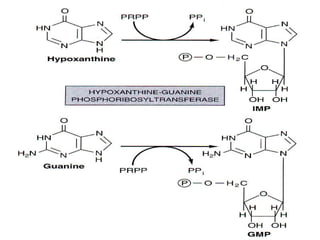
• Hypoxanthine-guanine phosphoribosyl transferase
(HGPRT) converts guanine & hypoxanthine respectively, to
GMP & IMP.
• Phosphoribosyl pyrophosphate (PRPP) is the donor of
ribose 5 phosphate in the salvage pathway.
• The salvage pathway is perticularly important in certain
tissues such as erythrocytes & brain where denovo
synthesis of purine nucleotides is not operative.
REGULATION OF PURINE NUCLEOTIDE
BIOSYNTHESIS
• The purine nucleotide synthesis is well coordinated to
meet the cellular demands.
• The intracellular concentration of PRPP regulates purine
synthesis to a large extent.
• This inturn is dependent on the availability of ribose 5
phosphate & the enzyme PRPP synthetase.
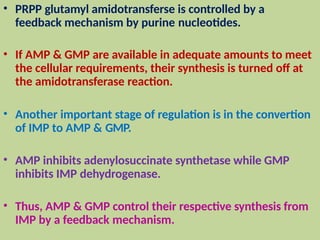
• PRPP glutamyl amidotransferse is controlled by a
feedback mechanism by purine nucleotides.
• If AMP & GMP are available in adequate amounts to meet
the cellular requirements, their synthesis is turned off at
the amidotransferase reaction.
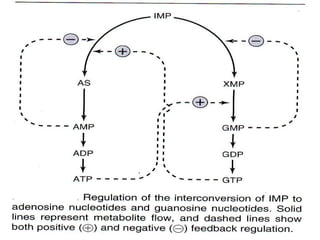
• Another important stage of regulation is in the convertion
of IMP to AMP & GMP.
• AMP inhibits adenylosuccinate synthetase while GMP
inhibits IMP dehydrogenase.
• Thus, AMP & GMP control their respective synthesis from
IMP by a feedback mechanism.
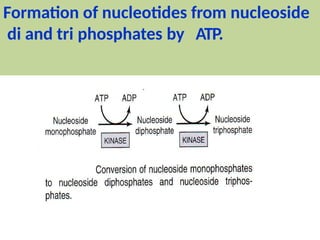
Formation of nucleotides from nucleoside
di and tri phosphates by ATP.
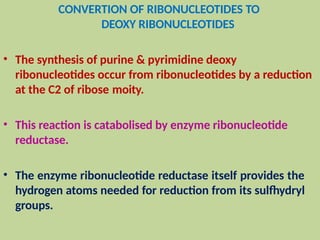
CONVERTION OF RIBONUCLEOTIDES TO
DEOXY RIBONUCLEOTIDES
• The synthesis of purine & pyrimidine deoxy
ribonucleotides occur from ribonucleotides by a reduction
at the C2 of ribose moity.
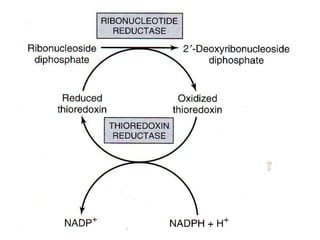
• This reaction is catabolised by enzyme ribonucleotide
reductase.
• The enzyme ribonucleotide reductase itself provides the
hydrogen atoms needed for reduction from its sulfhydryl
groups.
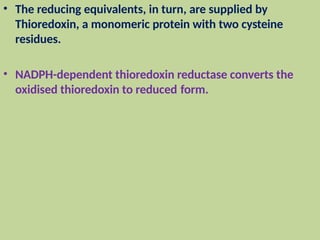
• The reducing equivalents, in turn, are supplied by
Thioredoxin, a monomeric protein with two cysteine
residues.
• NADPH-dependent thioredoxin reductase converts the
oxidised thioredoxin to reduced form.
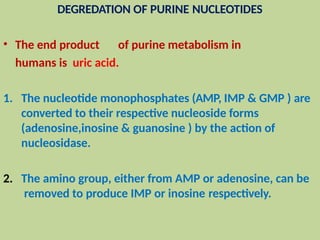
DEGREDATION OF PURINE NUCLEOTIDES
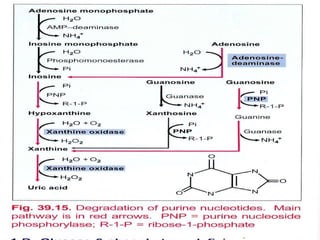
• The end product of purine metabolism in
humans is uric acid.
1. The nucleotide monophosphates (AMP, IMP & GMP ) are
converted to their respective nucleoside forms
(adenosine,inosine & guanosine ) by the action of
nucleosidase.
2. The amino group, either from AMP or adenosine, can be
removed to produce IMP or inosine respectively.
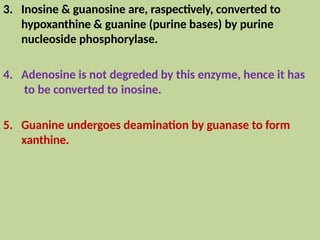
3. Inosine & guanosine are, raspectively, converted to
hypoxanthine & guanine (purine bases) by purine
nucleoside phosphorylase.
4. Adenosine is not degreded by this enzyme, hence it has
to be converted to inosine.
5. Guanine undergoes deamination by guanase to form
xanthine.
• Xanthine oxidase is an important enzyme that converts
hypoxanthine to xanthine, & xanthine to uric acid.
• This enzyme contains FAD, Molybdenum & Iron, & is
exclusively found in liver & small intestine.
• Xanthine oxidase liberates H2O2 & H2O which is harmful
to the tissues.
• Catlase cleaves H2O2 to H2O & O2.
• Uric acid ( 2,6,8-ttioxopurine ) is the final excretory
product of purine metabolism in humans.
• Uric acid can serve as an important antioxidant by getting
itself converted non enzymatically to allantoin.
• It is believed that the antioxidant role of ascorbic acid in
primates is replaced by uric acid, since these animals have
lost the ability to synthesize ascorbic acid.
• Most animals ( other than primates ) however oxidise uric
acid by the enzyme uricase to allantoin, where the purine
ring is cleaved.
• Allantoin is then converted to allantoic acid & excreated in
some fishes.
• Further degradation of allantoic acid may occur to
produce urea ( in amphibians, most fishes & some
molluscs ) &, later, to ammonia (in marine invertebrates).
DISORDERS OF PURINE METABOLISM
1. HYPERURICEMIA AND GOUT
Uric acid is the end product of purine metabolism in
humans.
The normal concentration of uric acid in the serum of
adults is in the range of 3-7 mg / dl.
In women, it is slightly lower ( by about 1 mg ) than in
men.
The daily excreation of uric acid is about 500-700 mg.
• Hyperuricemia refers to an elevation in the serum uric
acid concentration.
• This is sometimes associated with increased uric acid
excreation ( Uricosuria)
• GOUT is metabolic disease associated with
overproduction of uric acid.
• At the physiological pH, uric acid is found in a more
soluble form as sodium urate.
• In severe hyperuricemia, crystals of sodium urate get
deposited in the soft tissues, perticularly in the joints.
• Such deposits are commonly known as tophi.
• This causes inflammation in the joints resulting in a
painful gouty arthritis. Typical gouty arthritis affects first
metatarsophalangeal joint.(GREAT TOE).
• Sodium urate &/or uric acid may also precipitate in
kidneys & ureters that result in renal damage & stone
formation.
• Historically, gout was found to be often associated with
high living, over-eating & alcoho consumption.
• The prevalence of gout is about 3 / 1,000 persons, mostly
affecting males.
Clinical features:
•Attacks are precipitated by alcohol intake.
Often patient have few drinks , go to sleep
symptomless , but are awakened during
early hours by severe joint pains.
Synovial fluid shows birefringent crystals under
polar microscope is diagnostic.
• GOUT IS OF TWO TYPES
1. PRIMARY GOUT.
It is an inborn error of metabolism due to
overproduction of uric acid.
This is mostly related to over production of purine
nucleotides.
• PRPP synthetase : in normal circumstances , PRPP
synthetase is under feedback control by purine
nucleotides ( ADP & GDP ).
However, varient forms of PRPP synthetase-which are
not subjected to feedback regulation-have been
detected. This leades to increased production of purines.
• PRPP glutamylamidotransferse :
The lack of feedback control of this enzyme by purine
nucleotides also leads to their elevated synthesis.
• HGPRT deficiency : This is an enzyme of purine salvage
pathway, & its defect causes Lesch-Nyhan syndrome. This
disorder is associated with increased synthesis of purine
nucleotides by a two fold mechanism.
Firstly, decreased utilization of purines ( Hypoxanthine &
guanine ) by salvage pathway, resulting in the
accumulation & divertion of PRPP for purine nucleotides.
Secondly, the defect in salvage pathway leads to
decreased levels of IMP & GMP causing impairment
in the tightly controlled feedback regulation of their
production.
Glucose 6-phosphatase dificiency:
Intype I glycogen storage disease ( von-gierke’s ), glucose-6-
phosphate cannot be converted to glucose due to the
deficiency of glucose-6-phosphatase.
This leads to the increased utilazation of glucose-6-phosphate
by HMP shunt resulting in elevated levels of ribose-5-
phosphate & PRPP &, ultimately, purine overproduction.
von gierke’s disease is also associated with increased activity
of glycolysis.
Due to this, lactic acid accumulates in the body which
interferes with the uric acid excretion through renal tubules.
ELEVATION OF GLUTATHIONE REDUCTASE :
varient of glutathione reductase generates more
NADP+ which is utilized by HMP shunt .
This leads to increased ribose 5-phosphate and
PRPP synthesis.
Secondary gout:
Secondary hyperuricemia is due to various diseases causing
increased synthesis or decreased excretion of uric acid.
Increased degradation of nucleic acids (hence more Uric acid
formation) is observed in various cancers (leukemias,
polycythemias, lymphomas, etc).
Psoriasis and increased tissue breakdown (trauma,
starvation etc).
Treatment of Gout:
The drug of choice for the treatment of primary gout is
allopurinol.
This is a structural analog of hypoxanthine that
competitively inhibits the enzyme xanthine oxidase.
Further allopurinol is oxidized to alloxanthine by xanthine
oxidase.
Alloxanthine, in turn is a more effective inhibitor of xanthine
oxidase. This type of inhibition is referred to as suicide
inhibition.
Inhibition of xanthine oxidase by allopurinol leads to the
accumulation of hypoxanthine and xanthine.
These two compounds are more soluble than uric acid,
hence easily excreted.
Besides the drug therapy, restriction in dietary intake of
purines and alcohol is advised.
Consumption of plenty of water will also be useful.
Pseudogout:
The clinical manifestations of pseudo gout are similar to
gout.
This disorder is caused by the deposition of calcium
pyrophosphate crystals in joints.
Further serum uric acid concentration is normal in pseudo
gout.
Lesch-Nyhan syndrome
This disorder is due to the deficiency of hypoxanthine-
guanine phosphoribosyltransferase (HGPRT) , an enzyme
of purine salvage pathway .
Lesch-nyhan syndrome is a sex-linked metabolic disorder
since the structural gene for HGPRT is located ontlhe X-
chromosome.
It affects only the males and is characterized by excessive
uric acid production (often gouty arthritis).
Neurological abnormalities such as mental
retardation, aggressive behavior, learning disability etc.
The patients of this disorder have an irretible urge to bite
their fingers and lips, often causing self-mutilation.
The overpodluction of uric acid in lesch-nyhan syndrome
is explained .
HGPRT deficiency results in the accumulation of PRPP and
decrease in GMP and IMP, ultimatelyleading to increased
synthesis and degradation of purines.
The biochemical bases for the neurological symptoms
observed in Lesch-Nyhan syndrome is not clearly
understood.
This may be related to the dependence fo brian on the
salvage pathway for de novo synthesis of purine
nucleotides.
Uric acid is not toxic to the brain, since patients with
severe hyperuricemia (not related to HGPRT deficiency)
do not exhibit any neurological symptoms.
Immunodeficiency diseases associated with
purine metabolism
Two different immunodeficiency disorders associated
with the degradation of purine nucleosides are identified.
The enzyme defects are adenosine deaminase and purine
nucleoside phosphorylase, involved in uric acid synthesis.
The deficiency of adenosine deaminase (ADA) causes
severe combined immunodeficiency (SCID) involving T-cell
and usually B-cell dysfunction.
It is explained that ADA deficiency results in the
accumulation of dATP which is an inhibitor of
ribonucleotide reductase and therefore DNA synthesis
and cell replication.
The deficienc of purine nucleotide phosphorylase is
associated with impairment; of T-cell function but has no
effect on B-cell function.
Uric acid synthesis is decreased and the tissue levels of
purine nucleosides and nucleotides are higher.
It is believed that dGTP inhibits the development of
normal T-cells
Purine nuecleotide

Purine nuecleotide

  • 1.
    METABOLISM OF PURINEAND PYRIMIDINE NUCLEOTIDES Dr Bakhtawar farooq Nishter Medical university Biochemistry,
  • 2.
    Biosynthesis of purinenucleotides: • The three processes that contribute to purine nucleotide biosynthesis are. 1. Synthesis from amphibolic intermediates ( synthesis de novo ). 2. Phosphoribosylation of purines. 3. Phosphorylation of purine nucleosides.
  • 3.
    Purines are synthesizedby most of the tissues ,the major site is liver.Subcellular site -- cytoplasm • Denovo synthesis:Major pathway Synthesis of purine nucleotides from various small molecules derived as intermediates of many metabolic pathways in the body. • Salvage pathway: Minor pathway
  • 4.
    DENOVO SYNTHESIS Purine ringis built on ribose -5- phosphate
  • 5.
    • Parent purinenucliotide first synthesised is INOSINE MONO PHOSPHATE (IMP) It is a nucleotide composed of (HYPOXANTHINE + RIBOSE + PHOSPHATE ) • From IMP other purine nucleotides are synthesized, like • AMP(adenosine mono phosphate) • GMP(guanosine mono phosphate)
  • 7.
    Formation of PRPP Additionof N9 Addition of C4 , C5 and N 7 Addition of C8
  • 8.
    Addition of N3 Cyclisation(closure of ring) Addition of C6 Addition of N1
  • 9.
    Removal of fumarate Additionof C 2 Cyclisation
  • 11.
    Biosynthesis of PurineRibonucleotides 1. Ribose 5-phosphate, produced in the hexose monophosphate shunt of carbohydrate metabolism is the starting material for purine nucleotide synthesis. It reacts with ATP to form phsophoribosyl pyrophosphate (PRPP). PRPP Synthetase is inhibited by PRPP
  • 12.
    2. Glutamine transfersit’s amide nitrogen to PRPP to replace pyrophosphate and produce 5- phosphoribosylamine. The enzyme PRPP glutamyl amidotransferase is controlled by feedback inhibition of nucleoltides (IMP, AMP and GMP,).
  • 13.
    3. Phosphoribosylamine reactswith glycine in the presence of ATP to form glycinamide ribosyl 5- phosphate or glycinamide ribotide (GAR).
  • 14.
    4. N5,N10 formyltetrahydrofolate donates the formyl group and the product formed is formylglycinamide ribosyl 5- phosphate.
  • 15.
    5. Glutamine transfersthe second amido amino group to produce formylglycinamideine ribosyl 5- phosphate. Gln Glu ATPmg+ Synthetas e •
  • 16.
    6. The imidazolering of the purine is closed in an ATP dependent reaction to yield 5-aminoimidazole ribosyl 5-phosphate H2O ATP mg+ SYNTHETASE
  • 17.
    7. Incorporation ofCO2 (carboxylation) occurs to yield aminoimidazole carboxylate ribosyl 5-phosphate. This reaction does not require the vitamin biotin and /or ATP which is the case with most of the carboxylation reaction. CO2 8. Carboxylase
  • 18.
    8. Aspartate condenseswith aminoimidazole carboxylate ribosyl 5-phosphate. to form aminoimidazole 4-succinyl carboxamide ribosyl 5- phosphate. aspertate H2O synthetase
  • 19.
    9. Adenosuccinase cleavesoff fumarte and only the amino group of aspartate is retained to yield aminoimidazole 4- carboxamide ribosyl 5-phosphate. 9. f fumarate arginosuccinase
  • 20.
    10. N10 formyltetrahydrofolate donates a one-carbon moiety to produce formimidoimidazole 4-carboxamide ribosyl 5-phosphate. With this reaction, all the carbon and nitrogen atoms of purine ring are contributed by the respective sources.
  • 21.
    11. The finalreaction catalysed by cyclohydrolase leads to ring closure with an elimination of water molecule from formimidoimidazole ribosyl-5-P by Inosine - monophosphate (IMP) cyclohydrolase forms IMP.
  • 22.
    Synthesis of AMPand GMP from IMP • Inosine monophosphate is the immediate precursor for the formation of AMP & GMP • Aspertate condences with IMP in the presence of GTP to produce sdenylosuccinate which on cleavage forms AMP. • For the synthesis of GMP, IMP undergoes NAD+ dependent dehydrogenation to form Xanthosine monophosphate ( XMP). Glutamine then transfers amide nitrogen to XMP to produce GMP.
  • 24.
    Inhibitors of purinesynthesis. 1. Sulfonamides are the structural analogs of paraaminobenzoic acid (PABA). these sulfa drugs can be used to inhibit the synthesis of folic acid by microgranisms. this indirectly reduces the synthesis of purines and therefore, the nucleic acids (DNA and RNA). sulfonamides have no influence on humans, since folic acidf is not synthesized and is supplied through diet.
  • 25.
    The structural analogsof folic acid (eg: methotrexate) are widely used to control cancer. They inhibit the synthesis of purine nucleotides and thus nucleic acids. These inhibitors also affect the proliferation of normally growing cells. This causes many side-effects including anemia, baldness, scaly skin etc.
  • 26.
    SALVAGE PATHWAY FORPURINES • The free purines ( adenine, guanine & hypoxanthine ) are formed in the normal turnover of nucleic acids & also obtained from the dietary sources. • The purines can also be converted to corresponding nucleotides, & this process is known as ‘salvage pathway’.
  • 27.
    • Adenine phosphoribosyltransferase catalyses the formation of AMP from adenine. • Hypoxanthine-guanine phosphoribosyl transferase (HGPRT) converts guanine & hypoxanthine respectively, to GMP & IMP. • Phosphoribosyl pyrophosphate (PRPP) is the donor of ribose 5 phosphate in the salvage pathway. • The salvage pathway is perticularly important in certain tissues such as erythrocytes & brain where denovo synthesis of purine nucleotides is not operative.
  • 31.
    REGULATION OF PURINENUCLEOTIDE BIOSYNTHESIS • The purine nucleotide synthesis is well coordinated to meet the cellular demands. • The intracellular concentration of PRPP regulates purine synthesis to a large extent. • This inturn is dependent on the availability of ribose 5 phosphate & the enzyme PRPP synthetase.
  • 32.
    • PRPP glutamylamidotransferse is controlled by a feedback mechanism by purine nucleotides. • If AMP & GMP are available in adequate amounts to meet the cellular requirements, their synthesis is turned off at the amidotransferase reaction. • Another important stage of regulation is in the convertion of IMP to AMP & GMP. • AMP inhibits adenylosuccinate synthetase while GMP inhibits IMP dehydrogenase. • Thus, AMP & GMP control their respective synthesis from IMP by a feedback mechanism.
  • 34.
    Formation of nucleotidesfrom nucleoside di and tri phosphates by ATP.
  • 35.
    CONVERTION OF RIBONUCLEOTIDESTO DEOXY RIBONUCLEOTIDES • The synthesis of purine & pyrimidine deoxy ribonucleotides occur from ribonucleotides by a reduction at the C2 of ribose moity. • This reaction is catabolised by enzyme ribonucleotide reductase. • The enzyme ribonucleotide reductase itself provides the hydrogen atoms needed for reduction from its sulfhydryl groups.
  • 36.
    • The reducingequivalents, in turn, are supplied by Thioredoxin, a monomeric protein with two cysteine residues. • NADPH-dependent thioredoxin reductase converts the oxidised thioredoxin to reduced form.
  • 38.
    DEGREDATION OF PURINENUCLEOTIDES • The end product of purine metabolism in humans is uric acid. 1. The nucleotide monophosphates (AMP, IMP & GMP ) are converted to their respective nucleoside forms (adenosine,inosine & guanosine ) by the action of nucleosidase. 2. The amino group, either from AMP or adenosine, can be removed to produce IMP or inosine respectively.
  • 40.
    3. Inosine &guanosine are, raspectively, converted to hypoxanthine & guanine (purine bases) by purine nucleoside phosphorylase. 4. Adenosine is not degreded by this enzyme, hence it has to be converted to inosine. 5. Guanine undergoes deamination by guanase to form xanthine.
  • 41.
    • Xanthine oxidaseis an important enzyme that converts hypoxanthine to xanthine, & xanthine to uric acid. • This enzyme contains FAD, Molybdenum & Iron, & is exclusively found in liver & small intestine. • Xanthine oxidase liberates H2O2 & H2O which is harmful to the tissues. • Catlase cleaves H2O2 to H2O & O2.
  • 42.
    • Uric acid( 2,6,8-ttioxopurine ) is the final excretory product of purine metabolism in humans. • Uric acid can serve as an important antioxidant by getting itself converted non enzymatically to allantoin. • It is believed that the antioxidant role of ascorbic acid in primates is replaced by uric acid, since these animals have lost the ability to synthesize ascorbic acid.
  • 43.
    • Most animals( other than primates ) however oxidise uric acid by the enzyme uricase to allantoin, where the purine ring is cleaved. • Allantoin is then converted to allantoic acid & excreated in some fishes. • Further degradation of allantoic acid may occur to produce urea ( in amphibians, most fishes & some molluscs ) &, later, to ammonia (in marine invertebrates).
  • 44.
    DISORDERS OF PURINEMETABOLISM 1. HYPERURICEMIA AND GOUT Uric acid is the end product of purine metabolism in humans. The normal concentration of uric acid in the serum of adults is in the range of 3-7 mg / dl. In women, it is slightly lower ( by about 1 mg ) than in men. The daily excreation of uric acid is about 500-700 mg.
  • 45.
    • Hyperuricemia refersto an elevation in the serum uric acid concentration. • This is sometimes associated with increased uric acid excreation ( Uricosuria) • GOUT is metabolic disease associated with overproduction of uric acid. • At the physiological pH, uric acid is found in a more soluble form as sodium urate. • In severe hyperuricemia, crystals of sodium urate get deposited in the soft tissues, perticularly in the joints.
  • 46.
    • Such depositsare commonly known as tophi. • This causes inflammation in the joints resulting in a painful gouty arthritis. Typical gouty arthritis affects first metatarsophalangeal joint.(GREAT TOE). • Sodium urate &/or uric acid may also precipitate in kidneys & ureters that result in renal damage & stone formation. • Historically, gout was found to be often associated with high living, over-eating & alcoho consumption. • The prevalence of gout is about 3 / 1,000 persons, mostly affecting males.
  • 47.
    Clinical features: •Attacks areprecipitated by alcohol intake. Often patient have few drinks , go to sleep symptomless , but are awakened during early hours by severe joint pains. Synovial fluid shows birefringent crystals under polar microscope is diagnostic.
  • 48.
    • GOUT ISOF TWO TYPES 1. PRIMARY GOUT. It is an inborn error of metabolism due to overproduction of uric acid. This is mostly related to over production of purine nucleotides. • PRPP synthetase : in normal circumstances , PRPP synthetase is under feedback control by purine nucleotides ( ADP & GDP ). However, varient forms of PRPP synthetase-which are not subjected to feedback regulation-have been detected. This leades to increased production of purines.
  • 49.
    • PRPP glutamylamidotransferse: The lack of feedback control of this enzyme by purine nucleotides also leads to their elevated synthesis. • HGPRT deficiency : This is an enzyme of purine salvage pathway, & its defect causes Lesch-Nyhan syndrome. This disorder is associated with increased synthesis of purine nucleotides by a two fold mechanism. Firstly, decreased utilization of purines ( Hypoxanthine & guanine ) by salvage pathway, resulting in the accumulation & divertion of PRPP for purine nucleotides. Secondly, the defect in salvage pathway leads to decreased levels of IMP & GMP causing impairment in the tightly controlled feedback regulation of their production.
  • 50.
    Glucose 6-phosphatase dificiency: IntypeI glycogen storage disease ( von-gierke’s ), glucose-6- phosphate cannot be converted to glucose due to the deficiency of glucose-6-phosphatase. This leads to the increased utilazation of glucose-6-phosphate by HMP shunt resulting in elevated levels of ribose-5- phosphate & PRPP &, ultimately, purine overproduction. von gierke’s disease is also associated with increased activity of glycolysis. Due to this, lactic acid accumulates in the body which interferes with the uric acid excretion through renal tubules.
  • 51.
    ELEVATION OF GLUTATHIONEREDUCTASE : varient of glutathione reductase generates more NADP+ which is utilized by HMP shunt . This leads to increased ribose 5-phosphate and PRPP synthesis.
  • 52.
    Secondary gout: Secondary hyperuricemiais due to various diseases causing increased synthesis or decreased excretion of uric acid. Increased degradation of nucleic acids (hence more Uric acid formation) is observed in various cancers (leukemias, polycythemias, lymphomas, etc). Psoriasis and increased tissue breakdown (trauma, starvation etc).
  • 53.
    Treatment of Gout: Thedrug of choice for the treatment of primary gout is allopurinol. This is a structural analog of hypoxanthine that competitively inhibits the enzyme xanthine oxidase. Further allopurinol is oxidized to alloxanthine by xanthine oxidase. Alloxanthine, in turn is a more effective inhibitor of xanthine oxidase. This type of inhibition is referred to as suicide inhibition.
  • 54.
    Inhibition of xanthineoxidase by allopurinol leads to the accumulation of hypoxanthine and xanthine. These two compounds are more soluble than uric acid, hence easily excreted. Besides the drug therapy, restriction in dietary intake of purines and alcohol is advised. Consumption of plenty of water will also be useful.
  • 55.
    Pseudogout: The clinical manifestationsof pseudo gout are similar to gout. This disorder is caused by the deposition of calcium pyrophosphate crystals in joints. Further serum uric acid concentration is normal in pseudo gout.
  • 56.
    Lesch-Nyhan syndrome This disorderis due to the deficiency of hypoxanthine- guanine phosphoribosyltransferase (HGPRT) , an enzyme of purine salvage pathway . Lesch-nyhan syndrome is a sex-linked metabolic disorder since the structural gene for HGPRT is located ontlhe X- chromosome. It affects only the males and is characterized by excessive uric acid production (often gouty arthritis).
  • 57.
    Neurological abnormalities suchas mental retardation, aggressive behavior, learning disability etc. The patients of this disorder have an irretible urge to bite their fingers and lips, often causing self-mutilation. The overpodluction of uric acid in lesch-nyhan syndrome is explained . HGPRT deficiency results in the accumulation of PRPP and decrease in GMP and IMP, ultimatelyleading to increased synthesis and degradation of purines.
  • 58.
    The biochemical basesfor the neurological symptoms observed in Lesch-Nyhan syndrome is not clearly understood. This may be related to the dependence fo brian on the salvage pathway for de novo synthesis of purine nucleotides. Uric acid is not toxic to the brain, since patients with severe hyperuricemia (not related to HGPRT deficiency) do not exhibit any neurological symptoms.
  • 59.
    Immunodeficiency diseases associatedwith purine metabolism Two different immunodeficiency disorders associated with the degradation of purine nucleosides are identified. The enzyme defects are adenosine deaminase and purine nucleoside phosphorylase, involved in uric acid synthesis. The deficiency of adenosine deaminase (ADA) causes severe combined immunodeficiency (SCID) involving T-cell and usually B-cell dysfunction.
  • 60.
    It is explainedthat ADA deficiency results in the accumulation of dATP which is an inhibitor of ribonucleotide reductase and therefore DNA synthesis and cell replication. The deficienc of purine nucleotide phosphorylase is associated with impairment; of T-cell function but has no effect on B-cell function. Uric acid synthesis is decreased and the tissue levels of purine nucleosides and nucleotides are higher. It is believed that dGTP inhibits the development of normal T-cells