Normal organ Biological Effective Dose
(Saving kidney, bone marrow and liver)
Safety and toxicity
Azmal/Su/Jamila
BED: Introduction
• Radiobiological model
• Can help predict clinical outcomes when treatment
parameters are altered
• base on:
– linear quadratic model
– radiobiological data for patients
• assumes:
– full repair between two fractions
– no proliferation of tumor cells
BED: Definition
Biologically effective dose (of a given schedule) is:
• the total dose required to give the same log cell kill
as the schedule being studied,
• at an infinitely low dose-rate or with infinitely small
fractions well spaced out;
• with an overall time factor for repopulation during
continued irradiation
• for a tissue with a particular α/β ratio only
BED: Formula
BED=nd(1+d/[α/β]) - loge2 (T-Tk)/αTp
• n fractions of
• d Gy are given
• in an overall time of T days
• and tumour repopulation doesn’t start until day Tk
(using k for kick-off, or onset, of the delayed
repopulation during fractionated irradiation)
• assuming a constant repopulation rate or cell
doubling time Tp up to the end of the RT
α and β
• tissue specific coefficients for radiation damage
• α proportional to dose (one single event is lethal)
• β proportional to dose squared (two sublethal
events required for lethal damage)
• α/β ratio
- repair capacity
- quantifies the sensitivity of a given tissue to
changes in fractionation
Dose limiting organ
(organ with largest absorbed dose)
• nonmyeloablative radionuclide therapy: red marrow
• 90Y-ibritumomab tiuxetan therapy: liver
• 131I-tositumomab: lung, liver and kidney
• peptide receptor radionuclide therapy (PRRT): red
marrow and kidney
• 90Y-glass or resin microsphere: liver and lung
• 11C-docetaxel: liver and gall bladder
• 89Sr, 153Sm, 186/188Re- RP: bone surface, red marrow
• 223 RaCl2 : bone surface
Dose limiting organ
(organ with largest absorbed dose)
• nonmyeloablative radionuclide therapy: red marrow
• 90Y-ibritumomab tiuxetan therapy: liver
• 131I-tositumomab: lung, liver and kidney
• peptide receptor radionuclide therapy (PRRT): red
marrow and kidney
• 90Y-glass or resin microsphere: liver and lung
• 11C-docetaxel: liver and gall bladder
• 89Sr, 153Sm, 186/188Re- RP: bone surface, red marrow
• 223 RaCl2 : bone surface
Red marrow
Non specific/
?SSRT
mediated
Uptake
β or γ range
Mild transient myelotoxicity
Myelodysplastic syndrome
Blood based
Image based
2-3 Gy
Indv. dosimetry
α emitter
Figure:Penetrationof γ-rays,β particlesandαparticlesintobonemarrow
Cancer J 2013;19: 71-78
Kidney
Megalin/ cubilin
SSRT
Pinocytosis
Organic anion
transporter
Radiation nephropathy:
Acute/chronic
Planar
SPECT
3D RBD
28 vs 40 Gy
<7.4GBq/m2
L-lys & L-arg 25g/25g
Fractionation
111In-DTPA-exendin-4
40-50
MBq
Megalin deficient : 20-40 Gy/kidney
Wild type: 70 Gy/kidney
↓Body wt.
↑uri. protein
↑U&C
Histopath
16-19 weeks
ThickeningandnecrosisoftubularbasallaminaGlomerulo-sclerosis
Melisetal.JNuclMed.2010(51)
Megalin
• 600 kD, member of LDL protein family
• Also known as LRP2
• A multiligand binding receptor
• Expressed in plasma membrane of absorptive
epithelial cells: lungs, oviducts, thyroid,
parathyroid, eyes & ears
• Present as Megalin/Cubilin complex, a
scavenging protein receptor in apical
membrane of renal proximal tubular cells.
Megalin
• Facilitates renal re absorption (endocytosis) of
peptides, (binding) proteins, hormones, drugs,
toxins and enzymes.
• Re absorption of radio-labeled octreotide in
mice.
• ↓uptake and ↓renal retention of 111In-SSTR
analogue is seen in absence of megalin.
Figure: Abdominal scintigraphy in a patient
after 220MBq 111DTPA-octreotide:
(A) without and (B) with coinfusion of LysArg
Renal activity 52% controlled with LysArg
A B
Eur J Nucl Med (2003) 30:9-15
Liver
Portal triaditis
Low gr pHTN
RE Induced Liver Disease
(REILD)
99mTc-MAA
3D voxel
Bremsstrahlung SPECT
90Y PET
SPECT/MR
35-520 Gy
Lobar/segmentalRE
Fractionation
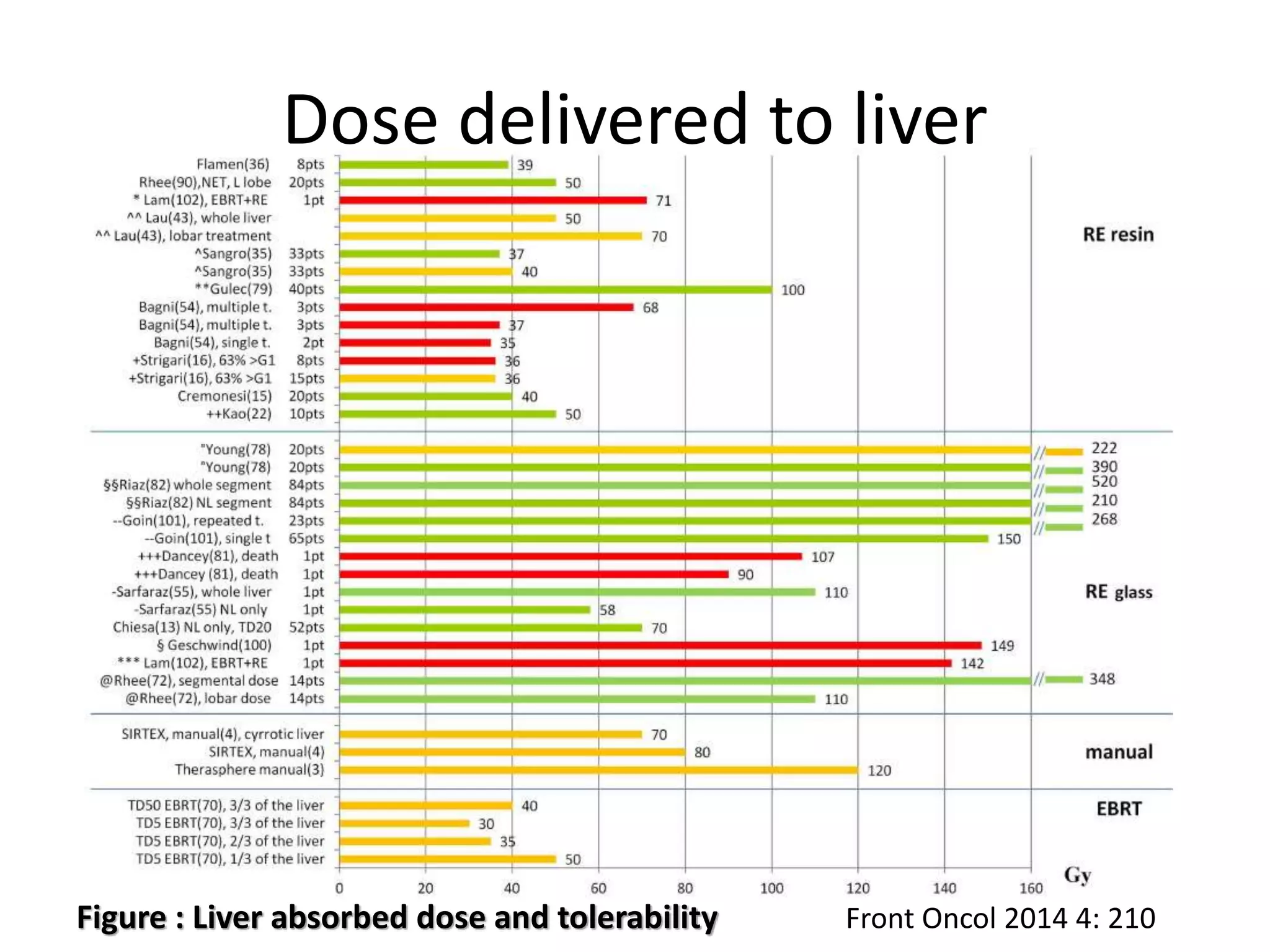
Dose delivered to liver
Figure : Liver absorbed dose and tolerability Front Oncol 2014 4: 210
Lung
β radiation
mediated
damage
Prog. pul. insuf, Pul. fibrosis
Radiation pneumonitis
99mTc-MAA
<20-30 Gy
Multicompartmental
method
Dose delivered to lung
Figure : Lung absorbed dose and tolerability Front Oncol 2014 4: 210
Suggested normal limits from literature
RN Disease Max Limit
131I DTC, Benign thyroid, NB, BCL 2Gy to blood
90Y Liver NET 2Gy to BM
Radio
peptide
NET 28Gy and 40Gy for
kidneys
90Y-
microsp
heres
HCC, metastatic liver tumors Variable ?35-520Gy
Zevalin NHL, Follicular lymphoma WB AD 1.3-2.4mGy/MBq
Bexxar NHL. Folliclar lymphoma WB AD 0.65-0.75 Gy
Suggestedsafetymeasuresfromliterature
RN Organ safety measures
131I, 90Y Bone marrow Individual dose optimization
radio
peptide
Kidney Co administratin of amino acids
90Y-
microsp
heres
Liver Selective placement of catheter to
hepatic artery, targeting of least
possible number of segments
90Y-
microsp
heres
Lung LS 20%, <20 or 30Gy
References
Fowler. Br J Radiol, 2010; 83:554-568
Jones et al. Clin Oncol, 2001;13:71-81
Brady et al. Cancer J 2013;19: 71-78
Cremonesi et al. J Nucl Med, 2007;48:1871-1879
Rajendran et al. J Nucl Med, 2008;49:837-844
van der Veldt et al. Eur J Nucl Med Mol Imaging, 2010;37:1950-1958
Rolleman et al. Eur J Nucl Med, 2003;30:9-15
Cremonesi et al. Front Oncol, 2014;4:210
Forreretal.Eur J Nucl Med Mol Imaging, 2009;36:1138-1146
Baroneetal. JNuclMed.2005;46:99s-106s
Bodeietal.EurJNuclMedMolImaging.2008;35:1847-1856
Otteetal.Eur J Nucl Med,1999;26: 1439-1447
Fisher et al. J Nucl Med, 2009;50:644-652
Zevalin prescribing information; http://www.zevalin.com/v3/pdf/
Bexxar prescribing information; http://us.gsk.com/products/assets/ us_bexxar.pdf.
O’Donoghue et al. Cancer Biother Radiopharm, 2002;17:435-443
Boucek et al. Eur J Nucl Med Mol Imaging, 2005;32:458-469

Normal organ biological effective dose azmal su jamila

  • 1.
    Normal organ BiologicalEffective Dose (Saving kidney, bone marrow and liver) Safety and toxicity Azmal/Su/Jamila
  • 2.
    BED: Introduction • Radiobiologicalmodel • Can help predict clinical outcomes when treatment parameters are altered • base on: – linear quadratic model – radiobiological data for patients • assumes: – full repair between two fractions – no proliferation of tumor cells
  • 3.
    BED: Definition Biologically effectivedose (of a given schedule) is: • the total dose required to give the same log cell kill as the schedule being studied, • at an infinitely low dose-rate or with infinitely small fractions well spaced out; • with an overall time factor for repopulation during continued irradiation • for a tissue with a particular α/β ratio only
  • 4.
    BED: Formula BED=nd(1+d/[α/β]) -loge2 (T-Tk)/αTp • n fractions of • d Gy are given • in an overall time of T days • and tumour repopulation doesn’t start until day Tk (using k for kick-off, or onset, of the delayed repopulation during fractionated irradiation) • assuming a constant repopulation rate or cell doubling time Tp up to the end of the RT
  • 5.
    α and β •tissue specific coefficients for radiation damage • α proportional to dose (one single event is lethal) • β proportional to dose squared (two sublethal events required for lethal damage) • α/β ratio - repair capacity - quantifies the sensitivity of a given tissue to changes in fractionation
  • 6.
    Dose limiting organ (organwith largest absorbed dose) • nonmyeloablative radionuclide therapy: red marrow • 90Y-ibritumomab tiuxetan therapy: liver • 131I-tositumomab: lung, liver and kidney • peptide receptor radionuclide therapy (PRRT): red marrow and kidney • 90Y-glass or resin microsphere: liver and lung • 11C-docetaxel: liver and gall bladder • 89Sr, 153Sm, 186/188Re- RP: bone surface, red marrow • 223 RaCl2 : bone surface
  • 7.
    Dose limiting organ (organwith largest absorbed dose) • nonmyeloablative radionuclide therapy: red marrow • 90Y-ibritumomab tiuxetan therapy: liver • 131I-tositumomab: lung, liver and kidney • peptide receptor radionuclide therapy (PRRT): red marrow and kidney • 90Y-glass or resin microsphere: liver and lung • 11C-docetaxel: liver and gall bladder • 89Sr, 153Sm, 186/188Re- RP: bone surface, red marrow • 223 RaCl2 : bone surface
  • 8.
    Red marrow Non specific/ ?SSRT mediated Uptake βor γ range Mild transient myelotoxicity Myelodysplastic syndrome Blood based Image based 2-3 Gy Indv. dosimetry α emitter
  • 9.
  • 10.
    Kidney Megalin/ cubilin SSRT Pinocytosis Organic anion transporter Radiationnephropathy: Acute/chronic Planar SPECT 3D RBD 28 vs 40 Gy <7.4GBq/m2 L-lys & L-arg 25g/25g Fractionation
  • 11.
    111In-DTPA-exendin-4 40-50 MBq Megalin deficient :20-40 Gy/kidney Wild type: 70 Gy/kidney ↓Body wt. ↑uri. protein ↑U&C Histopath 16-19 weeks ThickeningandnecrosisoftubularbasallaminaGlomerulo-sclerosis Melisetal.JNuclMed.2010(51)
  • 12.
    Megalin • 600 kD,member of LDL protein family • Also known as LRP2 • A multiligand binding receptor • Expressed in plasma membrane of absorptive epithelial cells: lungs, oviducts, thyroid, parathyroid, eyes & ears • Present as Megalin/Cubilin complex, a scavenging protein receptor in apical membrane of renal proximal tubular cells.
  • 13.
    Megalin • Facilitates renalre absorption (endocytosis) of peptides, (binding) proteins, hormones, drugs, toxins and enzymes. • Re absorption of radio-labeled octreotide in mice. • ↓uptake and ↓renal retention of 111In-SSTR analogue is seen in absence of megalin.
  • 14.
    Figure: Abdominal scintigraphyin a patient after 220MBq 111DTPA-octreotide: (A) without and (B) with coinfusion of LysArg Renal activity 52% controlled with LysArg A B Eur J Nucl Med (2003) 30:9-15
  • 15.
    Liver Portal triaditis Low grpHTN RE Induced Liver Disease (REILD) 99mTc-MAA 3D voxel Bremsstrahlung SPECT 90Y PET SPECT/MR 35-520 Gy Lobar/segmentalRE Fractionation
  • 16.
    Dose delivered toliver Figure : Liver absorbed dose and tolerability Front Oncol 2014 4: 210
  • 17.
    Lung β radiation mediated damage Prog. pul.insuf, Pul. fibrosis Radiation pneumonitis 99mTc-MAA <20-30 Gy Multicompartmental method
  • 18.
    Dose delivered tolung Figure : Lung absorbed dose and tolerability Front Oncol 2014 4: 210
  • 19.
    Suggested normal limitsfrom literature RN Disease Max Limit 131I DTC, Benign thyroid, NB, BCL 2Gy to blood 90Y Liver NET 2Gy to BM Radio peptide NET 28Gy and 40Gy for kidneys 90Y- microsp heres HCC, metastatic liver tumors Variable ?35-520Gy Zevalin NHL, Follicular lymphoma WB AD 1.3-2.4mGy/MBq Bexxar NHL. Folliclar lymphoma WB AD 0.65-0.75 Gy
  • 20.
    Suggestedsafetymeasuresfromliterature RN Organ safetymeasures 131I, 90Y Bone marrow Individual dose optimization radio peptide Kidney Co administratin of amino acids 90Y- microsp heres Liver Selective placement of catheter to hepatic artery, targeting of least possible number of segments 90Y- microsp heres Lung LS 20%, <20 or 30Gy
  • 22.
    References Fowler. Br JRadiol, 2010; 83:554-568 Jones et al. Clin Oncol, 2001;13:71-81 Brady et al. Cancer J 2013;19: 71-78 Cremonesi et al. J Nucl Med, 2007;48:1871-1879 Rajendran et al. J Nucl Med, 2008;49:837-844 van der Veldt et al. Eur J Nucl Med Mol Imaging, 2010;37:1950-1958 Rolleman et al. Eur J Nucl Med, 2003;30:9-15 Cremonesi et al. Front Oncol, 2014;4:210 Forreretal.Eur J Nucl Med Mol Imaging, 2009;36:1138-1146 Baroneetal. JNuclMed.2005;46:99s-106s Bodeietal.EurJNuclMedMolImaging.2008;35:1847-1856 Otteetal.Eur J Nucl Med,1999;26: 1439-1447 Fisher et al. J Nucl Med, 2009;50:644-652 Zevalin prescribing information; http://www.zevalin.com/v3/pdf/ Bexxar prescribing information; http://us.gsk.com/products/assets/ us_bexxar.pdf. O’Donoghue et al. Cancer Biother Radiopharm, 2002;17:435-443 Boucek et al. Eur J Nucl Med Mol Imaging, 2005;32:458-469

Editor's Notes

  • #3 Biology
  • #5 Tp is a little shorter than Tpot (potential doubling time measured before the tumour has received any cytotoxic treatment)
  • #6 Typical values for the α/β ratio : 5–25 Gy for early-reacting normal tissues and tumors and 2–5 Gy for late-responding normal tissues
  • #7 Cremonesi et al. J. Nucl. Med. 2007; 48 (11) Rajendran et al. J. Nucl. Med. 2008; 49: 837-844 van der Veldt et al. Eur J Nucl Med Mol Imaging (2010) 37:1950–1958 Slifstein et al. J. Nucl. Med. 2006; 47 (2) 11C-Raclopride striatal dopamine D2 receptor imaging: gall bladder
  • #8 Dosimetry is beneficial because it predicts: Probability of toxicity Normal tissue complication probability (NTCP) Tumor response Tumor control probability
  • #9 Forrer et al. Eur J Nucl Med Mol Imaging, 2009;36:1138-1146 Blood smear_MDS_hypogranular neutrophil_pseudo-Pelger-Huet nucleus_RBC: poikilocytosis(Wright-Giemsa stain) Bone marrow aspirate smear_MDS_dyserythropoiesis_nuclear hypolobation (pseudo–Pelger-Huët nucleus) of granulocyte_blast cell
  • #11 Same for different analogues No temporal change in term of total renal uptake but cortico-medullary discrepency Independent of sex and ?SSTR expression Matches with variation expression density of megalin in renal cortex, medulla and parts of PCT 60%, 85% and 30% reduction is seen with co administration of D-lysin, sodium maleate and cisplatin Megalin and cubilin mediated endocytosis; Somatostatin receptor mediated uptake; Fluid phase endocytosis (pinocytosis); Organic anion trasnporter mediated peritubular absorption azotemia, HTN, severe anemia (months to years after irradiation), if untreated, (gradual ↓CCR) leads to renal failure. mesangiolysis, sclerosis, tubular atrophy, and tubulointerstitial scarring
  • #12 Grading of histologic renal damage was most pronounced in female WT mice. Damage was similar but less frequent in megalin deficient mice.
  • #15 Rolleman et al. Eur J Nucl Med (2003) 30:9-15
  • #16 REILD manifest within 2 mo of RE (unlike 2-24 wk of EBRT induced RILD, central vein injury) Lobar or segmental RE can deliver higher AD compared to AD delivered to whole liver; lower volume of non tumoral liver parenchyma treated, higher is the tolerability. Basal liver function; patient naïve to RE Multiple administration with reduced parenchymal adsorbed dose result in lower BED, i.e. lower toxicity than a higher single dose administration Z1 encircles the portal tracts (hepatic arteries) Z3 is around central veins. Z2 bwn
  • #17 The graph shows the liver absorbed doses (Gy) reported in the literature with information about the associated liver tolerability. Red bars represent liver toxicity with fatal event (death); orange bars represent the threshold for observed toxicity or the limit recommended by the author; green bars represent tolerated absorbed doses. References are reported in parenthesis after the name of the first author. t., treatment; *(77) patient with previous EBRT (21 Gy) and RE with 71 Gy
  • #19 The graph shows the lung absorbed doses (Gy) reported in the literature, with information about the associated lung tolerability. The absorbed doses taken from the literature are reported although these are derived without including the attenuation correction. Absorbed dose values should be rescaled by an average factor of 0.6 (12). Red bars represent radiation-induced pneumonitis leading to death; orange bars represent the threshold for observed radiation-induced pneumonitis or the limit recommended by the author; green bars represent tolerated absorbed doses. The references are reported in parenthesis after the name of the first author.
  • #20 Forrer et al. Eur J Nucl Med Mol Imaging (2009) 36:1138–1146 Barone et al. J Nucl Med. 2005;46(suppl 1); Bodei et al. Eur J Nucl Med Mol Imaging. 2008;35; Otte et al. Eur J Nucl Med1999;26(11) Front Oncol 2014 4: 210 Zevalin prescribing information [package insert]. Irvine, CA: Spectrum Pharmaceuticals, Inc.; 2009. Available at: http://www.zevalin.com/v3/pdf/ Zevalin_Package_Insert.pdf. Accessed October 25, 2010. Fisher DR, Shen S, Meredith RF. MIRD dose estimate report no. 20: radiation absorbed-dose estimates for 111In- and 90Y-ibritumomab tiuxetan. J Nucl Med. 2009;50:644–652 Bexxar prescribing information [package insert]. Research Triangle Park, NC: GlaxoSmithKline; 2005. Available at: http://us.gsk.com/products/assets/ us_bexxar.pdf. Accessed October 25, 2010 O’Donoghue JA et al. Hematologic toxicity in radioimmunotherapy: dose-response relationships for I-131 labeled antibody therapy. Cancer Biother Radiopharm. 2002;17:435–443 Boucek JA et al. Validation of prospective whole-body bone marrow dosimetry by SPECT/CT multimodality imaging in 131I-anti-CD20 rituximab radioimmunotherapy of non-Hodgkin’s lymphoma. Eur J Nucl Med Mol Imaging. 2005;32:458–469