1
Industrial Training Project Report
On
“Coal - Fired Steam Power Plants”
National Thermal Power Corporation SIMHADRI (Visakhapatnam)
(Submitted towards completion of industrial training at NTPC SIMHADRI)
Under the guidance of: Submitted by:
Shri B.Venkata Rao, Uppu Ashish,
DGM, Ash Handling Plant, B.Tech, Mechanical Engg.
NTPC SIMHADRI, (4th
sem),
Visakhapatnam. GITAM University,
Visakhapatnam.
2
TRAINING SCHEDULE
DEPARTMENT PERIOD
BOILER MAINTAINANCE
11.05.2015
to
16.05.2015
TURBINE MAINTAINANCE
18.05.2015
to
23.05.2015
OFFSITE MAINTAINANCE
25.05.2015
to
30.05.2015
ASH HANDLING PLANT
01.06.2015
to
09.06.2015
3
CERTIFICATE
This is to certify that UPPU ASHISH, a student of 2012-2016 Batch
of B.Tech,Mechanical Engineering in 4th
Year of GITAM University,
Visakhapatnam has successfully completed his industrial training at
NTPC Simhadri, Visakhapatnam for four weeks from 7th
May to 9th
June 2015. He has completed the whole training as per the training
report submitted by him.
HR Manager
NTPC Simhadri,
Visakhapatnam
4
Acknowledgment
“It is not possible to prepare a project report without the assistance &
encouragement of other people. This one is certainly no exception.”
On the very outset of this report, I would like to extend my sincere &
heartfelt obligation towards all the personages who have helped me in
this endeavor. Without their active guidance, help, cooperation &
encouragement, I would not have made headway in the industrial
training
I am ineffably indebted to Mr. K.N. Reddy, AGM (MM-BMD); Mr.
D.Shravan, Dy. Manager (BMD-PP); Mr. Piyush Kanwar, Dy. Manager
(BMD-Mills); Mr. Balaji, Dy. Manager (BMD-RM); Mr. T.Prem Das, AGM
(MM-TMD & OS); Mr. Shridhar, Dy. Manager (MM-TMD) for
conscientious and encouragement to accomplish this assignment.
I am extremely thankful and pay my gratitude to my guide Mr. B.Venkata
Rao for his valuable guidance and support on completion of this project
in its presently.
I extend my gratitude to NTPC Ltd Simhadri and HR-EDC Dept. of NTPC
Ltd Simhadri for giving me this opportunity.
I also acknowledge with a deep sense of reverence, my gratitude
towards my parents, who has always supported me morally as well as
economically.
Any omission in this brief acknowledgement does not mean lack of
gratitude.
Thanking You
Ashish Uppu
5
TABLE OF CONTENTS
1. About NTPC……………………………………………… 6
2. About NTPC SIMHADRI……………………………. 14
3. NTPC power stations in India…………………… 18
4.Principal and Operation of a Thermal Power
Plant…………………………………………………………. 19
5.Principal components of a 500MW Thermal
Power Plant………………………………………………. 29
6.The Layout of NTPC Simhadri……………………. 45
7.Boiler and its auxiliaries……………………………. 48
8.The Steam Turbine Theory……………………… 118
9. Turbine and its auxiliaries……………………… 128
10. DM treatment
plant……………………………………………………….. 161
11. Cooling Towers…………………………………. 169
12. Circulating Water System…………………. 174
13. Principal components of CWS………….. 178
14. Ash Handling System……………………….. 183
15. Ways to increase the thermal efficiency of
power plants………………………………………….. 187
16. Losses during operation & maintenance of
a power plant…………………………………………. 190
5
TABLE OF CONTENTS
1. About NTPC……………………………………………… 6
2. About NTPC SIMHADRI……………………………. 14
3. NTPC power stations in India…………………… 18
4.Principal and Operation of a Thermal Power
Plant…………………………………………………………. 19
5.Principal components of a 500MW Thermal
Power Plant………………………………………………. 29
6.The Layout of NTPC Simhadri……………………. 45
7.Boiler and its auxiliaries……………………………. 48
8.The Steam Turbine Theory……………………… 118
9. Turbine and its auxiliaries……………………… 128
10. DM treatment
plant……………………………………………………….. 161
11. Cooling Towers…………………………………. 169
12. Circulating Water System…………………. 174
13. Principal components of CWS………….. 178
14. Ash Handling System……………………….. 183
15. Ways to increase the thermal efficiency of
power plants………………………………………….. 187
16. Losses during operation & maintenance of
a power plant…………………………………………. 190
5
TABLE OF CONTENTS
1. About NTPC……………………………………………… 6
2. About NTPC SIMHADRI……………………………. 14
3. NTPC power stations in India…………………… 18
4.Principal and Operation of a Thermal Power
Plant…………………………………………………………. 19
5.Principal components of a 500MW Thermal
Power Plant………………………………………………. 29
6.The Layout of NTPC Simhadri……………………. 45
7.Boiler and its auxiliaries……………………………. 48
8.The Steam Turbine Theory……………………… 118
9. Turbine and its auxiliaries……………………… 128
10. DM treatment
plant……………………………………………………….. 161
11. Cooling Towers…………………………………. 169
12. Circulating Water System…………………. 174
13. Principal components of CWS………….. 178
14. Ash Handling System……………………….. 183
15. Ways to increase the thermal efficiency of
power plants………………………………………….. 187
16. Losses during operation & maintenance of
a power plant…………………………………………. 190
6
About NTPC
NTPC Limited is the largest thermal power generating company of
India, Public Sector Company. It was incorporated in the year 1975 to
accelerate power development in the country as a wholly owned
company of the Government of India. NTPC is emerging as a diversified
power major with presence in the entire value chain of the power
generation business. Apart from power generation, which is the mainstay
of the company, NTPC has already ventured into consultancy, power
trading, ash utilization and coal mining. NTPC ranked 341st in the ‘2010,
Forbes Global 2000’ ranking of the World’s biggest companies. NTPC
became a Maharatna company in May, 2010, one of the only four
companies to be awarded this status.
Within a span of 31 years, NTPC has emerged as a truly national
power company, with power generating facilities in all the major regions of the
country. NTPC's core business is engineering, construction and operation
of power generating plants and providing consultancy to power utilities in
India and abroad.
The total installed capacity of the company is 31134 MW (including JVs)
with 15coal based and 7 gas based stations, located across the country.
In addition under JVs, 3 stations are coal based & another station uses
7
naphtha/LNG as fuel. By 2017, the power generation portfolio is
expected to have a diversified fuel mix with coal based capacity of
around 53000 MW, 10000 MW through gas, 9000 MW through Hydro
generation, about 2000 MW from nuclear sources and around 1000MW
from Renewable Energy Sources (RES). NTPC has adopted a multi-
pronged growth strategy which includes capacity addition through green
field projects, expansion of existing stations, joint ventures, subsidiaries
and takeover of stations.
NTPC has been operating its plants at high efficiency levels. Although the
company has 18.79% of the total national capacity it contributes 28.60%
of total power generation due to its focus on high efficiency. NTPC’s
share at 31 Mar 2001of the total installed capacity of the country was
24.51% and it generated 29.68%of the power of the country in 2008-09. Every
fourth home in India is lit by NTPC.170.88BU of electricity was produced by its
stations in the financial year 2005-2006. The Net Profit after Tax on March
31, 2006 was INR 58,202 million. The Net Profit after Tax for the quarter
ended June 30, 2006 was INR 15528 million, which is 18.65% more than
for the same quarter in the previous financial year. 2005). NTPC is as
second best utility in the world.
In October 2004, NTPC launched its Initial Public Offering (IPO)
consisting of 5.25% as fresh issue and 5.25% as offer for sale by
Government of India. NTPC thus became a listed company in November
2004 with the Government holding 89.5% of the equity share capital. In
February 2010, the Shareholding of Government of India was reduced
from 89.5% to 84.5% through Further Public Offer and the balance 10.5%
is held by FIIs, Domestic Banks, Public and others.
8
NTPC Limited
Type Public
Founded 1975
Headquarters Delhi, India
Key people R S Sharma, Chairman & Managing Director
Industry Electricity generation
Products Electricity
Revenue INR 416.37 billion (2008)
Net income INR 70.47 billion (2008)
Employees 23867 (2006)
Website http://www.ntpc.co.in
8
NTPC Limited
Type Public
Founded 1975
Headquarters Delhi, India
Key people R S Sharma, Chairman & Managing Director
Industry Electricity generation
Products Electricity
Revenue INR 416.37 billion (2008)
Net income INR 70.47 billion (2008)
Employees 23867 (2006)
Website http://www.ntpc.co.in
8
NTPC Limited
Type Public
Founded 1975
Headquarters Delhi, India
Key people R S Sharma, Chairman & Managing Director
Industry Electricity generation
Products Electricity
Revenue INR 416.37 billion (2008)
Net income INR 70.47 billion (2008)
Employees 23867 (2006)
Website http://www.ntpc.co.in
9
Strategies of NTPC
Technological Initiatives
 Introduction of steam generators (boilers) of the size of 800 MW.
 Integrated Gasification Combined Cycle (IGCC) Technology.
 Launch of Energy Technology Centre -A new initiative for
development of technologies with focus on fundamental R&D.
 The company sets aside up to 0.5% of the profits for R&D.
 Roadmap developed for adopting μClean Development.
 Mechanism to help get / earn μCertified Emission Reduction.
10
Corporate Social Responsibility
 As a responsible corporate citizen NTPC has taken up number of
CSR initiatives.
 NTPC Foundation formed to address Social issues at national
level
 NTPC has framed Corporate Social Responsibility Guidelines
committing up to 0.5% of net profit annually for Community
Welfare.
 The welfare of project affected persons and the local population
around NTPC projects are taken care of through well drawn
Rehabilitation and Resettlement policies.
 The company has also taken up distributed generation for remote
rural areas
Partnering government in various initiatives
 Consultant role to modernize and improvise several plants across
the country.
 Disseminate technologies to other players in the sector.
 Consultant role Partnership in Excellence Programme for
improvement of PLF of 15 Power Stations of SEBs.
 Rural Electrification work under Rajiv Gandhi Garmin Vidyutikaran.
Environment management
 All stations of NTPC are ISO 14001 certified.
 Various groups to care of environmental issues.
 The Environment Management Group.
 Ash tilization Division.
 Afforestation Group.
 Centre for Power Efficiency & Environment Protection.
 Group on Clean Development Mechanism.
11
 NTPC is the second largest owner of trees in the country after
the Forest department.
Vision
“To be the world’s largest and best power producer, powering India’s
growth.”
Mission
“Develop and provide reliable power, related products and services
at competitive prices, integrating multiple energy sources with
innovative and eco-friendly technologies and contribute to society.”
Core Values – BE COMMITTED
B Business ethics
E Environmentally and Economically Sustainable
C Customer Focus
O Organizational and Professional Pride
M Mutual Respect and Trust
M Motivating Self and Others
I Innovation and Speed
T Total Quality for Excellence
T Transparent and Respected Organization
E Enterprising
D Devoted
12
Journey of NTPC
12
Journey of NTPC
12
Journey of NTPC
13
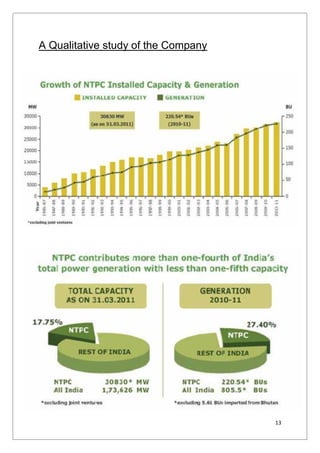
A Qualitative study of the Company
14
About NTPC Simhadri
Simhadri Super Thermal Power Plant is a coal-fired power plant
located in the Visakhapatnam district of the Indian state of Andhra
Pradesh. The power plant is one of the coal fired power plants of NTPC,
a Government of India enterprise. The coal for the power plant is
sourced from Kalinga Block of Talcher Coal fields in Odisha. Power
generated by units 1 and 2, making up for 1,000 MW, is dedicated to
power distribution companies owned by the Government of Andhra
Pradesh. The remainder 1,000 MW, generated by units 3 and 4, is
allocated to the states of Odisha, Tamil Nadu, and Karnataka. Their
shares are decided arbitrarily, with unsold power being sold to Andhra
Pradesh.
NTPC Simhadri is a modern coal-fired power plant, and is a combination
of four independent generation units, with common water and fuel
sources, and common ash ponds. Each of the four units has a
nameplate capacity of 500 MW. Units 1 and 2 were built in the first
phase of development, and were commissioned in February 2002 and
15
August 2004, respectively, to meet urgent needs of power in the largely
agrarian Coastal Andhra and North-Coastal Andhra regions. Units 3 and
4 were built in the second phase, and commissioned in March 2011 and
March 2012, respectively. Since the operator of this plant is a
Government of India enterprise, and since the plant was built with
central government funds, power generated by units 3 and 4 are sold to
distribution companies based in neighboring states of Odisha, Tamil
Nadu, and Karnataka, over the National Grid, as power stocks. The
allocations are decided between NTPC and the three states' discoms.
Unsold units are offered to discoms of Andhra Pradesh for purchase at
market prices.
Coal for NTPC Simhadri is sourced from Talcher Coal Fields, Odisha,
and transported by East Coast Railway (ECoR), over the Kolkata-
Chennai trunk line, with a spur heading towards the plant at Duvvada.
NTPC Simhadri uses fresh water sourced from the Yeluru Canal as
working fluid (steam which turns the turbines). For cooling, however, the
plant uses seawater pumped in from the Bay of Bengal. Seawater, with
its salt content, is unfit to be used as working fluid, without desalination.
16
PROJECT PROFILE
Approved Capacity 2000 MW (4 X 500 MW)
Location Paravada Mandal, Visakhapatnam, AP
Source of Finance JBIC Loan and Internal Resources
Fuel Source Mahanadi Coal Fields, Talcher
Fuel Requirement 5.04 Million Tons of Coal per annum
Mode of Transportation Rail
DM Water Source Water from Yelluru Canal
Sweet Water Requirement 600 m3
/ hr
Cooling Water Source Sea Water from Bay of Bengal
Sea Water Requirement 9100 m3
/ hr
Main Contractor M/s BHEL
Power Evacuation AP TRANSCO (Via Kalpaka)
Beneficiary State Andhra Pradesh
16
PROJECT PROFILE
Approved Capacity 2000 MW (4 X 500 MW)
Location Paravada Mandal, Visakhapatnam, AP
Source of Finance JBIC Loan and Internal Resources
Fuel Source Mahanadi Coal Fields, Talcher
Fuel Requirement 5.04 Million Tons of Coal per annum
Mode of Transportation Rail
DM Water Source Water from Yelluru Canal
Sweet Water Requirement 600 m3
/ hr
Cooling Water Source Sea Water from Bay of Bengal
Sea Water Requirement 9100 m3
/ hr
Main Contractor M/s BHEL
Power Evacuation AP TRANSCO (Via Kalpaka)
Beneficiary State Andhra Pradesh
16
PROJECT PROFILE
Approved Capacity 2000 MW (4 X 500 MW)
Location Paravada Mandal, Visakhapatnam, AP
Source of Finance JBIC Loan and Internal Resources
Fuel Source Mahanadi Coal Fields, Talcher
Fuel Requirement 5.04 Million Tons of Coal per annum
Mode of Transportation Rail
DM Water Source Water from Yelluru Canal
Sweet Water Requirement 600 m3
/ hr
Cooling Water Source Sea Water from Bay of Bengal
Sea Water Requirement 9100 m3
/ hr
Main Contractor M/s BHEL
Power Evacuation AP TRANSCO (Via Kalpaka)
Beneficiary State Andhra Pradesh
17
Salient Features of NTPC Simhadri
• First Coastal Based Coal fired thermal Power Project of NTPC
• Biggest Sea Water Intake-Well in India (For Drawing Sea Water
from Bay of Bengal)
• Use of Sea Water for Condenser Cooling and Ash Disposal
• Asia’s Tallest Natural Cooling Towers (165 m), 6th in the
World
• Use of Fly-Ash Bricks in the Construction of all Buildings
• Coal Based Project of NTPC Whose Entire Power is allocated to
Home State (AP)
• Use of Monitors and Large Video Screens (LVS) as Man Machine
Interface (MMIs) for Operating the Plant
• Use of Process Analysis, Diagnosis and Optimization (PADO) for the
first time in NTPC
• Flame Analysis of Boiler by Dedicated Scanners for all Coal
Burners
• Boiler Mapping By Acoustic Pyrometers
• Use of Distributed Digital Control and Management Information
System (DDCMIS)
• Totally Spring Loaded Floating Foundation for all Major
Equipments Including TG
• Use of INERGEN as Fire Protection System for the 1st time in
NTPC
• Use of Digital Automatic Voltage Regulator (DAVR)
• Use of VFD in ID Fan
18
NTPC POWER STATIONS IN INDIA
18
NTPC POWER STATIONS IN INDIA
18
NTPC POWER STATIONS IN INDIA
19
Principle and Operation of a Thermal Power
Plant
Principle:
Any Steam Power Plant operates under the Simple Rankine Cycle.
Hence the Rankine cycle is often termed as Basic Power Plant Cycle.
The Rankine Cycle
The Rankine cycle is a thermodynamic cyclewhich converts heat into
work. The heat is supplied externally to a closed loop, which usually uses
water as the working fluid. This cycle generates about 80% of all electric
power used throughout the world, including virtually all solar, thermal,
biomass, coal and nuclear power plants. It is named after William John
Macquorn Rankine,aScottish polymath. The thermal (steam) power plant
uses a dual (vapour+liquid) phase cycle. It is a closed cycle to enable
the working fluid (water) to be used again and again.
The basic principle of the working of a Thermal Power Plant is quite
simple. The fuel used in the plant is burnt in the boiler, and the heat
generated is then used to boil water which is circulated through several
Layout of a Simple
Rankine Cycle
T-S diagram of a Simple
Rankine Cycle
19
Principle and Operation of a Thermal Power
Plant
Principle:
Any Steam Power Plant operates under the Simple Rankine Cycle.
Hence the Rankine cycle is often termed as Basic Power Plant Cycle.
The Rankine Cycle
The Rankine cycle is a thermodynamic cyclewhich converts heat into
work. The heat is supplied externally to a closed loop, which usually uses
water as the working fluid. This cycle generates about 80% of all electric
power used throughout the world, including virtually all solar, thermal,
biomass, coal and nuclear power plants. It is named after William John
Macquorn Rankine,aScottish polymath. The thermal (steam) power plant
uses a dual (vapour+liquid) phase cycle. It is a closed cycle to enable
the working fluid (water) to be used again and again.
The basic principle of the working of a Thermal Power Plant is quite
simple. The fuel used in the plant is burnt in the boiler, and the heat
generated is then used to boil water which is circulated through several
Layout of a Simple
Rankine Cycle
T-S diagram of a Simple
Rankine Cycle
19
Principle and Operation of a Thermal Power
Plant
Principle:
Any Steam Power Plant operates under the Simple Rankine Cycle.
Hence the Rankine cycle is often termed as Basic Power Plant Cycle.
The Rankine Cycle
The Rankine cycle is a thermodynamic cyclewhich converts heat into
work. The heat is supplied externally to a closed loop, which usually uses
water as the working fluid. This cycle generates about 80% of all electric
power used throughout the world, including virtually all solar, thermal,
biomass, coal and nuclear power plants. It is named after William John
Macquorn Rankine,aScottish polymath. The thermal (steam) power plant
uses a dual (vapour+liquid) phase cycle. It is a closed cycle to enable
the working fluid (water) to be used again and again.
The basic principle of the working of a Thermal Power Plant is quite
simple. The fuel used in the plant is burnt in the boiler, and the heat
generated is then used to boil water which is circulated through several
Layout of a Simple
Rankine Cycle
T-S diagram of a Simple
Rankine Cycle
20
tubes, the steam that is generated is used to drive a turbine, which in
turn is coupled with a generator, which then produces the electricity.
A Rankine cycle describes a model of the operation of steam heat
engines most commonly found in power generation plants. Common
heat sources for power plants using the Rankine cycle are coal, natural gas,
oil, and nuclear. The Rankine cycle is sometimes referred to as a practical
Carnot cycle as, when an efficient turbine is used, the TS diagram will
begin to resemble the Carnot cycle. The main difference is that a pump
is used to pressurize liquid instead of a gas. This requires about 1/100th
(1%) as much energy as that compressing a gas in a compressor (as in the
Carnot cycle).The efficiency of a Rankine cycle is usually limited by the
working fluid. Without the pressure going super critical the temperature
range the cycle can operate over is quite small, turbine entry
temperatures are typically 565°C (the creep limit of stainless steel) and
condenser temperatures are around 30°C. This gives a theoretical
Carnot efficiency of around 63% compared with an actual efficiency of
42% for a modern coal-fired power station. This low turbine entry
temperature (compared with a gas turbine) is why the Rankine cycle is
often used as a bottoming cycle in combined cycle gas turbine power stations.
The working fluid in a Rankine cycle follows a closed loop and is re-used
constantly. The water vapor and entrained droplets often seen billowing
from power stations is generated by the cooling systems (not from the
closed loop Rankine power cycle) and represents the waste heat that
could not be converted to useful work.
Note that cooling towers operate using the latent heat of vaporization of
the cooling fluid. The white billowing clouds that form in cooling tower
operation are the result of water droplets which are entrained in the
cooling tower airflow; it is not, as commonly thought, steam. While many
substances could be used in the Rankine cycle, water is usually the fluid
21
of choice due to its favorable properties, such as nontoxic and un
reactive chemistry, abundance, and low cost, as well as its thermodynamic
properties. One of the principal advantages it holds over other cycles is
that during the compression stage relatively little work is required to drive
the pump, due to the working fluid being in its liquid phase at this point.
By condensing the fluid to liquid, the work required by the pump will only
consume approximately 1% to 3% of the turbine power and so give a
much higher efficiency for a real cycle. The benefit of this is lost
somewhat due to the lower heat addition temperature. Gas turbines, for
instance, have turbine entry temperatures approaching 1500°C.
Nonetheless, the efficiencies of steam cycles and gas turbines are fairly well
matched.
Ts diagram of a typical Rankine cycle operating between pressures of
0.06bar and 50bar.
There are four processes in the Rankine cycle, each changing the state
of the working fluid. These states are identified by number in the diagram
to the right
T-S diagram of a Typical
Rankine cycle
21
of choice due to its favorable properties, such as nontoxic and un
reactive chemistry, abundance, and low cost, as well as its thermodynamic
properties. One of the principal advantages it holds over other cycles is
that during the compression stage relatively little work is required to drive
the pump, due to the working fluid being in its liquid phase at this point.
By condensing the fluid to liquid, the work required by the pump will only
consume approximately 1% to 3% of the turbine power and so give a
much higher efficiency for a real cycle. The benefit of this is lost
somewhat due to the lower heat addition temperature. Gas turbines, for
instance, have turbine entry temperatures approaching 1500°C.
Nonetheless, the efficiencies of steam cycles and gas turbines are fairly well
matched.
Ts diagram of a typical Rankine cycle operating between pressures of
0.06bar and 50bar.
There are four processes in the Rankine cycle, each changing the state
of the working fluid. These states are identified by number in the diagram
to the right
T-S diagram of a Typical
Rankine cycle
21
of choice due to its favorable properties, such as nontoxic and un
reactive chemistry, abundance, and low cost, as well as its thermodynamic
properties. One of the principal advantages it holds over other cycles is
that during the compression stage relatively little work is required to drive
the pump, due to the working fluid being in its liquid phase at this point.
By condensing the fluid to liquid, the work required by the pump will only
consume approximately 1% to 3% of the turbine power and so give a
much higher efficiency for a real cycle. The benefit of this is lost
somewhat due to the lower heat addition temperature. Gas turbines, for
instance, have turbine entry temperatures approaching 1500°C.
Nonetheless, the efficiencies of steam cycles and gas turbines are fairly well
matched.
Ts diagram of a typical Rankine cycle operating between pressures of
0.06bar and 50bar.
There are four processes in the Rankine cycle, each changing the state
of the working fluid. These states are identified by number in the diagram
to the right
T-S diagram of a Typical
Rankine cycle
22
I. Process 1-2: The working fluid is pumped from low to high
pressure, as the fluid is a liquid at this stage the pump requires
little input energy.
II. Process 2-3: The high pressure liquid enters a boiler where it is
heated at constant pressure by an external heat source to become
a dry saturated vapor.
III. Process 3-4: The dry saturated vapor expands through a turbine,
generating power. This decreases the temperature and pressure of
the vapor and some condensation may occur.
IV. Process 4-1: The wet vapor then enters a condenser where it is
condensed at a constant pressure and temperature to become a
saturated liquid. The pressure and temperature of the condenser is
fixed by the temperature of the cooling coils as the fluid is
undergoing a phase-change.
In an ideal Rankine cycle thepumpand turbine would be isentropic, i.e.,
the pump and turbine would generate no entropy and hence maximize
the net work output processes1-2and 3-4 would be represented by vertical lines
onthe Ts diagram. The Rankine cycle shown here prevents the vapor
ending up in the superheat region after the expansion in the turbine,
which reduces the energy removed by the condensers.
In a real Rankine cycle, the compression by the pump and the
expansion in the turbine are not isentropic. In other words, these
processes are non-reversible and entropy is increased during the two
processes. This somewhat increases the power required by the pump
and decreases the power generated by the turbine. In particular the
efficiency of the steam turbine will be limited by water droplet formation. As
thewater condenses, water droplets hit the turbine blades at high speed
causing pitting and erosion, gradually decreasing the life of turbine
23
blades and efficiency of the turbine. The easiest way to overcome this
problem is by superheating the steam. On the Ts diagram above, state 3
is above a two phase region of steam and water so after expansion the
steam will be very wet. By superheating, state 3 will move to the right
of the diagram and hence produce a dryer steam after expansion.
Rankine Cycle with Reheat
In this two turbines work in series on a common shaft. The first accepts
vapor from the boiler at a high pressure. After the vapor has passed
through the first turbine (also referred as H.P turbine), it renters the
boiler and is reheated before it is allowed to pass through the second
turbine (often referred to as L.P turbine).It prevents the vapor from
condensing during its expansion which can intensely damage the turbine
blades, and improves the efficiency of the cycle by decreasing the net
work output. To protect the reheat tubes, steam is not allowed to expand
Rankine Cycle with superheating
24
deep into the two-phase region before it is taken for reheating, because
in that case the moisture particles in the steam while evaporating would
leave behind solid deposits in the form of scale which is difficult to
remove. A low reheat pressure may bring down the cycle efficiency.
Again, a high reheat pressure increases the moisture content at turbine
exhaust. Thus the reheat pressure is optimized. By increasing the
number of reheats, still higher steam pressures could be used, but
mechanical stresses increase at a higher proportion then the increase in
pressure, also increase. Hence more than two reheats have not been
used so far.
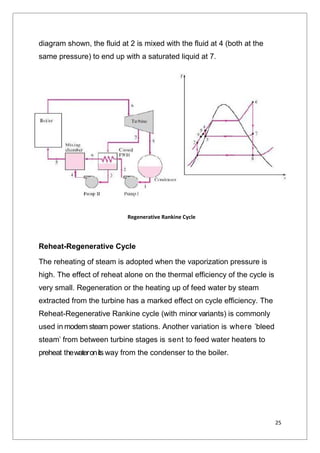
Regenerative Rankine Cycle
The main aim of the Regenerative Rankine cycle is to improve the cycle
efficiency by decreasing the net heat input. In Regenerative Rankine
cycle, after emerging from the condenser (possibly as a sub cooled
liquid) the working fluid is heated by steam tapped from the hot portion
of the cycle (i.e. from the intermediate stages of the turbine). On the
Rankine Cycle with Reheat
25
diagram shown, the fluid at 2 is mixed with the fluid at 4 (both at the
same pressure) to end up with a saturated liquid at 7.
Reheat-Regenerative Cycle
The reheating of steam is adopted when the vaporization pressure is
high. The effect of reheat alone on the thermal efficiency of the cycle is
very small. Regeneration or the heating up of feed water by steam
extracted from the turbine has a marked effect on cycle efficiency. The
Reheat-Regenerative Rankine cycle (with minor variants) is commonly
used in modern steam power stations. Another variation is where 'bleed
steam' from between turbine stages is sent to feed water heaters to
preheat thewateronits way from the condenser to the boiler.
Regenerative Rankine Cycle
26
Factors affecting thermal cycle efficiency
1. Initial steam pressure
2. Initial steam temperature
3. Reheat pressure and temperature, if reheat is used
4. Condenser pressure
5. Regenerative feed water heating
Operation-Fundamentals of Coal to Electricity:
Reheat – Regenerative Rankine
Cycle
Operation of a Steam Power Plant
26
Factors affecting thermal cycle efficiency
1. Initial steam pressure
2. Initial steam temperature
3. Reheat pressure and temperature, if reheat is used
4. Condenser pressure
5. Regenerative feed water heating
Operation-Fundamentals of Coal to Electricity:
Reheat – Regenerative Rankine
Cycle
Operation of a Steam Power Plant
26
Factors affecting thermal cycle efficiency
1. Initial steam pressure
2. Initial steam temperature
3. Reheat pressure and temperature, if reheat is used
4. Condenser pressure
5. Regenerative feed water heating
Operation-Fundamentals of Coal to Electricity:
Reheat – Regenerative Rankine
Cycle
Operation of a Steam Power Plant
27
28
MM
Mechanical Power to Electric Power
As the blades of the turbine rotate, the shaft of the generator which is coupled to that of the
turbine also rotates .It causes rotation of the exciter which produces an induced emf
(electric power)
29
Principle components of a 500MW thermal
power plant
Any 500MW thermal power plant comprises of the following
components:
1. Cooling tower
2. Cooling water pump
3. Transmission line (3-phase)
4. Unit transformer (3-phase)
5. Electric generator (3-phase)
6. Low pressure turbine
7. Feed Water Pump
A typical 500MW Thermal Power
Plant
29
Principle components of a 500MW thermal
power plant
Any 500MW thermal power plant comprises of the following
components:
1. Cooling tower
2. Cooling water pump
3. Transmission line (3-phase)
4. Unit transformer (3-phase)
5. Electric generator (3-phase)
6. Low pressure turbine
7. Feed Water Pump
A typical 500MW Thermal Power
Plant
29
Principle components of a 500MW thermal
power plant
Any 500MW thermal power plant comprises of the following
components:
1. Cooling tower
2. Cooling water pump
3. Transmission line (3-phase)
4. Unit transformer (3-phase)
5. Electric generator (3-phase)
6. Low pressure turbine
7. Feed Water Pump
A typical 500MW Thermal Power
Plant
30
8. Condenser
9. Intermediate pressure turbine
10. Steam governor valve
11. High pressure turbine
12. Deaerator
13. Feed heater
14. Coal conveyor
15. Coal hopper
16. Pulverized coal mill
17. Boiler drum
18. Ash hopper
19. Super heater
20. Forced draught fan
21. Re heater
22. Air intake tower
23. Economizer
24. Air pre heater
25. Electrostatic Precipitator (ESP)
26. Induced draught fan
27. Flue Gas
1. Cooling Tower
Cooling towers are heat removal devices used to transfer process
waste heat to the atmosphere. Cooling towers may either use the
evaporation of water to remove process heat and cool the working
fluid to near the wet-bulb air temperature or in the case of closed
circuit dry cooling towers rely solely on air to cool the working fluid to
near the dry-bulb air temperature. However, evaporative type cooling
31
towers are most commonly used. Common applications include
cooling the circulating water used in oil refineries, chemical plants,
power stations and building cooling. The towers vary in size from
small roof-top units to very large hyperboloid structures that can be
up to 200 meters tall and 100 meters in diameter, or rectangular
structures that can be over 40 meters tall and 80 meters long.
Smaller towers are normally factory-built, while larger ones are
constructed on site. The absorbed heat is rejected to the atmosphere
by the evaporation of some of the cooling water in mechanical
forced-draft or induced Draft towers or in natural draft hyperbolic
shaped cooling towers as seen at most nuclear power plants.
2. Cooling Water Pump
It pumps the water from the cooling tower to the condenser.
3. Three Phase Transmission line
Three phase electric power is a common method of electric power
transmission. It is a type of polyphase system mainly used to power
motors and many other devices. A three phase system uses less
conductive material to transmit electric power than equivalent single
phase, two phase, or direct current system at the same voltage. In a
three phase system, three circuits reach their instantaneous peak
values at different times. Taking current in one conductor as the
reference, the currents in the other two are delayed in time by one-
third and two-third of one cycle .This delay between “phases” has the
effect of giving constant power transfer over each cycle of the current
and also makes it possible to produce a rotating magnetic field in an
electric motor. At the power station, an electric generator converts
mechanical power into a set of electric currents, one from each
32
electromagnetic coil or winding of the generator. The current are
sinusoidal functions of time, all at the same frequency but offset in
time to give different phases. In a three phase system the phases are
spaced equally, giving a phase separation of one-third of one cycle.
Generators output at a voltage that ranges from hundreds of volts to
30,000 volts.
4. Unit transformer (3-phase)
At the power station, transformers step-up this voltage to one more
suitable for transmission. After numerous further conversions in the
transmission and distribution network the power is finally transformed
to the standard mains voltage (i.e. the “household” voltage). The
power may already have been split into single phase at this point or it
may still be three phase. Where the step-down is three phase at the
receiving stage, the output of this transformer is usually star
connected with the standard mains voltage being the phase-neutral
voltage. Another system commonly seen in North America is to have
a delta connected secondary with a center tap on one of the
windings supplying the ground and neutral. This allows for 240 V
three phase as well as three different single phase voltages( 120 V
between two of the phases and neutral , 208 V between the third
phase ( or wild leg) and neutral and 240 V between any two phase)
to be available from the same supply.
A unit Transformer
33
5. Electrical generator
An Electrical generator is a device that converts kinetic energy to
electrical energy, generally using electromagnetic induction. The task
of converting the electrical energy into mechanical energy is
accomplished by using a motor. The source of mechanical energy
maybe water falling through the turbine or steam turning a turbine (as
is the case with thermal power plants). There are several
classifications for modern steam turbines. Steam turbines are used in
our entire major coal fired power stations to drive the generators or
alternators, which produce electricity. The turbines themselves are
driven by steam generated in "boilers “or "steam generators" as they
are sometimes called. Electrical power stations use large steam
turbines driving electric generators to produce most (about 86%) of
the world’s electricity. These centralized stations are of two types:
fossil fuel power plants and nuclear power plants. The turbines used
for electric power generation are most often directly coupled to their-
generators .As the generators must rotate at constant synchronous
speeds according to the frequency of the electric power system, the
most common speeds are 3000 r/min for 50 Hz systems, and 3600
r/min for 60 Hz systems. Most large nuclear sets rotate at half those
speeds, and have a 4-pole generator rather than the more common
2-pole one.
An electric generator with an excitor
34
6. Low Pressure Turbine
Energy in the steam after it leaves the boiler is converted into
rotational energy as it passes through the turbine. The turbine
normally consists of several stages with each stages consisting of a
stationary blade (or nozzle) and a rotating blade. Stationary blades
convert the potential energy of the steam into kinetic energy and
direct the flow onto the rotating blades. The rotating blades convert
the kinetic energy into impulse and reaction forces, caused by
pressure drop, which results in the rotation of the turbine shaft. The
turbine shaft is connected to a generator, which produces the
electrical energy. Low Pressure Turbine (LPT) consists of 2x6
stages. After passing through Intermediate Pressure Turbine steam
is passed through LPT which is made up of two parts- LPC REAR &
LPC FRONT. As water gets cooler here it gathers into a HOTWELL
placed in lower parts of turbine.
7. Feed Water Pump
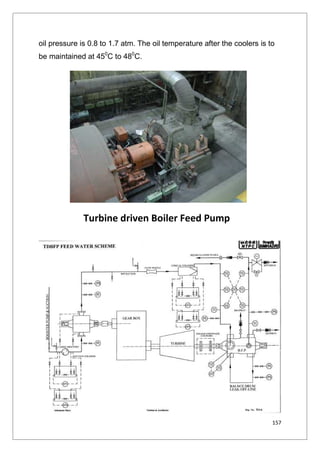
A Boiler feed water pump or simply a feed water pump is a specific
type of pump used to pump water into a steam boiler. The water may
be freshly supplied or returning condensation of the steam produced
by the boiler. These pumps are normally high pressure units that use
suction from a condensate return system and can be of the
centrifugal pump type or positive displacement type. Feed water
pumps range in size up to many horsepower and the electric motor is
usually separated from the pump body by some form of mechanical
coupling. Large industrial condensate pumps may also serve as the
feed water pump. In either case, to force the water into the boiler, the
pump must generate sufficient pressure to overcome the steam
pressure developed by the boiler. This is usually accomplished
35
through the use of a centrifugal pump. Feed water pumps usually run
intermittently and are controlled by a float switch or other similar
level-sensing device energizing the pump when it detects a lowered
liquid level in the boiler. Some pumps contain a two-stage switch. As
liquid lowers to the trigger point of the first stage, the pump is
activated. If the liquid continues to drop, (perhaps because the pump
has failed, its supply has been cut off or exhausted, or its discharge
is blocked) the second stage will be triggered. This stage may switch
off the boiler equipment (preventing the boiler from running dry and
overheating); trigger an alarm, or both.
8. Condenser
The steam coming out from the Low Pressure Turbine (a little above
its boiling pump) is brought into thermal contact with cold water
(pumped in from the cooling tower) in the condenser, where it
condenses rapidly back into water, creating near Vacuum-like
conditions inside the condenser chest allowing it to be pumped. If the
condenser can be made cooler, the pressure of the exhaust steam is
reduced and efficiency of the cycle increases. The surface
condenser is a shell and tube heat exchanger in which cooling water
is circulated through the tubes. The exhaust steam from the low
pressure turbine enters the shell where it is cooled and converted to
condensate (water) by flowing over the tubes as shown in the
adjacent diagram. Such condensers use steam ejectors or rotary
motor-driven exhausters for continuous removal of air and gases
from the steam side to maintain vacuum.
36
9. Intermediate Pressure Turbine
Intermediate Pressure Turbine (IPT) consists of 12 stages. When the
steam has been passed through HPT it enters into IPT. IPT has two
ends named as FRONT & REAR. Steam enters through front end
and leaves from Rear end.
10. Steam Governor Valve
Steam locomotives and the steam engines used on ships and
stationary applications such as power plants also required feed water
pumps. In this situation, though, the pump was often powered using
a small steam engine that ran using the steam produced by the boiler
a means had to be provided, of course, to put the initial charge of
water into the boiler (before steam power was available to operate
the steam-powered feed water pump).The pump was often a positive
displacement pump that had steam valves and cylinders at one end
and feed water cylinders at the other end; no crankshaft was
required. In thermal plants, the primary purpose of surface
condenser is to condense the exhaust steam from a steam turbine to
obtain maximum efficiency and also to convert the turbine exhaust
steam into pure water so that it may be reused in the steam
generator or boiler as boiler feed water. By condensing the exhaust
steam of a turbine at a pressure below atmospheric pressure, the
steam pressure drop between the inlet and exhaust of the turbine is
increased, which increases the amount heat available for conversion
to mechanical power. Most of the heat liberated due to condensation
of the exhaust steam is carried away by the cooling medium (water
or air) used by the surface condenser. Control valves are valves
used within industrial plants and elsewhere to control operating
37
conditions such as temperature, pressure, flow and liquid level by
fully or partially opening or closing in response to signals received
from controllers that compares a “set point” to a “process variable”
whose value is provided by sensors that monitor changes in such
conditions. The opening or closing of control valves is done by
means of electrical, hydraulic or pneumatic systems.
11. High Pressure Turbine
Steam coming from Boiler directly feeds into HPT at a temperature of
540°C and at a pressure of 170 kg/cm2. Here it passes through 12
different stages due to which its temperature goes down to 350°C
and pressure as 45 kg/cm2. This line is also called as CRH – COLD
REHEAT LINE. It is now passed to a REHEATER where its
temperature rises to 540°C and called as HRH-HOT REHEATED
LINE.
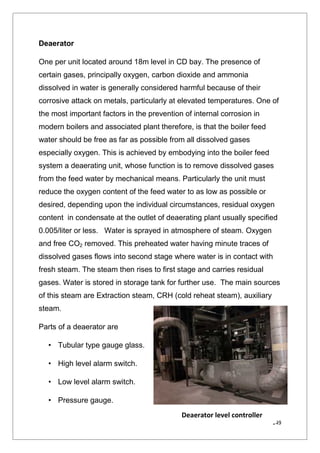
12. Deaerator
A Deaerator is a boiler feed device for air removal and used to
remove dissolved gases (an alternate would be the use of water
treatment chemicals) from boiler feed water to make it noncorrosive.
A deaerator is an open type feed water heater. A dearator typically
includes a vertical domed deaeration section as the deaeration boiler
feed water tank. A steam generating boiler requires that the
circulating steam, condensate, and feed water should be devoid of
dissolved gases, particularly corrosive ones and dissolved or
suspended solids. The gases will give rise to corrosion of the metal.
The solids will deposit on the heating surfaces giving rise to localized
heating and tube ruptures due to overheating. Under some
conditions it may give rise to stress corrosion cracking. Deaerator
38
level and pressure must be controlled by adjusting control valves the
level by regulating condensate flow and the pressure by regulating
steam flow. If operated properly, most deaerators will guarantee that
oxygen in the deaerated water will not exceed 7 ppb by weight
(0.005 cm3/L).
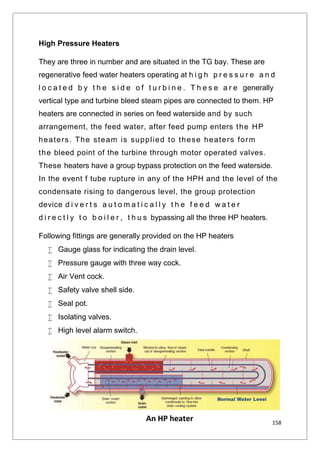
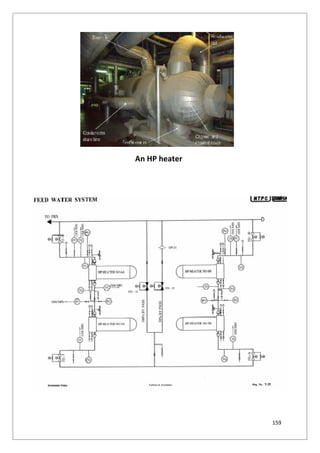
13. Feed water heater
A Feed water heater is a power plant component used to pre-heat
water delivered to a steam generating boiler. Preheating the feed
water reduces the irreversibility involved in steam generation and
therefore improves the thermodynamic efficiency of the system. This
reduces plant operating costs and also helps to avoid thermal shock
to the boiler metal when the feed water is introduced back into the
steam cycle. In a steam power (usually modeled as a modified
Rankine cycle), feed water heaters allow the feed water to be
brought up to the saturation temperature very gradually. This
minimizes the inevitable irreversibility associated with heat transfer to
the working fluid (water).
14. Coal conveyor
Coal conveyors are belts which are used to transfer coal from its
storage place to Coal Hopper. A belt conveyor consists of two
pulleys, with a continuous loop of material- the conveyor Belt – that
rotates about them. The pulleys are powered, moving the belt and
the material on the belt forward. Conveyor belts are extensively used
to transport industrial and agricultural material, such as grain, coal,
ores etc.
39
15. Coal Hopper
Coal Hoppers are the places which are used to feed coal to Coal Mill.
It also has the arrangement of entering Hot Air at 200°C inside it
which solves our two purposes:
1. If our Coal has moisture content then it dries it so that a proper
combustion takes place.
2. It raises the temperature of coal so that its temperature is more
near to its Ignite Temperature so that combustion is easy.
16. Pulverized Coal Mill
A pulverizer is a mechanical device for grinding coal for combustion
in a furnace in a Thermal power plant.
17. Boiler drum
Steam Drums are a regular feature of water tube boilers. It is
reservoir of water/steam at the top end of the water tubes in the
water-tube boiler. They store the steam generated in the water tubes
and act as a phase separator for the steam/water mixture. Usually,
the boiler drum is at an elevation of 75m. The difference in densities
between hot and cold water helps in the accumulation of the “hotter”-
water/and saturated –steam into steam drum. Made from high-grade
steel (probably stainless) and its working involve temperature of
390°C and pressure well above 350psi (2.4MPa). The separated
steam is drawn out from the top section of the drum. Saturated
Steam is drawn off the top of the drum. The steam will re-enter the
furnace in through a super heater, while the saturated water at the
bottom of steam drum flows down to the mud-drum /feed water drum
by down comer tubes accessories include a safety valve, water level
40
indicator and fuse plug. A steam drum is used in company of a mud-
drum/feed water drum which is located at a lower level. So that it
acts as a sump for the sludge or sediments which have a higher
tendency at the bottom.
18. Ash Hopper
A steam drum is used in the company of a mud-drum/feed water
drum which is located at a lower level. So that it acts as a sump for
the sludge or sediments which have a tendency to accumulate at the
bottom.
19. Super Heater
A Super heater is a device in a steam engine that heats the steam
generated by the boiler again increasing its thermal energy. Super
heaters increase the efficiency of the steam engine, and were widely
adopted. Steam which has been superheated is logically known as
superheated steam; non- superheated steam is called saturated
steam or wet steam. Super heaters are being applied most stationary
steam engines including power stations. The dry steam coming out
of the boiler drum passes through three stages of superheating.
Initially the main steam is passed through a low temperature super
heater followed by a divisional panel super heater and finally through
a platen super heater. The resulting steam obtained will be at 540o
C
this is sent to the inlet of the HP turbine.
20. Force Draught Fan
External fans are provided to give sufficient air for combustion. The
forced draught fan takes air from the atmosphere and, warms it in the
41
air pre heater for better combustion, injects it via the air nozzles on
the furnace wall.
21. Re heater
Re heater is a heater which is used to raise the temperature of steam
which has exhausted from the high pressure turbine. The steam
entering the re heater is known as Cold Reheat (CR). The steam
leaving the re heater is known as Hot Reheat (HR).
22. Air Intake
Air is taken from the environment by an air intake tower which is fed
to the fuel.
23. Economizer
Economizers are mechanical devices intended to reduce energy
consumption, or to perform another useful function like preheating a
fluid. The term economizer is used for other purposes as well-Boiler,
power plant, heating, ventilating and air-conditioning. In boilers,
economizer are heat exchange devices that heat fluids , usually
water, up to but not normally beyond the boiling point of the fluid.
Economizers are so named because they can make use of the
enthalpy and improving the boiler’s efficiency. They are devices fitted
to a boiler which save energy by using the heat from the exhaust
gases from the boiler to preheat the cold water used to fill it (the feed
water). Modern day boilers, such as those in cold fired power
stations, are still fitted with economizer which is decedents of
Green’s original design. In this context there are turbines before it is
pumped to the boilers. A common application of economizer in steam
power plants is to capture the waste heat from boiler stack gases
42
(flue gas) and transfer thus it to the boiler feed water thus lowering
the needed energy input , in turn reducing the firing rates to
accomplish the rated boiler output . Economizer lower stack
temperatures which may cause condensation of acidic combustion
gases and serious equipment corrosion damage if care is not taken
in their design and material selection.
24. Air Pre heater
Air pre heater is a general term to describe any device designed to
heat air before another process (for example, combustion in a boiler).
The purpose of the air pre heater is to recover the heat from the
boiler flue gas which increases the thermal efficiency of the boiler by
reducing the useful heat lost in the flue gas. As a consequence, the
flue gases are also sent to the flue gas stack (or chimney) at a lower
temperature allowing simplified design of the ducting and the flue gas
stack. It also allows control over the temperature of gases leaving the
stack (chimney).
25. Electrostatic Precipitator (ESP)
An Electrostatic precipitator (ESP) or electrostatic air cleaner is a
particulate device that removes particles from a flowing gas (such as
air) using the force of an induced electrostatic charge. Electrostatic
precipitators are highly efficient filtration devices, and can easily
remove fine particulate matter such as dust and smoke from the air
steam. ESPs continue to be excellent devices for control of many
industrial particulate emissions, including smoke from electricity-
generating utilities (coal and oil fired), salt cake collection from black
liquor boilers in pump mills, and catalyst collection from fluidized bed
catalytic crackers from several hundred thousand ACFM in the
43
largest coal-fired boiler applications. The original parallel plate-
Weighted wire design (described above) has evolved as more
efficient (and robust) discharge electrode designs, today focus is on
rigid discharge electrodes to which many sharpened spikes are
attached , maximizing corona production. Transformer –rectifier
systems apply voltages of 50-100 Kilovolts at relatively high current
densities. Modern controls minimize sparking and prevent arcing,
avoiding damage to the components. Automatic rapping systems and
hopper evacuation systems remove the collected particulate matter
while on line allowing ESPs to stay in operation for years at a time.
26. Induced Draught Fan
The induced draft fan assists the FD fan by drawing out combustible
gases from the furnace, maintaining a slightly negative pressure in
the furnace to avoid backfiring through any opening. At the furnace
outlet and before the furnace gases are handled by the ID fan, fine
dust carried by the outlet gases is removed to avoid atmospheric
pollution. This is an environmental limitation prescribed by law, which
additionally minimizes erosion of the ID fan.
27. Flue gas stack
A Flue gas stack is a type of chimney, a vertical pipe, channel or
similar structure through which combustion product gases called flue
gases are exhausted to the outside air. Flue gases are produced
when coal, oil, natural gas, wood or any other large combustion
device. Flue gas is usually composed of carbon dioxide (CO2) and
water vapor as well as nitrogen and excess oxygen remaining from
the intake combustion air. It also contains a small percentage of
pollutants such as particulates matter, carbon mono oxide, nitrogen
44
oxides and sulphur oxides. The flue gas stacks are often quite tall, up
to 400 meters (1300 feet) or more, so as to disperse the exhaust
pollutants over a greater area and thereby reduce the concentration
of the pollutants to the levels required by government's
environmental policies and regulations.
45
The Layout of NTPC Simhadri
The plant consists of two stages: Stage 1 (consisting of unit 1 and
unit 2) and Stage 2 (consisting of unit 3 and unit 4).Each unit has an
average capacity of 500MW.The boilers used in all the units are sub
critical type and employ tilting tangential firing. Each unit of stage 1
comprises of nine coal mills (bowl mills) while each unit of stage 2
consists of ten coal mills. In addition to, an HP turbine and an LP
turbine the plant uses an IP turbine too. Each pressure part in a unit
employs three pumps out of which one is a standby and two are
under service. Similarly, each unit uses four air pre heaters; two are
under service while the other two are for standby. The plant uses DM
water for steam generation and raw water for cooling purpose. The
plant uses Natural Draught Cooling System. The lube oil that is used
for lubrication and cooling purpose is Servo prime 46. For governing
the speed of the turbine throttle governing is employed. The output of
the plant is distributed and transmitted through a three phase
transmission system (Switch yard). The switch yard is of a one and
half breaker bus configuration. It uses Global Positioning System for
time synchronization. The plant uses a two pole synchronous
brushless generator. (Water cooled stator and hydrogen cooled
rotor).
46
A GENERAL LAYOUT OF A UNIT OF NTPC SIMHADRI
47
BOILER MAINTAINANCE
DEPARTMENT
48
Boiler and its auxiliaries
Boiler:
According to IBR, any closed vessel exceeding 22.75 liters in capacity
and which is used expressively for generating steam under pressure and
includes any mounting or other fitting attached to such vessel, which is
wholly, or partly under pressure when the steam is shut off can be
termed as a steam boiler. A boiler is the central or an important
component of the thermal power plant which focuses on producing
superheated steams that is used for running of the turbines which in turn
is used for the generation of electricity. A boiler is a closed vessel in
which the heat produced by the combustion of fuel is transferred to
water for its conversation into steam of the desired temperature &
pressure. The steam generating boiler has to produce steam at the
highest purity, pressure and temperature required for the steam
turbine that drives the electrical generator.
The heat-generating unit includes a furnace in which the fuel is burned.
With the advantage of water-cooled furnace walls, super heaters, air
heaters and economizers, the term steam generator was evolved as a
better description of the apparatus.
The boiler is a rectangular furnace about 50 ft (15 m) on a side and 130 ft (40 m)
tall. Its walls are made of a web of high pressure steel tubes about 2.3
inches (60mm) in diameter. Pulverized coal is air-blown into the furnace
from fuel nozzles at the four corners and it rapidly burns, forming a large fireball
at the center. The thermal radiation of the fireball heats the water that
circulates through the boiler tubes near the boiler perimeter. The
water circulation rate in the boiler is three to four times the throughput
and is typically driven by pumps. As the water in the boiler circulates it
49
absorbs heat and changes into steam at 370 °C and 3,200 psi (22.1MPa). It
is separated from the water inside a drum at the top of the furnace. The
saturated steam is introduced into superheat pendant tubes that hang in
the hottest part of the combustion gases as they exit the furnace. Here
the steam is superheated to 540 °C to prepare it for the turbine. The steam
generating boiler has to produce steam at the high purity, pressure and
temperature required for the steam turbine that drives the electrical
generator. The generator includes the economizer, the steam drum, the
chemical dosing equipment, and the furnace with its steam generating
tubes and the super heating coils. Necessary safety valves are located
at suitable points to avoid excessive boiler pressure. The air and flue
gas path equipment include: forced draft (FD) fan, air pre heater (APH),
boiler furnace, induced draft (ID) fan, fly ash collectors (electrostatic
precipitator or bag house) and the flue gas stack.
Construction of boilers is mainly of steel stainless steel a n d
wrought iron. In live steam models, copper or brass is often use.
An internal section of a boiler
49
absorbs heat and changes into steam at 370 °C and 3,200 psi (22.1MPa). It
is separated from the water inside a drum at the top of the furnace. The
saturated steam is introduced into superheat pendant tubes that hang in
the hottest part of the combustion gases as they exit the furnace. Here
the steam is superheated to 540 °C to prepare it for the turbine. The steam
generating boiler has to produce steam at the high purity, pressure and
temperature required for the steam turbine that drives the electrical
generator. The generator includes the economizer, the steam drum, the
chemical dosing equipment, and the furnace with its steam generating
tubes and the super heating coils. Necessary safety valves are located
at suitable points to avoid excessive boiler pressure. The air and flue
gas path equipment include: forced draft (FD) fan, air pre heater (APH),
boiler furnace, induced draft (ID) fan, fly ash collectors (electrostatic
precipitator or bag house) and the flue gas stack.
Construction of boilers is mainly of steel stainless steel a n d
wrought iron. In live steam models, copper or brass is often use.
An internal section of a boiler
49
absorbs heat and changes into steam at 370 °C and 3,200 psi (22.1MPa). It
is separated from the water inside a drum at the top of the furnace. The
saturated steam is introduced into superheat pendant tubes that hang in
the hottest part of the combustion gases as they exit the furnace. Here
the steam is superheated to 540 °C to prepare it for the turbine. The steam
generating boiler has to produce steam at the high purity, pressure and
temperature required for the steam turbine that drives the electrical
generator. The generator includes the economizer, the steam drum, the
chemical dosing equipment, and the furnace with its steam generating
tubes and the super heating coils. Necessary safety valves are located
at suitable points to avoid excessive boiler pressure. The air and flue
gas path equipment include: forced draft (FD) fan, air pre heater (APH),
boiler furnace, induced draft (ID) fan, fly ash collectors (electrostatic
precipitator or bag house) and the flue gas stack.
Construction of boilers is mainly of steel stainless steel a n d
wrought iron. In live steam models, copper or brass is often use.
An internal section of a boiler
50
For utility purpose, it should generate steam uninterruptedly at operating
pressure and temperature for running steam turbines.
Boilers may be classified on the basis of any of the following
characteristics:
 Use
 Pressure
 Materials
 Size
 Tube Content
 Tube Shape and position
 Firing
 Fuel
 Fluid
 Circulations
 Furnace position
 Furnace type
 General shape
 Trade name
 Special features.
Use: The characteristics of the boiler vary according to the nature of
service performed. Customarily boiler is called either stationary or
mobile. Large units used primarily for electric power generation are
known as control station steam generator or utility plants.
Pressure: To provide safety control over construction features, all boilers
must be constructed in accordance with the Boiler codes, which
differentiates boiler as per their characteristics. Boilers with operating
pressures above 224 kgf/cm2
are known as supercritical boilers, while
51
boilers with operating pressures below 224 kgf/cm2
are known as
subcritical boilers.
Materials: Selection of construction materials is controlled by boiler code
material specifications. Power boilers are usually constructed of special
steels.
Size: Rating code for boiler standardize the size and ratings of boilers
based on heating surfaces. The same is verified by performance tests.
Tube Contents: In addition to ordinary shell type of boiler, there are two
general steel boiler classifications, the fire tube and water tube boilers.
Fire tube boiler is boilers with straight tubes that are surrounded by
water and through which the products of combustion pass. Water tube
boilers are those, in which the tubes themselves contain steam or water,
the heat being applied to the outside surface.
Firing: The boiler may be a fired or unfired pressure vessel. In fired
boilers, the heat applied is a product of fuel combustion. A non-fired
boiler has a heat source other than combustion.
Fuel: Boilers are often designated with respect to the fuel burned.
Fluid: The general concept of a boiler is that of a vessel to generate
steam. A few utility plants have installed mercury boilers.
Circulation: The majority of boilers operate with natural circulation. Some
utilize positive circulation in which the operative fluid may be forced
'once through' or controlled with partial circulation.
Furnace Position: The boiler is an external combustion device in which
the combustion takes place outside the region of boiling water. The
relative location of the furnace to the boiler is indicated by the
description of the furnace as being internally or externally fired.
The furnace is internally fired if the furnace region is completely
surrounded by water.
52
Furnace type: The boiler may be described in terms of the furnace type.
General Shape: During the evaluation of the boiler as a heat producer,
many new shapes and designs have appeared and these are widely
recognized in the trade.
Trade Name: Many manufacturers coin their own name for each boiler
and these names come into common usage as being descriptive of the
boiler.
Special features: Sometimes the type of boiler like differential firing and
Tangential firing are employed. NTPC Simhadri uses tangential firing.
Boilers are generally categorized as follows:
• Steel boilers
• Fire Tube type
• Water tube type
• Horizontal Straight tube
Fire tube boiler type:
Fire-tube boilers rely on hot gases circulating through the boiler inside
tubes that are submerged in water. These gases usually make several
passes through the tubes, thereby transferring their heat through the
tube walls and causing the water to boil on the other side. Fire-tube
boilers are generally available in the range of 20 through 800 boiler
horsepower (BHP) and in pressures up to 150 psi.
Water tube boiler type:
Here the heat source is outside the tubes and the water to be heated is
inside. Most high-pressure and large boilers are of this type. In the
water-tube boiler, gases flow over water-filled tubes. These water-filled
tubes are in turn connected to large containers called drums.
53
The boiler mainly has natural circulation of gases, steam and other
things. They contain vertical membrane water. The pulverized fuel which
is being used in the furnace is fixed tangentially. They consume
approximately 350 ton/hr of coal of about 1370kg/cm2 of pressure
having temperature of 540o
C. The first pass of the boiler has a
combustion chamber enclosed with water walls of fusion welded
construction on all four sides. In addition there are four water platens to
increase the radiant heating surface.
Beside this platen super heater re heater sections are also suspended in
the furnace combustion chamber. The first pass is a high heat zone
since the fuel is burn in this pass.
The second pass is surrounded by steam cooled walls on all four sides
as well as roof of the boiler. A horizontal super heater, an economizer &
two air heaters are located in the second pass.
Large boiler capacities are often specified in terms of tons of steam
evaporated per hour under specified steam conditions.
Raw materials for boilers:
• Coal from mines
• Ambient air
• Water from natural resources (river, ponds)
• Generating heat energy
• Air for combustion
• Working fluid for steam generation, possessing heat energy
A 500MW steam generator consumes about 8000 tons of coal every
day. It will be considered good, if it requires about 200 cubic meter of
DM water in a day. It will produce about 9500 tons of Carbon dioxide
every day.
54
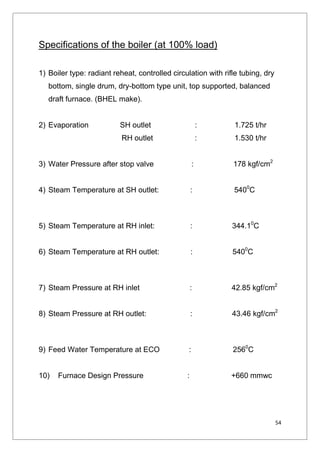
Specifications of the boiler (at 100% load)
1) Boiler type: radiant reheat, controlled circulation with rifle tubing, dry
bottom, single drum, dry-bottom type unit, top supported, balanced
draft furnace. (BHEL make).
2) Evaporation SH outlet : 1.725 t/hr
RH outlet : 1.530 t/hr
3) Water Pressure after stop valve : 178 kgf/cm2
4) Steam Temperature at SH outlet: : 5400
C
5) Steam Temperature at RH inlet: : 344.10
C
6) Steam Temperature at RH outlet: : 5400
C
7) Steam Pressure at RH inlet : 42.85 kgf/cm2
8) Steam Pressure at RH outlet: : 43.46 kgf/cm2
9) Feed Water Temperature at ECO : 2560
C
10) Furnace Design Pressure : +660 mmwc
55
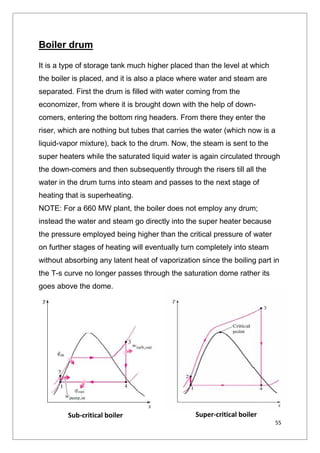
Boiler drum
It is a type of storage tank much higher placed than the level at which
the boiler is placed, and it is also a place where water and steam are
separated. First the drum is filled with water coming from the
economizer, from where it is brought down with the help of down-
comers, entering the bottom ring headers. From there they enter the
riser, which are nothing but tubes that carries the water (which now is a
liquid-vapor mixture), back to the drum. Now, the steam is sent to the
super heaters while the saturated liquid water is again circulated through
the down-comers and then subsequently through the risers till all the
water in the drum turns into steam and passes to the next stage of
heating that is superheating.
NOTE: For a 660 MW plant, the boiler does not employ any drum;
instead the water and steam go directly into the super heater because
the pressure employed being higher than the critical pressure of water
on further stages of heating will eventually turn completely into steam
without absorbing any latent heat of vaporization since the boiling part in
the T-s curve no longer passes through the saturation dome rather its
goes above the dome.
Sub-critical boiler Super-critical boiler
56
The boiler drum is of fusion-welded design with welded hemi-spherical
dished ends. It is provided with stubs for welding all the connecting
tubes i.e. down comers, risers, pipes, saturated steam outlet.
The function of steam drum internals is to separate th e
water from the steam generated in the furnace walls and to reduce the
dissolved solid contents of the steam below the prescribed limit of 1ppm
and also take care of the sudden change of steam demand for boiler.
The secondary stage of two opposed banks of closely spaced
thin corrugated sheets, which direct the steam and force the remaining
entertained water against the corrugated plates. Since the velocity is
relatively low this water does not get picked up again but runs
down the plates and off the second stage of the two steam outlets.
From the secondary separators the steam flows upwards
to the series of screen dryers, extending in layers across the length of
the drum. These screens perform the final stage of separation.
In the boiler drum, steam volume increases to 1,600 times from water
and produces tremendous force
Steam Drum Internals
57
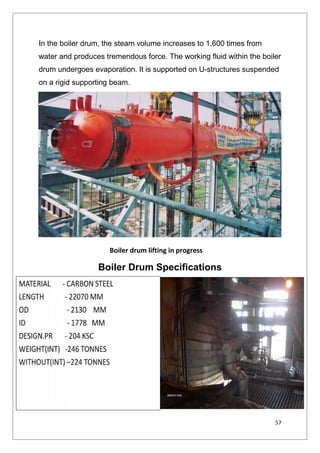
In the boiler drum, the steam volume increases to 1,600 times from
water and produces tremendous force. The working fluid within the boiler
drum undergoes evaporation. It is supported on U-structures suspended
on a rigid supporting beam.
Boiler Drum Specifications
Boiler drum lifting in progress
57
In the boiler drum, the steam volume increases to 1,600 times from
water and produces tremendous force. The working fluid within the boiler
drum undergoes evaporation. It is supported on U-structures suspended
on a rigid supporting beam.
Boiler Drum Specifications
Boiler drum lifting in progress
57
In the boiler drum, the steam volume increases to 1,600 times from
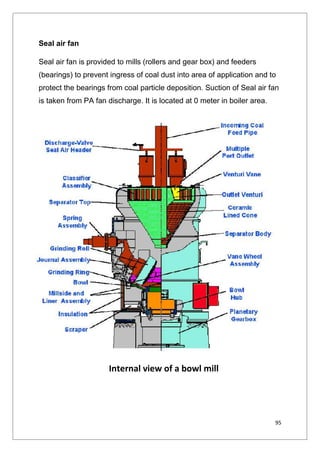
water and produces tremendous force. The working fluid within the boiler
drum undergoes evaporation. It is supported on U-structures suspended
on a rigid supporting beam.
Boiler Drum Specifications
Boiler drum lifting in progress
58
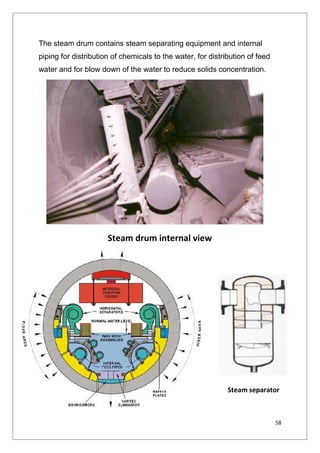
The steam drum contains steam separating equipment and internal
piping for distribution of chemicals to the water, for distribution of feed
water and for blow down of the water to reduce solids concentration.
Steam drum internal view
Steam separator
58
The steam drum contains steam separating equipment and internal
piping for distribution of chemicals to the water, for distribution of feed
water and for blow down of the water to reduce solids concentration.
Steam drum internal view
Steam separator
58
The steam drum contains steam separating equipment and internal
piping for distribution of chemicals to the water, for distribution of feed
water and for blow down of the water to reduce solids concentration.
Steam drum internal view
Steam separator
59
Once water enters the boiler or steam generator, the process of adding
the latent heat of vaporization or enthalpy is underway. The boiler
transfers energy to the water by the chemical reaction of burning some
type of fuel. The water enters the boiler through a section in the
convection pass called the economizer. From the economizer it passes
to the steam drum. Once the water enters the steam drum it goes down
the down comers to the lower inlet water wall headers. From the inlet
headers the water rises through the water walls and is eventually turned
into steam due to the heat being generated by the burners located on the front
and rear water walls (typically).As the water is turned into steam/vapor in
the water walls, the steam/vapor once again enters the steam drum.
The steam/vapor is passed through a series of steam and water
separators and then dryers inside the steam drum. The steam
separators and dryers remove the water droplets from the steam and the
cycle through the water walls is repeated. This process is known as
natural circulation. The boiler furnace auxiliary equipment includes coal
feed nozzles and igniter guns, soot blowers, water lancing and observation ports
(in the furnace walls) for observation of the furnace interior.
Furnace explosions due to any accumulation of combustible gases after
a trip out are avoided by flushing out such gases from the combustion
zone before igniting the coal. The steam drum (as well as the super
heater coils and headers) have air vents and drains needed for initial
start-up. The steam drum has an internal device that removes moisture
from the wet steam entering the drum from the steam generating tubes.
The dry steam then flows into the super heater coils.
60
Boiler Furnace
Furnace is primary part of boiler where the c h e m i c a l e n e r g y o f
f u e l i s c o n v e r t e d t o t h e r m a l e n e r g y b y
c o m b u s t i o n . F u r n a c e i s d e s i g n e d f o r e f f i c i e n t
a n d c o m p l e t e combustion. Major factors that assist for
efficient combustion are amount of fuel inside the furnace
and turbulence, which causes rapid mixing between fuel and air.
In modern boilers, water-cooled furnaces are used. In general, oil fired
furnace is employed in the boiler. Normally about 65% of furnace volume
is enough for an oil-fired boiler as compared to the corresponding P.F.
fired boiler. Oil-fired furnace is generally closed at the bottom, as
there is no need to remove slag as in case of P.F. fired boiler. The
bottom part will have small amount of slope to prevent film boiler
building in the bottom tubes. If boiler has to design for both P.F. as
well as oil, the f u r n a c e h a s t o b e d e s i g n e d f o r c o a l , a s
o t h e r wi s e h i g h e r h e a t loading with P.F. will cause
slogging and high furnace exit gas temperature.
The furnace walls are composed of tubes. The space between the tubes
is fusion welded to form a complete gas tight seal. The furnace arch is
composed of fusion welded tubes. The furnace extended side walls are
composed of fin welded tubes. The back pass front (furnace) roof is
compared of tubes peg fin welded. The spaces between the tubes and
openings are closed with fin material so a completely metallic surface is
exposed to the hot furnace gases. Poured insulation is used at each
horizontal buck stay to form a continuous band around the furnace
thereby preventing flue action of gases between the casing and water
walls. Bottom designs used in these coal fired units are of the open
hopper type, often referred to as the dry bottom type.
61
A water cooled furnace
62
Super Heaters
The steam from the boiler drum is then sent for superheating. This takes
place in three stages. In the first stage, the steam is sent to a simple
super heater, known as the low temperature super heaters (LTSH), after
which the second stage consists of several divisional panel super
heaters (DPSH) or radiant pendent super heaters (RPSH). The final
stage involves further heating in the Platen super heaters (PLSH), after
which the steam is sent through the Main Steam (MS) piping for driving
the turbine.
Superheating is done to increase the dryness fraction of the exiting
steam. This is because if the dryness fraction is low, as is the case with
saturated steam, the presence of moisture can cause corrosion of the
blades of the turbine. Super heated steam also has several merits such
as increased working capacity, ability to increase the plant efficiency,
lesser erosion and so on. It is also of interest to know that while the
super heater increases the temperature of the steam, it does not change
the pressure. There are different stages of super heaters besides the
sidewalls and extended sidewalls. The first stage consists of LTSH (low
temperature super heater), which is conventional mixed type with upper
& lower banks above the economizer assembly in rear pass. The other is
Divisional Panel Super heater which is hanging above in the first pass of
the boiler above the furnace. The third stage is the Platen Super heater
(placed above the furnace in convection path) from where the steam
goes into the HP turbine through the main steam line. The outlet
temperature & pressure of the steam coming out from the super heater
is 5400
Celsius & 157 kg/cm2
. After the HP turbine part is crossed the
steam is taken out through an outlet as CRH (Cold Re-heat steam) to be
re-heated again as HRH (Hot Re-heat steam) and then is fed to the IPT
63
(Intermediate pressure turbine) which goes directly to the LPT (Low
pressure turbine) through the IP-LP cross-over.
The enthalpy rise of steam in a given section of the super heater should
not exceed
 250 – 420 kJ/kg for High pressure. > 17 MPa
 < 280 kJ/kg for medium pressure. 7 Mpa – 17 MPa
 < 170 kJ/kg for low pressure. < 7 MPa
Convective Super heaters
64
Platen Super heaters
Pendant Super heaters
65
Super heater specifications
LTSH DPSH PSH
No. of tubes 744 432 400
Outer dia in
mm
44.5 44.5 54.0
Joining Butt Butt Butt
Max. steam
temperature
405 (H)
444 (P)
513 550
Max. gas
temperature
450 (H)
469 (P)
524 629
66
Water walls
The water from the bottom ring header is then transferred to the water
walls, where the first step in the formation of steam occurs by absorbing
heat from the hot interior of the boiler where the coal is burned
continuously. This saturated water steam mixture then enters the boiler
drum.
In a 500 MW unit, the water walls are of vertical type, and have rifled
tubing whereas in a 660 MW unit, the water walls are of spiral type till an
intermediate ring header from where it again goes up as vertical type
water walls. The advantage of the spiral wall tubes ensures an even
distribution of heat, and avoids higher thermal stresses in the water walls
by reducing the fluid temperature differences in the adjacent tubes and
thus minimizes the sagging produced in the tubes.
The above figure depicts the difference between the vertical water
wall and the spiral water wall type of tubing where the vertical water
walls have the rifle type of tubes to increase the surface area unlike
the spiral ones that have plain, smooth surfaces.
67
Heating and evaporation of feed water supplied to the boiler from the
economizers takes place within the water tubes. These are vertical tubes
connected at the top and bottom to the headers. These tubes receive
water from the boiler drum by means of down comers connected
between drum and water walls lower header. Approximately 50% of the
heat released by the combustion of the fuel in the furnace is absorbed
by the water walls.
Tangent tube The construction consists of water wall placed side by
side nearly touching each other. An envelope of thin sheet of steel called
"SKIN CASING" is placed in contact with the tubes, which provides a
seal against furnace leakage.
Membrane Water tube A number of tubes are joined by a process of
fusion welding or by means of steel strips called 'fins pressurized
furnace is possible with the related Advantages
Tangent water tube
67
Heating and evaporation of feed water supplied to the boiler from the
economizers takes place within the water tubes. These are vertical tubes
connected at the top and bottom to the headers. These tubes receive
water from the boiler drum by means of down comers connected
between drum and water walls lower header. Approximately 50% of the
heat released by the combustion of the fuel in the furnace is absorbed
by the water walls.
Tangent tube The construction consists of water wall placed side by
side nearly touching each other. An envelope of thin sheet of steel called
"SKIN CASING" is placed in contact with the tubes, which provides a
seal against furnace leakage.
Membrane Water tube A number of tubes are joined by a process of
fusion welding or by means of steel strips called 'fins pressurized
furnace is possible with the related Advantages
Tangent water tube
67
Heating and evaporation of feed water supplied to the boiler from the
economizers takes place within the water tubes. These are vertical tubes
connected at the top and bottom to the headers. These tubes receive
water from the boiler drum by means of down comers connected
between drum and water walls lower header. Approximately 50% of the
heat released by the combustion of the fuel in the furnace is absorbed
by the water walls.
Tangent tube The construction consists of water wall placed side by
side nearly touching each other. An envelope of thin sheet of steel called
"SKIN CASING" is placed in contact with the tubes, which provides a
seal against furnace leakage.
Membrane Water tube A number of tubes are joined by a process of
fusion welding or by means of steel strips called 'fins pressurized
furnace is possible with the related Advantages
Tangent water tube
68
• Increase in efficiency
• Better load response simpler combustion control.
• Quicker starting and stopping
• Increased availability of boiler.
• Heat transfer is better
• Weight is saved in refractory and structure
• Erection is made easy and quick
Down comers
There are six down comers in (500 MW) which carry water from boiler
drum to the ring header. They are installed from outside the furnace
to keep density difference for natural circulation of water & steam.
Membrane water tube
68
• Increase in efficiency
• Better load response simpler combustion control.
• Quicker starting and stopping
• Increased availability of boiler.
• Heat transfer is better
• Weight is saved in refractory and structure
• Erection is made easy and quick
Down comers
There are six down comers in (500 MW) which carry water from boiler
drum to the ring header. They are installed from outside the furnace
to keep density difference for natural circulation of water & steam.
Membrane water tube
68
• Increase in efficiency
• Better load response simpler combustion control.
• Quicker starting and stopping
• Increased availability of boiler.
• Heat transfer is better
• Weight is saved in refractory and structure
• Erection is made easy and quick
Down comers
There are six down comers in (500 MW) which carry water from boiler
drum to the ring header. They are installed from outside the furnace
to keep density difference for natural circulation of water & steam.
Membrane water tube
69
Water wall specifications
Front
Wall
Side
Wall
Rear
Wall
Roof
OD (mm) 51 51 51 57
D.thickness 5.6 5.6 5.6 6.3
Joining BUTT BUTT BUTT BUTT
Design pressure
of tube
208.8 208.8 208.8 203.7
Max. Pressure
of tube
197.8 197.8 197.8 192.7
DES.MET.TEMP 394 394 394 412
70
Safety valves
Device attached to the boiler for automatically relieving the pressure of
steam before it becomes great enough to cause bursting. The common
spring-loaded type is held closed by a spring designed to open the valve
when the internal pressure reaches a point in excess of the calculated
safe load of the boiler. Safety valves are installed on boilers according to
strict safety norms and IBR recommendation.
Boiler stop valves
A steam boiler must be fitted with a stop v a l v e ( a l s o k n o w n
a s a c r o w n v a l v e ) w h i c h i s o l a t e s t h e
s t e a m boiler and its pressure from the process or plant. It
is generally an angle pattern globe valve of the screw-down variety.
A spring loaded safety valve
70
Safety valves
Device attached to the boiler for automatically relieving the pressure of
steam before it becomes great enough to cause bursting. The common
spring-loaded type is held closed by a spring designed to open the valve
when the internal pressure reaches a point in excess of the calculated
safe load of the boiler. Safety valves are installed on boilers according to
strict safety norms and IBR recommendation.
Boiler stop valves
A steam boiler must be fitted with a stop v a l v e ( a l s o k n o w n
a s a c r o w n v a l v e ) w h i c h i s o l a t e s t h e
s t e a m boiler and its pressure from the process or plant. It
is generally an angle pattern globe valve of the screw-down variety.
A spring loaded safety valve
70
Safety valves
Device attached to the boiler for automatically relieving the pressure of
steam before it becomes great enough to cause bursting. The common
spring-loaded type is held closed by a spring designed to open the valve
when the internal pressure reaches a point in excess of the calculated
safe load of the boiler. Safety valves are installed on boilers according to
strict safety norms and IBR recommendation.
Boiler stop valves
A steam boiler must be fitted with a stop v a l v e ( a l s o k n o w n
a s a c r o w n v a l v e ) w h i c h i s o l a t e s t h e
s t e a m boiler and its pressure from the process or plant. It
is generally an angle pattern globe valve of the screw-down variety.
A spring loaded safety valve
71
The stop valve is not designed as a t h r o t t l i n g va l ve , a n d
s h o u l d b e f u l l y o p e n o r c l o s e d . I t s h o u l d always be
opened slowly to prevent any sudden rise in downstream pressure and
associated water hammer, and to help restrict the fall in boiler
pressure and any possible associated priming.
Three types of safety valves are commonly employed at NTPC Simhadri
 Electrically operated valve
 Pneumatically operated valve
 Manually operated valve
Boiler stop valve
72
Economizer
The economizer is a tube-shaped structure which contains water from
the boiler feed pump. This water is heated up by the hot flue gases
which pass through the economizer layout, which then enters the drum.
The economizer is usually placed below the second pass of the boiler,
below the Low Temperature Super heater. As the flue gases are being
constantly produced due to the combustion of coal, the water in the
economizer is being continuously being heated up, resulting in the
formation of steam to a partial extent. Economizer tubes are supported
in such a way that sagging, deflection & expansion will not occur at any
condition of operation. In other words, Boiler Economizers are feed-
water heaters in which the heat from waste gases is recovered to raise
the temperature of feed-water supplied to the boiler. It reduces the
exhaust gas temperature and saves the fuel. Modern power plants use
steel-tube-type economizers. It is divided into several sections of 0.6 –
0.8 m gap.
An Economizer
73
6o
C raise in feed water temperature by the economizer corresponds to a
1% saving in fuel consumption. 220
C reduction in flue gas temperature
increases the boiler efficiency by 1%.
Location and arrangement
 Ahead of air-heaters
 Following the primary super-heater or re-heater
 Counter-flow arrangement
 Horizontal placement (to facilitate draining)
 Stop valve and non-return valve incorporated to ensure
recirculation in case of no feed-flow
Plain tube: Several banks of tubes with either-in-line or staggered
type formation which induces more turbulence than the in-line
arrangement. This gives a higher rate of heat transfer and requires
less surface but at the expense of higher draught loss.
74
Welded Fin- tube: Fin welded design is used for improving the heat
transfer.
Feed pipe: Any pipe or connected fitting wholly or partly under pressure
through which feed water passes directly to a Boiler and which does not
form an integral part thereof.
Steam pipe: Any pipe through which steam passes from a Boiler to a
prime mover or other user or both, if the pressure at which steam passes
through such pipe exceeds 3. 5 Kilograms per square centimeter above
atmospheric pressure or such pipe exceeds 254 millimeters in internal
diameter.
Economizer Specifications
Material Carbon steel
SA210 GRA1
No. of coils 184
Outer diameter of tubes (in mm) 38.1
Actual thickness 5.3
Des.pr of tubes 217.8
Des.pr of headers 219.7
Fin welded design
74
Welded Fin- tube: Fin welded design is used for improving the heat
transfer.
Feed pipe: Any pipe or connected fitting wholly or partly under pressure
through which feed water passes directly to a Boiler and which does not
form an integral part thereof.
Steam pipe: Any pipe through which steam passes from a Boiler to a
prime mover or other user or both, if the pressure at which steam passes
through such pipe exceeds 3. 5 Kilograms per square centimeter above
atmospheric pressure or such pipe exceeds 254 millimeters in internal
diameter.
Economizer Specifications
Material Carbon steel
SA210 GRA1
No. of coils 184
Outer diameter of tubes (in mm) 38.1
Actual thickness 5.3
Des.pr of tubes 217.8
Des.pr of headers 219.7
Fin welded design
74
Welded Fin- tube: Fin welded design is used for improving the heat
transfer.
Feed pipe: Any pipe or connected fitting wholly or partly under pressure
through which feed water passes directly to a Boiler and which does not
form an integral part thereof.
Steam pipe: Any pipe through which steam passes from a Boiler to a
prime mover or other user or both, if the pressure at which steam passes
through such pipe exceeds 3. 5 Kilograms per square centimeter above
atmospheric pressure or such pipe exceeds 254 millimeters in internal
diameter.
Economizer Specifications
Material Carbon steel
SA210 GRA1
No. of coils 184
Outer diameter of tubes (in mm) 38.1
Actual thickness 5.3
Des.pr of tubes 217.8
Des.pr of headers 219.7
Fin welded design
75
Deaerator
A deaerator is a device that is widely used for the removal of air and
other dissolved gases from the feed water to steam-generating boilers.
In particular, dissolved oxygen in boiler feed water will cause serious
corrosion damage in steam systems by attaching to the walls of metal
piping and other metallic equipment and forming oxides (rust). Water
also combines with any dissolved carbon dioxide to form carbonic acid
that causes further corrosion. Most deaerators are designed to remove
oxygen down to levels of 7 ppb by weight (0.005 cm³/L) or less.
There are two basic types of deaerators, the tray-type and the spray-
type:
 The tray-type (also called the cascade-type) includes a vertical
domed deaeration section mounted on top of a horizontal
cylindrical vessel which serves as the deaerated boiler feed water
storage tank.
 The spray-type consists only of a horizontal (or vertical) cylindrical
vessel which serves as both the deaeration section and the boiler
feed water storage tank.
76
Re heater
Purpose: to re-heat the steam from HP turbine to 5400
C
It is composed of three sections:
 radiant wall re heater arranged in front & side water walls
 rear pendant section arranged above goose neck
 front section arranged between upper heater platen & rear water
wall hanger tubes
The arrangement and construction of a re-heater is similar to that of a
super-heater. In large modern boiler plant, the reheat sections are mixed
equally with super-heater sections. The pressure drop inside re-heater
tubes has an important adverse effect on the efficiency of turbine.
Pressure drop through the re-heater should be kept as low as possible.
The tube diameter is to be kept between 42 – 60mm. Its design is similar
to convective super-heaters. The Overall Heat Transfer Coefficient lies
between 90 – 110 W/m2
K. Reheating is another method of increasing
the cycle efficiency.
Re heater specifications
Max. operating pressure in kgf/cm2
46.7
Design pressure in kgf/cm2
52.4
Max. steam temperature in 0
C 540
Max. gas side mean temp in 0
C 593
Outer diameter (in mm) 54.0
Total no. of tubes 888
Joining butt
77
Coal system: Coal burners
Coal burners comprise of a coal nozzle, steel tip, seal plate and tilting
link mechanism, housed in coal compartment in all four corners of the
furnace and connected with coal pipes. One end (outlet) is rectangular
and another end is cylindrical. The burner can be tilted on a pivot pin.
The angle of tilt for the burner is about -300
to +300
. The nozzle tip has
separate coal and air passages. Coal and air passages are divided into
several parts. Each boiler of one unit consists of eight pulverized coal
burners. The pulverized coal is mixed with primary air flow which carries
the coal mixture to each of the four corners of the furnace burner
nozzles and into the furnace. Coal is pulverized to achieve optimum
efficiency.
Coal burners
78
Fuel- Oil system
Purpose:
(a) To establish initial boiler light up.
(b) To support the furnace flame during low load operation up to 15%
MCR load.
The Fuel oil system consists of
 Fuel oil Pumps
 Oil heaters
 Filters
 Steam tracing lines
The main objective is to get filtered oil at correct pressure and
temperature.
The Fuel Oil system prepares any of the two designated fuel oil for use
in oil burners (16 per boiler, 4 per elevation) to establish the above two
stated purposes. To achieve this, the system incorporates fuel oil
pumps, oil heaters, and filters, steam tracing lines which together ensure
that the fuel oil is progressively filtered, raised in temperature, raised in
pressure and delivered to the oil burners at the requisite atomizing
viscosity for optimum efficiency in the furnace.
Both the oil and coal burner nozzles fire at a tangent to an imaginary
circle at the furnace centre. The turbulent swirling action thus produces,
promotes the necessary mixing of the fuels and air to ensure complete
combustion of the fuel. A vertical tilt facility of the burner nozzles, which
is controlled by the automatic control system of the boiler, ensures
constant reheat outlet steam temperature at varying boiler loads.
79
In the tangential firing system the furnace itself constitutes the burner.
Fuel and air are introduced through the furnace through four wind box
assemblies located in the furnace corners. The fuel and air streams from
the wind box nozzles are directed to a firing circle in the centre of the
furnace. The rotative or cyclonic action that is the characteristic of this
type of firing is most effective in turbulently mixing the burning fuel in a
constantly changing air and gas atmosphere.
Oil burners:
Design Considerations
• Atomization of oil
• Properly shaped jet
• Complete combustion
• Excess air should be minimum
• Ready accessibility for repairs
Tangential Firing in a boiler furnace
80
The three main oils used in the oil burners are:
a) Light Diesel Oil
b) Heavy fuel oil
c) Low sulphur heavy stock (LSHS).
Heavy oil guns are used for stabilizing flame at low load carrying. Warm
up oil guns are used for cold boiler warm up during cold start up and
igniters are used for start up and oil flame stabilizing.
Operating Principle (Atomization):
Atomization breaks the fuel into fine particles that readily mixes with the
air for combustion. Oil should be divided up into small particles for
effective atomization.
The advantages of atomization are:
a) Atomizing burners can be used with heavier grades of oil.
b) Can be adopted to large applications because of its large capacity
range.
c) Complete combustion is assured by the ability of the small particles to
penetrate in turbulent combustion.
Atomization of fuel oil is done by means of oil guns.
Oil burners are classified according to the method used for atomization,
as follows:
a) Air-atomized burners
b) Steam-atomized burners
c) Mechanically atomized burners
81
Air atomizing systems are not recommended for heavy oil system as
they tend to chill the oil and decrease atomization quality.
Steam atomization system uses auxiliary steam to assist in the
atomization of the oil. The steam used in this method should be slightly
superheated and free from moisture. As in the case of air atomizing
system, the steam here is used for both atomizing as well as heating the
fuel as it pass through the tip and into the furnace. The main advantages
of steam atomizing burners over other are:
a) Simplicity of its design
b) Initial cost of installation is low
c) Low pumping pressure
d) Low preheating temperature.
HFO being a highly viscous fluid is atomized using auxiliary steam. Upon
passing hot steam, the temperature of HFO increases, this decreases
the viscosity of HFO and hence the oil can be freely transported from the
oil sump to the boiler furnace. This process is known as Steam Tracing.
82
Wind box assembly
The fuel firing equipment consists of four wind box assemblies located in
the furnace corners. Each wind box assembly is divided in its height into
a number of sections or compartments. The coal components (fuel air
compartment) contain air (intermediate air compartments). Combustion
air (secondary air) is admitted to the intermediate air compartments and
each fuel compartment (around the fuel nozzle) through sets of lower
dampers. Each set of dampers is operated by a damper drive cylinder
located at the side of the wind box. The drive cylinder at each elevation
(25 m to 35 m) are operated either remote manually or automatically by
the secondary air damper control system. Some of the (auxiliary) air
components between coal nozzles contain oil guns. Retractable High
Energy Arc (HEA) igniters are located adjacent to the retractable oil
guns. These igniters directly light up the oil guns.
Wind box Arrangement
83
All auxiliary air dampers regulate the wind box to furnace DP as per the
set point which is generated with respect to Boiler Load Index. All fuel air
dampers regulate in proportion to the fuel firing rate. Oil dampers are
used to maintain a rich mixture of air/oil at the time of Oil Firing. Over fire
dampers are used to reduce SOx & NOx percentage.
The function of the wind box component dampers is to proportion the
amount of secondary air admitted to an elevation pf fuel components in
relation to that admitted to adjacent elevation of auxiliary air components
Wind box Arrangement
84
An overview of Firing System
85
Coal bunkers and Feeders
Coal Bunker: These are in process storage silos used for storing
crushed coal from the coal handling system. Generally,
these are made up of welded steel plates. Normally, there are six such
bunkers supplying coal of the corresponding mills. These are located on
top of the mills so as to aid in gravity feeding of coal.
Coal Feeder: Coal feeders are used to regulate the flow of coal from
bunker to the pulverizer. Each mill is provided with a drag link
chain/ rotary/ gravimetric feeder to transport raw coal from
the bunker to the inlet chute, leading to mill at a desired rate.
There are principally three types of feeders namely:
 Chain Feeder
 Belt Feeder or gravimetric feeder
 Table type belt Feeder
NTPC Simhadri employs gravimetric pulverizer to feed the Coal from
Bunker to Pulverizer as per requirement. It comprises of a leveling bar to
check the level of coal in the bunker. It uses a specialized belt conveyer
whose belt speed can be varied as per the requirement. The amount of
Coal entry is controlled by the speed of the drive pulley. The drive pulley
is connected through the motor with variable speed drive. Either a DC
Motor or a Motor with Magnetic clutch is used.
Gravimetric feeder
86

Gravimetric Feeder
Bunker and feeder
arrangement
Gravimetric Feeder used in NTPC Simhadri
87
Coal mills (Pulverizers)
As the name suggests the coal particles are grinded into finer sized
granules. The coal which is stored in the bunker is sent into the mill,
through the conveyor belt which primarily controls the amount of coal
required to be sent to the furnace. It on reaching a rotating bowl in the
bottom encounters three grinding rolls which grinds it into fine powder
form of approx. 200 meshes per square inch. the fine coal powder along
with the heated air from the FD and PA fan is carried into the burner as
pulverized coal while the trash particles are rejected through a reject
system.
Types of coal pulverizers include:
 Impact
 Attrition
 Crushing
Sometimes these pulverizers employ all the three techniques all
together.
XRP
(BHEL)
E MILLS
(BABCOCK)
MPS
BOWL/
BALL & RACE
VERTICAL SPINDLE
PRESSURIZED
TUBE
CLASSIFICATION OF MILLS
88
Classification as per speed
The plant uses high speed bowl mills for crushing the coal.
Necessity of pulverizing the coal: The economic motives for the
introduction and development of pulverized fuel firing are:
i) Efficient utilization of cheaper low grade coals.
ii) Flexibility in firing with ability to meet fluctuating loads.
iii) Elimination of breaking losses.
iv) Better response to automatic control.
v) Ability to use high combustion air temperature for increasing the
overall efficiency of boiler.
vi) High availability.
v) Ability to burn a wide variety of coals.
Operating principle: The coal is to be ground is fed into the mill at or
near the centre of the revolving bowl. It passes between the grinding ring
in the revolving bowl and rolls as centrifugal force causes the material to
travel towards the outer perimeter of the bowl. The springs, which load
the rolls, impart the pressure necessary for grinding. The partially
pulverized coal continues up over the edge of the bowl.
88
Classification as per speed
The plant uses high speed bowl mills for crushing the coal.
Necessity of pulverizing the coal: The economic motives for the
introduction and development of pulverized fuel firing are:
i) Efficient utilization of cheaper low grade coals.
ii) Flexibility in firing with ability to meet fluctuating loads.
iii) Elimination of breaking losses.
iv) Better response to automatic control.
v) Ability to use high combustion air temperature for increasing the
overall efficiency of boiler.
vi) High availability.
v) Ability to burn a wide variety of coals.
Operating principle: The coal is to be ground is fed into the mill at or
near the centre of the revolving bowl. It passes between the grinding ring
in the revolving bowl and rolls as centrifugal force causes the material to
travel towards the outer perimeter of the bowl. The springs, which load
the rolls, impart the pressure necessary for grinding. The partially
pulverized coal continues up over the edge of the bowl.
88
Classification as per speed
The plant uses high speed bowl mills for crushing the coal.
Necessity of pulverizing the coal: The economic motives for the
introduction and development of pulverized fuel firing are:
i) Efficient utilization of cheaper low grade coals.
ii) Flexibility in firing with ability to meet fluctuating loads.
iii) Elimination of breaking losses.
iv) Better response to automatic control.
v) Ability to use high combustion air temperature for increasing the
overall efficiency of boiler.
vi) High availability.
v) Ability to burn a wide variety of coals.
Operating principle: The coal is to be ground is fed into the mill at or
near the centre of the revolving bowl. It passes between the grinding ring
in the revolving bowl and rolls as centrifugal force causes the material to
travel towards the outer perimeter of the bowl. The springs, which load
the rolls, impart the pressure necessary for grinding. The partially
pulverized coal continues up over the edge of the bowl.
89
Hot air enters the mill side housing below the bowl, is directed upward
past the bowl, into the deflector liners, then upward again into the
deflector openings at the top of the inner cone, then out through the
venturi and multiple port outlet assembly. As the air passes upward
around the bowl it picks up the partially pulverized coal. The lighter
particles are carried up through the deflector openings. The deflector
blades in the openings impart a spinning action to the material with the
degree of spin, set by the angle of opening of the blades, determining
the size of the finished product. Any oversize material is returned down
the inside of the inner cone to the bowl for additional grinding. When
pulverized to the desired extent, the pulverized fuel air mixture leaves
the mill and enters the piping system. Either constant airflow or variable
airflow methods are adopted. Any tramp iron or dense, difficult to grind
foreign material in the feed, if carried over the top of the bowl it drops out
through the air steam to the lower part of the mill side housing. Pivoted
scrapers attached to the bowl hub sweep the tramp iron or other material
around to the tramp iron discharge spout. The tramp iron spout is fitted
with a valve. Under normal operation, this valve remains open and
material is discharged into a sealed pyrite hopper. The valve is closed
only while the hopper is being emptied. Excessive spillage of coal with
rejects indicates that a mill is not functioning properly and remedial steps
should be taken as soon as possible to correct the situation. Normally
the causes for excessive spillage are a) Over feeding b) Too low a
journal spring pressure c) Too low airflow d) Too low a mill outlet
temperature e) excessively worn out grinding elements or improper mill
setting. The pulverizer operates under positive pressure, except the
suction mills. Seal air system provides clean air to a Chamber
surrounding seal and seal chamber to prevent hot air and coal dust from
escaping to the atmosphere or contaminating the gear bore lube oil.
90
Seal air is also supplied to each roller journal trunnion shaft to prevent
coal dust from entering the roller journal bearings.
Factors affecting the performance of the mill:
1. Size of the raw coal
2. Raw coal grind ability
3. Raw coal moisture content
4. Pulverized fuel fineness
5. Mill wear
6. Percentage ash in raw coal
The Bowl Mill is one of the most advanced designs of coal pulveriser
presently manufactured by BHEL. It possesses the following
advantages:
i) Low Power consumption.
ii) Reliability.
iii) Minimum maintenance and time required.
iv) Wide capacity with good turndown ratio
v) Ability to handle wide range of coals
vi) Quite and vibration less operation.
Design considerations:
a) Air temperatures up to 400 ° C can be used in these mills enabling the
mills to efficiently dry, grind and classify high moisture coals.
b) Expected wear surfaces are lined with removable type wear resisting
plates/ liners. Suitable access doors are available for easy replacement.
c) Undesirable foreign materials/ difficult to ground materials from coal
fall out and removed through tramp iron spout. This greatly reduces the
possibility of damage to mill parts.
d) Mill output can be raised from minimum to maximum in small
increments depending on boiler needs by varying the output of the
feeder and mill is sensitive to these variations in load. In order to obtain
91
rated capacity of the mill, it is necessary to have sufficient hot air
entering the mill to dry the coal and classifier deflector vanes set so as to
obtain the required fineness reasonably close to the value for which the
mills are designed.
e) Some size of mills is provided with built in lubrication system and
some size of mills with external lube oil system. However for all sizes of
mills the water cooler is fixed in the gear case, except for the HP series
of mills, where the cooler is also external. The journal bearings are
lubricated by oil filled in through the hole in the shaft. The oil level and
quality in the sump is to be maintained within the specified limits.
f) Sufficient journal spring pressure with not more than 0.5-mm clearance
between spring assembly head and journal head must be there to
achieve rated capacity at the required fineness. Because of space
limitation double coil springs are used, inner coil carrying approximately
25% of the total load, while the outer coil carries 75% of load. The
springs are wound in opposite direction to prevent possible interlocking
of the coils. Ring-roll clearances for efficient operation are obtained by
adjusting the stop bolts. If proper compression and ring-roll clearances
are not set, mill capacity reduces and the coal spillage increases.
g) Trunnion shaft supporting the journal assembly is mounted on
Trunnion shaft bushings. Rubber is bonded in between the two
concentric metal bearings and is capable of accommodating oscillating
motions, vibration etc. without wear or lubrication. Worm gear drive is
selected for bowl mills.
Bowl mill designation:
Suction type mills are designated as XRS whereas pressurized mills as
XRP and HP.
The nomenclature of each letter is as follows:
X - Frequency of power supply (50 cycles /sec)
92
R - Raymond, the inventor of bowl mills.
S - Suction type with exhauster coming after the mill
P - Pressurized type, with primary air fan coming before the mill.
H - High Performance mills.
The size of the mill is designated by the three numericals that follow the
above. For example, XRP 803 means, it is a Raymond Pressurized Bowl
Mill having the nominal bowl diameter of 80 inches with three numbers of
rollers grinding assemblies.
Constructional features:
a. Mill Drive and Bowl Assembly :
Mill Drive and Bowl Assembly consist of the main vertical shaft assembly
with Bearings, Worm gear, Worm shaft, Worm shat bearing etc.
Lubricant is maintained to the level of the centre line of the worm gear in
the Mill base. This lubricates the Bearings and Worm Gear- Worm shaft
in the Mill Base, when the Mill is in operation. The Bowl Assembly
consists of Bull Ring Assembly (Mounted on the Bowl), Skirt Scrapper
Assembly and vane wheel assembly (Attached to the Bowl). In
conventional design mills the fixed air guide vanes are provided in place
of rotating vane wheel assembly.
b. Mill Side and Liner Assembly :
The Hot Primary Air required for drying and carrying pulverized coal
enters the Mill, in the Mill side and air inlet housing. The Mill side and
Liner Assembly are insulated to prevent heat loss from primary air to the
atmosphere, or to the gearbox.
c. Separator Body Assembly :
The Separator body assembly consists of Journal Pressure Spring
Assemblies. Classifier Assembly and Deflector, Intermediate and Journal
Frame Liner Assemblies of Vane Wheel Assembly OR Separator body
93
liner separator bottom liners and air guide vanes of the conventional
design.
d. Roller Journal Assembly :
The Roller Assembly consists of Journal Shaft, Journal Bearings,
Journal Housings, Grinding Roll and Journal Head and Trunnion Shaft
Assembly and Vane Wheel Liners for Journal Head and Upper Journal
Housing. Three roller assemblies are there in a mill. Lub oil in the
Journal Assembly provides Stand Oil Lubrication for the bearings.
e. Mill Discharge Valve Assembly :
The Mill Discharge Valve Assemblies consists of four Multiport Outlet
and Mill Discharge Valves mounted on the multiple port outlet plate. Air
Cylinders operate the flaps in the Mill Discharge Valves. Solenoid Valves
and Limit Switches are provided to effect and indicate the open or close
position of the flap.
f. Coupling :
The Mill and Motor are coupled together by a flexible coupling. (Gear
Type or Bibby Type) for effecting the transmission from the motor to the
Mill. This type of coupling is also known as resilient coupling.
g. Tramp Iron Spout Assembly :
The Tramp Iron Spout Assembly consists of Tramp Iron Spout Body.
Tramp Iron Spout Adapter and Valve Gate. This assembly is mounted on
Mill base to guide the rejects from the Mill side and Liner Assembly to
pyrite Hopper assembly.
h. Pyrite Hopper Assembly :
The Pyrite Hopper Assembly consists of Pyrite Hopper Body and an
outlet valve, which is manually operated. The Pyrite Hopper Body will be
mounted with Tramp Iron spout Assembly. Using the outlet valve, the
rejects can be removed from Pyrite Hopper through a conveyor or wheel
barrow for every half an hour of mill operation. In a pressurized mill
94
before opening the Flap valve of Pyrite Hopper, the Tramp Iron Valve
should be closed to prevent hot primary air leaking into the atmosphere.
Specification of bowl mill:
Capacity 66.3T/Hr
Pulverizer Speed 600 RPM
Power 525 KW
Rolls 3
Coal 55 HGI, 14% Moisture
Fineness 70% thru 200 Mesh
Principle features of bowl mill:
 Grinding chamber
 Classifier mounted above it
 Pulverization takes place in rotating bowl
 Rolls rotating free on journal do the crushing
 Heavy springs provide the pressure between the coal and the rolls
 Rolls do not touch the grinding rings
 Tramp iron and foreign material discharged.
Internal and external features of a bowl mill
95
Seal air fan
Seal air fan is provided to mills (rollers and gear box) and feeders
(bearings) to prevent ingress of coal dust into area of application and to
protect the bearings from coal particle deposition. Suction of Seal air fan
is taken from PA fan discharge. It is located at 0 meter in boiler area.
Internal view of a bowl mill
96
Air System
The mill produces Pulverized coal 80% of which passes through 200
mesh. Primary air mixed with Pulverized coal (PF) is carried to the coal
nozzle in the wind box assembly. PF from coal nozzle is directed
towards the centre of boiler burning zone. Pre-heated secondary air
enters boiler and surrounds the PF and help in combustion. The primary
air is supplied by Primary Air (PA) fan and the secondary air is supplied
by Forced Draft (FD) fan. Also to dispose the flue gases into the
atmosphere and to maintain a negative pressure, for combustion, within
the boiler furnace an Induced Draft (ID) fan is employed. A fan is
capable of imparting energy to the air/gas in the form of a boost
in pressure. The boost is dependent on density for a given fan at
a given speed. The higher the temperature, the lower is
the boost. Fan performance (Max. capability) is represented as volume
vs. pressure boost.
The basic information needed to select a fan is:
 Air or Gas flow (Kg/hr).
 Density (function of temperature and pressure).
 System, resistance (losses).
Classification of Fans
In boiler practice, we meet the following types of fans.
 Axial fans: In this type the movement of air or gas is
parallel to its exit of rotation. These fans are better suited to
low resistance applications. Th e a xi a l f l o w f a n u s e s t h e
s c r e w l i k e a c t i o n o f a m u l t i p l i e d rotating shaft, or
propeller, to move air or gas in a straight through path. Here both
97
the axes inlet air and outlet air flow are parallel to the axis of the
fan.
 Centrifugal (Radial) fans: This fan moves gas or air perpendicular
to the axis of rotation. There are advantages when the
air must be moved in a system where the frictional resistance is
relatively high. Th e b l a d e wh e e l wh i r l s a i r
c e n t r i f u g a l l y b e t we e n e a c h p a i r o f blades and forces it
out peripherally at high velocity and high static pressure. More air
is sucked in at the eye of the impeller. As the air leaves the
revolving blade tips, part of its velocity is converted into additional
static pressure by scroll shaped housing. Here the axis of the inlet
air is parallel to the fan axis and that of the outlet air is
perpendicular to the fan axis.
Axial fan
Radial fan
98
Classification of blades
There are three types of blades:
 Backward curved blades.
 Forward curved blades.
 Radial blades.
Fans used in Thermal Power Plant
Usually, there are three fans used in any thermal power plant. They are:
1. Induced draught fan: The induced Draft Fans are generally of Axial -
Impulse Type. Impeller nominal diameter is of the order of 2500 mm.
The fan consists of the following sub-assemblies:
 Suction Chamber or housing
 Inlet Vane Control or Inlet dampers
 rotor with two sleeve bearings
 Outlet Guide Vane Assembly
 Shaft seal
There are two induced draught fans per boiler, both operating. In 500
MW fans are single-stage, double-inlet centrifugal fans (NDVZ type). The
outlet guides are fixed in between the case of the diffuser and the
casing. These guide vanes serve to direct the flow axially and to
stabilize the draft-flow caused in the impeller. These outlet blades
are removable type from outside. During operation of the fan
itself these blades can be replaced one by one. Periodically, the outlet
blades can be removed one at a time to find out the extent of wear on
the blade. If excessive wear is noticed the blade can be replaced by a
new blade. The inlet dampers can be adjusted externally. The rotor
consists of a hollow shaft with an impeller joined by means of a flange.
The fan housing is sealed at the shaft passage to the outside by means
of labyrinth seals. The rotor is placed between oil-lubricated sleeve
99
bearings. The fan is adapted to ten changing operating conditions by
varying the speed of the fan and also by adjustable inlet dampers
arranged in the front of the impeller on either side. The main purpose of
an ID fan is to suck the flue gas through all the above mentioned
equipments and to maintain the furnace pressure. ID fans use 1.41% of
plant load for a 500 MW plant. It also maintains the furnace draft.
ID fan specifications
Fan type: NDZV 47 S No. of boilers: Two
Medium: Flue Gas Temperature: 150°c
Capacity: 587m3
/s Total head: 490mmwc
Density: 0.793 kg/m3 Speed: 545 rpm
Coupling: REYNOLDS Fan Regulation: VFD & IGV
Motor Rating: 4000 kW
An ID fan
100
ID fan designation
NDZV 47 S
Here NDZV implies Radial Double Suction simply supported
47 implies Impeller Tip diameter in decimeter
S implies Type of Impeller
2. Forced draught (FD) fan: There are two FD fans per boiler. The fan,
normally of the same type as ID Fan, consists of the
following components:
 Suction bend
 Inlet housing
 Fan housing
 Main bearings (anti-friction bearings)
 Impeller with adjustable blades and pitch control mechanism
 Guide vane casing with guide vanes
 Diffuser.
The centrifugal and setting forces of the blades are taken up by
the blade bearings. The blade shafts are placed in combined radial and
axial antifriction bearings which are sealed off to the outside. The angle
of-incidence of the blades may be adjusted during operation. Th e
c h a r a c t e r i s t i c p r e s s u r e vo l u m e c u r ve s o f t h e f a n m a y
b e c h a n g e d i n a l a r g e r a n g e w i t h o u t e s s e n t i a l l y
m o d i f y i n g t h e e f f i c i e n c y . T h e f a n c a n t h e n b e
e a s i l y a d a p t e d t o c h a n g i n g operating conditions.
An FD fan
101
The rotor is accommodated in cylindrical roller bearings and an
inclined ball bearing at the drive side adsorbs the axial thrust. An oil-
hydraulic servo motor (also known as a power cylinder) flanged to the
impeller and rotating with it adjusts the blades during operation
lubrication and cooling these bearings is assured by a combined
oil level and circulating lubrication system. Turbine oil with a viscosity of
61.2 – 74.8 mm2
/sec at 400
C is employed.
FD fan Specifications
Fan type: AP1-26/16 No. of boilers: Two
Medium: Atmospheric Air Capacity: 267m3/s
Total head: 410mmwc Density: 1.060 kg/ m3
Speed: 980 rpm Coupling: Spacer Type
Fan regulation: Blade Pitch Control Motor rating: 1430 kW
Volts: 3300 volt
102
The forced draft fans, also known as the secondary air fans are used to
provide the secondary air required for combustion, and to maintain the
wind box differential pressure. The features of the FD fans are: axial
flow, single stage, impulse fan. FD fans use 0.36% of plant load for a
500 MW plant.
FD fan designation:
The model no. of the FD fan used at NTPC Simhadri is AP1 26/16,
where A refers to the fact that it is an axial flow fan, P refers to the fan
being progressive, 1 refers to the fan involving a single stage, and the
numbers 26 and 16 refer to the distances in decimeters from the centre
of the shaft to the tip of the impeller and the base of the impeller,
respectively. Similar designation is followed for PA fans.
3. Primary air (PA) fan: There are two primary air fans per boiler. The fan
consists of the following components:
 Suction bend
 Fan housing with guide vanes (stage 1)
 Main bearings (anti-friction bearings)
103
 Rotor, consisting of shaft, impellers with adjustable blades and
pitch control mechanism.
 Guide vane housing with guide vanes.
 Diffuser
On its impeller side, the suction bend is designed as an inlet nozzle.
Guide vanes of axial flow type are installed in the fan and guide vane
housings, in order to guide the flow. Suction bend and diffuser are
connected to the fan housing via expansion joints. The fan is driven from
the inlet side.
The centrifugal and setting forces of the blades are taken up by
the blade bearings. The blade shafts are placed in combined radial and
axial antifriction bearings which are sealed off to the outside. The angle
of-incidence of the blades may be adjusted during operation.
The rotor is accommodated in cylindrical roller bearings and an
inclined ball bearing at the drive side adsorbs the axial thrust. An oil-
hydraulic servo motor (also known as a power cylinder) flanged to the
impeller and rotating with it adjusts the blades during operation
Lubrication and cooling these bearings is assured by a combined
oil level and circulating lubrication system. Turbine oil with a viscosity of
61.2 – 74.8 mm2
/sec at 400
C is employed.
PA fan has a flange mounted design, single stage suction, NDFV
type, backward curved bladed radial fan and operates on the principle of
energy transformation due to centrifugal forces. Some amount of
the velocity energy is converted to pressure energy in the spiral
c a s i n g . T h e f a n i s d r i v e n a t a c o n s t a n t s p e e d
a n d t h e f l o w i s controlled by varying the angle of the inlet vane
control. The special feature of the fan is that is provided with inlet
guide vane control with a positive and precise link mechanism. The
primary air fans are used to carry the pulverized coal particles from the
104
mills to the boiler. They are also used to maintain the coal-air
temperature. The specifications of the PA fan used at the plant under
investigation are: axial flow, double stage, reaction fan. A PA fan uses
0.72% of plant load for a 500 MW plant.
PA fan Specifications
Fan type: AP2-20/12 No. of boiler: Two
Medium: Atmospheric Air Capacity: 186m3
/s
Total head: 1195mmwc Density: 1.060 kg/ m3
Speed: 1480 rpm Coupling: Spacer Type
Fan regulation: Blade Pitch Control Motor rating: 2800 kW
Volts: 11000 volt
A PA fan
105
Air Pre heater
Air pre heater absorbs waste heat from the flue gases and transfers
this heat to incoming cold air, by means of continuously
rotating heat transfer element of specially formed metal plates.
Thousands of these high efficiency elements are spaced and
compactly arranged within 12 sections. Sloped compartments of
radially divided cylindrical shell called the rotor. The housing
surrounding the rotor is provided with duct connecting both the
ends and is adequately scaled by radial and circumferential
scaling.
Air pre heaters can further be classified as:
 Primary air pre heater (size: 27.5)
 Secondary air pre heater (size: 30)
Location and Functioning of an air pre heater
106
Air pre heater is a general term to describe any device designed to heat
air before another process (for example combustion in a boiler). It is a
heat transfer surface in which air temperature is raised by transferring
heat from other medium such as flue gas. The purpose of the air pre
heater is to recover the heat from the flue gas from the boiler to improve
boiler efficiency by burning fuel with warm air which increases
combustion efficiency, and reduces useful heat lost from the flue. As a
consequence, the gases are sent to the chimney or stack at a lower
temperature (to meet emission norms, for example) allowing simplified
design of the ducting and stack.
APH is the last heat exchanger in the boiler flue gas circuit. To achieve
maximum boiler efficiency maximum possible useful heat must be
removed from the gas before it leaves the APH. However certain
minimum temperature has to be maintained in the flue gas to prevent
cold end corrosion.
Functions:
An air pre-heater heats the combustion air where it is economically
feasible. These are used for pre-heating the primary and secondary air
before entering the furnace.
The pre-heating helps the following:
 Igniting the fuel.
 Improving combustion.
 Drying the pulverized coal in pulverizer.
 Reducing the stack gas temperature and increasing
 The boiler efficiency.
Advantages:
1. Increase in boiler efficiency.
2. Stability of combustion increases by use of hot air.
107
3. Intensify and improved combustion. Intensified combustion permits
faster load variation and fluctuation.
4. Permitting to burn poor quality of coal.
5. High heat transfer rate in the furnace and hence lesser heat
transfer area requirement.
6. Less un burnt fuel particle in flue gas thus combustion and both
efficiency is improved.
In the case of pulverised coal combustion, hot air can be used for
heating the coal as well as for transporting the pulverised coal to
burners. This being a non-pressure part will not warrant shutdown of unit
due to corrosion of heat transfer surface which is inherent with lowering
of flue gas temperature.
Types:
1. Recuperative type
a. Tubular air heater
b. Plate type air heater
2. Regenerative type
a. Ljungstrom type
b. Rothemuhle type
The APH used at NTPC Simhadri is a Ljungstrom regenerative type
APH.
Construction:
Air Pre heater consists of:
 Connecting plates
 Housing
 Rotor
 Heating surface elements
108
 Bearings
 Sector plates and Sealing arrangement
In this design, the whole air pre heater casing is supported on the boiler
supporting structure itself with necessary expansion joints in the ducting.
The vertical rotor is supported on thrust bearings at the lower end and
has oil bath lubrication. Oil in bath is cooled by water circulating in coils
inside a cooler. The top end of the rotor has a simple roller bearing to
hold the shaft in a vertical position.
The rotor is built up on the vertical shaft with radial supports and cages
for holding the baskets in position. Radial and circumferential seal plates
are also provided to avoid leakages of gases or air between the sectors
or between the duct and the casing while in rotation. Air pre heater
baskets elements are made up of zigzag corrugated plates pressed into
a steel basket giving sufficient annular space in between for the gas to
pass through. These plates are corrugated to give more surface area per
Guide Bearing Assembly Support Bearing Assembly
108
 Bearings
 Sector plates and Sealing arrangement
In this design, the whole air pre heater casing is supported on the boiler
supporting structure itself with necessary expansion joints in the ducting.
The vertical rotor is supported on thrust bearings at the lower end and
has oil bath lubrication. Oil in bath is cooled by water circulating in coils
inside a cooler. The top end of the rotor has a simple roller bearing to
hold the shaft in a vertical position.
The rotor is built up on the vertical shaft with radial supports and cages
for holding the baskets in position. Radial and circumferential seal plates
are also provided to avoid leakages of gases or air between the sectors
or between the duct and the casing while in rotation. Air pre heater
baskets elements are made up of zigzag corrugated plates pressed into
a steel basket giving sufficient annular space in between for the gas to
pass through. These plates are corrugated to give more surface area per
Guide Bearing Assembly Support Bearing Assembly
108
 Bearings
 Sector plates and Sealing arrangement
In this design, the whole air pre heater casing is supported on the boiler
supporting structure itself with necessary expansion joints in the ducting.
The vertical rotor is supported on thrust bearings at the lower end and
has oil bath lubrication. Oil in bath is cooled by water circulating in coils
inside a cooler. The top end of the rotor has a simple roller bearing to
hold the shaft in a vertical position.
The rotor is built up on the vertical shaft with radial supports and cages
for holding the baskets in position. Radial and circumferential seal plates
are also provided to avoid leakages of gases or air between the sectors
or between the duct and the casing while in rotation. Air pre heater
baskets elements are made up of zigzag corrugated plates pressed into
a steel basket giving sufficient annular space in between for the gas to
pass through. These plates are corrugated to give more surface area per
Guide Bearing Assembly Support Bearing Assembly
109
unit mass for efficient heat transfer and also to give it the rigidity for
stacking them into the baskets.
The Heating Elements used are Hot End Baskets, Hot Intermediate
Baskets and Cold End Baskets. The material used for Cold end in the
basket is a special type of steel (corten steel (trade name)) which has
high resistance to the low temperature sulphur corrosion, thus
prolonging operational life. In the hot end mild steels are used. The
Radial seal
110
optimal geometric shape is usually corrugated and sizes are
determined based on design modeling and experimental data. The
turbulence of air and gas flow through the package increases the heat
transfer rate.
The air pre heater is rotated by means of an electric drive motor through
a rack and a pinion. The power from the motor is transmitted via a shaft
to the rack and then the pinion. The power from the pinion is transmitted
to the rotor assembly of the APH through another shaft. In case, the
electric motor fails an air motor is used in its place which is driven by
compressed air from the compressor house. The air motor can be put up
to 3 hrs of service as a temporary drive till the electric motor is repaired.
Arrangement of Heating Elements
A Regenerative air pre heater
111
Working:
A regenerative type air pre-heater absorbs waste heat from flue gas and
transfers this heat to the incoming cold air by means of continuously
rotating heat transfer elements of specially formed metal sheets. In other
words, the flue gas flows through a closely packed matrix with
consequent increase in matrix temp. And subsequently air is passed
through the matrix to pick up the heat. A bi-sector APH preheats the
combustion air. Thousands of these high efficiency elements are spaced
and compactly arranged within sector shaped compartments of a radially
divided cylindrical shell called the rotor. The housing surrounding the
rotor is provided with duct connections at both ends, and is adequately
sealed by radial and axial sealing members forming an air passage
through one half of the APH and a gas passage through the other. The
rotor itself is the medium of heat transfer in this system, and is usually
composed of some form of carbon steel structure. As the rotor slowly
Ljungstrom Regenerative Air Pre heater
112
revolves the elements alternately pass through the air and gas
passages; heat is absorbed by the element surfaces passing through the
hot gas stream, then as the same surfaces pass through the air stream,
they release the heat to increase the temperature of the combustion of
process air. It rotates quite slowly in order (around 1-5 RPM) to allow
optimum heat transfer first from the hot exhaust gases to the element,
then as it rotates, from the element to the cooler air in the other sectors.
During initial startup of the boiler flue gases are not readily produced but
it is required to pre heat the air hence special air pre heaters called
Steam Cold Air Pre heaters (SCAPH) are used. These air pre heaters
use auxiliary steam to pre heat the incoming air into the boiler during
initial start up. Once, combustion in the boiler takes place flue gases are
released which are diverted to APHs for preheating of air.
113
Advantages of Ljungstrom Regenerative Air Pre heater:
 Significant reduction in overall size and weight.
 Easy and economic replacement of heating surface with separate
cold end and hot end packs.
 Min. metal temp. at cold end is higher. This metal temp. oscillates
some 20-22ºC above and below mean of air entering temp. and gas
exit temp.
Problems:
 High Air leakages resulting high fan power.
 Dust carry over to furnace is high causing ash erosion of boiler tubes
in burner panels.
 Baskets are subjected to abrasive wear, hence frequent replacement
of the baskets are called for
 Prone to air heater fire, the problem is aggravated during oil firing
APH Performance:
 Higher than expected leakage would decrease the condition of
improved working.
 Higher inlet flue gas temperature is rather rare, but this could be one
reason for high exit temperature.
 Optimum flue gas temperature is required for effective ESP
performance
 Unequal temperature at air heater exit should be investigated.
Working of an air pre heater
114
Performance of APH may be degraded due to the following reasons:
Seal Leakage, Erosion, Corrosion, High Press Drop Across APH, APH
Fire.
APH Specifications
Number of air pre heater per unit: 2
Heater size: 27-VI-(T)-74” casing
A p p r o x h e a t i n g s u r f a c e : 1 9 0 0 0 m 2
e a c h
Rotor drive motor: 15 H.P.
Speed reduction ratio: 110:1
A p p r o x o i l c a p a c i t y : 1 3 G a l l o n s
S o l e n o i d d r i ve : e l e c t r i c a l & a i r m o t o r
M e c h a n i s m: r a c k & p i n i o n
H E A TI N G E L E M E N T S
H o t e n d : c a r b o n s t e e l d u t y p e
H o t i n t e r me d i a t e : c a r b o n s t e e l d u t yp e
C o l d e n d : C o r t e n s t e e l n f t yp e
V a l u e 1 1 0 V , A . C
Ai r c i r c ul a t i on S ys t e m Ar r a n g e m e n t :
P r i ma r y a i r s y s t e m : Ambient air is drawn into the primary air
ducting by two 50% duty, motor driven axial reaction fans. Air
discharging from each fan is divided into two parts, one passes first
through an air pre-heater then through a gate into the P.A bus duct. The
second goes to the cold air duct. The mix of both is used to carry the
pulverized coal to the boiler.
Secondary air system: Ambient air is drawn into the secondary air
system by two 50% duty, motor driven axial reaction forced draft fans
115
with variable pitch control. Air discharging from each fan passes first
through an air preheated then through an isolating damper into the
secondary air bust duct. The cross over duct extends around to each
side of the boiler furnace to form two secondary air to burner ducts. At
the sides of the furnace, the ducts split to supply air to two corners. Then
split again to supply air to each of nineteen burner/air nozzle elevations
in the burner box.
Energy Losses in the boiler
 Heat loss from furnace surface.
 Unburned carbon losses.
 Incomplete combustion losses.
 Loss due to hot ash.
 Loss due to moisture in air and fuel.
 Loss due to combustion generated moisture.
 Dry Exhaust Gas Losses.
Primary and secondary air systems
115
with variable pitch control. Air discharging from each fan passes first
through an air preheated then through an isolating damper into the
secondary air bust duct. The cross over duct extends around to each
side of the boiler furnace to form two secondary air to burner ducts. At
the sides of the furnace, the ducts split to supply air to two corners. Then
split again to supply air to each of nineteen burner/air nozzle elevations
in the burner box.
Energy Losses in the boiler
 Heat loss from furnace surface.
 Unburned carbon losses.
 Incomplete combustion losses.
 Loss due to hot ash.
 Loss due to moisture in air and fuel.
 Loss due to combustion generated moisture.
 Dry Exhaust Gas Losses.
Primary and secondary air systems
115
with variable pitch control. Air discharging from each fan passes first
through an air preheated then through an isolating damper into the
secondary air bust duct. The cross over duct extends around to each
side of the boiler furnace to form two secondary air to burner ducts. At
the sides of the furnace, the ducts split to supply air to two corners. Then
split again to supply air to each of nineteen burner/air nozzle elevations
in the burner box.
Energy Losses in the boiler
 Heat loss from furnace surface.
 Unburned carbon losses.
 Incomplete combustion losses.
 Loss due to hot ash.
 Loss due to moisture in air and fuel.
 Loss due to combustion generated moisture.
 Dry Exhaust Gas Losses.
Primary and secondary air systems
116
Overview of air system
Arrangement of Boiler Auxiliaries
117
TURBINE MAINTAINANCE
DEPARTMENT
118
Steam Turbine theory
A steam turbine is a mechanical device that extracts thermal energy
from pressurized steam, and converts it into useful mechanical work.
Here steam expands from high pressure to low pressure. The steam
turbine is a form of heat engine that derives much of its improvement in
thermodynamic efficiency from the use of multiple stages in the
expansion of the steam.
Characteristics of a Steam turbine:
 It can be operated from <1 MW to >1300MW
 High-pressure steam flows through the turbine blades and turns the
turbine shaft.
 The shaft of the turbine is coupled to the generator shaft to produce
electricity.
 Power output is proportional to the steam pressure drop in the
turbine.
Basic operation of a Steam turbine
119
Operating Principle:
A steam turbine’s two main parts are the cylinder (casing) and the rotor.
As the steam passes through the fixed blades or nozzles it expands
and its velocity increases. The high-velocity jet of steam strikes
the first set of moving blades. The kinetic energy of the
steam changes into mechanical energy, causing the shaft to rotate. The
steam then enters the next set of fixed blades and strikes the
next row of moving blades. As the steam flows through the turbine, its
pressure and temperature decreases, while its volume increases. The
decrease in pressure and temperature occurs as the steam
transmits .energy to the shaft and performs work. After passing
through the last turbine s t a g e , t h e s t e a m e xh a u s t s i n t o t h e
c o n d e n s e r o r p r o c e s s s t e a m system. The kinetic energy of
the steam changes into mechanical erringly through the impact
(impulse) or reaction of the steam against the blades.
Turbine classification
Based on the principle of action of steam turbines nay be classified as:
Impulse Turbine:
In Impulse Turbine steam expands in fixed nozzles. The high velocity
steam from nozzles does work on moving blades which causes the
shaft to rotate. The essential features of impulse t u r b i n e a r e
t h a t a l l p r e s s u r e d r o p s o c c u r a t n o z z l e s a n d n o t
o n blades. This is obtained by making the blade passage of constant
cross-section area. A simple impulse turbine is not very efficient
because it does not fully use the velocity of the steam. Many impulse
turbines are velocity compounded. This means they have two or
more sets of moving blades in each stage. A single-stage impulse
120
turbine is known as the de Laval turbine. Tip leakage is a major problem
in an impulse turbine. For higher efficiency, twisted (or warped) blades
are used in the later stages of the turbine. Steam velocity can be
maximized by having maximum pressure drop in the nozzles. Hence in
100% Impulse steam Turbine, whole pressure drop will be in stationary
blades or nozzles. To sustain high velocity impulse stage should be very
robust in construction.
Reaction Turbine:
In this type of turbine pressure is reduced at both fixed & m o vi n g
b l a d e s . B o t h f i xe d & m o vi n g b l a d e s a c t a s n o z z l e s .
The expansion of steam takes place on moving blades. A
reaction turbine uses the "kickback" force of the steam as it
leaves the moving blades and fixed blades have the s a me
s h a p e a n d a c t l i k e n o z z l e s . T h u s , s t e a m e x p a n d s ,
l o o s e s pressure and increases in velocity as it passes through both
sets of blades. The pressure drop suffered by steam while passing
through moving blades causes additional conversion of pressure energy
into kinetic energy within these blades, thus giving rise to reaction and
adding to the propelling force. The blade passage cross-sectional area is
varied (converging type). All reaction turbines are pressure-
compounded turbines. A 100% Impulse or Reaction stage is purely a
theoretical assumption not practically feasible.
Parson’s turbine is a special reaction turbine in which equal enthalpy
drops occur in the fixed and moving blades.
In a reaction turbine, with reduction of inlet pressure, specific volume
increases, thus also increasing the volume flow rate, thereby requiring
increased flow area. This requires increased blade height and mean
121
wheel diameter. For higher efficiency, twisted (or warped) blades are
used in the later stages of the turbine.
S t e a m t u r b i n e s m a y a l s o b e c l a s s i f i e d i n t o t h e
f o l l o w i n g c a t e g o r i e s :
According to the direction of steam flow
 Axial turbines
 Radial turbines
A c c o r d i n g t o t h e s t e a m c o n d i t i o n s a t
i n l e t t o turbines
 Low-pressure turbines
 Medium -pressure turbines
 High-pressure
 Turbines of very high pressures
121
wheel diameter. For higher efficiency, twisted (or warped) blades are
used in the later stages of the turbine.
S t e a m t u r b i n e s m a y a l s o b e c l a s s i f i e d i n t o t h e
f o l l o w i n g c a t e g o r i e s :
According to the direction of steam flow
 Axial turbines
 Radial turbines
A c c o r d i n g t o t h e s t e a m c o n d i t i o n s a t
i n l e t t o turbines
 Low-pressure turbines
 Medium -pressure turbines
 High-pressure
 Turbines of very high pressures
121
wheel diameter. For higher efficiency, twisted (or warped) blades are
used in the later stages of the turbine.
S t e a m t u r b i n e s m a y a l s o b e c l a s s i f i e d i n t o t h e
f o l l o w i n g c a t e g o r i e s :
According to the direction of steam flow
 Axial turbines
 Radial turbines
A c c o r d i n g t o t h e s t e a m c o n d i t i o n s a t
i n l e t t o turbines
 Low-pressure turbines
 Medium -pressure turbines
 High-pressure
 Turbines of very high pressures
122
 Turbines of supercritical pressures
According to their usage in industry
 Turbines with constant speed of rotation primarily
used for driving alternators.
 S t e a m t u r b i n e s wi t h va r i a b l e s p e e d m e a n t f o r
d r i vi n g t u r b o blowers, air circulators, pumps etc.
 Turbines with variable speed: Turbines of this type are usually
 employed in steamers, ships and railway locomotives
(turbo locomotives)
Compounding:
In a steam turbine, if steam is allowed to expand in a single row of
nozzle, the velocity at exit from the nozzles is very large.
Subsequently, the rotational speed of the turbine can be high, in
the range of 30,000 rpm. Such high rotational speeds cannot be
properly utilized due to friction losses, centrifugal stresses, and
energy losses at exit. Therefore, steam turbines are
compounded by expanding the steam in a number of stages.
Following are the types of compounded turbine:
 Velocity Compounded Turbine:
Like simple turbine it has only one set or row of nozzles & entire
steam pressure drop takes place there. The kinetic energy of steam on
the nozzles is utilized in moving the blades. The role of fixed blades is to
change the direction of steam jet & to guide it.
 Pressure Compounded Turbine:
This is basically a no. of single impulse turbines in series or on the same
shaft. The exhaust of first turbine enters the nozzle of the next
turbine. Total pressure drop of steam does not take on first
123
nozzle ring but divided equally on all of them. The pressure drop
occurs only in the nozzles, not in the moving blades.
 Pressure Velocity Compounded Turbine:
It is just the combination of the two compounding has the advantages
of allowing bigger pressure drops in each stage & so fewer
stages are necessary. Here for given pressure drop the
turbine will be shorter length but diameter will be increased.
Pressure Compounding of a steam turbine
124
The turbine cycle
Fresh steam from boiler is supplied to the turbine through the
emergency stop valve. From the stop valves steam is supplied to
control valves situated on HP cylinders on the front bearing end.
After expansion through 12 stages at the HP cylinder steam flows back
to boiler for reheating and reheated steam from the boiler
cover to the intermediate pressure turbine trough two
interceptor valves and four control valves mounted on the
IP turbine.
After flowing trough IP turbine steam enters the middle part of the LP
turbine through cross over pipes. In LP turbine the exhaust steam
condenses in the surface condensers welded directly to the exhaust part
of LP turbine.
The selection of extraction points and cold reheat pressure has been
done with a view to achieve the highest efficiency. These are two
extractions from HP turbine, four from IP turbine and o n e f r o m
L P t u r b i n e . S t e a m a t 1 . 1 0 t o 1 . 0 3 g / c m 2
( a b s ) i s
supplied for the gland sealing. Steam for this purpose is
Velocity compounding of a Steam Turbine
125
obtained from deaerator through a collection where
pressure of steam is regulated.
From the condenser condensate is pumped with the help of 3x50%
capacity condensate pumps to deaerator through the low pressure
regenerative equipments.
Feed water is pumped from deaerator to the boiler through the HP
heaters by means of 3x50% capacity feed pumps connected before the
HP heaters.
Governing of Steam Turbines
Fundamentally governing means to control the output of the turbine by
varying the inlet steam flow by means of throttling valves of the turbine.
The valves are controlled by the governor.
The basic functions of Turbine governing are:
The Turbine Cycle
126
1. Safe start up & shut down of machine
2. To change the output of the machine as per requirement
3. To protect the machine from damage
4. To protect the machine from over speeding during load throw off
5. To control speed and load on the turbine (operation of control
valves)
6. To ensure safety of the turbine under unacceptable operating
conditions (operation of emergency stop valves and NRVs)
Types of governing
 Throttle governing: In throttle controlled turbines, steam flow is
controlled by opening and closing of all the control valves
simultaneously to the extent required by load and admitting the
steam to the group of nozzles located on the entire periphery.
 Nozzle governing: In nozzle controlled turbines, steam flow is
controlled by sequential opening or closing of control valves allowing
steam to flow to associated nozzle groups.
Types of governing systems
The governing system can be one of the following types:
• Mechanical: In mechanical governing system, the speed
transducer is a mechanical centrifugal type speed governor, which
actuates control valves through mechanical linkages. Currently,
purely mechanical governing systems for utility turbines are
obsolete.
• Hydro-mechanical: In hydro-mechanical governing system, speed
transducer is usually mechanical centrifugal type speed governor.
It is connected to hydraulic system either hydraulically or
mechanically. In hydraulic system, signal is amplified so that
control valve servomotors can be actuated.
127
• Hydraulic: In hydraulic governing system, speed transducer is a
centrifugal pump, whose discharge pressure is proportional to
square of speed. This signal is sent to hydraulic converter /
transformer which generate a signal proportional to valve opening /
closure required. Before applying the signal to control valve
servomotors, the same is suitably amplified
• Electro-hydraulic: This system provides very good combination
of electrical measuring & signal processing and hydraulic controls.
It offers many advantages over other three types of governing
systems and is popular in large steam turbine units due to growing
automation of turbine and generator sets.
Thus the individual TG governing system imply a need to
 withstand a full load rejection safely
 Provide appropriate contributions to system frequency control.
128
Turbine and its auxiliaries
The Main turbine
The 500MW turbines is predominantly of reaction-condensing- tandem-
compound, three cylinder- horizontal, disc and diaphragm, reheat type
with throttle governing and regenerative system of feed water heating
and is coupled directly with A.C. Generator. The turbine is suitable for
sliding pressure operation to avoid throttling losses at partial loads. It
comprises of separate HP, IP and LP cylinders, whose
rotors are mounted on a single shaft. The HP turbine is a
single cylinder and comprises of 18 stages whereas the IP and LP
turbines re double flow cylinders having 12 stages & 6 stages
respectively. The individual turbine rotors and the Generator rotor are
connected by rigid couplings. The HP & IP turbine rotor are rigidly
compounded & IP rotor by lens type semi flexible coupling. All the
three rotors are aligned on four bearings of which the bearing no.2 is
combined with thrust bearing.
The main superheated steam branches off into two streams from
the boiler and passes through four combined emergency stop
va l ve ( m a i n s t o p va l ve s ) a n d c o n t r o l va l ve s b y a
s i mp l e t h r o t t l e g o ve r n i n g s ys t e m, b e f o r e e n t e r i n g t h e
g o ve r n i n g wh e e l chamber of the HP turbine. After expanding
in the 12 stages in the HP turbine the steam returned in the boiler for
reheating. On the two exhaust lines of HP turbine, swing check valves
are provided to prevent hot steam from the re heater flowing back into
the HP turbine.
The reheated steam from the boiler enter IP turbine via interceptor
valves and control valves and after expanding enters the LP
turbine stage via 2 numbers of cross over pipes.
129
In the LP stage the steam expands in axially opposite direction to
counteract the trust and enters the condenser placed d i r e c t l y
b e l o w t h e L P t u r b i n e . T h e c o o l i n g w a t e r f l o w i n g
t h r o u g h o u t t h e c o n d e n s e r t u b e s c o n d e n s e s t h e s t e a m
a n d t h e condensate collected in the hot well of the condenser.
The condensate collected is pumped by means of 3x50% duty
condensate pumps through LP heaters to deaerator f r o m
wh e r e t h e b o i l e r f e e d p u m p d e l i ve r s t h e wa t e r t o
b o i l e r t h r o u g h H P h e a t e r s t h u s
f o r m i n g a c l o s e d c y c l e .
HP Turbine
The outer casing of the HP turbine is of the barrel type, which prevents
mass accumulation with high thermal stresses, and has neither axial nor
a radial flange. Barrel-type casing permits quick startup and high rate of
change of load. The guide blade carrier is axially split and kinematically
supported. The space between the outer casing and the inner casing is
A 500 MW Steam Turbine (Cross-sectional view)
130
fed from admission steam to HP turbine. This steam is drained through
HP casing during start up which promotes quicker heating of inner
casing which results in lesser problems of differential expansion. The
inner casing is attached in the horizontal and vertical planes in the barrel
casing so that it can freely expand radially in all directions and axially
from a fixed point (HP- inlet side). The HP turbine is provided with a
balance piston in the admission side to counter act the axial thrust
caused by steam forces. HP turbine is provided with 18 stages of
reaction blades. The HP casing is made of creep resisting Chromium-
Molybdenum-vanadium (Cr-Mo-V) steel casing. The steam chests which
accommodate the control valves are also made of the same material in
the form of castings. The HP rotor is machined from single Cr-Mo-V steel
forging with integral discs. The blades are attached to their respective
wheels by ‘T’ root fastenings. In all the moving wheels, balancing holes
are also machined to reduce the axial thrust. The HP turbine rotor is also
fitted with a balancing drum to eliminate the axial thrust.
A HP turbine
130
fed from admission steam to HP turbine. This steam is drained through
HP casing during start up which promotes quicker heating of inner
casing which results in lesser problems of differential expansion. The
inner casing is attached in the horizontal and vertical planes in the barrel
casing so that it can freely expand radially in all directions and axially
from a fixed point (HP- inlet side). The HP turbine is provided with a
balance piston in the admission side to counter act the axial thrust
caused by steam forces. HP turbine is provided with 18 stages of
reaction blades. The HP casing is made of creep resisting Chromium-
Molybdenum-vanadium (Cr-Mo-V) steel casing. The steam chests which
accommodate the control valves are also made of the same material in
the form of castings. The HP rotor is machined from single Cr-Mo-V steel
forging with integral discs. The blades are attached to their respective
wheels by ‘T’ root fastenings. In all the moving wheels, balancing holes
are also machined to reduce the axial thrust. The HP turbine rotor is also
fitted with a balancing drum to eliminate the axial thrust.
A HP turbine
130
fed from admission steam to HP turbine. This steam is drained through
HP casing during start up which promotes quicker heating of inner
casing which results in lesser problems of differential expansion. The
inner casing is attached in the horizontal and vertical planes in the barrel
casing so that it can freely expand radially in all directions and axially
from a fixed point (HP- inlet side). The HP turbine is provided with a
balance piston in the admission side to counter act the axial thrust
caused by steam forces. HP turbine is provided with 18 stages of
reaction blades. The HP casing is made of creep resisting Chromium-
Molybdenum-vanadium (Cr-Mo-V) steel casing. The steam chests which
accommodate the control valves are also made of the same material in
the form of castings. The HP rotor is machined from single Cr-Mo-V steel
forging with integral discs. The blades are attached to their respective
wheels by ‘T’ root fastenings. In all the moving wheels, balancing holes
are also machined to reduce the axial thrust. The HP turbine rotor is also
fitted with a balancing drum to eliminate the axial thrust.
A HP turbine
131
Characteristics of a HP turbine
• Single flow
• double shell casing
• Inner casing : Vertically split
• Outer casing: Barrel type
• Single exhaust in L/H
• Mono block rotor
• Reaction blading with integral shroud
• Rigid coupling
• Casing mounted valves
• Transported as single unit
IP Turbine
It is of double flow construction and consists of two casinos. Both are
axially split and the inner casing kinematically supported and carries the
guide blades. The inner casing is attached to the outer casing in such a
manner as to be free to expand axially from a fixed point and radially in
all directions. IP turbine has 12 stages per flow. The IP turbine casing is
made of two parts. The front part is made of creep resisting Chromium-
Molybdenum-Vanadium steel casings and the exhaust part is of steel
fabricated structure. The two parts are connected by a vertical joint. The
control valves of IP turbine are mounted on the casing itself. In an IP
turbine the nozzle boxes are cast integral with the casing itself. The IP
rotor has seven discs integrally forged with rotor while the last four discs
132
are shrunk fit. The shaft is made of high creep resisting Cr-Mo-V steel
forgings. The blades on the integral discs are secured by ‘T’ root
fastenings while on shrunk fit disc by ‘fork root’ fastenings. It provides
opposed double flow in the two blade sections and compensates axial
thrust. Steam after reheating enters the inner casing from Top & Bottom.
Outer casing is subjected to only low pressure and low temperature
conditions
An IP Turbine
Cross sectional view of an IP
turbine
An IP turbine
132
are shrunk fit. The shaft is made of high creep resisting Cr-Mo-V steel
forgings. The blades on the integral discs are secured by ‘T’ root
fastenings while on shrunk fit disc by ‘fork root’ fastenings. It provides
opposed double flow in the two blade sections and compensates axial
thrust. Steam after reheating enters the inner casing from Top & Bottom.
Outer casing is subjected to only low pressure and low temperature
conditions
An IP Turbine
Cross sectional view of an IP
turbine
An IP turbine
132
are shrunk fit. The shaft is made of high creep resisting Cr-Mo-V steel
forgings. The blades on the integral discs are secured by ‘T’ root
fastenings while on shrunk fit disc by ‘fork root’ fastenings. It provides
opposed double flow in the two blade sections and compensates axial
thrust. Steam after reheating enters the inner casing from Top & Bottom.
Outer casing is subjected to only low pressure and low temperature
conditions
An IP Turbine
Cross sectional view of an IP
turbine
An IP turbine
133
Characteristics of IP turbine
• Single / double flow
• Double shell casing
• Horizontally split
• Two exhaust in L/H
• Mono block rotor
• Reaction blading
• Rigid coupling
• Usually transported as single unit
LP Turbine
The casing of the double-flow LP cylinder is of three-shell design. The
shells are axially split and of rigid welded construction. The inner shell
taking the first row of guide blades is attached kinematically in the middle
shell. Independent of the outer shell, the middle shell, is supported at
four points on longitudinal beams. LP turbine is provided with 6 reaction
stages/flow. The LP turbine rotor consists of shrunk fit discs mounted on
a shaft. The shaft is a forging of Cr-Mo-V steel while the discs are of high
strength nickel steel forgings. Blades are secured to the respective discs
by riveted fork root fastenings. The LP turbine casing consists of three
parts i.e. one middle part and two exhaust parts. The three parts are
fabricated from weld able mild steel. The exhaust casings are bolted to
the middle casings by a vertical flange. The casings are divided in the
horizontal plane through the turbine centre line.
134
Steam enters the middle casing from top and then divides into twp
equal, axially opposed flows, to pass through four stages. The last but
one stage on each side is ‘Baumann’s stages’. They expand a part of
the steam down to the condenser pressure and allow rest of the steam
to expand through the last stages. To protect the IP cylinder against
excessive internal pressure, four atmospheric relief valves are provided
in the exhaust hoods. Each valve assembly has 1 mm thick gasket ring
clamped between valve seats and valve disc. If due to some reasons the
pressure at exhaust hood rises to 1.2 abs, then the valve disc tries to lift
and thereby rupture the gasket ring, thus allowing the steam to exhaust
into the atmosphere in the turbine hall
Characteristics of an LP turbine
• Double flow
• Three shell casing
• Horizontally split
• Mono block rotor
• Reaction blading
• Rigid coupling
135
An LP turbine
Cross-sectional view of an LP
turbine
An LP turbine
136
Blading
The entire turbine is provided with reaction blading. The guide blades
and moving blades of the HP and IP parts and the front rows of the LP
part with inverted T-roots and shrouding are milled from one piece. The
last stages of the LP part consists of twisted, drop-forged moving blades
with fir tree roots inverted in corresponding grooves of the rotor and
guide blade rows made of sheet steel.
Bearings
The HP turbine is supported by two bearings, a journal bearing at the
front end of the turbine and a combined journal and thrust bearing
directly adjacent to the coupling with the IP rotor. The IP and LP rotors
have a journal bearing each at the end of the shaft. The thrust bearing
takes up residual thrust from both the directions. The bearing
temperatures are measured by thermocouples. No of general bearing
are 6 and the no of thrust bearing are 1. These Bearings are usually
forced lubricated and have provision for admission of jacking oil. The
function of the journal bearing is to support the turbine rotor. The journal
bearing consists of the upper & lower shells, bearing cap, spherical
block, spherical support and key. The bearing shells are provided with a
Babbitt face. Bearing is pivot mounted on the spherical support to
prevent the bending movement on the rotor. A cap which fits in to the
corresponding groove in the bearing shell prevents vertical movement of
the bearing shell. The bearing shells are fixed laterally by key. Each key
is held in position in the bearing pedestal by two lateral collars. The
Temperature of the bearings at every instant is monitored. Upper and
lower shell can be removed without the removal of Rotor. To do this
shaft is lifted slightly by means of jacking device but within the clearance
137
of shaft seal. The lower bearing shell can be turned upward to the top
position and removed. The thrust bearing is normally Mitchell type and is
usually combines with a journal bearing, housed in spherically machined
steel shell. The bearing between the HP and IP rotors is of this type,
while the rest are journal bearings.
Sealing glands
To eliminate the possibility of steam leakage to atmosphere from the
inlet and exhaust ends of the cylinder, labyrinth glands of the axial
clearance type are provided which provide a trouble free frictionless
sealing. These glands seal the steam in the cylinders against
atmosphere.
Each gland sealing consists of a number of thin sealing strips which in
the HP and IP parts are alternatively caulked into grooves in the shafts
and surrounding sealing rings. The sealing strips in the LP part are only
caulked into the sealing rings. These rings are split into segments which
are forced radially against a projection by helical springs and are able to
yield in the event of rubbing.
Labyrinth seal glands
138
Emergency Stop Valves and Control Valves
The turbine is equipped with emergency stop valves to cut off steam
supply and with control valves to regulate steam supply. Emergency
Stop Valves (ESV) are provided in the main stream line and the
interceptor valves (IV) are provided in the hot reheat line.
Emergency stop valves are actuated by servomotor controlled by the
protection system. ESV remains fully open or fully close. The stop valves
are spring- operated single-seat type. Control valves are actuated by the
governing system through servomotors to regulate steam supply as
required by the load. Valves are single seat type.
The HP turbine is equipped with four initial steam stop and control
valves. A stop and control valve with stems arranged at right angles to
each other are combined in a common body.
The IP turbine has four combined reheat stop and control valves. The
reheat stop valves are spring loaded single-seat valves. The control
valves operate in parallel and are fully open in the upper load range. In
the lower load range, they control the steam flow to the IP turbine and
ensure stable operation even when the turbo set is supplying only the
station load.
Turbine Governing System
The turbine has an electro-hydraulic governing system. An electric
system measures and controls speed and output, and operates the
control valves hydraulically in conjunction with an electro-hydraulic
converter. The electro-hydraulic governing system permits run-up control
of the turbine up to the rated speed and keeps speed swings following
sudden load shedding low. The linear-output characteristic can be very
closely set even during operation.
139
Barring Gear
The barring gear is mounted on the LP rear bearing cover to mesh with
spur gear on the LP rotor rear coupling. The primary function of the
barring gear is to rotate the turbo-generation rotors slowly and
continuously during start-up and shut down periods when changes in
rotor temperature occur.
When a turbine is shut down, cooling of its inner elements continues for
many hours. If the rotor is allowed to remain standstill during this cooling
period, distortion of rotor begins almost immediately. This distortion is
caused by flow of hot vapors to the upper part of the casings, resulting in
upper half of the turbine beings at a higher temperature, than lower half.
Hence to eliminate the possibility of distortion during shut-down, barring
gear is used to keep the rotor revolving until the temperature change has
stopped and casings have become cool.
An Electro Hydraulic Governor
140
The same phenomenon is also observed during starting of the turbine,
when steam is supplied to the sealing to create the vacuum. If the rotor
is stationary, there would be non- uniform heating of the rotor which will
result in distortion of rotors. The barring gear during starting of turbine,
would slowly rotate the turbine-generator rotor, and thereby resulting in
the uniform heating of rotor. Thus any distortion on the rotor would be
avoided. During starting, period operation of the barring gear eliminates
the necessity of ‘breaking away’ the turbine generator rotors from stand-
still and thereby provides for a more uniform, smooth and controlled
starting.
Turbine Oil system
Functions:
1. For lubricating and cooling the bearings.
2. Driving the hydraulic turning gear during interruptions to operation,
on start up and shutdown.
3. Jacking up the shaft at low speeds (turning gear operation, start-up
and shut-down)
Oil System
When the machine is running, the main oil pump situated in the bearing
pedestal draws oil from the main oil tank by injectors and conveys it to
the pressure system for lubrication. The return oil is drained into the
tank. During ‘the start up and shut down condition’, one of the two full
load auxiliary oil pumps circulates the oil.
When the main and full load auxiliary oil pumps fail, the lubrication oil is
maintained by a DC- driven emergency oil pump.
The jacking oil required for supporting the shaft system is supplied by
one of the two jacking oil pumps, which takes its suction from the main
oil tank. Two oil vapor extractors are mounted on the MOT to produce
141
slight vacuum in the main oil tank and the bearing pedestals to draw off
any oil vapors. There are 2x100% oil coolers and a duplex filter on the
oil line to thrust bearings. Main oil tank is provided with a basket filter.
Oil specification
 Name of Oil Servo Prime 46
 Specific Gravity at 500
C 0.852
 Kinematic viscosity at 500
C 28 centistokes
 Flash point 2010
C (min.)
 Pour point -6.60
C (max.)
 Ash percentage by weight 0.01%
 Mechanical impurities Nil
Main Oil Tank
The main oil tank not only serves as a storage tank but also for
detrainment the oil.
The capacity of the tank is such that the full quantity of oil is circulated
not more than 8 times per hour. This results in a retention time of
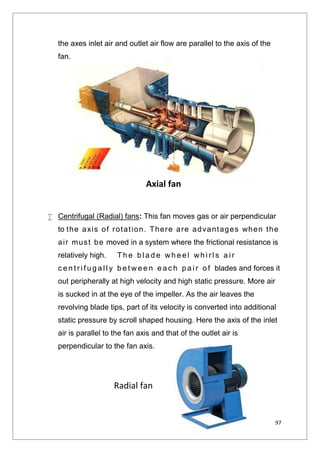
approx. 7 to 8 minutes from entry into the tank to suction by the pump.
This time allows sedimentation and detrainment of the oil.
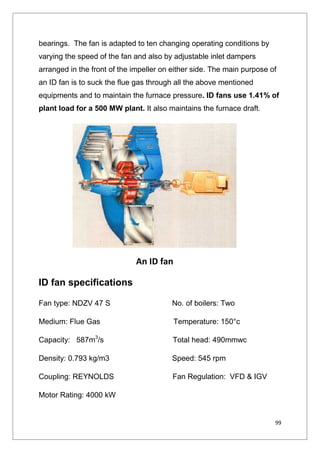
Oil returning to the tank from the oil supply system first flows through a
submerged inlet into the riser section of the tank where the first stage
deaeration takes place as the oil rises to the top of the tank. Oil flows
from the riser section through the oil strainer into the adjacent section of
the tank where it is then drawn off on the opposite side by the suction
pipe of the oil pumps.
142
Main Oil Pump
The main oil pump is situated in the front bearing pedestal and supplies
the entire turbine with oil that is used for bearing lubrication, cooling the
shaft journals and as primary and test oil. It is coupled with turbine rotor
through a gear coupling. The main oil pump is driven direct from the
turbine shaft via the coupling. These pumps also convey oil in the
suction branches of the main oil pump for oil injector, which maintains a
steady suction flow to main oil pump. It takes over when the turbine
speed is greater than 2800 rpm.
Auxiliary Oil Pump
The auxiliary oil pump is a vertical one stage rotary pump with a radial
impeller and spiral casing. It is fixed to the cover of the oil tank and
submerges into the oil with the pump body. It is driven by an electric
motor that is bolted to the cover plate of the main oil tank. The pump
shaft bearing in the pump casing and a grooved ball bearing in the
bearing yoke. The bearings are lubricated from the pressure chamber of
the pump; the sleeve bearing via a bore in the casing; the grooved ball
bearing via lube line. Generally, three in number, two AC motor driven
and one DC motor driven. Supplies oil during turbo-set starting and
stopping when the turbine is running at speed lower than 2800 rpm
supplies oil to governing system as well as to the lubrication system. It
also serves as standby to main centrifugal oil pump.
Emergency Oil pump
This is a centrifugal pump, driven by D.C. electric motor. It is vertical
type. This automatically cuts in whenever there is failure of A.C. supply
at power station and or the lub oil pressure falls below a certain value.
This pump can meet the lubrication system requirement under the
conditions mentioned above.
143
Shaft lift oil pump (Jacking Oil Pump)
The lift oil pump is a self-priming screw-spindle pump with three spindles
and internal bearings. It is a jack-screw immersion pimp situated on the
tank. The pump supplies high pressure (about 12 kgf/cm2
) oil from the
main oil tank in order to lift the turbine rotor at low speeds, thus
preventing damage to the bearings when shaft speeds are too low for
hydrodynamic lubrication to take place. The pump is driven by a three
phase A.C. motor. The pressure oil piping of the lifting oil pump that is
not in operation is closed by the check valves. The pressure in the
system is kept constant by means of the pressure limiting valve. When
the turbine is started up or shut down, the hydraulic lifting device is used
to increase or maintain the oil film between the rotor and bearings. The
necessary torque from the hydraulic turning device or from the manual
turning device is reduced in this way. The bearings are relieved by high
pressure oil that is forced under the individual bearing pins, thus raising
the rotor. In order to avoid damage to the bearings, the lifting oil pump
must be switched on below a certain speed. The drain from the bearings
is connected back to the oil tank only.
Oil coolers
The oil of the lubrication and governing system is cooled in the oil
coolers. The cooling medium for these coolers is circulating water. It
Consists of tube nest, inner & outer shell & water boxes. The pressure of
the cooling water is kept lower than that of oil to avoid its mixing with oil
in the event of tube rupture.
Five oil coolers have been foreseen, out of which four are for continuous
operation and one remains as a standby, provided the cooling water
temperature is not more than 360
C. The oil coolers are in parallel for
maintenance purposes, the oil and cooling water system to any one of
the oil coolers may be cut off. Oil temperature controller is employed for
144
maintaining the lub oil temp at rated value by controlling the flow through
the coolers.
Duplex oil filter
It is provided to filter the oil before supply. The duplex filter consists of
two filter bodies and is fitted with a changeover device which enables the
filters to be switched as desired.
Three-way control valve
It is electrically driven and has the function of regulating the lubricating
oil temperature. Possible oil flow paths for regulating the oil temperature
are:
1. All lubricating oil flows through the oil cooler.
2. Lubricating oil flows through oil cooler and by-pass piping
3. All lubricating oil flows through the by-pass piping.
Condensate system
Condensate: The steam after condensing in the condenser is known as
condensate, and is extracted out of the hot well by condensate
extraction pump and taken to the deaerator through drain cooler, gland
steam condenser and series of LP heaters.
This contains the following:
Low Pressure heaters
Turbine is provided with non-controlled extractions which a r e
u t i l i z e d f o r h e a t i n g t h e c o n d e n s a t e f r o m t u r b i n e
b l e e d i n g s ys t e m . There are four 10W pressure LP heaters in
which the last four extractions are used. LP Heater-1 has two parts LPH-
1A a n d L P H - 1 B l o c a t e d i n t h e u p p e r p a r t s o f
c o n d e n s e r A a n d condenser B respectively. These are of
horizontal type with shell and tube construction. LP heaters 2, 3 and
4 are of similar construction and they are mounted in a row at
145
4m level. They are of vertical construction with brass tubes the
ends of which are expanded into tube plate. The condensate flows
in the "U" tubes in four passes and extraction steam washes the
outside of the tubes. Condensate passes through these four L.P.
heaters in succession. These heaters are equipped with necessary
safety valves in the steam space level indicator for visual level
indication of heating steam. Condensate pressure vacuum gauges
are employed for measurement of steam pressure etc.
LPT
1ST
STAGE
Stages of LP heating
An LP heater
145
4m level. They are of vertical construction with brass tubes the
ends of which are expanded into tube plate. The condensate flows
in the "U" tubes in four passes and extraction steam washes the
outside of the tubes. Condensate passes through these four L.P.
heaters in succession. These heaters are equipped with necessary
safety valves in the steam space level indicator for visual level
indication of heating steam. Condensate pressure vacuum gauges
are employed for measurement of steam pressure etc.
LPT
1ST
STAGE
Stages of LP heating
An LP heater
145
4m level. They are of vertical construction with brass tubes the
ends of which are expanded into tube plate. The condensate flows
in the "U" tubes in four passes and extraction steam washes the
outside of the tubes. Condensate passes through these four L.P.
heaters in succession. These heaters are equipped with necessary
safety valves in the steam space level indicator for visual level
indication of heating steam. Condensate pressure vacuum gauges
are employed for measurement of steam pressure etc.
LPT
1ST
STAGE
Stages of LP heating
An LP heater
146
Condensate Extraction Pumps
The function of these pumps is to pumps out the condensate to the
desecrator through ejectors, gland steam cooler, a n d L P h e a t e r s .
T h e s e p u m p s a r e o f ve r t i c a l b a r r e l o r c a n i s t e r ,
d o u b l e s u c t i o n , m u l t i s t a g e , d i f f u s e r t yp e . T h e
s u c t i o n b a r r e l i s i n s t a l l e d o n t h e p u m p f l o o r . I n t e r n a l
b e a r i n g s ( L e a d e d b r o n z e b e a r i n g s ) i n s t a l l e d i n a
c o l u m n p i p e a n d t h e t o p c a s i n g i s p r o vi d e d f o r
s u p p o r t i n g t h e p u m p s h a f t a g a i n s t t h e r a d i a l l o a d .
U p p e r a n d l o we r b e a r i n g s ( l e a d e d b r o n z e ) a r e
i n s t a l l e d i n t h e s t u f f i n g b o x a n d s u c t i o n b e l l . Th e
we i g h t o f t h e p u m p r o t o r a n d t h e h yd r a u l i c t h r u s t
a c t i n g o n t h e r o t o r i n t h e a xi a l d i r e c t i o n s a r e
s u p p o r t e d b y t h e t h r u s t b e a r i n g s i n t h e m o t o r . Th e s e
p u m p s a r e d r i ve n b y 1 1 2 0 K W i n d u c t i o n mo t o r ,
d e l i ve r i n g 8 1 0 0 0 0 k g / h r o f c o n d e n s a t e wa t e r a g a i n s t
3 0 7 m o f t o t a l d yn a m i c h e a d a t t h e r a t e d c o n d i t i o n .
T h e s e p u m p s h a ve f o u r s t a g e s a n d s i n c e t h e suction is
147
at a negative pressure, special arrangements have been m a d e
f o r p r o vi d i n g s e a l i n g . T h i s p u m p i s r a t e d g e n e r a l l y
f o r 160m3
/ hr. at a pressure 13.2 Kg/cm2
. They are 3 per unit of 50%
capacity each located near the condenser hot well. Here the suction is
under vacuum.
Hot well
Condenser Extraction pumps
148
Specifications of CEP
A Condenser Extraction Pump148
Specifications of CEP
A Condenser Extraction Pump148
Specifications of CEP
A Condenser Extraction Pump
149
Deaerator
One per unit located around 18m level in CD bay. The presence of
certain gases, principally oxygen, carbon dioxide and ammonia
dissolved in water is generally considered harmful because of their
corrosive attack on metals, particularly at elevated temperatures. One of
the most important factors in the prevention of internal corrosion in
modern boilers and associated plant therefore, is that the boiler feed
water should be free as far as possible from all dissolved gases
especially oxygen. This is achieved by embodying into the boiler feed
system a deaerating unit, whose function is to remove dissolved gases
from the feed water by mechanical means. Particularly the unit must
reduce the oxygen content of the feed water to as low as possible or
desired, depending upon the individual circumstances, residual oxygen
content in condensate at the outlet of deaerating plant usually specified
0.005/liter or less. Water is sprayed in atmosphere of steam. Oxygen
and free CO2 removed. This preheated water having minute traces of
dissolved gases flows into second stage where water is in contact with
fresh steam. The steam then rises to first stage and carries residual
gases. Water is stored in storage tank for further use. The main sources
of this steam are Extraction steam, CRH (cold reheat steam), auxiliary
steam.
Parts of a deaerator are
• Tubular type gauge glass.
• High level alarm switch.
• Low level alarm switch.
• Pressure gauge.
Deaerator level controller
150
• Safety valves
• Isolating valves for steam pipes.
Specifications of a deaerator
• Design pressure - 9.0 kg/cm2
• Operating pressure - 6.8 kg/cm2
• Capacity - 170 m3
• No. of trays - 576
• No. of spray valves - 108
• No. of safety valves - 6
An Overview of deaerator and hot well
151
A Deaerator
152
Feed water system
The main equipments coming under this system are:
Booster Pump
Each boiler feed pump is provided with a booster pump in its suction line
which is driven by the main motor of the boiler feed pump. By the use of
a booster pump in the main pump suction line, always there will be
positive suction pressure which will remove the possibility of Cavitation.
Each pump set consists of a Weir type FAIE 64 booster stage pump and
a Weir type FK4E36 pressure stage pump.
The Weir type FAIE 64 booster stage pump is a single stage, horizontal,
axial split casing type, having the suction and discharge branches
integrally cast in the casing lower half, thus allowing the pump internals
to be removed without disturbing the suction and discharge pipe work or
the alignment between the pump and discharge.
The pump shaft is sealed at the drive end and non-drive end by Crane
mechanical seals. The rotating assembly is supported by plain white
metal lined journal bearings and axially located by Glacier double tilting
pad thrust bearing.
153
Specifications
 Single stage, horizontal, axial split casing
 Aim: to obtain positive suction pressure in order to avoid cavitation
 suction temp : 164 0
c
 suction pressure : 9.06 bar
 discharge pressure : 20.3 bar
 speed : 1494 rpm
 power consumption : 608 kW
Boiler Feed Pumps
They are three per unit of 50% capacity each located in the 0m level in
the TG bay. The pump is Weir type FK4E36 pressure stage pump. It is a
multi- stage pump. This pump is horizontal at zero level and of barrel
design driven by an Electric motor through a hydraulic coupling. All the
bearings of pump and motor are forced lubricated by a suitable oil
lubricating system with adequate protection to trip the pump if the
lubrication oil pressure falls below a preset value. The pump internals
are designed as a cartridge which can be easily removed for
maintenance without disturbing the suction and discharge pipe work, or
the alignment of the pump and the turbo coupling. The pump is sealed
at the drive end and non-drive end by labyrinth glands.
The pump casing consists of a forged steel barrel with welded suction,
discharge branches; inter stage tapping and mounting feet.
The high-pressure boiler feed pump is very expensive m a c h i n e
wh i c h c a l l s f o r a ve r y c a r e f u l o p e r a t i o n a n d s k i l l e d
maintenance. The safety in operation and efficiency of the
feed pump depends largely on the reliable operation and
maintenance. Operating staff must be able to find out the causes of
154
defect at the very beginning which can be easily removed without
endangering the operator of the power plant and also without
the expensive dismantling of the high pressure feed pump.
The feed pump consists of pump barrel, into which is mounted the inside
stator together with rotor. The hydraulic part is e n c l o s e d b y t h e
h i g h p r e s s u r e c o ve r a l o n g wi t h t h e b a l a n c i n g device.
The suction side of the barrel and the space in the
high pressure cover behind the balancing device are enclosed by the
low pressure covers along with the stuffing box casings. The
brackets o f t h e r a d i a l b e a r i n g o f t h e s u c t i o n s i d e a n d
r a d i a l a n d t h r u s t bearing of the discharge side are fixed to
the low pressure covers. T h e e n t i r e p u m p s a r e
m o u n t e d o n a f o u n d a t i o n f r a m e . T h e hydraulic
coupling and two claws coupling with coupling guards are also
delivered along with the pump. Water cooling and oil
lubricating are provided with their accessories. The use of Mechanical
seal reduces the losses of feed water in the stuffing box to maintain and
working ability of the feed pump increases. Cooling is carried out by the
circulation of water between the stuffing box space and the cooler. Even
after stopping the pump stuffing box cooling should be continued as its
cooling circuit is different from the seal coolers. Coolers are designed to
keep the stuffing box space temperature below 800
C. The rotating
assembly is supported by plain white metal lined journal bearings and
axially located by Glacier double tilting pad thrust bearing. BFP have two
main uses namely, to give the required pressure to the feed water before
entering into boiler and to supply water for de superheating in the boiler.
155
Specifications
 single cylinder turbine
 axial flow type
 No of stages  14
 Normal speed  5275 rpm
 Steam pr.  6.33 kg/cm2
 Output  5732 kW
 Steam cons.  36 tons/hr
Turbine Driven Boiler Feed Pump
The single cylinder turbine is of the axial flow type. The live steam
flows through the emergency stop valve and then through the main
Control Valves 5 nos. (Nozzle governing). These valves regulate the
steam supply through the turbine in accordance with load
Sectional view of a Boiler Feed pump
156
requirements. The control valves are actuated by a lift b a r
wh i c h i s r a i s e d o r l o we r e d vi a a l e ve r s ys t e m b y t h e
r e l a y cylinder mounted on the turbine casing.
The journal bearings supporting the turbine shaft are arranged in the
two bearing blocks. The front end -bearing block also houses the
thrust bearing, which locates the turbine shaft and takes up "the
axial forces”. There are 14 stages of reaction balding. The
balancing piston is provided at the. Steam admission side to
compensate the axial thrust to the maximum extent. Since the
axial thrust varies with the load, the residual thrust is taken up
by the thrust bearing. The leak off from the balancing piston
is connected back to the turbine after 9th stage. The turbine is
provided with hydraulic and electro-hydraulic governing system. A
primary oil pump is used as a speed sensor for hydraulic governing and
shall Probes are used as a speed sensor for electro hydraulic governing.
Whenever steam is drawn from the cold reheat line or auxiliary
supply, steam flow is controlled by auxiliary control valve.
During this period the main control valves (4 nos.) will
remain fully opened and the bypass valve across it will
remain closed. (Bypass remains closed for a short period
when change, over from IP steam to CRH takes place).The steam
exhaust for the BFP- Turbine is connected to the main condenser and
the turbine glands are sealed by gland steam.
The turbine is provided with a hand barring facility. The turbine rotor is
connected to the pressure pump through detachable coupling and to the
booster pump through a set of reduction gears. A plate type filter is
provided and either one can be isolated during the running of the
turbine. The control oil pressure is around 5 to 8 ata and the lubricating
157
oil pressure is 0.8 to 1.7 atm. The oil temperature after the coolers is to
be maintained at 450
C to 480
C.
Turbine driven Boiler Feed Pump
158
High Pressure Heaters
They are three in number and are situated in the TG bay. These are
regenerative feed water heaters operating at h i g h p r e s s u r e a n d
l o c a t e d b y t h e s i d e o f t u r b i n e . T h e s e a r e generally
vertical type and turbine bleed steam pipes are connected to them. HP
heaters are connected in series on feed waterside and by such
arrangement, the feed water, after feed pump enters the HP
heaters. The steam is supplied to these heaters form
the bleed point of the turbine through motor operated valves.
These heaters have a group bypass protection on the feed waterside.
In the event f tube rupture in any of the HPH and the level of the
condensate rising to dangerous level, the group protection
device d i v e r t s a u t o m a t i c a l l y t h e f e e d w a t e r
d i r e c t l y t o b o i l e r , t h u s bypassing all the three HP heaters.
Following fittings are generally provided on the HP heaters
 Gauge glass for indicating the drain level.
 Pressure gauge with three way cock.
 Air Vent cock.
 Safety valve shell side.
 Seal pot.
 Isolating valves.
 High level alarm switch.
An HP heater
159
An HP heater
160
OFFSITE MAINTAINANCE
161
DM water treatment plant
As the types of boiler are not alike their working pressure and operating
conditions vary and so do the types and methods of water
treatment. Water treatment plants used in t h e r m a l p o w e r
p l a n t s a r e d e s i g n e d t o p r o c e s s t h e r a w w a t e r t o
water low in dissolved solids known as "dematerialized w a t e r " . N o
d o u b t , t h i s p l a n t h a s t o b e e n g i n e e r e d v e r y
c a r e f u l l y k e e p i n g i n v i e w t h e t y p e o f r a w w a t e r t o
t h e t h e r m a l p l a n t , i t s treatment costs and overall economics.
T h e t y p e o f d e m i n e r a l i z a t i o n p r o c e s s chosen for a
power station depends on three main factors:
 The quality of the raw water.
 The degree of de-ionization i.e. treated water quality
 Selectivity of resins.
W a t e r t r e a t m e n t p r o c e s s wh i c h i s g e n e r a l l y m a d e u p
o f t wo sections:
 Pretreatment section
 Demineralization section
Pretreatment section
Pretreatment plant removes the suspended solids such as clay, silt,
organic and inorganic matter, plants and other microscopic
organism. The turbidity may be taken as of two types of suspended
solids in water. Firstly, the separable solids and s e c o n d l y t h e
n o n s e p a r a b l e s o l i d s ( c o l l o i d s ) . T h e
c o a r s e components, such as sand, silt etc, can be removed from the
water by simple sedimentation. Finer particles however, will not settle in
any reasonable time and must be flocculated to produce the
large p a r t i c l e s w h i c h a r e a b l e t o s e t t l e . L o n g t e r m
162
a b i l i t y t o r e m a i n suspended in water is basically a function of
both size and specific g r a vi t y. T h e s e t t l i n g r a t e o f t h e
c o l l o i d a l a n d f i n e l y d i vi d e d (approximately 0.01 to 1
micron) suspended matter is so slow that removing them from
water by plain sedimentation is tank shaving ordinary dimensions is
impossible. Settling velocity of finely divided and collide
particles under gravity also are so small that ordinary
sedimentation is not possible. It is necessary, therefore, to use
procedures which agglomerate the small particles into
larger aggregates, which have practical settling velocities.
The term "Coagulation" and "flocculation" have been used
indiscriminately to describe process of turbidity removal.
"Coagulation" means to bring together the suspended particles.
The process describes the e f f e c t p r o d u c e d b y t h e a d d i t i o n
o f a c h e m i c a l A l ( S P ) g t o a c o l l o i d a l d i s p e r s i o n
r e s u l t i n g i n p a r t i c l e d e s t a b i l i z a t i o n b y a reduction of force
tending to keep particles apart. Rapid mixing is i m p o r t a n t a t t h i s
s t a g e t o o b t a i n . U n i f o r m d i s p e r s i o n o f t h e
c h e m i c a l a n d t o i n c r e a s e o p p o r t u n i t y f o r p a r t i c l e s t o
p a r t i c l e c o n t a c t . T h i s o p e r a t i o n i s d o n e
b y f l a s h m i x e r i n t h e clarifier. Second stage of
formation of settle able particles f r o m d e s t a b i l i z e d
c o l l o i d a l s i z e d p a r t i c l e s i s t e r m e d a
"flocculation". Here coagulated particles grow in size by attaching to
each other. In contrast to coagulation where the primary force is
e l e c t r o s t a t i c o r i n t r i n s i c , " f l o c c u l a t i o n " o c c u r s
b y c h e m i c a l bridging. Flocculation is obtained by gentle and
prolonged mixing w h i c h c o n v e r t s t h e s u b m i c r o s c o p i c
c o a g u l a t e d p a r t i c l e i n t o discrete, visible & suspended
163
particles. At this stage particles are l a r g e e n o u g h t o s e t t l e
r a p i d l y u n d e r t h e i n f l u e n c e o f g r a vi t y anomaly be removed.
This is best at pH ~6.5 - 7.0 & higher retention time.
For removing the organic matter chlorine as a biocide is dosed in
clarifier. It is essential to remove organic matter because it may lead to
fouling of ion exchange resin in DM Plant. Also the organic matter at
high temperature may get converted to CO2 & cause metal corrosion in
boiler system. To completely eliminate the organic matter a slight excess
of chlorine is dosed (~ 0.5ppm at Clarifier O/l).The clarified water so
produced is passed through filter beds (Graded Sand / Anthracite can be
used) to remove any floating turbid matter. This is called filtered water.
This water is being used for drinking purpose & for demineralization.
I f p r e t r e a t m e n t o f t h e w a t e r i s n o t d o n e
e f f i c i e n t l y t h e n t h e consequences are as follows:
 Si02 may escape with water which will increase the
anion loading.
 Organic matter may escape which may cause organic fouling i n
t h e a n i o n e xc h a n g e r b e d s . I n t h e 'p r e - t r e a t m e n t
Raw water being pre treated
164
p l a n t c h l o r i n e a d d i t i o n p r o vi s i o n i s n o r m a l l y
m a d e t o c o mb a t organic contamination.
 Cation loading may unnecessary increase due to addition
of Ca (OH)2 in excess of calculated amount for raising the pH
of the water for maximum floe formation and also
AKOrDg m a y p r e c i p i t a t e o u t . I f l e s s t h a n
c a l c u l a t e d a m o u n t o f C a ( O H ) 2 i s a d d e d ,
p r o p e r p H f l o c c u l a t i o n w i l l n o t b e obtained and
silica escape to demineralization section will occur, thereby
increasing load on anion bed.
Demineralization section
This filter water is now used for de mineralizing purpose and
is fed to cation exchanger bed, but enroute being first de
chlorinated, which is either done by passing through activated
carbon filter or injecting along the flow of water, an equivalent
amount of sodium sulphite through some stroke pumps.
Excess chlorine is removed in ACF.At ACF O/l Turbidity <0.1 NTU &
Free Cl2 <0.1ppm. The absorbed chlorine is released by backwash
whenever Free Cl2 >0.1ppm or the end of rated cycle whichever is
earlier. The residual chlorine which is- maintained in clarification plant to
remove organic matter from raw water is now detrimental to action resin
and must be eliminated before its entry to this bed. Normally, the
typical scheme of demineralization up to the .mark against average
surface water is three bed systems with a provision of removing
gaseous carbon dioxide from water before feeding to Anion
Exchanger.
Resins, which are built on synthetic matrix of a styrene divinely benzene
copolymer, are manufactured in such a way that these have the ability
165
to, exchange one ion for another, hold it temporarily in chemical
combination and give it to a strong electrolytic solution. Suitable
treatment is also given to them in such a way that a particular resin
absorbs only a particular group of ions. Resins, when absorbing
and releasing cationic portion of d i s s o l v e d s a l t s , i s
c a l l e d c a t i o n , e x c h a n g e r r e s i n a n d w h e n removing
anionic portion is called anion exchanger resin. Preset trend is of
employing 'strongly acidic cation exchanger resin and strongly
basic anion exchanger resin in a DM Plant of modern
thermal power station. We may see that the chemically
active group in a cationic resin is SOx-H (normally represented
by RH) and in an anionic resin the active group is either tertiary
amine or quaternary ammonium group (normally the resin is
represented by ROH). The reaction of exchange may be
further represented as below
Cation Resin
R-H + Na  R-Na + H2SO4
K K HCl
Mg Mg
Ca Ca HNO3
In the form of Resins in Removed in
Salts H2CO3 degasser tower
Anion Resin
R-OH + H2SO4  R-SO4 + H2O
HCl
HNO3
Mineral acid obtained Resins in
from cation exhausted form
166
The water from the ex-cation contains carbonic acid also sufficiently,
which is very weak acid difficult to be removed by strongly basic anion
resin and causing hindrance to remove silicate ions from the bed. It is
therefore a usual practice to remove carbonic acid before it is led to
anion exchanger bed; this is done in a degasser.
In the degasser, the ex-cation water is trickled in fine streams
from top of a tall tower packed with, rasching rings, and compressed
air is passed from the bottom. Carbonic acid breaks into C02
and water mechanically ( H e n r y ' s L a w ) w i t h t h e
c a r b o n d i o x i d e e s c a p i n g i n t o t h e atmosphere.
The water is accumulated in suitable storage tank below the
tower, called degassed water dump from where the same is led to anion
exchanger bed, using acid resistant pump.
H2CO3  H2O + CO2
The ex-anion water is fed to the mixed bed exchanger (regenerative
type ion exchanger resin beds both strong and weak) containing
both cationic resin and anionic resin. This bed not only takes
care of sodium slip from cation but also silica slip from anion
exchanger very effectively. The final output from t h e mi xe d
b e d i s E x i r a - o r d i n a r i l y p u r e wa t e r h a vi n g l e s s
t h a n 0.2/mho conductivity 7.0 and silica content less than 0.02 pm. Any
DM plant storage tanks and degasser towers
167
deviation from the above quality means that the resins in
mixed b e d a r e e xh a u s t e d a n d n e e d r e g e n e r a t i o n ,
r e g e n e r a t i o n o f t h e mixed bed first calls for suitable, back
washing and settling, so that the two types of resins are separated from
each other. Lighter anion resin rises to the top and the heavier
cation resin settles to the bottom. Both the resins are then
regenerated separately with alkali and acid, rinsed to the desired value
and air mixed, to mix the resin a g a i n t h o r o u g h l y. I t i s t h e n p u t
t o f i n a l r i n s i n g t i l l t h e d e s i r e d quality is obtained. It may be
mentioned here that there are two types of strongly basic anion
exchanger. Type II resins are slightly less basic than type I,
but have higher regeneration efficiency than type I. Again as type II
resins are unable to remove silica effectively, type I resins also
have to be used for the purpose. As such, the general
condition so far prevailing in India, is to employ type II resin in
anion exchangers bed and type I resin in mixed bed (for the
anionic portion). It is also a general convention to regenerate the above
two resins under through fare system i.e. the caustic soda
entering into mixed bed for regeneration, of type I anion resin, is
utilized to regenerate type II resin in anion exchanger bed.
The content of utilizing the above resin and mode of
regeneration is now days being switched over from the
economy to a higher cost s o a s t o h a ve m o r e s t r i n g e n t
q u a l i t y c o n t r o l o f t h e f i n a l D M water.
R-OH + HCl  RCl + H20
2 R-OH + H2SO4  R2SO4 +2H20
168
At anion O/l, pH 8-9, Conductivity < 20 umhos/cm , Silica< 200 ppb will
be achieved.
Internal Treatment
This final D.M. effluent is then either led to hot well of the condenser
directly as make up to boilers, or being stored in D.M. Water
storage tanks first and then pumped for makeup purpose to boiler feed.
As the D.M. Water has a good affinity to absorb carbon dioxide and
oxygen, and both are extremely harmful to metal surfaces for their
destruction like corrosion, these have to b e r e m o v e d b e f o r e i t
i s f e d t o b o i l e r . T h i s i s b e i n g d o n e i n desecrator.
Still the residual oxygen which is remaining in the water is
neutralized by a suitable doze of hydrazine, at the point after
desecrator. To have further minimum corrosion, the pH
of feed water is to be maintained at around 9.0 for which
purpose ammonia in suitable doze is added to this make up water at a
point along with hydrazine as stated above.
Cation and anion exchange
resin unit in a DM plant
169
Cooling towers
Necessity
Cooling water system plays a vital role in dissipation of waste heat in
power station. More than 60 % of total heat input to the plant is finally
dissipated as waste heat. The waste heat from the power plant is carried
away by circulating water and ultimately gets dissipated in cooling tower.
Types
 Natural draught cooling tower (NDCT): These are structures
supported on RCC columns, Most of the structure is empty shell
but the lower portion contains a cooling stack over which hot water
is distributed by RCC channel or pipe system. The lower portion of
the shell is open to allow the air to go to the cooling stack
supported on the RCC columns, which are designed for horizontal
load due to wind. A pond is constructed below the toer to catch the
cooled water and make-up water for circulation. As the warm water
falls in the stack, it gives its heat to the air there, which becomes
Where water supply is not consistent, closed loop cooling system with cooling tower
is used.
170
lighter than the ambient air and a draft is created due to chimney
action. In this case, cooling is dependent on dry bulb temperature
i.e. better in humid conditions. Natural draft cooling towers are
normally adopted near coastal areas where humidity is generally
very high. But the capital cost of NDCT is about 60% than that of
IDCT and FDCT put together.
 Induced draught cooling tower (IDCT): In this system the fan is
located at the top and air enters from the openings located at the
ground level. Air, mixed with vapors, is discharged through a fan
stack located at the top of the tower. In this case, moist air is
discharged higher in the atmosphere thereby dispersing to a
greater distance from the tower. There is a cylindrical RCC
structure supported on RCC columns. Hot water is taken to the top
of the tower by steel pipes and discharged on the packing with
distribution system of precast RCC trough and tubes. Eliminators
of asbestos are provided at the top to arrest the droplets. The fan
is located at the top to draw air from the cylinder for dispersion.
Hot water is cooled by the induced air travelling up. Cold water is
collected in the pond located below the cooling tower where make
– up water is also discharged.
 Forced draught cooling tower (FDCT): Here, motor driven fans
located at the base, i.e. ground level, below air into the tower from
the sides. The top of the tower is open to the air vapor discharge.
The main draw back in this type of tower is that exit velocity is low
and this results in recirculation of hot air into the fan intake. Thus,
the efficiency of the tower is reduced. The other disadvantages of
FDCTs are: High velocity from the fan located at the base makes it
difficult to distribute air evenly over the whole of packing. Low
height, low velocity of air and low wind velocity generally results in
171
recirculation of hot air. This results in rise in cold water
temperature and reduction in efficiency. Frequent clogging due to
organic matter and thus reduction in efficiency.
At NTPC Simhadri, each unit has one Natural Draft Cooling Tower.
Principle:
Natural Draft CT depends on the airflow caused by natural driving
pressure due to the density difference between the cool outside air and
hot humid air inside. The driving pressure “P” is given by
P = (density (o) – density (i) fill exit)* H
Normally the density difference is low. Hence “H” has to be more in order
to achieve “P”. The Hyperbolic profile of NDCT offers great resistance to
outside wing loading and superior strength when compared to other
forms. It has little to do with inside air flow.
DETAILS OF NDCTs OF STAGE-I (2X500 MW)
• No. of NDCTs: 2
• Height of NDCT: 165 m
• Bottom diameter: 100 m
• Top diameter: 70 m
• Total no of Racker columns: 88 per NDCT
• Shell thickness: 300-350 mm
A Natural Draught Cooling Tower
172
An Induced Draft Cooling Towers
Types of Cooling Towers
A Forced Draft Cooling Towers
173
Inner view of an NDCT
Drift Eliminators
174
Circulating water system
Modern high capacity thermal power stations require enormous quantity
of water for steam production. This steam has to be recycled again to
generate power. For recycling steam, it has to be condensed into water.
Circulating water is a system that is used for condensing the steam.
USES OF CIRCULATING WATER
 Condensing of steam
 Cooling of dm cooling water
 Ash evacuation
 Bottom de ashing
 Fly ash removal
Circulating Water System at NTPC
Simhadri
174
Circulating water system
Modern high capacity thermal power stations require enormous quantity
of water for steam production. This steam has to be recycled again to
generate power. For recycling steam, it has to be condensed into water.
Circulating water is a system that is used for condensing the steam.
USES OF CIRCULATING WATER
 Condensing of steam
 Cooling of dm cooling water
 Ash evacuation
 Bottom de ashing
 Fly ash removal
Circulating Water System at NTPC
Simhadri
174
Circulating water system
Modern high capacity thermal power stations require enormous quantity
of water for steam production. This steam has to be recycled again to
generate power. For recycling steam, it has to be condensed into water.
Circulating water is a system that is used for condensing the steam.
USES OF CIRCULATING WATER
 Condensing of steam
 Cooling of dm cooling water
 Ash evacuation
 Bottom de ashing
 Fly ash removal
Circulating Water System at NTPC
Simhadri
175
Theory of circulation
Water must flow through the heat absorption surface of the boiler in
order that it is evaporated into steam. In drum type units
(natural and controlled circulation) the water is circulated
from the drum through the generating circuits and then back to
the drum where the steam is separated and directed to the super
heater. The water leaves the drum through the down comers at a
temperature slightly below the saturation temperature. The
flow through the furnace wall is at saturation temperatur e.
Heat absorbed in water wall is latent heat of vaporization
creating a mixture of steam and water. The ratio of the weight of the
water to the weight of the steam in the mixture leaving the heat
absorption surface is called Circulation ratio.
Water circulation system in a Thermal
Power Plant
176
The types of boiler circulating system are:
 Natural circulation system
 Controlled circulation system
 Combines circulation system
Natural circulation system
Water delivered to steam generator from feed heater is at a
temperature well below the saturation value corresponding
to that pressure. Entering first the economizer it is h e a t e d t o
a b o u t 3 0 - 4 0 ˚ C b e l o w s a t u r a t i o n t e m p e r a t u r e . F r o m
economizer the water enters the drum and thus joins the circulation
system. Water entering the drum flows through the down
comer and enters ring heater at the bottom. In the water walls a part of
the wa t e r i s c o n ve r t e d t o s t e a m a n d t h e m i xt u r e f l o ws
b a c k t o t h e drum. In the drum, the steam is separated, and sent to
super heater f o r s u p e r h e a t i n g a n d t h e n s e n t t o t h e
h i g h p r e s s u r e t u r b i n e . R e m a i n i n g w a t e r m i x e s
w i t h t h e i n c o m i n g w a t e r f r o m t h e economizer and
the cycle is repeated. The circulation in this case takes place on the
thermo-siphon principle. The down comers contain relatively cold water
whereas the riser tubes contain a steam water mixture. Circulation
takes place at such a rate that the driving force and the frictional
resistance in water walls are balanced.
As the pressure increases, the difference in density between water and
steam reduces. Thus the hydrostatic head available will not be able to
overcome the frictional resistance for a flow corresponding t o t h e
m i n i m u m r e q u i r e m e n t o f c o o l i n g o f wa t e r wa l l t u b e s .
Therefore natural circulation is limited to the boiler with
drum operating pressure around 175 kg/cm².
177
Controlled circulation system
Beyond 80 kg/cm² of pressure, circulation is to be assisted with
mechanical pumps to overcome the frictional losses. To regulate the
flow through various tubes, orifice plates are used. This system is
applicable in the high sub-critical regions (200 kg/cm²).
Combined circulation system
Beyond the critical pressure, phase t r a n s f o r m a t i o n i s a b s e n t ,
a n d h e n c e o n c e t h r o u g h s y s t e m i s adopted.
However, it has been found that even at super
critical pressure, it is advantageous to re circulate the
water through the f u r n a c e t u b e s a n d s i mp l i f i e s t h e
s t a r t u p p r o c e d u r e . A t y p i c a l operating pressure for such a
system is 260 kg/cm².
Natural circulating system
178
Principal Components of CWS
Condenser
There are two condensers entered to the two exhausters of the LP
turbine. These are surface type condensers with two pass arrangement.
Cooling water pumped into each condenser by a vertical CW pump
through the inlet pipe. Water enters the inlet chamber of the front water
box, passes horizontally through the brass tubes to the water box at the
other end, takes a turn, passes through the upper cluster of tubes and
reaches the outlet chamber in the front water box. From there, cooling
water leaves the condenser through the outlet pipe and discharged into
the discharge duct.
Steam exhausted from the LP turbine washing the outside of the
condenser tubes losses its latent heat to the cooling water in the steam
side of the condenser. This condensate collects in the hot well, welded
to the bottom of the condensers.
Sectional view of a condenser
179
Ejectors
There are two 100% capacity ejectors of the steam eject type. The
purpose of the ejector is to evacuate air and other non-condensing
gases from the condensers and thus maintain the vacuum in the
condensers.
A 3 stage ejector using steam from the deaerator with 11 ata header as
the working medium is employed. In addition to the main ejectors there
is a single starting ejector which is used for initial pulling of vacuum up to
500mm of Hg. It consists of nozzle through which the working steam
expands; the throat of the nozzle is connected to the air pipe from the
condenser.
C.W. pumps
The pumps which supply the cooling water to the condensers are called
circulating water pumps. There are two such pumps for each unit with
requisite capacity.
These pumps are normally vertical, wet pit, mixed flow type, designed for
continuous heavy duty; suitable for water drawn through an open gravity
intake channel terminating in twin-closed ducts running parallel to the
main building.
The fluid through the suction bow/eye provided with stream lined guide
vanes, whose function is to prevent pre-whirl and impart hydraulically
correct flow to the liquid. The propeller, in turn, imparts motion to the
fluid. The purpose of the discharge bowl provided with streamlined
diffuser vanes, is to direct the flow of water into the discharge column.
Bulk requirement of water is used in thermal plants for the purpose of
cooling the steam in condensers. The requirement of water for this
purpose is of the order of 1.5-to2.0 cusecs/MW of installation where
sufficient water is available once through system is used.
180
Specifications
 Discharge : 31000m3/hr
 Head:28m
 rpm:330rpm
 2 pumps per unit (60%)
An Overview CW system
A CW pump
An Overview of CW system
A Plate Heat Exchanger for
cooling auxiliary cooling
water
181
Auxiliary cooling water system
Usually a part of the water to condenser is tapped off and supplied for
the following sub-systems:
Turbine lub oil and gas cooler directly from CW pump discharge
Bearing cooling system
DM plant
General services and miscellaneous cooling.
182
ASH HANDLING PLANT
183
Ash Handling System
The ash produced in the boiler is transported to ash dump area by
means of sluicing type hydraulic ash handling system, which consists
of Bottom ash system, Ash water system and Ash slurry system.
Bottom ash system
In the bottom ash system the ash d i s c h a r g e d f r o m t h e
f u r n a c e b o t t o m i s c o l l e c t e d i n t wo wa t e r compounded
scraper through installed below bottom ash hoppers. The ash is
continuously transported by means of the scraper chain conveyor
onto the respective clinker grinders which reduce the l u m p
s i z e s t o t h e r e q u i r e d f i n e n e s s . T h e c r u s h e d a s h f r o m
t h e bottom ash hopper from where the ash slurry is further transported
to operation, the bottom ash can is discharged directly
into the sluice channel through the bifurcating chute bypass the
grinder. The position of the flap gate in the bifurcating chute
bypasses the grinder. The position of the flap gate in the bifurcating
chute is to be manually changed. The main types of hoppers used in
power stations are:
1. Water Filter Hoppers: This consists of a tank made of steel plate.
The bottom ash from the boiler falls into water filled tank and is
immediately quenched large pieces of ash break up due to
thermal shock, thus the ash collected will be fairly small size and
during the disposal not much difficulty in terms of crushing aspects
will be encountered. These hoppers may or may not be lined with
refractory which goes off too frequently due to temperature
variations. The unlined hoppers have problems on corrosion for
which special coating are recommended.
184
2. Quencher cooled Ash hopper: This uses a series of quenchers
located near the top of the hoppers which provide fine spray of
water. This ensures that the ash is cooled sufficiently to prevent
after combustion and simitering within the hopper. The spray water
also keeps the refractory lining of the hopper cool. The quencher
type hoppers are not very effective as far as the breaking up of ash
due to thermal shocks is concerned. If there is a tendency of slag
accumulation of large pieces clinker grinders are normally used.
Fly ash system
The flushing apparatus are provided under E . P . h o p p e r s ( 4 0
n o s . ) , e c o n o mi z e r h o p p e r s ( 4 n o s . ) , a i r p r e heaters (2
nos.), and stack hoppers (4 nos.). The fly ash gets mixed
with flushing water and the resulting slurry drops into the ash
sluice channel. Low pressure water is applied through the
n o z z l e d i r e c t i n g t a n g e n t i a l l y t o t h e s e c t i o n o f p i p e t o
c r e a t e t u r b u l e n c e a n d p r o p e r m i x i n g o f a s h
w i t h w a t e r . F o r t h e maintenance of flushing apparatus
plate valve is provided between apparatus and connecting tube.
Bottom ash handling system
185
Ash water system
High pressure water required for bottom ash hopper quenching
nozzles, bottom ash hopper spraying, clinker grinder
sealing scraper bars, cleaning nozzles, bottom ash hopper seal
through flushing, economizer hopper flushing nozzles and
sluicing trench jetting nozzles is tapped from the high
pressure water ring mainly provided in the plant area. Low pressure
water required for bottom ash hopper seal through make up, scraper
conveyor make up, flushing a p p a r a t u s j e t t i n g n o z z l e s f o r
a l l f l y a s h h o p p e r s e x c e p t i n g economizer hoppers, is
trapped from low pressure water rings mainly provided in the
plant area.
Ash slurry system
Bottom ash and fly ash slurry of the system is sluiced up to ash pump
along the channel with the acid of high pressure water jets located
at suitable intervals along the channel. Slurry pump suction line
consisting of reducing elbow with drain va l v e , r e d u c e r a n d
Fly ash handling system
186
b u t t e r f l y va l v e a n d p o r t i o n o f s l u r r y p u m p delivery line
consisting of butterfly valve, pipe & fitting has also been provided.
Ash slurry pump
Electrostatic Precipitator with fly ash hoppers
187
Ways to increase the thermal efficiency of
power plants:
The basic idea behind all the modifications to increase the thermal
efficiency of a power cycle is the same: Increase the average
temperature at which heat is transferred to the working fluid in the
boiler, or decrease the average temperature at which heat is
rejected from the working fluid in the condenser. That is, the
average fluid temperature should be as high as possible during heat
addition and as low as possible during heat rejection.
Lowering the Condenser Pressure (Lowers Tlow,avg): Steam exists as
a saturated mixture in the condenser at the saturation temperature
corresponding to the pressure inside the condenser. Therefore, lowering
the operating pressure of the condenser automatically lowers the
temperature of the steam, and thus the temperature at which heat is
rejected. The effect of lowering the condenser pressure on the Rankine
cycle efficiency is illustrated on a T-s diagram in Fig.1. For comparison
purposes, the turbine inlet state is maintained the same. The colored
area on this diagram represents the increase in net work output as a
result of lowering the condenser pressure from P4 to P4’. The heat input
requirements also increase (represented by the area under curve 2-2),
but this increase is very small. Thus the overall effect of lowering the
condenser pressure is an increase in the thermal efficiency of the cycle.
188
Effect of lowering of the condenser pressure on efficiency
Superheating the Steam to High Temperatures (Increases Thigh, avg):
The average temperature at which heat is transferred to steam can be
increased without increasing the boiler pressure by superheating the
steam to high temperatures. The effect of superheating on the
performance of vapor power cycles is illustrated on a T-s diagram in
Fig.2. The colored area on this diagram represents the increase in the
net work. The total area under the process curve 3-3 represents the
increase in the heat input. Thus both the net work and heat input
increase as a result of superheating the steam to a higher temperature.
The overall effect is an increase in thermal efficiency, however, since the
average temperature at which heat is added increases.
Effect of superheating the steam to high temperatures
189
Increasing the Boiler Pressure (Increases Thigh, avg): Another way of
increasing the average temperature during the heat-addition process is
to increase the operating pressure of the boiler, which automatically
raises the temperature at which boiling takes place. This, in turn, raises
the average temperature at which heat is transferred to the steam and
thus raises the thermal efficiency of the cycle. The effect of increasing
the boiler pressure on the performance of vapor power cycles is
illustrated on a T-s diagram in Fig.3. Notice that for a fixed turbine inlet
temperature, the cycle shifts to the left and the moisture content of
steam at the turbine exit increases. This undesirable side effect can be
corrected, however, by reheating the steam, as discussed in the next
section.
Effect of increasing boiler pressure to increase efficiency
190
Losses during operation & maintenance of
a power plant
1) SURFACE ROUGHNESS:
It increases friction & resistance. It can be due to Chemical deposits,
Solid particle damage, and Corrosion Pitting & Water erosion. As a
thumb rule, surface roughness of about 0.05 mm can lead to a decrease
in efficiency of 4%.
2) LEAKAGE LOSS:
 Inter stage Leakage
 Turbine end Gland Leakages
 About 2 - 7.5 kW is lost per stage if clearances are increased by
0.025 mm depending upon LP or HP stage.
3) WETNESS LOSS:
 Drag Loss: Due to difference in the velocities of the steam &
water particles, water particles lag behind & can even take
different trajectory leading to losses.
 Sudden condensation can create shock disturbances & hence
losses.
 About 1% wetness leads to 1% loss in stage efficiency.
4) OFF DESIGN LOSSES:
 Losses resulting due to turbine not operating with design terminal
conditions.
 Change in Main Steam pressure & temperature.
191
 Change in HRH pressure & temperature.
 Condenser Back Pressure
 Convergent-Divergent nozzles are more prone to Off Design
losses then Convergent nozzles as shock formation is not there in
convergent nozzles.
5) PARTIAL ADMISSION LOSSES:
 In Impulse turbines, the controlling stage is fed with means of
nozzle boxes, the control valves of which open or close
sequentially.
 At some partial load some nozzle boxes can be partially open /
completely closed.
 Shock formation takes place as rotor blades at some time are full
of steam & at some other moment, devoid of steam leading to
considerable losses.
6) LOSS DUE TO EROSION OF LP LAST STAGE BLADES:
 Erosion of the last stage blades leads to considerable loss of
energy. Also, it is the least efficient stage.
 Erosion in the 10% length of the blade leads to decrease in 0.1%
of efficiency
192
Conclusion
As an undergraduate of GITAM University I would like to say that this
training program is an excellent opportunity for us to get to the ground
level and experience the things that we would have never gained
through going straight into a job. I am grateful to GITAM University and
NTPC Ltd Simhadri for giving us this wonderful opportunity. The main
objective of the industrial training is to provide an opportunity to
undergraduates to identify, observe and practice how engineering is
applicable in the real industry. It is not only to get experience on
technical practices but also to observe management practices and to
interact with fellow workers. It is easy to work with sophisticated
machines, but not with people. The only chance that an undergraduate
has to have this experience is the industrial training period. I feel I got
the maximum out of that experience. Also I learnt the way of work in an
organization, the importance of being punctual, the importance of
maximum commitment, and the importance of team spirit. The training
program having several destinations was a lot more useful than staying
at one place throughout the whole one month. It was an advantage for
me to be in the O & M-MM Division where I have boosted up my skills
and abilities. The conclusion that I can make is that NTPC Ltd Simhadri
is the right place for students to do their industrial training. In my opinion,
I have gained lots of knowledge and experience needed to be successful
in a great engineering challenge, as in my opinion, Engineering is after
all a Challenge, and not a Job.

Project Report on Industrial Summer Training at NTPC Simhadri

  • 1.
    1 Industrial Training ProjectReport On “Coal - Fired Steam Power Plants” National Thermal Power Corporation SIMHADRI (Visakhapatnam) (Submitted towards completion of industrial training at NTPC SIMHADRI) Under the guidance of: Submitted by: Shri B.Venkata Rao, Uppu Ashish, DGM, Ash Handling Plant, B.Tech, Mechanical Engg. NTPC SIMHADRI, (4th sem), Visakhapatnam. GITAM University, Visakhapatnam.
  • 2.
    2 TRAINING SCHEDULE DEPARTMENT PERIOD BOILERMAINTAINANCE 11.05.2015 to 16.05.2015 TURBINE MAINTAINANCE 18.05.2015 to 23.05.2015 OFFSITE MAINTAINANCE 25.05.2015 to 30.05.2015 ASH HANDLING PLANT 01.06.2015 to 09.06.2015
  • 3.
    3 CERTIFICATE This is tocertify that UPPU ASHISH, a student of 2012-2016 Batch of B.Tech,Mechanical Engineering in 4th Year of GITAM University, Visakhapatnam has successfully completed his industrial training at NTPC Simhadri, Visakhapatnam for four weeks from 7th May to 9th June 2015. He has completed the whole training as per the training report submitted by him. HR Manager NTPC Simhadri, Visakhapatnam
  • 4.
    4 Acknowledgment “It is notpossible to prepare a project report without the assistance & encouragement of other people. This one is certainly no exception.” On the very outset of this report, I would like to extend my sincere & heartfelt obligation towards all the personages who have helped me in this endeavor. Without their active guidance, help, cooperation & encouragement, I would not have made headway in the industrial training I am ineffably indebted to Mr. K.N. Reddy, AGM (MM-BMD); Mr. D.Shravan, Dy. Manager (BMD-PP); Mr. Piyush Kanwar, Dy. Manager (BMD-Mills); Mr. Balaji, Dy. Manager (BMD-RM); Mr. T.Prem Das, AGM (MM-TMD & OS); Mr. Shridhar, Dy. Manager (MM-TMD) for conscientious and encouragement to accomplish this assignment. I am extremely thankful and pay my gratitude to my guide Mr. B.Venkata Rao for his valuable guidance and support on completion of this project in its presently. I extend my gratitude to NTPC Ltd Simhadri and HR-EDC Dept. of NTPC Ltd Simhadri for giving me this opportunity. I also acknowledge with a deep sense of reverence, my gratitude towards my parents, who has always supported me morally as well as economically. Any omission in this brief acknowledgement does not mean lack of gratitude. Thanking You Ashish Uppu
  • 5.
    5 TABLE OF CONTENTS 1.About NTPC……………………………………………… 6 2. About NTPC SIMHADRI……………………………. 14 3. NTPC power stations in India…………………… 18 4.Principal and Operation of a Thermal Power Plant…………………………………………………………. 19 5.Principal components of a 500MW Thermal Power Plant………………………………………………. 29 6.The Layout of NTPC Simhadri……………………. 45 7.Boiler and its auxiliaries……………………………. 48 8.The Steam Turbine Theory……………………… 118 9. Turbine and its auxiliaries……………………… 128 10. DM treatment plant……………………………………………………….. 161 11. Cooling Towers…………………………………. 169 12. Circulating Water System…………………. 174 13. Principal components of CWS………….. 178 14. Ash Handling System……………………….. 183 15. Ways to increase the thermal efficiency of power plants………………………………………….. 187 16. Losses during operation & maintenance of a power plant…………………………………………. 190 5 TABLE OF CONTENTS 1. About NTPC……………………………………………… 6 2. About NTPC SIMHADRI……………………………. 14 3. NTPC power stations in India…………………… 18 4.Principal and Operation of a Thermal Power Plant…………………………………………………………. 19 5.Principal components of a 500MW Thermal Power Plant………………………………………………. 29 6.The Layout of NTPC Simhadri……………………. 45 7.Boiler and its auxiliaries……………………………. 48 8.The Steam Turbine Theory……………………… 118 9. Turbine and its auxiliaries……………………… 128 10. DM treatment plant……………………………………………………….. 161 11. Cooling Towers…………………………………. 169 12. Circulating Water System…………………. 174 13. Principal components of CWS………….. 178 14. Ash Handling System……………………….. 183 15. Ways to increase the thermal efficiency of power plants………………………………………….. 187 16. Losses during operation & maintenance of a power plant…………………………………………. 190 5 TABLE OF CONTENTS 1. About NTPC……………………………………………… 6 2. About NTPC SIMHADRI……………………………. 14 3. NTPC power stations in India…………………… 18 4.Principal and Operation of a Thermal Power Plant…………………………………………………………. 19 5.Principal components of a 500MW Thermal Power Plant………………………………………………. 29 6.The Layout of NTPC Simhadri……………………. 45 7.Boiler and its auxiliaries……………………………. 48 8.The Steam Turbine Theory……………………… 118 9. Turbine and its auxiliaries……………………… 128 10. DM treatment plant……………………………………………………….. 161 11. Cooling Towers…………………………………. 169 12. Circulating Water System…………………. 174 13. Principal components of CWS………….. 178 14. Ash Handling System……………………….. 183 15. Ways to increase the thermal efficiency of power plants………………………………………….. 187 16. Losses during operation & maintenance of a power plant…………………………………………. 190
  • 6.
    6 About NTPC NTPC Limitedis the largest thermal power generating company of India, Public Sector Company. It was incorporated in the year 1975 to accelerate power development in the country as a wholly owned company of the Government of India. NTPC is emerging as a diversified power major with presence in the entire value chain of the power generation business. Apart from power generation, which is the mainstay of the company, NTPC has already ventured into consultancy, power trading, ash utilization and coal mining. NTPC ranked 341st in the ‘2010, Forbes Global 2000’ ranking of the World’s biggest companies. NTPC became a Maharatna company in May, 2010, one of the only four companies to be awarded this status. Within a span of 31 years, NTPC has emerged as a truly national power company, with power generating facilities in all the major regions of the country. NTPC's core business is engineering, construction and operation of power generating plants and providing consultancy to power utilities in India and abroad. The total installed capacity of the company is 31134 MW (including JVs) with 15coal based and 7 gas based stations, located across the country. In addition under JVs, 3 stations are coal based & another station uses
  • 7.
    7 naphtha/LNG as fuel.By 2017, the power generation portfolio is expected to have a diversified fuel mix with coal based capacity of around 53000 MW, 10000 MW through gas, 9000 MW through Hydro generation, about 2000 MW from nuclear sources and around 1000MW from Renewable Energy Sources (RES). NTPC has adopted a multi- pronged growth strategy which includes capacity addition through green field projects, expansion of existing stations, joint ventures, subsidiaries and takeover of stations. NTPC has been operating its plants at high efficiency levels. Although the company has 18.79% of the total national capacity it contributes 28.60% of total power generation due to its focus on high efficiency. NTPC’s share at 31 Mar 2001of the total installed capacity of the country was 24.51% and it generated 29.68%of the power of the country in 2008-09. Every fourth home in India is lit by NTPC.170.88BU of electricity was produced by its stations in the financial year 2005-2006. The Net Profit after Tax on March 31, 2006 was INR 58,202 million. The Net Profit after Tax for the quarter ended June 30, 2006 was INR 15528 million, which is 18.65% more than for the same quarter in the previous financial year. 2005). NTPC is as second best utility in the world. In October 2004, NTPC launched its Initial Public Offering (IPO) consisting of 5.25% as fresh issue and 5.25% as offer for sale by Government of India. NTPC thus became a listed company in November 2004 with the Government holding 89.5% of the equity share capital. In February 2010, the Shareholding of Government of India was reduced from 89.5% to 84.5% through Further Public Offer and the balance 10.5% is held by FIIs, Domestic Banks, Public and others.
  • 8.
    8 NTPC Limited Type Public Founded1975 Headquarters Delhi, India Key people R S Sharma, Chairman & Managing Director Industry Electricity generation Products Electricity Revenue INR 416.37 billion (2008) Net income INR 70.47 billion (2008) Employees 23867 (2006) Website http://www.ntpc.co.in 8 NTPC Limited Type Public Founded 1975 Headquarters Delhi, India Key people R S Sharma, Chairman & Managing Director Industry Electricity generation Products Electricity Revenue INR 416.37 billion (2008) Net income INR 70.47 billion (2008) Employees 23867 (2006) Website http://www.ntpc.co.in 8 NTPC Limited Type Public Founded 1975 Headquarters Delhi, India Key people R S Sharma, Chairman & Managing Director Industry Electricity generation Products Electricity Revenue INR 416.37 billion (2008) Net income INR 70.47 billion (2008) Employees 23867 (2006) Website http://www.ntpc.co.in
  • 9.
    9 Strategies of NTPC TechnologicalInitiatives  Introduction of steam generators (boilers) of the size of 800 MW.  Integrated Gasification Combined Cycle (IGCC) Technology.  Launch of Energy Technology Centre -A new initiative for development of technologies with focus on fundamental R&D.  The company sets aside up to 0.5% of the profits for R&D.  Roadmap developed for adopting μClean Development.  Mechanism to help get / earn μCertified Emission Reduction.
  • 10.
    10 Corporate Social Responsibility As a responsible corporate citizen NTPC has taken up number of CSR initiatives.  NTPC Foundation formed to address Social issues at national level  NTPC has framed Corporate Social Responsibility Guidelines committing up to 0.5% of net profit annually for Community Welfare.  The welfare of project affected persons and the local population around NTPC projects are taken care of through well drawn Rehabilitation and Resettlement policies.  The company has also taken up distributed generation for remote rural areas Partnering government in various initiatives  Consultant role to modernize and improvise several plants across the country.  Disseminate technologies to other players in the sector.  Consultant role Partnership in Excellence Programme for improvement of PLF of 15 Power Stations of SEBs.  Rural Electrification work under Rajiv Gandhi Garmin Vidyutikaran. Environment management  All stations of NTPC are ISO 14001 certified.  Various groups to care of environmental issues.  The Environment Management Group.  Ash tilization Division.  Afforestation Group.  Centre for Power Efficiency & Environment Protection.  Group on Clean Development Mechanism.
  • 11.
    11  NTPC isthe second largest owner of trees in the country after the Forest department. Vision “To be the world’s largest and best power producer, powering India’s growth.” Mission “Develop and provide reliable power, related products and services at competitive prices, integrating multiple energy sources with innovative and eco-friendly technologies and contribute to society.” Core Values – BE COMMITTED B Business ethics E Environmentally and Economically Sustainable C Customer Focus O Organizational and Professional Pride M Mutual Respect and Trust M Motivating Self and Others I Innovation and Speed T Total Quality for Excellence T Transparent and Respected Organization E Enterprising D Devoted
  • 12.
    12 Journey of NTPC 12 Journeyof NTPC 12 Journey of NTPC
  • 13.
    13 A Qualitative studyof the Company
  • 14.
    14 About NTPC Simhadri SimhadriSuper Thermal Power Plant is a coal-fired power plant located in the Visakhapatnam district of the Indian state of Andhra Pradesh. The power plant is one of the coal fired power plants of NTPC, a Government of India enterprise. The coal for the power plant is sourced from Kalinga Block of Talcher Coal fields in Odisha. Power generated by units 1 and 2, making up for 1,000 MW, is dedicated to power distribution companies owned by the Government of Andhra Pradesh. The remainder 1,000 MW, generated by units 3 and 4, is allocated to the states of Odisha, Tamil Nadu, and Karnataka. Their shares are decided arbitrarily, with unsold power being sold to Andhra Pradesh. NTPC Simhadri is a modern coal-fired power plant, and is a combination of four independent generation units, with common water and fuel sources, and common ash ponds. Each of the four units has a nameplate capacity of 500 MW. Units 1 and 2 were built in the first phase of development, and were commissioned in February 2002 and
  • 15.
    15 August 2004, respectively,to meet urgent needs of power in the largely agrarian Coastal Andhra and North-Coastal Andhra regions. Units 3 and 4 were built in the second phase, and commissioned in March 2011 and March 2012, respectively. Since the operator of this plant is a Government of India enterprise, and since the plant was built with central government funds, power generated by units 3 and 4 are sold to distribution companies based in neighboring states of Odisha, Tamil Nadu, and Karnataka, over the National Grid, as power stocks. The allocations are decided between NTPC and the three states' discoms. Unsold units are offered to discoms of Andhra Pradesh for purchase at market prices. Coal for NTPC Simhadri is sourced from Talcher Coal Fields, Odisha, and transported by East Coast Railway (ECoR), over the Kolkata- Chennai trunk line, with a spur heading towards the plant at Duvvada. NTPC Simhadri uses fresh water sourced from the Yeluru Canal as working fluid (steam which turns the turbines). For cooling, however, the plant uses seawater pumped in from the Bay of Bengal. Seawater, with its salt content, is unfit to be used as working fluid, without desalination.
  • 16.
    16 PROJECT PROFILE Approved Capacity2000 MW (4 X 500 MW) Location Paravada Mandal, Visakhapatnam, AP Source of Finance JBIC Loan and Internal Resources Fuel Source Mahanadi Coal Fields, Talcher Fuel Requirement 5.04 Million Tons of Coal per annum Mode of Transportation Rail DM Water Source Water from Yelluru Canal Sweet Water Requirement 600 m3 / hr Cooling Water Source Sea Water from Bay of Bengal Sea Water Requirement 9100 m3 / hr Main Contractor M/s BHEL Power Evacuation AP TRANSCO (Via Kalpaka) Beneficiary State Andhra Pradesh 16 PROJECT PROFILE Approved Capacity 2000 MW (4 X 500 MW) Location Paravada Mandal, Visakhapatnam, AP Source of Finance JBIC Loan and Internal Resources Fuel Source Mahanadi Coal Fields, Talcher Fuel Requirement 5.04 Million Tons of Coal per annum Mode of Transportation Rail DM Water Source Water from Yelluru Canal Sweet Water Requirement 600 m3 / hr Cooling Water Source Sea Water from Bay of Bengal Sea Water Requirement 9100 m3 / hr Main Contractor M/s BHEL Power Evacuation AP TRANSCO (Via Kalpaka) Beneficiary State Andhra Pradesh 16 PROJECT PROFILE Approved Capacity 2000 MW (4 X 500 MW) Location Paravada Mandal, Visakhapatnam, AP Source of Finance JBIC Loan and Internal Resources Fuel Source Mahanadi Coal Fields, Talcher Fuel Requirement 5.04 Million Tons of Coal per annum Mode of Transportation Rail DM Water Source Water from Yelluru Canal Sweet Water Requirement 600 m3 / hr Cooling Water Source Sea Water from Bay of Bengal Sea Water Requirement 9100 m3 / hr Main Contractor M/s BHEL Power Evacuation AP TRANSCO (Via Kalpaka) Beneficiary State Andhra Pradesh
  • 17.
    17 Salient Features ofNTPC Simhadri • First Coastal Based Coal fired thermal Power Project of NTPC • Biggest Sea Water Intake-Well in India (For Drawing Sea Water from Bay of Bengal) • Use of Sea Water for Condenser Cooling and Ash Disposal • Asia’s Tallest Natural Cooling Towers (165 m), 6th in the World • Use of Fly-Ash Bricks in the Construction of all Buildings • Coal Based Project of NTPC Whose Entire Power is allocated to Home State (AP) • Use of Monitors and Large Video Screens (LVS) as Man Machine Interface (MMIs) for Operating the Plant • Use of Process Analysis, Diagnosis and Optimization (PADO) for the first time in NTPC • Flame Analysis of Boiler by Dedicated Scanners for all Coal Burners • Boiler Mapping By Acoustic Pyrometers • Use of Distributed Digital Control and Management Information System (DDCMIS) • Totally Spring Loaded Floating Foundation for all Major Equipments Including TG • Use of INERGEN as Fire Protection System for the 1st time in NTPC • Use of Digital Automatic Voltage Regulator (DAVR) • Use of VFD in ID Fan
  • 18.
    18 NTPC POWER STATIONSIN INDIA 18 NTPC POWER STATIONS IN INDIA 18 NTPC POWER STATIONS IN INDIA
  • 19.
    19 Principle and Operationof a Thermal Power Plant Principle: Any Steam Power Plant operates under the Simple Rankine Cycle. Hence the Rankine cycle is often termed as Basic Power Plant Cycle. The Rankine Cycle The Rankine cycle is a thermodynamic cyclewhich converts heat into work. The heat is supplied externally to a closed loop, which usually uses water as the working fluid. This cycle generates about 80% of all electric power used throughout the world, including virtually all solar, thermal, biomass, coal and nuclear power plants. It is named after William John Macquorn Rankine,aScottish polymath. The thermal (steam) power plant uses a dual (vapour+liquid) phase cycle. It is a closed cycle to enable the working fluid (water) to be used again and again. The basic principle of the working of a Thermal Power Plant is quite simple. The fuel used in the plant is burnt in the boiler, and the heat generated is then used to boil water which is circulated through several Layout of a Simple Rankine Cycle T-S diagram of a Simple Rankine Cycle 19 Principle and Operation of a Thermal Power Plant Principle: Any Steam Power Plant operates under the Simple Rankine Cycle. Hence the Rankine cycle is often termed as Basic Power Plant Cycle. The Rankine Cycle The Rankine cycle is a thermodynamic cyclewhich converts heat into work. The heat is supplied externally to a closed loop, which usually uses water as the working fluid. This cycle generates about 80% of all electric power used throughout the world, including virtually all solar, thermal, biomass, coal and nuclear power plants. It is named after William John Macquorn Rankine,aScottish polymath. The thermal (steam) power plant uses a dual (vapour+liquid) phase cycle. It is a closed cycle to enable the working fluid (water) to be used again and again. The basic principle of the working of a Thermal Power Plant is quite simple. The fuel used in the plant is burnt in the boiler, and the heat generated is then used to boil water which is circulated through several Layout of a Simple Rankine Cycle T-S diagram of a Simple Rankine Cycle 19 Principle and Operation of a Thermal Power Plant Principle: Any Steam Power Plant operates under the Simple Rankine Cycle. Hence the Rankine cycle is often termed as Basic Power Plant Cycle. The Rankine Cycle The Rankine cycle is a thermodynamic cyclewhich converts heat into work. The heat is supplied externally to a closed loop, which usually uses water as the working fluid. This cycle generates about 80% of all electric power used throughout the world, including virtually all solar, thermal, biomass, coal and nuclear power plants. It is named after William John Macquorn Rankine,aScottish polymath. The thermal (steam) power plant uses a dual (vapour+liquid) phase cycle. It is a closed cycle to enable the working fluid (water) to be used again and again. The basic principle of the working of a Thermal Power Plant is quite simple. The fuel used in the plant is burnt in the boiler, and the heat generated is then used to boil water which is circulated through several Layout of a Simple Rankine Cycle T-S diagram of a Simple Rankine Cycle
  • 20.
    20 tubes, the steamthat is generated is used to drive a turbine, which in turn is coupled with a generator, which then produces the electricity. A Rankine cycle describes a model of the operation of steam heat engines most commonly found in power generation plants. Common heat sources for power plants using the Rankine cycle are coal, natural gas, oil, and nuclear. The Rankine cycle is sometimes referred to as a practical Carnot cycle as, when an efficient turbine is used, the TS diagram will begin to resemble the Carnot cycle. The main difference is that a pump is used to pressurize liquid instead of a gas. This requires about 1/100th (1%) as much energy as that compressing a gas in a compressor (as in the Carnot cycle).The efficiency of a Rankine cycle is usually limited by the working fluid. Without the pressure going super critical the temperature range the cycle can operate over is quite small, turbine entry temperatures are typically 565°C (the creep limit of stainless steel) and condenser temperatures are around 30°C. This gives a theoretical Carnot efficiency of around 63% compared with an actual efficiency of 42% for a modern coal-fired power station. This low turbine entry temperature (compared with a gas turbine) is why the Rankine cycle is often used as a bottoming cycle in combined cycle gas turbine power stations. The working fluid in a Rankine cycle follows a closed loop and is re-used constantly. The water vapor and entrained droplets often seen billowing from power stations is generated by the cooling systems (not from the closed loop Rankine power cycle) and represents the waste heat that could not be converted to useful work. Note that cooling towers operate using the latent heat of vaporization of the cooling fluid. The white billowing clouds that form in cooling tower operation are the result of water droplets which are entrained in the cooling tower airflow; it is not, as commonly thought, steam. While many substances could be used in the Rankine cycle, water is usually the fluid
  • 21.
    21 of choice dueto its favorable properties, such as nontoxic and un reactive chemistry, abundance, and low cost, as well as its thermodynamic properties. One of the principal advantages it holds over other cycles is that during the compression stage relatively little work is required to drive the pump, due to the working fluid being in its liquid phase at this point. By condensing the fluid to liquid, the work required by the pump will only consume approximately 1% to 3% of the turbine power and so give a much higher efficiency for a real cycle. The benefit of this is lost somewhat due to the lower heat addition temperature. Gas turbines, for instance, have turbine entry temperatures approaching 1500°C. Nonetheless, the efficiencies of steam cycles and gas turbines are fairly well matched. Ts diagram of a typical Rankine cycle operating between pressures of 0.06bar and 50bar. There are four processes in the Rankine cycle, each changing the state of the working fluid. These states are identified by number in the diagram to the right T-S diagram of a Typical Rankine cycle 21 of choice due to its favorable properties, such as nontoxic and un reactive chemistry, abundance, and low cost, as well as its thermodynamic properties. One of the principal advantages it holds over other cycles is that during the compression stage relatively little work is required to drive the pump, due to the working fluid being in its liquid phase at this point. By condensing the fluid to liquid, the work required by the pump will only consume approximately 1% to 3% of the turbine power and so give a much higher efficiency for a real cycle. The benefit of this is lost somewhat due to the lower heat addition temperature. Gas turbines, for instance, have turbine entry temperatures approaching 1500°C. Nonetheless, the efficiencies of steam cycles and gas turbines are fairly well matched. Ts diagram of a typical Rankine cycle operating between pressures of 0.06bar and 50bar. There are four processes in the Rankine cycle, each changing the state of the working fluid. These states are identified by number in the diagram to the right T-S diagram of a Typical Rankine cycle 21 of choice due to its favorable properties, such as nontoxic and un reactive chemistry, abundance, and low cost, as well as its thermodynamic properties. One of the principal advantages it holds over other cycles is that during the compression stage relatively little work is required to drive the pump, due to the working fluid being in its liquid phase at this point. By condensing the fluid to liquid, the work required by the pump will only consume approximately 1% to 3% of the turbine power and so give a much higher efficiency for a real cycle. The benefit of this is lost somewhat due to the lower heat addition temperature. Gas turbines, for instance, have turbine entry temperatures approaching 1500°C. Nonetheless, the efficiencies of steam cycles and gas turbines are fairly well matched. Ts diagram of a typical Rankine cycle operating between pressures of 0.06bar and 50bar. There are four processes in the Rankine cycle, each changing the state of the working fluid. These states are identified by number in the diagram to the right T-S diagram of a Typical Rankine cycle
  • 22.
    22 I. Process 1-2:The working fluid is pumped from low to high pressure, as the fluid is a liquid at this stage the pump requires little input energy. II. Process 2-3: The high pressure liquid enters a boiler where it is heated at constant pressure by an external heat source to become a dry saturated vapor. III. Process 3-4: The dry saturated vapor expands through a turbine, generating power. This decreases the temperature and pressure of the vapor and some condensation may occur. IV. Process 4-1: The wet vapor then enters a condenser where it is condensed at a constant pressure and temperature to become a saturated liquid. The pressure and temperature of the condenser is fixed by the temperature of the cooling coils as the fluid is undergoing a phase-change. In an ideal Rankine cycle thepumpand turbine would be isentropic, i.e., the pump and turbine would generate no entropy and hence maximize the net work output processes1-2and 3-4 would be represented by vertical lines onthe Ts diagram. The Rankine cycle shown here prevents the vapor ending up in the superheat region after the expansion in the turbine, which reduces the energy removed by the condensers. In a real Rankine cycle, the compression by the pump and the expansion in the turbine are not isentropic. In other words, these processes are non-reversible and entropy is increased during the two processes. This somewhat increases the power required by the pump and decreases the power generated by the turbine. In particular the efficiency of the steam turbine will be limited by water droplet formation. As thewater condenses, water droplets hit the turbine blades at high speed causing pitting and erosion, gradually decreasing the life of turbine
  • 23.
    23 blades and efficiencyof the turbine. The easiest way to overcome this problem is by superheating the steam. On the Ts diagram above, state 3 is above a two phase region of steam and water so after expansion the steam will be very wet. By superheating, state 3 will move to the right of the diagram and hence produce a dryer steam after expansion. Rankine Cycle with Reheat In this two turbines work in series on a common shaft. The first accepts vapor from the boiler at a high pressure. After the vapor has passed through the first turbine (also referred as H.P turbine), it renters the boiler and is reheated before it is allowed to pass through the second turbine (often referred to as L.P turbine).It prevents the vapor from condensing during its expansion which can intensely damage the turbine blades, and improves the efficiency of the cycle by decreasing the net work output. To protect the reheat tubes, steam is not allowed to expand Rankine Cycle with superheating
  • 24.
    24 deep into thetwo-phase region before it is taken for reheating, because in that case the moisture particles in the steam while evaporating would leave behind solid deposits in the form of scale which is difficult to remove. A low reheat pressure may bring down the cycle efficiency. Again, a high reheat pressure increases the moisture content at turbine exhaust. Thus the reheat pressure is optimized. By increasing the number of reheats, still higher steam pressures could be used, but mechanical stresses increase at a higher proportion then the increase in pressure, also increase. Hence more than two reheats have not been used so far. Regenerative Rankine Cycle The main aim of the Regenerative Rankine cycle is to improve the cycle efficiency by decreasing the net heat input. In Regenerative Rankine cycle, after emerging from the condenser (possibly as a sub cooled liquid) the working fluid is heated by steam tapped from the hot portion of the cycle (i.e. from the intermediate stages of the turbine). On the Rankine Cycle with Reheat
  • 25.
    25 diagram shown, thefluid at 2 is mixed with the fluid at 4 (both at the same pressure) to end up with a saturated liquid at 7. Reheat-Regenerative Cycle The reheating of steam is adopted when the vaporization pressure is high. The effect of reheat alone on the thermal efficiency of the cycle is very small. Regeneration or the heating up of feed water by steam extracted from the turbine has a marked effect on cycle efficiency. The Reheat-Regenerative Rankine cycle (with minor variants) is commonly used in modern steam power stations. Another variation is where 'bleed steam' from between turbine stages is sent to feed water heaters to preheat thewateronits way from the condenser to the boiler. Regenerative Rankine Cycle
  • 26.
    26 Factors affecting thermalcycle efficiency 1. Initial steam pressure 2. Initial steam temperature 3. Reheat pressure and temperature, if reheat is used 4. Condenser pressure 5. Regenerative feed water heating Operation-Fundamentals of Coal to Electricity: Reheat – Regenerative Rankine Cycle Operation of a Steam Power Plant 26 Factors affecting thermal cycle efficiency 1. Initial steam pressure 2. Initial steam temperature 3. Reheat pressure and temperature, if reheat is used 4. Condenser pressure 5. Regenerative feed water heating Operation-Fundamentals of Coal to Electricity: Reheat – Regenerative Rankine Cycle Operation of a Steam Power Plant 26 Factors affecting thermal cycle efficiency 1. Initial steam pressure 2. Initial steam temperature 3. Reheat pressure and temperature, if reheat is used 4. Condenser pressure 5. Regenerative feed water heating Operation-Fundamentals of Coal to Electricity: Reheat – Regenerative Rankine Cycle Operation of a Steam Power Plant
  • 27.
  • 28.
    28 MM Mechanical Power toElectric Power As the blades of the turbine rotate, the shaft of the generator which is coupled to that of the turbine also rotates .It causes rotation of the exciter which produces an induced emf (electric power)
  • 29.
    29 Principle components ofa 500MW thermal power plant Any 500MW thermal power plant comprises of the following components: 1. Cooling tower 2. Cooling water pump 3. Transmission line (3-phase) 4. Unit transformer (3-phase) 5. Electric generator (3-phase) 6. Low pressure turbine 7. Feed Water Pump A typical 500MW Thermal Power Plant 29 Principle components of a 500MW thermal power plant Any 500MW thermal power plant comprises of the following components: 1. Cooling tower 2. Cooling water pump 3. Transmission line (3-phase) 4. Unit transformer (3-phase) 5. Electric generator (3-phase) 6. Low pressure turbine 7. Feed Water Pump A typical 500MW Thermal Power Plant 29 Principle components of a 500MW thermal power plant Any 500MW thermal power plant comprises of the following components: 1. Cooling tower 2. Cooling water pump 3. Transmission line (3-phase) 4. Unit transformer (3-phase) 5. Electric generator (3-phase) 6. Low pressure turbine 7. Feed Water Pump A typical 500MW Thermal Power Plant
  • 30.
    30 8. Condenser 9. Intermediatepressure turbine 10. Steam governor valve 11. High pressure turbine 12. Deaerator 13. Feed heater 14. Coal conveyor 15. Coal hopper 16. Pulverized coal mill 17. Boiler drum 18. Ash hopper 19. Super heater 20. Forced draught fan 21. Re heater 22. Air intake tower 23. Economizer 24. Air pre heater 25. Electrostatic Precipitator (ESP) 26. Induced draught fan 27. Flue Gas 1. Cooling Tower Cooling towers are heat removal devices used to transfer process waste heat to the atmosphere. Cooling towers may either use the evaporation of water to remove process heat and cool the working fluid to near the wet-bulb air temperature or in the case of closed circuit dry cooling towers rely solely on air to cool the working fluid to near the dry-bulb air temperature. However, evaporative type cooling
  • 31.
    31 towers are mostcommonly used. Common applications include cooling the circulating water used in oil refineries, chemical plants, power stations and building cooling. The towers vary in size from small roof-top units to very large hyperboloid structures that can be up to 200 meters tall and 100 meters in diameter, or rectangular structures that can be over 40 meters tall and 80 meters long. Smaller towers are normally factory-built, while larger ones are constructed on site. The absorbed heat is rejected to the atmosphere by the evaporation of some of the cooling water in mechanical forced-draft or induced Draft towers or in natural draft hyperbolic shaped cooling towers as seen at most nuclear power plants. 2. Cooling Water Pump It pumps the water from the cooling tower to the condenser. 3. Three Phase Transmission line Three phase electric power is a common method of electric power transmission. It is a type of polyphase system mainly used to power motors and many other devices. A three phase system uses less conductive material to transmit electric power than equivalent single phase, two phase, or direct current system at the same voltage. In a three phase system, three circuits reach their instantaneous peak values at different times. Taking current in one conductor as the reference, the currents in the other two are delayed in time by one- third and two-third of one cycle .This delay between “phases” has the effect of giving constant power transfer over each cycle of the current and also makes it possible to produce a rotating magnetic field in an electric motor. At the power station, an electric generator converts mechanical power into a set of electric currents, one from each
  • 32.
    32 electromagnetic coil orwinding of the generator. The current are sinusoidal functions of time, all at the same frequency but offset in time to give different phases. In a three phase system the phases are spaced equally, giving a phase separation of one-third of one cycle. Generators output at a voltage that ranges from hundreds of volts to 30,000 volts. 4. Unit transformer (3-phase) At the power station, transformers step-up this voltage to one more suitable for transmission. After numerous further conversions in the transmission and distribution network the power is finally transformed to the standard mains voltage (i.e. the “household” voltage). The power may already have been split into single phase at this point or it may still be three phase. Where the step-down is three phase at the receiving stage, the output of this transformer is usually star connected with the standard mains voltage being the phase-neutral voltage. Another system commonly seen in North America is to have a delta connected secondary with a center tap on one of the windings supplying the ground and neutral. This allows for 240 V three phase as well as three different single phase voltages( 120 V between two of the phases and neutral , 208 V between the third phase ( or wild leg) and neutral and 240 V between any two phase) to be available from the same supply. A unit Transformer
  • 33.
    33 5. Electrical generator AnElectrical generator is a device that converts kinetic energy to electrical energy, generally using electromagnetic induction. The task of converting the electrical energy into mechanical energy is accomplished by using a motor. The source of mechanical energy maybe water falling through the turbine or steam turning a turbine (as is the case with thermal power plants). There are several classifications for modern steam turbines. Steam turbines are used in our entire major coal fired power stations to drive the generators or alternators, which produce electricity. The turbines themselves are driven by steam generated in "boilers “or "steam generators" as they are sometimes called. Electrical power stations use large steam turbines driving electric generators to produce most (about 86%) of the world’s electricity. These centralized stations are of two types: fossil fuel power plants and nuclear power plants. The turbines used for electric power generation are most often directly coupled to their- generators .As the generators must rotate at constant synchronous speeds according to the frequency of the electric power system, the most common speeds are 3000 r/min for 50 Hz systems, and 3600 r/min for 60 Hz systems. Most large nuclear sets rotate at half those speeds, and have a 4-pole generator rather than the more common 2-pole one. An electric generator with an excitor
  • 34.
    34 6. Low PressureTurbine Energy in the steam after it leaves the boiler is converted into rotational energy as it passes through the turbine. The turbine normally consists of several stages with each stages consisting of a stationary blade (or nozzle) and a rotating blade. Stationary blades convert the potential energy of the steam into kinetic energy and direct the flow onto the rotating blades. The rotating blades convert the kinetic energy into impulse and reaction forces, caused by pressure drop, which results in the rotation of the turbine shaft. The turbine shaft is connected to a generator, which produces the electrical energy. Low Pressure Turbine (LPT) consists of 2x6 stages. After passing through Intermediate Pressure Turbine steam is passed through LPT which is made up of two parts- LPC REAR & LPC FRONT. As water gets cooler here it gathers into a HOTWELL placed in lower parts of turbine. 7. Feed Water Pump A Boiler feed water pump or simply a feed water pump is a specific type of pump used to pump water into a steam boiler. The water may be freshly supplied or returning condensation of the steam produced by the boiler. These pumps are normally high pressure units that use suction from a condensate return system and can be of the centrifugal pump type or positive displacement type. Feed water pumps range in size up to many horsepower and the electric motor is usually separated from the pump body by some form of mechanical coupling. Large industrial condensate pumps may also serve as the feed water pump. In either case, to force the water into the boiler, the pump must generate sufficient pressure to overcome the steam pressure developed by the boiler. This is usually accomplished
  • 35.
    35 through the useof a centrifugal pump. Feed water pumps usually run intermittently and are controlled by a float switch or other similar level-sensing device energizing the pump when it detects a lowered liquid level in the boiler. Some pumps contain a two-stage switch. As liquid lowers to the trigger point of the first stage, the pump is activated. If the liquid continues to drop, (perhaps because the pump has failed, its supply has been cut off or exhausted, or its discharge is blocked) the second stage will be triggered. This stage may switch off the boiler equipment (preventing the boiler from running dry and overheating); trigger an alarm, or both. 8. Condenser The steam coming out from the Low Pressure Turbine (a little above its boiling pump) is brought into thermal contact with cold water (pumped in from the cooling tower) in the condenser, where it condenses rapidly back into water, creating near Vacuum-like conditions inside the condenser chest allowing it to be pumped. If the condenser can be made cooler, the pressure of the exhaust steam is reduced and efficiency of the cycle increases. The surface condenser is a shell and tube heat exchanger in which cooling water is circulated through the tubes. The exhaust steam from the low pressure turbine enters the shell where it is cooled and converted to condensate (water) by flowing over the tubes as shown in the adjacent diagram. Such condensers use steam ejectors or rotary motor-driven exhausters for continuous removal of air and gases from the steam side to maintain vacuum.
  • 36.
    36 9. Intermediate PressureTurbine Intermediate Pressure Turbine (IPT) consists of 12 stages. When the steam has been passed through HPT it enters into IPT. IPT has two ends named as FRONT & REAR. Steam enters through front end and leaves from Rear end. 10. Steam Governor Valve Steam locomotives and the steam engines used on ships and stationary applications such as power plants also required feed water pumps. In this situation, though, the pump was often powered using a small steam engine that ran using the steam produced by the boiler a means had to be provided, of course, to put the initial charge of water into the boiler (before steam power was available to operate the steam-powered feed water pump).The pump was often a positive displacement pump that had steam valves and cylinders at one end and feed water cylinders at the other end; no crankshaft was required. In thermal plants, the primary purpose of surface condenser is to condense the exhaust steam from a steam turbine to obtain maximum efficiency and also to convert the turbine exhaust steam into pure water so that it may be reused in the steam generator or boiler as boiler feed water. By condensing the exhaust steam of a turbine at a pressure below atmospheric pressure, the steam pressure drop between the inlet and exhaust of the turbine is increased, which increases the amount heat available for conversion to mechanical power. Most of the heat liberated due to condensation of the exhaust steam is carried away by the cooling medium (water or air) used by the surface condenser. Control valves are valves used within industrial plants and elsewhere to control operating
  • 37.
    37 conditions such astemperature, pressure, flow and liquid level by fully or partially opening or closing in response to signals received from controllers that compares a “set point” to a “process variable” whose value is provided by sensors that monitor changes in such conditions. The opening or closing of control valves is done by means of electrical, hydraulic or pneumatic systems. 11. High Pressure Turbine Steam coming from Boiler directly feeds into HPT at a temperature of 540°C and at a pressure of 170 kg/cm2. Here it passes through 12 different stages due to which its temperature goes down to 350°C and pressure as 45 kg/cm2. This line is also called as CRH – COLD REHEAT LINE. It is now passed to a REHEATER where its temperature rises to 540°C and called as HRH-HOT REHEATED LINE. 12. Deaerator A Deaerator is a boiler feed device for air removal and used to remove dissolved gases (an alternate would be the use of water treatment chemicals) from boiler feed water to make it noncorrosive. A deaerator is an open type feed water heater. A dearator typically includes a vertical domed deaeration section as the deaeration boiler feed water tank. A steam generating boiler requires that the circulating steam, condensate, and feed water should be devoid of dissolved gases, particularly corrosive ones and dissolved or suspended solids. The gases will give rise to corrosion of the metal. The solids will deposit on the heating surfaces giving rise to localized heating and tube ruptures due to overheating. Under some conditions it may give rise to stress corrosion cracking. Deaerator
  • 38.
    38 level and pressuremust be controlled by adjusting control valves the level by regulating condensate flow and the pressure by regulating steam flow. If operated properly, most deaerators will guarantee that oxygen in the deaerated water will not exceed 7 ppb by weight (0.005 cm3/L). 13. Feed water heater A Feed water heater is a power plant component used to pre-heat water delivered to a steam generating boiler. Preheating the feed water reduces the irreversibility involved in steam generation and therefore improves the thermodynamic efficiency of the system. This reduces plant operating costs and also helps to avoid thermal shock to the boiler metal when the feed water is introduced back into the steam cycle. In a steam power (usually modeled as a modified Rankine cycle), feed water heaters allow the feed water to be brought up to the saturation temperature very gradually. This minimizes the inevitable irreversibility associated with heat transfer to the working fluid (water). 14. Coal conveyor Coal conveyors are belts which are used to transfer coal from its storage place to Coal Hopper. A belt conveyor consists of two pulleys, with a continuous loop of material- the conveyor Belt – that rotates about them. The pulleys are powered, moving the belt and the material on the belt forward. Conveyor belts are extensively used to transport industrial and agricultural material, such as grain, coal, ores etc.
  • 39.
    39 15. Coal Hopper CoalHoppers are the places which are used to feed coal to Coal Mill. It also has the arrangement of entering Hot Air at 200°C inside it which solves our two purposes: 1. If our Coal has moisture content then it dries it so that a proper combustion takes place. 2. It raises the temperature of coal so that its temperature is more near to its Ignite Temperature so that combustion is easy. 16. Pulverized Coal Mill A pulverizer is a mechanical device for grinding coal for combustion in a furnace in a Thermal power plant. 17. Boiler drum Steam Drums are a regular feature of water tube boilers. It is reservoir of water/steam at the top end of the water tubes in the water-tube boiler. They store the steam generated in the water tubes and act as a phase separator for the steam/water mixture. Usually, the boiler drum is at an elevation of 75m. The difference in densities between hot and cold water helps in the accumulation of the “hotter”- water/and saturated –steam into steam drum. Made from high-grade steel (probably stainless) and its working involve temperature of 390°C and pressure well above 350psi (2.4MPa). The separated steam is drawn out from the top section of the drum. Saturated Steam is drawn off the top of the drum. The steam will re-enter the furnace in through a super heater, while the saturated water at the bottom of steam drum flows down to the mud-drum /feed water drum by down comer tubes accessories include a safety valve, water level
  • 40.
    40 indicator and fuseplug. A steam drum is used in company of a mud- drum/feed water drum which is located at a lower level. So that it acts as a sump for the sludge or sediments which have a higher tendency at the bottom. 18. Ash Hopper A steam drum is used in the company of a mud-drum/feed water drum which is located at a lower level. So that it acts as a sump for the sludge or sediments which have a tendency to accumulate at the bottom. 19. Super Heater A Super heater is a device in a steam engine that heats the steam generated by the boiler again increasing its thermal energy. Super heaters increase the efficiency of the steam engine, and were widely adopted. Steam which has been superheated is logically known as superheated steam; non- superheated steam is called saturated steam or wet steam. Super heaters are being applied most stationary steam engines including power stations. The dry steam coming out of the boiler drum passes through three stages of superheating. Initially the main steam is passed through a low temperature super heater followed by a divisional panel super heater and finally through a platen super heater. The resulting steam obtained will be at 540o C this is sent to the inlet of the HP turbine. 20. Force Draught Fan External fans are provided to give sufficient air for combustion. The forced draught fan takes air from the atmosphere and, warms it in the
  • 41.
    41 air pre heaterfor better combustion, injects it via the air nozzles on the furnace wall. 21. Re heater Re heater is a heater which is used to raise the temperature of steam which has exhausted from the high pressure turbine. The steam entering the re heater is known as Cold Reheat (CR). The steam leaving the re heater is known as Hot Reheat (HR). 22. Air Intake Air is taken from the environment by an air intake tower which is fed to the fuel. 23. Economizer Economizers are mechanical devices intended to reduce energy consumption, or to perform another useful function like preheating a fluid. The term economizer is used for other purposes as well-Boiler, power plant, heating, ventilating and air-conditioning. In boilers, economizer are heat exchange devices that heat fluids , usually water, up to but not normally beyond the boiling point of the fluid. Economizers are so named because they can make use of the enthalpy and improving the boiler’s efficiency. They are devices fitted to a boiler which save energy by using the heat from the exhaust gases from the boiler to preheat the cold water used to fill it (the feed water). Modern day boilers, such as those in cold fired power stations, are still fitted with economizer which is decedents of Green’s original design. In this context there are turbines before it is pumped to the boilers. A common application of economizer in steam power plants is to capture the waste heat from boiler stack gases
  • 42.
    42 (flue gas) andtransfer thus it to the boiler feed water thus lowering the needed energy input , in turn reducing the firing rates to accomplish the rated boiler output . Economizer lower stack temperatures which may cause condensation of acidic combustion gases and serious equipment corrosion damage if care is not taken in their design and material selection. 24. Air Pre heater Air pre heater is a general term to describe any device designed to heat air before another process (for example, combustion in a boiler). The purpose of the air pre heater is to recover the heat from the boiler flue gas which increases the thermal efficiency of the boiler by reducing the useful heat lost in the flue gas. As a consequence, the flue gases are also sent to the flue gas stack (or chimney) at a lower temperature allowing simplified design of the ducting and the flue gas stack. It also allows control over the temperature of gases leaving the stack (chimney). 25. Electrostatic Precipitator (ESP) An Electrostatic precipitator (ESP) or electrostatic air cleaner is a particulate device that removes particles from a flowing gas (such as air) using the force of an induced electrostatic charge. Electrostatic precipitators are highly efficient filtration devices, and can easily remove fine particulate matter such as dust and smoke from the air steam. ESPs continue to be excellent devices for control of many industrial particulate emissions, including smoke from electricity- generating utilities (coal and oil fired), salt cake collection from black liquor boilers in pump mills, and catalyst collection from fluidized bed catalytic crackers from several hundred thousand ACFM in the
  • 43.
    43 largest coal-fired boilerapplications. The original parallel plate- Weighted wire design (described above) has evolved as more efficient (and robust) discharge electrode designs, today focus is on rigid discharge electrodes to which many sharpened spikes are attached , maximizing corona production. Transformer –rectifier systems apply voltages of 50-100 Kilovolts at relatively high current densities. Modern controls minimize sparking and prevent arcing, avoiding damage to the components. Automatic rapping systems and hopper evacuation systems remove the collected particulate matter while on line allowing ESPs to stay in operation for years at a time. 26. Induced Draught Fan The induced draft fan assists the FD fan by drawing out combustible gases from the furnace, maintaining a slightly negative pressure in the furnace to avoid backfiring through any opening. At the furnace outlet and before the furnace gases are handled by the ID fan, fine dust carried by the outlet gases is removed to avoid atmospheric pollution. This is an environmental limitation prescribed by law, which additionally minimizes erosion of the ID fan. 27. Flue gas stack A Flue gas stack is a type of chimney, a vertical pipe, channel or similar structure through which combustion product gases called flue gases are exhausted to the outside air. Flue gases are produced when coal, oil, natural gas, wood or any other large combustion device. Flue gas is usually composed of carbon dioxide (CO2) and water vapor as well as nitrogen and excess oxygen remaining from the intake combustion air. It also contains a small percentage of pollutants such as particulates matter, carbon mono oxide, nitrogen
  • 44.
    44 oxides and sulphuroxides. The flue gas stacks are often quite tall, up to 400 meters (1300 feet) or more, so as to disperse the exhaust pollutants over a greater area and thereby reduce the concentration of the pollutants to the levels required by government's environmental policies and regulations.
  • 45.
    45 The Layout ofNTPC Simhadri The plant consists of two stages: Stage 1 (consisting of unit 1 and unit 2) and Stage 2 (consisting of unit 3 and unit 4).Each unit has an average capacity of 500MW.The boilers used in all the units are sub critical type and employ tilting tangential firing. Each unit of stage 1 comprises of nine coal mills (bowl mills) while each unit of stage 2 consists of ten coal mills. In addition to, an HP turbine and an LP turbine the plant uses an IP turbine too. Each pressure part in a unit employs three pumps out of which one is a standby and two are under service. Similarly, each unit uses four air pre heaters; two are under service while the other two are for standby. The plant uses DM water for steam generation and raw water for cooling purpose. The plant uses Natural Draught Cooling System. The lube oil that is used for lubrication and cooling purpose is Servo prime 46. For governing the speed of the turbine throttle governing is employed. The output of the plant is distributed and transmitted through a three phase transmission system (Switch yard). The switch yard is of a one and half breaker bus configuration. It uses Global Positioning System for time synchronization. The plant uses a two pole synchronous brushless generator. (Water cooled stator and hydrogen cooled rotor).
  • 46.
    46 A GENERAL LAYOUTOF A UNIT OF NTPC SIMHADRI
  • 47.
  • 48.
    48 Boiler and itsauxiliaries Boiler: According to IBR, any closed vessel exceeding 22.75 liters in capacity and which is used expressively for generating steam under pressure and includes any mounting or other fitting attached to such vessel, which is wholly, or partly under pressure when the steam is shut off can be termed as a steam boiler. A boiler is the central or an important component of the thermal power plant which focuses on producing superheated steams that is used for running of the turbines which in turn is used for the generation of electricity. A boiler is a closed vessel in which the heat produced by the combustion of fuel is transferred to water for its conversation into steam of the desired temperature & pressure. The steam generating boiler has to produce steam at the highest purity, pressure and temperature required for the steam turbine that drives the electrical generator. The heat-generating unit includes a furnace in which the fuel is burned. With the advantage of water-cooled furnace walls, super heaters, air heaters and economizers, the term steam generator was evolved as a better description of the apparatus. The boiler is a rectangular furnace about 50 ft (15 m) on a side and 130 ft (40 m) tall. Its walls are made of a web of high pressure steel tubes about 2.3 inches (60mm) in diameter. Pulverized coal is air-blown into the furnace from fuel nozzles at the four corners and it rapidly burns, forming a large fireball at the center. The thermal radiation of the fireball heats the water that circulates through the boiler tubes near the boiler perimeter. The water circulation rate in the boiler is three to four times the throughput and is typically driven by pumps. As the water in the boiler circulates it
  • 49.
    49 absorbs heat andchanges into steam at 370 °C and 3,200 psi (22.1MPa). It is separated from the water inside a drum at the top of the furnace. The saturated steam is introduced into superheat pendant tubes that hang in the hottest part of the combustion gases as they exit the furnace. Here the steam is superheated to 540 °C to prepare it for the turbine. The steam generating boiler has to produce steam at the high purity, pressure and temperature required for the steam turbine that drives the electrical generator. The generator includes the economizer, the steam drum, the chemical dosing equipment, and the furnace with its steam generating tubes and the super heating coils. Necessary safety valves are located at suitable points to avoid excessive boiler pressure. The air and flue gas path equipment include: forced draft (FD) fan, air pre heater (APH), boiler furnace, induced draft (ID) fan, fly ash collectors (electrostatic precipitator or bag house) and the flue gas stack. Construction of boilers is mainly of steel stainless steel a n d wrought iron. In live steam models, copper or brass is often use. An internal section of a boiler 49 absorbs heat and changes into steam at 370 °C and 3,200 psi (22.1MPa). It is separated from the water inside a drum at the top of the furnace. The saturated steam is introduced into superheat pendant tubes that hang in the hottest part of the combustion gases as they exit the furnace. Here the steam is superheated to 540 °C to prepare it for the turbine. The steam generating boiler has to produce steam at the high purity, pressure and temperature required for the steam turbine that drives the electrical generator. The generator includes the economizer, the steam drum, the chemical dosing equipment, and the furnace with its steam generating tubes and the super heating coils. Necessary safety valves are located at suitable points to avoid excessive boiler pressure. The air and flue gas path equipment include: forced draft (FD) fan, air pre heater (APH), boiler furnace, induced draft (ID) fan, fly ash collectors (electrostatic precipitator or bag house) and the flue gas stack. Construction of boilers is mainly of steel stainless steel a n d wrought iron. In live steam models, copper or brass is often use. An internal section of a boiler 49 absorbs heat and changes into steam at 370 °C and 3,200 psi (22.1MPa). It is separated from the water inside a drum at the top of the furnace. The saturated steam is introduced into superheat pendant tubes that hang in the hottest part of the combustion gases as they exit the furnace. Here the steam is superheated to 540 °C to prepare it for the turbine. The steam generating boiler has to produce steam at the high purity, pressure and temperature required for the steam turbine that drives the electrical generator. The generator includes the economizer, the steam drum, the chemical dosing equipment, and the furnace with its steam generating tubes and the super heating coils. Necessary safety valves are located at suitable points to avoid excessive boiler pressure. The air and flue gas path equipment include: forced draft (FD) fan, air pre heater (APH), boiler furnace, induced draft (ID) fan, fly ash collectors (electrostatic precipitator or bag house) and the flue gas stack. Construction of boilers is mainly of steel stainless steel a n d wrought iron. In live steam models, copper or brass is often use. An internal section of a boiler
  • 50.
    50 For utility purpose,it should generate steam uninterruptedly at operating pressure and temperature for running steam turbines. Boilers may be classified on the basis of any of the following characteristics:  Use  Pressure  Materials  Size  Tube Content  Tube Shape and position  Firing  Fuel  Fluid  Circulations  Furnace position  Furnace type  General shape  Trade name  Special features. Use: The characteristics of the boiler vary according to the nature of service performed. Customarily boiler is called either stationary or mobile. Large units used primarily for electric power generation are known as control station steam generator or utility plants. Pressure: To provide safety control over construction features, all boilers must be constructed in accordance with the Boiler codes, which differentiates boiler as per their characteristics. Boilers with operating pressures above 224 kgf/cm2 are known as supercritical boilers, while
  • 51.
    51 boilers with operatingpressures below 224 kgf/cm2 are known as subcritical boilers. Materials: Selection of construction materials is controlled by boiler code material specifications. Power boilers are usually constructed of special steels. Size: Rating code for boiler standardize the size and ratings of boilers based on heating surfaces. The same is verified by performance tests. Tube Contents: In addition to ordinary shell type of boiler, there are two general steel boiler classifications, the fire tube and water tube boilers. Fire tube boiler is boilers with straight tubes that are surrounded by water and through which the products of combustion pass. Water tube boilers are those, in which the tubes themselves contain steam or water, the heat being applied to the outside surface. Firing: The boiler may be a fired or unfired pressure vessel. In fired boilers, the heat applied is a product of fuel combustion. A non-fired boiler has a heat source other than combustion. Fuel: Boilers are often designated with respect to the fuel burned. Fluid: The general concept of a boiler is that of a vessel to generate steam. A few utility plants have installed mercury boilers. Circulation: The majority of boilers operate with natural circulation. Some utilize positive circulation in which the operative fluid may be forced 'once through' or controlled with partial circulation. Furnace Position: The boiler is an external combustion device in which the combustion takes place outside the region of boiling water. The relative location of the furnace to the boiler is indicated by the description of the furnace as being internally or externally fired. The furnace is internally fired if the furnace region is completely surrounded by water.
  • 52.
    52 Furnace type: Theboiler may be described in terms of the furnace type. General Shape: During the evaluation of the boiler as a heat producer, many new shapes and designs have appeared and these are widely recognized in the trade. Trade Name: Many manufacturers coin their own name for each boiler and these names come into common usage as being descriptive of the boiler. Special features: Sometimes the type of boiler like differential firing and Tangential firing are employed. NTPC Simhadri uses tangential firing. Boilers are generally categorized as follows: • Steel boilers • Fire Tube type • Water tube type • Horizontal Straight tube Fire tube boiler type: Fire-tube boilers rely on hot gases circulating through the boiler inside tubes that are submerged in water. These gases usually make several passes through the tubes, thereby transferring their heat through the tube walls and causing the water to boil on the other side. Fire-tube boilers are generally available in the range of 20 through 800 boiler horsepower (BHP) and in pressures up to 150 psi. Water tube boiler type: Here the heat source is outside the tubes and the water to be heated is inside. Most high-pressure and large boilers are of this type. In the water-tube boiler, gases flow over water-filled tubes. These water-filled tubes are in turn connected to large containers called drums.
  • 53.
    53 The boiler mainlyhas natural circulation of gases, steam and other things. They contain vertical membrane water. The pulverized fuel which is being used in the furnace is fixed tangentially. They consume approximately 350 ton/hr of coal of about 1370kg/cm2 of pressure having temperature of 540o C. The first pass of the boiler has a combustion chamber enclosed with water walls of fusion welded construction on all four sides. In addition there are four water platens to increase the radiant heating surface. Beside this platen super heater re heater sections are also suspended in the furnace combustion chamber. The first pass is a high heat zone since the fuel is burn in this pass. The second pass is surrounded by steam cooled walls on all four sides as well as roof of the boiler. A horizontal super heater, an economizer & two air heaters are located in the second pass. Large boiler capacities are often specified in terms of tons of steam evaporated per hour under specified steam conditions. Raw materials for boilers: • Coal from mines • Ambient air • Water from natural resources (river, ponds) • Generating heat energy • Air for combustion • Working fluid for steam generation, possessing heat energy A 500MW steam generator consumes about 8000 tons of coal every day. It will be considered good, if it requires about 200 cubic meter of DM water in a day. It will produce about 9500 tons of Carbon dioxide every day.
  • 54.
    54 Specifications of theboiler (at 100% load) 1) Boiler type: radiant reheat, controlled circulation with rifle tubing, dry bottom, single drum, dry-bottom type unit, top supported, balanced draft furnace. (BHEL make). 2) Evaporation SH outlet : 1.725 t/hr RH outlet : 1.530 t/hr 3) Water Pressure after stop valve : 178 kgf/cm2 4) Steam Temperature at SH outlet: : 5400 C 5) Steam Temperature at RH inlet: : 344.10 C 6) Steam Temperature at RH outlet: : 5400 C 7) Steam Pressure at RH inlet : 42.85 kgf/cm2 8) Steam Pressure at RH outlet: : 43.46 kgf/cm2 9) Feed Water Temperature at ECO : 2560 C 10) Furnace Design Pressure : +660 mmwc
  • 55.
    55 Boiler drum It isa type of storage tank much higher placed than the level at which the boiler is placed, and it is also a place where water and steam are separated. First the drum is filled with water coming from the economizer, from where it is brought down with the help of down- comers, entering the bottom ring headers. From there they enter the riser, which are nothing but tubes that carries the water (which now is a liquid-vapor mixture), back to the drum. Now, the steam is sent to the super heaters while the saturated liquid water is again circulated through the down-comers and then subsequently through the risers till all the water in the drum turns into steam and passes to the next stage of heating that is superheating. NOTE: For a 660 MW plant, the boiler does not employ any drum; instead the water and steam go directly into the super heater because the pressure employed being higher than the critical pressure of water on further stages of heating will eventually turn completely into steam without absorbing any latent heat of vaporization since the boiling part in the T-s curve no longer passes through the saturation dome rather its goes above the dome. Sub-critical boiler Super-critical boiler
  • 56.
    56 The boiler drumis of fusion-welded design with welded hemi-spherical dished ends. It is provided with stubs for welding all the connecting tubes i.e. down comers, risers, pipes, saturated steam outlet. The function of steam drum internals is to separate th e water from the steam generated in the furnace walls and to reduce the dissolved solid contents of the steam below the prescribed limit of 1ppm and also take care of the sudden change of steam demand for boiler. The secondary stage of two opposed banks of closely spaced thin corrugated sheets, which direct the steam and force the remaining entertained water against the corrugated plates. Since the velocity is relatively low this water does not get picked up again but runs down the plates and off the second stage of the two steam outlets. From the secondary separators the steam flows upwards to the series of screen dryers, extending in layers across the length of the drum. These screens perform the final stage of separation. In the boiler drum, steam volume increases to 1,600 times from water and produces tremendous force Steam Drum Internals
  • 57.
    57 In the boilerdrum, the steam volume increases to 1,600 times from water and produces tremendous force. The working fluid within the boiler drum undergoes evaporation. It is supported on U-structures suspended on a rigid supporting beam. Boiler Drum Specifications Boiler drum lifting in progress 57 In the boiler drum, the steam volume increases to 1,600 times from water and produces tremendous force. The working fluid within the boiler drum undergoes evaporation. It is supported on U-structures suspended on a rigid supporting beam. Boiler Drum Specifications Boiler drum lifting in progress 57 In the boiler drum, the steam volume increases to 1,600 times from water and produces tremendous force. The working fluid within the boiler drum undergoes evaporation. It is supported on U-structures suspended on a rigid supporting beam. Boiler Drum Specifications Boiler drum lifting in progress
  • 58.
    58 The steam drumcontains steam separating equipment and internal piping for distribution of chemicals to the water, for distribution of feed water and for blow down of the water to reduce solids concentration. Steam drum internal view Steam separator 58 The steam drum contains steam separating equipment and internal piping for distribution of chemicals to the water, for distribution of feed water and for blow down of the water to reduce solids concentration. Steam drum internal view Steam separator 58 The steam drum contains steam separating equipment and internal piping for distribution of chemicals to the water, for distribution of feed water and for blow down of the water to reduce solids concentration. Steam drum internal view Steam separator
  • 59.
    59 Once water entersthe boiler or steam generator, the process of adding the latent heat of vaporization or enthalpy is underway. The boiler transfers energy to the water by the chemical reaction of burning some type of fuel. The water enters the boiler through a section in the convection pass called the economizer. From the economizer it passes to the steam drum. Once the water enters the steam drum it goes down the down comers to the lower inlet water wall headers. From the inlet headers the water rises through the water walls and is eventually turned into steam due to the heat being generated by the burners located on the front and rear water walls (typically).As the water is turned into steam/vapor in the water walls, the steam/vapor once again enters the steam drum. The steam/vapor is passed through a series of steam and water separators and then dryers inside the steam drum. The steam separators and dryers remove the water droplets from the steam and the cycle through the water walls is repeated. This process is known as natural circulation. The boiler furnace auxiliary equipment includes coal feed nozzles and igniter guns, soot blowers, water lancing and observation ports (in the furnace walls) for observation of the furnace interior. Furnace explosions due to any accumulation of combustible gases after a trip out are avoided by flushing out such gases from the combustion zone before igniting the coal. The steam drum (as well as the super heater coils and headers) have air vents and drains needed for initial start-up. The steam drum has an internal device that removes moisture from the wet steam entering the drum from the steam generating tubes. The dry steam then flows into the super heater coils.
  • 60.
    60 Boiler Furnace Furnace isprimary part of boiler where the c h e m i c a l e n e r g y o f f u e l i s c o n v e r t e d t o t h e r m a l e n e r g y b y c o m b u s t i o n . F u r n a c e i s d e s i g n e d f o r e f f i c i e n t a n d c o m p l e t e combustion. Major factors that assist for efficient combustion are amount of fuel inside the furnace and turbulence, which causes rapid mixing between fuel and air. In modern boilers, water-cooled furnaces are used. In general, oil fired furnace is employed in the boiler. Normally about 65% of furnace volume is enough for an oil-fired boiler as compared to the corresponding P.F. fired boiler. Oil-fired furnace is generally closed at the bottom, as there is no need to remove slag as in case of P.F. fired boiler. The bottom part will have small amount of slope to prevent film boiler building in the bottom tubes. If boiler has to design for both P.F. as well as oil, the f u r n a c e h a s t o b e d e s i g n e d f o r c o a l , a s o t h e r wi s e h i g h e r h e a t loading with P.F. will cause slogging and high furnace exit gas temperature. The furnace walls are composed of tubes. The space between the tubes is fusion welded to form a complete gas tight seal. The furnace arch is composed of fusion welded tubes. The furnace extended side walls are composed of fin welded tubes. The back pass front (furnace) roof is compared of tubes peg fin welded. The spaces between the tubes and openings are closed with fin material so a completely metallic surface is exposed to the hot furnace gases. Poured insulation is used at each horizontal buck stay to form a continuous band around the furnace thereby preventing flue action of gases between the casing and water walls. Bottom designs used in these coal fired units are of the open hopper type, often referred to as the dry bottom type.
  • 61.
  • 62.
    62 Super Heaters The steamfrom the boiler drum is then sent for superheating. This takes place in three stages. In the first stage, the steam is sent to a simple super heater, known as the low temperature super heaters (LTSH), after which the second stage consists of several divisional panel super heaters (DPSH) or radiant pendent super heaters (RPSH). The final stage involves further heating in the Platen super heaters (PLSH), after which the steam is sent through the Main Steam (MS) piping for driving the turbine. Superheating is done to increase the dryness fraction of the exiting steam. This is because if the dryness fraction is low, as is the case with saturated steam, the presence of moisture can cause corrosion of the blades of the turbine. Super heated steam also has several merits such as increased working capacity, ability to increase the plant efficiency, lesser erosion and so on. It is also of interest to know that while the super heater increases the temperature of the steam, it does not change the pressure. There are different stages of super heaters besides the sidewalls and extended sidewalls. The first stage consists of LTSH (low temperature super heater), which is conventional mixed type with upper & lower banks above the economizer assembly in rear pass. The other is Divisional Panel Super heater which is hanging above in the first pass of the boiler above the furnace. The third stage is the Platen Super heater (placed above the furnace in convection path) from where the steam goes into the HP turbine through the main steam line. The outlet temperature & pressure of the steam coming out from the super heater is 5400 Celsius & 157 kg/cm2 . After the HP turbine part is crossed the steam is taken out through an outlet as CRH (Cold Re-heat steam) to be re-heated again as HRH (Hot Re-heat steam) and then is fed to the IPT
  • 63.
    63 (Intermediate pressure turbine)which goes directly to the LPT (Low pressure turbine) through the IP-LP cross-over. The enthalpy rise of steam in a given section of the super heater should not exceed  250 – 420 kJ/kg for High pressure. > 17 MPa  < 280 kJ/kg for medium pressure. 7 Mpa – 17 MPa  < 170 kJ/kg for low pressure. < 7 MPa Convective Super heaters
  • 64.
  • 65.
    65 Super heater specifications LTSHDPSH PSH No. of tubes 744 432 400 Outer dia in mm 44.5 44.5 54.0 Joining Butt Butt Butt Max. steam temperature 405 (H) 444 (P) 513 550 Max. gas temperature 450 (H) 469 (P) 524 629
  • 66.
    66 Water walls The waterfrom the bottom ring header is then transferred to the water walls, where the first step in the formation of steam occurs by absorbing heat from the hot interior of the boiler where the coal is burned continuously. This saturated water steam mixture then enters the boiler drum. In a 500 MW unit, the water walls are of vertical type, and have rifled tubing whereas in a 660 MW unit, the water walls are of spiral type till an intermediate ring header from where it again goes up as vertical type water walls. The advantage of the spiral wall tubes ensures an even distribution of heat, and avoids higher thermal stresses in the water walls by reducing the fluid temperature differences in the adjacent tubes and thus minimizes the sagging produced in the tubes. The above figure depicts the difference between the vertical water wall and the spiral water wall type of tubing where the vertical water walls have the rifle type of tubes to increase the surface area unlike the spiral ones that have plain, smooth surfaces.
  • 67.
    67 Heating and evaporationof feed water supplied to the boiler from the economizers takes place within the water tubes. These are vertical tubes connected at the top and bottom to the headers. These tubes receive water from the boiler drum by means of down comers connected between drum and water walls lower header. Approximately 50% of the heat released by the combustion of the fuel in the furnace is absorbed by the water walls. Tangent tube The construction consists of water wall placed side by side nearly touching each other. An envelope of thin sheet of steel called "SKIN CASING" is placed in contact with the tubes, which provides a seal against furnace leakage. Membrane Water tube A number of tubes are joined by a process of fusion welding or by means of steel strips called 'fins pressurized furnace is possible with the related Advantages Tangent water tube 67 Heating and evaporation of feed water supplied to the boiler from the economizers takes place within the water tubes. These are vertical tubes connected at the top and bottom to the headers. These tubes receive water from the boiler drum by means of down comers connected between drum and water walls lower header. Approximately 50% of the heat released by the combustion of the fuel in the furnace is absorbed by the water walls. Tangent tube The construction consists of water wall placed side by side nearly touching each other. An envelope of thin sheet of steel called "SKIN CASING" is placed in contact with the tubes, which provides a seal against furnace leakage. Membrane Water tube A number of tubes are joined by a process of fusion welding or by means of steel strips called 'fins pressurized furnace is possible with the related Advantages Tangent water tube 67 Heating and evaporation of feed water supplied to the boiler from the economizers takes place within the water tubes. These are vertical tubes connected at the top and bottom to the headers. These tubes receive water from the boiler drum by means of down comers connected between drum and water walls lower header. Approximately 50% of the heat released by the combustion of the fuel in the furnace is absorbed by the water walls. Tangent tube The construction consists of water wall placed side by side nearly touching each other. An envelope of thin sheet of steel called "SKIN CASING" is placed in contact with the tubes, which provides a seal against furnace leakage. Membrane Water tube A number of tubes are joined by a process of fusion welding or by means of steel strips called 'fins pressurized furnace is possible with the related Advantages Tangent water tube
  • 68.
    68 • Increase inefficiency • Better load response simpler combustion control. • Quicker starting and stopping • Increased availability of boiler. • Heat transfer is better • Weight is saved in refractory and structure • Erection is made easy and quick Down comers There are six down comers in (500 MW) which carry water from boiler drum to the ring header. They are installed from outside the furnace to keep density difference for natural circulation of water & steam. Membrane water tube 68 • Increase in efficiency • Better load response simpler combustion control. • Quicker starting and stopping • Increased availability of boiler. • Heat transfer is better • Weight is saved in refractory and structure • Erection is made easy and quick Down comers There are six down comers in (500 MW) which carry water from boiler drum to the ring header. They are installed from outside the furnace to keep density difference for natural circulation of water & steam. Membrane water tube 68 • Increase in efficiency • Better load response simpler combustion control. • Quicker starting and stopping • Increased availability of boiler. • Heat transfer is better • Weight is saved in refractory and structure • Erection is made easy and quick Down comers There are six down comers in (500 MW) which carry water from boiler drum to the ring header. They are installed from outside the furnace to keep density difference for natural circulation of water & steam. Membrane water tube
  • 69.
    69 Water wall specifications Front Wall Side Wall Rear Wall Roof OD(mm) 51 51 51 57 D.thickness 5.6 5.6 5.6 6.3 Joining BUTT BUTT BUTT BUTT Design pressure of tube 208.8 208.8 208.8 203.7 Max. Pressure of tube 197.8 197.8 197.8 192.7 DES.MET.TEMP 394 394 394 412
  • 70.
    70 Safety valves Device attachedto the boiler for automatically relieving the pressure of steam before it becomes great enough to cause bursting. The common spring-loaded type is held closed by a spring designed to open the valve when the internal pressure reaches a point in excess of the calculated safe load of the boiler. Safety valves are installed on boilers according to strict safety norms and IBR recommendation. Boiler stop valves A steam boiler must be fitted with a stop v a l v e ( a l s o k n o w n a s a c r o w n v a l v e ) w h i c h i s o l a t e s t h e s t e a m boiler and its pressure from the process or plant. It is generally an angle pattern globe valve of the screw-down variety. A spring loaded safety valve 70 Safety valves Device attached to the boiler for automatically relieving the pressure of steam before it becomes great enough to cause bursting. The common spring-loaded type is held closed by a spring designed to open the valve when the internal pressure reaches a point in excess of the calculated safe load of the boiler. Safety valves are installed on boilers according to strict safety norms and IBR recommendation. Boiler stop valves A steam boiler must be fitted with a stop v a l v e ( a l s o k n o w n a s a c r o w n v a l v e ) w h i c h i s o l a t e s t h e s t e a m boiler and its pressure from the process or plant. It is generally an angle pattern globe valve of the screw-down variety. A spring loaded safety valve 70 Safety valves Device attached to the boiler for automatically relieving the pressure of steam before it becomes great enough to cause bursting. The common spring-loaded type is held closed by a spring designed to open the valve when the internal pressure reaches a point in excess of the calculated safe load of the boiler. Safety valves are installed on boilers according to strict safety norms and IBR recommendation. Boiler stop valves A steam boiler must be fitted with a stop v a l v e ( a l s o k n o w n a s a c r o w n v a l v e ) w h i c h i s o l a t e s t h e s t e a m boiler and its pressure from the process or plant. It is generally an angle pattern globe valve of the screw-down variety. A spring loaded safety valve
  • 71.
    71 The stop valveis not designed as a t h r o t t l i n g va l ve , a n d s h o u l d b e f u l l y o p e n o r c l o s e d . I t s h o u l d always be opened slowly to prevent any sudden rise in downstream pressure and associated water hammer, and to help restrict the fall in boiler pressure and any possible associated priming. Three types of safety valves are commonly employed at NTPC Simhadri  Electrically operated valve  Pneumatically operated valve  Manually operated valve Boiler stop valve
  • 72.
    72 Economizer The economizer isa tube-shaped structure which contains water from the boiler feed pump. This water is heated up by the hot flue gases which pass through the economizer layout, which then enters the drum. The economizer is usually placed below the second pass of the boiler, below the Low Temperature Super heater. As the flue gases are being constantly produced due to the combustion of coal, the water in the economizer is being continuously being heated up, resulting in the formation of steam to a partial extent. Economizer tubes are supported in such a way that sagging, deflection & expansion will not occur at any condition of operation. In other words, Boiler Economizers are feed- water heaters in which the heat from waste gases is recovered to raise the temperature of feed-water supplied to the boiler. It reduces the exhaust gas temperature and saves the fuel. Modern power plants use steel-tube-type economizers. It is divided into several sections of 0.6 – 0.8 m gap. An Economizer
  • 73.
    73 6o C raise infeed water temperature by the economizer corresponds to a 1% saving in fuel consumption. 220 C reduction in flue gas temperature increases the boiler efficiency by 1%. Location and arrangement  Ahead of air-heaters  Following the primary super-heater or re-heater  Counter-flow arrangement  Horizontal placement (to facilitate draining)  Stop valve and non-return valve incorporated to ensure recirculation in case of no feed-flow Plain tube: Several banks of tubes with either-in-line or staggered type formation which induces more turbulence than the in-line arrangement. This gives a higher rate of heat transfer and requires less surface but at the expense of higher draught loss.
  • 74.
    74 Welded Fin- tube:Fin welded design is used for improving the heat transfer. Feed pipe: Any pipe or connected fitting wholly or partly under pressure through which feed water passes directly to a Boiler and which does not form an integral part thereof. Steam pipe: Any pipe through which steam passes from a Boiler to a prime mover or other user or both, if the pressure at which steam passes through such pipe exceeds 3. 5 Kilograms per square centimeter above atmospheric pressure or such pipe exceeds 254 millimeters in internal diameter. Economizer Specifications Material Carbon steel SA210 GRA1 No. of coils 184 Outer diameter of tubes (in mm) 38.1 Actual thickness 5.3 Des.pr of tubes 217.8 Des.pr of headers 219.7 Fin welded design 74 Welded Fin- tube: Fin welded design is used for improving the heat transfer. Feed pipe: Any pipe or connected fitting wholly or partly under pressure through which feed water passes directly to a Boiler and which does not form an integral part thereof. Steam pipe: Any pipe through which steam passes from a Boiler to a prime mover or other user or both, if the pressure at which steam passes through such pipe exceeds 3. 5 Kilograms per square centimeter above atmospheric pressure or such pipe exceeds 254 millimeters in internal diameter. Economizer Specifications Material Carbon steel SA210 GRA1 No. of coils 184 Outer diameter of tubes (in mm) 38.1 Actual thickness 5.3 Des.pr of tubes 217.8 Des.pr of headers 219.7 Fin welded design 74 Welded Fin- tube: Fin welded design is used for improving the heat transfer. Feed pipe: Any pipe or connected fitting wholly or partly under pressure through which feed water passes directly to a Boiler and which does not form an integral part thereof. Steam pipe: Any pipe through which steam passes from a Boiler to a prime mover or other user or both, if the pressure at which steam passes through such pipe exceeds 3. 5 Kilograms per square centimeter above atmospheric pressure or such pipe exceeds 254 millimeters in internal diameter. Economizer Specifications Material Carbon steel SA210 GRA1 No. of coils 184 Outer diameter of tubes (in mm) 38.1 Actual thickness 5.3 Des.pr of tubes 217.8 Des.pr of headers 219.7 Fin welded design
  • 75.
    75 Deaerator A deaerator isa device that is widely used for the removal of air and other dissolved gases from the feed water to steam-generating boilers. In particular, dissolved oxygen in boiler feed water will cause serious corrosion damage in steam systems by attaching to the walls of metal piping and other metallic equipment and forming oxides (rust). Water also combines with any dissolved carbon dioxide to form carbonic acid that causes further corrosion. Most deaerators are designed to remove oxygen down to levels of 7 ppb by weight (0.005 cm³/L) or less. There are two basic types of deaerators, the tray-type and the spray- type:  The tray-type (also called the cascade-type) includes a vertical domed deaeration section mounted on top of a horizontal cylindrical vessel which serves as the deaerated boiler feed water storage tank.  The spray-type consists only of a horizontal (or vertical) cylindrical vessel which serves as both the deaeration section and the boiler feed water storage tank.
  • 76.
    76 Re heater Purpose: tore-heat the steam from HP turbine to 5400 C It is composed of three sections:  radiant wall re heater arranged in front & side water walls  rear pendant section arranged above goose neck  front section arranged between upper heater platen & rear water wall hanger tubes The arrangement and construction of a re-heater is similar to that of a super-heater. In large modern boiler plant, the reheat sections are mixed equally with super-heater sections. The pressure drop inside re-heater tubes has an important adverse effect on the efficiency of turbine. Pressure drop through the re-heater should be kept as low as possible. The tube diameter is to be kept between 42 – 60mm. Its design is similar to convective super-heaters. The Overall Heat Transfer Coefficient lies between 90 – 110 W/m2 K. Reheating is another method of increasing the cycle efficiency. Re heater specifications Max. operating pressure in kgf/cm2 46.7 Design pressure in kgf/cm2 52.4 Max. steam temperature in 0 C 540 Max. gas side mean temp in 0 C 593 Outer diameter (in mm) 54.0 Total no. of tubes 888 Joining butt
  • 77.
    77 Coal system: Coalburners Coal burners comprise of a coal nozzle, steel tip, seal plate and tilting link mechanism, housed in coal compartment in all four corners of the furnace and connected with coal pipes. One end (outlet) is rectangular and another end is cylindrical. The burner can be tilted on a pivot pin. The angle of tilt for the burner is about -300 to +300 . The nozzle tip has separate coal and air passages. Coal and air passages are divided into several parts. Each boiler of one unit consists of eight pulverized coal burners. The pulverized coal is mixed with primary air flow which carries the coal mixture to each of the four corners of the furnace burner nozzles and into the furnace. Coal is pulverized to achieve optimum efficiency. Coal burners
  • 78.
    78 Fuel- Oil system Purpose: (a)To establish initial boiler light up. (b) To support the furnace flame during low load operation up to 15% MCR load. The Fuel oil system consists of  Fuel oil Pumps  Oil heaters  Filters  Steam tracing lines The main objective is to get filtered oil at correct pressure and temperature. The Fuel Oil system prepares any of the two designated fuel oil for use in oil burners (16 per boiler, 4 per elevation) to establish the above two stated purposes. To achieve this, the system incorporates fuel oil pumps, oil heaters, and filters, steam tracing lines which together ensure that the fuel oil is progressively filtered, raised in temperature, raised in pressure and delivered to the oil burners at the requisite atomizing viscosity for optimum efficiency in the furnace. Both the oil and coal burner nozzles fire at a tangent to an imaginary circle at the furnace centre. The turbulent swirling action thus produces, promotes the necessary mixing of the fuels and air to ensure complete combustion of the fuel. A vertical tilt facility of the burner nozzles, which is controlled by the automatic control system of the boiler, ensures constant reheat outlet steam temperature at varying boiler loads.
  • 79.
    79 In the tangentialfiring system the furnace itself constitutes the burner. Fuel and air are introduced through the furnace through four wind box assemblies located in the furnace corners. The fuel and air streams from the wind box nozzles are directed to a firing circle in the centre of the furnace. The rotative or cyclonic action that is the characteristic of this type of firing is most effective in turbulently mixing the burning fuel in a constantly changing air and gas atmosphere. Oil burners: Design Considerations • Atomization of oil • Properly shaped jet • Complete combustion • Excess air should be minimum • Ready accessibility for repairs Tangential Firing in a boiler furnace
  • 80.
    80 The three mainoils used in the oil burners are: a) Light Diesel Oil b) Heavy fuel oil c) Low sulphur heavy stock (LSHS). Heavy oil guns are used for stabilizing flame at low load carrying. Warm up oil guns are used for cold boiler warm up during cold start up and igniters are used for start up and oil flame stabilizing. Operating Principle (Atomization): Atomization breaks the fuel into fine particles that readily mixes with the air for combustion. Oil should be divided up into small particles for effective atomization. The advantages of atomization are: a) Atomizing burners can be used with heavier grades of oil. b) Can be adopted to large applications because of its large capacity range. c) Complete combustion is assured by the ability of the small particles to penetrate in turbulent combustion. Atomization of fuel oil is done by means of oil guns. Oil burners are classified according to the method used for atomization, as follows: a) Air-atomized burners b) Steam-atomized burners c) Mechanically atomized burners
  • 81.
    81 Air atomizing systemsare not recommended for heavy oil system as they tend to chill the oil and decrease atomization quality. Steam atomization system uses auxiliary steam to assist in the atomization of the oil. The steam used in this method should be slightly superheated and free from moisture. As in the case of air atomizing system, the steam here is used for both atomizing as well as heating the fuel as it pass through the tip and into the furnace. The main advantages of steam atomizing burners over other are: a) Simplicity of its design b) Initial cost of installation is low c) Low pumping pressure d) Low preheating temperature. HFO being a highly viscous fluid is atomized using auxiliary steam. Upon passing hot steam, the temperature of HFO increases, this decreases the viscosity of HFO and hence the oil can be freely transported from the oil sump to the boiler furnace. This process is known as Steam Tracing.
  • 82.
    82 Wind box assembly Thefuel firing equipment consists of four wind box assemblies located in the furnace corners. Each wind box assembly is divided in its height into a number of sections or compartments. The coal components (fuel air compartment) contain air (intermediate air compartments). Combustion air (secondary air) is admitted to the intermediate air compartments and each fuel compartment (around the fuel nozzle) through sets of lower dampers. Each set of dampers is operated by a damper drive cylinder located at the side of the wind box. The drive cylinder at each elevation (25 m to 35 m) are operated either remote manually or automatically by the secondary air damper control system. Some of the (auxiliary) air components between coal nozzles contain oil guns. Retractable High Energy Arc (HEA) igniters are located adjacent to the retractable oil guns. These igniters directly light up the oil guns. Wind box Arrangement
  • 83.
    83 All auxiliary airdampers regulate the wind box to furnace DP as per the set point which is generated with respect to Boiler Load Index. All fuel air dampers regulate in proportion to the fuel firing rate. Oil dampers are used to maintain a rich mixture of air/oil at the time of Oil Firing. Over fire dampers are used to reduce SOx & NOx percentage. The function of the wind box component dampers is to proportion the amount of secondary air admitted to an elevation pf fuel components in relation to that admitted to adjacent elevation of auxiliary air components Wind box Arrangement
  • 84.
    84 An overview ofFiring System
  • 85.
    85 Coal bunkers andFeeders Coal Bunker: These are in process storage silos used for storing crushed coal from the coal handling system. Generally, these are made up of welded steel plates. Normally, there are six such bunkers supplying coal of the corresponding mills. These are located on top of the mills so as to aid in gravity feeding of coal. Coal Feeder: Coal feeders are used to regulate the flow of coal from bunker to the pulverizer. Each mill is provided with a drag link chain/ rotary/ gravimetric feeder to transport raw coal from the bunker to the inlet chute, leading to mill at a desired rate. There are principally three types of feeders namely:  Chain Feeder  Belt Feeder or gravimetric feeder  Table type belt Feeder NTPC Simhadri employs gravimetric pulverizer to feed the Coal from Bunker to Pulverizer as per requirement. It comprises of a leveling bar to check the level of coal in the bunker. It uses a specialized belt conveyer whose belt speed can be varied as per the requirement. The amount of Coal entry is controlled by the speed of the drive pulley. The drive pulley is connected through the motor with variable speed drive. Either a DC Motor or a Motor with Magnetic clutch is used. Gravimetric feeder
  • 86.
    86 Gravimetric Feeder Bunker andfeeder arrangement Gravimetric Feeder used in NTPC Simhadri
  • 87.
    87 Coal mills (Pulverizers) Asthe name suggests the coal particles are grinded into finer sized granules. The coal which is stored in the bunker is sent into the mill, through the conveyor belt which primarily controls the amount of coal required to be sent to the furnace. It on reaching a rotating bowl in the bottom encounters three grinding rolls which grinds it into fine powder form of approx. 200 meshes per square inch. the fine coal powder along with the heated air from the FD and PA fan is carried into the burner as pulverized coal while the trash particles are rejected through a reject system. Types of coal pulverizers include:  Impact  Attrition  Crushing Sometimes these pulverizers employ all the three techniques all together. XRP (BHEL) E MILLS (BABCOCK) MPS BOWL/ BALL & RACE VERTICAL SPINDLE PRESSURIZED TUBE CLASSIFICATION OF MILLS
  • 88.
    88 Classification as perspeed The plant uses high speed bowl mills for crushing the coal. Necessity of pulverizing the coal: The economic motives for the introduction and development of pulverized fuel firing are: i) Efficient utilization of cheaper low grade coals. ii) Flexibility in firing with ability to meet fluctuating loads. iii) Elimination of breaking losses. iv) Better response to automatic control. v) Ability to use high combustion air temperature for increasing the overall efficiency of boiler. vi) High availability. v) Ability to burn a wide variety of coals. Operating principle: The coal is to be ground is fed into the mill at or near the centre of the revolving bowl. It passes between the grinding ring in the revolving bowl and rolls as centrifugal force causes the material to travel towards the outer perimeter of the bowl. The springs, which load the rolls, impart the pressure necessary for grinding. The partially pulverized coal continues up over the edge of the bowl. 88 Classification as per speed The plant uses high speed bowl mills for crushing the coal. Necessity of pulverizing the coal: The economic motives for the introduction and development of pulverized fuel firing are: i) Efficient utilization of cheaper low grade coals. ii) Flexibility in firing with ability to meet fluctuating loads. iii) Elimination of breaking losses. iv) Better response to automatic control. v) Ability to use high combustion air temperature for increasing the overall efficiency of boiler. vi) High availability. v) Ability to burn a wide variety of coals. Operating principle: The coal is to be ground is fed into the mill at or near the centre of the revolving bowl. It passes between the grinding ring in the revolving bowl and rolls as centrifugal force causes the material to travel towards the outer perimeter of the bowl. The springs, which load the rolls, impart the pressure necessary for grinding. The partially pulverized coal continues up over the edge of the bowl. 88 Classification as per speed The plant uses high speed bowl mills for crushing the coal. Necessity of pulverizing the coal: The economic motives for the introduction and development of pulverized fuel firing are: i) Efficient utilization of cheaper low grade coals. ii) Flexibility in firing with ability to meet fluctuating loads. iii) Elimination of breaking losses. iv) Better response to automatic control. v) Ability to use high combustion air temperature for increasing the overall efficiency of boiler. vi) High availability. v) Ability to burn a wide variety of coals. Operating principle: The coal is to be ground is fed into the mill at or near the centre of the revolving bowl. It passes between the grinding ring in the revolving bowl and rolls as centrifugal force causes the material to travel towards the outer perimeter of the bowl. The springs, which load the rolls, impart the pressure necessary for grinding. The partially pulverized coal continues up over the edge of the bowl.
  • 89.
    89 Hot air entersthe mill side housing below the bowl, is directed upward past the bowl, into the deflector liners, then upward again into the deflector openings at the top of the inner cone, then out through the venturi and multiple port outlet assembly. As the air passes upward around the bowl it picks up the partially pulverized coal. The lighter particles are carried up through the deflector openings. The deflector blades in the openings impart a spinning action to the material with the degree of spin, set by the angle of opening of the blades, determining the size of the finished product. Any oversize material is returned down the inside of the inner cone to the bowl for additional grinding. When pulverized to the desired extent, the pulverized fuel air mixture leaves the mill and enters the piping system. Either constant airflow or variable airflow methods are adopted. Any tramp iron or dense, difficult to grind foreign material in the feed, if carried over the top of the bowl it drops out through the air steam to the lower part of the mill side housing. Pivoted scrapers attached to the bowl hub sweep the tramp iron or other material around to the tramp iron discharge spout. The tramp iron spout is fitted with a valve. Under normal operation, this valve remains open and material is discharged into a sealed pyrite hopper. The valve is closed only while the hopper is being emptied. Excessive spillage of coal with rejects indicates that a mill is not functioning properly and remedial steps should be taken as soon as possible to correct the situation. Normally the causes for excessive spillage are a) Over feeding b) Too low a journal spring pressure c) Too low airflow d) Too low a mill outlet temperature e) excessively worn out grinding elements or improper mill setting. The pulverizer operates under positive pressure, except the suction mills. Seal air system provides clean air to a Chamber surrounding seal and seal chamber to prevent hot air and coal dust from escaping to the atmosphere or contaminating the gear bore lube oil.
  • 90.
    90 Seal air isalso supplied to each roller journal trunnion shaft to prevent coal dust from entering the roller journal bearings. Factors affecting the performance of the mill: 1. Size of the raw coal 2. Raw coal grind ability 3. Raw coal moisture content 4. Pulverized fuel fineness 5. Mill wear 6. Percentage ash in raw coal The Bowl Mill is one of the most advanced designs of coal pulveriser presently manufactured by BHEL. It possesses the following advantages: i) Low Power consumption. ii) Reliability. iii) Minimum maintenance and time required. iv) Wide capacity with good turndown ratio v) Ability to handle wide range of coals vi) Quite and vibration less operation. Design considerations: a) Air temperatures up to 400 ° C can be used in these mills enabling the mills to efficiently dry, grind and classify high moisture coals. b) Expected wear surfaces are lined with removable type wear resisting plates/ liners. Suitable access doors are available for easy replacement. c) Undesirable foreign materials/ difficult to ground materials from coal fall out and removed through tramp iron spout. This greatly reduces the possibility of damage to mill parts. d) Mill output can be raised from minimum to maximum in small increments depending on boiler needs by varying the output of the feeder and mill is sensitive to these variations in load. In order to obtain
  • 91.
    91 rated capacity ofthe mill, it is necessary to have sufficient hot air entering the mill to dry the coal and classifier deflector vanes set so as to obtain the required fineness reasonably close to the value for which the mills are designed. e) Some size of mills is provided with built in lubrication system and some size of mills with external lube oil system. However for all sizes of mills the water cooler is fixed in the gear case, except for the HP series of mills, where the cooler is also external. The journal bearings are lubricated by oil filled in through the hole in the shaft. The oil level and quality in the sump is to be maintained within the specified limits. f) Sufficient journal spring pressure with not more than 0.5-mm clearance between spring assembly head and journal head must be there to achieve rated capacity at the required fineness. Because of space limitation double coil springs are used, inner coil carrying approximately 25% of the total load, while the outer coil carries 75% of load. The springs are wound in opposite direction to prevent possible interlocking of the coils. Ring-roll clearances for efficient operation are obtained by adjusting the stop bolts. If proper compression and ring-roll clearances are not set, mill capacity reduces and the coal spillage increases. g) Trunnion shaft supporting the journal assembly is mounted on Trunnion shaft bushings. Rubber is bonded in between the two concentric metal bearings and is capable of accommodating oscillating motions, vibration etc. without wear or lubrication. Worm gear drive is selected for bowl mills. Bowl mill designation: Suction type mills are designated as XRS whereas pressurized mills as XRP and HP. The nomenclature of each letter is as follows: X - Frequency of power supply (50 cycles /sec)
  • 92.
    92 R - Raymond,the inventor of bowl mills. S - Suction type with exhauster coming after the mill P - Pressurized type, with primary air fan coming before the mill. H - High Performance mills. The size of the mill is designated by the three numericals that follow the above. For example, XRP 803 means, it is a Raymond Pressurized Bowl Mill having the nominal bowl diameter of 80 inches with three numbers of rollers grinding assemblies. Constructional features: a. Mill Drive and Bowl Assembly : Mill Drive and Bowl Assembly consist of the main vertical shaft assembly with Bearings, Worm gear, Worm shaft, Worm shat bearing etc. Lubricant is maintained to the level of the centre line of the worm gear in the Mill base. This lubricates the Bearings and Worm Gear- Worm shaft in the Mill Base, when the Mill is in operation. The Bowl Assembly consists of Bull Ring Assembly (Mounted on the Bowl), Skirt Scrapper Assembly and vane wheel assembly (Attached to the Bowl). In conventional design mills the fixed air guide vanes are provided in place of rotating vane wheel assembly. b. Mill Side and Liner Assembly : The Hot Primary Air required for drying and carrying pulverized coal enters the Mill, in the Mill side and air inlet housing. The Mill side and Liner Assembly are insulated to prevent heat loss from primary air to the atmosphere, or to the gearbox. c. Separator Body Assembly : The Separator body assembly consists of Journal Pressure Spring Assemblies. Classifier Assembly and Deflector, Intermediate and Journal Frame Liner Assemblies of Vane Wheel Assembly OR Separator body
  • 93.
    93 liner separator bottomliners and air guide vanes of the conventional design. d. Roller Journal Assembly : The Roller Assembly consists of Journal Shaft, Journal Bearings, Journal Housings, Grinding Roll and Journal Head and Trunnion Shaft Assembly and Vane Wheel Liners for Journal Head and Upper Journal Housing. Three roller assemblies are there in a mill. Lub oil in the Journal Assembly provides Stand Oil Lubrication for the bearings. e. Mill Discharge Valve Assembly : The Mill Discharge Valve Assemblies consists of four Multiport Outlet and Mill Discharge Valves mounted on the multiple port outlet plate. Air Cylinders operate the flaps in the Mill Discharge Valves. Solenoid Valves and Limit Switches are provided to effect and indicate the open or close position of the flap. f. Coupling : The Mill and Motor are coupled together by a flexible coupling. (Gear Type or Bibby Type) for effecting the transmission from the motor to the Mill. This type of coupling is also known as resilient coupling. g. Tramp Iron Spout Assembly : The Tramp Iron Spout Assembly consists of Tramp Iron Spout Body. Tramp Iron Spout Adapter and Valve Gate. This assembly is mounted on Mill base to guide the rejects from the Mill side and Liner Assembly to pyrite Hopper assembly. h. Pyrite Hopper Assembly : The Pyrite Hopper Assembly consists of Pyrite Hopper Body and an outlet valve, which is manually operated. The Pyrite Hopper Body will be mounted with Tramp Iron spout Assembly. Using the outlet valve, the rejects can be removed from Pyrite Hopper through a conveyor or wheel barrow for every half an hour of mill operation. In a pressurized mill
  • 94.
    94 before opening theFlap valve of Pyrite Hopper, the Tramp Iron Valve should be closed to prevent hot primary air leaking into the atmosphere. Specification of bowl mill: Capacity 66.3T/Hr Pulverizer Speed 600 RPM Power 525 KW Rolls 3 Coal 55 HGI, 14% Moisture Fineness 70% thru 200 Mesh Principle features of bowl mill:  Grinding chamber  Classifier mounted above it  Pulverization takes place in rotating bowl  Rolls rotating free on journal do the crushing  Heavy springs provide the pressure between the coal and the rolls  Rolls do not touch the grinding rings  Tramp iron and foreign material discharged. Internal and external features of a bowl mill
  • 95.
    95 Seal air fan Sealair fan is provided to mills (rollers and gear box) and feeders (bearings) to prevent ingress of coal dust into area of application and to protect the bearings from coal particle deposition. Suction of Seal air fan is taken from PA fan discharge. It is located at 0 meter in boiler area. Internal view of a bowl mill
  • 96.
    96 Air System The millproduces Pulverized coal 80% of which passes through 200 mesh. Primary air mixed with Pulverized coal (PF) is carried to the coal nozzle in the wind box assembly. PF from coal nozzle is directed towards the centre of boiler burning zone. Pre-heated secondary air enters boiler and surrounds the PF and help in combustion. The primary air is supplied by Primary Air (PA) fan and the secondary air is supplied by Forced Draft (FD) fan. Also to dispose the flue gases into the atmosphere and to maintain a negative pressure, for combustion, within the boiler furnace an Induced Draft (ID) fan is employed. A fan is capable of imparting energy to the air/gas in the form of a boost in pressure. The boost is dependent on density for a given fan at a given speed. The higher the temperature, the lower is the boost. Fan performance (Max. capability) is represented as volume vs. pressure boost. The basic information needed to select a fan is:  Air or Gas flow (Kg/hr).  Density (function of temperature and pressure).  System, resistance (losses). Classification of Fans In boiler practice, we meet the following types of fans.  Axial fans: In this type the movement of air or gas is parallel to its exit of rotation. These fans are better suited to low resistance applications. Th e a xi a l f l o w f a n u s e s t h e s c r e w l i k e a c t i o n o f a m u l t i p l i e d rotating shaft, or propeller, to move air or gas in a straight through path. Here both
  • 97.
    97 the axes inletair and outlet air flow are parallel to the axis of the fan.  Centrifugal (Radial) fans: This fan moves gas or air perpendicular to the axis of rotation. There are advantages when the air must be moved in a system where the frictional resistance is relatively high. Th e b l a d e wh e e l wh i r l s a i r c e n t r i f u g a l l y b e t we e n e a c h p a i r o f blades and forces it out peripherally at high velocity and high static pressure. More air is sucked in at the eye of the impeller. As the air leaves the revolving blade tips, part of its velocity is converted into additional static pressure by scroll shaped housing. Here the axis of the inlet air is parallel to the fan axis and that of the outlet air is perpendicular to the fan axis. Axial fan Radial fan
  • 98.
    98 Classification of blades Thereare three types of blades:  Backward curved blades.  Forward curved blades.  Radial blades. Fans used in Thermal Power Plant Usually, there are three fans used in any thermal power plant. They are: 1. Induced draught fan: The induced Draft Fans are generally of Axial - Impulse Type. Impeller nominal diameter is of the order of 2500 mm. The fan consists of the following sub-assemblies:  Suction Chamber or housing  Inlet Vane Control or Inlet dampers  rotor with two sleeve bearings  Outlet Guide Vane Assembly  Shaft seal There are two induced draught fans per boiler, both operating. In 500 MW fans are single-stage, double-inlet centrifugal fans (NDVZ type). The outlet guides are fixed in between the case of the diffuser and the casing. These guide vanes serve to direct the flow axially and to stabilize the draft-flow caused in the impeller. These outlet blades are removable type from outside. During operation of the fan itself these blades can be replaced one by one. Periodically, the outlet blades can be removed one at a time to find out the extent of wear on the blade. If excessive wear is noticed the blade can be replaced by a new blade. The inlet dampers can be adjusted externally. The rotor consists of a hollow shaft with an impeller joined by means of a flange. The fan housing is sealed at the shaft passage to the outside by means of labyrinth seals. The rotor is placed between oil-lubricated sleeve
  • 99.
    99 bearings. The fanis adapted to ten changing operating conditions by varying the speed of the fan and also by adjustable inlet dampers arranged in the front of the impeller on either side. The main purpose of an ID fan is to suck the flue gas through all the above mentioned equipments and to maintain the furnace pressure. ID fans use 1.41% of plant load for a 500 MW plant. It also maintains the furnace draft. ID fan specifications Fan type: NDZV 47 S No. of boilers: Two Medium: Flue Gas Temperature: 150°c Capacity: 587m3 /s Total head: 490mmwc Density: 0.793 kg/m3 Speed: 545 rpm Coupling: REYNOLDS Fan Regulation: VFD & IGV Motor Rating: 4000 kW An ID fan
  • 100.
    100 ID fan designation NDZV47 S Here NDZV implies Radial Double Suction simply supported 47 implies Impeller Tip diameter in decimeter S implies Type of Impeller 2. Forced draught (FD) fan: There are two FD fans per boiler. The fan, normally of the same type as ID Fan, consists of the following components:  Suction bend  Inlet housing  Fan housing  Main bearings (anti-friction bearings)  Impeller with adjustable blades and pitch control mechanism  Guide vane casing with guide vanes  Diffuser. The centrifugal and setting forces of the blades are taken up by the blade bearings. The blade shafts are placed in combined radial and axial antifriction bearings which are sealed off to the outside. The angle of-incidence of the blades may be adjusted during operation. Th e c h a r a c t e r i s t i c p r e s s u r e vo l u m e c u r ve s o f t h e f a n m a y b e c h a n g e d i n a l a r g e r a n g e w i t h o u t e s s e n t i a l l y m o d i f y i n g t h e e f f i c i e n c y . T h e f a n c a n t h e n b e e a s i l y a d a p t e d t o c h a n g i n g operating conditions. An FD fan
  • 101.
    101 The rotor isaccommodated in cylindrical roller bearings and an inclined ball bearing at the drive side adsorbs the axial thrust. An oil- hydraulic servo motor (also known as a power cylinder) flanged to the impeller and rotating with it adjusts the blades during operation lubrication and cooling these bearings is assured by a combined oil level and circulating lubrication system. Turbine oil with a viscosity of 61.2 – 74.8 mm2 /sec at 400 C is employed. FD fan Specifications Fan type: AP1-26/16 No. of boilers: Two Medium: Atmospheric Air Capacity: 267m3/s Total head: 410mmwc Density: 1.060 kg/ m3 Speed: 980 rpm Coupling: Spacer Type Fan regulation: Blade Pitch Control Motor rating: 1430 kW Volts: 3300 volt
  • 102.
    102 The forced draftfans, also known as the secondary air fans are used to provide the secondary air required for combustion, and to maintain the wind box differential pressure. The features of the FD fans are: axial flow, single stage, impulse fan. FD fans use 0.36% of plant load for a 500 MW plant. FD fan designation: The model no. of the FD fan used at NTPC Simhadri is AP1 26/16, where A refers to the fact that it is an axial flow fan, P refers to the fan being progressive, 1 refers to the fan involving a single stage, and the numbers 26 and 16 refer to the distances in decimeters from the centre of the shaft to the tip of the impeller and the base of the impeller, respectively. Similar designation is followed for PA fans. 3. Primary air (PA) fan: There are two primary air fans per boiler. The fan consists of the following components:  Suction bend  Fan housing with guide vanes (stage 1)  Main bearings (anti-friction bearings)
  • 103.
    103  Rotor, consistingof shaft, impellers with adjustable blades and pitch control mechanism.  Guide vane housing with guide vanes.  Diffuser On its impeller side, the suction bend is designed as an inlet nozzle. Guide vanes of axial flow type are installed in the fan and guide vane housings, in order to guide the flow. Suction bend and diffuser are connected to the fan housing via expansion joints. The fan is driven from the inlet side. The centrifugal and setting forces of the blades are taken up by the blade bearings. The blade shafts are placed in combined radial and axial antifriction bearings which are sealed off to the outside. The angle of-incidence of the blades may be adjusted during operation. The rotor is accommodated in cylindrical roller bearings and an inclined ball bearing at the drive side adsorbs the axial thrust. An oil- hydraulic servo motor (also known as a power cylinder) flanged to the impeller and rotating with it adjusts the blades during operation Lubrication and cooling these bearings is assured by a combined oil level and circulating lubrication system. Turbine oil with a viscosity of 61.2 – 74.8 mm2 /sec at 400 C is employed. PA fan has a flange mounted design, single stage suction, NDFV type, backward curved bladed radial fan and operates on the principle of energy transformation due to centrifugal forces. Some amount of the velocity energy is converted to pressure energy in the spiral c a s i n g . T h e f a n i s d r i v e n a t a c o n s t a n t s p e e d a n d t h e f l o w i s controlled by varying the angle of the inlet vane control. The special feature of the fan is that is provided with inlet guide vane control with a positive and precise link mechanism. The primary air fans are used to carry the pulverized coal particles from the
  • 104.
    104 mills to theboiler. They are also used to maintain the coal-air temperature. The specifications of the PA fan used at the plant under investigation are: axial flow, double stage, reaction fan. A PA fan uses 0.72% of plant load for a 500 MW plant. PA fan Specifications Fan type: AP2-20/12 No. of boiler: Two Medium: Atmospheric Air Capacity: 186m3 /s Total head: 1195mmwc Density: 1.060 kg/ m3 Speed: 1480 rpm Coupling: Spacer Type Fan regulation: Blade Pitch Control Motor rating: 2800 kW Volts: 11000 volt A PA fan
  • 105.
    105 Air Pre heater Airpre heater absorbs waste heat from the flue gases and transfers this heat to incoming cold air, by means of continuously rotating heat transfer element of specially formed metal plates. Thousands of these high efficiency elements are spaced and compactly arranged within 12 sections. Sloped compartments of radially divided cylindrical shell called the rotor. The housing surrounding the rotor is provided with duct connecting both the ends and is adequately scaled by radial and circumferential scaling. Air pre heaters can further be classified as:  Primary air pre heater (size: 27.5)  Secondary air pre heater (size: 30) Location and Functioning of an air pre heater
  • 106.
    106 Air pre heateris a general term to describe any device designed to heat air before another process (for example combustion in a boiler). It is a heat transfer surface in which air temperature is raised by transferring heat from other medium such as flue gas. The purpose of the air pre heater is to recover the heat from the flue gas from the boiler to improve boiler efficiency by burning fuel with warm air which increases combustion efficiency, and reduces useful heat lost from the flue. As a consequence, the gases are sent to the chimney or stack at a lower temperature (to meet emission norms, for example) allowing simplified design of the ducting and stack. APH is the last heat exchanger in the boiler flue gas circuit. To achieve maximum boiler efficiency maximum possible useful heat must be removed from the gas before it leaves the APH. However certain minimum temperature has to be maintained in the flue gas to prevent cold end corrosion. Functions: An air pre-heater heats the combustion air where it is economically feasible. These are used for pre-heating the primary and secondary air before entering the furnace. The pre-heating helps the following:  Igniting the fuel.  Improving combustion.  Drying the pulverized coal in pulverizer.  Reducing the stack gas temperature and increasing  The boiler efficiency. Advantages: 1. Increase in boiler efficiency. 2. Stability of combustion increases by use of hot air.
  • 107.
    107 3. Intensify andimproved combustion. Intensified combustion permits faster load variation and fluctuation. 4. Permitting to burn poor quality of coal. 5. High heat transfer rate in the furnace and hence lesser heat transfer area requirement. 6. Less un burnt fuel particle in flue gas thus combustion and both efficiency is improved. In the case of pulverised coal combustion, hot air can be used for heating the coal as well as for transporting the pulverised coal to burners. This being a non-pressure part will not warrant shutdown of unit due to corrosion of heat transfer surface which is inherent with lowering of flue gas temperature. Types: 1. Recuperative type a. Tubular air heater b. Plate type air heater 2. Regenerative type a. Ljungstrom type b. Rothemuhle type The APH used at NTPC Simhadri is a Ljungstrom regenerative type APH. Construction: Air Pre heater consists of:  Connecting plates  Housing  Rotor  Heating surface elements
  • 108.
    108  Bearings  Sectorplates and Sealing arrangement In this design, the whole air pre heater casing is supported on the boiler supporting structure itself with necessary expansion joints in the ducting. The vertical rotor is supported on thrust bearings at the lower end and has oil bath lubrication. Oil in bath is cooled by water circulating in coils inside a cooler. The top end of the rotor has a simple roller bearing to hold the shaft in a vertical position. The rotor is built up on the vertical shaft with radial supports and cages for holding the baskets in position. Radial and circumferential seal plates are also provided to avoid leakages of gases or air between the sectors or between the duct and the casing while in rotation. Air pre heater baskets elements are made up of zigzag corrugated plates pressed into a steel basket giving sufficient annular space in between for the gas to pass through. These plates are corrugated to give more surface area per Guide Bearing Assembly Support Bearing Assembly 108  Bearings  Sector plates and Sealing arrangement In this design, the whole air pre heater casing is supported on the boiler supporting structure itself with necessary expansion joints in the ducting. The vertical rotor is supported on thrust bearings at the lower end and has oil bath lubrication. Oil in bath is cooled by water circulating in coils inside a cooler. The top end of the rotor has a simple roller bearing to hold the shaft in a vertical position. The rotor is built up on the vertical shaft with radial supports and cages for holding the baskets in position. Radial and circumferential seal plates are also provided to avoid leakages of gases or air between the sectors or between the duct and the casing while in rotation. Air pre heater baskets elements are made up of zigzag corrugated plates pressed into a steel basket giving sufficient annular space in between for the gas to pass through. These plates are corrugated to give more surface area per Guide Bearing Assembly Support Bearing Assembly 108  Bearings  Sector plates and Sealing arrangement In this design, the whole air pre heater casing is supported on the boiler supporting structure itself with necessary expansion joints in the ducting. The vertical rotor is supported on thrust bearings at the lower end and has oil bath lubrication. Oil in bath is cooled by water circulating in coils inside a cooler. The top end of the rotor has a simple roller bearing to hold the shaft in a vertical position. The rotor is built up on the vertical shaft with radial supports and cages for holding the baskets in position. Radial and circumferential seal plates are also provided to avoid leakages of gases or air between the sectors or between the duct and the casing while in rotation. Air pre heater baskets elements are made up of zigzag corrugated plates pressed into a steel basket giving sufficient annular space in between for the gas to pass through. These plates are corrugated to give more surface area per Guide Bearing Assembly Support Bearing Assembly
  • 109.
    109 unit mass forefficient heat transfer and also to give it the rigidity for stacking them into the baskets. The Heating Elements used are Hot End Baskets, Hot Intermediate Baskets and Cold End Baskets. The material used for Cold end in the basket is a special type of steel (corten steel (trade name)) which has high resistance to the low temperature sulphur corrosion, thus prolonging operational life. In the hot end mild steels are used. The Radial seal
  • 110.
    110 optimal geometric shapeis usually corrugated and sizes are determined based on design modeling and experimental data. The turbulence of air and gas flow through the package increases the heat transfer rate. The air pre heater is rotated by means of an electric drive motor through a rack and a pinion. The power from the motor is transmitted via a shaft to the rack and then the pinion. The power from the pinion is transmitted to the rotor assembly of the APH through another shaft. In case, the electric motor fails an air motor is used in its place which is driven by compressed air from the compressor house. The air motor can be put up to 3 hrs of service as a temporary drive till the electric motor is repaired. Arrangement of Heating Elements A Regenerative air pre heater
  • 111.
    111 Working: A regenerative typeair pre-heater absorbs waste heat from flue gas and transfers this heat to the incoming cold air by means of continuously rotating heat transfer elements of specially formed metal sheets. In other words, the flue gas flows through a closely packed matrix with consequent increase in matrix temp. And subsequently air is passed through the matrix to pick up the heat. A bi-sector APH preheats the combustion air. Thousands of these high efficiency elements are spaced and compactly arranged within sector shaped compartments of a radially divided cylindrical shell called the rotor. The housing surrounding the rotor is provided with duct connections at both ends, and is adequately sealed by radial and axial sealing members forming an air passage through one half of the APH and a gas passage through the other. The rotor itself is the medium of heat transfer in this system, and is usually composed of some form of carbon steel structure. As the rotor slowly Ljungstrom Regenerative Air Pre heater
  • 112.
    112 revolves the elementsalternately pass through the air and gas passages; heat is absorbed by the element surfaces passing through the hot gas stream, then as the same surfaces pass through the air stream, they release the heat to increase the temperature of the combustion of process air. It rotates quite slowly in order (around 1-5 RPM) to allow optimum heat transfer first from the hot exhaust gases to the element, then as it rotates, from the element to the cooler air in the other sectors. During initial startup of the boiler flue gases are not readily produced but it is required to pre heat the air hence special air pre heaters called Steam Cold Air Pre heaters (SCAPH) are used. These air pre heaters use auxiliary steam to pre heat the incoming air into the boiler during initial start up. Once, combustion in the boiler takes place flue gases are released which are diverted to APHs for preheating of air.
  • 113.
    113 Advantages of LjungstromRegenerative Air Pre heater:  Significant reduction in overall size and weight.  Easy and economic replacement of heating surface with separate cold end and hot end packs.  Min. metal temp. at cold end is higher. This metal temp. oscillates some 20-22ºC above and below mean of air entering temp. and gas exit temp. Problems:  High Air leakages resulting high fan power.  Dust carry over to furnace is high causing ash erosion of boiler tubes in burner panels.  Baskets are subjected to abrasive wear, hence frequent replacement of the baskets are called for  Prone to air heater fire, the problem is aggravated during oil firing APH Performance:  Higher than expected leakage would decrease the condition of improved working.  Higher inlet flue gas temperature is rather rare, but this could be one reason for high exit temperature.  Optimum flue gas temperature is required for effective ESP performance  Unequal temperature at air heater exit should be investigated. Working of an air pre heater
  • 114.
    114 Performance of APHmay be degraded due to the following reasons: Seal Leakage, Erosion, Corrosion, High Press Drop Across APH, APH Fire. APH Specifications Number of air pre heater per unit: 2 Heater size: 27-VI-(T)-74” casing A p p r o x h e a t i n g s u r f a c e : 1 9 0 0 0 m 2 e a c h Rotor drive motor: 15 H.P. Speed reduction ratio: 110:1 A p p r o x o i l c a p a c i t y : 1 3 G a l l o n s S o l e n o i d d r i ve : e l e c t r i c a l & a i r m o t o r M e c h a n i s m: r a c k & p i n i o n H E A TI N G E L E M E N T S H o t e n d : c a r b o n s t e e l d u t y p e H o t i n t e r me d i a t e : c a r b o n s t e e l d u t yp e C o l d e n d : C o r t e n s t e e l n f t yp e V a l u e 1 1 0 V , A . C Ai r c i r c ul a t i on S ys t e m Ar r a n g e m e n t : P r i ma r y a i r s y s t e m : Ambient air is drawn into the primary air ducting by two 50% duty, motor driven axial reaction fans. Air discharging from each fan is divided into two parts, one passes first through an air pre-heater then through a gate into the P.A bus duct. The second goes to the cold air duct. The mix of both is used to carry the pulverized coal to the boiler. Secondary air system: Ambient air is drawn into the secondary air system by two 50% duty, motor driven axial reaction forced draft fans
  • 115.
    115 with variable pitchcontrol. Air discharging from each fan passes first through an air preheated then through an isolating damper into the secondary air bust duct. The cross over duct extends around to each side of the boiler furnace to form two secondary air to burner ducts. At the sides of the furnace, the ducts split to supply air to two corners. Then split again to supply air to each of nineteen burner/air nozzle elevations in the burner box. Energy Losses in the boiler  Heat loss from furnace surface.  Unburned carbon losses.  Incomplete combustion losses.  Loss due to hot ash.  Loss due to moisture in air and fuel.  Loss due to combustion generated moisture.  Dry Exhaust Gas Losses. Primary and secondary air systems 115 with variable pitch control. Air discharging from each fan passes first through an air preheated then through an isolating damper into the secondary air bust duct. The cross over duct extends around to each side of the boiler furnace to form two secondary air to burner ducts. At the sides of the furnace, the ducts split to supply air to two corners. Then split again to supply air to each of nineteen burner/air nozzle elevations in the burner box. Energy Losses in the boiler  Heat loss from furnace surface.  Unburned carbon losses.  Incomplete combustion losses.  Loss due to hot ash.  Loss due to moisture in air and fuel.  Loss due to combustion generated moisture.  Dry Exhaust Gas Losses. Primary and secondary air systems 115 with variable pitch control. Air discharging from each fan passes first through an air preheated then through an isolating damper into the secondary air bust duct. The cross over duct extends around to each side of the boiler furnace to form two secondary air to burner ducts. At the sides of the furnace, the ducts split to supply air to two corners. Then split again to supply air to each of nineteen burner/air nozzle elevations in the burner box. Energy Losses in the boiler  Heat loss from furnace surface.  Unburned carbon losses.  Incomplete combustion losses.  Loss due to hot ash.  Loss due to moisture in air and fuel.  Loss due to combustion generated moisture.  Dry Exhaust Gas Losses. Primary and secondary air systems
  • 116.
    116 Overview of airsystem Arrangement of Boiler Auxiliaries
  • 117.
  • 118.
    118 Steam Turbine theory Asteam turbine is a mechanical device that extracts thermal energy from pressurized steam, and converts it into useful mechanical work. Here steam expands from high pressure to low pressure. The steam turbine is a form of heat engine that derives much of its improvement in thermodynamic efficiency from the use of multiple stages in the expansion of the steam. Characteristics of a Steam turbine:  It can be operated from <1 MW to >1300MW  High-pressure steam flows through the turbine blades and turns the turbine shaft.  The shaft of the turbine is coupled to the generator shaft to produce electricity.  Power output is proportional to the steam pressure drop in the turbine. Basic operation of a Steam turbine
  • 119.
    119 Operating Principle: A steamturbine’s two main parts are the cylinder (casing) and the rotor. As the steam passes through the fixed blades or nozzles it expands and its velocity increases. The high-velocity jet of steam strikes the first set of moving blades. The kinetic energy of the steam changes into mechanical energy, causing the shaft to rotate. The steam then enters the next set of fixed blades and strikes the next row of moving blades. As the steam flows through the turbine, its pressure and temperature decreases, while its volume increases. The decrease in pressure and temperature occurs as the steam transmits .energy to the shaft and performs work. After passing through the last turbine s t a g e , t h e s t e a m e xh a u s t s i n t o t h e c o n d e n s e r o r p r o c e s s s t e a m system. The kinetic energy of the steam changes into mechanical erringly through the impact (impulse) or reaction of the steam against the blades. Turbine classification Based on the principle of action of steam turbines nay be classified as: Impulse Turbine: In Impulse Turbine steam expands in fixed nozzles. The high velocity steam from nozzles does work on moving blades which causes the shaft to rotate. The essential features of impulse t u r b i n e a r e t h a t a l l p r e s s u r e d r o p s o c c u r a t n o z z l e s a n d n o t o n blades. This is obtained by making the blade passage of constant cross-section area. A simple impulse turbine is not very efficient because it does not fully use the velocity of the steam. Many impulse turbines are velocity compounded. This means they have two or more sets of moving blades in each stage. A single-stage impulse
  • 120.
    120 turbine is knownas the de Laval turbine. Tip leakage is a major problem in an impulse turbine. For higher efficiency, twisted (or warped) blades are used in the later stages of the turbine. Steam velocity can be maximized by having maximum pressure drop in the nozzles. Hence in 100% Impulse steam Turbine, whole pressure drop will be in stationary blades or nozzles. To sustain high velocity impulse stage should be very robust in construction. Reaction Turbine: In this type of turbine pressure is reduced at both fixed & m o vi n g b l a d e s . B o t h f i xe d & m o vi n g b l a d e s a c t a s n o z z l e s . The expansion of steam takes place on moving blades. A reaction turbine uses the "kickback" force of the steam as it leaves the moving blades and fixed blades have the s a me s h a p e a n d a c t l i k e n o z z l e s . T h u s , s t e a m e x p a n d s , l o o s e s pressure and increases in velocity as it passes through both sets of blades. The pressure drop suffered by steam while passing through moving blades causes additional conversion of pressure energy into kinetic energy within these blades, thus giving rise to reaction and adding to the propelling force. The blade passage cross-sectional area is varied (converging type). All reaction turbines are pressure- compounded turbines. A 100% Impulse or Reaction stage is purely a theoretical assumption not practically feasible. Parson’s turbine is a special reaction turbine in which equal enthalpy drops occur in the fixed and moving blades. In a reaction turbine, with reduction of inlet pressure, specific volume increases, thus also increasing the volume flow rate, thereby requiring increased flow area. This requires increased blade height and mean
  • 121.
    121 wheel diameter. Forhigher efficiency, twisted (or warped) blades are used in the later stages of the turbine. S t e a m t u r b i n e s m a y a l s o b e c l a s s i f i e d i n t o t h e f o l l o w i n g c a t e g o r i e s : According to the direction of steam flow  Axial turbines  Radial turbines A c c o r d i n g t o t h e s t e a m c o n d i t i o n s a t i n l e t t o turbines  Low-pressure turbines  Medium -pressure turbines  High-pressure  Turbines of very high pressures 121 wheel diameter. For higher efficiency, twisted (or warped) blades are used in the later stages of the turbine. S t e a m t u r b i n e s m a y a l s o b e c l a s s i f i e d i n t o t h e f o l l o w i n g c a t e g o r i e s : According to the direction of steam flow  Axial turbines  Radial turbines A c c o r d i n g t o t h e s t e a m c o n d i t i o n s a t i n l e t t o turbines  Low-pressure turbines  Medium -pressure turbines  High-pressure  Turbines of very high pressures 121 wheel diameter. For higher efficiency, twisted (or warped) blades are used in the later stages of the turbine. S t e a m t u r b i n e s m a y a l s o b e c l a s s i f i e d i n t o t h e f o l l o w i n g c a t e g o r i e s : According to the direction of steam flow  Axial turbines  Radial turbines A c c o r d i n g t o t h e s t e a m c o n d i t i o n s a t i n l e t t o turbines  Low-pressure turbines  Medium -pressure turbines  High-pressure  Turbines of very high pressures
  • 122.
    122  Turbines ofsupercritical pressures According to their usage in industry  Turbines with constant speed of rotation primarily used for driving alternators.  S t e a m t u r b i n e s wi t h va r i a b l e s p e e d m e a n t f o r d r i vi n g t u r b o blowers, air circulators, pumps etc.  Turbines with variable speed: Turbines of this type are usually  employed in steamers, ships and railway locomotives (turbo locomotives) Compounding: In a steam turbine, if steam is allowed to expand in a single row of nozzle, the velocity at exit from the nozzles is very large. Subsequently, the rotational speed of the turbine can be high, in the range of 30,000 rpm. Such high rotational speeds cannot be properly utilized due to friction losses, centrifugal stresses, and energy losses at exit. Therefore, steam turbines are compounded by expanding the steam in a number of stages. Following are the types of compounded turbine:  Velocity Compounded Turbine: Like simple turbine it has only one set or row of nozzles & entire steam pressure drop takes place there. The kinetic energy of steam on the nozzles is utilized in moving the blades. The role of fixed blades is to change the direction of steam jet & to guide it.  Pressure Compounded Turbine: This is basically a no. of single impulse turbines in series or on the same shaft. The exhaust of first turbine enters the nozzle of the next turbine. Total pressure drop of steam does not take on first
  • 123.
    123 nozzle ring butdivided equally on all of them. The pressure drop occurs only in the nozzles, not in the moving blades.  Pressure Velocity Compounded Turbine: It is just the combination of the two compounding has the advantages of allowing bigger pressure drops in each stage & so fewer stages are necessary. Here for given pressure drop the turbine will be shorter length but diameter will be increased. Pressure Compounding of a steam turbine
  • 124.
    124 The turbine cycle Freshsteam from boiler is supplied to the turbine through the emergency stop valve. From the stop valves steam is supplied to control valves situated on HP cylinders on the front bearing end. After expansion through 12 stages at the HP cylinder steam flows back to boiler for reheating and reheated steam from the boiler cover to the intermediate pressure turbine trough two interceptor valves and four control valves mounted on the IP turbine. After flowing trough IP turbine steam enters the middle part of the LP turbine through cross over pipes. In LP turbine the exhaust steam condenses in the surface condensers welded directly to the exhaust part of LP turbine. The selection of extraction points and cold reheat pressure has been done with a view to achieve the highest efficiency. These are two extractions from HP turbine, four from IP turbine and o n e f r o m L P t u r b i n e . S t e a m a t 1 . 1 0 t o 1 . 0 3 g / c m 2 ( a b s ) i s supplied for the gland sealing. Steam for this purpose is Velocity compounding of a Steam Turbine
  • 125.
    125 obtained from deaeratorthrough a collection where pressure of steam is regulated. From the condenser condensate is pumped with the help of 3x50% capacity condensate pumps to deaerator through the low pressure regenerative equipments. Feed water is pumped from deaerator to the boiler through the HP heaters by means of 3x50% capacity feed pumps connected before the HP heaters. Governing of Steam Turbines Fundamentally governing means to control the output of the turbine by varying the inlet steam flow by means of throttling valves of the turbine. The valves are controlled by the governor. The basic functions of Turbine governing are: The Turbine Cycle
  • 126.
    126 1. Safe startup & shut down of machine 2. To change the output of the machine as per requirement 3. To protect the machine from damage 4. To protect the machine from over speeding during load throw off 5. To control speed and load on the turbine (operation of control valves) 6. To ensure safety of the turbine under unacceptable operating conditions (operation of emergency stop valves and NRVs) Types of governing  Throttle governing: In throttle controlled turbines, steam flow is controlled by opening and closing of all the control valves simultaneously to the extent required by load and admitting the steam to the group of nozzles located on the entire periphery.  Nozzle governing: In nozzle controlled turbines, steam flow is controlled by sequential opening or closing of control valves allowing steam to flow to associated nozzle groups. Types of governing systems The governing system can be one of the following types: • Mechanical: In mechanical governing system, the speed transducer is a mechanical centrifugal type speed governor, which actuates control valves through mechanical linkages. Currently, purely mechanical governing systems for utility turbines are obsolete. • Hydro-mechanical: In hydro-mechanical governing system, speed transducer is usually mechanical centrifugal type speed governor. It is connected to hydraulic system either hydraulically or mechanically. In hydraulic system, signal is amplified so that control valve servomotors can be actuated.
  • 127.
    127 • Hydraulic: Inhydraulic governing system, speed transducer is a centrifugal pump, whose discharge pressure is proportional to square of speed. This signal is sent to hydraulic converter / transformer which generate a signal proportional to valve opening / closure required. Before applying the signal to control valve servomotors, the same is suitably amplified • Electro-hydraulic: This system provides very good combination of electrical measuring & signal processing and hydraulic controls. It offers many advantages over other three types of governing systems and is popular in large steam turbine units due to growing automation of turbine and generator sets. Thus the individual TG governing system imply a need to  withstand a full load rejection safely  Provide appropriate contributions to system frequency control.
  • 128.
    128 Turbine and itsauxiliaries The Main turbine The 500MW turbines is predominantly of reaction-condensing- tandem- compound, three cylinder- horizontal, disc and diaphragm, reheat type with throttle governing and regenerative system of feed water heating and is coupled directly with A.C. Generator. The turbine is suitable for sliding pressure operation to avoid throttling losses at partial loads. It comprises of separate HP, IP and LP cylinders, whose rotors are mounted on a single shaft. The HP turbine is a single cylinder and comprises of 18 stages whereas the IP and LP turbines re double flow cylinders having 12 stages & 6 stages respectively. The individual turbine rotors and the Generator rotor are connected by rigid couplings. The HP & IP turbine rotor are rigidly compounded & IP rotor by lens type semi flexible coupling. All the three rotors are aligned on four bearings of which the bearing no.2 is combined with thrust bearing. The main superheated steam branches off into two streams from the boiler and passes through four combined emergency stop va l ve ( m a i n s t o p va l ve s ) a n d c o n t r o l va l ve s b y a s i mp l e t h r o t t l e g o ve r n i n g s ys t e m, b e f o r e e n t e r i n g t h e g o ve r n i n g wh e e l chamber of the HP turbine. After expanding in the 12 stages in the HP turbine the steam returned in the boiler for reheating. On the two exhaust lines of HP turbine, swing check valves are provided to prevent hot steam from the re heater flowing back into the HP turbine. The reheated steam from the boiler enter IP turbine via interceptor valves and control valves and after expanding enters the LP turbine stage via 2 numbers of cross over pipes.
  • 129.
    129 In the LPstage the steam expands in axially opposite direction to counteract the trust and enters the condenser placed d i r e c t l y b e l o w t h e L P t u r b i n e . T h e c o o l i n g w a t e r f l o w i n g t h r o u g h o u t t h e c o n d e n s e r t u b e s c o n d e n s e s t h e s t e a m a n d t h e condensate collected in the hot well of the condenser. The condensate collected is pumped by means of 3x50% duty condensate pumps through LP heaters to deaerator f r o m wh e r e t h e b o i l e r f e e d p u m p d e l i ve r s t h e wa t e r t o b o i l e r t h r o u g h H P h e a t e r s t h u s f o r m i n g a c l o s e d c y c l e . HP Turbine The outer casing of the HP turbine is of the barrel type, which prevents mass accumulation with high thermal stresses, and has neither axial nor a radial flange. Barrel-type casing permits quick startup and high rate of change of load. The guide blade carrier is axially split and kinematically supported. The space between the outer casing and the inner casing is A 500 MW Steam Turbine (Cross-sectional view)
  • 130.
    130 fed from admissionsteam to HP turbine. This steam is drained through HP casing during start up which promotes quicker heating of inner casing which results in lesser problems of differential expansion. The inner casing is attached in the horizontal and vertical planes in the barrel casing so that it can freely expand radially in all directions and axially from a fixed point (HP- inlet side). The HP turbine is provided with a balance piston in the admission side to counter act the axial thrust caused by steam forces. HP turbine is provided with 18 stages of reaction blades. The HP casing is made of creep resisting Chromium- Molybdenum-vanadium (Cr-Mo-V) steel casing. The steam chests which accommodate the control valves are also made of the same material in the form of castings. The HP rotor is machined from single Cr-Mo-V steel forging with integral discs. The blades are attached to their respective wheels by ‘T’ root fastenings. In all the moving wheels, balancing holes are also machined to reduce the axial thrust. The HP turbine rotor is also fitted with a balancing drum to eliminate the axial thrust. A HP turbine 130 fed from admission steam to HP turbine. This steam is drained through HP casing during start up which promotes quicker heating of inner casing which results in lesser problems of differential expansion. The inner casing is attached in the horizontal and vertical planes in the barrel casing so that it can freely expand radially in all directions and axially from a fixed point (HP- inlet side). The HP turbine is provided with a balance piston in the admission side to counter act the axial thrust caused by steam forces. HP turbine is provided with 18 stages of reaction blades. The HP casing is made of creep resisting Chromium- Molybdenum-vanadium (Cr-Mo-V) steel casing. The steam chests which accommodate the control valves are also made of the same material in the form of castings. The HP rotor is machined from single Cr-Mo-V steel forging with integral discs. The blades are attached to their respective wheels by ‘T’ root fastenings. In all the moving wheels, balancing holes are also machined to reduce the axial thrust. The HP turbine rotor is also fitted with a balancing drum to eliminate the axial thrust. A HP turbine 130 fed from admission steam to HP turbine. This steam is drained through HP casing during start up which promotes quicker heating of inner casing which results in lesser problems of differential expansion. The inner casing is attached in the horizontal and vertical planes in the barrel casing so that it can freely expand radially in all directions and axially from a fixed point (HP- inlet side). The HP turbine is provided with a balance piston in the admission side to counter act the axial thrust caused by steam forces. HP turbine is provided with 18 stages of reaction blades. The HP casing is made of creep resisting Chromium- Molybdenum-vanadium (Cr-Mo-V) steel casing. The steam chests which accommodate the control valves are also made of the same material in the form of castings. The HP rotor is machined from single Cr-Mo-V steel forging with integral discs. The blades are attached to their respective wheels by ‘T’ root fastenings. In all the moving wheels, balancing holes are also machined to reduce the axial thrust. The HP turbine rotor is also fitted with a balancing drum to eliminate the axial thrust. A HP turbine
  • 131.
    131 Characteristics of aHP turbine • Single flow • double shell casing • Inner casing : Vertically split • Outer casing: Barrel type • Single exhaust in L/H • Mono block rotor • Reaction blading with integral shroud • Rigid coupling • Casing mounted valves • Transported as single unit IP Turbine It is of double flow construction and consists of two casinos. Both are axially split and the inner casing kinematically supported and carries the guide blades. The inner casing is attached to the outer casing in such a manner as to be free to expand axially from a fixed point and radially in all directions. IP turbine has 12 stages per flow. The IP turbine casing is made of two parts. The front part is made of creep resisting Chromium- Molybdenum-Vanadium steel casings and the exhaust part is of steel fabricated structure. The two parts are connected by a vertical joint. The control valves of IP turbine are mounted on the casing itself. In an IP turbine the nozzle boxes are cast integral with the casing itself. The IP rotor has seven discs integrally forged with rotor while the last four discs
  • 132.
    132 are shrunk fit.The shaft is made of high creep resisting Cr-Mo-V steel forgings. The blades on the integral discs are secured by ‘T’ root fastenings while on shrunk fit disc by ‘fork root’ fastenings. It provides opposed double flow in the two blade sections and compensates axial thrust. Steam after reheating enters the inner casing from Top & Bottom. Outer casing is subjected to only low pressure and low temperature conditions An IP Turbine Cross sectional view of an IP turbine An IP turbine 132 are shrunk fit. The shaft is made of high creep resisting Cr-Mo-V steel forgings. The blades on the integral discs are secured by ‘T’ root fastenings while on shrunk fit disc by ‘fork root’ fastenings. It provides opposed double flow in the two blade sections and compensates axial thrust. Steam after reheating enters the inner casing from Top & Bottom. Outer casing is subjected to only low pressure and low temperature conditions An IP Turbine Cross sectional view of an IP turbine An IP turbine 132 are shrunk fit. The shaft is made of high creep resisting Cr-Mo-V steel forgings. The blades on the integral discs are secured by ‘T’ root fastenings while on shrunk fit disc by ‘fork root’ fastenings. It provides opposed double flow in the two blade sections and compensates axial thrust. Steam after reheating enters the inner casing from Top & Bottom. Outer casing is subjected to only low pressure and low temperature conditions An IP Turbine Cross sectional view of an IP turbine An IP turbine
  • 133.
    133 Characteristics of IPturbine • Single / double flow • Double shell casing • Horizontally split • Two exhaust in L/H • Mono block rotor • Reaction blading • Rigid coupling • Usually transported as single unit LP Turbine The casing of the double-flow LP cylinder is of three-shell design. The shells are axially split and of rigid welded construction. The inner shell taking the first row of guide blades is attached kinematically in the middle shell. Independent of the outer shell, the middle shell, is supported at four points on longitudinal beams. LP turbine is provided with 6 reaction stages/flow. The LP turbine rotor consists of shrunk fit discs mounted on a shaft. The shaft is a forging of Cr-Mo-V steel while the discs are of high strength nickel steel forgings. Blades are secured to the respective discs by riveted fork root fastenings. The LP turbine casing consists of three parts i.e. one middle part and two exhaust parts. The three parts are fabricated from weld able mild steel. The exhaust casings are bolted to the middle casings by a vertical flange. The casings are divided in the horizontal plane through the turbine centre line.
  • 134.
    134 Steam enters themiddle casing from top and then divides into twp equal, axially opposed flows, to pass through four stages. The last but one stage on each side is ‘Baumann’s stages’. They expand a part of the steam down to the condenser pressure and allow rest of the steam to expand through the last stages. To protect the IP cylinder against excessive internal pressure, four atmospheric relief valves are provided in the exhaust hoods. Each valve assembly has 1 mm thick gasket ring clamped between valve seats and valve disc. If due to some reasons the pressure at exhaust hood rises to 1.2 abs, then the valve disc tries to lift and thereby rupture the gasket ring, thus allowing the steam to exhaust into the atmosphere in the turbine hall Characteristics of an LP turbine • Double flow • Three shell casing • Horizontally split • Mono block rotor • Reaction blading • Rigid coupling
  • 135.
    135 An LP turbine Cross-sectionalview of an LP turbine An LP turbine
  • 136.
    136 Blading The entire turbineis provided with reaction blading. The guide blades and moving blades of the HP and IP parts and the front rows of the LP part with inverted T-roots and shrouding are milled from one piece. The last stages of the LP part consists of twisted, drop-forged moving blades with fir tree roots inverted in corresponding grooves of the rotor and guide blade rows made of sheet steel. Bearings The HP turbine is supported by two bearings, a journal bearing at the front end of the turbine and a combined journal and thrust bearing directly adjacent to the coupling with the IP rotor. The IP and LP rotors have a journal bearing each at the end of the shaft. The thrust bearing takes up residual thrust from both the directions. The bearing temperatures are measured by thermocouples. No of general bearing are 6 and the no of thrust bearing are 1. These Bearings are usually forced lubricated and have provision for admission of jacking oil. The function of the journal bearing is to support the turbine rotor. The journal bearing consists of the upper & lower shells, bearing cap, spherical block, spherical support and key. The bearing shells are provided with a Babbitt face. Bearing is pivot mounted on the spherical support to prevent the bending movement on the rotor. A cap which fits in to the corresponding groove in the bearing shell prevents vertical movement of the bearing shell. The bearing shells are fixed laterally by key. Each key is held in position in the bearing pedestal by two lateral collars. The Temperature of the bearings at every instant is monitored. Upper and lower shell can be removed without the removal of Rotor. To do this shaft is lifted slightly by means of jacking device but within the clearance
  • 137.
    137 of shaft seal.The lower bearing shell can be turned upward to the top position and removed. The thrust bearing is normally Mitchell type and is usually combines with a journal bearing, housed in spherically machined steel shell. The bearing between the HP and IP rotors is of this type, while the rest are journal bearings. Sealing glands To eliminate the possibility of steam leakage to atmosphere from the inlet and exhaust ends of the cylinder, labyrinth glands of the axial clearance type are provided which provide a trouble free frictionless sealing. These glands seal the steam in the cylinders against atmosphere. Each gland sealing consists of a number of thin sealing strips which in the HP and IP parts are alternatively caulked into grooves in the shafts and surrounding sealing rings. The sealing strips in the LP part are only caulked into the sealing rings. These rings are split into segments which are forced radially against a projection by helical springs and are able to yield in the event of rubbing. Labyrinth seal glands
  • 138.
    138 Emergency Stop Valvesand Control Valves The turbine is equipped with emergency stop valves to cut off steam supply and with control valves to regulate steam supply. Emergency Stop Valves (ESV) are provided in the main stream line and the interceptor valves (IV) are provided in the hot reheat line. Emergency stop valves are actuated by servomotor controlled by the protection system. ESV remains fully open or fully close. The stop valves are spring- operated single-seat type. Control valves are actuated by the governing system through servomotors to regulate steam supply as required by the load. Valves are single seat type. The HP turbine is equipped with four initial steam stop and control valves. A stop and control valve with stems arranged at right angles to each other are combined in a common body. The IP turbine has four combined reheat stop and control valves. The reheat stop valves are spring loaded single-seat valves. The control valves operate in parallel and are fully open in the upper load range. In the lower load range, they control the steam flow to the IP turbine and ensure stable operation even when the turbo set is supplying only the station load. Turbine Governing System The turbine has an electro-hydraulic governing system. An electric system measures and controls speed and output, and operates the control valves hydraulically in conjunction with an electro-hydraulic converter. The electro-hydraulic governing system permits run-up control of the turbine up to the rated speed and keeps speed swings following sudden load shedding low. The linear-output characteristic can be very closely set even during operation.
  • 139.
    139 Barring Gear The barringgear is mounted on the LP rear bearing cover to mesh with spur gear on the LP rotor rear coupling. The primary function of the barring gear is to rotate the turbo-generation rotors slowly and continuously during start-up and shut down periods when changes in rotor temperature occur. When a turbine is shut down, cooling of its inner elements continues for many hours. If the rotor is allowed to remain standstill during this cooling period, distortion of rotor begins almost immediately. This distortion is caused by flow of hot vapors to the upper part of the casings, resulting in upper half of the turbine beings at a higher temperature, than lower half. Hence to eliminate the possibility of distortion during shut-down, barring gear is used to keep the rotor revolving until the temperature change has stopped and casings have become cool. An Electro Hydraulic Governor
  • 140.
    140 The same phenomenonis also observed during starting of the turbine, when steam is supplied to the sealing to create the vacuum. If the rotor is stationary, there would be non- uniform heating of the rotor which will result in distortion of rotors. The barring gear during starting of turbine, would slowly rotate the turbine-generator rotor, and thereby resulting in the uniform heating of rotor. Thus any distortion on the rotor would be avoided. During starting, period operation of the barring gear eliminates the necessity of ‘breaking away’ the turbine generator rotors from stand- still and thereby provides for a more uniform, smooth and controlled starting. Turbine Oil system Functions: 1. For lubricating and cooling the bearings. 2. Driving the hydraulic turning gear during interruptions to operation, on start up and shutdown. 3. Jacking up the shaft at low speeds (turning gear operation, start-up and shut-down) Oil System When the machine is running, the main oil pump situated in the bearing pedestal draws oil from the main oil tank by injectors and conveys it to the pressure system for lubrication. The return oil is drained into the tank. During ‘the start up and shut down condition’, one of the two full load auxiliary oil pumps circulates the oil. When the main and full load auxiliary oil pumps fail, the lubrication oil is maintained by a DC- driven emergency oil pump. The jacking oil required for supporting the shaft system is supplied by one of the two jacking oil pumps, which takes its suction from the main oil tank. Two oil vapor extractors are mounted on the MOT to produce
  • 141.
    141 slight vacuum inthe main oil tank and the bearing pedestals to draw off any oil vapors. There are 2x100% oil coolers and a duplex filter on the oil line to thrust bearings. Main oil tank is provided with a basket filter. Oil specification  Name of Oil Servo Prime 46  Specific Gravity at 500 C 0.852  Kinematic viscosity at 500 C 28 centistokes  Flash point 2010 C (min.)  Pour point -6.60 C (max.)  Ash percentage by weight 0.01%  Mechanical impurities Nil Main Oil Tank The main oil tank not only serves as a storage tank but also for detrainment the oil. The capacity of the tank is such that the full quantity of oil is circulated not more than 8 times per hour. This results in a retention time of approx. 7 to 8 minutes from entry into the tank to suction by the pump. This time allows sedimentation and detrainment of the oil. Oil returning to the tank from the oil supply system first flows through a submerged inlet into the riser section of the tank where the first stage deaeration takes place as the oil rises to the top of the tank. Oil flows from the riser section through the oil strainer into the adjacent section of the tank where it is then drawn off on the opposite side by the suction pipe of the oil pumps.
  • 142.
    142 Main Oil Pump Themain oil pump is situated in the front bearing pedestal and supplies the entire turbine with oil that is used for bearing lubrication, cooling the shaft journals and as primary and test oil. It is coupled with turbine rotor through a gear coupling. The main oil pump is driven direct from the turbine shaft via the coupling. These pumps also convey oil in the suction branches of the main oil pump for oil injector, which maintains a steady suction flow to main oil pump. It takes over when the turbine speed is greater than 2800 rpm. Auxiliary Oil Pump The auxiliary oil pump is a vertical one stage rotary pump with a radial impeller and spiral casing. It is fixed to the cover of the oil tank and submerges into the oil with the pump body. It is driven by an electric motor that is bolted to the cover plate of the main oil tank. The pump shaft bearing in the pump casing and a grooved ball bearing in the bearing yoke. The bearings are lubricated from the pressure chamber of the pump; the sleeve bearing via a bore in the casing; the grooved ball bearing via lube line. Generally, three in number, two AC motor driven and one DC motor driven. Supplies oil during turbo-set starting and stopping when the turbine is running at speed lower than 2800 rpm supplies oil to governing system as well as to the lubrication system. It also serves as standby to main centrifugal oil pump. Emergency Oil pump This is a centrifugal pump, driven by D.C. electric motor. It is vertical type. This automatically cuts in whenever there is failure of A.C. supply at power station and or the lub oil pressure falls below a certain value. This pump can meet the lubrication system requirement under the conditions mentioned above.
  • 143.
    143 Shaft lift oilpump (Jacking Oil Pump) The lift oil pump is a self-priming screw-spindle pump with three spindles and internal bearings. It is a jack-screw immersion pimp situated on the tank. The pump supplies high pressure (about 12 kgf/cm2 ) oil from the main oil tank in order to lift the turbine rotor at low speeds, thus preventing damage to the bearings when shaft speeds are too low for hydrodynamic lubrication to take place. The pump is driven by a three phase A.C. motor. The pressure oil piping of the lifting oil pump that is not in operation is closed by the check valves. The pressure in the system is kept constant by means of the pressure limiting valve. When the turbine is started up or shut down, the hydraulic lifting device is used to increase or maintain the oil film between the rotor and bearings. The necessary torque from the hydraulic turning device or from the manual turning device is reduced in this way. The bearings are relieved by high pressure oil that is forced under the individual bearing pins, thus raising the rotor. In order to avoid damage to the bearings, the lifting oil pump must be switched on below a certain speed. The drain from the bearings is connected back to the oil tank only. Oil coolers The oil of the lubrication and governing system is cooled in the oil coolers. The cooling medium for these coolers is circulating water. It Consists of tube nest, inner & outer shell & water boxes. The pressure of the cooling water is kept lower than that of oil to avoid its mixing with oil in the event of tube rupture. Five oil coolers have been foreseen, out of which four are for continuous operation and one remains as a standby, provided the cooling water temperature is not more than 360 C. The oil coolers are in parallel for maintenance purposes, the oil and cooling water system to any one of the oil coolers may be cut off. Oil temperature controller is employed for
  • 144.
    144 maintaining the luboil temp at rated value by controlling the flow through the coolers. Duplex oil filter It is provided to filter the oil before supply. The duplex filter consists of two filter bodies and is fitted with a changeover device which enables the filters to be switched as desired. Three-way control valve It is electrically driven and has the function of regulating the lubricating oil temperature. Possible oil flow paths for regulating the oil temperature are: 1. All lubricating oil flows through the oil cooler. 2. Lubricating oil flows through oil cooler and by-pass piping 3. All lubricating oil flows through the by-pass piping. Condensate system Condensate: The steam after condensing in the condenser is known as condensate, and is extracted out of the hot well by condensate extraction pump and taken to the deaerator through drain cooler, gland steam condenser and series of LP heaters. This contains the following: Low Pressure heaters Turbine is provided with non-controlled extractions which a r e u t i l i z e d f o r h e a t i n g t h e c o n d e n s a t e f r o m t u r b i n e b l e e d i n g s ys t e m . There are four 10W pressure LP heaters in which the last four extractions are used. LP Heater-1 has two parts LPH- 1A a n d L P H - 1 B l o c a t e d i n t h e u p p e r p a r t s o f c o n d e n s e r A a n d condenser B respectively. These are of horizontal type with shell and tube construction. LP heaters 2, 3 and 4 are of similar construction and they are mounted in a row at
  • 145.
    145 4m level. Theyare of vertical construction with brass tubes the ends of which are expanded into tube plate. The condensate flows in the "U" tubes in four passes and extraction steam washes the outside of the tubes. Condensate passes through these four L.P. heaters in succession. These heaters are equipped with necessary safety valves in the steam space level indicator for visual level indication of heating steam. Condensate pressure vacuum gauges are employed for measurement of steam pressure etc. LPT 1ST STAGE Stages of LP heating An LP heater 145 4m level. They are of vertical construction with brass tubes the ends of which are expanded into tube plate. The condensate flows in the "U" tubes in four passes and extraction steam washes the outside of the tubes. Condensate passes through these four L.P. heaters in succession. These heaters are equipped with necessary safety valves in the steam space level indicator for visual level indication of heating steam. Condensate pressure vacuum gauges are employed for measurement of steam pressure etc. LPT 1ST STAGE Stages of LP heating An LP heater 145 4m level. They are of vertical construction with brass tubes the ends of which are expanded into tube plate. The condensate flows in the "U" tubes in four passes and extraction steam washes the outside of the tubes. Condensate passes through these four L.P. heaters in succession. These heaters are equipped with necessary safety valves in the steam space level indicator for visual level indication of heating steam. Condensate pressure vacuum gauges are employed for measurement of steam pressure etc. LPT 1ST STAGE Stages of LP heating An LP heater
  • 146.
    146 Condensate Extraction Pumps Thefunction of these pumps is to pumps out the condensate to the desecrator through ejectors, gland steam cooler, a n d L P h e a t e r s . T h e s e p u m p s a r e o f ve r t i c a l b a r r e l o r c a n i s t e r , d o u b l e s u c t i o n , m u l t i s t a g e , d i f f u s e r t yp e . T h e s u c t i o n b a r r e l i s i n s t a l l e d o n t h e p u m p f l o o r . I n t e r n a l b e a r i n g s ( L e a d e d b r o n z e b e a r i n g s ) i n s t a l l e d i n a c o l u m n p i p e a n d t h e t o p c a s i n g i s p r o vi d e d f o r s u p p o r t i n g t h e p u m p s h a f t a g a i n s t t h e r a d i a l l o a d . U p p e r a n d l o we r b e a r i n g s ( l e a d e d b r o n z e ) a r e i n s t a l l e d i n t h e s t u f f i n g b o x a n d s u c t i o n b e l l . Th e we i g h t o f t h e p u m p r o t o r a n d t h e h yd r a u l i c t h r u s t a c t i n g o n t h e r o t o r i n t h e a xi a l d i r e c t i o n s a r e s u p p o r t e d b y t h e t h r u s t b e a r i n g s i n t h e m o t o r . Th e s e p u m p s a r e d r i ve n b y 1 1 2 0 K W i n d u c t i o n mo t o r , d e l i ve r i n g 8 1 0 0 0 0 k g / h r o f c o n d e n s a t e wa t e r a g a i n s t 3 0 7 m o f t o t a l d yn a m i c h e a d a t t h e r a t e d c o n d i t i o n . T h e s e p u m p s h a ve f o u r s t a g e s a n d s i n c e t h e suction is
  • 147.
    147 at a negativepressure, special arrangements have been m a d e f o r p r o vi d i n g s e a l i n g . T h i s p u m p i s r a t e d g e n e r a l l y f o r 160m3 / hr. at a pressure 13.2 Kg/cm2 . They are 3 per unit of 50% capacity each located near the condenser hot well. Here the suction is under vacuum. Hot well Condenser Extraction pumps
  • 148.
    148 Specifications of CEP ACondenser Extraction Pump148 Specifications of CEP A Condenser Extraction Pump148 Specifications of CEP A Condenser Extraction Pump
  • 149.
    149 Deaerator One per unitlocated around 18m level in CD bay. The presence of certain gases, principally oxygen, carbon dioxide and ammonia dissolved in water is generally considered harmful because of their corrosive attack on metals, particularly at elevated temperatures. One of the most important factors in the prevention of internal corrosion in modern boilers and associated plant therefore, is that the boiler feed water should be free as far as possible from all dissolved gases especially oxygen. This is achieved by embodying into the boiler feed system a deaerating unit, whose function is to remove dissolved gases from the feed water by mechanical means. Particularly the unit must reduce the oxygen content of the feed water to as low as possible or desired, depending upon the individual circumstances, residual oxygen content in condensate at the outlet of deaerating plant usually specified 0.005/liter or less. Water is sprayed in atmosphere of steam. Oxygen and free CO2 removed. This preheated water having minute traces of dissolved gases flows into second stage where water is in contact with fresh steam. The steam then rises to first stage and carries residual gases. Water is stored in storage tank for further use. The main sources of this steam are Extraction steam, CRH (cold reheat steam), auxiliary steam. Parts of a deaerator are • Tubular type gauge glass. • High level alarm switch. • Low level alarm switch. • Pressure gauge. Deaerator level controller
  • 150.
    150 • Safety valves •Isolating valves for steam pipes. Specifications of a deaerator • Design pressure - 9.0 kg/cm2 • Operating pressure - 6.8 kg/cm2 • Capacity - 170 m3 • No. of trays - 576 • No. of spray valves - 108 • No. of safety valves - 6 An Overview of deaerator and hot well
  • 151.
  • 152.
    152 Feed water system Themain equipments coming under this system are: Booster Pump Each boiler feed pump is provided with a booster pump in its suction line which is driven by the main motor of the boiler feed pump. By the use of a booster pump in the main pump suction line, always there will be positive suction pressure which will remove the possibility of Cavitation. Each pump set consists of a Weir type FAIE 64 booster stage pump and a Weir type FK4E36 pressure stage pump. The Weir type FAIE 64 booster stage pump is a single stage, horizontal, axial split casing type, having the suction and discharge branches integrally cast in the casing lower half, thus allowing the pump internals to be removed without disturbing the suction and discharge pipe work or the alignment between the pump and discharge. The pump shaft is sealed at the drive end and non-drive end by Crane mechanical seals. The rotating assembly is supported by plain white metal lined journal bearings and axially located by Glacier double tilting pad thrust bearing.
  • 153.
    153 Specifications  Single stage,horizontal, axial split casing  Aim: to obtain positive suction pressure in order to avoid cavitation  suction temp : 164 0 c  suction pressure : 9.06 bar  discharge pressure : 20.3 bar  speed : 1494 rpm  power consumption : 608 kW Boiler Feed Pumps They are three per unit of 50% capacity each located in the 0m level in the TG bay. The pump is Weir type FK4E36 pressure stage pump. It is a multi- stage pump. This pump is horizontal at zero level and of barrel design driven by an Electric motor through a hydraulic coupling. All the bearings of pump and motor are forced lubricated by a suitable oil lubricating system with adequate protection to trip the pump if the lubrication oil pressure falls below a preset value. The pump internals are designed as a cartridge which can be easily removed for maintenance without disturbing the suction and discharge pipe work, or the alignment of the pump and the turbo coupling. The pump is sealed at the drive end and non-drive end by labyrinth glands. The pump casing consists of a forged steel barrel with welded suction, discharge branches; inter stage tapping and mounting feet. The high-pressure boiler feed pump is very expensive m a c h i n e wh i c h c a l l s f o r a ve r y c a r e f u l o p e r a t i o n a n d s k i l l e d maintenance. The safety in operation and efficiency of the feed pump depends largely on the reliable operation and maintenance. Operating staff must be able to find out the causes of
  • 154.
    154 defect at thevery beginning which can be easily removed without endangering the operator of the power plant and also without the expensive dismantling of the high pressure feed pump. The feed pump consists of pump barrel, into which is mounted the inside stator together with rotor. The hydraulic part is e n c l o s e d b y t h e h i g h p r e s s u r e c o ve r a l o n g wi t h t h e b a l a n c i n g device. The suction side of the barrel and the space in the high pressure cover behind the balancing device are enclosed by the low pressure covers along with the stuffing box casings. The brackets o f t h e r a d i a l b e a r i n g o f t h e s u c t i o n s i d e a n d r a d i a l a n d t h r u s t bearing of the discharge side are fixed to the low pressure covers. T h e e n t i r e p u m p s a r e m o u n t e d o n a f o u n d a t i o n f r a m e . T h e hydraulic coupling and two claws coupling with coupling guards are also delivered along with the pump. Water cooling and oil lubricating are provided with their accessories. The use of Mechanical seal reduces the losses of feed water in the stuffing box to maintain and working ability of the feed pump increases. Cooling is carried out by the circulation of water between the stuffing box space and the cooler. Even after stopping the pump stuffing box cooling should be continued as its cooling circuit is different from the seal coolers. Coolers are designed to keep the stuffing box space temperature below 800 C. The rotating assembly is supported by plain white metal lined journal bearings and axially located by Glacier double tilting pad thrust bearing. BFP have two main uses namely, to give the required pressure to the feed water before entering into boiler and to supply water for de superheating in the boiler.
  • 155.
    155 Specifications  single cylinderturbine  axial flow type  No of stages  14  Normal speed  5275 rpm  Steam pr.  6.33 kg/cm2  Output  5732 kW  Steam cons.  36 tons/hr Turbine Driven Boiler Feed Pump The single cylinder turbine is of the axial flow type. The live steam flows through the emergency stop valve and then through the main Control Valves 5 nos. (Nozzle governing). These valves regulate the steam supply through the turbine in accordance with load Sectional view of a Boiler Feed pump
  • 156.
    156 requirements. The controlvalves are actuated by a lift b a r wh i c h i s r a i s e d o r l o we r e d vi a a l e ve r s ys t e m b y t h e r e l a y cylinder mounted on the turbine casing. The journal bearings supporting the turbine shaft are arranged in the two bearing blocks. The front end -bearing block also houses the thrust bearing, which locates the turbine shaft and takes up "the axial forces”. There are 14 stages of reaction balding. The balancing piston is provided at the. Steam admission side to compensate the axial thrust to the maximum extent. Since the axial thrust varies with the load, the residual thrust is taken up by the thrust bearing. The leak off from the balancing piston is connected back to the turbine after 9th stage. The turbine is provided with hydraulic and electro-hydraulic governing system. A primary oil pump is used as a speed sensor for hydraulic governing and shall Probes are used as a speed sensor for electro hydraulic governing. Whenever steam is drawn from the cold reheat line or auxiliary supply, steam flow is controlled by auxiliary control valve. During this period the main control valves (4 nos.) will remain fully opened and the bypass valve across it will remain closed. (Bypass remains closed for a short period when change, over from IP steam to CRH takes place).The steam exhaust for the BFP- Turbine is connected to the main condenser and the turbine glands are sealed by gland steam. The turbine is provided with a hand barring facility. The turbine rotor is connected to the pressure pump through detachable coupling and to the booster pump through a set of reduction gears. A plate type filter is provided and either one can be isolated during the running of the turbine. The control oil pressure is around 5 to 8 ata and the lubricating
  • 157.
    157 oil pressure is0.8 to 1.7 atm. The oil temperature after the coolers is to be maintained at 450 C to 480 C. Turbine driven Boiler Feed Pump
  • 158.
    158 High Pressure Heaters Theyare three in number and are situated in the TG bay. These are regenerative feed water heaters operating at h i g h p r e s s u r e a n d l o c a t e d b y t h e s i d e o f t u r b i n e . T h e s e a r e generally vertical type and turbine bleed steam pipes are connected to them. HP heaters are connected in series on feed waterside and by such arrangement, the feed water, after feed pump enters the HP heaters. The steam is supplied to these heaters form the bleed point of the turbine through motor operated valves. These heaters have a group bypass protection on the feed waterside. In the event f tube rupture in any of the HPH and the level of the condensate rising to dangerous level, the group protection device d i v e r t s a u t o m a t i c a l l y t h e f e e d w a t e r d i r e c t l y t o b o i l e r , t h u s bypassing all the three HP heaters. Following fittings are generally provided on the HP heaters  Gauge glass for indicating the drain level.  Pressure gauge with three way cock.  Air Vent cock.  Safety valve shell side.  Seal pot.  Isolating valves.  High level alarm switch. An HP heater
  • 159.
  • 160.
  • 161.
    161 DM water treatmentplant As the types of boiler are not alike their working pressure and operating conditions vary and so do the types and methods of water treatment. Water treatment plants used in t h e r m a l p o w e r p l a n t s a r e d e s i g n e d t o p r o c e s s t h e r a w w a t e r t o water low in dissolved solids known as "dematerialized w a t e r " . N o d o u b t , t h i s p l a n t h a s t o b e e n g i n e e r e d v e r y c a r e f u l l y k e e p i n g i n v i e w t h e t y p e o f r a w w a t e r t o t h e t h e r m a l p l a n t , i t s treatment costs and overall economics. T h e t y p e o f d e m i n e r a l i z a t i o n p r o c e s s chosen for a power station depends on three main factors:  The quality of the raw water.  The degree of de-ionization i.e. treated water quality  Selectivity of resins. W a t e r t r e a t m e n t p r o c e s s wh i c h i s g e n e r a l l y m a d e u p o f t wo sections:  Pretreatment section  Demineralization section Pretreatment section Pretreatment plant removes the suspended solids such as clay, silt, organic and inorganic matter, plants and other microscopic organism. The turbidity may be taken as of two types of suspended solids in water. Firstly, the separable solids and s e c o n d l y t h e n o n s e p a r a b l e s o l i d s ( c o l l o i d s ) . T h e c o a r s e components, such as sand, silt etc, can be removed from the water by simple sedimentation. Finer particles however, will not settle in any reasonable time and must be flocculated to produce the large p a r t i c l e s w h i c h a r e a b l e t o s e t t l e . L o n g t e r m
  • 162.
    162 a b il i t y t o r e m a i n suspended in water is basically a function of both size and specific g r a vi t y. T h e s e t t l i n g r a t e o f t h e c o l l o i d a l a n d f i n e l y d i vi d e d (approximately 0.01 to 1 micron) suspended matter is so slow that removing them from water by plain sedimentation is tank shaving ordinary dimensions is impossible. Settling velocity of finely divided and collide particles under gravity also are so small that ordinary sedimentation is not possible. It is necessary, therefore, to use procedures which agglomerate the small particles into larger aggregates, which have practical settling velocities. The term "Coagulation" and "flocculation" have been used indiscriminately to describe process of turbidity removal. "Coagulation" means to bring together the suspended particles. The process describes the e f f e c t p r o d u c e d b y t h e a d d i t i o n o f a c h e m i c a l A l ( S P ) g t o a c o l l o i d a l d i s p e r s i o n r e s u l t i n g i n p a r t i c l e d e s t a b i l i z a t i o n b y a reduction of force tending to keep particles apart. Rapid mixing is i m p o r t a n t a t t h i s s t a g e t o o b t a i n . U n i f o r m d i s p e r s i o n o f t h e c h e m i c a l a n d t o i n c r e a s e o p p o r t u n i t y f o r p a r t i c l e s t o p a r t i c l e c o n t a c t . T h i s o p e r a t i o n i s d o n e b y f l a s h m i x e r i n t h e clarifier. Second stage of formation of settle able particles f r o m d e s t a b i l i z e d c o l l o i d a l s i z e d p a r t i c l e s i s t e r m e d a "flocculation". Here coagulated particles grow in size by attaching to each other. In contrast to coagulation where the primary force is e l e c t r o s t a t i c o r i n t r i n s i c , " f l o c c u l a t i o n " o c c u r s b y c h e m i c a l bridging. Flocculation is obtained by gentle and prolonged mixing w h i c h c o n v e r t s t h e s u b m i c r o s c o p i c c o a g u l a t e d p a r t i c l e i n t o discrete, visible & suspended
  • 163.
    163 particles. At thisstage particles are l a r g e e n o u g h t o s e t t l e r a p i d l y u n d e r t h e i n f l u e n c e o f g r a vi t y anomaly be removed. This is best at pH ~6.5 - 7.0 & higher retention time. For removing the organic matter chlorine as a biocide is dosed in clarifier. It is essential to remove organic matter because it may lead to fouling of ion exchange resin in DM Plant. Also the organic matter at high temperature may get converted to CO2 & cause metal corrosion in boiler system. To completely eliminate the organic matter a slight excess of chlorine is dosed (~ 0.5ppm at Clarifier O/l).The clarified water so produced is passed through filter beds (Graded Sand / Anthracite can be used) to remove any floating turbid matter. This is called filtered water. This water is being used for drinking purpose & for demineralization. I f p r e t r e a t m e n t o f t h e w a t e r i s n o t d o n e e f f i c i e n t l y t h e n t h e consequences are as follows:  Si02 may escape with water which will increase the anion loading.  Organic matter may escape which may cause organic fouling i n t h e a n i o n e xc h a n g e r b e d s . I n t h e 'p r e - t r e a t m e n t Raw water being pre treated
  • 164.
    164 p l an t c h l o r i n e a d d i t i o n p r o vi s i o n i s n o r m a l l y m a d e t o c o mb a t organic contamination.  Cation loading may unnecessary increase due to addition of Ca (OH)2 in excess of calculated amount for raising the pH of the water for maximum floe formation and also AKOrDg m a y p r e c i p i t a t e o u t . I f l e s s t h a n c a l c u l a t e d a m o u n t o f C a ( O H ) 2 i s a d d e d , p r o p e r p H f l o c c u l a t i o n w i l l n o t b e obtained and silica escape to demineralization section will occur, thereby increasing load on anion bed. Demineralization section This filter water is now used for de mineralizing purpose and is fed to cation exchanger bed, but enroute being first de chlorinated, which is either done by passing through activated carbon filter or injecting along the flow of water, an equivalent amount of sodium sulphite through some stroke pumps. Excess chlorine is removed in ACF.At ACF O/l Turbidity <0.1 NTU & Free Cl2 <0.1ppm. The absorbed chlorine is released by backwash whenever Free Cl2 >0.1ppm or the end of rated cycle whichever is earlier. The residual chlorine which is- maintained in clarification plant to remove organic matter from raw water is now detrimental to action resin and must be eliminated before its entry to this bed. Normally, the typical scheme of demineralization up to the .mark against average surface water is three bed systems with a provision of removing gaseous carbon dioxide from water before feeding to Anion Exchanger. Resins, which are built on synthetic matrix of a styrene divinely benzene copolymer, are manufactured in such a way that these have the ability
  • 165.
    165 to, exchange oneion for another, hold it temporarily in chemical combination and give it to a strong electrolytic solution. Suitable treatment is also given to them in such a way that a particular resin absorbs only a particular group of ions. Resins, when absorbing and releasing cationic portion of d i s s o l v e d s a l t s , i s c a l l e d c a t i o n , e x c h a n g e r r e s i n a n d w h e n removing anionic portion is called anion exchanger resin. Preset trend is of employing 'strongly acidic cation exchanger resin and strongly basic anion exchanger resin in a DM Plant of modern thermal power station. We may see that the chemically active group in a cationic resin is SOx-H (normally represented by RH) and in an anionic resin the active group is either tertiary amine or quaternary ammonium group (normally the resin is represented by ROH). The reaction of exchange may be further represented as below Cation Resin R-H + Na  R-Na + H2SO4 K K HCl Mg Mg Ca Ca HNO3 In the form of Resins in Removed in Salts H2CO3 degasser tower Anion Resin R-OH + H2SO4  R-SO4 + H2O HCl HNO3 Mineral acid obtained Resins in from cation exhausted form
  • 166.
    166 The water fromthe ex-cation contains carbonic acid also sufficiently, which is very weak acid difficult to be removed by strongly basic anion resin and causing hindrance to remove silicate ions from the bed. It is therefore a usual practice to remove carbonic acid before it is led to anion exchanger bed; this is done in a degasser. In the degasser, the ex-cation water is trickled in fine streams from top of a tall tower packed with, rasching rings, and compressed air is passed from the bottom. Carbonic acid breaks into C02 and water mechanically ( H e n r y ' s L a w ) w i t h t h e c a r b o n d i o x i d e e s c a p i n g i n t o t h e atmosphere. The water is accumulated in suitable storage tank below the tower, called degassed water dump from where the same is led to anion exchanger bed, using acid resistant pump. H2CO3  H2O + CO2 The ex-anion water is fed to the mixed bed exchanger (regenerative type ion exchanger resin beds both strong and weak) containing both cationic resin and anionic resin. This bed not only takes care of sodium slip from cation but also silica slip from anion exchanger very effectively. The final output from t h e mi xe d b e d i s E x i r a - o r d i n a r i l y p u r e wa t e r h a vi n g l e s s t h a n 0.2/mho conductivity 7.0 and silica content less than 0.02 pm. Any DM plant storage tanks and degasser towers
  • 167.
    167 deviation from theabove quality means that the resins in mixed b e d a r e e xh a u s t e d a n d n e e d r e g e n e r a t i o n , r e g e n e r a t i o n o f t h e mixed bed first calls for suitable, back washing and settling, so that the two types of resins are separated from each other. Lighter anion resin rises to the top and the heavier cation resin settles to the bottom. Both the resins are then regenerated separately with alkali and acid, rinsed to the desired value and air mixed, to mix the resin a g a i n t h o r o u g h l y. I t i s t h e n p u t t o f i n a l r i n s i n g t i l l t h e d e s i r e d quality is obtained. It may be mentioned here that there are two types of strongly basic anion exchanger. Type II resins are slightly less basic than type I, but have higher regeneration efficiency than type I. Again as type II resins are unable to remove silica effectively, type I resins also have to be used for the purpose. As such, the general condition so far prevailing in India, is to employ type II resin in anion exchangers bed and type I resin in mixed bed (for the anionic portion). It is also a general convention to regenerate the above two resins under through fare system i.e. the caustic soda entering into mixed bed for regeneration, of type I anion resin, is utilized to regenerate type II resin in anion exchanger bed. The content of utilizing the above resin and mode of regeneration is now days being switched over from the economy to a higher cost s o a s t o h a ve m o r e s t r i n g e n t q u a l i t y c o n t r o l o f t h e f i n a l D M water. R-OH + HCl  RCl + H20 2 R-OH + H2SO4  R2SO4 +2H20
  • 168.
    168 At anion O/l,pH 8-9, Conductivity < 20 umhos/cm , Silica< 200 ppb will be achieved. Internal Treatment This final D.M. effluent is then either led to hot well of the condenser directly as make up to boilers, or being stored in D.M. Water storage tanks first and then pumped for makeup purpose to boiler feed. As the D.M. Water has a good affinity to absorb carbon dioxide and oxygen, and both are extremely harmful to metal surfaces for their destruction like corrosion, these have to b e r e m o v e d b e f o r e i t i s f e d t o b o i l e r . T h i s i s b e i n g d o n e i n desecrator. Still the residual oxygen which is remaining in the water is neutralized by a suitable doze of hydrazine, at the point after desecrator. To have further minimum corrosion, the pH of feed water is to be maintained at around 9.0 for which purpose ammonia in suitable doze is added to this make up water at a point along with hydrazine as stated above. Cation and anion exchange resin unit in a DM plant
  • 169.
    169 Cooling towers Necessity Cooling watersystem plays a vital role in dissipation of waste heat in power station. More than 60 % of total heat input to the plant is finally dissipated as waste heat. The waste heat from the power plant is carried away by circulating water and ultimately gets dissipated in cooling tower. Types  Natural draught cooling tower (NDCT): These are structures supported on RCC columns, Most of the structure is empty shell but the lower portion contains a cooling stack over which hot water is distributed by RCC channel or pipe system. The lower portion of the shell is open to allow the air to go to the cooling stack supported on the RCC columns, which are designed for horizontal load due to wind. A pond is constructed below the toer to catch the cooled water and make-up water for circulation. As the warm water falls in the stack, it gives its heat to the air there, which becomes Where water supply is not consistent, closed loop cooling system with cooling tower is used.
  • 170.
    170 lighter than theambient air and a draft is created due to chimney action. In this case, cooling is dependent on dry bulb temperature i.e. better in humid conditions. Natural draft cooling towers are normally adopted near coastal areas where humidity is generally very high. But the capital cost of NDCT is about 60% than that of IDCT and FDCT put together.  Induced draught cooling tower (IDCT): In this system the fan is located at the top and air enters from the openings located at the ground level. Air, mixed with vapors, is discharged through a fan stack located at the top of the tower. In this case, moist air is discharged higher in the atmosphere thereby dispersing to a greater distance from the tower. There is a cylindrical RCC structure supported on RCC columns. Hot water is taken to the top of the tower by steel pipes and discharged on the packing with distribution system of precast RCC trough and tubes. Eliminators of asbestos are provided at the top to arrest the droplets. The fan is located at the top to draw air from the cylinder for dispersion. Hot water is cooled by the induced air travelling up. Cold water is collected in the pond located below the cooling tower where make – up water is also discharged.  Forced draught cooling tower (FDCT): Here, motor driven fans located at the base, i.e. ground level, below air into the tower from the sides. The top of the tower is open to the air vapor discharge. The main draw back in this type of tower is that exit velocity is low and this results in recirculation of hot air into the fan intake. Thus, the efficiency of the tower is reduced. The other disadvantages of FDCTs are: High velocity from the fan located at the base makes it difficult to distribute air evenly over the whole of packing. Low height, low velocity of air and low wind velocity generally results in
  • 171.
    171 recirculation of hotair. This results in rise in cold water temperature and reduction in efficiency. Frequent clogging due to organic matter and thus reduction in efficiency. At NTPC Simhadri, each unit has one Natural Draft Cooling Tower. Principle: Natural Draft CT depends on the airflow caused by natural driving pressure due to the density difference between the cool outside air and hot humid air inside. The driving pressure “P” is given by P = (density (o) – density (i) fill exit)* H Normally the density difference is low. Hence “H” has to be more in order to achieve “P”. The Hyperbolic profile of NDCT offers great resistance to outside wing loading and superior strength when compared to other forms. It has little to do with inside air flow. DETAILS OF NDCTs OF STAGE-I (2X500 MW) • No. of NDCTs: 2 • Height of NDCT: 165 m • Bottom diameter: 100 m • Top diameter: 70 m • Total no of Racker columns: 88 per NDCT • Shell thickness: 300-350 mm A Natural Draught Cooling Tower
  • 172.
    172 An Induced DraftCooling Towers Types of Cooling Towers A Forced Draft Cooling Towers
  • 173.
    173 Inner view ofan NDCT Drift Eliminators
  • 174.
    174 Circulating water system Modernhigh capacity thermal power stations require enormous quantity of water for steam production. This steam has to be recycled again to generate power. For recycling steam, it has to be condensed into water. Circulating water is a system that is used for condensing the steam. USES OF CIRCULATING WATER  Condensing of steam  Cooling of dm cooling water  Ash evacuation  Bottom de ashing  Fly ash removal Circulating Water System at NTPC Simhadri 174 Circulating water system Modern high capacity thermal power stations require enormous quantity of water for steam production. This steam has to be recycled again to generate power. For recycling steam, it has to be condensed into water. Circulating water is a system that is used for condensing the steam. USES OF CIRCULATING WATER  Condensing of steam  Cooling of dm cooling water  Ash evacuation  Bottom de ashing  Fly ash removal Circulating Water System at NTPC Simhadri 174 Circulating water system Modern high capacity thermal power stations require enormous quantity of water for steam production. This steam has to be recycled again to generate power. For recycling steam, it has to be condensed into water. Circulating water is a system that is used for condensing the steam. USES OF CIRCULATING WATER  Condensing of steam  Cooling of dm cooling water  Ash evacuation  Bottom de ashing  Fly ash removal Circulating Water System at NTPC Simhadri
  • 175.
    175 Theory of circulation Watermust flow through the heat absorption surface of the boiler in order that it is evaporated into steam. In drum type units (natural and controlled circulation) the water is circulated from the drum through the generating circuits and then back to the drum where the steam is separated and directed to the super heater. The water leaves the drum through the down comers at a temperature slightly below the saturation temperature. The flow through the furnace wall is at saturation temperatur e. Heat absorbed in water wall is latent heat of vaporization creating a mixture of steam and water. The ratio of the weight of the water to the weight of the steam in the mixture leaving the heat absorption surface is called Circulation ratio. Water circulation system in a Thermal Power Plant
  • 176.
    176 The types ofboiler circulating system are:  Natural circulation system  Controlled circulation system  Combines circulation system Natural circulation system Water delivered to steam generator from feed heater is at a temperature well below the saturation value corresponding to that pressure. Entering first the economizer it is h e a t e d t o a b o u t 3 0 - 4 0 ˚ C b e l o w s a t u r a t i o n t e m p e r a t u r e . F r o m economizer the water enters the drum and thus joins the circulation system. Water entering the drum flows through the down comer and enters ring heater at the bottom. In the water walls a part of the wa t e r i s c o n ve r t e d t o s t e a m a n d t h e m i xt u r e f l o ws b a c k t o t h e drum. In the drum, the steam is separated, and sent to super heater f o r s u p e r h e a t i n g a n d t h e n s e n t t o t h e h i g h p r e s s u r e t u r b i n e . R e m a i n i n g w a t e r m i x e s w i t h t h e i n c o m i n g w a t e r f r o m t h e economizer and the cycle is repeated. The circulation in this case takes place on the thermo-siphon principle. The down comers contain relatively cold water whereas the riser tubes contain a steam water mixture. Circulation takes place at such a rate that the driving force and the frictional resistance in water walls are balanced. As the pressure increases, the difference in density between water and steam reduces. Thus the hydrostatic head available will not be able to overcome the frictional resistance for a flow corresponding t o t h e m i n i m u m r e q u i r e m e n t o f c o o l i n g o f wa t e r wa l l t u b e s . Therefore natural circulation is limited to the boiler with drum operating pressure around 175 kg/cm².
  • 177.
    177 Controlled circulation system Beyond80 kg/cm² of pressure, circulation is to be assisted with mechanical pumps to overcome the frictional losses. To regulate the flow through various tubes, orifice plates are used. This system is applicable in the high sub-critical regions (200 kg/cm²). Combined circulation system Beyond the critical pressure, phase t r a n s f o r m a t i o n i s a b s e n t , a n d h e n c e o n c e t h r o u g h s y s t e m i s adopted. However, it has been found that even at super critical pressure, it is advantageous to re circulate the water through the f u r n a c e t u b e s a n d s i mp l i f i e s t h e s t a r t u p p r o c e d u r e . A t y p i c a l operating pressure for such a system is 260 kg/cm². Natural circulating system
  • 178.
    178 Principal Components ofCWS Condenser There are two condensers entered to the two exhausters of the LP turbine. These are surface type condensers with two pass arrangement. Cooling water pumped into each condenser by a vertical CW pump through the inlet pipe. Water enters the inlet chamber of the front water box, passes horizontally through the brass tubes to the water box at the other end, takes a turn, passes through the upper cluster of tubes and reaches the outlet chamber in the front water box. From there, cooling water leaves the condenser through the outlet pipe and discharged into the discharge duct. Steam exhausted from the LP turbine washing the outside of the condenser tubes losses its latent heat to the cooling water in the steam side of the condenser. This condensate collects in the hot well, welded to the bottom of the condensers. Sectional view of a condenser
  • 179.
    179 Ejectors There are two100% capacity ejectors of the steam eject type. The purpose of the ejector is to evacuate air and other non-condensing gases from the condensers and thus maintain the vacuum in the condensers. A 3 stage ejector using steam from the deaerator with 11 ata header as the working medium is employed. In addition to the main ejectors there is a single starting ejector which is used for initial pulling of vacuum up to 500mm of Hg. It consists of nozzle through which the working steam expands; the throat of the nozzle is connected to the air pipe from the condenser. C.W. pumps The pumps which supply the cooling water to the condensers are called circulating water pumps. There are two such pumps for each unit with requisite capacity. These pumps are normally vertical, wet pit, mixed flow type, designed for continuous heavy duty; suitable for water drawn through an open gravity intake channel terminating in twin-closed ducts running parallel to the main building. The fluid through the suction bow/eye provided with stream lined guide vanes, whose function is to prevent pre-whirl and impart hydraulically correct flow to the liquid. The propeller, in turn, imparts motion to the fluid. The purpose of the discharge bowl provided with streamlined diffuser vanes, is to direct the flow of water into the discharge column. Bulk requirement of water is used in thermal plants for the purpose of cooling the steam in condensers. The requirement of water for this purpose is of the order of 1.5-to2.0 cusecs/MW of installation where sufficient water is available once through system is used.
  • 180.
    180 Specifications  Discharge :31000m3/hr  Head:28m  rpm:330rpm  2 pumps per unit (60%) An Overview CW system A CW pump An Overview of CW system A Plate Heat Exchanger for cooling auxiliary cooling water
  • 181.
    181 Auxiliary cooling watersystem Usually a part of the water to condenser is tapped off and supplied for the following sub-systems: Turbine lub oil and gas cooler directly from CW pump discharge Bearing cooling system DM plant General services and miscellaneous cooling.
  • 182.
  • 183.
    183 Ash Handling System Theash produced in the boiler is transported to ash dump area by means of sluicing type hydraulic ash handling system, which consists of Bottom ash system, Ash water system and Ash slurry system. Bottom ash system In the bottom ash system the ash d i s c h a r g e d f r o m t h e f u r n a c e b o t t o m i s c o l l e c t e d i n t wo wa t e r compounded scraper through installed below bottom ash hoppers. The ash is continuously transported by means of the scraper chain conveyor onto the respective clinker grinders which reduce the l u m p s i z e s t o t h e r e q u i r e d f i n e n e s s . T h e c r u s h e d a s h f r o m t h e bottom ash hopper from where the ash slurry is further transported to operation, the bottom ash can is discharged directly into the sluice channel through the bifurcating chute bypass the grinder. The position of the flap gate in the bifurcating chute bypasses the grinder. The position of the flap gate in the bifurcating chute is to be manually changed. The main types of hoppers used in power stations are: 1. Water Filter Hoppers: This consists of a tank made of steel plate. The bottom ash from the boiler falls into water filled tank and is immediately quenched large pieces of ash break up due to thermal shock, thus the ash collected will be fairly small size and during the disposal not much difficulty in terms of crushing aspects will be encountered. These hoppers may or may not be lined with refractory which goes off too frequently due to temperature variations. The unlined hoppers have problems on corrosion for which special coating are recommended.
  • 184.
    184 2. Quencher cooledAsh hopper: This uses a series of quenchers located near the top of the hoppers which provide fine spray of water. This ensures that the ash is cooled sufficiently to prevent after combustion and simitering within the hopper. The spray water also keeps the refractory lining of the hopper cool. The quencher type hoppers are not very effective as far as the breaking up of ash due to thermal shocks is concerned. If there is a tendency of slag accumulation of large pieces clinker grinders are normally used. Fly ash system The flushing apparatus are provided under E . P . h o p p e r s ( 4 0 n o s . ) , e c o n o mi z e r h o p p e r s ( 4 n o s . ) , a i r p r e heaters (2 nos.), and stack hoppers (4 nos.). The fly ash gets mixed with flushing water and the resulting slurry drops into the ash sluice channel. Low pressure water is applied through the n o z z l e d i r e c t i n g t a n g e n t i a l l y t o t h e s e c t i o n o f p i p e t o c r e a t e t u r b u l e n c e a n d p r o p e r m i x i n g o f a s h w i t h w a t e r . F o r t h e maintenance of flushing apparatus plate valve is provided between apparatus and connecting tube. Bottom ash handling system
  • 185.
    185 Ash water system Highpressure water required for bottom ash hopper quenching nozzles, bottom ash hopper spraying, clinker grinder sealing scraper bars, cleaning nozzles, bottom ash hopper seal through flushing, economizer hopper flushing nozzles and sluicing trench jetting nozzles is tapped from the high pressure water ring mainly provided in the plant area. Low pressure water required for bottom ash hopper seal through make up, scraper conveyor make up, flushing a p p a r a t u s j e t t i n g n o z z l e s f o r a l l f l y a s h h o p p e r s e x c e p t i n g economizer hoppers, is trapped from low pressure water rings mainly provided in the plant area. Ash slurry system Bottom ash and fly ash slurry of the system is sluiced up to ash pump along the channel with the acid of high pressure water jets located at suitable intervals along the channel. Slurry pump suction line consisting of reducing elbow with drain va l v e , r e d u c e r a n d Fly ash handling system
  • 186.
    186 b u tt e r f l y va l v e a n d p o r t i o n o f s l u r r y p u m p delivery line consisting of butterfly valve, pipe & fitting has also been provided. Ash slurry pump Electrostatic Precipitator with fly ash hoppers
  • 187.
    187 Ways to increasethe thermal efficiency of power plants: The basic idea behind all the modifications to increase the thermal efficiency of a power cycle is the same: Increase the average temperature at which heat is transferred to the working fluid in the boiler, or decrease the average temperature at which heat is rejected from the working fluid in the condenser. That is, the average fluid temperature should be as high as possible during heat addition and as low as possible during heat rejection. Lowering the Condenser Pressure (Lowers Tlow,avg): Steam exists as a saturated mixture in the condenser at the saturation temperature corresponding to the pressure inside the condenser. Therefore, lowering the operating pressure of the condenser automatically lowers the temperature of the steam, and thus the temperature at which heat is rejected. The effect of lowering the condenser pressure on the Rankine cycle efficiency is illustrated on a T-s diagram in Fig.1. For comparison purposes, the turbine inlet state is maintained the same. The colored area on this diagram represents the increase in net work output as a result of lowering the condenser pressure from P4 to P4’. The heat input requirements also increase (represented by the area under curve 2-2), but this increase is very small. Thus the overall effect of lowering the condenser pressure is an increase in the thermal efficiency of the cycle.
  • 188.
    188 Effect of loweringof the condenser pressure on efficiency Superheating the Steam to High Temperatures (Increases Thigh, avg): The average temperature at which heat is transferred to steam can be increased without increasing the boiler pressure by superheating the steam to high temperatures. The effect of superheating on the performance of vapor power cycles is illustrated on a T-s diagram in Fig.2. The colored area on this diagram represents the increase in the net work. The total area under the process curve 3-3 represents the increase in the heat input. Thus both the net work and heat input increase as a result of superheating the steam to a higher temperature. The overall effect is an increase in thermal efficiency, however, since the average temperature at which heat is added increases. Effect of superheating the steam to high temperatures
  • 189.
    189 Increasing the BoilerPressure (Increases Thigh, avg): Another way of increasing the average temperature during the heat-addition process is to increase the operating pressure of the boiler, which automatically raises the temperature at which boiling takes place. This, in turn, raises the average temperature at which heat is transferred to the steam and thus raises the thermal efficiency of the cycle. The effect of increasing the boiler pressure on the performance of vapor power cycles is illustrated on a T-s diagram in Fig.3. Notice that for a fixed turbine inlet temperature, the cycle shifts to the left and the moisture content of steam at the turbine exit increases. This undesirable side effect can be corrected, however, by reheating the steam, as discussed in the next section. Effect of increasing boiler pressure to increase efficiency
  • 190.
    190 Losses during operation& maintenance of a power plant 1) SURFACE ROUGHNESS: It increases friction & resistance. It can be due to Chemical deposits, Solid particle damage, and Corrosion Pitting & Water erosion. As a thumb rule, surface roughness of about 0.05 mm can lead to a decrease in efficiency of 4%. 2) LEAKAGE LOSS:  Inter stage Leakage  Turbine end Gland Leakages  About 2 - 7.5 kW is lost per stage if clearances are increased by 0.025 mm depending upon LP or HP stage. 3) WETNESS LOSS:  Drag Loss: Due to difference in the velocities of the steam & water particles, water particles lag behind & can even take different trajectory leading to losses.  Sudden condensation can create shock disturbances & hence losses.  About 1% wetness leads to 1% loss in stage efficiency. 4) OFF DESIGN LOSSES:  Losses resulting due to turbine not operating with design terminal conditions.  Change in Main Steam pressure & temperature.
  • 191.
    191  Change inHRH pressure & temperature.  Condenser Back Pressure  Convergent-Divergent nozzles are more prone to Off Design losses then Convergent nozzles as shock formation is not there in convergent nozzles. 5) PARTIAL ADMISSION LOSSES:  In Impulse turbines, the controlling stage is fed with means of nozzle boxes, the control valves of which open or close sequentially.  At some partial load some nozzle boxes can be partially open / completely closed.  Shock formation takes place as rotor blades at some time are full of steam & at some other moment, devoid of steam leading to considerable losses. 6) LOSS DUE TO EROSION OF LP LAST STAGE BLADES:  Erosion of the last stage blades leads to considerable loss of energy. Also, it is the least efficient stage.  Erosion in the 10% length of the blade leads to decrease in 0.1% of efficiency
  • 192.
    192 Conclusion As an undergraduateof GITAM University I would like to say that this training program is an excellent opportunity for us to get to the ground level and experience the things that we would have never gained through going straight into a job. I am grateful to GITAM University and NTPC Ltd Simhadri for giving us this wonderful opportunity. The main objective of the industrial training is to provide an opportunity to undergraduates to identify, observe and practice how engineering is applicable in the real industry. It is not only to get experience on technical practices but also to observe management practices and to interact with fellow workers. It is easy to work with sophisticated machines, but not with people. The only chance that an undergraduate has to have this experience is the industrial training period. I feel I got the maximum out of that experience. Also I learnt the way of work in an organization, the importance of being punctual, the importance of maximum commitment, and the importance of team spirit. The training program having several destinations was a lot more useful than staying at one place throughout the whole one month. It was an advantage for me to be in the O & M-MM Division where I have boosted up my skills and abilities. The conclusion that I can make is that NTPC Ltd Simhadri is the right place for students to do their industrial training. In my opinion, I have gained lots of knowledge and experience needed to be successful in a great engineering challenge, as in my opinion, Engineering is after all a Challenge, and not a Job.