OBSTETRICAL ANESTHESIA
NATNAEL DECHASA (MSc .)
ANALGESIA FOR LABOR AND DELIVERY
Contents/outline/
• Where is the pain coming from?
• Is pain bad in labor?
• What are analgesic options ?
Nhati Dream
PAIN OF CHILDBIRTH
Nociceptive pathways involved
 T10 – L1 during labor &
 S2-S4 for delivery
NB#
10 ml of lignocaine 1% is
injected into the episiotomy by
injection around it.
Nhati Dream
PAIN OF CHILDBIRTH…
Psychological stress can cause:
increased levels of catecholamines & hyperventilation
These may result in decreased uterine blood flow leading to hypoxia and
acidosis in the fetus.
NB#
Catecholamines are important neurohormone in stress responses.
High levels cause high blood pressure which can lead to headaches, sweating,
pounding of the heart, pain in the chest, and anxiety.
E.g. Dopamine, epinephrine (adrenaline)
Nhati Dream
FACTORS AFFECTING PAIN PERCEPTION IN LABOR
• Mental preparation
• Family support
• Medical support
• Cultural expectations
• Underlying mental status
• Parity
• Size and presentation of the fetus
• Maternal pelvic anatomy
• Duration of labor
• Medications
Nhati Dream
ANALGESIA FOR LABOR AND DELIVERY
• Non-medication
• Inhalational
• Parenteral
• Regional
Nhati Dream
ANALGESIA- NON MEDICATION OPTIONS
• Hypnosis
• Breathing exercises
• White Noise/ Music
• Massage/ walking
• Water bath
Nhati Dream
HYPNOBIRTHING
• The laboring person uses positive affirmations, suggestions, and
visualizations to relax their body, guide their thoughts, and control
breathing.
• This can be done through self-hypnosis or by receiving assistance from a
hypnotherapist.
Nhati Dream
BREATHING EXERCISES
• Put one hand on your belly just below your ribs and the other hand on your chest.
• Take a deep breath in through your nose, and let your belly push your hand out.
Your chest should not move.
• Breathe out through pursed lips as if you were whistling.
• Do this breathing in between or during contractions.
•
• st.
Nhati Dream
WHITE NOISE/ MUSIC
• Audio analgesia, or using music, white noise or environmental sounds like
waves crashing, boosts mood, reduces anxiety and stress, and can lessen
pain during labor.
Nhati Dream
MASSAGE & WALKING
Nhati Dream
WATER BATHING
 Warm water immersion in labour can diminish stress hormones (catecholamines)
and reduce pain by increasing the body's production of pain relievers
(endorphins).
Nhati Dream
RARELY …USED
Aromatherapy,
• Essential oils can help reduce sensations of labor pain,
as well as nausea, vomiting, and headaches.
Acupuncture.
• It's used to promote labor, ease labor pain, and reduce obstruction.
• Acupuncture can be especially helpful to ripen the cervix, release oxytocin,
and encourage a more natural, efficient labor.
Others…
Nhati Dream
INHALATION MEDICATIONS/#/
• Nitronox: 50:50 mixture of oxygen and nitrous oxide
• Low dose Isoflurane in oxygen.
Advantages: on demand delivery, relatively safe
Disadvantages: variable efficacy, nausea, drowsiness, neonatal
depression
Nhati Dream
LOCAL ANESTHETICS
Nhati Dream
 Good for the pain of cervical dilation phase but no help for the
perineum
 3-5cc in each site( always aspirate 1st)
 Complications are lacerations, intravascular injection, Parametrial
hematoma, abscess, and hypotension
Fetal complications of para cervical block
Up to 70% get bradycardic (last 2-10min)
PARA CERVICAL BLOCK
Nhati Dream
PARA CERVICAL BLOCK
Nhati Dream
PUDENDAL BLOCK
• Transvaginally or transperineal
• Use a needle guide (Iowa trumpet)
• 7-10cc each side of lidocaine1% or chlorprocaine 2%
• For pelvic outlet manipulations(2nd stage)
Complications of Pudendal blocks
Systemic toxicity(IV)
Vaginal laceration
Vaginal or ischiorectal hematoma
Retro psoas or sub gluteal abscess
Nhati Dream
PUDENDAL BLOCK
 7-10cc each side of lidocaine1% or chlorprocaine 2%
To relieve pain during the second (pushing) stage of labour, an injection called
a pudendal block can be given through the vaginal wall and into the pudendal
nerve in the pelvis.
Nhati Dream
PERINEAL INFILTRATION
• Local infiltration of the perineum is a simple and commonly
used technique for providing pain relief for episiotomy &
repair of perineal lacerations
• Most common anesthetic
• Best choice is lidocaine
Nhati Dream
EPIDURAL ANESTHESIA
 Best anesthesia for PIH
 More technically challenging
 Slower onset
 Need prior IV hydration
 Continuous monitoring of the FHR and contractions
 Used in SVDs & CS
 Used for CS when already placed for labor analgesia
 Placed at L2-3 or L3-4
 Continuous infusion better than boluses
 15mg/hrBupivicaine and Chlorprocaine have become the agents of
choice for epidural anesthesia (IV of either can cause cardiac collapse
and death
 Continuous infusion better than boluses
Nhati Dream
EPIDURAL ANESTHESIA
Potential Complications:
• Hypotension
• Headache (approx 1:100)
• Transient backache ~24hrs
• Urinary retention
• Unintentional spinal injection
• Intravascular injection of
local anesthetic
• Neurological damage
• Infection
Nhati Dream
ANEST…FOR CAESAREAN SECTION
Contents
• Preparation
• Preventing complications
• Choice of Anesthetic technique
• Effects on the fetus
Nhati Dream
PREPARATION
• Premeds: antacid (sodium citrate)
• IV access and fluid bolus within 30 minutes of operating .
• Left lateral tilt with wedge under right pelvis
• Routine Monitors: pulse oximeter, fetal monitoring
Nhati Dream
PREVENTING COMPLICATIONS
• Aspiration prophylaxis
• Detailed airway assessment
• Fluid resuscitation/left lateral tilt to prevent hypotension
• Safe practice for placement of neuraxial blocks.
Nhati Dream
ANESTHETIC TECHNIQUES
• Local infiltration by surgeon
• Regional anesthesia: spinal, epidural, combined spinal-epidural
• General anesthesia
Nhati Dream
LOCAL INFILTRATION
• Rarely performed
• Patient usually in extremis
• Surgery must be done via midline incision, gentle retraction, no
exteriorization of the uterus
• Usually done to supplement a regional technique if local
anesthetic toxicity not a concern
Nhati Dream
SPINAL ANESTHESIA
 Administered in the
subdural space
 Simple to perform
 Rapid onset
 Single shot technique
 Profound neural block
 Technique of choice for caesarian section
 Considered to intersect the body of L4 or the L4-L5 intervertebral
space.
 In younger children, it passes through L5 –S1.
Nhati Dream
SPINAL ANESTHESIA
Potential Complications:
• Hypotension
• Headache (rare ~1:100)
• Backache (temporary ~24hrs)
• Nausea/vomiting (secondary to BP, narcotics)
• Neurological damage (very rare)
• Anaphylaxis (very rare)
Nhati Dream
COMBINED SPINAL-EPIDURAL
• Used when require the speed and density of a spinal anesthetic with
the flexibility of prolonging the block by supplemental increments of
local anesthesia via the epidural catheter
• Complications: as mentioned for spinals and epidurals
Nhati Dream
LANDMARKS & ANATOMY
T7
T12-L1
L4
S2
The standard positions recommended for an
spinal anesthetic injection are
 Sitting and lateral decubitus positions with
an optimal flexion of the back.
Nhati Dream
HIGH/TOTAL SPINAL
• Mechanism: Blockade of neuronal transmission in the cervical spinal cord
and brainstem.
• Risk Factors
• Prior Epidural
• Large spinal anesthetic dose
• Immediate supine positioning
• Increased intra-abdominal pressure (pregnancy and truncal obesity)
• Management: MOSTLY SUPPORTIVE!
Nhati Dream
HEMODYNAMIC COMPROMISE
1. HYPOTENSION
• IV Fluid bolus
• Vasopressors: Ephedrine, phenylephrine
• Left lateral tilt
2. BRADYCARDIA
• Atropine 0.5mg IV, may repeat if necessary
• Epinephrine 50-100 mcg IV,preferred, especially if severe
hypotension or unresponsive to other vasopressors.
Nhati Dream
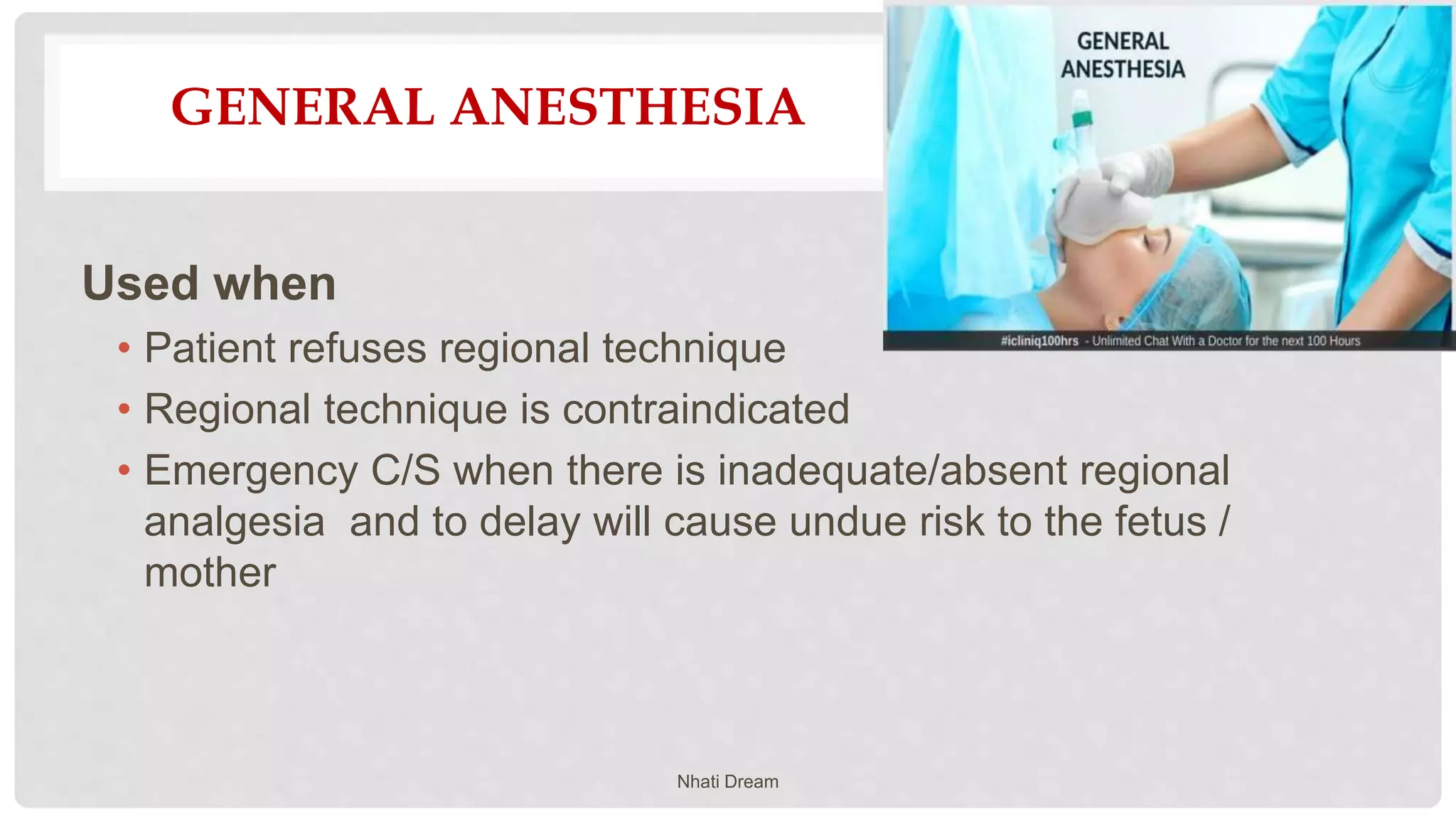
GENERAL ANESTHESIA
Used when
• Patient refuses regional technique
• Regional technique is contraindicated
• Emergency C/S when there is inadequate/absent regional
analgesia and to delay will cause undue risk to the fetus /
mother
Nhati Dream
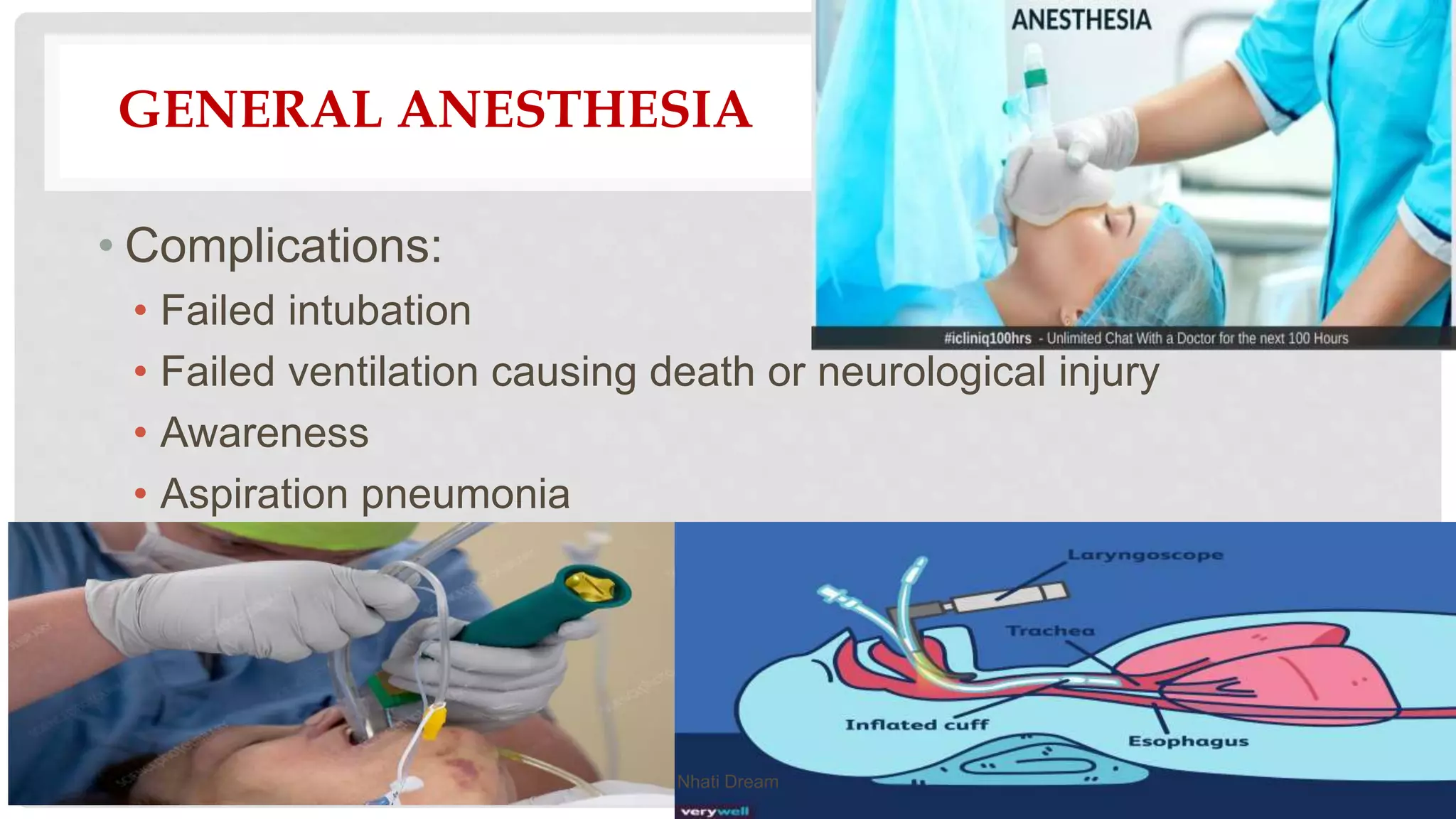
GENERAL ANESTHESIA
• Complications:
• Failed intubation
• Failed ventilation causing death or neurological injury
• Awareness
• Aspiration pneumonia
Nhati Dream
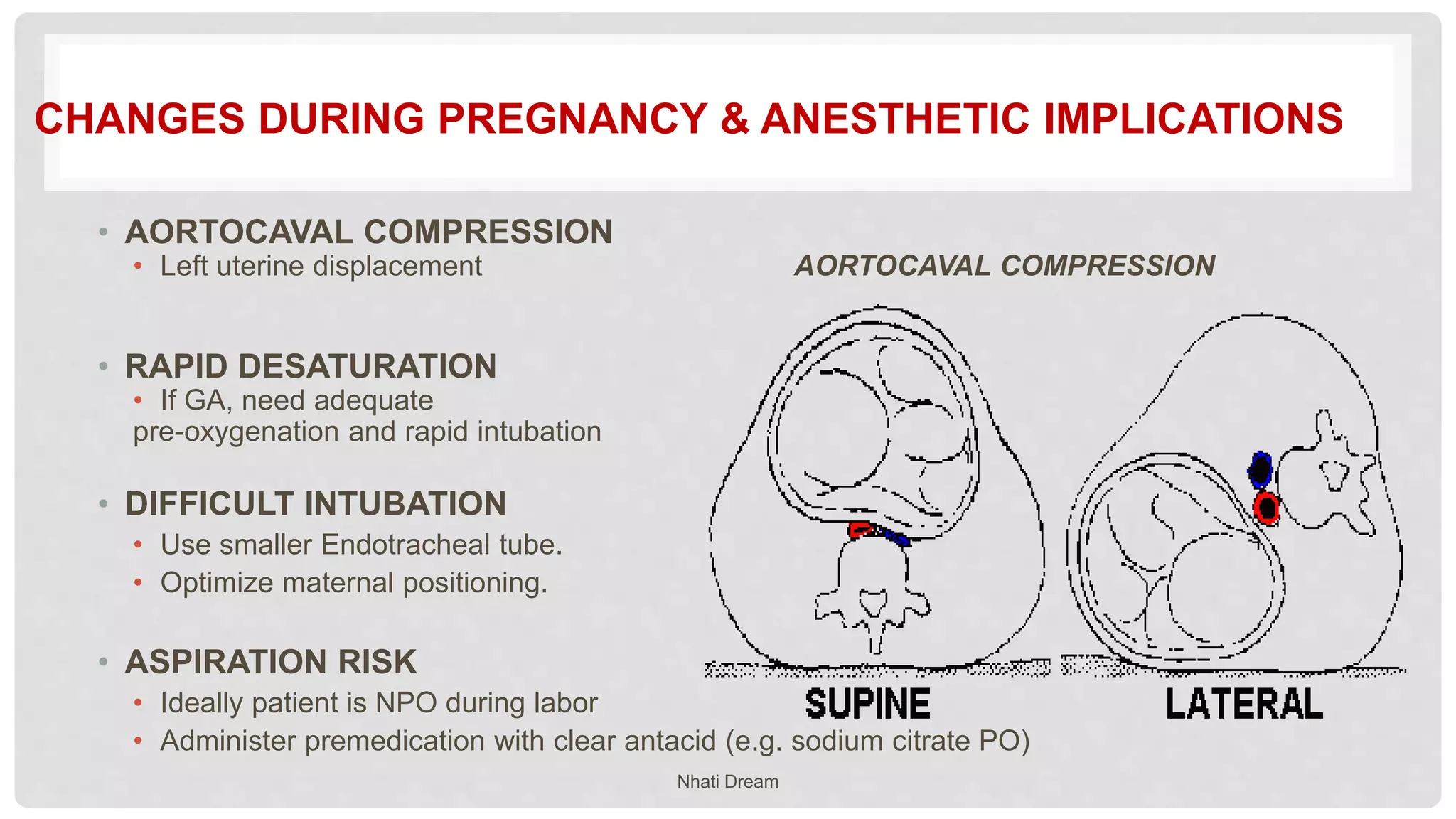
CHANGES DURING PREGNANCY & ANESTHETIC IMPLICATIONS
• AORTOCAVAL COMPRESSION
• Left uterine displacement AORTOCAVAL COMPRESSION
• RAPID DESATURATION
• If GA, need adequate
pre-oxygenation and rapid intubation
• DIFFICULT INTUBATION
• Use smaller Endotracheal tube.
• Optimize maternal positioning.
• ASPIRATION RISK
• Ideally patient is NPO during labor
• Administer premedication with clear antacid (e.g. sodium citrate PO)
Nhati Dream
REFERENCE
Nhati Dream
THANK YOU
Nhati Dream

Obstetric Anesthesia ppt [ Natnael Dechasa ].pptx

  • 1.
  • 2.
    ANALGESIA FOR LABORAND DELIVERY Contents/outline/ • Where is the pain coming from? • Is pain bad in labor? • What are analgesic options ? Nhati Dream
  • 3.
    PAIN OF CHILDBIRTH Nociceptivepathways involved  T10 – L1 during labor &  S2-S4 for delivery NB# 10 ml of lignocaine 1% is injected into the episiotomy by injection around it. Nhati Dream
  • 4.
    PAIN OF CHILDBIRTH… Psychologicalstress can cause: increased levels of catecholamines & hyperventilation These may result in decreased uterine blood flow leading to hypoxia and acidosis in the fetus. NB# Catecholamines are important neurohormone in stress responses. High levels cause high blood pressure which can lead to headaches, sweating, pounding of the heart, pain in the chest, and anxiety. E.g. Dopamine, epinephrine (adrenaline) Nhati Dream
  • 5.
    FACTORS AFFECTING PAINPERCEPTION IN LABOR • Mental preparation • Family support • Medical support • Cultural expectations • Underlying mental status • Parity • Size and presentation of the fetus • Maternal pelvic anatomy • Duration of labor • Medications Nhati Dream
  • 6.
    ANALGESIA FOR LABORAND DELIVERY • Non-medication • Inhalational • Parenteral • Regional Nhati Dream
  • 7.
    ANALGESIA- NON MEDICATIONOPTIONS • Hypnosis • Breathing exercises • White Noise/ Music • Massage/ walking • Water bath Nhati Dream
  • 8.
    HYPNOBIRTHING • The laboringperson uses positive affirmations, suggestions, and visualizations to relax their body, guide their thoughts, and control breathing. • This can be done through self-hypnosis or by receiving assistance from a hypnotherapist. Nhati Dream
  • 9.
    BREATHING EXERCISES • Putone hand on your belly just below your ribs and the other hand on your chest. • Take a deep breath in through your nose, and let your belly push your hand out. Your chest should not move. • Breathe out through pursed lips as if you were whistling. • Do this breathing in between or during contractions. • • st. Nhati Dream
  • 10.
    WHITE NOISE/ MUSIC •Audio analgesia, or using music, white noise or environmental sounds like waves crashing, boosts mood, reduces anxiety and stress, and can lessen pain during labor. Nhati Dream
  • 11.
  • 12.
    WATER BATHING  Warmwater immersion in labour can diminish stress hormones (catecholamines) and reduce pain by increasing the body's production of pain relievers (endorphins). Nhati Dream
  • 13.
    RARELY …USED Aromatherapy, • Essentialoils can help reduce sensations of labor pain, as well as nausea, vomiting, and headaches. Acupuncture. • It's used to promote labor, ease labor pain, and reduce obstruction. • Acupuncture can be especially helpful to ripen the cervix, release oxytocin, and encourage a more natural, efficient labor. Others… Nhati Dream
  • 14.
    INHALATION MEDICATIONS/#/ • Nitronox:50:50 mixture of oxygen and nitrous oxide • Low dose Isoflurane in oxygen. Advantages: on demand delivery, relatively safe Disadvantages: variable efficacy, nausea, drowsiness, neonatal depression Nhati Dream
  • 15.
  • 16.
     Good forthe pain of cervical dilation phase but no help for the perineum  3-5cc in each site( always aspirate 1st)  Complications are lacerations, intravascular injection, Parametrial hematoma, abscess, and hypotension Fetal complications of para cervical block Up to 70% get bradycardic (last 2-10min) PARA CERVICAL BLOCK Nhati Dream
  • 17.
  • 18.
    PUDENDAL BLOCK • Transvaginallyor transperineal • Use a needle guide (Iowa trumpet) • 7-10cc each side of lidocaine1% or chlorprocaine 2% • For pelvic outlet manipulations(2nd stage) Complications of Pudendal blocks Systemic toxicity(IV) Vaginal laceration Vaginal or ischiorectal hematoma Retro psoas or sub gluteal abscess Nhati Dream
  • 19.
    PUDENDAL BLOCK  7-10cceach side of lidocaine1% or chlorprocaine 2% To relieve pain during the second (pushing) stage of labour, an injection called a pudendal block can be given through the vaginal wall and into the pudendal nerve in the pelvis. Nhati Dream
  • 20.
    PERINEAL INFILTRATION • Localinfiltration of the perineum is a simple and commonly used technique for providing pain relief for episiotomy & repair of perineal lacerations • Most common anesthetic • Best choice is lidocaine Nhati Dream
  • 21.
    EPIDURAL ANESTHESIA  Bestanesthesia for PIH  More technically challenging  Slower onset  Need prior IV hydration  Continuous monitoring of the FHR and contractions  Used in SVDs & CS  Used for CS when already placed for labor analgesia  Placed at L2-3 or L3-4  Continuous infusion better than boluses  15mg/hrBupivicaine and Chlorprocaine have become the agents of choice for epidural anesthesia (IV of either can cause cardiac collapse and death  Continuous infusion better than boluses Nhati Dream
  • 22.
    EPIDURAL ANESTHESIA Potential Complications: •Hypotension • Headache (approx 1:100) • Transient backache ~24hrs • Urinary retention • Unintentional spinal injection • Intravascular injection of local anesthetic • Neurological damage • Infection Nhati Dream
  • 23.
    ANEST…FOR CAESAREAN SECTION Contents •Preparation • Preventing complications • Choice of Anesthetic technique • Effects on the fetus Nhati Dream
  • 24.
    PREPARATION • Premeds: antacid(sodium citrate) • IV access and fluid bolus within 30 minutes of operating . • Left lateral tilt with wedge under right pelvis • Routine Monitors: pulse oximeter, fetal monitoring Nhati Dream
  • 25.
    PREVENTING COMPLICATIONS • Aspirationprophylaxis • Detailed airway assessment • Fluid resuscitation/left lateral tilt to prevent hypotension • Safe practice for placement of neuraxial blocks. Nhati Dream
  • 26.
    ANESTHETIC TECHNIQUES • Localinfiltration by surgeon • Regional anesthesia: spinal, epidural, combined spinal-epidural • General anesthesia Nhati Dream
  • 27.
    LOCAL INFILTRATION • Rarelyperformed • Patient usually in extremis • Surgery must be done via midline incision, gentle retraction, no exteriorization of the uterus • Usually done to supplement a regional technique if local anesthetic toxicity not a concern Nhati Dream
  • 28.
    SPINAL ANESTHESIA  Administeredin the subdural space  Simple to perform  Rapid onset  Single shot technique  Profound neural block  Technique of choice for caesarian section  Considered to intersect the body of L4 or the L4-L5 intervertebral space.  In younger children, it passes through L5 –S1. Nhati Dream
  • 29.
    SPINAL ANESTHESIA Potential Complications: •Hypotension • Headache (rare ~1:100) • Backache (temporary ~24hrs) • Nausea/vomiting (secondary to BP, narcotics) • Neurological damage (very rare) • Anaphylaxis (very rare) Nhati Dream
  • 30.
    COMBINED SPINAL-EPIDURAL • Usedwhen require the speed and density of a spinal anesthetic with the flexibility of prolonging the block by supplemental increments of local anesthesia via the epidural catheter • Complications: as mentioned for spinals and epidurals Nhati Dream
  • 31.
    LANDMARKS & ANATOMY T7 T12-L1 L4 S2 Thestandard positions recommended for an spinal anesthetic injection are  Sitting and lateral decubitus positions with an optimal flexion of the back. Nhati Dream
  • 32.
    HIGH/TOTAL SPINAL • Mechanism:Blockade of neuronal transmission in the cervical spinal cord and brainstem. • Risk Factors • Prior Epidural • Large spinal anesthetic dose • Immediate supine positioning • Increased intra-abdominal pressure (pregnancy and truncal obesity) • Management: MOSTLY SUPPORTIVE! Nhati Dream
  • 33.
    HEMODYNAMIC COMPROMISE 1. HYPOTENSION •IV Fluid bolus • Vasopressors: Ephedrine, phenylephrine • Left lateral tilt 2. BRADYCARDIA • Atropine 0.5mg IV, may repeat if necessary • Epinephrine 50-100 mcg IV,preferred, especially if severe hypotension or unresponsive to other vasopressors. Nhati Dream
  • 34.
    GENERAL ANESTHESIA Used when •Patient refuses regional technique • Regional technique is contraindicated • Emergency C/S when there is inadequate/absent regional analgesia and to delay will cause undue risk to the fetus / mother Nhati Dream
  • 35.
    GENERAL ANESTHESIA • Complications: •Failed intubation • Failed ventilation causing death or neurological injury • Awareness • Aspiration pneumonia Nhati Dream
  • 36.
    CHANGES DURING PREGNANCY& ANESTHETIC IMPLICATIONS • AORTOCAVAL COMPRESSION • Left uterine displacement AORTOCAVAL COMPRESSION • RAPID DESATURATION • If GA, need adequate pre-oxygenation and rapid intubation • DIFFICULT INTUBATION • Use smaller Endotracheal tube. • Optimize maternal positioning. • ASPIRATION RISK • Ideally patient is NPO during labor • Administer premedication with clear antacid (e.g. sodium citrate PO) Nhati Dream
  • 37.
  • 38.