P, NP, and NP-Complete
Prepared by
Md. Shafiuzzaman, Lecturer,
Dept. of CSE, JUST
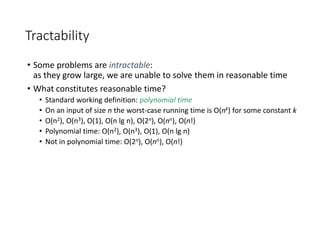
Tractability
• Some problems are intractable:
as they grow large, we are unable to solve them in reasonable time
• What constitutes reasonable time?
• Standard working definition: polynomial time
• On an input of size n the worst-case running time is O(nk) for some constant k
• O(n2), O(n3), O(1), O(n lg n), O(2n), O(nn), O(n!)
• Polynomial time: O(n2), O(n3), O(1), O(n lg n)
• Not in polynomial time: O(2n), O(nn), O(n!)
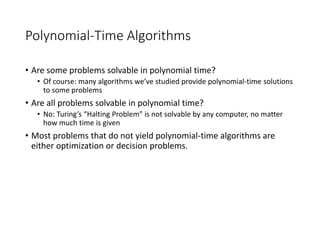
Polynomial-Time Algorithms
• Are some problems solvable in polynomial time?
• Of course: many algorithms we’ve studied provide polynomial-time solutions
to some problems
• Are all problems solvable in polynomial time?
• No: Turing’s “Halting Problem” is not solvable by any computer, no matter
how much time is given
• Most problems that do not yield polynomial-time algorithms are
either optimization or decision problems.
Optimization/Decision Problems
• Optimization Problems
• An optimization problem is one which asks, “What is the optimal solution to
problem X?”
• Examples:
• 0-1 Knapsack
• Fractional Knapsack
• Minimum Spanning Tree
• Decision Problems
• An decision problem is one with yes/no answer
• Examples:
• Does a graph G have a MST of weight  W?
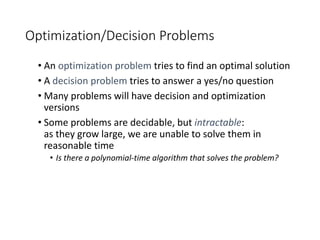
Optimization/Decision Problems
• An optimization problem tries to find an optimal solution
• A decision problem tries to answer a yes/no question
• Many problems will have decision and optimization
versions
• Some problems are decidable, but intractable:
as they grow large, we are unable to solve them in
reasonable time
• Is there a polynomial-time algorithm that solves the problem?
The Class P
P: the class of decision problems that have polynomial-time
deterministic algorithms.
• That is, they are solvable in O(p(n)), where p(n) is a polynomial on n
• A deterministic algorithm is (essentially) one that always computes the
correct answer
Why polynomial?
• if not, very inefficient
• nice closure properties
• the sum and composition of two polynomials are always polynomials too
Sample Problems in P
• Fractional Knapsack
• MST
• Sorting
• Others?
The class NP
NP: the class of decision problems that are solvable in polynomial
time on a nondeterministic machine (or with a nondeterministic
algorithm)
• (A determinstic computer is what we know)
• A nondeterministic computer is one that can “guess” the right
answer or solution
• Think of a nondeterministic computer as a parallel machine that can
freely spawn an infinite number of processes
• Thus NP can also be thought of as the class of problems
• whose solutions can be verified in polynomial time
• Note that NP stands for “Nondeterministic Polynomial-time”
Sample Problems in NP
• Fractional Knapsack
• MST
• Sorting
• Others?
• Hamiltonian Cycle (Traveling Salesman)
• Graph Coloring
• Satisfiability (SAT)
• the problem of deciding whether a given
Boolean formula is satisfiable
Review: P And NP Summary
• P = set of problems that can be solved in polynomial time
• Examples: Fractional Knapsack, …
• NP = set of problems for which a solution can be verified in
polynomial time
• Examples: Fractional Knapsack,…, Hamiltonian Cycle, CNF SAT, 3-CNF SAT
• Clearly P  NP
• Open question: Does P = NP?
• Most suspect not
• An August 2010 claim of proof that P ≠ NP, by Vinay Deolalikar, researcher at
HP Labs, Palo Alto, has flaws
NP-complete problems
• A decision problem D is NP-complete iff
1. D  NP
2. every problem in NP is polynomial-time reducible to D
• Cook’s theorem (1971): CNF-sat is NP-complete
Reduction
• A problem R can be reduced to another problem Q if any instance of R can be
rephrased to an instance of Q, the solution to which provides a solution to
the instance of R
• This rephrasing is called a transformation
• Intuitively: If R reduces in polynomial time to Q, R is “no harder to solve”
than Q
NP-Hard and NP-Complete
• If R is polynomial-time reducible to Q, we denote this R p Q
• Definition of NP-Hard and NP-Complete:
• If all problems R  NP are polynomial-time reducible to Q, then Q is NP-Hard
• We say Q is NP-Complete if Q is NP-Hard
and Q  NP

Np complete

  • 1.
    P, NP, andNP-Complete Prepared by Md. Shafiuzzaman, Lecturer, Dept. of CSE, JUST
  • 2.
    Tractability • Some problemsare intractable: as they grow large, we are unable to solve them in reasonable time • What constitutes reasonable time? • Standard working definition: polynomial time • On an input of size n the worst-case running time is O(nk) for some constant k • O(n2), O(n3), O(1), O(n lg n), O(2n), O(nn), O(n!) • Polynomial time: O(n2), O(n3), O(1), O(n lg n) • Not in polynomial time: O(2n), O(nn), O(n!)
  • 3.
    Polynomial-Time Algorithms • Aresome problems solvable in polynomial time? • Of course: many algorithms we’ve studied provide polynomial-time solutions to some problems • Are all problems solvable in polynomial time? • No: Turing’s “Halting Problem” is not solvable by any computer, no matter how much time is given • Most problems that do not yield polynomial-time algorithms are either optimization or decision problems.
  • 4.
    Optimization/Decision Problems • OptimizationProblems • An optimization problem is one which asks, “What is the optimal solution to problem X?” • Examples: • 0-1 Knapsack • Fractional Knapsack • Minimum Spanning Tree • Decision Problems • An decision problem is one with yes/no answer • Examples: • Does a graph G have a MST of weight  W?
  • 5.
    Optimization/Decision Problems • Anoptimization problem tries to find an optimal solution • A decision problem tries to answer a yes/no question • Many problems will have decision and optimization versions • Some problems are decidable, but intractable: as they grow large, we are unable to solve them in reasonable time • Is there a polynomial-time algorithm that solves the problem?
  • 6.
    The Class P P:the class of decision problems that have polynomial-time deterministic algorithms. • That is, they are solvable in O(p(n)), where p(n) is a polynomial on n • A deterministic algorithm is (essentially) one that always computes the correct answer Why polynomial? • if not, very inefficient • nice closure properties • the sum and composition of two polynomials are always polynomials too
  • 7.
    Sample Problems inP • Fractional Knapsack • MST • Sorting • Others?
  • 8.
    The class NP NP:the class of decision problems that are solvable in polynomial time on a nondeterministic machine (or with a nondeterministic algorithm) • (A determinstic computer is what we know) • A nondeterministic computer is one that can “guess” the right answer or solution • Think of a nondeterministic computer as a parallel machine that can freely spawn an infinite number of processes • Thus NP can also be thought of as the class of problems • whose solutions can be verified in polynomial time • Note that NP stands for “Nondeterministic Polynomial-time”
  • 9.
    Sample Problems inNP • Fractional Knapsack • MST • Sorting • Others? • Hamiltonian Cycle (Traveling Salesman) • Graph Coloring • Satisfiability (SAT) • the problem of deciding whether a given Boolean formula is satisfiable
  • 10.
    Review: P AndNP Summary • P = set of problems that can be solved in polynomial time • Examples: Fractional Knapsack, … • NP = set of problems for which a solution can be verified in polynomial time • Examples: Fractional Knapsack,…, Hamiltonian Cycle, CNF SAT, 3-CNF SAT • Clearly P  NP • Open question: Does P = NP? • Most suspect not • An August 2010 claim of proof that P ≠ NP, by Vinay Deolalikar, researcher at HP Labs, Palo Alto, has flaws
  • 11.
    NP-complete problems • Adecision problem D is NP-complete iff 1. D  NP 2. every problem in NP is polynomial-time reducible to D • Cook’s theorem (1971): CNF-sat is NP-complete
  • 12.
    Reduction • A problemR can be reduced to another problem Q if any instance of R can be rephrased to an instance of Q, the solution to which provides a solution to the instance of R • This rephrasing is called a transformation • Intuitively: If R reduces in polynomial time to Q, R is “no harder to solve” than Q
  • 13.
    NP-Hard and NP-Complete •If R is polynomial-time reducible to Q, we denote this R p Q • Definition of NP-Hard and NP-Complete: • If all problems R  NP are polynomial-time reducible to Q, then Q is NP-Hard • We say Q is NP-Complete if Q is NP-Hard and Q  NP