NP-Completeness
NP-Completeness
•NP-completeness means that many important
problems can not be solved quickly in polynomial
time
•NP-complete problem, any of a class of
computational problems for which no efficient
solution algorithm has been found.
•Many significant computer-science problems belong
to this class—e.g., the traveling salesman problem,
satisfiability problems, and graph-
covering problems.
How to solve NP-Complete problems
• Use a heuristic: come up with a method for solving a
reasonable fraction of the common cases.
• Solve approximately: come up with a solution that you
can prove that is close to right.
• Use an exponential time solution: if you really have to
solve the problem exactly and stop worrying about finding
a better solution
4
Optimization & Decision Problems
• Decision problems
• Given an input and a question regarding a problem,
determine if the answer is yes or no
• Optimization problems
• Find a solution with the “best” value
• Optimization problems can be cast as decision
problems that are easier to study
• E.g.: Shortest path: G = unweighted directed graph
• Find a path between u and v that uses the fewest edges
• Does a path exist from u to v consisting of at most k edges?
5
Algorithmic vs Problem Complexity
• The algorithmic complexity of a computation is some measure of
how difficult is to perform the computation (i.e., specific to an
algorithm)
• The complexity of a computational problem or task is the complexity
of the algorithm with the lowest order of growth of complexity for
solving that problem or performing that task.
• e.g. the problem of searching an ordered list has at most lgn time complexity.
• Computational Complexity: deals with classifying problems by how
hard they are.
6
Class of “P” Problems
• Class P consists of (decision) problems that are solvable
in polynomial time
• Polynomial-time algorithms
• Worst-case running time is O(nk), for some constant k
• Examples of polynomial time:
• O(n2), O(n3), O(1), O(n lg n)
• Examples of non-polynomial time:
• O(2n), O(nn), O(n!)
7
Tractable/Intractable Problems
• Problems in P are also called tractable
• Problems not in P are intractable or unsolvable
• Can be solved in reasonable time only for small inputs
• Or, can not be solved at all
• Are non-polynomial algorithms always worst than
polynomial algorithms?
- n1,000,000 is technically tractable, but really impossible - nlog
log log n is technically intractable, but easy
8
Example of Unsolvable Problem
• Turing discovered in the 1930’s that there are problems unsolvable
by any algorithm.
• The most famous of them is the halting problem
• Given an arbitrary algorithm and its input, will that algorithm eventually halt,
or will it continue forever in an “infinite loop?”
9
Examples of Intractable Problems
10
Intractable Problems
• Can be classified in various categories based on their degree of
difficulty, e.g.,
• NP
• NP-complete
• NP-hard
• Let’s define NP algorithms and NP problems …
11
Nondeterministic and NP Algorithms
Nondeterministic algorithm = two stage procedure:
1) Nondeterministic (“guessing”) stage:
generate randomly an arbitrary string that can be thought
of as a candidate solution (“certificate”)
2) Deterministic (“verification”) stage:
take the certificate and the instance to the problem and
returns YES if the certificate represents a solution
NP algorithms (Nondeterministic polynomial)
verification stage is polynomial
12
Class of “NP” Problems
• Class NP consists of problems that could be solved by
NP algorithms
• i.e., verifiable in polynomial time
• If we were given a “certificate” of a solution, we could
verify that the certificate is correct in time polynomial
to the size of the input
• Warning: NP does not mean “non-polynomial”
13
E.g.: Hamiltonian Cycle
• Given: a directed graph G = (V, E), determine a simple cycle that
contains each vertex in V
• Each vertex can only be visited once
• Certificate:
• Sequence: v1, v2, v3, …, v|V|
hamiltonian
not
hamiltonian
14
Is P = NP?
• Any problem in P is also in NP:
P  NP
• The big (and open question) is whether NP  P or P = NP
• i.e., if it is always easy to check a solution, should it also be easy to find a
solution?
• Most computer scientists believe that this is false but we do not have
a proof …
P
NP
15
NP-Completeness (informally)
• NP-complete problems are
defined as the hardest
problems in NP
• Most practical problems turn out to be either P or NP-complete.
• Study NP-complete problems …
P
NP
NP-complete
16
Reductions
• Reduction is a way of saying that one problem is “easier”
than another.
• We say that problem A is easier than problem B,
(i.e., we write “A  B”)
if we can solve A using the algorithm that solves B.
• Idea: transform the inputs of A to inputs of B
f Problem B
  yes
no
yes
no
Problem A
17
Polynomial Reductions
• Given two problems A, B, we say that A is polynomially reducible to
B (A p B) if:
1. There exists a function f that converts the input of A to inputs of B in
polynomial time
2. A(i) = YES  B(f(i)) = YES
18
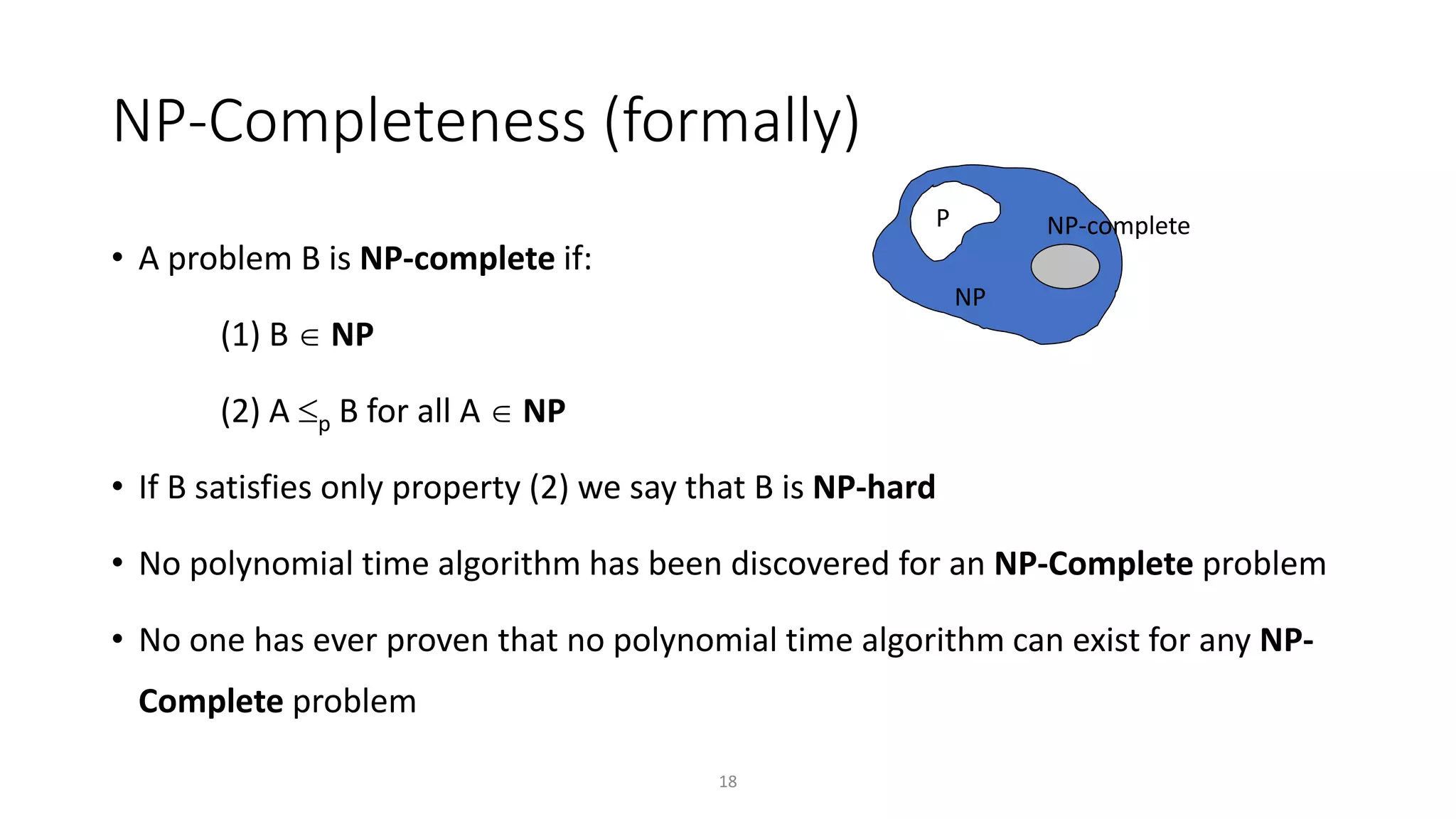
NP-Completeness (formally)
• A problem B is NP-complete if:
(1) B  NP
(2) A p B for all A  NP
• If B satisfies only property (2) we say that B is NP-hard
• No polynomial time algorithm has been discovered for an NP-Complete problem
• No one has ever proven that no polynomial time algorithm can exist for any NP-
Complete problem
P
NP
NP-complete
19
Implications of Reduction
- If A p B and B  P, then A  P
- if A p B and A  P, then B  P
f Problem B
  yes
no
yes
no
Problem A
20
Proving Polynomial Time
1. Use a polynomial time reduction algorithm to
transform A into B
2. Run a known polynomial time algorithm for B
3. Use the answer for B as the answer for A
Polynomial time algorithm to decide A
f Polynomial time
algorithm to decide B
  yes
no
yes
no
22
Proving NP-Completeness In Practice
• Prove that the problem B is in NP
• A randomly generated string can be checked in polynomial time to determine
if it represents a solution
• Show that one known NP-Complete problem can be transformed to B
in polynomial time
• No need to check that all NP-Complete problems are reducible to B
23
Revisit “Is P = NP?”
Theorem: If any NP-Complete problem can be solved in polynomial time
 then P = NP.
P
NP
NP-complete
24
P & NP-Complete Problems
• Shortest simple path
• Given a graph G = (V, E) find a shortest path from a source to all other vertices
• Polynomial solution: O(VE)
• Longest simple path
• Given a graph G = (V, E) find a longest path from a source to all other vertices
• NP-complete
25
P & NP-Complete Problems
• Euler tour
• G = (V, E) a connected, directed graph find a cycle that traverses each edge of
G exactly once (may visit a vertex multiple times)
• Polynomial solution O(E)
• Hamiltonian cycle
• G = (V, E) a connected, directed graph find a cycle that visits each vertex of G
exactly once
• NP-complete
29
Clique
Clique Problem:
• Undirected graph G = (V, E)
• Clique: a subset of vertices in V all connected to each other
by edges in E (i.e., forming a complete graph)
• Size of a clique: number of vertices it contains
Optimization problem:
• Find a clique of maximum size
Decision problem:
• Does G have a clique of size k?
Clique(G, 2) = YES
Clique(G, 3) = NO
Clique(G, 3) = YES
Clique(G, 4) = NO
30
Clique Verifier
• Given: an undirected graph G = (V, E)
• Problem: Does G have a clique of size k?
• Certificate:
• A set of k nodes
• Verifier:
• Verify that for all pairs of vertices in this set there exists an edge in E
31
3-CNF p Clique
• Idea:
• Construct a graph G such that  is satisfiable only if G has a
clique of size k
32
NP-naming convention
• NP-complete - means problems that are 'complete' in NP, i.e. the
most difficult to solve in NP
• NP-hard - stands for 'at least' as hard as NP (but not necessarily in
NP);
• NP-easy - stands for 'at most' as hard as NP (but not necessarily in
NP);
• NP-equivalent - means equally difficult as NP, (but not necessarily in
NP);
33
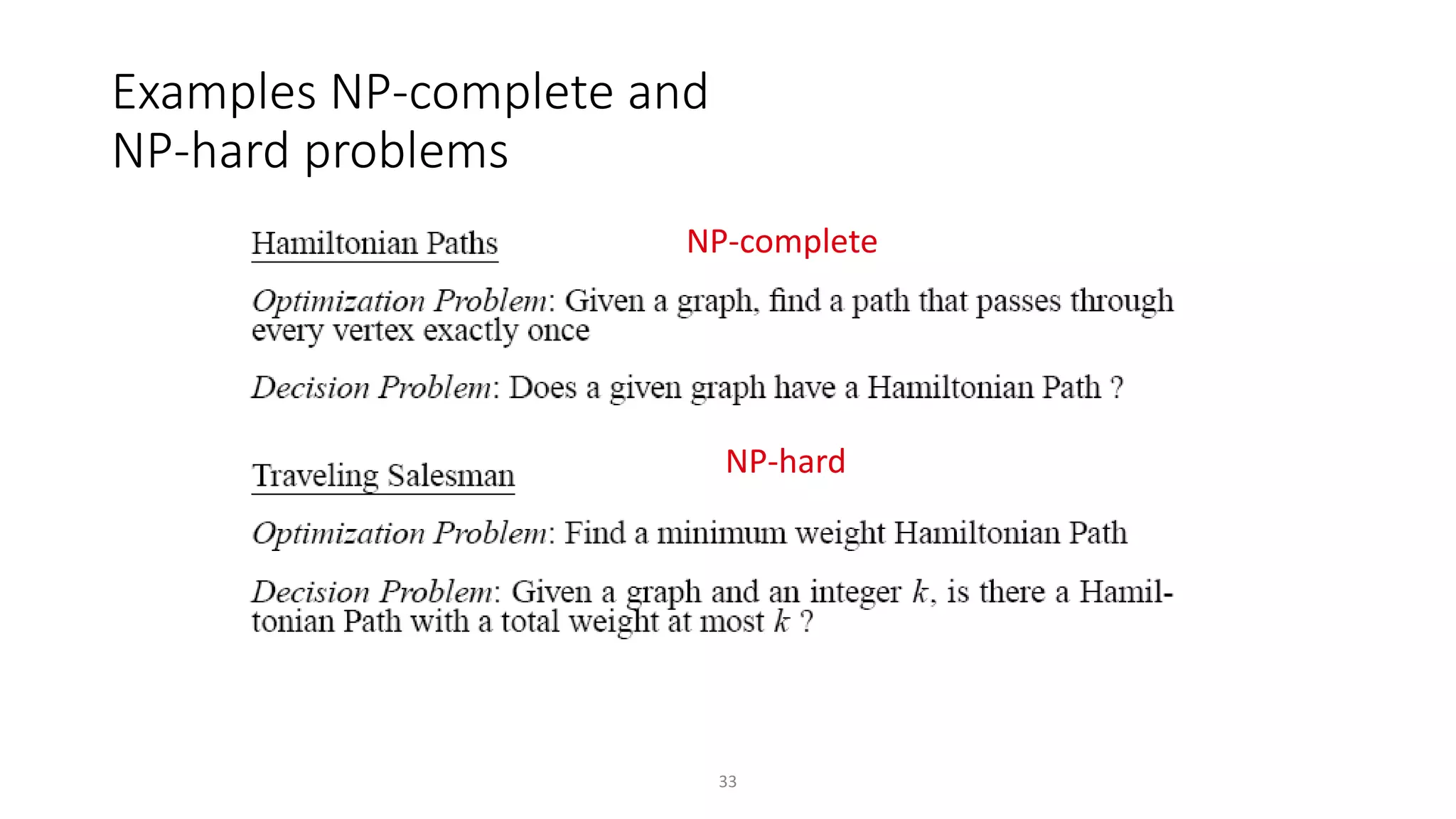
Examples NP-complete and
NP-hard problems
NP-complete
NP-hard

NP-Completeness-myppt.pptx

  • 1.
  • 2.
    NP-Completeness •NP-completeness means thatmany important problems can not be solved quickly in polynomial time •NP-complete problem, any of a class of computational problems for which no efficient solution algorithm has been found. •Many significant computer-science problems belong to this class—e.g., the traveling salesman problem, satisfiability problems, and graph- covering problems.
  • 3.
    How to solveNP-Complete problems • Use a heuristic: come up with a method for solving a reasonable fraction of the common cases. • Solve approximately: come up with a solution that you can prove that is close to right. • Use an exponential time solution: if you really have to solve the problem exactly and stop worrying about finding a better solution
  • 4.
    4 Optimization & DecisionProblems • Decision problems • Given an input and a question regarding a problem, determine if the answer is yes or no • Optimization problems • Find a solution with the “best” value • Optimization problems can be cast as decision problems that are easier to study • E.g.: Shortest path: G = unweighted directed graph • Find a path between u and v that uses the fewest edges • Does a path exist from u to v consisting of at most k edges?
  • 5.
    5 Algorithmic vs ProblemComplexity • The algorithmic complexity of a computation is some measure of how difficult is to perform the computation (i.e., specific to an algorithm) • The complexity of a computational problem or task is the complexity of the algorithm with the lowest order of growth of complexity for solving that problem or performing that task. • e.g. the problem of searching an ordered list has at most lgn time complexity. • Computational Complexity: deals with classifying problems by how hard they are.
  • 6.
    6 Class of “P”Problems • Class P consists of (decision) problems that are solvable in polynomial time • Polynomial-time algorithms • Worst-case running time is O(nk), for some constant k • Examples of polynomial time: • O(n2), O(n3), O(1), O(n lg n) • Examples of non-polynomial time: • O(2n), O(nn), O(n!)
  • 7.
    7 Tractable/Intractable Problems • Problemsin P are also called tractable • Problems not in P are intractable or unsolvable • Can be solved in reasonable time only for small inputs • Or, can not be solved at all • Are non-polynomial algorithms always worst than polynomial algorithms? - n1,000,000 is technically tractable, but really impossible - nlog log log n is technically intractable, but easy
  • 8.
    8 Example of UnsolvableProblem • Turing discovered in the 1930’s that there are problems unsolvable by any algorithm. • The most famous of them is the halting problem • Given an arbitrary algorithm and its input, will that algorithm eventually halt, or will it continue forever in an “infinite loop?”
  • 9.
  • 10.
    10 Intractable Problems • Canbe classified in various categories based on their degree of difficulty, e.g., • NP • NP-complete • NP-hard • Let’s define NP algorithms and NP problems …
  • 11.
    11 Nondeterministic and NPAlgorithms Nondeterministic algorithm = two stage procedure: 1) Nondeterministic (“guessing”) stage: generate randomly an arbitrary string that can be thought of as a candidate solution (“certificate”) 2) Deterministic (“verification”) stage: take the certificate and the instance to the problem and returns YES if the certificate represents a solution NP algorithms (Nondeterministic polynomial) verification stage is polynomial
  • 12.
    12 Class of “NP”Problems • Class NP consists of problems that could be solved by NP algorithms • i.e., verifiable in polynomial time • If we were given a “certificate” of a solution, we could verify that the certificate is correct in time polynomial to the size of the input • Warning: NP does not mean “non-polynomial”
  • 13.
    13 E.g.: Hamiltonian Cycle •Given: a directed graph G = (V, E), determine a simple cycle that contains each vertex in V • Each vertex can only be visited once • Certificate: • Sequence: v1, v2, v3, …, v|V| hamiltonian not hamiltonian
  • 14.
    14 Is P =NP? • Any problem in P is also in NP: P  NP • The big (and open question) is whether NP  P or P = NP • i.e., if it is always easy to check a solution, should it also be easy to find a solution? • Most computer scientists believe that this is false but we do not have a proof … P NP
  • 15.
    15 NP-Completeness (informally) • NP-completeproblems are defined as the hardest problems in NP • Most practical problems turn out to be either P or NP-complete. • Study NP-complete problems … P NP NP-complete
  • 16.
    16 Reductions • Reduction isa way of saying that one problem is “easier” than another. • We say that problem A is easier than problem B, (i.e., we write “A  B”) if we can solve A using the algorithm that solves B. • Idea: transform the inputs of A to inputs of B f Problem B   yes no yes no Problem A
  • 17.
    17 Polynomial Reductions • Giventwo problems A, B, we say that A is polynomially reducible to B (A p B) if: 1. There exists a function f that converts the input of A to inputs of B in polynomial time 2. A(i) = YES  B(f(i)) = YES
  • 18.
    18 NP-Completeness (formally) • Aproblem B is NP-complete if: (1) B  NP (2) A p B for all A  NP • If B satisfies only property (2) we say that B is NP-hard • No polynomial time algorithm has been discovered for an NP-Complete problem • No one has ever proven that no polynomial time algorithm can exist for any NP- Complete problem P NP NP-complete
  • 19.
    19 Implications of Reduction -If A p B and B  P, then A  P - if A p B and A  P, then B  P f Problem B   yes no yes no Problem A
  • 20.
    20 Proving Polynomial Time 1.Use a polynomial time reduction algorithm to transform A into B 2. Run a known polynomial time algorithm for B 3. Use the answer for B as the answer for A Polynomial time algorithm to decide A f Polynomial time algorithm to decide B   yes no yes no
  • 21.
    22 Proving NP-Completeness InPractice • Prove that the problem B is in NP • A randomly generated string can be checked in polynomial time to determine if it represents a solution • Show that one known NP-Complete problem can be transformed to B in polynomial time • No need to check that all NP-Complete problems are reducible to B
  • 22.
    23 Revisit “Is P= NP?” Theorem: If any NP-Complete problem can be solved in polynomial time  then P = NP. P NP NP-complete
  • 23.
    24 P & NP-CompleteProblems • Shortest simple path • Given a graph G = (V, E) find a shortest path from a source to all other vertices • Polynomial solution: O(VE) • Longest simple path • Given a graph G = (V, E) find a longest path from a source to all other vertices • NP-complete
  • 24.
    25 P & NP-CompleteProblems • Euler tour • G = (V, E) a connected, directed graph find a cycle that traverses each edge of G exactly once (may visit a vertex multiple times) • Polynomial solution O(E) • Hamiltonian cycle • G = (V, E) a connected, directed graph find a cycle that visits each vertex of G exactly once • NP-complete
  • 25.
    29 Clique Clique Problem: • Undirectedgraph G = (V, E) • Clique: a subset of vertices in V all connected to each other by edges in E (i.e., forming a complete graph) • Size of a clique: number of vertices it contains Optimization problem: • Find a clique of maximum size Decision problem: • Does G have a clique of size k? Clique(G, 2) = YES Clique(G, 3) = NO Clique(G, 3) = YES Clique(G, 4) = NO
  • 26.
    30 Clique Verifier • Given:an undirected graph G = (V, E) • Problem: Does G have a clique of size k? • Certificate: • A set of k nodes • Verifier: • Verify that for all pairs of vertices in this set there exists an edge in E
  • 27.
    31 3-CNF p Clique •Idea: • Construct a graph G such that  is satisfiable only if G has a clique of size k
  • 28.
    32 NP-naming convention • NP-complete- means problems that are 'complete' in NP, i.e. the most difficult to solve in NP • NP-hard - stands for 'at least' as hard as NP (but not necessarily in NP); • NP-easy - stands for 'at most' as hard as NP (but not necessarily in NP); • NP-equivalent - means equally difficult as NP, (but not necessarily in NP);
  • 29.
    33 Examples NP-complete and NP-hardproblems NP-complete NP-hard