P, NP, NP-Hard & NP-complete
problems
Prof. Shaik Naseera
Department of CSE
JNTUACEK, Kalikiri
1
Objectives
• P, NP, NP-Hard and NP-Complete
• Solving 3-CNF Sat problem
• Discussion of Gate Questions
2
Types of Problems
• Trackable
• Intrackable
• Decision
• Optimization
3
Trackable : Problems that can be solvable
in a reasonable(polynomial) time.
Intrackable : Some problems are
intractable, as they grow large, we are
unable to solve them in reasonable time.
Tractability
• What constitutes reasonable time?
– Standard working definition: polynomial time
– On an input of size n the worst-case running
time is O(nk) for some constant k
– O(n2), O(n3), O(1), O(n lg n), O(2n), O(nn), O(n!)
– Polynomial time: O(n2), O(n3), O(1), O(n lg n)
– Not in polynomial time: O(2n), O(nn), O(n!)
• Are all problems solvable in polynomial
time?
– No: Turing’s “Halting Problem” is not solvable
by any computer, no matter how much time is
given.
4
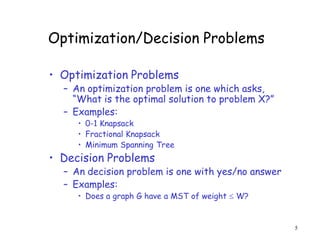
Optimization/Decision Problems
• Optimization Problems
– An optimization problem is one which asks,
“What is the optimal solution to problem X?”
– Examples:
• 0-1 Knapsack
• Fractional Knapsack
• Minimum Spanning Tree
• Decision Problems
– An decision problem is one with yes/no answer
– Examples:
• Does a graph G have a MST of weight  W?
5
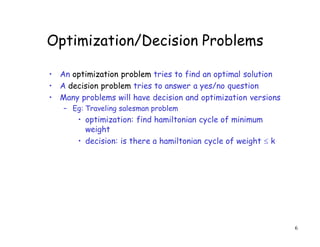
Optimization/Decision Problems
• An optimization problem tries to find an optimal solution
• A decision problem tries to answer a yes/no question
• Many problems will have decision and optimization versions
– Eg: Traveling salesman problem
• optimization: find hamiltonian cycle of minimum
weight
• decision: is there a hamiltonian cycle of weight  k
6
P, NP, NP-Hard, NP-Complete
-Definitions
7
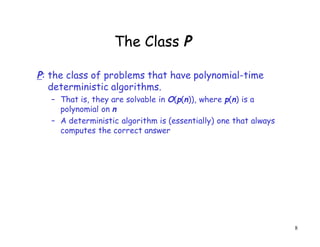
The Class P
P: the class of problems that have polynomial-time
deterministic algorithms.
– That is, they are solvable in O(p(n)), where p(n) is a
polynomial on n
– A deterministic algorithm is (essentially) one that always
computes the correct answer
8
Sample Problems in P
• Fractional Knapsack
• MST
• Sorting
• Others?
9
The class NP
NP: the class of decision problems that are solvable in
polynomial time on a nondeterministic machine (or with
a nondeterministic algorithm)
– (A determinstic computer is what we know)
– A nondeterministic computer is one that can “guess” the right
answer or solution
• Think of a nondeterministic computer as a parallel
machine that can freely spawn an infinite number of
processes
• Thus NP can also be thought of as the class of
problems “whose solutions can be verified in polynomial time”
• Note that NP stands for “Nondeterministic
Polynomial-time”
10
Sample Problems in NP
• Fractional Knapsack
• MST
• Others?
– Traveling Salesman
– Graph Coloring
– Satisfiability (SAT)
• the problem of deciding whether a given
Boolean formula is satisfiable
11
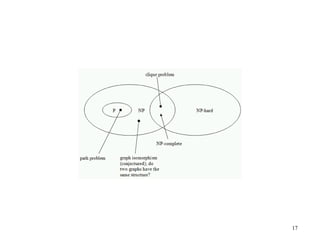
P And NP Summary
• P = set of problems that can be solved in
polynomial time
– Examples: Fractional Knapsack, …
• NP = set of problems for which a solution can be
verified in polynomial time
– Examples: Fractional Knapsack,…, TSP, CNF
SAT, 3-CNF SAT
• Clearly P  NP
• Open question: Does P = NP?
– P ≠ NP
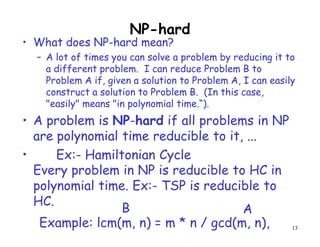
NP-hard
• What does NP-hard mean?
– A lot of times you can solve a problem by reducing it to
a different problem. I can reduce Problem B to
Problem A if, given a solution to Problem A, I can easily
construct a solution to Problem B. (In this case,
"easily" means "in polynomial time.“).
• A problem is NP-hard if all problems in NP
are polynomial time reducible to it, ...
•
Every problem in NP is reducible to HC in
polynomial time. Ex:- TSP is reducible to
HC.
13
Example: lcm(m, n) = m * n / gcd(m, n),
B A
Ex:- Hamiltonian Cycle
NP-complete problems
• A problem is NP-complete if the problem is
both
– NP-hard, and
– NP.
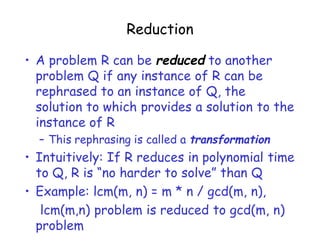
Reduction
• A problem R can be reduced to another
problem Q if any instance of R can be
rephrased to an instance of Q, the
solution to which provides a solution to the
instance of R
– This rephrasing is called a transformation
• Intuitively: If R reduces in polynomial time
to Q, R is “no harder to solve” than Q
• Example: lcm(m, n) = m * n / gcd(m, n),
lcm(m,n) problem is reduced to gcd(m, n)
problem
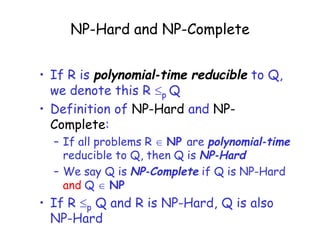
NP-Hard and NP-Complete
• If R is polynomial-time reducible to Q,
we denote this R p Q
• Definition of NP-Hard and NP-
Complete:
– If all problems R  NP are polynomial-time
reducible to Q, then Q is NP-Hard
– We say Q is NP-Complete if Q is NP-Hard
and Q  NP
• If R p Q and R is NP-Hard, Q is also
NP-Hard
17
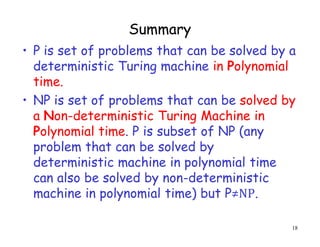
Summary
• P is set of problems that can be solved by a
deterministic Turing machine in Polynomial
time.
• NP is set of problems that can be solved by
a Non-deterministic Turing Machine in
Polynomial time. P is subset of NP (any
problem that can be solved by
deterministic machine in polynomial time
can also be solved by non-deterministic
machine in polynomial time) but P≠NP.
18
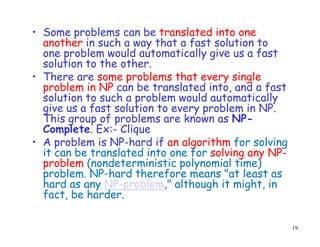
• Some problems can be translated into one
another in such a way that a fast solution to
one problem would automatically give us a fast
solution to the other.
• There are some problems that every single
problem in NP can be translated into, and a fast
solution to such a problem would automatically
give us a fast solution to every problem in NP.
This group of problems are known as NP-
Complete. Ex:- Clique
• A problem is NP-hard if an algorithm for solving
it can be translated into one for solving any NP-
problem (nondeterministic polynomial time)
problem. NP-hard therefore means "at least as
hard as any NP-problem," although it might, in
fact, be harder.
19
First NP-complete problem—
Circuit Satisfiability (problem
definition)
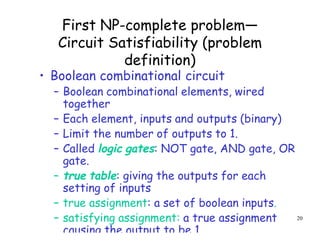
• Boolean combinational circuit
– Boolean combinational elements, wired
together
– Each element, inputs and outputs (binary)
– Limit the number of outputs to 1.
– Called logic gates: NOT gate, AND gate, OR
gate.
– true table: giving the outputs for each
setting of inputs
– true assignment: a set of boolean inputs.
– satisfying assignment: a true assignment
causing the output to be 1.
20
Circuit Satisfiability
Problem: definition
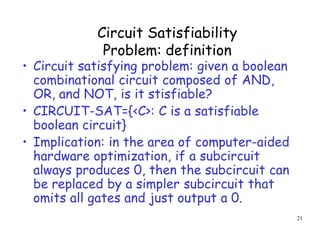
• Circuit satisfying problem: given a boolean
combinational circuit composed of AND,
OR, and NOT, is it stisfiable?
• CIRCUIT-SAT={<C>: C is a satisfiable
boolean circuit}
• Implication: in the area of computer-aided
hardware optimization, if a subcircuit
always produces 0, then the subcircuit can
be replaced by a simpler subcircuit that
omits all gates and just output a 0.
21
22
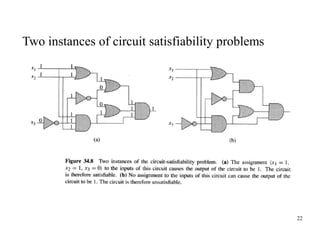
Two instances of circuit satisfiability problems
Solving circuit-satisfiability
problem
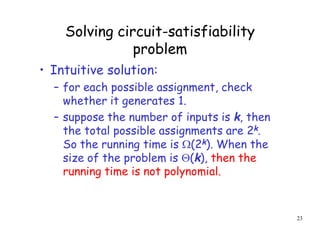
• Intuitive solution:
– for each possible assignment, check
whether it generates 1.
– suppose the number of inputs is k, then
the total possible assignments are 2k.
So the running time is (2k). When the
size of the problem is (k), then the
running time is not polynomial.
23
24
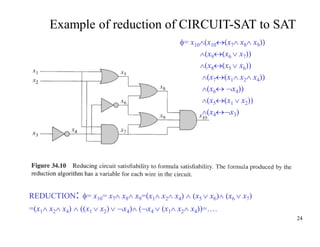
Example of reduction of CIRCUIT-SAT to SAT
= x10(x10(x7 x8 x9))
(x9(x6  x7))
(x8(x5  x6))
(x7(x1 x2 x4))
(x6 x4))
(x5(x1  x2))
(x4x3)
REDUCTION: = x10= x7 x8 x9=(x1 x2 x4)  (x5  x6) (x6  x7)
=(x1 x2 x4)  ((x1  x2)  x4) (x4  (x1 x2 x4))=….
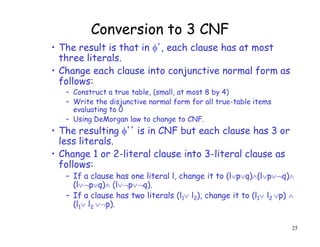
Conversion to 3 CNF
• The result is that in ', each clause has at most
three literals.
• Change each clause into conjunctive normal form as
follows:
– Construct a true table, (small, at most 8 by 4)
– Write the disjunctive normal form for all true-table items
evaluating to 0
– Using DeMorgan law to change to CNF.
• The resulting '' is in CNF but each clause has 3 or
less literals.
• Change 1 or 2-literal clause into 3-literal clause as
follows:
– If a clause has one literal l, change it to (lpq)(lpq)
(lpq) (lpq).
– If a clause has two literals (l1 l2), change it to (l1 l2 p) 
(l1 l2 p).
25
26
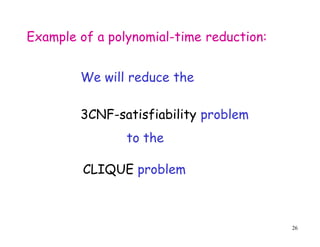
Example of a polynomial-time reduction:
We will reduce the
3CNF-satisfiability problem
to the
CLIQUE problem
27
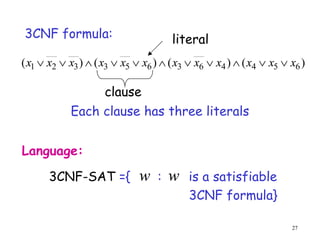
3CNF formula:
)
(
)
(
)
(
)
( 6
5
4
4
6
3
6
5
3
3
2
1 x
x
x
x
x
x
x
x
x
x
x
x 










Each clause has three literals
3CNF-SAT ={ : is a satisfiable
3CNF formula}
w w
Language:
literal
clause
28
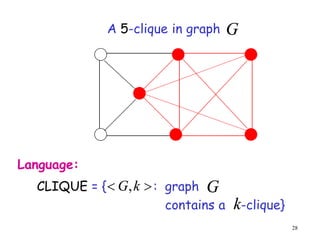
A 5-clique in graph
CLIQUE = { : graph
contains a -clique}

 k
G, G
k
G
Language:
29
)
(
)
(
)
(
)
( 4
3
2
3
2
1
4
2
1
4
2
1 x
x
x
x
x
x
x
x
x
x
x
x 










Clause 2
Clause 1
Clause 3
1
x
2
x
1
x 2
x 4
x
1
x
2
x
3
x
2
x
4
x
4
x
3
x
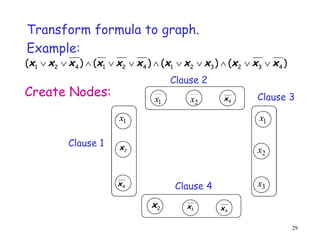
Transform formula to graph.
Example:
Clause 4
Create Nodes:
30
)
(
)
(
)
(
)
( 4
3
2
3
2
1
4
2
1
4
2
1 x
x
x
x
x
x
x
x
x
x
x
x 










1
x
2
x
1
x 2
x 4
x
1
x
2
x
2
x
4
x
4
x
3
x
3
x
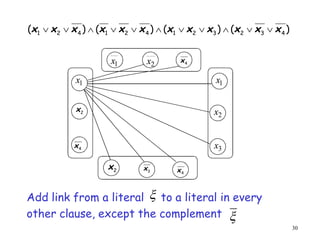
Add link from a literal to a literal in every
other clause, except the complement


31
)
(
)
(
)
(
)
( 4
3
2
3
2
1
4
2
1
4
2
1 x
x
x
x
x
x
x
x
x
x
x
x 










1
x
2
x
1
x 2
x 4
x
1
x
2
x
3
x
2
x
4
x
4
x
3
x
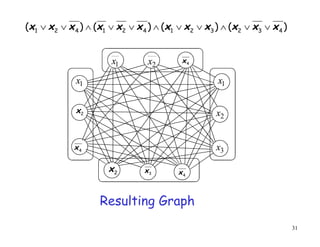
Resulting Graph
32
1
0
0
1
4
3
2
1




x
x
x
x
1
)
(
)
(
)
(
)
( 4
3
2
3
2
1
4
2
1
4
2
1 










 x
x
x
x
x
x
x
x
x
x
x
x
1
x
2
x
1
x 2
x 4
x
1
x
2
x
3
x
2
x
4
x
4
x
3
x
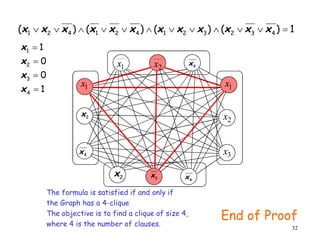
The formula is satisfied if and only if
the Graph has a 4-clique
The objective is to find a clique of size 4,
where 4 is the number of clauses.
End of Proof
33
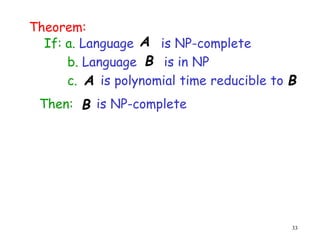
Theorem:
If: a. Language is NP-complete
b. Language is in NP
c. is polynomial time reducible to
A
A B
B
Then: is NP-complete
B
34
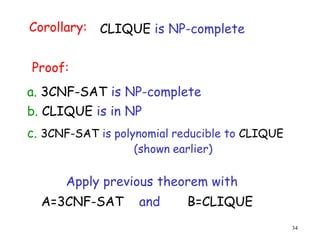
Corollary: CLIQUE is NP-complete
Proof:
b. CLIQUE is in NP
c. 3CNF-SAT is polynomial reducible to CLIQUE
a. 3CNF-SAT is NP-complete
Apply previous theorem with
A=3CNF-SAT and B=CLIQUE
(shown earlier)
Previous Gate Questions
35
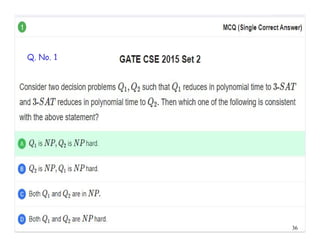
36
Q. No. 1
37
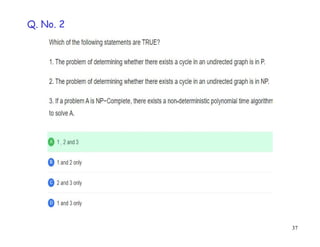
Q. No. 2
38
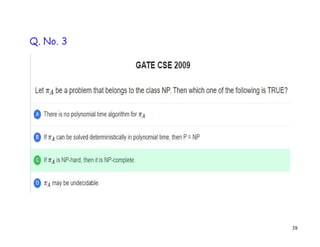
Q. No. 3
39
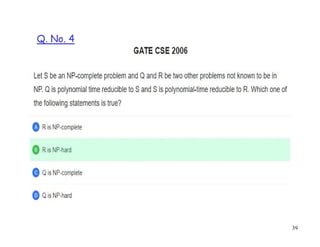
Q. No. 4
40
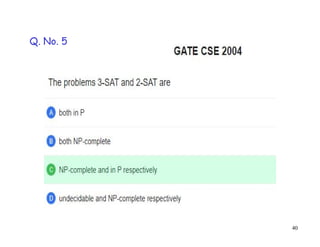
Q. No. 5
41
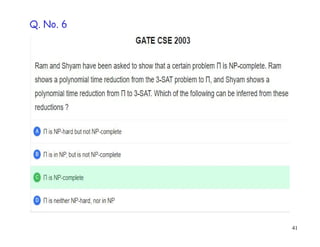
Q. No. 6
42
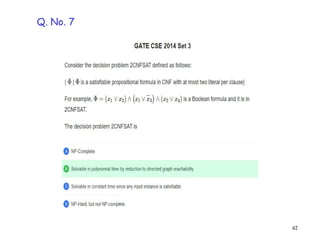
Q. No. 7
43
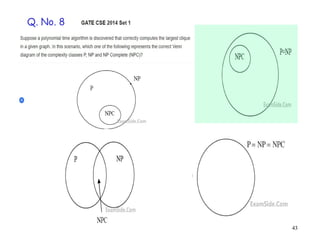
Q. No. 8
44
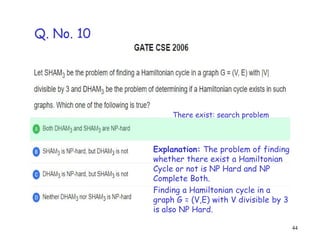
Explanation: The problem of finding
whether there exist a Hamiltonian
Cycle or not is NP Hard and NP
Complete Both.
Finding a Hamiltonian cycle in a
graph G = (V,E) with V divisible by 3
is also NP Hard.
Q. No. 10
There exist: search problem
45
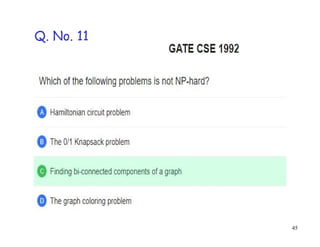
Q. No. 11
Thank You
46

DAA.pdf

  • 1.
    P, NP, NP-Hard& NP-complete problems Prof. Shaik Naseera Department of CSE JNTUACEK, Kalikiri 1
  • 2.
    Objectives • P, NP,NP-Hard and NP-Complete • Solving 3-CNF Sat problem • Discussion of Gate Questions 2
  • 3.
    Types of Problems •Trackable • Intrackable • Decision • Optimization 3 Trackable : Problems that can be solvable in a reasonable(polynomial) time. Intrackable : Some problems are intractable, as they grow large, we are unable to solve them in reasonable time.
  • 4.
    Tractability • What constitutesreasonable time? – Standard working definition: polynomial time – On an input of size n the worst-case running time is O(nk) for some constant k – O(n2), O(n3), O(1), O(n lg n), O(2n), O(nn), O(n!) – Polynomial time: O(n2), O(n3), O(1), O(n lg n) – Not in polynomial time: O(2n), O(nn), O(n!) • Are all problems solvable in polynomial time? – No: Turing’s “Halting Problem” is not solvable by any computer, no matter how much time is given. 4
  • 5.
    Optimization/Decision Problems • OptimizationProblems – An optimization problem is one which asks, “What is the optimal solution to problem X?” – Examples: • 0-1 Knapsack • Fractional Knapsack • Minimum Spanning Tree • Decision Problems – An decision problem is one with yes/no answer – Examples: • Does a graph G have a MST of weight  W? 5
  • 6.
    Optimization/Decision Problems • Anoptimization problem tries to find an optimal solution • A decision problem tries to answer a yes/no question • Many problems will have decision and optimization versions – Eg: Traveling salesman problem • optimization: find hamiltonian cycle of minimum weight • decision: is there a hamiltonian cycle of weight  k 6
  • 7.
    P, NP, NP-Hard,NP-Complete -Definitions 7
  • 8.
    The Class P P:the class of problems that have polynomial-time deterministic algorithms. – That is, they are solvable in O(p(n)), where p(n) is a polynomial on n – A deterministic algorithm is (essentially) one that always computes the correct answer 8
  • 9.
    Sample Problems inP • Fractional Knapsack • MST • Sorting • Others? 9
  • 10.
    The class NP NP:the class of decision problems that are solvable in polynomial time on a nondeterministic machine (or with a nondeterministic algorithm) – (A determinstic computer is what we know) – A nondeterministic computer is one that can “guess” the right answer or solution • Think of a nondeterministic computer as a parallel machine that can freely spawn an infinite number of processes • Thus NP can also be thought of as the class of problems “whose solutions can be verified in polynomial time” • Note that NP stands for “Nondeterministic Polynomial-time” 10
  • 11.
    Sample Problems inNP • Fractional Knapsack • MST • Others? – Traveling Salesman – Graph Coloring – Satisfiability (SAT) • the problem of deciding whether a given Boolean formula is satisfiable 11
  • 12.
    P And NPSummary • P = set of problems that can be solved in polynomial time – Examples: Fractional Knapsack, … • NP = set of problems for which a solution can be verified in polynomial time – Examples: Fractional Knapsack,…, TSP, CNF SAT, 3-CNF SAT • Clearly P  NP • Open question: Does P = NP? – P ≠ NP
  • 13.
    NP-hard • What doesNP-hard mean? – A lot of times you can solve a problem by reducing it to a different problem. I can reduce Problem B to Problem A if, given a solution to Problem A, I can easily construct a solution to Problem B. (In this case, "easily" means "in polynomial time.“). • A problem is NP-hard if all problems in NP are polynomial time reducible to it, ... • Every problem in NP is reducible to HC in polynomial time. Ex:- TSP is reducible to HC. 13 Example: lcm(m, n) = m * n / gcd(m, n), B A Ex:- Hamiltonian Cycle
  • 14.
    NP-complete problems • Aproblem is NP-complete if the problem is both – NP-hard, and – NP.
  • 15.
    Reduction • A problemR can be reduced to another problem Q if any instance of R can be rephrased to an instance of Q, the solution to which provides a solution to the instance of R – This rephrasing is called a transformation • Intuitively: If R reduces in polynomial time to Q, R is “no harder to solve” than Q • Example: lcm(m, n) = m * n / gcd(m, n), lcm(m,n) problem is reduced to gcd(m, n) problem
  • 16.
    NP-Hard and NP-Complete •If R is polynomial-time reducible to Q, we denote this R p Q • Definition of NP-Hard and NP- Complete: – If all problems R  NP are polynomial-time reducible to Q, then Q is NP-Hard – We say Q is NP-Complete if Q is NP-Hard and Q  NP • If R p Q and R is NP-Hard, Q is also NP-Hard
  • 17.
  • 18.
    Summary • P isset of problems that can be solved by a deterministic Turing machine in Polynomial time. • NP is set of problems that can be solved by a Non-deterministic Turing Machine in Polynomial time. P is subset of NP (any problem that can be solved by deterministic machine in polynomial time can also be solved by non-deterministic machine in polynomial time) but P≠NP. 18
  • 19.
    • Some problemscan be translated into one another in such a way that a fast solution to one problem would automatically give us a fast solution to the other. • There are some problems that every single problem in NP can be translated into, and a fast solution to such a problem would automatically give us a fast solution to every problem in NP. This group of problems are known as NP- Complete. Ex:- Clique • A problem is NP-hard if an algorithm for solving it can be translated into one for solving any NP- problem (nondeterministic polynomial time) problem. NP-hard therefore means "at least as hard as any NP-problem," although it might, in fact, be harder. 19
  • 20.
    First NP-complete problem— CircuitSatisfiability (problem definition) • Boolean combinational circuit – Boolean combinational elements, wired together – Each element, inputs and outputs (binary) – Limit the number of outputs to 1. – Called logic gates: NOT gate, AND gate, OR gate. – true table: giving the outputs for each setting of inputs – true assignment: a set of boolean inputs. – satisfying assignment: a true assignment causing the output to be 1. 20
  • 21.
    Circuit Satisfiability Problem: definition •Circuit satisfying problem: given a boolean combinational circuit composed of AND, OR, and NOT, is it stisfiable? • CIRCUIT-SAT={<C>: C is a satisfiable boolean circuit} • Implication: in the area of computer-aided hardware optimization, if a subcircuit always produces 0, then the subcircuit can be replaced by a simpler subcircuit that omits all gates and just output a 0. 21
  • 22.
    22 Two instances ofcircuit satisfiability problems
  • 23.
    Solving circuit-satisfiability problem • Intuitivesolution: – for each possible assignment, check whether it generates 1. – suppose the number of inputs is k, then the total possible assignments are 2k. So the running time is (2k). When the size of the problem is (k), then the running time is not polynomial. 23
  • 24.
    24 Example of reductionof CIRCUIT-SAT to SAT = x10(x10(x7 x8 x9)) (x9(x6  x7)) (x8(x5  x6)) (x7(x1 x2 x4)) (x6 x4)) (x5(x1  x2)) (x4x3) REDUCTION: = x10= x7 x8 x9=(x1 x2 x4)  (x5  x6) (x6  x7) =(x1 x2 x4)  ((x1  x2)  x4) (x4  (x1 x2 x4))=….
  • 25.
    Conversion to 3CNF • The result is that in ', each clause has at most three literals. • Change each clause into conjunctive normal form as follows: – Construct a true table, (small, at most 8 by 4) – Write the disjunctive normal form for all true-table items evaluating to 0 – Using DeMorgan law to change to CNF. • The resulting '' is in CNF but each clause has 3 or less literals. • Change 1 or 2-literal clause into 3-literal clause as follows: – If a clause has one literal l, change it to (lpq)(lpq) (lpq) (lpq). – If a clause has two literals (l1 l2), change it to (l1 l2 p)  (l1 l2 p). 25
  • 26.
    26 Example of apolynomial-time reduction: We will reduce the 3CNF-satisfiability problem to the CLIQUE problem
  • 27.
    27 3CNF formula: ) ( ) ( ) ( ) ( 6 5 4 4 6 3 6 5 3 3 2 1x x x x x x x x x x x x            Each clause has three literals 3CNF-SAT ={ : is a satisfiable 3CNF formula} w w Language: literal clause
  • 28.
    28 A 5-clique ingraph CLIQUE = { : graph contains a -clique}   k G, G k G Language:
  • 29.
    29 ) ( ) ( ) ( ) ( 4 3 2 3 2 1 4 2 1 4 2 1 x x x x x x x x x x x x           Clause 2 Clause 1 Clause 3 1 x 2 x 1 x 2 x 4 x 1 x 2 x 3 x 2 x 4 x 4 x 3 x Transform formula to graph. Example: Clause 4 Create Nodes:
  • 30.
    30 ) ( ) ( ) ( ) ( 4 3 2 3 2 1 4 2 1 4 2 1 x x x x x x x x x x x x           1 x 2 x 1 x 2 x 4 x 1 x 2 x 2 x 4 x 4 x 3 x 3 x Add link from a literal to a literal in every other clause, except the complement  
  • 31.
    31 ) ( ) ( ) ( ) ( 4 3 2 3 2 1 4 2 1 4 2 1 x x x x x x x x x x x x           1 x 2 x 1 x 2 x 4 x 1 x 2 x 3 x 2 x 4 x 4 x 3 x Resulting Graph
  • 32.
    32 1 0 0 1 4 3 2 1     x x x x 1 ) ( ) ( ) ( ) ( 4 3 2 3 2 1 4 2 1 4 2 1            x x x x x x x x x x x x 1 x 2 x 1 x 2 x 4 x 1 x 2 x 3 x 2 x 4 x 4 x 3 x The formula is satisfied if and only if the Graph has a 4-clique The objective is to find a clique of size 4, where 4 is the number of clauses. End of Proof
  • 33.
    33 Theorem: If: a. Languageis NP-complete b. Language is in NP c. is polynomial time reducible to A A B B Then: is NP-complete B
  • 34.
    34 Corollary: CLIQUE isNP-complete Proof: b. CLIQUE is in NP c. 3CNF-SAT is polynomial reducible to CLIQUE a. 3CNF-SAT is NP-complete Apply previous theorem with A=3CNF-SAT and B=CLIQUE (shown earlier)
  • 35.
  • 36.
  • 37.
  • 38.
  • 39.
  • 40.
  • 41.
  • 42.
  • 43.
  • 44.
    44 Explanation: The problemof finding whether there exist a Hamiltonian Cycle or not is NP Hard and NP Complete Both. Finding a Hamiltonian cycle in a graph G = (V,E) with V divisible by 3 is also NP Hard. Q. No. 10 There exist: search problem
  • 45.
  • 46.