Cryptococcus
~Nawang Sherpa
Cryptococcus
Cryptococcus is an invasive fungus that causes cryptococcosis an
opportunistic yeast infection commonly associated with
immunosuppressive individuals while being rare in healthy individuals.
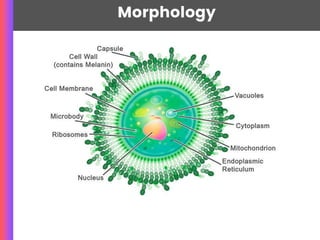
Cryptococcus neoformans primarily exists in its yeast form during
infection. The yeast cells are typically round to oval-shaped and are
encapsulated by a polysaccharide capsule, which is a key virulence factor
of the fungus. This capsule is composed mainly of glucuronoxylomannan
(GXM) and helps the yeast evade host immune defenses.
The two species of Cryptococcus that are commonly associated with
infections in humans are Cryptococcus neoformans and Cryptococcus
gatti.
Morphology
TAXONOMY
Kingdom: Fungi
Phylum: Basidiomycota
Class: Tremellomycetes
Order: Tremellales
Family: Tremellaceae
Genus: Cryptococcus
Species: neoformans, gatti
Cryptococcosis
~Nawang Sherpa
• The organism is widely prevalent in certain regions of the
world. However, the most common forms of exposure
include a history of exposure to soil, bird droppings.
• Since cryptococcosis was originally reported from
Europe, it was formerly referred to as European
blastomycosis. Cryptococcosis has been identified as a
common opportunistic infection in AIDS patients.
Pathogenesis and Virulence factor
Cryptococcus spores or desiccated yeast cells are typically
acquired through inhalation of environmental sources such
as soil, bird droppings, or decaying organic matter.
Once inhaled, the spores or yeast cells may establish a
primary infection in the lungs, leading to pneumonia or
asymptomatic colonization.
In immunocompromised individuals or those with impaired
cellular immunity, such as patients with HIV/AIDS or organ
transplant recipients,
Pathogenesis and Virulence factor
Cryptococcus can disseminate from the lungs to other organs
via the bloodstream or lymphatic system. Common sites of
dissemination include the central nervous system (CNS), leading
to cryptococcal meningitis, as well as the skin, bones, and other
visceral organs.
Cryptococcus has a particular tropism for the CNS, where it
can cause life-threatening meningitis.
Once in the CNS, the fungus can penetrate the blood-brain
barrier and infect the brain and spinal cord, resulting in a range
of neurological symptoms, including headache, fever, altered
mental status, and focal neurological deficits.
Pathogenesis and Virulence factor
The polysaccharide capsule is a critical virulence factor of
Cryptococcus. It is composed mainly of glucuronoxylomannan
(GXM) and galactoxylomannan (GalXM).
The capsule inhibits phagocytosis by host immune cells, modulates
host immune responses, and contributes to the survival and
persistence of the fungus within the host.
Cryptococcus has the ability to produce melanin, a pigment that
contributes to its virulence. Melanin production protects the fungus
from host immune defenses, such as oxidative stress and
phagocytosis, and enhances its survival in the host environment.
Clinical Manifestation
Cryptococcus infections can manifest in various clinical
presentations, ranging from asymptomatic colonization to severe
disseminated disease, particularly in immunocompromised
individuals.
Asymptomatic Colonization:
• Many individuals who inhale Cryptococcus spores may
remain asymptomatic and become colonized with the fungus
in the respiratory tract.
• Asymptomatic colonization is common, especially in healthy
individuals with intact immune systems, and may not require
treatment.
Pathogenesis and Virulence factor
Pulmonary Cryptococcosis:
• Pulmonary cryptococcosis refers to localized infection in the
lungs, which may present as an asymptomatic solitary
pulmonary nodule or with symptoms such as cough, chest
pain, and mild fever.
• In immunocompromised individuals, pulmonary infection may
progress to pneumonia, characterized by cough, dyspnea, and
occasionally hemoptysis.
• Radiological findings may include pulmonary nodules,
infiltrates, cavities, and hilar lymphadenopathy.
Pathogenesis and Virulence factor
Cryptococcal Meningitis:
• Cryptococcal meningitis is the most severe form of
cryptococcosis and occurs when Cryptococcus invades the
central nervous system (CNS).
• Clinical features include headache, fever, altered mental status,
confusion, lethargy, neck stiffness (meningeal signs), nausea,
vomiting, and photophobia.
• Cryptococcal meningitis can lead to intracranial hypertension,
seizures, focal neurological deficits, and coma if left untreated.
• Diagnosis is confirmed by the detection of Cryptococcus
antigen in cerebrospinal fluid (CSF) or isolation of the fungus
from CSF by culture.
Pathogenesis and Virulence factor
Disseminated Cryptococcosis:
⚬ Disseminated cryptococcosis occurs when Cryptococcus
spreads from the primary site of infection to other organs
through the bloodstream or lymphatics.
⚬ Common sites of dissemination include the skin, bones,
joints, liver, spleen, kidneys, and adrenal glands.
⚬ Disseminated infection may present with a wide range of
symptoms depending on the organs involved, such as skin
lesions, osteomyelitis, hepatosplenomegaly, and adrenal
insufficiency.
Pathogenesis and Virulence factor
Ocular Cryptococcosis:
⚬ Ocular involvement, such as cryptococcal chorioretinitis
or endophthalmitis, can occur in cryptococcosis,
especially in disseminated disease.
⚬ Patients may present with visual disturbances, floaters,
photophobia, eye pain, and decreased visual acuity.
Cutaneous Cryptococcosis:
⚬ Cutaneous cryptococcosis manifests as skin lesions, such
as papules, nodules, ulcers, abscesses, or cellulitis.
⚬ Skin lesions may be solitary or multiple and can occur due
to direct inoculation, hematogenous dissemination, or
extension from underlying tissue involvement.
Laboratory Diagnosis
Direct Microscopic Examination:
• India Ink Staining: A drop of India ink is mixed with the clinical
specimen (e.g., cerebrospinal fluid, respiratory secretions), and
the preparation is examined microscopically. Cryptococcus yeast
cells appear as round to oval structures surrounded by a clear halo
(the capsule), which stands out against the dark background of the
ink.
• Calcofluor White Staining: Calcofluor white is a fluorescent dye
that binds to chitin in the fungal cell wall. It can be used to
visualize Cryptococcus yeast cells under fluorescence
microscopy. Calcofluor white staining may enhance the detection
of Cryptococcus in clinical specimens.
CLINICAL MANIFESTATION
Culture:
• Sabouraud Dextrose Agar (SDA): Cryptococcus can be cultured
on SDA medium supplemented with antibiotics (such as
chloramphenicol) and incubated at 25-30°C. Colonies typically
appear creamy to mucoid and may exhibit a wrinkled or
umbonate (raised) morphology. Identification of Cryptococcus
species can be confirmed based on colony characteristics and
additional biochemical tests.
• Selective Media: Some specialized media, such as canavanine-
glycine-bromothymol blue agar (CGB), can be used to
selectively isolate Cryptococcus species from clinical specimens
by inhibiting the growth of other microorganisms.
CLINICAL MANIFESTATION
Cryptococcal Antigen Detection:
• Latex Agglutination Test: Cryptococcal antigen can be
detected in clinical specimens (e.g., serum, cerebrospinal
fluid) using latex agglutination assays. Commercial kits are
available for rapid detection of cryptococcal antigen, offering
high sensitivity and specificity.
• Enzyme Immunoassays (EIAs): Enzyme immunoassays based
on the detection of cryptococcal antigen are commonly used in
clinical laboratories. These assays provide quantitative results
and can be performed on various sample types, including
serum and cerebrospinal fluid.
CLINICAL MANIFESTATION
Molecular Methods:
• Polymerase Chain Reaction (PCR): PCR assays targeting
specific regions of Cryptococcus DNA can be used for rapid
and sensitive detection of the fungus in clinical specimens.
PCR can also be employed for species identification and
genotyping of Cryptococcus isolates.
• DNA Sequencing: DNA sequencing of specific gene targets,
such as the internal transcribed spacer (ITS) region or the
capsular gene (CAP59), can provide additional information
for species identification and strain characterization.
CLINICAL MANIFESTATION
Histopathological Examination:
• Histopathological examination of tissue specimens (e.g.,
biopsy samples) stained with special stains (e.g., Gomori
methenamine silver stain) can reveal the presence of
Cryptococcus organisms within host tissues. This method
is particularly useful for diagnosing invasive cryptococcal
infections.
Treatment
Amphotericin B, 5-fluorocytosine, iroidazoles (miconazole,
ketoconazole), triazoles (itraconazole, fluconazole,
voriconazole) and echinocandins (caspofungin, micafungin)
may be used.
Medically Important Cryptococcus species.pptx

Medically Important Cryptococcus species.pptx

  • 1.
  • 2.
    Cryptococcus Cryptococcus is aninvasive fungus that causes cryptococcosis an opportunistic yeast infection commonly associated with immunosuppressive individuals while being rare in healthy individuals. Cryptococcus neoformans primarily exists in its yeast form during infection. The yeast cells are typically round to oval-shaped and are encapsulated by a polysaccharide capsule, which is a key virulence factor of the fungus. This capsule is composed mainly of glucuronoxylomannan (GXM) and helps the yeast evade host immune defenses. The two species of Cryptococcus that are commonly associated with infections in humans are Cryptococcus neoformans and Cryptococcus gatti.
  • 3.
  • 4.
    TAXONOMY Kingdom: Fungi Phylum: Basidiomycota Class:Tremellomycetes Order: Tremellales Family: Tremellaceae Genus: Cryptococcus Species: neoformans, gatti
  • 5.
    Cryptococcosis ~Nawang Sherpa • Theorganism is widely prevalent in certain regions of the world. However, the most common forms of exposure include a history of exposure to soil, bird droppings. • Since cryptococcosis was originally reported from Europe, it was formerly referred to as European blastomycosis. Cryptococcosis has been identified as a common opportunistic infection in AIDS patients.
  • 6.
    Pathogenesis and Virulencefactor Cryptococcus spores or desiccated yeast cells are typically acquired through inhalation of environmental sources such as soil, bird droppings, or decaying organic matter. Once inhaled, the spores or yeast cells may establish a primary infection in the lungs, leading to pneumonia or asymptomatic colonization. In immunocompromised individuals or those with impaired cellular immunity, such as patients with HIV/AIDS or organ transplant recipients,
  • 7.
    Pathogenesis and Virulencefactor Cryptococcus can disseminate from the lungs to other organs via the bloodstream or lymphatic system. Common sites of dissemination include the central nervous system (CNS), leading to cryptococcal meningitis, as well as the skin, bones, and other visceral organs. Cryptococcus has a particular tropism for the CNS, where it can cause life-threatening meningitis. Once in the CNS, the fungus can penetrate the blood-brain barrier and infect the brain and spinal cord, resulting in a range of neurological symptoms, including headache, fever, altered mental status, and focal neurological deficits.
  • 8.
    Pathogenesis and Virulencefactor The polysaccharide capsule is a critical virulence factor of Cryptococcus. It is composed mainly of glucuronoxylomannan (GXM) and galactoxylomannan (GalXM). The capsule inhibits phagocytosis by host immune cells, modulates host immune responses, and contributes to the survival and persistence of the fungus within the host. Cryptococcus has the ability to produce melanin, a pigment that contributes to its virulence. Melanin production protects the fungus from host immune defenses, such as oxidative stress and phagocytosis, and enhances its survival in the host environment.
  • 9.
    Clinical Manifestation Cryptococcus infectionscan manifest in various clinical presentations, ranging from asymptomatic colonization to severe disseminated disease, particularly in immunocompromised individuals. Asymptomatic Colonization: • Many individuals who inhale Cryptococcus spores may remain asymptomatic and become colonized with the fungus in the respiratory tract. • Asymptomatic colonization is common, especially in healthy individuals with intact immune systems, and may not require treatment.
  • 10.
    Pathogenesis and Virulencefactor Pulmonary Cryptococcosis: • Pulmonary cryptococcosis refers to localized infection in the lungs, which may present as an asymptomatic solitary pulmonary nodule or with symptoms such as cough, chest pain, and mild fever. • In immunocompromised individuals, pulmonary infection may progress to pneumonia, characterized by cough, dyspnea, and occasionally hemoptysis. • Radiological findings may include pulmonary nodules, infiltrates, cavities, and hilar lymphadenopathy.
  • 11.
    Pathogenesis and Virulencefactor Cryptococcal Meningitis: • Cryptococcal meningitis is the most severe form of cryptococcosis and occurs when Cryptococcus invades the central nervous system (CNS). • Clinical features include headache, fever, altered mental status, confusion, lethargy, neck stiffness (meningeal signs), nausea, vomiting, and photophobia. • Cryptococcal meningitis can lead to intracranial hypertension, seizures, focal neurological deficits, and coma if left untreated. • Diagnosis is confirmed by the detection of Cryptococcus antigen in cerebrospinal fluid (CSF) or isolation of the fungus from CSF by culture.
  • 12.
    Pathogenesis and Virulencefactor Disseminated Cryptococcosis: ⚬ Disseminated cryptococcosis occurs when Cryptococcus spreads from the primary site of infection to other organs through the bloodstream or lymphatics. ⚬ Common sites of dissemination include the skin, bones, joints, liver, spleen, kidneys, and adrenal glands. ⚬ Disseminated infection may present with a wide range of symptoms depending on the organs involved, such as skin lesions, osteomyelitis, hepatosplenomegaly, and adrenal insufficiency.
  • 13.
    Pathogenesis and Virulencefactor Ocular Cryptococcosis: ⚬ Ocular involvement, such as cryptococcal chorioretinitis or endophthalmitis, can occur in cryptococcosis, especially in disseminated disease. ⚬ Patients may present with visual disturbances, floaters, photophobia, eye pain, and decreased visual acuity. Cutaneous Cryptococcosis: ⚬ Cutaneous cryptococcosis manifests as skin lesions, such as papules, nodules, ulcers, abscesses, or cellulitis. ⚬ Skin lesions may be solitary or multiple and can occur due to direct inoculation, hematogenous dissemination, or extension from underlying tissue involvement.
  • 14.
    Laboratory Diagnosis Direct MicroscopicExamination: • India Ink Staining: A drop of India ink is mixed with the clinical specimen (e.g., cerebrospinal fluid, respiratory secretions), and the preparation is examined microscopically. Cryptococcus yeast cells appear as round to oval structures surrounded by a clear halo (the capsule), which stands out against the dark background of the ink. • Calcofluor White Staining: Calcofluor white is a fluorescent dye that binds to chitin in the fungal cell wall. It can be used to visualize Cryptococcus yeast cells under fluorescence microscopy. Calcofluor white staining may enhance the detection of Cryptococcus in clinical specimens.
  • 15.
    CLINICAL MANIFESTATION Culture: • SabouraudDextrose Agar (SDA): Cryptococcus can be cultured on SDA medium supplemented with antibiotics (such as chloramphenicol) and incubated at 25-30°C. Colonies typically appear creamy to mucoid and may exhibit a wrinkled or umbonate (raised) morphology. Identification of Cryptococcus species can be confirmed based on colony characteristics and additional biochemical tests. • Selective Media: Some specialized media, such as canavanine- glycine-bromothymol blue agar (CGB), can be used to selectively isolate Cryptococcus species from clinical specimens by inhibiting the growth of other microorganisms.
  • 16.
    CLINICAL MANIFESTATION Cryptococcal AntigenDetection: • Latex Agglutination Test: Cryptococcal antigen can be detected in clinical specimens (e.g., serum, cerebrospinal fluid) using latex agglutination assays. Commercial kits are available for rapid detection of cryptococcal antigen, offering high sensitivity and specificity. • Enzyme Immunoassays (EIAs): Enzyme immunoassays based on the detection of cryptococcal antigen are commonly used in clinical laboratories. These assays provide quantitative results and can be performed on various sample types, including serum and cerebrospinal fluid.
  • 17.
    CLINICAL MANIFESTATION Molecular Methods: •Polymerase Chain Reaction (PCR): PCR assays targeting specific regions of Cryptococcus DNA can be used for rapid and sensitive detection of the fungus in clinical specimens. PCR can also be employed for species identification and genotyping of Cryptococcus isolates. • DNA Sequencing: DNA sequencing of specific gene targets, such as the internal transcribed spacer (ITS) region or the capsular gene (CAP59), can provide additional information for species identification and strain characterization.
  • 18.
    CLINICAL MANIFESTATION Histopathological Examination: •Histopathological examination of tissue specimens (e.g., biopsy samples) stained with special stains (e.g., Gomori methenamine silver stain) can reveal the presence of Cryptococcus organisms within host tissues. This method is particularly useful for diagnosing invasive cryptococcal infections.
  • 19.
    Treatment Amphotericin B, 5-fluorocytosine,iroidazoles (miconazole, ketoconazole), triazoles (itraconazole, fluconazole, voriconazole) and echinocandins (caspofungin, micafungin) may be used.