The Atom
Notes
The Atom
From the Greek prefix A- meaning
“not”
And the Greek Root –tomos meaning
“cut”
Means “uncuttable”
The ancient Greeks wanted to learn about
the smallest particle of matter
The Ancients
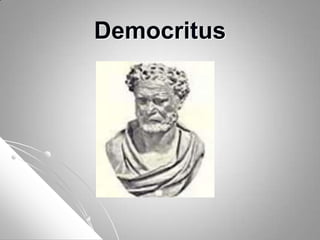
Democritus
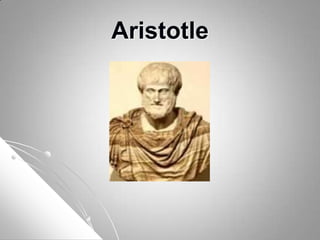
Aristotle
Democritus
Democritus
 Believed that all matter consisted of
extremely small particles that could not
be divided.
 He called these particles atoms (from
the Greek “ατοµος”, meaning “uncut” or
“indivisible”).
Democritus
 He believed there were different types of
atoms with specific sets of properties.
 The atoms in liquids, for example, were
round and smooth
 The atoms in solids were rough and prickly
Aristotle
Aristotle
 He did not think there was a limit to the
number of times matter could be divided
 He thought that all substances were built
up from only four elements
Earth
Air
Fire
Water
The Moderns
Dalton
Thomson
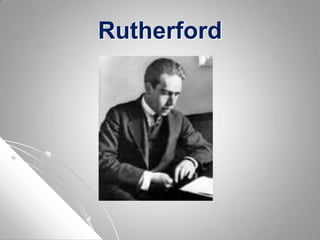
Rutherford
Bohr
Schrodinger & Heisenberg
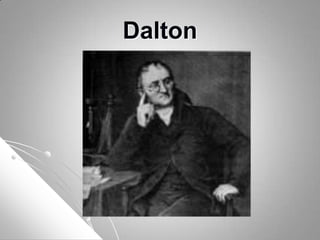
Dalton
Dalton’s Model of the Atom
Created the 1st Atomic Theory
His theory explained why the
elements in a compound always
bond in the same way
Dalton’s Model of the Atom
He proposed the theory:
All matter is made up of individual
particles, called atoms, which
cannot be divided.
Dalton’s Model of the Atom
All elements are composed of
same atoms
Dalton’s Model of the Atom
All atoms of the same element
have the same mass
Dalton’s Model of the Atom
Atoms of different elements
have different masses.
Dalton’s Model of the Atom
Compounds contain atoms of
more than one element.
Dalton’s Model of the Atom
In a particular
compound, atoms of different
elements always combine in
the same way
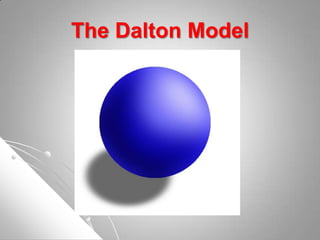
The Dalton Model
The Dalton Model
 Video:
 http://www.youtube.com/watch?v=HFF-
2wyyTKc&feature=results_video&playnext
=1&list=PLF3AEE12BDB1E3858
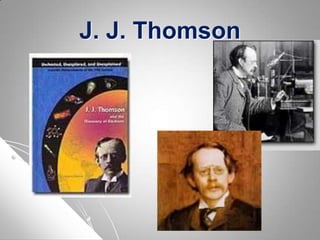
J. J. Thomson
J. J. Thomson’s Model of
the Atom
Thomson’s experiments with
beams of charged particles in a
sealed glass tube led him to the
conclusion that atoms were
made of even smaller particles
J. J. Thomson’s Model of the
Atom
Thomson reasoned:
If the charge of an atom is
neutral, the atom must contain
equal amounts of both positive
and negative charges
The Thomson Model
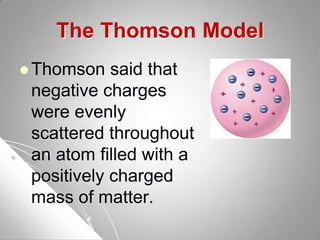
 Thomson said that
negative charges
were evenly
scattered throughout
an atom filled with a
positively charged
mass of matter.
The Thomson Model
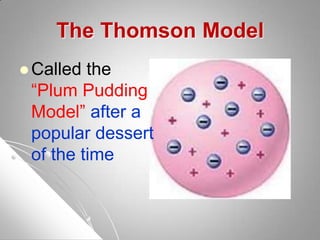
 Called the
“Plum Pudding
Model” after a
popular dessert
of the time
The Thomson Model
 Video:
 http://www.youtube.com/watch?v=JwdGFZ
A3WOs
Rutherford
Rutherford’s Model of the
Atom
Rutherford discovered that
uranium emits fast-moving
particles with a positive charge.
He called them alpha particles.
Rutherford’s Model of the
Atom
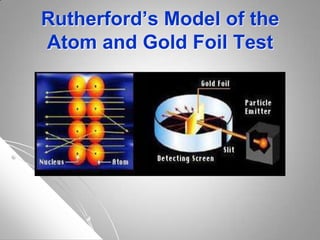
In an experiment he charted the
path of alpha particles after they
passed through a thin layer of
gold foil and a number of the
particles were deflected.
Many more than
expected, sometimes by more
than 90°.
Rutherford’s Model of the
Atom
Proved most of an atom is
actually empty space!
Rutherford’s Model of the
Atom
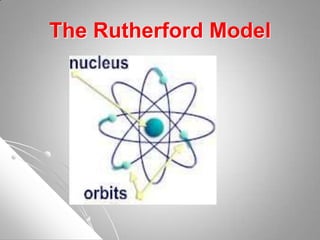
The positive charge of an atom
must be concentrated in a very
small central area that he called
the nucleus.
Rutherford’s Model of the
Atom
Further experiments determined
that the positive charge of an
atom is by the number of
protons in the nucleus.
Rutherford’s Model of the
Atom
Each proton has a charge of +1.
The Rutherford Model
Rutherford’s Model of the
Atom and Gold Foil Test
Rutherford’s Model
 Video
 Nucleus of an Atom
Niels Bohr
The Bohr Model of the
Atom
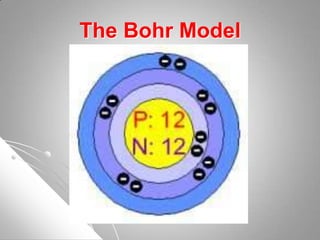
 In Bohr’s model, electrons
move with constant speed in
fixed orbits around the
nucleus, like planets around a
sun.
The Bohr Model of the Atom
 Electrons gain or lose energy
when they move between orbits
or energy levels. Energy levels
are like stairs on a staircase or
shelves in a bookshelf
The Bohr Model of the Atom
 Evidence for discrete, unique
energy levels comes from the
light given off when energy is
added to the atoms of an
element (such as when
fireworks explode or electricity
is added to a neon light).
The Bohr Model of the Atom
 No two elements have the
same set of energy levels, so
the emission pattern can be
used to identify the element.
The Bohr Model of the Atom
 Video”
 The Niels Bohr Rap
The Bohr Model
Schrodinger &
Heisenberg
Schrodinger & Heisenberg
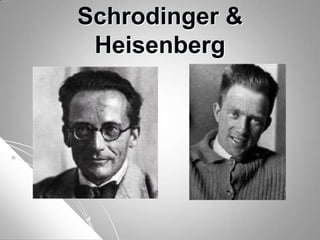
These scientists discovered that
electrons are less predictable
than in Bohr’s model of fixed
orbits.
Schrodinger & Heisenberg
Atoms gain or lose energy.
when electrons move from one
energy level to another
Schrodinger & Heisenberg
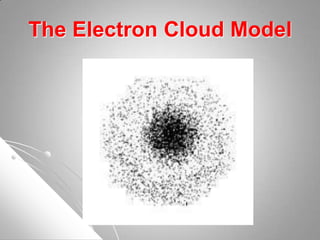
They use an electron cloud
model to show the most likely
locations for electrons as they
move around the nucleus.
Schrodinger & Heisenberg
The electron cloud represents
all the orbitals in an atom.
Schrodinger & Heisenberg
An orbital is a region of space
around the nucleus where an
electron is likely to be found.
Schrodinger & Heisenberg
Orbitals come in different
sizes, shapes, and locations
Schrodinger & Heisenberg
An electron configuration is the
arrangement of electrons in the
orbitals of an atom.
Schrodinger & Heisenberg
 The most stable electron
configuration is the one in which
the electrons are in orbitals with
the lowest possible energies
 Video :
 Change of Atom-Dalton, Thomson,
Rutherford, Bohr
The Electron Cloud Model
 Video:
 electron cloud model
The Nature of Science
 Each scientist was correct for his
time and ability to make
observations.
 As improvements in technology
came about, each later scientist
proved the previous scientist(s)
slightly incorrect.
The Nature of Science
 Now there is a totally different
model of the atom from the first
model presented by Dalton.
 Only some of the theories of each
scientist remain.
 In general…
The Nature of Science
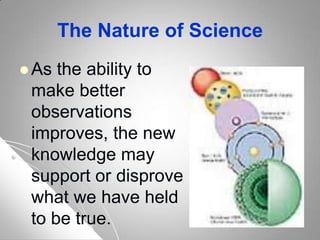
 As the ability to
make better
observations
improves, the new
knowledge may
support or disprove
what we have held
to be true.
The Nature of Science
 As the ability to make better
scientific observations improved,
 Atomic theory changed over time
 Scientists improved upon
previous scientists theories by
proving the correct and disproving
the incorrect
The Nature of Science
 From Dalton’s solid sphere that
bonded the same way all the
time…
 To Thomson’s “Plum Pudding “
model of equal amounts of
positive and negative charges…
The Nature of Science
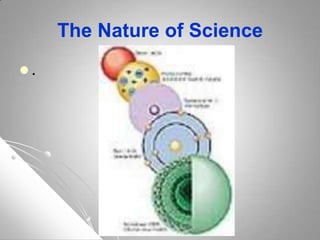
 Then Rutherford proved that the
equal charges were separated by
vast space in a nucleus and
orbiting electrons
 And Bohr gave order to the
orbiting electrons saying that they
maintained constant orbits
The Nature of Science
 .

Notes lab 04a the atom complete notes

  • 1.
  • 2.
    The Atom From theGreek prefix A- meaning “not” And the Greek Root –tomos meaning “cut” Means “uncuttable” The ancient Greeks wanted to learn about the smallest particle of matter
  • 3.
  • 4.
  • 5.
    Democritus  Believed thatall matter consisted of extremely small particles that could not be divided.  He called these particles atoms (from the Greek “ατοµος”, meaning “uncut” or “indivisible”).
  • 6.
    Democritus  He believedthere were different types of atoms with specific sets of properties.  The atoms in liquids, for example, were round and smooth  The atoms in solids were rough and prickly
  • 7.
  • 8.
    Aristotle  He didnot think there was a limit to the number of times matter could be divided  He thought that all substances were built up from only four elements Earth Air Fire Water
  • 9.
  • 10.
  • 11.
    Dalton’s Model ofthe Atom Created the 1st Atomic Theory His theory explained why the elements in a compound always bond in the same way
  • 12.
    Dalton’s Model ofthe Atom He proposed the theory: All matter is made up of individual particles, called atoms, which cannot be divided.
  • 13.
    Dalton’s Model ofthe Atom All elements are composed of same atoms
  • 14.
    Dalton’s Model ofthe Atom All atoms of the same element have the same mass
  • 15.
    Dalton’s Model ofthe Atom Atoms of different elements have different masses.
  • 16.
    Dalton’s Model ofthe Atom Compounds contain atoms of more than one element.
  • 17.
    Dalton’s Model ofthe Atom In a particular compound, atoms of different elements always combine in the same way
  • 18.
  • 19.
    The Dalton Model Video:  http://www.youtube.com/watch?v=HFF- 2wyyTKc&feature=results_video&playnext =1&list=PLF3AEE12BDB1E3858
  • 20.
  • 21.
    J. J. Thomson’sModel of the Atom Thomson’s experiments with beams of charged particles in a sealed glass tube led him to the conclusion that atoms were made of even smaller particles
  • 22.
    J. J. Thomson’sModel of the Atom Thomson reasoned: If the charge of an atom is neutral, the atom must contain equal amounts of both positive and negative charges
  • 23.
    The Thomson Model Thomson said that negative charges were evenly scattered throughout an atom filled with a positively charged mass of matter.
  • 24.
    The Thomson Model Called the “Plum Pudding Model” after a popular dessert of the time
  • 25.
    The Thomson Model Video:  http://www.youtube.com/watch?v=JwdGFZ A3WOs
  • 26.
  • 27.
    Rutherford’s Model ofthe Atom Rutherford discovered that uranium emits fast-moving particles with a positive charge. He called them alpha particles.
  • 28.
    Rutherford’s Model ofthe Atom In an experiment he charted the path of alpha particles after they passed through a thin layer of gold foil and a number of the particles were deflected. Many more than expected, sometimes by more than 90°.
  • 29.
    Rutherford’s Model ofthe Atom Proved most of an atom is actually empty space!
  • 30.
    Rutherford’s Model ofthe Atom The positive charge of an atom must be concentrated in a very small central area that he called the nucleus.
  • 31.
    Rutherford’s Model ofthe Atom Further experiments determined that the positive charge of an atom is by the number of protons in the nucleus.
  • 32.
    Rutherford’s Model ofthe Atom Each proton has a charge of +1.
  • 33.
  • 34.
    Rutherford’s Model ofthe Atom and Gold Foil Test
  • 35.
  • 36.
  • 37.
    The Bohr Modelof the Atom  In Bohr’s model, electrons move with constant speed in fixed orbits around the nucleus, like planets around a sun.
  • 38.
    The Bohr Modelof the Atom  Electrons gain or lose energy when they move between orbits or energy levels. Energy levels are like stairs on a staircase or shelves in a bookshelf
  • 39.
    The Bohr Modelof the Atom  Evidence for discrete, unique energy levels comes from the light given off when energy is added to the atoms of an element (such as when fireworks explode or electricity is added to a neon light).
  • 40.
    The Bohr Modelof the Atom  No two elements have the same set of energy levels, so the emission pattern can be used to identify the element.
  • 41.
    The Bohr Modelof the Atom  Video”  The Niels Bohr Rap
  • 42.
  • 43.
  • 44.
    Schrodinger & Heisenberg Thesescientists discovered that electrons are less predictable than in Bohr’s model of fixed orbits.
  • 45.
    Schrodinger & Heisenberg Atomsgain or lose energy. when electrons move from one energy level to another
  • 46.
    Schrodinger & Heisenberg Theyuse an electron cloud model to show the most likely locations for electrons as they move around the nucleus.
  • 47.
    Schrodinger & Heisenberg Theelectron cloud represents all the orbitals in an atom.
  • 48.
    Schrodinger & Heisenberg Anorbital is a region of space around the nucleus where an electron is likely to be found.
  • 49.
    Schrodinger & Heisenberg Orbitalscome in different sizes, shapes, and locations
  • 50.
    Schrodinger & Heisenberg Anelectron configuration is the arrangement of electrons in the orbitals of an atom.
  • 51.
    Schrodinger & Heisenberg The most stable electron configuration is the one in which the electrons are in orbitals with the lowest possible energies
  • 52.
     Video : Change of Atom-Dalton, Thomson, Rutherford, Bohr
  • 53.
  • 54.
    The Electron CloudModel  Video:  electron cloud model
  • 55.
    The Nature ofScience  Each scientist was correct for his time and ability to make observations.  As improvements in technology came about, each later scientist proved the previous scientist(s) slightly incorrect.
  • 56.
    The Nature ofScience  Now there is a totally different model of the atom from the first model presented by Dalton.  Only some of the theories of each scientist remain.  In general…
  • 57.
    The Nature ofScience  As the ability to make better observations improves, the new knowledge may support or disprove what we have held to be true.
  • 58.
    The Nature ofScience  As the ability to make better scientific observations improved,  Atomic theory changed over time  Scientists improved upon previous scientists theories by proving the correct and disproving the incorrect
  • 59.
    The Nature ofScience  From Dalton’s solid sphere that bonded the same way all the time…  To Thomson’s “Plum Pudding “ model of equal amounts of positive and negative charges…
  • 60.
    The Nature ofScience  Then Rutherford proved that the equal charges were separated by vast space in a nucleus and orbiting electrons  And Bohr gave order to the orbiting electrons saying that they maintained constant orbits
  • 61.
    The Nature ofScience  .