Note-taking skills
Breaking down a big picture into details
with appropriate chunks
Lesson 2
Speech analysis
• view a speech as whole, single message,
made up of related parts
• divide a speech up into its component
parts,
• summarize the main message of each
section of a speech,
• note an entire speech and its component
parts on a single page.
There are many ways to approach the
analysis of a speech. You can look at the
context in which the speech is given, who is
speaking, to whom and why or on what
occasion and in which style.
Mind Map
A mind map is a way of organizing information on a piece of paper.
Usually it takes the form of an organic chart laid out on a large
sheet of paper. Words and drawings are connected to one another
on the page in various ways: by lines, by their position on the page
relative to one another, and so on.
Though the original format is rather narrow (Buzan, 2010), for our
purposes mind maps also include any sort of pictorial or spatial
representation of information on the page. This form of
representing ideas taps into the way the mind associates and
recalls information and can therefore be useful in helping us to
organize and remember information.
Creating a mind map requires an understanding and analysis of
the incoming speech, and it is this that is so useful for interpreters.
The very act of making yourself draw a mind map forces you to
dissect the speech, and that in turn means you listen far more
attentively than the normal listener. It will help you see that a
speech is not just an uninterrupted stream of words but a
deliberately ordered collection of chunks of information. In drawing
a mind map, you will create a visual image that shows (1) an
overview of the whole speech on a single page and (2) how the
different parts of the speech fit together. It is a great analysis
exercise! And once you’ve got a mind map like this. You’ll find it
relatively easy to recall most of the original speech from it. But
remember, you’re not trying to get all the details when you make a
mind map. You’re trying to record only the outline of the speech.
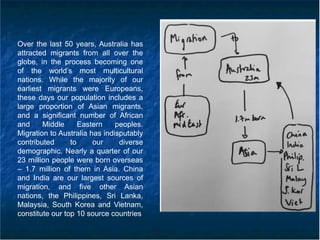
Over the last 50 years, Australia has
attracted migrants from all over the
globe, in the process becoming one
of the world’s most multicultural
nations. While the majority of our
earliest migrants were Europeans,
these days our population includes a
large proportion of Asian migrants,
and a significant number of African
and Middle Eastern peoples.
Migration to Australia has indisputably
contributed to our diverse
demographic. Nearly a quarter of our
23 million people were born overseas
– 1.7 million of them in Asia. China
and India are our largest sources of
migration, and five other Asian
nations, the Philippines, Sri Lanka,
Malaysia, South Korea and Vietnam,
constitute our top 10 source countries
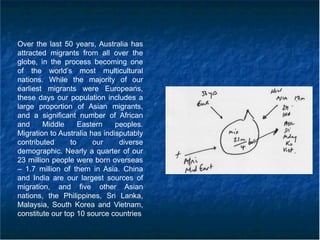
Over the last 50 years, Australia has
attracted migrants from all over the
globe, in the process becoming one
of the world’s most multicultural
nations. While the majority of our
earliest migrants were Europeans,
these days our population includes a
large proportion of Asian migrants,
and a significant number of African
and Middle Eastern peoples.
Migration to Australia has indisputably
contributed to our diverse
demographic. Nearly a quarter of our
23 million people were born overseas
– 1.7 million of them in Asia. China
and India are our largest sources of
migration, and five other Asian
nations, the Philippines, Sri Lanka,
Malaysia, South Korea and Vietnam,
constitute our top 10 source countries
https://www.symbolovnik.cz/en/weight
Note-Taking: The Power of Selectivity
Give yourself a point for each one of
these highlighted words that made it to
your page (word, abbreviation, symbol)
The importance of taking notes
➢
Our short-term memory alone can not
retain the amount of information the
speaker gives i the act of interpreting. We
need to employ other means to help with
our retaining and retrieval of information.
Notes are an aid to enhance the work of
understanding, analysis and re-expression.
➢
The main use of notes is to relieve
memory. Although an interpreter may have
understood the main ideas of a speech, it is
almost impossible for him/her to recall all
the elements of a five-minute speech,
particular if it contains numbers, names,
lists, since s elements cannot be recalled on
the basis of analysis and logic.
■
请注意,每个人的记忆,思维,和反应都有各
自的特点。没有必要全部照搬别人的方法。最好
用的笔记方式是你自己发展出来的,适合自己的
系统。
■
比如,笔记越简单,记录就越迅速。但笔记简
单了,对短期记忆的要求就相对提高了。所以,
笔记多少为最佳,因人而易,需要摸索出适合于
自己的平衡。
笔记各条要点相辅相成,也有一个掌握好平衡的
问题,也不是绝对的,也需要你走出自己的路
Importance of note-taking
• Katharine Allen (51st
ATA Conference, Denver)
◦ Importance of developing note-taking skills in community
interpreting
• so that we’re not interrupting speakers all the time for short consecutive
interpretation.
◦ Community interpreting training programs are teaching would-be
interpreters to interrupt people all the time
• Sometimes the medical provider is giving a long explanation to the patient
about his/her condition and their plans for patient recovery.
◦ If interrupted they might lose track of what they’re saying, etc.
Importance of note-taking
• In court,
• Many interpreters are now using digital recorders in the long
consecutive mode
• Then providing simultaneous interpretation
• However, recorders sometimes fail (technical problems,
etc)
Note-taking?
• But, long consecutive interpreting with note-taking may not be the best
model all the time
• the distance between the original speech and the interpreted
rendition is too long
• paralinguistic elements (nonverbal communication, intonation, emotional
outbursts, etc) are lost.
• Maybe in these emotionally charged settings, the simultaneous
mode would be the best format? Thoughts?
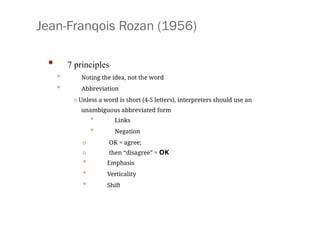
Jean-Franqois Rozan (1956)
• 7 principles
• Noting the idea, not the word
• Abbreviation
o Unless a word is short (4-5 letters), interpreters should use an
unambiguous abbreviated form
• Links
• Negation
o OK = agree;
o then “disagree” = OK
• Emphasis
• Verticality
• Shift
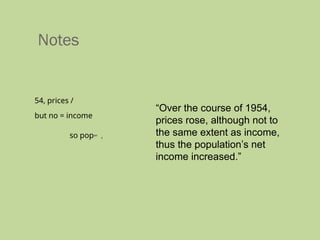
Notes
54, prices /
but no = income
so popon
,
“Over the course of 1954,
prices rose, although not to
the same extent as income,
thus the population’s net
income increased.”
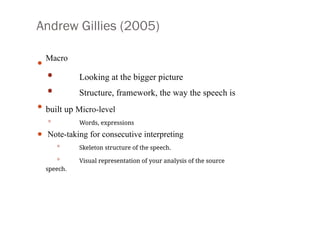
Andrew Gillies (2005)
• Macro
•
•
• Looking at the bigger picture
• Structure, framework, the way the speech is
built up Micro-level
• Words, expressions
Note-taking for consecutive interpreting
• Skeleton structure of the speech.
• Visual representation of your analysis of the source
speech.
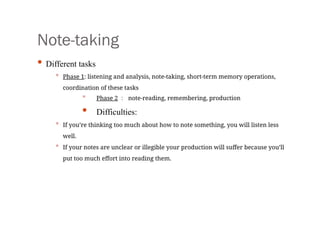
Note-taking
• Different tasks
• Phase 1: listening and analysis, note-taking, short-term memory operations,
coordination of these tasks
• Phase 2 : note-reading, remembering, production
• Difficulties:
• If you’re thinking too much about how to note something, you will listen less
well.
• If your notes are unclear or illegible your production will suffer because you’ll
put too much effort into reading them.
Note-taking
• Dissecting the speech
• Analyzing its structure, progression
• Analyzing the communicative fUnction of different parts of the speech
• Recognizing the main ideas and secondary ones
• Spotting the links between them
Mini Summaries
• To summarize:
• Function and structure of the speech’s
parts.
• Not the content!
Mind Maps
•
•
•
•
Way of organizing information on a piece of paper
Organic chart
Words and drawings are connected to one-another on the page in
various ways
• Lines
• Position on the page relative to one another How
the mind associates and recalls information
SOV
• “Who did what to whom?^
• The sentence
• Basic unit of
communication
• Subject
• Verb
• Object
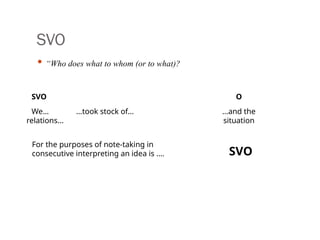
SVO
• “Who does what to whom (or to what)?
SVO
We… …took stock of…
relations...
O
…and the
situation
For the purposes of note-taking in
consecutive interpreting an idea is …. SVO
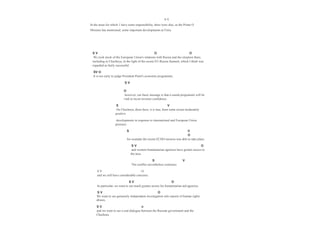
S V
In the areas for which 1 have some responsibility, there were also, as the Prime O
Minister has mentioned, some important developments at Feira.
S V O O
Wc took stock of the European Union's relations with Russia and the situation there,
including in Chechnya, in the light of the recent EU-Russia Summit, which I think was
regarded as fairly successful.
SV O
It is too early to judge President Putin's economic programme;
S V
O
however, our basic message is that a sound programme will be
vital to twost investor confidence.
S V
On Chechnya, there have, it is true, been some recent moderately
positive
developments in response to international and European Union
pressure:
S V
O
for example the recent ECHO mission was able to take place
S V O
and western humanitarian agencies have greater access to
the area.
S V
The conflict nevertheless continues
S V O
and we still have considerable concerns.
S V O
In particular, we want to see much greater access for humanitarian aid agencies.
S V O
We want to see genuinely independent investigation inlo reports of human rights
abuses,
S V o
and we want to see a real dialogue between the Russian government and the
Chechens.
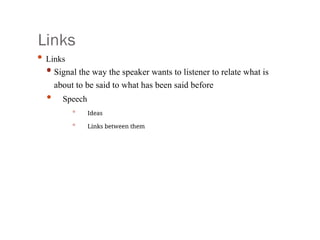
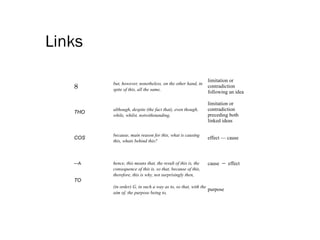
Links
• Links
• Signal the way the speaker wants to listener to relate what is
about to be said to what has been said before
• Speech
• Ideas
• Links between them
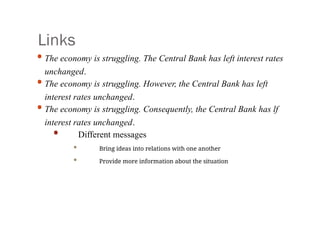
Links
• The economy is struggling. The Central Bank has left interest rates
unchanged.
• The economy is struggling. However, the Central Bank has left
interest rates unchanged.
• The economy is struggling. Consequently, the Central Bank has lf
interest rates unchanged.
• Different messages
• Bring ideas into relations with one another
• Provide more information about the situation
Links
//
Britain and Germany are among those countries pushing most
for an ambitious new WTO round.
—
So, for both the UK and Germany, the failure of the trade
talks in Cancun was a huge disappointment.
// A successful trade round would be a massive prize.
if If we could halve world tariffs,
then
[then] that would add as much as $400 billion annually to
world incomes, of which at least 150 billion will flow to
developing countries.
// Thafs more than 3 times what they currently get in aid.
BUT But to achieve this we need to reform the CAP.
Links
8
but, however, nonetheless, on the other hand, in
spite of this, all the same,
limitation or
contradiction
following an idea
THO
although, despite (the fact that), even though,
while, whilst, notwithstanding,
limitation or
contradiction
preceding both
linked ideas
COS
because, main reason for this, what is causing
this, whats behind this?
effect — cause
—A hence, this means that, the result of this is, the
consequence of this is, so that, because of this,
therefore, this is why, not surprisingly then,
cause 一 effect
TO
(in order) G, in such a way as to, so that, with the
aim of, the purpose being to,
purpose
Parallel Values
• It’s not uncommon for speakers to have the same subject doing
many different things.
• By noting the verbs parallel to one another on the page
• Clearly see they have the same subject
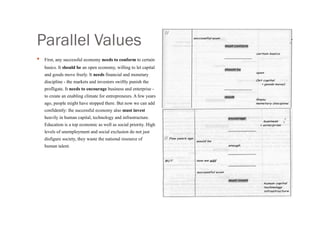
Parallel Values
• First, any successful economy needs to conform to certain
basics. It should be an open economy, willing to let capital
and goods move freely. It needs financial and monetary
discipline - the markets and investors swiftly punish the
profligate. It needs to encourage business and enterprise -
to create an enabling climate for entrepreneurs. A few years
ago, people might have stopped there. But now we can add
confidently: the successful economy also must invest
heavily in human capital, technology and infrastructure.
Education is a top economic as well as social priority. High
levels of unemployment and social exclusion do not just
disfigure society, they waste the national resource of
human talent.
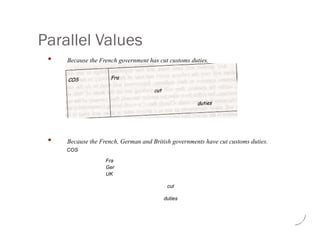
Parallel Values
• Because the French government has cut customs duties.
• Because the French, German and British governments have cut customs duties.
COS
Fra
Ger
UK
cut
duties
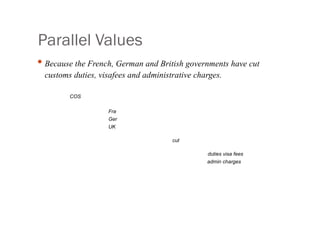
Parallel Values
• Because the French, German and British governments have cut
customs duties, visafees and administrative charges.
COS
Fra
Ger
UK
cut
duties visa fees
admin charges
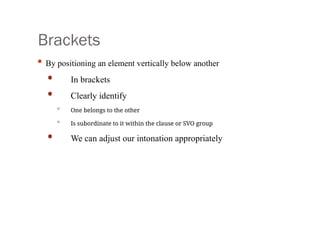
Brackets
• By positioning an element vertically below another
• In brackets
• Clearly identify
• One belongs to the other
• Is subordinate to it within the clause or SVO group
• We can adjust our intonation appropriately
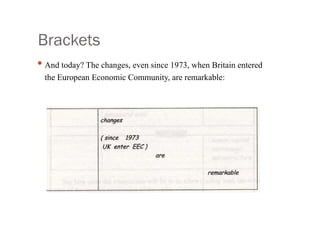
Brackets
• And today? The changes, even since 1973, when Britain entered
the European Economic Community, are remarkable:
笔记要点
■
1. 少写多划。划线条比写文字快。线条形象,
相当于翻译的 " 半成品 " ,有助译员眼看笔记,
口出译文。两种情况下应该尽量用线条:
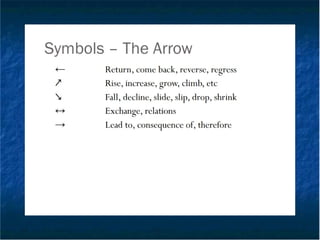
表示动作和动态的词句。比如,以上升的斜线代
表 " 发展 " , " 增加 " , " 进步 "," 进一步 " ;以下
降的斜线代表 " 减少 " , " 下降 " , " 恶化 " 等
等。
表示因果或前后关系的词句。比如,用一条线代
表 " 因为 / 所以 " , "… 之后 " , " 在…之前 " ,以
体现出上下前后之间的关联关系。
2. 少字多意
■
养成一个词的笔记不超过一个字的习惯。中文里
有大量的词汇是由两个,或两个以上的字组成。
只要看到其中一个,你的短期记忆就应该能够补
齐其余的字。不必多写。比如, " 中国 " 最多写
个 " 中 " 。 " 北京 " 最多写个 " 北 " 。英文词也同
理处理。 "politics" 最多
写 "poli" , "government" 最多写 "gov" ,等等。
另外,需要培养以笔记与记忆互动;看到一个字能
说出几个字,甚至一串词的能力。 在有上下文的
情况下,这不难。比如,谈中国的 近况,听
到 " 改革,开放 " 记一个 " 改 " 字,不难从短期记
忆中说出原文。听到 "British Prime Minister Tony
Blair" ,记 "PM" ,也同样能说出原文。
■
3. 通用一小组线条 / 标记。否则在自己本
来熟悉的中英文之外,又编出一套自己不熟
悉的文码使用,会导致需要想一想用哪个符
号的情况,适得其反。
■
4. 少横多竖。采取从上往下的阶梯结构
记录,尽量少用通常书写时的横向记录。
阶梯结构形象地体现出上下文的逻辑结
构,简化了译员的思维过程,方便出译
文。
■
5. 快速书写。必须发展自己的汉字快速书写系
统。笔记完全是自己看,而且只需要几分钟之内能
看懂就行。很多汉字笔划减少后,并不影响确认。
■
6. 明确结束。上一段话和下一段话之
间,必须有明确的界限。上一次的结束
点,就成了下一次听力的开始点。
所需装备
■ 最后,讲一下所需装备。
建议你使用带有活页圈的笔记本。有活页
圈才能来回翻倒方便。笔记本大小以自己
感觉舒服为准。
■
持笔记本的手势。记完一页,翻过去一页。讲话人收口
后,一把抓地全部翻回来,落眼处正是这个段子的开头。然
后,译一页,翻过去一页。这段译完后,把翻过去的几页一
把 压在手掌中。这等于是用手掌把已经翻完的,和下一段
的 笔记清楚分开。这点很重要。否则,很容易出现讲话人
收 口后,你来回翻找本段首页的难堪局面。
如果是坐在桌前,笔记本放在桌面上,也是记完一页,翻
过去一页。也千万不要忘记在讲话人开口说下一段之前,
把已经翻完的笔记页压到笔记本下。
■
笔,建议用按压式的。这样,一手持
本,另一手随时都可以掏出笔来,一按就
开始记。如果是旋转开盖的笔,则需要两
只手操作。如果笔套不紧的,还时不时要
掉,很分心。长年惯带两支笔,免遭墨水
用尽之难 .
■ Language used in your notes: SL and
TL
■
Use whatever language that comes
to your mind
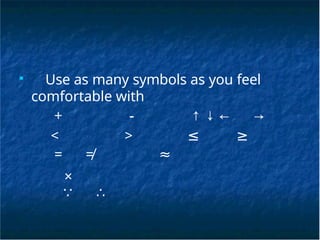
■
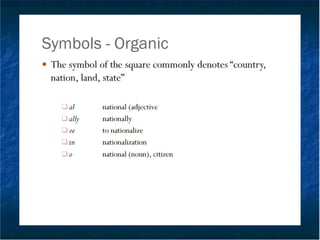
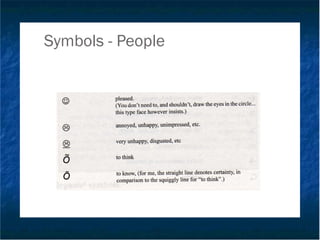
Use as many symbols as you feel
comfortable with
+ - ↑ ↓ ← →
< > ≤ ≥
= ≠ ≈
×
∵ ∴
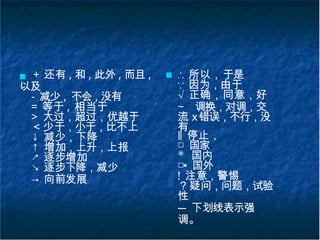
■ + 还有 , 和 , 此外 , 而且 ,
以及
- 减少 , 不会 , 没有
= 等于 , 相当于
> 大过,超过,优越于
<少于,小于,比不上
↓ 减少,下降
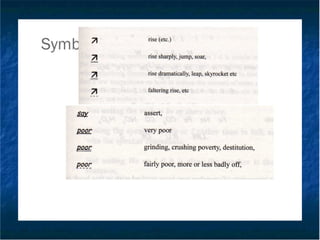
↑ 增加,上升,上报
↗ 逐步增加
↘ 逐步下降,减少
→ 向前发展
■ ∴ 所以,于是
∵ 因为,由于
√ 正确,同意,好
~ 调换,对调,交
流 ⅹ错误,不行,没
有
‖ 停止,
□ 国家
◉ 国内
□• 国外
! 注意,警惕
?疑问,问题,试验
性
--- 下划线表示强
调。
■ Use abbreviations
“Prof” for “professor”, “dept” for
“department”, “std” for “standard”. “ref”
for “reference”, “eg” for “for example”, “ie”
for “that is”, “esp” for “especially”, “min”
for “minimum”, “max” for “maximum”,
and “usu” for “usually”
cf for compare
std standard SH shanghai
■
GDP (gross domestic product), GNP
(gross national product), 5yr P (five year
plan), SOE (state owned enterprise), FIE
(foreign invested enterprise), JV (joint
venture), SEZ (special economic zone), trd
(trade),
■
invt (investment), respon (responsibility)
memo (memorandum), demo
(demonstration), Ad (advertisement), TQC
(total quality control 全面质量管理 ), CI
(corporate image 企业形象 ), Attn
(attention),dept (department),
■
Exch (exchange), coop (cooperation), prodc
(production), ref (reference), info (information), IT
indy (information industry), telcom
(telecommunication), IDD (international direct
dialing), R&D (research and development),
CAD( computer assisted design),agrd(agreed).
CEO(chief executive officer), Govt(government),
FOB ( free on board),CIF(cost,insurance,fright) 。
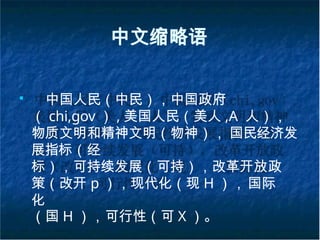
中文缩略语
■
中国人民(中民),中国政府
( chi,gov ) , 美国人民(美人 ,A 人),
物质文明和精神文明(物神), 国民经济发
展指标(经
标),可持续发展(可持),改革开放政
策(改开 p ),现代化(现 H ),国际
化
(国 H ),可行性(可 X )。
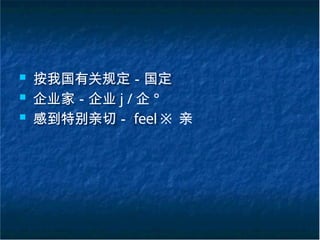
■ 按我国有关规定-国定
■ 企业家-企业 j / 企 °
■ 感到特别亲切- feel ※ 亲
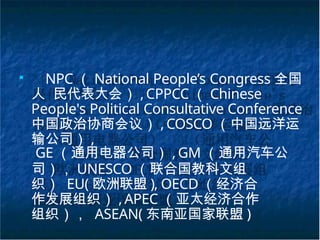
■
NPC ( National People’s Congress 全国
人 民代表大会) ,CPPCC ( Chinese
People's Political Consultative Conference
中国政治协商会议) , COSCO (中国远洋运
输公司) ,
GE (通用电器公司) , GM (通用汽车公
司), UNESCO (联合国教科文组
织) EU( 欧洲联盟 ), OECD (经济合
作发展组织) , APEC (亚太经济合作
组织), ASEAN( 东南亚国家联盟 )
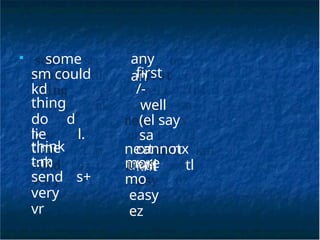
you u
your ur
■ the - for
f
that -t from
fr
and
&
if .f
are
r
is z
he
e
be b
or o you u
to t your ur
in
n
an a
of so s
has
hs
had hd
have
hv
she )e
shall
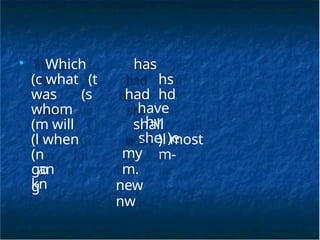
)l most
m-
■
Which
(c what (t
was (s
whom
(m will
(l when
(n
can
kn
go
g
my
m.
new
nw
any
an
■
some
sm could
kd
thing
-,
think
-nk
first
/-
well
(el say
sa
next nx
until tl
cannot
knt
do d
lie l.
time
t.m
send s+
very
vr
more
mo
easy
ez
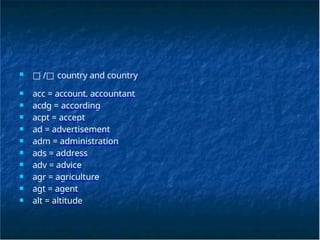
■ □ /□ country and country
■ acc = account, accountant
■ acdg = according
■ acpt = accept
■ ad = advertisement
■ adm = administration
■ ads = address
■ adv = advice
■ agr = agriculture
■ agt = agent
■ alt = altitude
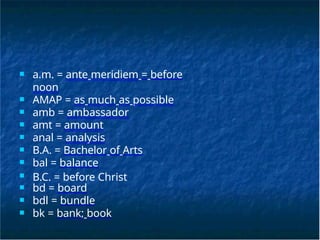
■ a.m. = ante meridiem = before
noon
■ AMAP = as much as possible
■ amb = ambassador
■ amt = amount
■ anal = analysis
■ B.A. = Bachelor of Arts
■ bal = balance
■ B.C. = before Christ
■ bd = board
■ bdl = bundle
■ bk = bank; book
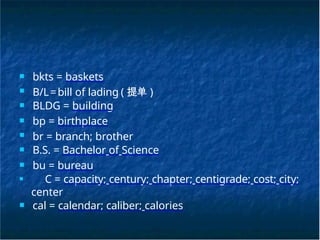
■ bkts = baskets
■ B/L=bill of lading ( 提单 )
■ BLDG = building
■ bp = birthplace
■ br = branch; brother
■ B.S. = Bachelor of Science
■ bu = bureau
■ C = capacity; century; chapter; centigrade; cost; city;
center
■ cal = calendar; caliber; calories
■ cap = capital; captain
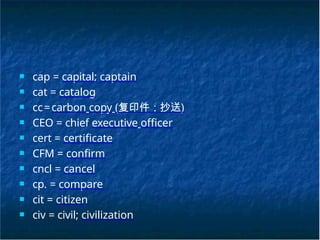
■ cat = catalog
■ cc=carbon copy (复印件;抄送)
■ CEO = chief executive officer
■ cert = certificate
■ CFM = confirm
■ cncl = cancel
■ cp. = compare
■ cit = citizen
■ civ = civil; civilization
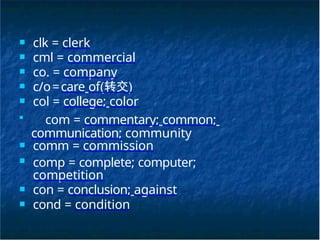
■ clk = clerk
■ cml = commercial
■ co. = company
■ c/o=care of(转交)
■ col = college; color
■
com = commentary; common;
communication; community
■ comm = commission
■ comp = complete; computer;
competition
■ con = conclusion; against
■ cond = condition
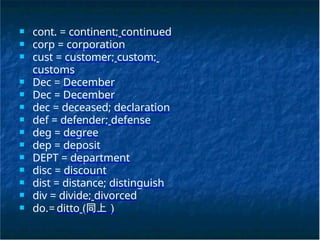
■ cont. = continent; continued
■ corp = corporation
■ cust = customer; custom;
customs
■ Dec = December
■ Dec = December
■ dec = deceased; declaration
■ def = defender; defense
■ deg = degree
■ dep = deposit
■ DEPT = department
■ disc = discount
■ dist = distance; distinguish
■ div = divide; divorced
■ do.= ditto (同上)
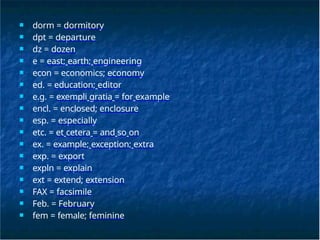
■ dorm = dormitory
■ dpt = departure
■ dz = dozen
■ e = east; earth; engineering
■ econ = economics; economy
■ ed. = education; editor
■ e.g. = exempli gratia = for example
■ encl. = enclosed; enclosure
■ esp. = especially
■ etc. = et cetera = and so on
■ ex. = example; exception; extra
■ exp. = export
■ expln = explain
■ ext = extend; extension
■ FAX = facsimile
■ Feb. = February
■ fem = female; feminine
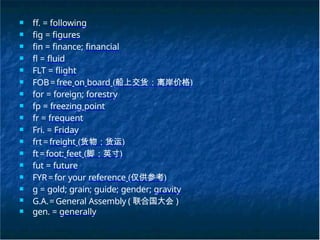
■ ff. = following
■ fig = figures
■ fin = finance; financial
■ fl = fluid
■ FLT = flight
■ FOB=free on board (船上交货;离岸价格)
■ for = foreign; forestry
■ fp = freezing point
■ fr = frequent
■ Fri. = Friday
■ frt=freight (货物;货运)
■ ft=foot; feet (脚;英寸)
■ fut = future
■ FYR=for your reference (仅供参考)
■ g = gold; grain; guide; gender; gravity
■ G.A.= General Assembly ( 联合国大会 )
■ gen. = generally
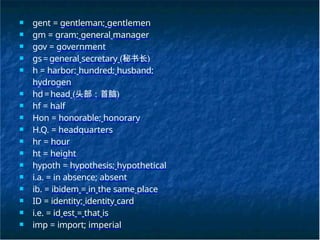
■ gent = gentleman; gentlemen
■ gm = gram; general manager
■ gov = government
■ gs=general secretary (秘书长)
■ h = harbor; hundred; husband;
hydrogen
■ hd=head (头部;首脑)
■ hf = half
■ Hon = honorable; honorary
■ H.Q. = headquarters
■ hr = hour
■ ht = height
■ hypoth = hypothesis; hypothetical
■ i.a. = in absence; absent
■ ib. = ibidem = in the same place
■ ID = identity; identity card
■ i.e. = id est = that is
■ imp = import; imperial
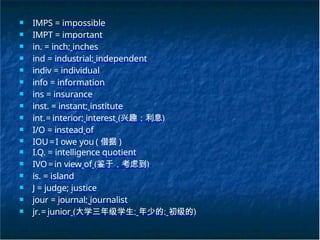
■ IMPS = impossible
■ IMPT = important
■ in. = inch; inches
■ ind = industrial; independent
■ indiv = individual
■ info = information
■ ins = insurance
■ inst. = instant; institute
■ int.= interior; interest (兴趣;利息)
■ I/O = instead of
■ IOU=I owe you ( 借据 )
■ I.Q. = intelligence quotient
■ IVO=in view of (鉴于,考虑到)
■ is. = island
■ J = judge; justice
■ jour = journal; journalist
■ jr.= junior (大学三年级学生; 年少的; 初级的)
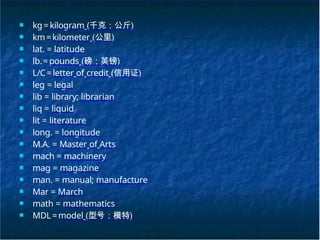
■ kg=kilogram (千克;公斤)
■ km=kilometer (公里)
■ lat. = latitude
■ lb.= pounds (磅;英镑)
■ L/C=letter of credit (信用证)
■ leg = legal
■ lib = library; librarian
■ liq = liquid
■ lit = literature
■ long. = longitude
■ M.A. = Master of Arts
■ mach = machinery
■ mag = magazine
■ man. = manual; manufacture
■ Mar = March
■ math = mathematics
■ MDL=model (型号;模特)
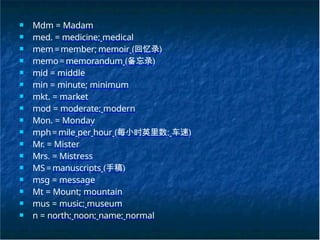
■ Mdm = Madam
■ med. = medicine; medical
■ mem=member; memoir (回忆录)
■ memo=memorandum (备忘录)
■ mid = middle
■ min = minute; minimum
■ mkt. = market
■ mod = moderate; modern
■ Mon. = Monday
■ mph=mile per hour (每小时英里数; 车速)
■ Mr. = Mister
■ Mrs. = Mistress
■ MS=manuscripts (手稿)
■ msg = message
■ Mt = Mount; mountain
■ mus = music; museum
■ n = north; noon; name; normal
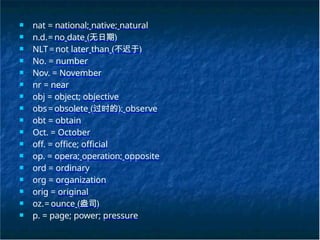
■ nat = national; native; natural
■ n.d.= no date (无日期)
■ NLT=not later than (不迟于)
■ No. = number
■ Nov. = November
■ nr = near
■ obj = object; objective
■ obs=obsolete (过时的); observe
■ obt = obtain
■ Oct. = October
■ off. = office; official
■ op. = opera; operation; opposite
■ ord = ordinary
■ org = organization
■ orig = original
■ oz.= ounce (盎司)
■ p. = page; power; pressure
■ para = paragraph
■ part = particular; partner
■ pass = passive; passenger
■ PAT = patent
■ payt = payment
■ pc = piece; personal computer
■ pd.= paid (钱款)已付
■ perf = perform; performance
■ Ph.D. = Doctor of Philosophy
■ pk= park; peak (备注:pk
这个符号大家可以根据时髦的用语来灵活拓展其含义 )
■ pkg = package
■ PLS = please
■ p.m. = post meridiem = [w]afternoon
■ POB = post-office box
■ pop = popular; population
■ pr. = pair; preferred
■ prec = preceding
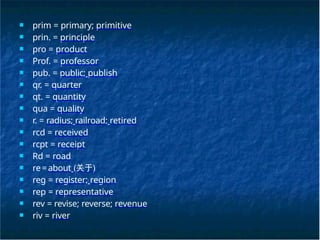
■ prim = primary; primitive
■ prin. = principle
■ pro = product
■ Prof. = professor
■ pub. = public; publish
■ qr. = quarter
■ qt. = quantity
■ qua = quality
■ r. = radius; railroad; retired
■ rcd = received
■ rcpt = receipt
■ Rd = road
■ re=about (关于)
■ reg = register; region
■ rep = representative
■ rev = revise; reverse; revenue
■ riv = river
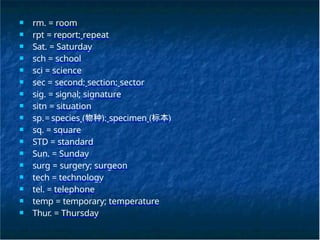
■ rm. = room
■ rpt = report; repeat
■ Sat. = Saturday
■ sch = school
■ sci = science
■ sec = second; section; sector
■ sig. = signal; signature
■ sitn = situation
■ sp.= species (物种); specimen (标本)
■ sq. = square
■ STD = standard
■ Sun. = Sunday
■ surg = surgery; surgeon
■ tech = technology
■ tel. = telephone
■ temp = temporary; temperature
■ Thur. = Thursday
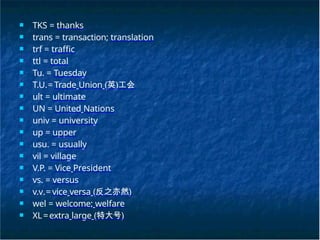
■ TKS = thanks
■ trans = transaction; translation
■ trf = traffic
■ ttl = total
■ Tu. = Tuesday
■ T.U.= Trade Union (英)工会
■ ult = ultimate
■ UN = United Nations
■ univ = university
■ up = upper
■ usu. = usually
■ vil = village
■ V.P. = Vice President
■ vs. = versus
■ v.v.= vice versa (反之亦然)
■ wel = welcome; welfare
■ XL=extra large (特大号)
Note-taking: What to
note
➢ Note down the main ideas.
➢ Systematically note down the links between different id
➢ Note down the point of view being expressed.
➢ Pay attention to verb tenses, conditional forms, and
mod verbs.
➢ Note down accurately the numbers, dates and
proper names.
. 笔记的原
则
■ 1. 理解为主,笔记为辅。
应以聆听讲者,全面地吸收讯息、认真理解为听
力主体,笔记只是辅助的作用,不宜舍本逐末。
2. 笔记应呈现讯息的概念与结构。
无论用图标或文字与符号,都应将之组成完整的
讯息概念或组织结构。
■ 3. 记下密度与难度高的讯息。
讯息负荷过量且不易记住的内容(如数字、专有
名词),一定要做笔记。
■
4. 笔记的内容与符号,以多重利用为原则。
任何已记下的笔记内容与符号,都应尽量拉线再
次利用,或用不同颜色的笔在原来的笔记上再做
笔记,以最经济的方式发挥笔记的作用到极限。
■ 5. 笔记的语言符号,必须能够沟通。
应避免使用自己不熟悉的符号。
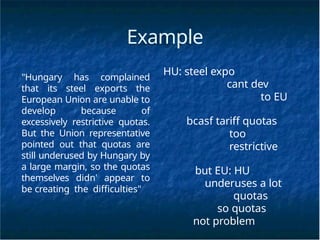
Example
"Hungary has complained
that its steel exports the
European Union are unable to
develop because of
excessively restrictive quotas.
But the Union representative
pointed out that quotas are
still underused by Hungary by
a large margin, so the quotas
themselves didn' appear to
be creating the difficulties"
HU: steel expo
cant dev
to EU
bcasf tariff quotas
too
restrictive
but EU: HU
underuses a lot
quotas
so quotas
not problem
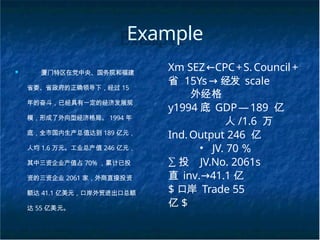
Example
■ 厦门特区在党中央、国务院和福建
省委、省政府的正确领导下,经过 15
年的奋斗,已经具有一定的经济发展规
模,形成了外向型经济格局。 1994 年
底,全市国内生产总值达到 189 亿元,
人均 1.6 万元。工业总产值 246 亿元,
其中三资企业产值占 70% ,累计已投
资的三资企业 2061 家,外商直接投资
额达 41.1 亿美元,口岸外贸进出口总额
达 55 亿美元。
Xm SEZ←CPC+S.Council+
省 15Ys→ 经发 scale
外经格
y1994 底 GDP—189 亿
人 /1.6 万
Ind.Output 246 亿
• JV. 70 %
∑ 投 JV.No. 2061s
直 inv.→41.1 亿
$ 口岸 Trade 55
亿 $

《口译笔记法》PPT课件.pptx interpreting note-taking

  • 1.
    Note-taking skills Breaking downa big picture into details with appropriate chunks Lesson 2
  • 2.
    Speech analysis • viewa speech as whole, single message, made up of related parts • divide a speech up into its component parts, • summarize the main message of each section of a speech, • note an entire speech and its component parts on a single page.
  • 3.
    There are manyways to approach the analysis of a speech. You can look at the context in which the speech is given, who is speaking, to whom and why or on what occasion and in which style.
  • 4.
    Mind Map A mindmap is a way of organizing information on a piece of paper. Usually it takes the form of an organic chart laid out on a large sheet of paper. Words and drawings are connected to one another on the page in various ways: by lines, by their position on the page relative to one another, and so on. Though the original format is rather narrow (Buzan, 2010), for our purposes mind maps also include any sort of pictorial or spatial representation of information on the page. This form of representing ideas taps into the way the mind associates and recalls information and can therefore be useful in helping us to organize and remember information.
  • 5.
    Creating a mindmap requires an understanding and analysis of the incoming speech, and it is this that is so useful for interpreters. The very act of making yourself draw a mind map forces you to dissect the speech, and that in turn means you listen far more attentively than the normal listener. It will help you see that a speech is not just an uninterrupted stream of words but a deliberately ordered collection of chunks of information. In drawing a mind map, you will create a visual image that shows (1) an overview of the whole speech on a single page and (2) how the different parts of the speech fit together. It is a great analysis exercise! And once you’ve got a mind map like this. You’ll find it relatively easy to recall most of the original speech from it. But remember, you’re not trying to get all the details when you make a mind map. You’re trying to record only the outline of the speech.
  • 6.
    Over the last50 years, Australia has attracted migrants from all over the globe, in the process becoming one of the world’s most multicultural nations. While the majority of our earliest migrants were Europeans, these days our population includes a large proportion of Asian migrants, and a significant number of African and Middle Eastern peoples. Migration to Australia has indisputably contributed to our diverse demographic. Nearly a quarter of our 23 million people were born overseas – 1.7 million of them in Asia. China and India are our largest sources of migration, and five other Asian nations, the Philippines, Sri Lanka, Malaysia, South Korea and Vietnam, constitute our top 10 source countries
  • 7.
    Over the last50 years, Australia has attracted migrants from all over the globe, in the process becoming one of the world’s most multicultural nations. While the majority of our earliest migrants were Europeans, these days our population includes a large proportion of Asian migrants, and a significant number of African and Middle Eastern peoples. Migration to Australia has indisputably contributed to our diverse demographic. Nearly a quarter of our 23 million people were born overseas – 1.7 million of them in Asia. China and India are our largest sources of migration, and five other Asian nations, the Philippines, Sri Lanka, Malaysia, South Korea and Vietnam, constitute our top 10 source countries
  • 9.
  • 10.
    Note-Taking: The Powerof Selectivity Give yourself a point for each one of these highlighted words that made it to your page (word, abbreviation, symbol)
  • 11.
    The importance oftaking notes ➢ Our short-term memory alone can not retain the amount of information the speaker gives i the act of interpreting. We need to employ other means to help with our retaining and retrieval of information. Notes are an aid to enhance the work of understanding, analysis and re-expression.
  • 12.
    ➢ The main useof notes is to relieve memory. Although an interpreter may have understood the main ideas of a speech, it is almost impossible for him/her to recall all the elements of a five-minute speech, particular if it contains numbers, names, lists, since s elements cannot be recalled on the basis of analysis and logic.
  • 13.
  • 14.
    Importance of note-taking •Katharine Allen (51st ATA Conference, Denver) ◦ Importance of developing note-taking skills in community interpreting • so that we’re not interrupting speakers all the time for short consecutive interpretation. ◦ Community interpreting training programs are teaching would-be interpreters to interrupt people all the time • Sometimes the medical provider is giving a long explanation to the patient about his/her condition and their plans for patient recovery. ◦ If interrupted they might lose track of what they’re saying, etc.
  • 15.
    Importance of note-taking •In court, • Many interpreters are now using digital recorders in the long consecutive mode • Then providing simultaneous interpretation • However, recorders sometimes fail (technical problems, etc)
  • 16.
    Note-taking? • But, longconsecutive interpreting with note-taking may not be the best model all the time • the distance between the original speech and the interpreted rendition is too long • paralinguistic elements (nonverbal communication, intonation, emotional outbursts, etc) are lost. • Maybe in these emotionally charged settings, the simultaneous mode would be the best format? Thoughts?
  • 17.
    Jean-Franqois Rozan (1956) •7 principles • Noting the idea, not the word • Abbreviation o Unless a word is short (4-5 letters), interpreters should use an unambiguous abbreviated form • Links • Negation o OK = agree; o then “disagree” = OK • Emphasis • Verticality • Shift
  • 18.
    Notes 54, prices / butno = income so popon , “Over the course of 1954, prices rose, although not to the same extent as income, thus the population’s net income increased.”
  • 19.
    Andrew Gillies (2005) •Macro • • • Looking at the bigger picture • Structure, framework, the way the speech is built up Micro-level • Words, expressions Note-taking for consecutive interpreting • Skeleton structure of the speech. • Visual representation of your analysis of the source speech.
  • 20.
    Note-taking • Different tasks •Phase 1: listening and analysis, note-taking, short-term memory operations, coordination of these tasks • Phase 2 : note-reading, remembering, production • Difficulties: • If you’re thinking too much about how to note something, you will listen less well. • If your notes are unclear or illegible your production will suffer because you’ll put too much effort into reading them.
  • 21.
    Note-taking • Dissecting thespeech • Analyzing its structure, progression • Analyzing the communicative fUnction of different parts of the speech • Recognizing the main ideas and secondary ones • Spotting the links between them
  • 22.
    Mini Summaries • Tosummarize: • Function and structure of the speech’s parts. • Not the content!
  • 23.
    Mind Maps • • • • Way oforganizing information on a piece of paper Organic chart Words and drawings are connected to one-another on the page in various ways • Lines • Position on the page relative to one another How the mind associates and recalls information
  • 24.
    SOV • “Who didwhat to whom?^ • The sentence • Basic unit of communication • Subject • Verb • Object
  • 25.
    SVO • “Who doeswhat to whom (or to what)? SVO We… …took stock of… relations... O …and the situation For the purposes of note-taking in consecutive interpreting an idea is …. SVO
  • 26.
    S V In theareas for which 1 have some responsibility, there were also, as the Prime O Minister has mentioned, some important developments at Feira. S V O O Wc took stock of the European Union's relations with Russia and the situation there, including in Chechnya, in the light of the recent EU-Russia Summit, which I think was regarded as fairly successful. SV O It is too early to judge President Putin's economic programme; S V O however, our basic message is that a sound programme will be vital to twost investor confidence. S V On Chechnya, there have, it is true, been some recent moderately positive developments in response to international and European Union pressure: S V O for example the recent ECHO mission was able to take place S V O and western humanitarian agencies have greater access to the area. S V The conflict nevertheless continues S V O and we still have considerable concerns. S V O In particular, we want to see much greater access for humanitarian aid agencies. S V O We want to see genuinely independent investigation inlo reports of human rights abuses, S V o and we want to see a real dialogue between the Russian government and the Chechens.
  • 27.
    Links • Links • Signalthe way the speaker wants to listener to relate what is about to be said to what has been said before • Speech • Ideas • Links between them
  • 28.
    Links • The economyis struggling. The Central Bank has left interest rates unchanged. • The economy is struggling. However, the Central Bank has left interest rates unchanged. • The economy is struggling. Consequently, the Central Bank has lf interest rates unchanged. • Different messages • Bring ideas into relations with one another • Provide more information about the situation
  • 29.
    Links // Britain and Germanyare among those countries pushing most for an ambitious new WTO round. — So, for both the UK and Germany, the failure of the trade talks in Cancun was a huge disappointment. // A successful trade round would be a massive prize. if If we could halve world tariffs, then [then] that would add as much as $400 billion annually to world incomes, of which at least 150 billion will flow to developing countries. // Thafs more than 3 times what they currently get in aid. BUT But to achieve this we need to reform the CAP.
  • 30.
    Links 8 but, however, nonetheless,on the other hand, in spite of this, all the same, limitation or contradiction following an idea THO although, despite (the fact that), even though, while, whilst, notwithstanding, limitation or contradiction preceding both linked ideas COS because, main reason for this, what is causing this, whats behind this? effect — cause —A hence, this means that, the result of this is, the consequence of this is, so that, because of this, therefore, this is why, not surprisingly then, cause 一 effect TO (in order) G, in such a way as to, so that, with the aim of, the purpose being to, purpose
  • 31.
    Parallel Values • It’snot uncommon for speakers to have the same subject doing many different things. • By noting the verbs parallel to one another on the page • Clearly see they have the same subject
  • 32.
    Parallel Values • First,any successful economy needs to conform to certain basics. It should be an open economy, willing to let capital and goods move freely. It needs financial and monetary discipline - the markets and investors swiftly punish the profligate. It needs to encourage business and enterprise - to create an enabling climate for entrepreneurs. A few years ago, people might have stopped there. But now we can add confidently: the successful economy also must invest heavily in human capital, technology and infrastructure. Education is a top economic as well as social priority. High levels of unemployment and social exclusion do not just disfigure society, they waste the national resource of human talent.
  • 33.
    Parallel Values • Becausethe French government has cut customs duties. • Because the French, German and British governments have cut customs duties. COS Fra Ger UK cut duties
  • 34.
    Parallel Values • Becausethe French, German and British governments have cut customs duties, visafees and administrative charges. COS Fra Ger UK cut duties visa fees admin charges
  • 35.
    Brackets • By positioningan element vertically below another • In brackets • Clearly identify • One belongs to the other • Is subordinate to it within the clause or SVO group • We can adjust our intonation appropriately
  • 36.
    Brackets • And today?The changes, even since 1973, when Britain entered the European Economic Community, are remarkable:
  • 42.
    笔记要点 ■ 1. 少写多划。划线条比写文字快。线条形象, 相当于翻译的 "半成品 " ,有助译员眼看笔记, 口出译文。两种情况下应该尽量用线条: 表示动作和动态的词句。比如,以上升的斜线代 表 " 发展 " , " 增加 " , " 进步 "," 进一步 " ;以下 降的斜线代表 " 减少 " , " 下降 " , " 恶化 " 等 等。 表示因果或前后关系的词句。比如,用一条线代 表 " 因为 / 所以 " , "… 之后 " , " 在…之前 " ,以 体现出上下前后之间的关联关系。
  • 43.
    2. 少字多意 ■ 养成一个词的笔记不超过一个字的习惯。中文里 有大量的词汇是由两个,或两个以上的字组成。 只要看到其中一个,你的短期记忆就应该能够补 齐其余的字。不必多写。比如, "中国 " 最多写 个 " 中 " 。 " 北京 " 最多写个 " 北 " 。英文词也同 理处理。 "politics" 最多 写 "poli" , "government" 最多写 "gov" ,等等。 另外,需要培养以笔记与记忆互动;看到一个字能 说出几个字,甚至一串词的能力。 在有上下文的 情况下,这不难。比如,谈中国的 近况,听 到 " 改革,开放 " 记一个 " 改 " 字,不难从短期记 忆中说出原文。听到 "British Prime Minister Tony Blair" ,记 "PM" ,也同样能说出原文。
  • 44.
    ■ 3. 通用一小组线条 /标记。否则在自己本 来熟悉的中英文之外,又编出一套自己不熟 悉的文码使用,会导致需要想一想用哪个符 号的情况,适得其反。
  • 45.
  • 46.
  • 47.
  • 48.
  • 49.
  • 50.
  • 51.
    ■ Language usedin your notes: SL and TL ■ Use whatever language that comes to your mind
  • 52.
    ■ Use as manysymbols as you feel comfortable with + - ↑ ↓ ← → < > ≤ ≥ = ≠ ≈ × ∵ ∴
  • 53.
    ■ + 还有, 和 , 此外 , 而且 , 以及 - 减少 , 不会 , 没有 = 等于 , 相当于 > 大过,超过,优越于 <少于,小于,比不上 ↓ 减少,下降 ↑ 增加,上升,上报 ↗ 逐步增加 ↘ 逐步下降,减少 → 向前发展 ■ ∴ 所以,于是 ∵ 因为,由于 √ 正确,同意,好 ~ 调换,对调,交 流 ⅹ错误,不行,没 有 ‖ 停止, □ 国家 ◉ 国内 □• 国外 ! 注意,警惕 ?疑问,问题,试验 性 --- 下划线表示强 调。
  • 54.
    ■ Use abbreviations “Prof”for “professor”, “dept” for “department”, “std” for “standard”. “ref” for “reference”, “eg” for “for example”, “ie” for “that is”, “esp” for “especially”, “min” for “minimum”, “max” for “maximum”, and “usu” for “usually” cf for compare std standard SH shanghai
  • 55.
    ■ GDP (gross domesticproduct), GNP (gross national product), 5yr P (five year plan), SOE (state owned enterprise), FIE (foreign invested enterprise), JV (joint venture), SEZ (special economic zone), trd (trade),
  • 56.
    ■ invt (investment), respon(responsibility) memo (memorandum), demo (demonstration), Ad (advertisement), TQC (total quality control 全面质量管理 ), CI (corporate image 企业形象 ), Attn (attention),dept (department),
  • 57.
    ■ Exch (exchange), coop(cooperation), prodc (production), ref (reference), info (information), IT indy (information industry), telcom (telecommunication), IDD (international direct dialing), R&D (research and development), CAD( computer assisted design),agrd(agreed). CEO(chief executive officer), Govt(government), FOB ( free on board),CIF(cost,insurance,fright) 。
  • 58.
    中文缩略语 ■ 中国人民(中民),中国政府 ( chi,gov ), 美国人民(美人 ,A 人), 物质文明和精神文明(物神), 国民经济发 展指标(经 标),可持续发展(可持),改革开放政 策(改开 p ),现代化(现 H ),国际 化 (国 H ),可行性(可 X )。
  • 59.
    ■ 按我国有关规定-国定 ■ 企业家-企业j / 企 ° ■ 感到特别亲切- feel ※ 亲
  • 60.
    ■ NPC ( NationalPeople’s Congress 全国 人 民代表大会) ,CPPCC ( Chinese People's Political Consultative Conference 中国政治协商会议) , COSCO (中国远洋运 输公司) , GE (通用电器公司) , GM (通用汽车公 司), UNESCO (联合国教科文组 织) EU( 欧洲联盟 ), OECD (经济合 作发展组织) , APEC (亚太经济合作 组织), ASEAN( 东南亚国家联盟 )
  • 61.
  • 62.
    ■ the -for f that -t from fr and & if .f are r is z he e be b or o you u to t your ur in n an a of so s
  • 63.
    has hs had hd have hv she )e shall )lmost m- ■ Which (c what (t was (s whom (m will (l when (n can kn go g my m. new nw
  • 64.
    any an ■ some sm could kd thing -, think -nk first /- well (el say sa nextnx until tl cannot knt do d lie l. time t.m send s+ very vr more mo easy ez
  • 65.
    ■ □ /□country and country ■ acc = account, accountant ■ acdg = according ■ acpt = accept ■ ad = advertisement ■ adm = administration ■ ads = address ■ adv = advice ■ agr = agriculture ■ agt = agent ■ alt = altitude
  • 66.
    ■ a.m. =ante meridiem = before noon ■ AMAP = as much as possible ■ amb = ambassador ■ amt = amount ■ anal = analysis ■ B.A. = Bachelor of Arts ■ bal = balance ■ B.C. = before Christ ■ bd = board ■ bdl = bundle ■ bk = bank; book
  • 67.
    ■ bkts =baskets ■ B/L=bill of lading ( 提单 ) ■ BLDG = building ■ bp = birthplace ■ br = branch; brother ■ B.S. = Bachelor of Science ■ bu = bureau ■ C = capacity; century; chapter; centigrade; cost; city; center ■ cal = calendar; caliber; calories
  • 68.
    ■ cap =capital; captain ■ cat = catalog ■ cc=carbon copy (复印件;抄送) ■ CEO = chief executive officer ■ cert = certificate ■ CFM = confirm ■ cncl = cancel ■ cp. = compare ■ cit = citizen ■ civ = civil; civilization
  • 69.
    ■ clk =clerk ■ cml = commercial ■ co. = company ■ c/o=care of(转交) ■ col = college; color ■ com = commentary; common; communication; community ■ comm = commission ■ comp = complete; computer; competition ■ con = conclusion; against ■ cond = condition
  • 70.
    ■ cont. =continent; continued ■ corp = corporation ■ cust = customer; custom; customs ■ Dec = December ■ Dec = December ■ dec = deceased; declaration ■ def = defender; defense ■ deg = degree ■ dep = deposit ■ DEPT = department ■ disc = discount ■ dist = distance; distinguish ■ div = divide; divorced ■ do.= ditto (同上)
  • 71.
    ■ dorm =dormitory ■ dpt = departure ■ dz = dozen ■ e = east; earth; engineering ■ econ = economics; economy ■ ed. = education; editor ■ e.g. = exempli gratia = for example ■ encl. = enclosed; enclosure ■ esp. = especially ■ etc. = et cetera = and so on ■ ex. = example; exception; extra ■ exp. = export ■ expln = explain ■ ext = extend; extension ■ FAX = facsimile ■ Feb. = February ■ fem = female; feminine
  • 72.
    ■ ff. =following ■ fig = figures ■ fin = finance; financial ■ fl = fluid ■ FLT = flight ■ FOB=free on board (船上交货;离岸价格) ■ for = foreign; forestry ■ fp = freezing point ■ fr = frequent ■ Fri. = Friday ■ frt=freight (货物;货运) ■ ft=foot; feet (脚;英寸) ■ fut = future ■ FYR=for your reference (仅供参考) ■ g = gold; grain; guide; gender; gravity ■ G.A.= General Assembly ( 联合国大会 ) ■ gen. = generally
  • 73.
    ■ gent =gentleman; gentlemen ■ gm = gram; general manager ■ gov = government ■ gs=general secretary (秘书长) ■ h = harbor; hundred; husband; hydrogen ■ hd=head (头部;首脑) ■ hf = half ■ Hon = honorable; honorary ■ H.Q. = headquarters ■ hr = hour ■ ht = height ■ hypoth = hypothesis; hypothetical ■ i.a. = in absence; absent ■ ib. = ibidem = in the same place ■ ID = identity; identity card ■ i.e. = id est = that is ■ imp = import; imperial
  • 74.
    ■ IMPS =impossible ■ IMPT = important ■ in. = inch; inches ■ ind = industrial; independent ■ indiv = individual ■ info = information ■ ins = insurance ■ inst. = instant; institute ■ int.= interior; interest (兴趣;利息) ■ I/O = instead of ■ IOU=I owe you ( 借据 ) ■ I.Q. = intelligence quotient ■ IVO=in view of (鉴于,考虑到) ■ is. = island ■ J = judge; justice ■ jour = journal; journalist ■ jr.= junior (大学三年级学生; 年少的; 初级的)
  • 75.
    ■ kg=kilogram (千克;公斤) ■km=kilometer (公里) ■ lat. = latitude ■ lb.= pounds (磅;英镑) ■ L/C=letter of credit (信用证) ■ leg = legal ■ lib = library; librarian ■ liq = liquid ■ lit = literature ■ long. = longitude ■ M.A. = Master of Arts ■ mach = machinery ■ mag = magazine ■ man. = manual; manufacture ■ Mar = March ■ math = mathematics ■ MDL=model (型号;模特)
  • 76.
    ■ Mdm =Madam ■ med. = medicine; medical ■ mem=member; memoir (回忆录) ■ memo=memorandum (备忘录) ■ mid = middle ■ min = minute; minimum ■ mkt. = market ■ mod = moderate; modern ■ Mon. = Monday ■ mph=mile per hour (每小时英里数; 车速) ■ Mr. = Mister ■ Mrs. = Mistress ■ MS=manuscripts (手稿) ■ msg = message ■ Mt = Mount; mountain ■ mus = music; museum ■ n = north; noon; name; normal
  • 77.
    ■ nat =national; native; natural ■ n.d.= no date (无日期) ■ NLT=not later than (不迟于) ■ No. = number ■ Nov. = November ■ nr = near ■ obj = object; objective ■ obs=obsolete (过时的); observe ■ obt = obtain ■ Oct. = October ■ off. = office; official ■ op. = opera; operation; opposite ■ ord = ordinary ■ org = organization ■ orig = original ■ oz.= ounce (盎司) ■ p. = page; power; pressure
  • 78.
    ■ para =paragraph ■ part = particular; partner ■ pass = passive; passenger ■ PAT = patent ■ payt = payment ■ pc = piece; personal computer ■ pd.= paid (钱款)已付 ■ perf = perform; performance ■ Ph.D. = Doctor of Philosophy ■ pk= park; peak (备注:pk 这个符号大家可以根据时髦的用语来灵活拓展其含义 ) ■ pkg = package ■ PLS = please ■ p.m. = post meridiem = [w]afternoon ■ POB = post-office box ■ pop = popular; population ■ pr. = pair; preferred ■ prec = preceding
  • 79.
    ■ prim =primary; primitive ■ prin. = principle ■ pro = product ■ Prof. = professor ■ pub. = public; publish ■ qr. = quarter ■ qt. = quantity ■ qua = quality ■ r. = radius; railroad; retired ■ rcd = received ■ rcpt = receipt ■ Rd = road ■ re=about (关于) ■ reg = register; region ■ rep = representative ■ rev = revise; reverse; revenue ■ riv = river
  • 80.
    ■ rm. =room ■ rpt = report; repeat ■ Sat. = Saturday ■ sch = school ■ sci = science ■ sec = second; section; sector ■ sig. = signal; signature ■ sitn = situation ■ sp.= species (物种); specimen (标本) ■ sq. = square ■ STD = standard ■ Sun. = Sunday ■ surg = surgery; surgeon ■ tech = technology ■ tel. = telephone ■ temp = temporary; temperature ■ Thur. = Thursday
  • 81.
    ■ TKS =thanks ■ trans = transaction; translation ■ trf = traffic ■ ttl = total ■ Tu. = Tuesday ■ T.U.= Trade Union (英)工会 ■ ult = ultimate ■ UN = United Nations ■ univ = university ■ up = upper ■ usu. = usually ■ vil = village ■ V.P. = Vice President ■ vs. = versus ■ v.v.= vice versa (反之亦然) ■ wel = welcome; welfare ■ XL=extra large (特大号)
  • 82.
    Note-taking: What to note ➢Note down the main ideas. ➢ Systematically note down the links between different id ➢ Note down the point of view being expressed. ➢ Pay attention to verb tenses, conditional forms, and mod verbs. ➢ Note down accurately the numbers, dates and proper names.
  • 83.
    . 笔记的原 则 ■ 1.理解为主,笔记为辅。 应以聆听讲者,全面地吸收讯息、认真理解为听 力主体,笔记只是辅助的作用,不宜舍本逐末。 2. 笔记应呈现讯息的概念与结构。 无论用图标或文字与符号,都应将之组成完整的 讯息概念或组织结构。
  • 84.
    ■ 3. 记下密度与难度高的讯息。 讯息负荷过量且不易记住的内容(如数字、专有 名词),一定要做笔记。 ■ 4.笔记的内容与符号,以多重利用为原则。 任何已记下的笔记内容与符号,都应尽量拉线再 次利用,或用不同颜色的笔在原来的笔记上再做 笔记,以最经济的方式发挥笔记的作用到极限。
  • 85.
  • 86.
    Example "Hungary has complained thatits steel exports the European Union are unable to develop because of excessively restrictive quotas. But the Union representative pointed out that quotas are still underused by Hungary by a large margin, so the quotas themselves didn' appear to be creating the difficulties" HU: steel expo cant dev to EU bcasf tariff quotas too restrictive but EU: HU underuses a lot quotas so quotas not problem
  • 87.
    Example ■ 厦门特区在党中央、国务院和福建 省委、省政府的正确领导下,经过 15 年的奋斗,已经具有一定的经济发展规 模,形成了外向型经济格局。1994 年 底,全市国内生产总值达到 189 亿元, 人均 1.6 万元。工业总产值 246 亿元, 其中三资企业产值占 70% ,累计已投 资的三资企业 2061 家,外商直接投资 额达 41.1 亿美元,口岸外贸进出口总额 达 55 亿美元。 Xm SEZ←CPC+S.Council+ 省 15Ys→ 经发 scale 外经格 y1994 底 GDP—189 亿 人 /1.6 万 Ind.Output 246 亿 • JV. 70 % ∑ 投 JV.No. 2061s 直 inv.→41.1 亿 $ 口岸 Trade 55 亿 $