Note-Taking
Why Take Notes
   Note-taking serves two main academic
    purposes:
       It provides a method to identify/predict what will
        be on tests and puts that information in a format
        that can be easily studied.
       It provides a method for pulling together the
        important information a student can use in writing
        a research paper or preparing a speech.
Four Purposes for Notetaking

   Provides written record for review
   Forces listener to pay attention
   Requires organization which involves active
    effort from listener
   Requires condensing and rephrasing which
    aid understanding
Good Note-taking Suggestions
   Label notes at top of page
   Use separate notebooks for each class
   Make notes legible
   Use only one side of paper
   Identify specialized vocabulary
   Develop your own set of symbols
   Leave blanks and/or lots of white space for filling in
    information missed
   Use telegraphic, not complete sentences (Provide the
    maximum amount of information in the minimum
    number of words)
   Develop a relatively simple note-taking system you
    will actually use
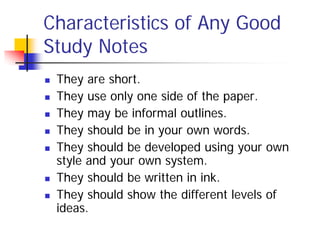
Characteristics of Any Good
Study Notes
   They are short.
   They use only one side of the paper.
   They may be informal outlines.
   They should be in your own words.
   They should be developed using your own
    style and your own system.
   They should be written in ink.
   They should show the different levels of
    ideas.
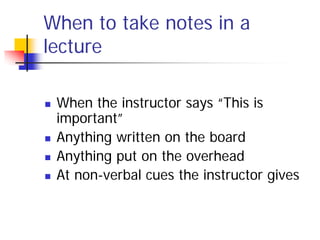
When to take notes in a
lecture

   When the instructor says “This is
    important”
   Anything written on the board
   Anything put on the overhead
   At non-verbal cues the instructor gives
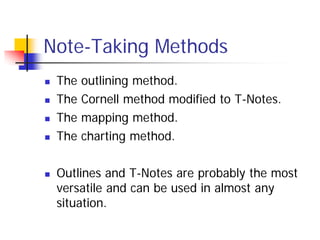
Note-Taking Methods
   The   outlining method.
   The   Cornell method modified to T-Notes.
   The   mapping method.
   The   charting method.

   Outlines and T-Notes are probably the most
    versatile and can be used in almost any
    situation.
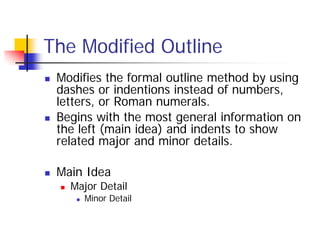
The Modified Outline
   Modifies the formal outline method by using
    dashes or indentions instead of numbers,
    letters, or Roman numerals.
   Begins with the most general information on
    the left (main idea) and indents to show
    related major and minor details.

   Main Idea
       Major Detail
            Minor Detail
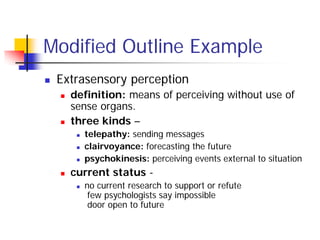
Modified Outline Example
   Extrasensory perception
       definition: means of perceiving without use of
        sense organs.
       three kinds –
            telepathy: sending messages
            clairvoyance: forecasting the future
            psychokinesis: perceiving events external to situation
       current status -
            no current research to support or refute
              few psychologists say impossible
              door open to future
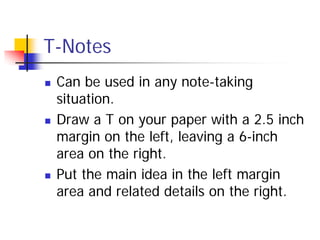
T-Notes
   Can be used in any note-taking
    situation.
   Draw a T on your paper with a 2.5 inch
    margin on the left, leaving a 6-inch
    area on the right.
   Put the main idea in the left margin
    area and related details on the right.
T-Note Example
Label             Date
Characteristics   1. Uses as few words as
of any good          possible.
Note-taking       2. Focuses on main ideas,
system               major details, terms.
                  3. Are written in own words.
                  4. Are written on only one side
                     of paper.
                  5. Provides lots of white space
                     (skip lines between ideas.)
T-Note Example 2

Label          Date
Extrasensory   Definition: means of perceiving without
Perception     use of sense organs
               Three kinds:
               Telepathy: sending messages

               Clairvoyance: forecasting the future

               Psychokinesis: perceiving events external

               to situation
               Current Status:

               No current research to support or refute

               Door open to future
Mapping Method of Note-
Taking
   Provides a visual over-view of important
    information.
   Shows relationships among ideas.
   Is easy to edit.
   Appeals to visual learning styles.
   Is not recommended for lecture notes,
    but is helpful as text study notes.
Guidelines for Making Maps
   Begin with what you consider the most
    important idea as the “center” or “top” of the
    map. Branch out from it to related ideas.
   Write your ideas on lines that are connected
    to other lines in order to express clearly the
    relationship between various ideas.
   Print ideas in ink and in capital letters so they
    can be easily read.
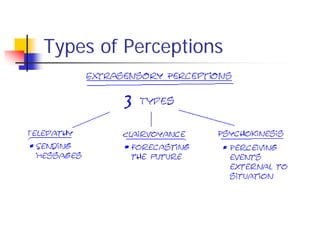
Types of Perceptions
The Charting Method of Note-
Taking
   Useful for certain types of text notes.
   Can help focus on facts and
    relationships in preparing for tests.
   Helps give an overview of information.
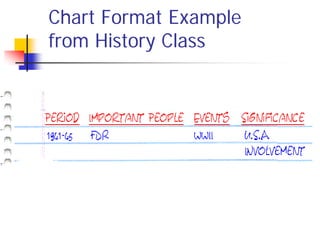
Chart Format Example
from History Class

Note taking

  • 1.
  • 2.
    Why Take Notes  Note-taking serves two main academic purposes:  It provides a method to identify/predict what will be on tests and puts that information in a format that can be easily studied.  It provides a method for pulling together the important information a student can use in writing a research paper or preparing a speech.
  • 3.
    Four Purposes forNotetaking  Provides written record for review  Forces listener to pay attention  Requires organization which involves active effort from listener  Requires condensing and rephrasing which aid understanding
  • 4.
    Good Note-taking Suggestions  Label notes at top of page  Use separate notebooks for each class  Make notes legible  Use only one side of paper  Identify specialized vocabulary  Develop your own set of symbols  Leave blanks and/or lots of white space for filling in information missed  Use telegraphic, not complete sentences (Provide the maximum amount of information in the minimum number of words)  Develop a relatively simple note-taking system you will actually use
  • 5.
    Characteristics of AnyGood Study Notes  They are short.  They use only one side of the paper.  They may be informal outlines.  They should be in your own words.  They should be developed using your own style and your own system.  They should be written in ink.  They should show the different levels of ideas.
  • 6.
    When to takenotes in a lecture  When the instructor says “This is important”  Anything written on the board  Anything put on the overhead  At non-verbal cues the instructor gives
  • 7.
    Note-Taking Methods  The outlining method.  The Cornell method modified to T-Notes.  The mapping method.  The charting method.  Outlines and T-Notes are probably the most versatile and can be used in almost any situation.
  • 8.
    The Modified Outline  Modifies the formal outline method by using dashes or indentions instead of numbers, letters, or Roman numerals.  Begins with the most general information on the left (main idea) and indents to show related major and minor details.  Main Idea  Major Detail  Minor Detail
  • 9.
    Modified Outline Example  Extrasensory perception  definition: means of perceiving without use of sense organs.  three kinds –  telepathy: sending messages  clairvoyance: forecasting the future  psychokinesis: perceiving events external to situation  current status -  no current research to support or refute few psychologists say impossible door open to future
  • 10.
    T-Notes  Can be used in any note-taking situation.  Draw a T on your paper with a 2.5 inch margin on the left, leaving a 6-inch area on the right.  Put the main idea in the left margin area and related details on the right.
  • 11.
    T-Note Example Label Date Characteristics 1. Uses as few words as of any good possible. Note-taking 2. Focuses on main ideas, system major details, terms. 3. Are written in own words. 4. Are written on only one side of paper. 5. Provides lots of white space (skip lines between ideas.)
  • 12.
    T-Note Example 2 Label Date Extrasensory Definition: means of perceiving without Perception use of sense organs Three kinds: Telepathy: sending messages Clairvoyance: forecasting the future Psychokinesis: perceiving events external to situation Current Status: No current research to support or refute Door open to future
  • 13.
    Mapping Method ofNote- Taking  Provides a visual over-view of important information.  Shows relationships among ideas.  Is easy to edit.  Appeals to visual learning styles.  Is not recommended for lecture notes, but is helpful as text study notes.
  • 14.
    Guidelines for MakingMaps  Begin with what you consider the most important idea as the “center” or “top” of the map. Branch out from it to related ideas.  Write your ideas on lines that are connected to other lines in order to express clearly the relationship between various ideas.  Print ideas in ink and in capital letters so they can be easily read.
  • 15.
  • 16.
    The Charting Methodof Note- Taking  Useful for certain types of text notes.  Can help focus on facts and relationships in preparing for tests.  Helps give an overview of information.
  • 17.