


Take Note! 
Media Center 
Hialeah Gardens High School 
Anabel Parra
Why take notes? 
Note-taking skills are important to be 
successful in high school and in college because: 
1. During a lecture, information that is not in the 
textbook may be covered. 
2. Notes serve as a record of what was covered in 
class. 
3. Notes are a great source to help one review for 
a test. 
4. Writing down important information reinforces 
what one has heard and helps one remember. 
5. One is actively engaged in listening and 
becomes a better listener when taking notes.
Note-taking tips: 
When in class… 
1. Write the date of the lecture. 
2. Write the title of the lecture. 
3. Write the name of the class. 
4. Write neatly so your notes are legible. 
5. Write only one idea per line. 
6. Leave a blank space to add ideas later on. 
7. Write all main ideas covered in class. 
8. Write important details discussed in class. 
9. Write key terms and definitions from class. 
10. Abbreviate what you write. 
11. Don’t use extra words that aren’t important. 
12. Don’t worry about punctuation. 
13. Underline or circle anything that is emphasized or 
repeated.
Note taking tips: 
After class… 
 Read your notes within 24 hours. 
 Rewrite, reorganize, or type your notes – this will help you 
understand and remember. 
 Rewrite using complete sentences and spell out anything 
that had been abbreviated. 
 Highlight important information. 
 Write down any questions you may have for the teacher.
Three ways to take notes: 
1. Free-Form 
2. The Cornell System 
3. Outline
Free-Form notes 
• Write one idea per line, leaving 
space after each line. 
• After class, rewrite and add 
more information.
The Cornell System 
• This system was invented by Dr. 
Walter Pauk at Cornell University. 
• It involves 5 stages 
1. Record 
2. Reduce 
3. Recite 
4. Reflect 
5. Review
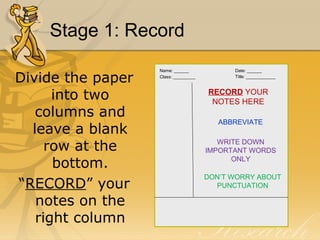
Stage 1: Record 
Divide the paper 
into two 
columns and 
leave a blank 
row at the 
bottom. 
“RECORD” your 
notes on the 
right column 
Name: ______ Date: ______ 
Class: _________ Title: ____________ 
RECORD YOUR 
NOTES HERE 
ABBREVIATE 
WRITE DOWN 
IMPORTANT WORDS 
ONLY 
DON’T WORRY ABOUT 
PUNCTUATION
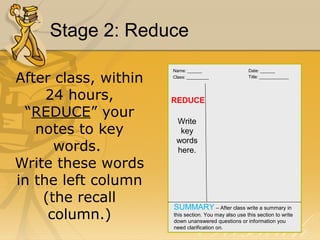
Stage 2: Reduce 
After class, within 
24 hours, 
“REDUCE” your 
notes to key 
words. 
Write these words 
in the left column 
(the recall 
column.) 
Name: ______ Date: ______ 
Class: _________ Title: ____________ 
REDUCE 
Write 
key 
words 
here. 
SUMMARY – After class write a summary in 
this section. You may also use this section to write 
down unanswered questions or information you 
need clarification on.
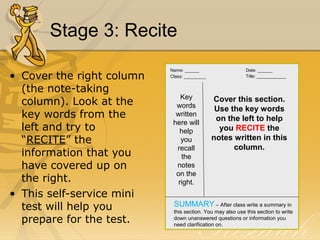
Stage 3: Recite 
• Cover the right column 
(the note-taking 
column). Look at the 
key words from the 
left and try to 
“RECITE” the 
information that you 
have covered up on 
the right. 
• This self-service mini 
test will help you 
prepare for the test. 
Name: ______ Date: ______ 
Class: _________ Title: ____________ 
Cover this section. 
Use the key words 
on the left to help 
you RECITE the 
notes written in this 
column. 
Key 
words 
written 
here will 
help 
you 
recall 
the 
notes 
on the 
right. 
SUMMARY – After class write a summary in 
this section. You may also use this section to write 
down unanswered questions or information you 
need clarification on.
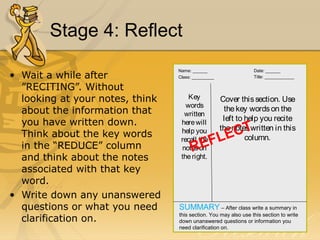
Stage 4: Reflect 
• Wait a while after 
”RECITING”. Without 
looking at your notes, think 
about the information that 
you have written down. 
Think about the key words 
in the “REDUCE” column 
and think about the notes 
associated with that key 
word. 
• Write down any unanswered 
questions or what you need 
clarification on. 
Name: ______ Date: ______ 
Class: _________ Title: ____________ 
Key 
words 
written 
here will 
help you 
recall the 
notes on 
the right. 
Cover this section. Use 
the key words on the 
left to help you recite 
the notes written in this 
REFLECT 
column. 
SUMMARY – After class write a summary in 
this section. You may also use this section to write 
down unanswered questions or information you 
need clarification on.
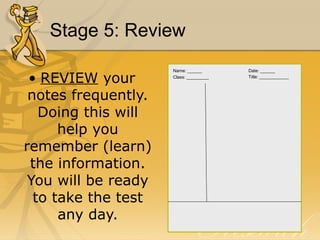
Stage 5: Review 
• REVIEW your 
notes frequently. 
Doing this will 
help you 
remember (learn) 
the information. 
You will be ready 
to take the test 
any day. 
Name: ______ Date: ______ 
Class: _________ Title: ____________
Outline 
• Use this “outline” note-taking style if the 
teacher is going over the textbook. (The 
textbook is already organized with headings 
and subheadings.) 
• Keep your notes short and abbreviate. Don’t 
write down every word. 
• Number the main facts and ideas. Write down 
related information under those main 
facts/ideas. 
See example on the following slide:
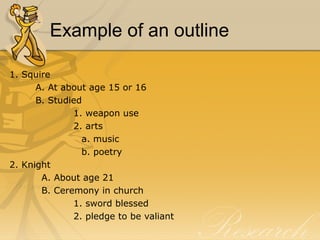
Example of an outline 
1. Squire 
A. At about age 15 or 16 
B. Studied 
1. weapon use 
2. arts 
a. music 
b. poetry 
2. Knight 
A. About age 21 
B. Ceremony in church 
1. sword blessed 
2. pledge to be valiant
Works Cited 
"Cornell Notes." The Learning Toolbox Home. James Madison University. 
Web. 24 Jan. 2012. 
<http://coe.jmu.edu/LearningToolbox/cornellnotes.html>. 
Pauk, Walter. "The Cornell Note-taking System." Cornell Note-taking 
System. Cornell University, 20 Jan. 2006. Web. 24 Jan. 2014. 
<http://lsc.sas.cornell.edu/Sidebars/Study_Skills_Resources/cornellsys 
tem.pdf>. 
Schumm, Jeanne Shay. “School power: study skill strategies for 
succeeding in school. Minneapolis: Free Spirit, 2001. 
Valenza, Joyce Kasman., Emily Valenza, and Joyce Kasman. Valenza. 
Power Tools Recharged: 125+ Essential Forms and Presentations for 
Your School Library Information Program. Chicago: American Library 
Association, 2004. Print.
Take note! 
Anabel Parra 
Hialeah Gardens High School

Note taking skills

  • 1.
    Take Note! MediaCenter Hialeah Gardens High School Anabel Parra
  • 2.
    Why take notes? Note-taking skills are important to be successful in high school and in college because: 1. During a lecture, information that is not in the textbook may be covered. 2. Notes serve as a record of what was covered in class. 3. Notes are a great source to help one review for a test. 4. Writing down important information reinforces what one has heard and helps one remember. 5. One is actively engaged in listening and becomes a better listener when taking notes.
  • 3.
    Note-taking tips: Whenin class… 1. Write the date of the lecture. 2. Write the title of the lecture. 3. Write the name of the class. 4. Write neatly so your notes are legible. 5. Write only one idea per line. 6. Leave a blank space to add ideas later on. 7. Write all main ideas covered in class. 8. Write important details discussed in class. 9. Write key terms and definitions from class. 10. Abbreviate what you write. 11. Don’t use extra words that aren’t important. 12. Don’t worry about punctuation. 13. Underline or circle anything that is emphasized or repeated.
  • 4.
    Note taking tips: After class…  Read your notes within 24 hours.  Rewrite, reorganize, or type your notes – this will help you understand and remember.  Rewrite using complete sentences and spell out anything that had been abbreviated.  Highlight important information.  Write down any questions you may have for the teacher.
  • 5.
    Three ways totake notes: 1. Free-Form 2. The Cornell System 3. Outline
  • 6.
    Free-Form notes •Write one idea per line, leaving space after each line. • After class, rewrite and add more information.
  • 7.
    The Cornell System • This system was invented by Dr. Walter Pauk at Cornell University. • It involves 5 stages 1. Record 2. Reduce 3. Recite 4. Reflect 5. Review
  • 8.
    Stage 1: Record Divide the paper into two columns and leave a blank row at the bottom. “RECORD” your notes on the right column Name: ______ Date: ______ Class: _________ Title: ____________ RECORD YOUR NOTES HERE ABBREVIATE WRITE DOWN IMPORTANT WORDS ONLY DON’T WORRY ABOUT PUNCTUATION
  • 9.
    Stage 2: Reduce After class, within 24 hours, “REDUCE” your notes to key words. Write these words in the left column (the recall column.) Name: ______ Date: ______ Class: _________ Title: ____________ REDUCE Write key words here. SUMMARY – After class write a summary in this section. You may also use this section to write down unanswered questions or information you need clarification on.
  • 10.
    Stage 3: Recite • Cover the right column (the note-taking column). Look at the key words from the left and try to “RECITE” the information that you have covered up on the right. • This self-service mini test will help you prepare for the test. Name: ______ Date: ______ Class: _________ Title: ____________ Cover this section. Use the key words on the left to help you RECITE the notes written in this column. Key words written here will help you recall the notes on the right. SUMMARY – After class write a summary in this section. You may also use this section to write down unanswered questions or information you need clarification on.
  • 11.
    Stage 4: Reflect • Wait a while after ”RECITING”. Without looking at your notes, think about the information that you have written down. Think about the key words in the “REDUCE” column and think about the notes associated with that key word. • Write down any unanswered questions or what you need clarification on. Name: ______ Date: ______ Class: _________ Title: ____________ Key words written here will help you recall the notes on the right. Cover this section. Use the key words on the left to help you recite the notes written in this REFLECT column. SUMMARY – After class write a summary in this section. You may also use this section to write down unanswered questions or information you need clarification on.
  • 12.
    Stage 5: Review • REVIEW your notes frequently. Doing this will help you remember (learn) the information. You will be ready to take the test any day. Name: ______ Date: ______ Class: _________ Title: ____________
  • 13.
    Outline • Usethis “outline” note-taking style if the teacher is going over the textbook. (The textbook is already organized with headings and subheadings.) • Keep your notes short and abbreviate. Don’t write down every word. • Number the main facts and ideas. Write down related information under those main facts/ideas. See example on the following slide:
  • 14.
    Example of anoutline 1. Squire A. At about age 15 or 16 B. Studied 1. weapon use 2. arts a. music b. poetry 2. Knight A. About age 21 B. Ceremony in church 1. sword blessed 2. pledge to be valiant
  • 15.
    Works Cited "CornellNotes." The Learning Toolbox Home. James Madison University. Web. 24 Jan. 2012. <http://coe.jmu.edu/LearningToolbox/cornellnotes.html>. Pauk, Walter. "The Cornell Note-taking System." Cornell Note-taking System. Cornell University, 20 Jan. 2006. Web. 24 Jan. 2014. <http://lsc.sas.cornell.edu/Sidebars/Study_Skills_Resources/cornellsys tem.pdf>. Schumm, Jeanne Shay. “School power: study skill strategies for succeeding in school. Minneapolis: Free Spirit, 2001. Valenza, Joyce Kasman., Emily Valenza, and Joyce Kasman. Valenza. Power Tools Recharged: 125+ Essential Forms and Presentations for Your School Library Information Program. Chicago: American Library Association, 2004. Print.
  • 16.
    Take note! AnabelParra Hialeah Gardens High School