



















Just Another Meme Vector v 1.0
Coming up Game demographics: Who plays? Game dynamics: What makes games fun? Some examples of a maturing medium The future: Where games are going
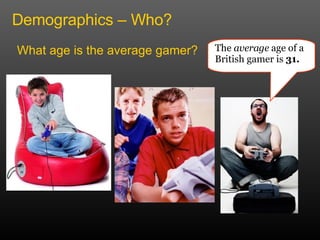
Demographics – Who? What age is the average gamer? The  average  age of a British gamer is  31.
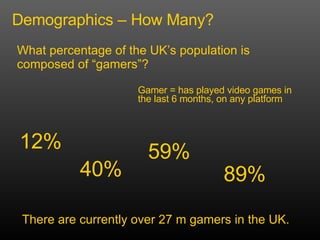
What percentage of the UK’s population is composed of “gamers”? Gamer = has played video games in the last 6 months, on any platform There are currently over 27 m gamers in the UK. Demographics – How Many? 12% 40% 59% 89%
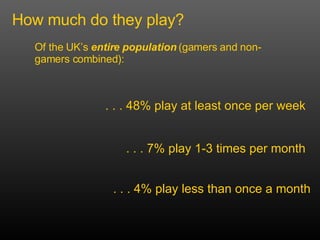
How much do they play? Of the UK’s  entire population   (gamers and non-gamers combined): . . . 48% play at least once per week . . . 7% play 1-3 times per month . . . 4% play less than once a month
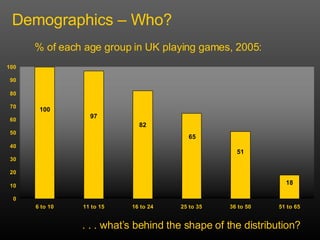
. . . what’s behind the shape of the distribution? % of each age group in UK playing games, 2005: Demographics – Who?
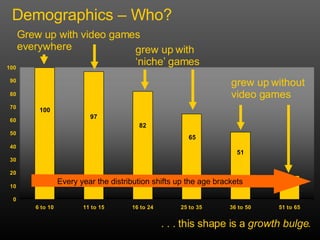
Demographics – Who? . . . this shape is a  growth bulge . grew up without video games grew up with ‘niche’ games Grew up with video games everywhere Every year the distribution shifts up the age brackets
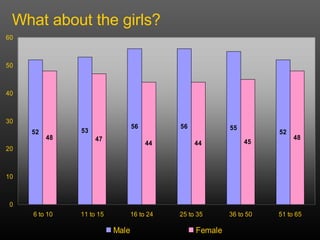
What about the girls?
 
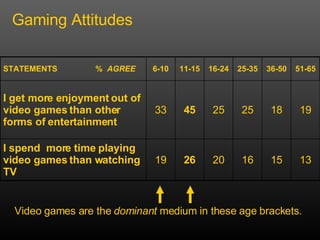
Gaming Attitudes 13 15 16 20 26 19 I spend  more time playing video games than watching TV   19 18 25 25 45 33 I get more enjoyment out of video games than other forms of entertainment 16-24 6-10 11-15 25-35 51-65 36-50 STATEMENTS  %  AGREE Video games are the  dominant  medium in these age brackets.
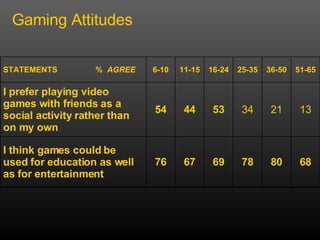
Gaming Attitudes 51-65 36-50 25-35 16-24 11-15 6-10 STATEMENTS  %  AGREE 68 80 78 69 67 76 I think games could be used for education as well as for entertainment 13 21 34 53 44 54 I prefer playing video games with friends as a social activity rather than on my own
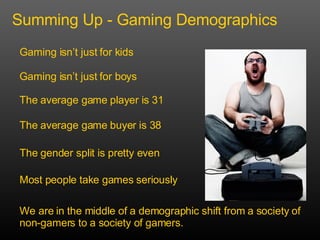
The gender split is pretty even Most people take games seriously The average game buyer is 38 We are in the middle of a demographic shift from a society of non-gamers to a society of gamers. Summing Up - Gaming Demographics Gaming isn’t just for kids Gaming isn’t just for boys The average game player is 31
Coming up Game demographics: Who plays? Game dynamics: What makes games fun? A maturing medium: Some examples  The Future: Where games are going
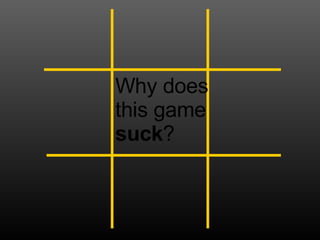
Why does this game  suck ?
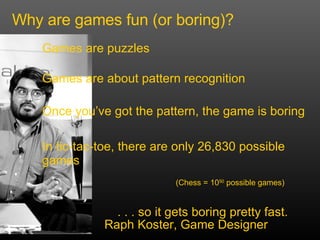
Why are games fun (or boring)? Games are puzzles Once you’ve got the pattern, the game is boring In tic-tac-toe, there are only 26,830 possible games Games are about pattern recognition . . . so it gets boring pretty fast. (Chess = 10 50  possible games)   Raph Koster, Game Designer
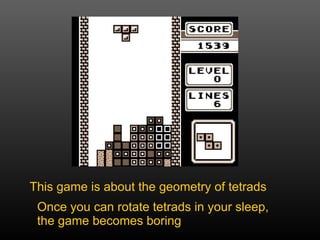
This game is about the geometry of tetrads Once you can rotate tetrads in your sleep, the game becomes boring
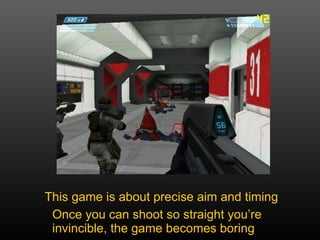
This game is about precise aim and timing Once you can shoot so straight you’re invincible, the game becomes boring
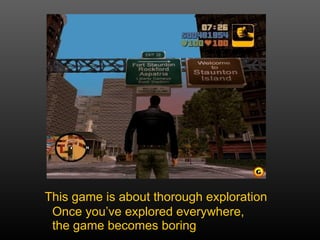
This game is about thorough exploration Once you’ve explored everywhere, the game becomes boring
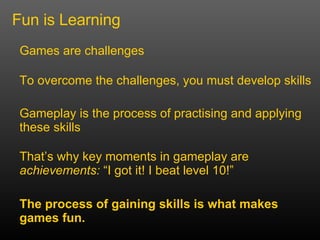
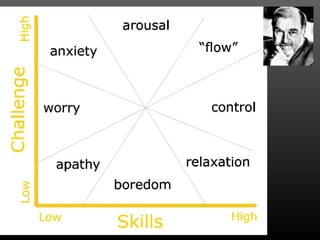
Fun is Learning Games are challenges That’s why key moments in gameplay are  achievements:  “I got it! I beat level 10!” The process of gaining skills is what makes games fun. To overcome the challenges, you must develop skills Gameplay is the process of practising and applying these skills
 
 
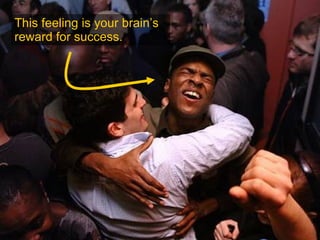
This feeling is your brain’s reward for success.
 
 
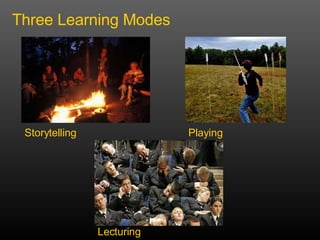
Three Learning Modes Storytelling Playing Lecturing
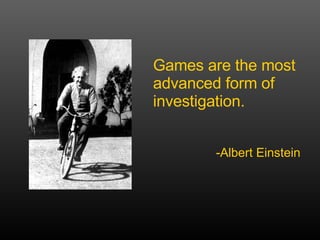
Games are the most advanced form of investigation. -Albert Einstein
That’s why we’re interested.
But can a game really deliver journalism?  . . . or any serious message, for that matter?
Games are stupid, right?
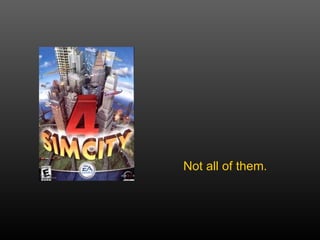
Not all of them.


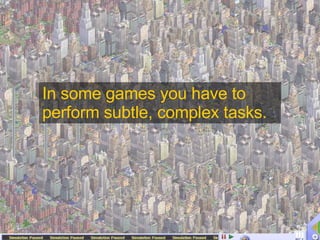
In some games you have to perform subtle, complex tasks.
Sim City Is About And it sold   18 million copies Tax policy Infrastructure networks Zoning laws
Game challenges can be very sophisticated. To complete them successfully, you have to learn.  You can learn about all sorts of things. How about some examples of games teaching socially relevant lessons? Games are Teachers
Coming up Game demographics: Who plays? Game dynamics: What makes games fun? A maturing medium: Some examples  The Future: Where games are going
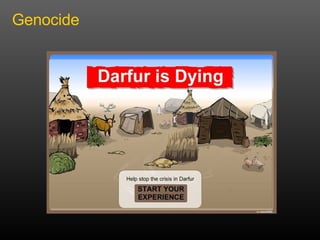
Genocide
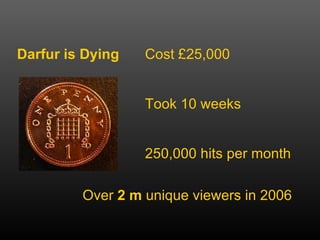
Darfur is Dying Cost £25,000 Took 10 weeks 250,000 hits per month Over  2 m  unique viewers in 2006
Conflict Resolution
The War on Terror A game making an editorial point . . .
Fast Food Economics (Another editorial point . . .)
Historical Debate (How is  this  different?)
Coming up Game demographics: Who plays? Game dynamics: What makes games fun? A maturing medium: Some examples  The Future: Where games are going
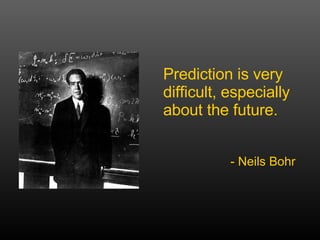
Prediction is very difficult, especially about the future. - Neils Bohr
The medium will mature further
Movies, 1927
The Return of Social Gaming
A Good Year % growth in each medium in UK, 2007:
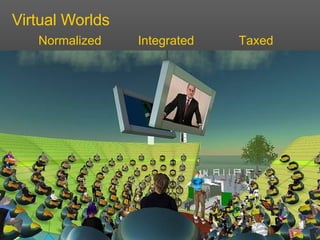
Virtual Worlds Normalized Integrated Taxed
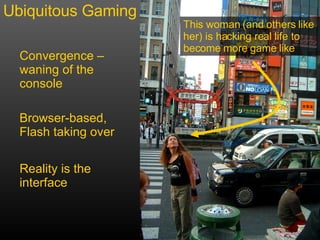
Ubiquitous Gaming Convergence – waning of the console Browser-based, Flash taking over Reality is the interface This woman (and others like her) is hacking real life to become more game like
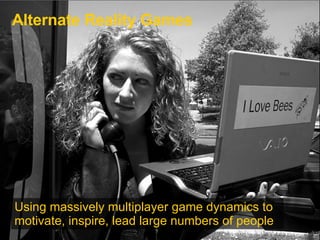
Alternate Reality Games Using massively multiplayer game dynamics to motivate, inspire, lead large numbers of people
Further Reading Raph Koster,  A Theory of Fun for Game Design Steven Johnson,  Everything Bad is Good For You Jane McGonigal,  Why I Love Bees
For links, slides and more info,  http://trippenbach.wordpress.com

Just Another Meme Vector

  • 1.
    Just Another MemeVector v 1.0
  • 2.
    Coming up Gamedemographics: Who plays? Game dynamics: What makes games fun? Some examples of a maturing medium The future: Where games are going
  • 3.
    Demographics – Who?What age is the average gamer? The average age of a British gamer is 31.
  • 4.
    What percentage ofthe UK’s population is composed of “gamers”? Gamer = has played video games in the last 6 months, on any platform There are currently over 27 m gamers in the UK. Demographics – How Many? 12% 40% 59% 89%
  • 5.
    How much dothey play? Of the UK’s entire population (gamers and non-gamers combined): . . . 48% play at least once per week . . . 7% play 1-3 times per month . . . 4% play less than once a month
  • 6.
    . . .what’s behind the shape of the distribution? % of each age group in UK playing games, 2005: Demographics – Who?
  • 7.
    Demographics – Who?. . . this shape is a growth bulge . grew up without video games grew up with ‘niche’ games Grew up with video games everywhere Every year the distribution shifts up the age brackets
  • 8.
  • 9.
  • 10.
    Gaming Attitudes 1315 16 20 26 19 I spend more time playing video games than watching TV 19 18 25 25 45 33 I get more enjoyment out of video games than other forms of entertainment 16-24 6-10 11-15 25-35 51-65 36-50 STATEMENTS % AGREE Video games are the dominant medium in these age brackets.
  • 11.
    Gaming Attitudes 51-6536-50 25-35 16-24 11-15 6-10 STATEMENTS % AGREE 68 80 78 69 67 76 I think games could be used for education as well as for entertainment 13 21 34 53 44 54 I prefer playing video games with friends as a social activity rather than on my own
  • 12.
    The gender splitis pretty even Most people take games seriously The average game buyer is 38 We are in the middle of a demographic shift from a society of non-gamers to a society of gamers. Summing Up - Gaming Demographics Gaming isn’t just for kids Gaming isn’t just for boys The average game player is 31
  • 13.
    Coming up Gamedemographics: Who plays? Game dynamics: What makes games fun? A maturing medium: Some examples The Future: Where games are going
  • 14.
    Why does thisgame suck ?
  • 15.
    Why are gamesfun (or boring)? Games are puzzles Once you’ve got the pattern, the game is boring In tic-tac-toe, there are only 26,830 possible games Games are about pattern recognition . . . so it gets boring pretty fast. (Chess = 10 50 possible games) Raph Koster, Game Designer
  • 16.
    This game isabout the geometry of tetrads Once you can rotate tetrads in your sleep, the game becomes boring
  • 17.
    This game isabout precise aim and timing Once you can shoot so straight you’re invincible, the game becomes boring
  • 18.
    This game isabout thorough exploration Once you’ve explored everywhere, the game becomes boring
  • 19.
    Fun is LearningGames are challenges That’s why key moments in gameplay are achievements: “I got it! I beat level 10!” The process of gaining skills is what makes games fun. To overcome the challenges, you must develop skills Gameplay is the process of practising and applying these skills
  • 20.
  • 21.
  • 22.
    This feeling isyour brain’s reward for success.
  • 23.
  • 24.
  • 25.
    Three Learning ModesStorytelling Playing Lecturing
  • 26.
    Games are themost advanced form of investigation. -Albert Einstein
  • 27.
  • 28.
    But can agame really deliver journalism? . . . or any serious message, for that matter?
  • 29.
  • 30.
  • 31.
  • 32.
  • 33.
  • 34.
  • 35.
    In some gamesyou have to perform subtle, complex tasks.
  • 36.
    Sim City IsAbout And it sold 18 million copies Tax policy Infrastructure networks Zoning laws
  • 37.
    Game challenges canbe very sophisticated. To complete them successfully, you have to learn. You can learn about all sorts of things. How about some examples of games teaching socially relevant lessons? Games are Teachers
  • 38.
    Coming up Gamedemographics: Who plays? Game dynamics: What makes games fun? A maturing medium: Some examples The Future: Where games are going
  • 39.
  • 40.
    Darfur is DyingCost £25,000 Took 10 weeks 250,000 hits per month Over 2 m unique viewers in 2006
  • 41.
  • 42.
    The War onTerror A game making an editorial point . . .
  • 43.
    Fast Food Economics(Another editorial point . . .)
  • 44.
    Historical Debate (Howis this different?)
  • 45.
    Coming up Gamedemographics: Who plays? Game dynamics: What makes games fun? A maturing medium: Some examples The Future: Where games are going
  • 46.
    Prediction is verydifficult, especially about the future. - Neils Bohr
  • 47.
    The medium willmature further
  • 48.
  • 49.
    The Return ofSocial Gaming
  • 50.
    A Good Year% growth in each medium in UK, 2007:
  • 51.
    Virtual Worlds NormalizedIntegrated Taxed
  • 52.
    Ubiquitous Gaming Convergence– waning of the console Browser-based, Flash taking over Reality is the interface This woman (and others like her) is hacking real life to become more game like
  • 53.
    Alternate Reality GamesUsing massively multiplayer game dynamics to motivate, inspire, lead large numbers of people
  • 54.
    Further Reading RaphKoster, A Theory of Fun for Game Design Steven Johnson, Everything Bad is Good For You Jane McGonigal, Why I Love Bees
  • 55.
    For links, slidesand more info, http://trippenbach.wordpress.com