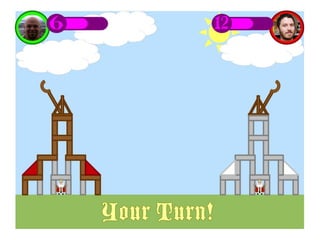
Social & Mobile
Game Primer
Focused Game Design
For a Mature Market
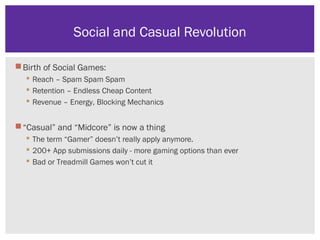
Birth of Social Games:
 Reach – Spam Spam Spam
 Retention – Endless Cheap Content
 Revenue – Energy, Blocking Mechanics
“Casual” and “Midcore” is now a thing
 The term “Gamer” doesn’t really apply anymore.
 200+ App submissions daily - more gaming options than ever
 Bad or Treadmill Games won’t cut it
Social and Casual Revolution
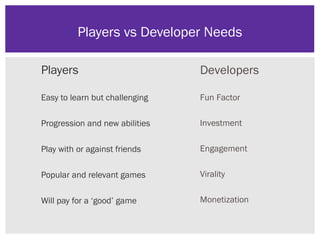
Players
Easy to learn but challenging
Progression and new abilities
Play with or against friends
Popular and relevant games
Will pay for a ‘good’ game
Players vs Developer Needs
Developers
Fun Factor
Investment
Engagement
Virality
Monetization
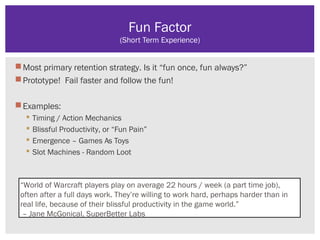
Most primary retention strategy. Is it “fun once, fun always?”
Prototype! Fail faster and follow the fun!
Examples:
 Timing / Action Mechanics
 Blissful Productivity, or “Fun Pain”
 Emergence – Games As Toys
 Slot Machines - Random Loot
Fun Factor
(Short Term Experience)
“World of Warcraft players play on average 22 hours / week (a part time job),
often after a full days work. They’re willing to work hard, perhaps harder than in
real life, because of their blissful productivity in the game world.”
– Jane McGonical, SuperBetter Labs
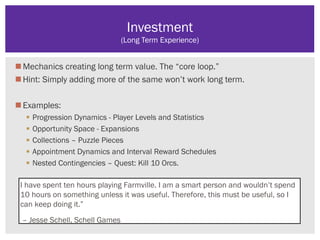
Mechanics creating long term value. The “core loop.”
Hint: Simply adding more of the same won’t work long term.
Examples:
 Progression Dynamics - Player Levels and Statistics
 Opportunity Space - Expansions
 Collections – Puzzle Pieces
 Appointment Dynamics and Interval Reward Schedules
 Nested Contingencies – Quest: Kill 10 Orcs.
Investment
(Long Term Experience)
I have spent ten hours playing Farmville. I am a smart person and wouldn’t spend
10 hours on something unless it was useful. Therefore, this must be useful, so I
can keep doing it.”
– Jesse Schell, Schell Games
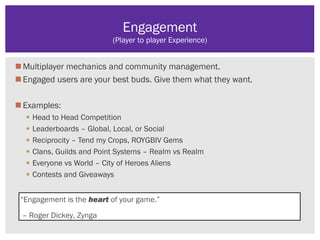
Multiplayer mechanics and community management.
Engaged users are your best buds. Give them what they want.
Examples:
 Head to Head Competition
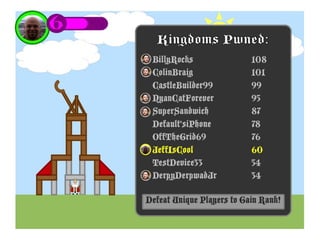
 Leaderboards – Global, Local, or Social
 Reciprocity – Tend my Crops, ROYGBIV Gems
 Clans, Guilds and Point Systems – Realm vs Realm
 Everyone vs World – City of Heroes Aliens
 Contests and Giveaways
Engagement
(Player to player Experience)
“Engagement is the heart of your game.”
– Roger Dickey, Zynga
Mechanics that increase reach by providing:
 A compelling incentive to invite new user
 An enticing invitation
 An obvious, low friction channel to share the invitation
Examples:
 Pyramid Schemes and Visiting Friends - Farmville
 Contact Farming and Suggesting Opponents - Words With Friends
 Gifting your App – Tricky Messaging Techniques
 Marketing Tricks – User Segregation & Ratings
Virality
(Auto-Marketing)
Protip: When new installs and reactivations become improbable, focus on catering
to your most engaged, loyal users. They’re most likely to pay anyway.
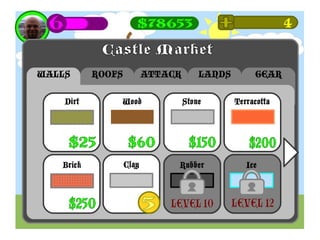
What will people pay for?
 Fun and Story (Quest Unlocks, Hard to Sell)
 Decoration and Identity
 Primacy and Exclusivity (Seasonal Items)
 Chance and Rarity (Grab Bags, Mystery Boxes)
 Competition and Social Value (Sharable Power)
 Stat Progress and Vanity
 Scarcity and Consumables (Bullets, Food, Energy)
 Space and Expansion
Monetization
(The Business)
“Your game is a store, treat it like one.”
– Jon Walsh, Fuse Powered, Inc.
All of these mechanics drive each other.
The key is elegance. Beware the “Pizza that nobody wants.”
Perform a cost-benefit analysis of every feature.
 It costs much less to spend time in the design phase.
Example: Collections – Collect X Things to Receive Y
 How do I get the things?
 For simply playing?
 Grind, Spam, or Pay
 What do I receive?
 Coins – Yay? / Premium Coins – Better, but limited.
 Consumable, Mystery Box – Repeatable
 New Ability – Investment, Addictive
The Whole Package
(Connecting Influences)

Games are now a Service industry

Seamless and platform agnostic

Multiplatform, not Cross-Platform

Social (Integrated)

Snackable

Asynchronous, turn-based works!

Value Reigns

Free (Mostly)
Current and Future Games
“If you want to work in games, go make something.”
– John Comes, Uber Entertainment

Focused Game Design for a Mature Market

  • 1.
    Social & Mobile GamePrimer Focused Game Design For a Mature Market
  • 2.
    Birth of SocialGames:  Reach – Spam Spam Spam  Retention – Endless Cheap Content  Revenue – Energy, Blocking Mechanics “Casual” and “Midcore” is now a thing  The term “Gamer” doesn’t really apply anymore.  200+ App submissions daily - more gaming options than ever  Bad or Treadmill Games won’t cut it Social and Casual Revolution
  • 3.
    Players Easy to learnbut challenging Progression and new abilities Play with or against friends Popular and relevant games Will pay for a ‘good’ game Players vs Developer Needs Developers Fun Factor Investment Engagement Virality Monetization
  • 4.
    Most primary retentionstrategy. Is it “fun once, fun always?” Prototype! Fail faster and follow the fun! Examples:  Timing / Action Mechanics  Blissful Productivity, or “Fun Pain”  Emergence – Games As Toys  Slot Machines - Random Loot Fun Factor (Short Term Experience) “World of Warcraft players play on average 22 hours / week (a part time job), often after a full days work. They’re willing to work hard, perhaps harder than in real life, because of their blissful productivity in the game world.” – Jane McGonical, SuperBetter Labs
  • 6.
    Mechanics creating longterm value. The “core loop.” Hint: Simply adding more of the same won’t work long term. Examples:  Progression Dynamics - Player Levels and Statistics  Opportunity Space - Expansions  Collections – Puzzle Pieces  Appointment Dynamics and Interval Reward Schedules  Nested Contingencies – Quest: Kill 10 Orcs. Investment (Long Term Experience) I have spent ten hours playing Farmville. I am a smart person and wouldn’t spend 10 hours on something unless it was useful. Therefore, this must be useful, so I can keep doing it.” – Jesse Schell, Schell Games
  • 8.
    Multiplayer mechanics andcommunity management. Engaged users are your best buds. Give them what they want. Examples:  Head to Head Competition  Leaderboards – Global, Local, or Social  Reciprocity – Tend my Crops, ROYGBIV Gems  Clans, Guilds and Point Systems – Realm vs Realm  Everyone vs World – City of Heroes Aliens  Contests and Giveaways Engagement (Player to player Experience) “Engagement is the heart of your game.” – Roger Dickey, Zynga
  • 10.
    Mechanics that increasereach by providing:  A compelling incentive to invite new user  An enticing invitation  An obvious, low friction channel to share the invitation Examples:  Pyramid Schemes and Visiting Friends - Farmville  Contact Farming and Suggesting Opponents - Words With Friends  Gifting your App – Tricky Messaging Techniques  Marketing Tricks – User Segregation & Ratings Virality (Auto-Marketing) Protip: When new installs and reactivations become improbable, focus on catering to your most engaged, loyal users. They’re most likely to pay anyway.
  • 12.
    What will peoplepay for?  Fun and Story (Quest Unlocks, Hard to Sell)  Decoration and Identity  Primacy and Exclusivity (Seasonal Items)  Chance and Rarity (Grab Bags, Mystery Boxes)  Competition and Social Value (Sharable Power)  Stat Progress and Vanity  Scarcity and Consumables (Bullets, Food, Energy)  Space and Expansion Monetization (The Business) “Your game is a store, treat it like one.” – Jon Walsh, Fuse Powered, Inc.
  • 14.
    All of thesemechanics drive each other. The key is elegance. Beware the “Pizza that nobody wants.” Perform a cost-benefit analysis of every feature.  It costs much less to spend time in the design phase. Example: Collections – Collect X Things to Receive Y  How do I get the things?  For simply playing?  Grind, Spam, or Pay  What do I receive?  Coins – Yay? / Premium Coins – Better, but limited.  Consumable, Mystery Box – Repeatable  New Ability – Investment, Addictive The Whole Package (Connecting Influences)
  • 15.
     Games are nowa Service industry  Seamless and platform agnostic  Multiplatform, not Cross-Platform  Social (Integrated)  Snackable  Asynchronous, turn-based works!  Value Reigns  Free (Mostly) Current and Future Games “If you want to work in games, go make something.” – John Comes, Uber Entertainment