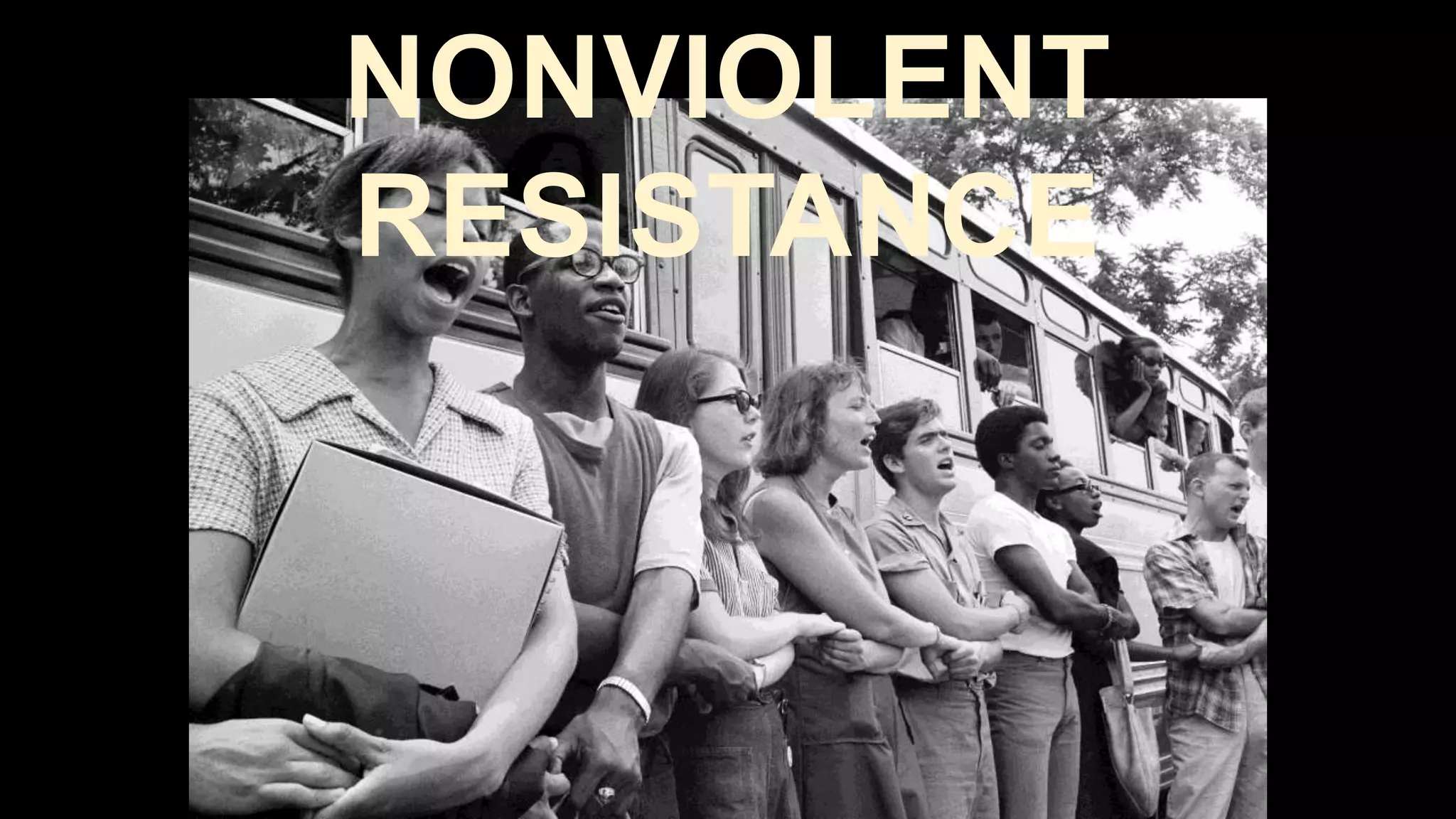
NONVIOLENT
RESISTANCE
Nonviolence: in principle and/or in practice
• Philosophical nonviolence: opposed to all forms of violence as a matter or principle.
• Strategic nonviolence: To embrace strategies of nonviolent resistance because they
work for making change.
Nonviolent resistance: What is it? (Gene Sharp)
“Nonviolent action refers to those methods of protest, resistance, and intervention
without physical violence in which the members of the nonviolent group do, or refuse to
do, certain things. They may commit acts of omission – refuse to perform acts which
they usually perform, are expected by custom to perform, or are required by law or
regulation to perform; or acts of commission – perform acts which they usually do not
perform, are not expected by custom to perform, or are forbidden by law or regulation
from performing; or a combination of both.”
~ Gene Sharp, Social Power and Political Freedom (218)
• A David and Goliath strategy.
• The emphasis is on resistance.
• Aims for maximum access and inclusiveness.
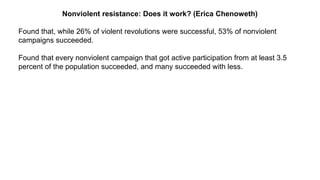
Nonviolent resistance: Does it work? (Erica Chenoweth)
Found that, while 26% of violent revolutions were successful, 53% of nonviolent
campaigns succeeded.
Found that every nonviolent campaign that got active participation from at least 3.5
percent of the population succeeded, and many succeeded with less.
Nonviolent resistance: How does it work? (Sharp)
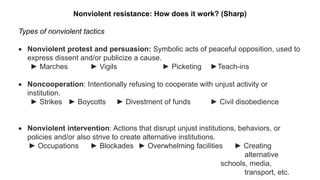
Types of nonviolent tactics
 Nonviolent protest and persuasion: Symbolic acts of peaceful opposition, used to
express dissent and/or publicize a cause.
► Marches ► Vigils ► Picketing ►Teach-ins
 Noncooperation: Intentionally refusing to cooperate with unjust activity or
institution.
► Strikes ► Boycotts ► Divestment of funds ► Civil disobedience
 Nonviolent intervention: Actions that disrupt unjust institutions, behaviors, or
policies and/or also strive to create alternative institutions.
► Occupations ► Blockades ► Overwhelming facilities ► Creating
alternative
schools, media,
transport, etc.
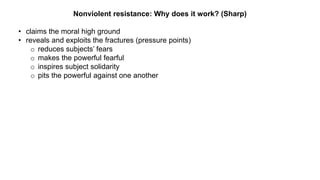
Nonviolent resistance: Why does it work? (Sharp)
• claims the moral high ground
• reveals and exploits the fractures (pressure points)
o reduces subjects’ fears
o makes the powerful fearful
o inspires subject solidarity
o pits the powerful against one another
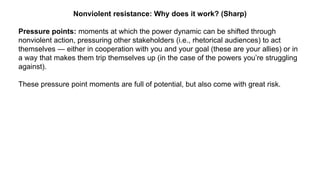
Nonviolent resistance: Why does it work? (Sharp)
Pressure points: moments at which the power dynamic can be shifted through
nonviolent action, pressuring other stakeholders (i.e., rhetorical audiences) to act
themselves — either in cooperation with you and your goal (these are your allies) or in
a way that makes them trip themselves up (in the case of the powers you’re struggling
against).
These pressure point moments are full of potential, but also come with great risk.

Nonviolent resistance, fall 2018 (1)

  • 1.
  • 2.
    Nonviolence: in principleand/or in practice • Philosophical nonviolence: opposed to all forms of violence as a matter or principle. • Strategic nonviolence: To embrace strategies of nonviolent resistance because they work for making change.
  • 3.
    Nonviolent resistance: Whatis it? (Gene Sharp) “Nonviolent action refers to those methods of protest, resistance, and intervention without physical violence in which the members of the nonviolent group do, or refuse to do, certain things. They may commit acts of omission – refuse to perform acts which they usually perform, are expected by custom to perform, or are required by law or regulation to perform; or acts of commission – perform acts which they usually do not perform, are not expected by custom to perform, or are forbidden by law or regulation from performing; or a combination of both.” ~ Gene Sharp, Social Power and Political Freedom (218) • A David and Goliath strategy. • The emphasis is on resistance. • Aims for maximum access and inclusiveness.
  • 4.
    Nonviolent resistance: Doesit work? (Erica Chenoweth) Found that, while 26% of violent revolutions were successful, 53% of nonviolent campaigns succeeded. Found that every nonviolent campaign that got active participation from at least 3.5 percent of the population succeeded, and many succeeded with less.
  • 5.
    Nonviolent resistance: Howdoes it work? (Sharp) Types of nonviolent tactics  Nonviolent protest and persuasion: Symbolic acts of peaceful opposition, used to express dissent and/or publicize a cause. ► Marches ► Vigils ► Picketing ►Teach-ins  Noncooperation: Intentionally refusing to cooperate with unjust activity or institution. ► Strikes ► Boycotts ► Divestment of funds ► Civil disobedience  Nonviolent intervention: Actions that disrupt unjust institutions, behaviors, or policies and/or also strive to create alternative institutions. ► Occupations ► Blockades ► Overwhelming facilities ► Creating alternative schools, media, transport, etc.
  • 6.
    Nonviolent resistance: Whydoes it work? (Sharp) • claims the moral high ground • reveals and exploits the fractures (pressure points) o reduces subjects’ fears o makes the powerful fearful o inspires subject solidarity o pits the powerful against one another
  • 7.
    Nonviolent resistance: Whydoes it work? (Sharp) Pressure points: moments at which the power dynamic can be shifted through nonviolent action, pressuring other stakeholders (i.e., rhetorical audiences) to act themselves — either in cooperation with you and your goal (these are your allies) or in a way that makes them trip themselves up (in the case of the powers you’re struggling against). These pressure point moments are full of potential, but also come with great risk.