chronicle and story
A chronicle is a retelling of events in the order that they
happened.
chronicle and story
A chronicle is a retelling of events in the order that they
happened.
A story recounts events such as to indicate why they
happened as they did (the causes and reasons) and what they
might mean.
chronicle and story
A chronicle is a retelling of events in the order that they
happened.
A story recounts events such as to indicate why they
happened as they did (the causes and reasons) and what they
might mean.
Because a story indicating causes, reasons, and
meanings, it might recount events in the order that they
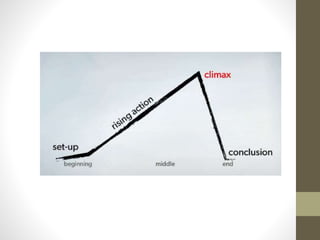
happened or it might not. The order of events (or plot) is
determined by the story’s dramatic and thematic needs. (See
below.)
chronicle and story
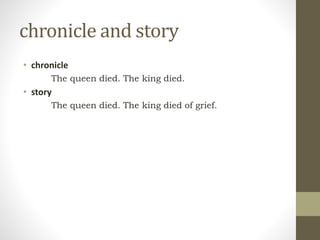
• chronicle
The queen died. The king died.
chronicle and story
• chronicle
The queen died. The king died.
• story
The queen died. The king died of grief.
chronicle and story
• chronicle
The queen died. The king died.
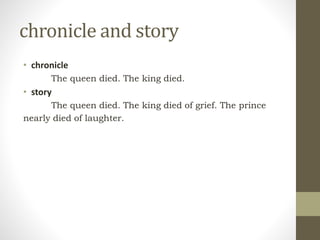
• story
The queen died. The king died of grief. The prince
nearly died of laughter.
chronicle and story
• chronicle
The queen died. The king died.
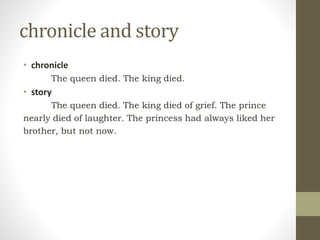
• story
The queen died. The king died of grief. The prince
nearly died of laughter. The princess had always liked her
brother, but not now.
chronicle and story
• chronicle
The queen died. The king died.
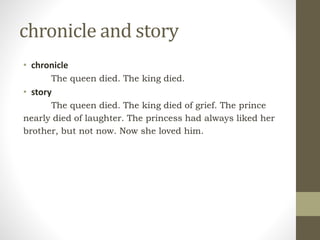
• story
The queen died. The king died of grief. The prince
nearly died of laughter. The princess had always liked her
brother, but not now. Now she loved him.
chronicle and story
• chronicle
The queen died. The king died.
• story
The queen died. The king died of grief. The prince
nearly died of laughter. The princess had always liked her
brother, but not now. Now she loved him.
In the village, Michael, the orphan boy who worked
for the blacksmith, knelt down, said a prayer for the king
and queen, and wept.
Drama, theme, & plot:
Writing history
Drama
• The specific conflict that motivates the action, assigns roles to
characters, and gives the story its shape.
Drama
• The specific conflict that motivates the action, assigns roles to
characters, and gives the story its shape.
Theme
• The “big idea” that gives the text a shape and a purpose; it’s
deeper meaning.
Drama
• The specific conflict that motivates the action, assigns roles to
characters, and gives the story its shape.
Theme
• The “big idea” that gives the text a shape and a purpose; it’s
deeper meaning.
Plot
• The selection and sequencing of details.
• Through plotting, the text’s dramatic conflict is developed and
its theme unfolded.
Historical narrative
• Discovers the “big picture” within the “small,” a community-
wide theme within a personal drama, a large-scale
transformation in power relations played out in an individual-
level conflict/resolution.

Chronicle, story - drama, theme, plot

  • 1.
    chronicle and story Achronicle is a retelling of events in the order that they happened.
  • 2.
    chronicle and story Achronicle is a retelling of events in the order that they happened. A story recounts events such as to indicate why they happened as they did (the causes and reasons) and what they might mean.
  • 3.
    chronicle and story Achronicle is a retelling of events in the order that they happened. A story recounts events such as to indicate why they happened as they did (the causes and reasons) and what they might mean. Because a story indicating causes, reasons, and meanings, it might recount events in the order that they happened or it might not. The order of events (or plot) is determined by the story’s dramatic and thematic needs. (See below.)
  • 4.
    chronicle and story •chronicle The queen died. The king died.
  • 5.
    chronicle and story •chronicle The queen died. The king died. • story The queen died. The king died of grief.
  • 6.
    chronicle and story •chronicle The queen died. The king died. • story The queen died. The king died of grief. The prince nearly died of laughter.
  • 7.
    chronicle and story •chronicle The queen died. The king died. • story The queen died. The king died of grief. The prince nearly died of laughter. The princess had always liked her brother, but not now.
  • 8.
    chronicle and story •chronicle The queen died. The king died. • story The queen died. The king died of grief. The prince nearly died of laughter. The princess had always liked her brother, but not now. Now she loved him.
  • 9.
    chronicle and story •chronicle The queen died. The king died. • story The queen died. The king died of grief. The prince nearly died of laughter. The princess had always liked her brother, but not now. Now she loved him. In the village, Michael, the orphan boy who worked for the blacksmith, knelt down, said a prayer for the king and queen, and wept.
  • 11.
    Drama, theme, &plot: Writing history
  • 12.
    Drama • The specificconflict that motivates the action, assigns roles to characters, and gives the story its shape.
  • 13.
    Drama • The specificconflict that motivates the action, assigns roles to characters, and gives the story its shape. Theme • The “big idea” that gives the text a shape and a purpose; it’s deeper meaning.
  • 14.
    Drama • The specificconflict that motivates the action, assigns roles to characters, and gives the story its shape. Theme • The “big idea” that gives the text a shape and a purpose; it’s deeper meaning. Plot • The selection and sequencing of details. • Through plotting, the text’s dramatic conflict is developed and its theme unfolded.
  • 15.
    Historical narrative • Discoversthe “big picture” within the “small,” a community- wide theme within a personal drama, a large-scale transformation in power relations played out in an individual- level conflict/resolution.