EKPHRASIS
EKPHRASIS
• Ludwig Wittgenstein: “The world is the totality of facts, not of things. . . . An
atomic fact is a combination of objects (entities, things).”
EKPHRASIS
• Ludwig Wittgenstein: “The world is the totality of facts, not of things. . . . An
atomic fact is a combination of objects (entities, things).”
• FORM and CONTENT:
EKPHRASIS
• Ludwig Wittgenstein: “The world is the totality of facts, not of things. . . . An
atomic fact is a combination of objects (entities, things).”
• FORM and CONTENT:
– CONTENT: What a sentence says.
EKPHRASIS
• Ludwig Wittgenstein: “The world is the totality of facts, not of things. . . . An
atomic fact is a combination of objects (entities, things).”
• FORM and CONTENT:
– CONTENT: What a sentence says.
– FORM: How it says it, i.e., the way the words are arranged.
EKPHRASIS
• Ludwig Wittgenstein: “The world is the totality of facts, not of things. . . . An
atomic fact is a combination of objects (entities, things).”
• FORM and CONTENT:
– CONTENT: What a sentence says.
– FORM: How it says it, i.e., the way the words are arranged.
“The grass is green.” / “Green is the grass.” — Same content,
different form
EKPHRASIS
• Ludwig Wittgenstein: “The world is the totality of facts, not of things. . . . An
atomic fact is a combination of objects (entities, things).”
• FORM and CONTENT:
– CONTENT: What a sentence says.
– FORM: How it says it, i.e., the way the words are arranged.
“The grass is green.” / “Green is the grass.” — Same content,
different form
“The sky is blue.” / “Blue is the sky.” — ?
EKPHRASIS
• Ludwig Wittgenstein: “The world is the totality of facts, not of things. . . . An
atomic fact is a combination of objects (entities, things).”
• FORM and CONTENT:
– CONTENT: What a sentence says.
– FORM: How it says it, i.e., the way the words are arranged.
“The grass is green.” / “Green is the grass.” — Same content,
different form
“The sky is blue.” / “Blue is the sky.” — ?
“Blue is the sky.” / “Green is the grass.” — ?
EKPHRASIS
• Ludwig Wittgenstein: “The world is the totality of facts, not of things. . . . An
atomic fact is a combination of objects (entities, things).”
• FORM and CONTENT:
– CONTENT: What a sentence says.
– FORM: How it says it, i.e., the way the words are arranged.
“The grass is green.” / “Green is the grass.” — Same content,
different form
“The sky is blue.” / “Blue is the sky.” — ?
“Blue is the sky.” / “Green is the grass.” — ?
“Emerald are the meadows.” / “The heavens are azure.” — ?
EKPHRASIS
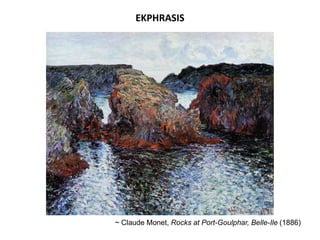
~ Claude Monet, Rocks at Port-Goulphar, Belle-Ile (1886)
EKPHRASIS
In the late summer of that year we lived in a house in a village that looked across the
river and the plain to the mountains. In the bed of the river there were pebbles and
boulders, dry and white in the sun, and the water was clear and swiftly moving and
blue in the channels. Troops went by the house and down the road and the dust they
raised powdered the leaves of the trees. The trunks of the trees too were dusty and the
leaves fell early that year and we saw the troops marching along the road and the dust
rising and leaves, stirred by the breeze, falling and the soldiers marching and afterward
the road bare and white except for the leaves.
~ Ernest Hemingway, A Farewell to Arms
EKPHRASIS
It was a bright cold day in April, and the clocks were striking thirteen.
~ George Orwell, 1984
EKPHRASIS
The clocks were striking thirteen on an April day, bright and cold.
EKPHRASIS
Under certain circumstances there are few hours in life more agreeable than the hour
dedicated to the ceremony known as afternoon tea.
~ Henry James, The Portrait of a Lady
EKPHRASIS
Afternoon tea is the most agreeable hour of the day, under certain circumstances.
EKPHRASIS
It satisfies every childlike curiosity, every muted desire, whatever there is in him of the
scientist, the poet, the primitive seer, the watcher of fire and shooting stars, whatever
obsessions eat at the night side of his mind, whatever sweet and dreamy yearnings he
has ever felt for nameless places faraway, whatever earth sense he possesses, the
neural pulse of some wilder awareness, a sympathy for beasts, whatever belief in an
immanent vital force, the Lord of Creation, whatever secret harboring of the idea of
human oneness, whatever wishfulness and simplehearted hope, whatever of too much
and not enough, all at once and little by little, whatever burning urge to escape
responsibility and routine, escape his own overspecialization, the circumscribed and
inward spiraling self, whatever remnants of his boyish longing to fly, his dreams of
strange spaces and eerie heights, his fantasies of happy death, whatever indolent and
sybaritic leanings, lotus-eater, smoker of grasses and herbs, blue-eyed gazer into
space—all these are satisfied, all collected and massed in that living body, the sight he
sees from the window.
~ Don DeLillo, "Human Moments in World War III," 1983
EKPHRASIS
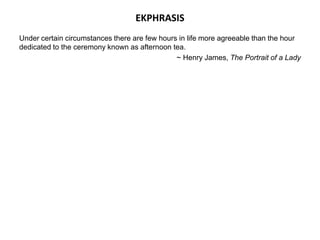
In Top Hats —
in Trouble,
Weegee, 1942
1
EKPHRASIS
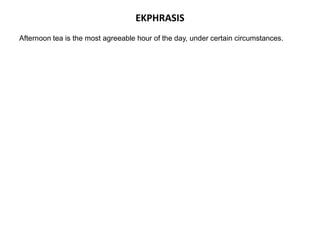
The Ecstasy
of Saint
Teresa,
Bernini,
1647–1652
2
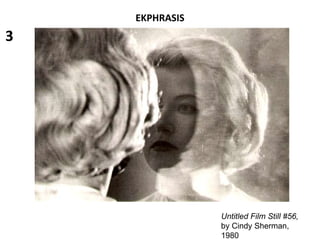
EKPHRASIS
Untitled Film Still #56,
by Cindy Sherman,
1980
3
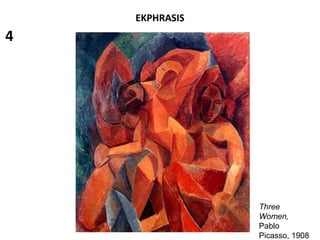
EKPHRASIS
Three
Women,
Pablo
Picasso, 1908
4
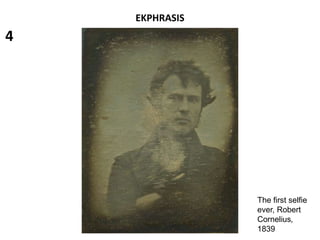
EKPHRASIS
The first selfie
ever, Robert
Cornelius,
1839
4
EKPHRASIS
Time to write!

Ekphrasis

  • 1.
  • 2.
    EKPHRASIS • Ludwig Wittgenstein:“The world is the totality of facts, not of things. . . . An atomic fact is a combination of objects (entities, things).”
  • 3.
    EKPHRASIS • Ludwig Wittgenstein:“The world is the totality of facts, not of things. . . . An atomic fact is a combination of objects (entities, things).” • FORM and CONTENT:
  • 4.
    EKPHRASIS • Ludwig Wittgenstein:“The world is the totality of facts, not of things. . . . An atomic fact is a combination of objects (entities, things).” • FORM and CONTENT: – CONTENT: What a sentence says.
  • 5.
    EKPHRASIS • Ludwig Wittgenstein:“The world is the totality of facts, not of things. . . . An atomic fact is a combination of objects (entities, things).” • FORM and CONTENT: – CONTENT: What a sentence says. – FORM: How it says it, i.e., the way the words are arranged.
  • 6.
    EKPHRASIS • Ludwig Wittgenstein:“The world is the totality of facts, not of things. . . . An atomic fact is a combination of objects (entities, things).” • FORM and CONTENT: – CONTENT: What a sentence says. – FORM: How it says it, i.e., the way the words are arranged. “The grass is green.” / “Green is the grass.” — Same content, different form
  • 7.
    EKPHRASIS • Ludwig Wittgenstein:“The world is the totality of facts, not of things. . . . An atomic fact is a combination of objects (entities, things).” • FORM and CONTENT: – CONTENT: What a sentence says. – FORM: How it says it, i.e., the way the words are arranged. “The grass is green.” / “Green is the grass.” — Same content, different form “The sky is blue.” / “Blue is the sky.” — ?
  • 8.
    EKPHRASIS • Ludwig Wittgenstein:“The world is the totality of facts, not of things. . . . An atomic fact is a combination of objects (entities, things).” • FORM and CONTENT: – CONTENT: What a sentence says. – FORM: How it says it, i.e., the way the words are arranged. “The grass is green.” / “Green is the grass.” — Same content, different form “The sky is blue.” / “Blue is the sky.” — ? “Blue is the sky.” / “Green is the grass.” — ?
  • 9.
    EKPHRASIS • Ludwig Wittgenstein:“The world is the totality of facts, not of things. . . . An atomic fact is a combination of objects (entities, things).” • FORM and CONTENT: – CONTENT: What a sentence says. – FORM: How it says it, i.e., the way the words are arranged. “The grass is green.” / “Green is the grass.” — Same content, different form “The sky is blue.” / “Blue is the sky.” — ? “Blue is the sky.” / “Green is the grass.” — ? “Emerald are the meadows.” / “The heavens are azure.” — ?
  • 10.
    EKPHRASIS ~ Claude Monet,Rocks at Port-Goulphar, Belle-Ile (1886)
  • 11.
    EKPHRASIS In the latesummer of that year we lived in a house in a village that looked across the river and the plain to the mountains. In the bed of the river there were pebbles and boulders, dry and white in the sun, and the water was clear and swiftly moving and blue in the channels. Troops went by the house and down the road and the dust they raised powdered the leaves of the trees. The trunks of the trees too were dusty and the leaves fell early that year and we saw the troops marching along the road and the dust rising and leaves, stirred by the breeze, falling and the soldiers marching and afterward the road bare and white except for the leaves. ~ Ernest Hemingway, A Farewell to Arms
  • 12.
    EKPHRASIS It was abright cold day in April, and the clocks were striking thirteen. ~ George Orwell, 1984
  • 13.
    EKPHRASIS The clocks werestriking thirteen on an April day, bright and cold.
  • 14.
    EKPHRASIS Under certain circumstancesthere are few hours in life more agreeable than the hour dedicated to the ceremony known as afternoon tea. ~ Henry James, The Portrait of a Lady
  • 15.
    EKPHRASIS Afternoon tea isthe most agreeable hour of the day, under certain circumstances.
  • 16.
    EKPHRASIS It satisfies everychildlike curiosity, every muted desire, whatever there is in him of the scientist, the poet, the primitive seer, the watcher of fire and shooting stars, whatever obsessions eat at the night side of his mind, whatever sweet and dreamy yearnings he has ever felt for nameless places faraway, whatever earth sense he possesses, the neural pulse of some wilder awareness, a sympathy for beasts, whatever belief in an immanent vital force, the Lord of Creation, whatever secret harboring of the idea of human oneness, whatever wishfulness and simplehearted hope, whatever of too much and not enough, all at once and little by little, whatever burning urge to escape responsibility and routine, escape his own overspecialization, the circumscribed and inward spiraling self, whatever remnants of his boyish longing to fly, his dreams of strange spaces and eerie heights, his fantasies of happy death, whatever indolent and sybaritic leanings, lotus-eater, smoker of grasses and herbs, blue-eyed gazer into space—all these are satisfied, all collected and massed in that living body, the sight he sees from the window. ~ Don DeLillo, "Human Moments in World War III," 1983
  • 17.
    EKPHRASIS In Top Hats— in Trouble, Weegee, 1942 1
  • 18.
  • 19.
    EKPHRASIS Untitled Film Still#56, by Cindy Sherman, 1980 3
  • 20.
  • 21.
    EKPHRASIS The first selfie ever,Robert Cornelius, 1839 4
  • 22.