PATTERNS OF NON-
MENDELIAN INHERITANCE
GENETICS
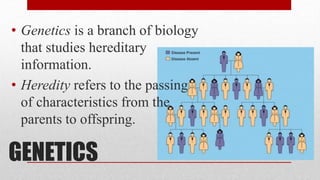
• Genetics is a branch of biology
that studies hereditary
information.
• Heredity refers to the passing
of characteristics from the
parents to offspring.
GENETICS
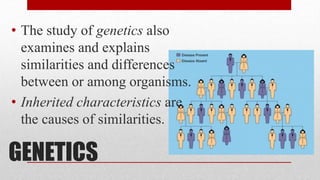
• The study of genetics also
examines and explains
similarities and differences
between or among organisms.
• Inherited characteristics are
the causes of similarities.
GENETICS
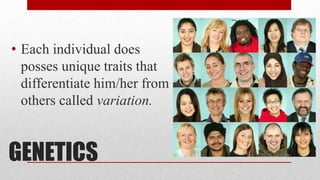
• Each individual does
posses unique traits that
differentiate him/her from
others called variation.
DIVISIONS OF
GENETICS
DIVISIONS OF GENETICS
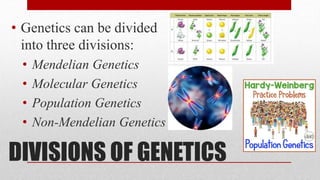
• Genetics can be divided
into three divisions:
• Mendelian Genetics
• Molecular Genetics
• Population Genetics
• Non-Mendelian Genetics
DIVISIONS OF GENETICS
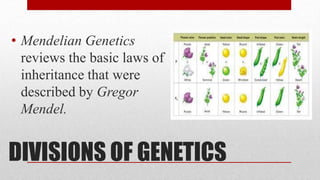
• Mendelian Genetics
reviews the basic laws of
inheritance that were
described by Gregor
Mendel.
DIVISIONS OF GENETICS
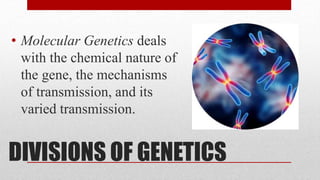
• Molecular Genetics deals
with the chemical nature of
the gene, the mechanisms
of transmission, and its
varied transmission.
DIVISIONS OF GENETICS
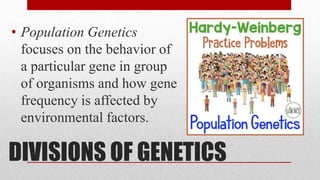
• Population Genetics
focuses on the behavior of
a particular gene in group
of organisms and how gene
frequency is affected by
environmental factors.
IT ALL BEGAN WITH
GARDEN PEAS
GREGOR JOHANN MENDEL
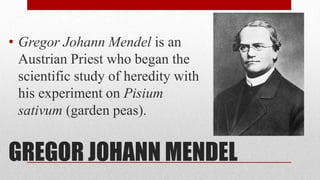
• Gregor Johann Mendel is an
Austrian Priest who began the
scientific study of heredity with
his experiment on Pisium
sativum (garden peas).
GREGOR JOHANN MENDEL
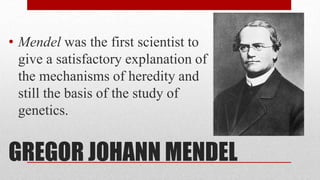
• Mendel was the first scientist to
give a satisfactory explanation of
the mechanisms of heredity and
still the basis of the study of
genetics.
THE START OF MENDELIAN GENETICS
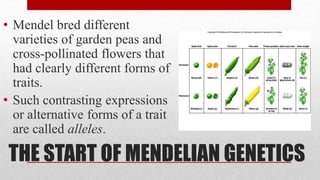
• Mendel bred different
varieties of garden peas and
cross-pollinated flowers that
had clearly different forms of
traits.
• Such contrasting expressions
or alternative forms of a trait
are called alleles.
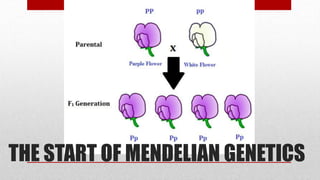
THE START OF MENDELIAN GENETICS
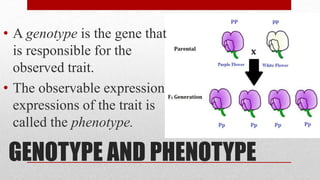
GENOTYPE AND PHENOTYPE
• A genotype is the gene that
is responsible for the
observed trait.
• The observable expression
expressions of the trait is
called the phenotype.
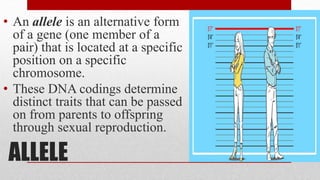
ALLELE
• An allele is an alternative form
of a gene (one member of a
pair) that is located at a specific
position on a specific
chromosome.
• These DNA codings determine
distinct traits that can be passed
on from parents to offspring
through sexual reproduction.
NON-MENDELIAN
INHERITANCE
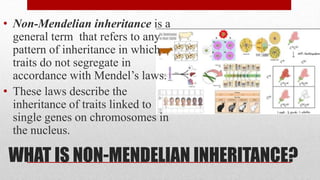
WHAT IS NON-MENDELIAN INHERITANCE?
• Non-Mendelian inheritance is a
general term that refers to any
pattern of inheritance in which
traits do not segregate in
accordance with Mendel’s laws.
• These laws describe the
inheritance of traits linked to
single genes on chromosomes in
the nucleus.
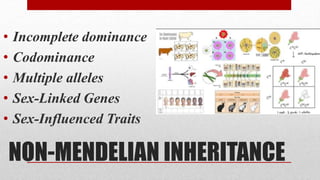
NON-MENDELIAN INHERITANCE
• Incomplete dominance
• Codominance
• Multiple alleles
• Sex-Linked Genes
• Sex-Influenced Traits
INCOMPLETE DOMINANCE
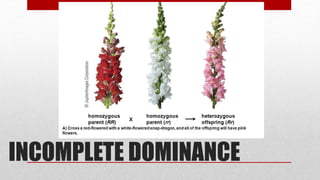
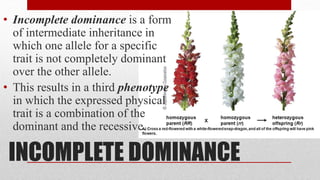
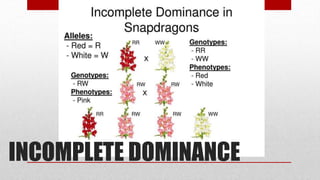
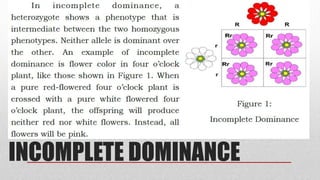
• Incomplete dominance is a form
of intermediate inheritance in
which one allele for a specific
trait is not completely dominant
over the other allele.
• This results in a third phenotype
in which the expressed physical
trait is a combination of the
dominant and the recessive.
INCOMPLETE DOMINANCE
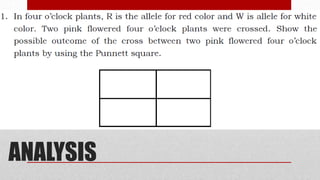
ANALYSIS
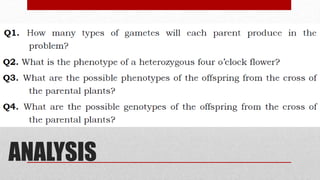
ANALYSIS
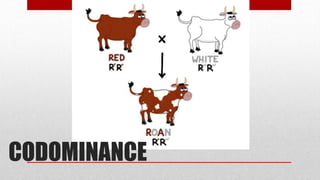
CODOMINANCE
CODOMINANCE
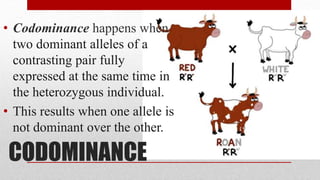
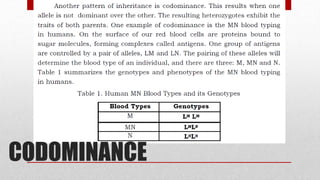
• Codominance happens when
two dominant alleles of a
contrasting pair fully
expressed at the same time in
the heterozygous individual.
• This results when one allele is
not dominant over the other.
CODOMINANCE
ANALYSIS
ANALYSIS
MULTIPLE ALLELES
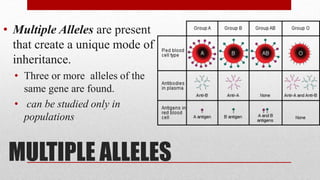
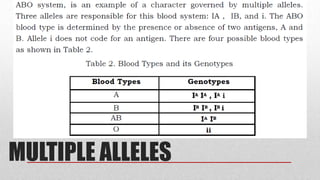
• Multiple Alleles are present
that create a unique mode of
inheritance.
• Three or more alleles of the
same gene are found.
• can be studied only in
populations
MULTIPLE ALLELES
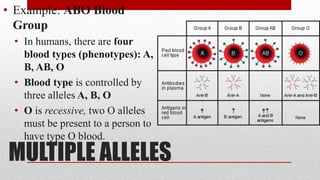
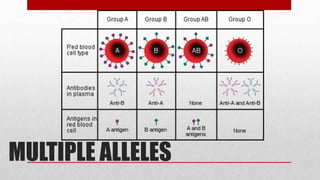
• Example: ABO Blood
Group
• In humans, there are four
blood types (phenotypes): A,
B, AB, O
• Blood type is controlled by
three alleles A, B, O
• O is recessive, two O alleles
must be present to a person to
have type O blood.
MULTIPLE ALLELES
MULTIPLE ALLELES
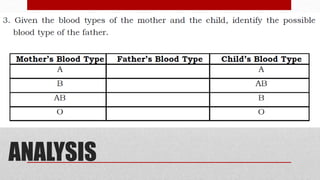
ANALYSIS
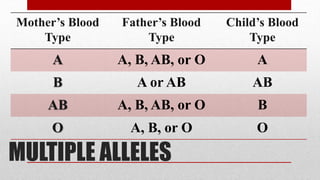
MULTIPLE ALLELES
Mother’s Blood
Type
Father’s Blood
Type
Child’s Blood
Type
A A, B, AB, or O A
B A or AB AB
AB A, B, AB, or O B
O A, B, or O O
SEX-LINKED GENES
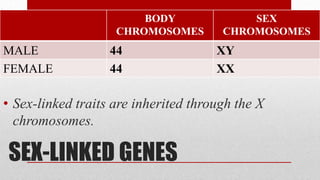
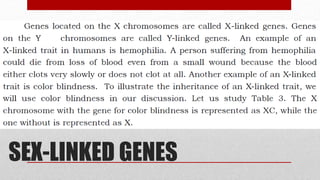
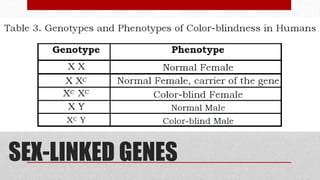
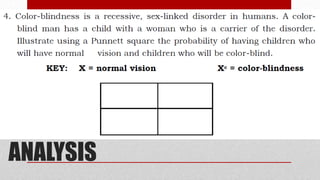
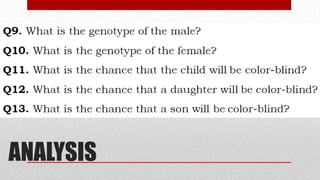
• Sex-linked traits are inherited through the X
chromosomes.
BODY
CHROMOSOMES
SEX
CHROMOSOMES
MALE 44 XY
FEMALE 44 XX
SEX-LINKED GENES
SEX-LINKED GENES
SEX-LINKED GENES
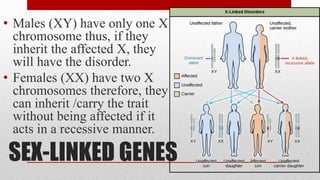
• Males (XY) have only one X
chromosome thus, if they
inherit the affected X, they
will have the disorder.
• Females (XX) have two X
chromosomes therefore, they
can inherit /carry the trait
without being affected if it
acts in a recessive manner.
SEX-LINKED GENES
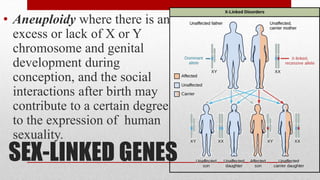
• Aneuploidy where there is an
excess or lack of X or Y
chromosome and genital
development during
conception, and the social
interactions after birth may
contribute to a certain degree
to the expression of human
sexuality.
ANALYSIS
ANALYSIS
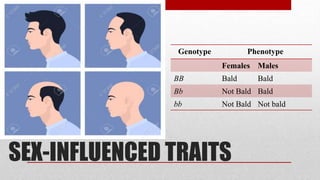
SEX-INFLUENCED TRAITS
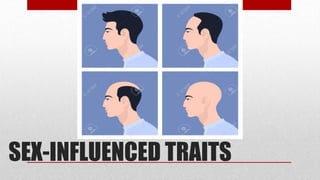
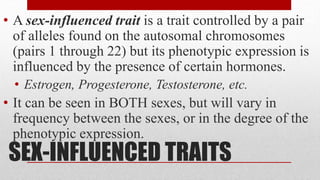
• A sex-influenced trait is a trait controlled by a pair
of alleles found on the autosomal chromosomes
(pairs 1 through 22) but its phenotypic expression is
influenced by the presence of certain hormones.
• Estrogen, Progesterone, Testosterone, etc.
• It can be seen in BOTH sexes, but will vary in
frequency between the sexes, or in the degree of the
phenotypic expression.
SEX-INFLUENCED TRAITS
Genotype Phenotype
Females Males
BB Bald Bald
Bb Not Bald Bald
bb Not Bald Not bald
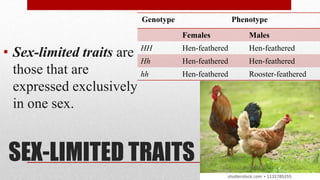
SEX-LIMITED TRAITS
• Sex-limited traits are
those that are
expressed exclusively
in one sex.
Genotype Phenotype
Females Males
HH Hen-feathered Hen-feathered
Hh Hen-feathered Hen-feathered
hh Hen-feathered Rooster-feathered
NON-MENDELIAN GENETICS.pptx

NON-MENDELIAN GENETICS.pptx

  • 1.
  • 5.
    GENETICS • Genetics isa branch of biology that studies hereditary information. • Heredity refers to the passing of characteristics from the parents to offspring.
  • 6.
    GENETICS • The studyof genetics also examines and explains similarities and differences between or among organisms. • Inherited characteristics are the causes of similarities.
  • 7.
    GENETICS • Each individualdoes posses unique traits that differentiate him/her from others called variation.
  • 8.
  • 9.
    DIVISIONS OF GENETICS •Genetics can be divided into three divisions: • Mendelian Genetics • Molecular Genetics • Population Genetics • Non-Mendelian Genetics
  • 10.
    DIVISIONS OF GENETICS •Mendelian Genetics reviews the basic laws of inheritance that were described by Gregor Mendel.
  • 11.
    DIVISIONS OF GENETICS •Molecular Genetics deals with the chemical nature of the gene, the mechanisms of transmission, and its varied transmission.
  • 12.
    DIVISIONS OF GENETICS •Population Genetics focuses on the behavior of a particular gene in group of organisms and how gene frequency is affected by environmental factors.
  • 13.
    IT ALL BEGANWITH GARDEN PEAS
  • 14.
    GREGOR JOHANN MENDEL •Gregor Johann Mendel is an Austrian Priest who began the scientific study of heredity with his experiment on Pisium sativum (garden peas).
  • 15.
    GREGOR JOHANN MENDEL •Mendel was the first scientist to give a satisfactory explanation of the mechanisms of heredity and still the basis of the study of genetics.
  • 16.
    THE START OFMENDELIAN GENETICS • Mendel bred different varieties of garden peas and cross-pollinated flowers that had clearly different forms of traits. • Such contrasting expressions or alternative forms of a trait are called alleles.
  • 17.
    THE START OFMENDELIAN GENETICS
  • 18.
    GENOTYPE AND PHENOTYPE •A genotype is the gene that is responsible for the observed trait. • The observable expression expressions of the trait is called the phenotype.
  • 19.
    ALLELE • An alleleis an alternative form of a gene (one member of a pair) that is located at a specific position on a specific chromosome. • These DNA codings determine distinct traits that can be passed on from parents to offspring through sexual reproduction.
  • 20.
  • 21.
    WHAT IS NON-MENDELIANINHERITANCE? • Non-Mendelian inheritance is a general term that refers to any pattern of inheritance in which traits do not segregate in accordance with Mendel’s laws. • These laws describe the inheritance of traits linked to single genes on chromosomes in the nucleus.
  • 22.
    NON-MENDELIAN INHERITANCE • Incompletedominance • Codominance • Multiple alleles • Sex-Linked Genes • Sex-Influenced Traits
  • 23.
  • 24.
    INCOMPLETE DOMINANCE • Incompletedominance is a form of intermediate inheritance in which one allele for a specific trait is not completely dominant over the other allele. • This results in a third phenotype in which the expressed physical trait is a combination of the dominant and the recessive.
  • 25.
  • 26.
  • 27.
  • 28.
  • 29.
  • 30.
    CODOMINANCE • Codominance happenswhen two dominant alleles of a contrasting pair fully expressed at the same time in the heterozygous individual. • This results when one allele is not dominant over the other.
  • 31.
  • 32.
  • 33.
  • 34.
    MULTIPLE ALLELES • MultipleAlleles are present that create a unique mode of inheritance. • Three or more alleles of the same gene are found. • can be studied only in populations
  • 35.
    MULTIPLE ALLELES • Example:ABO Blood Group • In humans, there are four blood types (phenotypes): A, B, AB, O • Blood type is controlled by three alleles A, B, O • O is recessive, two O alleles must be present to a person to have type O blood.
  • 36.
  • 37.
  • 38.
  • 39.
    MULTIPLE ALLELES Mother’s Blood Type Father’sBlood Type Child’s Blood Type A A, B, AB, or O A B A or AB AB AB A, B, AB, or O B O A, B, or O O
  • 40.
    SEX-LINKED GENES • Sex-linkedtraits are inherited through the X chromosomes. BODY CHROMOSOMES SEX CHROMOSOMES MALE 44 XY FEMALE 44 XX
  • 41.
  • 42.
  • 43.
    SEX-LINKED GENES • Males(XY) have only one X chromosome thus, if they inherit the affected X, they will have the disorder. • Females (XX) have two X chromosomes therefore, they can inherit /carry the trait without being affected if it acts in a recessive manner.
  • 44.
    SEX-LINKED GENES • Aneuploidywhere there is an excess or lack of X or Y chromosome and genital development during conception, and the social interactions after birth may contribute to a certain degree to the expression of human sexuality.
  • 45.
  • 46.
  • 47.
  • 48.
    SEX-INFLUENCED TRAITS • Asex-influenced trait is a trait controlled by a pair of alleles found on the autosomal chromosomes (pairs 1 through 22) but its phenotypic expression is influenced by the presence of certain hormones. • Estrogen, Progesterone, Testosterone, etc. • It can be seen in BOTH sexes, but will vary in frequency between the sexes, or in the degree of the phenotypic expression.
  • 49.
    SEX-INFLUENCED TRAITS Genotype Phenotype FemalesMales BB Bald Bald Bb Not Bald Bald bb Not Bald Not bald
  • 50.
    SEX-LIMITED TRAITS • Sex-limitedtraits are those that are expressed exclusively in one sex. Genotype Phenotype Females Males HH Hen-feathered Hen-feathered Hh Hen-feathered Hen-feathered hh Hen-feathered Rooster-feathered

Editor's Notes

  • #25  In incomplete dominance, a heterozygote shows a phenotype that is intermediate between the two homozygous phenotypes. Neither allele is dominant over the other.