Lecture 4

Nonlinear Stochastic Programming
by the Monte-Carlo method

  Leonidas Sakalauskas
  Institute of Mathematics and Informatics
  Vilnius, Lithuania <sakal@ktl.mii.lt>

  EURO Working Group on Continuous Optimization
Content
   Stochastic unconstrained optimization
   Monte Carlo estimators
   Statistical testing of optimality
   Gradient-based stochastic algorithm
   Rule for Monte-Carlo sample size regulation
   Counterexamples
   Nonlinear stochastic constrained optimization
   Convergence Analysis
   Counterexample
Stochastic unconstrained
      optimization
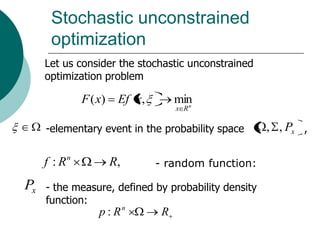
     Let us consider the stochastic unconstrained
     optimization problem

                F ( x)    Ef x,        min
                                         n
                                       x R


     -elementary event in the probability space        , , Px ,

            n
     f :R                R,       - random function:

Px   - the measure, defined by probability density
     function:
                    p : Rn         R
Monte-Carlo samples
We assume here that the Monte-Carlo samples of a
certain size N are provided for any x R n

             Y   ( y1, y 2 ,..., y N ),
the sampling estimator of the objective function
                              N
                       1
             F ( x)                 f ( x, y j )
                       N      j 1
and sampling variance can be computed
                        N
         2        1                    j
                                                   2
       D ( x)                 f ( x, y ) F ( x)
                 N 1    j 1
Gradient


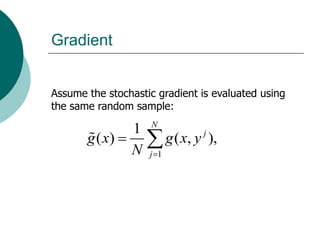
Assume the stochastic gradient is evaluated using
the same random sample:
                    N
                1                 j
       g ( x)             g ( x, y ),
                N   j 1
Covariance matrix
  and the sampling covariance matrix is computed as
  well

              N
         1                   j                  j
                                                            T
A( x)               g x, y       g x   g x, y         g x
        N n   j 1
Gradient search procedure

                        0      n
Let some initial point x            be given and the
random sample of a certain initial size N0 be generated at
this point, as well as, the Monte-Carlo estimates be
computed.
The iterative stochastic procedure of gradient search can
be used further:


             x   t 1
                       x   t       ~( x t )
                                   g
Monte-Carlo sample size problem

There is no a great necessity to compute
  estimators with a high accuracy on starting the
  optimisation, because then it suffices only to
  approximately evaluate the direction leading to
  the optimum.
Therefore, one can obtain not so large samples at
  the beginning of the optimum search and, later
  on, increase the size of samples so as to get the
  estimate of the objective function with a desired
  accuracy just at the time of decision making on
  finding the solution to the optimisation problem.
Monte-Carlo sample size problem

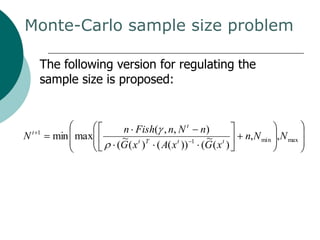
     The following version for regulating the
     sample size is proposed:


                    n Fish( , n, N t n)
Nt   1
         min max    ~ t T         t  1 ~ t       n, N min , N max
                   (G ( x ) ( A( x )) (G ( x )
Statistical testing of the optimality
               hypothesis

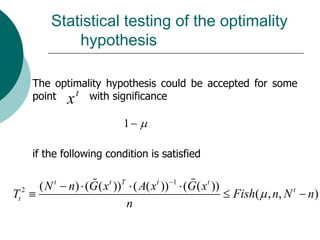
       The optimality hypothesis could be accepted for some
       point x t with significance

                             1

       if the following condition is satisfied


        (N t   n) (G ( x t ))T ( A( x t ))   1
                                                 (G ( x t ))
Tt 2                                                           Fish( , n, N t   n)
                              n
Statistical testing of the optimality
         hypothesis

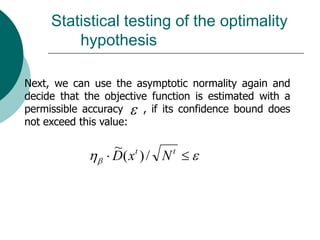
Next, we can use the asymptotic normality again and
decide that the objective function is estimated with a
permissible accuracy    , if its confidence bound does
not exceed this value:

                 ~ t
                 D( x ) / N t
Importance sampling

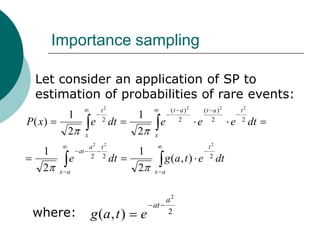
  Let consider an application of SP to
  estimation of probabilities of rare events:
                          t2                    ( t a )2       (t a )2        t2
            1             2
                                    1               2             2           2
P( x )                e        dt           e              e              e        dt
            2     x                 2   x
                   a2 t 2                                       t2
    1           at
                   2 2
                                    1                           2
            e                  dt           g (a , t ) e             dt
    2     x a                       2   x a


                                           a2
                                        at
 where:               g (a , t )    e      2
Importance sampling

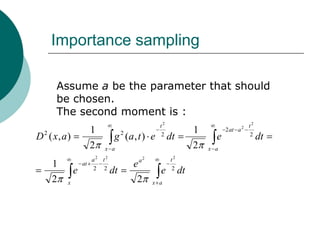
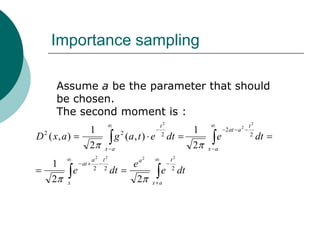
      Assume a be the parameter that should
      be chosen.
      The second moment is :
                                               t2                                    t2
  2                 1              2           2
                                                              1         2 at a   2
                                                                                     2
D ( x, a)                      g (a , t ) e         dt              e                     dt
                    2     x a                                 2   x a
                     a2 t 2             a2          t2
      1           at
                     2 2
                                       e            2
              e               dt               e         dt
      2   x                             2    x a
Importance sampling

      Assume a be the parameter that should
      be chosen.
      The second moment is :
                                               t2                                    t2
  2                 1              2           2
                                                              1         2 at a   2
                                                                                     2
D ( x, a)                      g (a , t ) e         dt              e                     dt
                    2     x a                                 2   x a
                     a2 t 2             a2          t2
      1           at
                     2 2
                                       e            2
              e               dt               e         dt
      2   x                             2    x a
Importance sampling

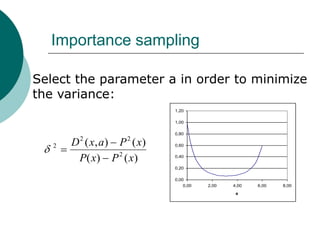
Select the parameter a in order to minimize
the variance:
                           1,20

                           1,00

                           0,80
        2          2
   2   D ( x, a) P ( x)    0,60


        P( x ) P 2 ( x )   0,40

                           0,20

                           0,00
                               0,00   2,00   4,00   6,00   8,00
                                              a
Importance sampling


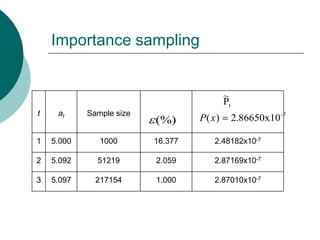
                                            ~
                                            Pt
t    at     Sample size
                          (%)      P( x )        2.86650x10 -7

1   5.000      1000       16.377       2.48182x10⁻⁷

2   5.092     51219       2.059        2.87169x10⁻⁷

3   5.097     217154      1.000        2.87010x10⁻⁷
Manpower-planning problem

The employer must decide upon a base
level of regular staff at various skill levels.
The recourse actions available are regular
staff overtime or outside temporary help in
order to meet unknown demand of service
at minimum cost (Ermolyev and Wets
(1988)).
Manpower-planning problem

x j : base level of regular staff at skill level j = 1, 2, 3
y j ,t : amount of overtime help

 z j ,t :    amount of temporary help,
cj :        cost of regular staff at skill level j = 1, 2, 3

qj :          cost of overtime,

 rj :        cost of temporary help

 wt :       demand of services at period t,

  t   : absentees rate for regular staff at time t,
            ratio of amount of skill level j per amount of
 j 1    :   j-1 required,
Manpower-planning problem
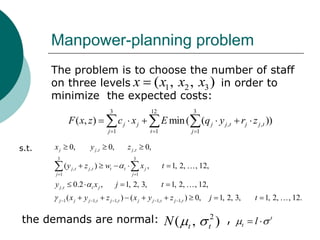
       The problem is to choose the number of staff
       on three levels x ( x1 , x2 , x3 ) in order to
       minimize the expected costs:
                                         3                                12                       3
                F ( x, z )                      cj xj                           E min (                 (q j y j , t    rj z j ,t ))
                                         j 1                              t 1                     j 1


s.t.   xj        0,           y j ,t     0,               z j ,t     0,
        3                                                     3
             (y j ,t     z j ,t )       wt            t            xj ,            t 1, 2,         , 12,
       j 1                                                   j 1

       y j ,t      0.2        t   xj,         j 1, 2, 3,                        t 1, 2,            , 12,
         j 1    (x j     yj    1, t     zj    1, t   ) (x j           yj    1, t     zj   1, t   ) 0,      j 1, 2, 3,        t 1, 2,   , 12.

the demands are normal:                                                            N( t,                    2
                                                                                                                )   ,   t    l     t
                                                                                                           t
X 12
   3


       Manpower-planning problem

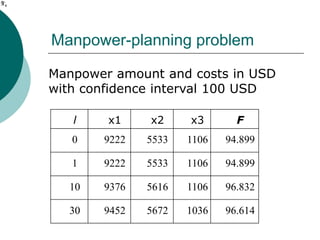
       Manpower amount and costs in USD
       with confidence interval 100 USD

          l    x1    x2     x3       F
          0   9222   5533   1106   94.899

          1   9222   5533   1106   94.899

         10   9376   5616   1106   96.832

         30   9452   5672   1036   96.614
Nonlinear Stochastic Programming
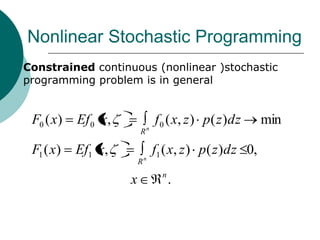
   Constrained continuous (nonlinear )stochastic
    programming problem is in general


     F0 ( x)   Ef 0 x,            f 0 ( x, z ) p ( z )dz     min
                             Rn

     F1 ( x)   Ef1 x,             f1 ( x, z ) p ( z )dz 0,
                             Rn
                                    n
                         x              .
Nonlinear Stochastic Programming
Let us define the Lagrange function

         L( x, ) F0 ( x)        F1 ( x)

          L( x, ) El ( x, , )


l ( x,     , )     f 0 ( x, )             f1 ( x, )
Nonlinear Stochastic Programming
       Procedure for stochastic optimization:

                      t 1           t    ~
                  x             x            x L( x t ,   t
                                                              )
 t 1                        t             ~ t                     ~
        max[0,                          ( F1 ( x )                DF1 ( x t ))]

 0        0                 0
N ,           ,         x               - initial values
                                        - parameters of
        0,                      0         optimization
Conditions and testing of optimality


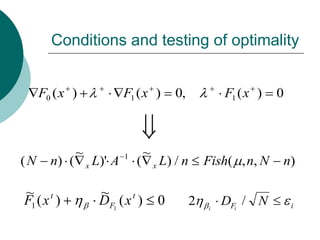
     F0 ( x )                 F1 ( x )            0,           F1 ( x )   0


              ~               1       ~
(N     n) (       x   L)' A       (       x   L) / n       Fish( , n, N   n)

~ t                    ~      t
F1 ( x )               DF1 ( x )              0        2   i
                                                               DFi / N        i
Analysis of Convergence

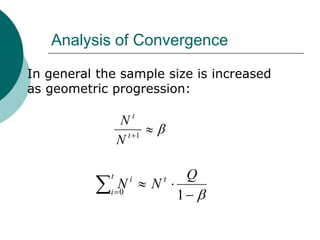
In general the sample size is increased
as geometric progression:

                       t
                 N
                   t       1
                 N

             t     i               t       Q
               N
             i 0
                               N
                                       1
Wrap-Up and conclusions


   The approach presented in this lecture is
    grounded by the termination procedure and
    the rule for adaptive regulation of size of
    Monte-Carlo samples, taking into account the
    statistical modeling accuracy.
Wrap-Up and Conclusions
   The computer study shows that the approach
    developed provides us the estimator for a
    reliable testing of the optimality hypothesis in a
    wide range of dimensionality of stochastic
    optimization problem (2<n<100)

   Termination procedure proposed allows us to
    test the optimality hypothesis and to evaluate
    reliably the confidence intervals of the
    objective and constraint functions

Nonlinear Stochastic Programming by the Monte-Carlo method

  • 1.
    Lecture 4 Nonlinear StochasticProgramming by the Monte-Carlo method Leonidas Sakalauskas Institute of Mathematics and Informatics Vilnius, Lithuania <sakal@ktl.mii.lt> EURO Working Group on Continuous Optimization
  • 2.
    Content  Stochastic unconstrained optimization  Monte Carlo estimators  Statistical testing of optimality  Gradient-based stochastic algorithm  Rule for Monte-Carlo sample size regulation  Counterexamples  Nonlinear stochastic constrained optimization  Convergence Analysis  Counterexample
  • 3.
    Stochastic unconstrained optimization Let us consider the stochastic unconstrained optimization problem F ( x) Ef x, min n x R -elementary event in the probability space , , Px , n f :R R, - random function: Px - the measure, defined by probability density function: p : Rn R
  • 4.
    Monte-Carlo samples We assumehere that the Monte-Carlo samples of a certain size N are provided for any x R n Y ( y1, y 2 ,..., y N ), the sampling estimator of the objective function N 1 F ( x) f ( x, y j ) N j 1 and sampling variance can be computed N 2 1 j 2 D ( x) f ( x, y ) F ( x) N 1 j 1
  • 5.
    Gradient Assume the stochasticgradient is evaluated using the same random sample: N 1 j g ( x) g ( x, y ), N j 1
  • 6.
    Covariance matrix and the sampling covariance matrix is computed as well N 1 j j T A( x) g x, y g x g x, y g x N n j 1
  • 7.
    Gradient search procedure 0 n Let some initial point x be given and the random sample of a certain initial size N0 be generated at this point, as well as, the Monte-Carlo estimates be computed. The iterative stochastic procedure of gradient search can be used further: x t 1 x t ~( x t ) g
  • 8.
    Monte-Carlo sample sizeproblem There is no a great necessity to compute estimators with a high accuracy on starting the optimisation, because then it suffices only to approximately evaluate the direction leading to the optimum. Therefore, one can obtain not so large samples at the beginning of the optimum search and, later on, increase the size of samples so as to get the estimate of the objective function with a desired accuracy just at the time of decision making on finding the solution to the optimisation problem.
  • 9.
    Monte-Carlo sample sizeproblem The following version for regulating the sample size is proposed: n Fish( , n, N t n) Nt 1 min max ~ t T t 1 ~ t n, N min , N max (G ( x ) ( A( x )) (G ( x )
  • 10.
    Statistical testing ofthe optimality hypothesis The optimality hypothesis could be accepted for some point x t with significance 1 if the following condition is satisfied (N t n) (G ( x t ))T ( A( x t )) 1 (G ( x t )) Tt 2 Fish( , n, N t n) n
  • 11.
    Statistical testing ofthe optimality hypothesis Next, we can use the asymptotic normality again and decide that the objective function is estimated with a permissible accuracy , if its confidence bound does not exceed this value: ~ t D( x ) / N t
  • 12.
    Importance sampling Let consider an application of SP to estimation of probabilities of rare events: t2 ( t a )2 (t a )2 t2 1 2 1 2 2 2 P( x ) e dt e e e dt 2 x 2 x a2 t 2 t2 1 at 2 2 1 2 e dt g (a , t ) e dt 2 x a 2 x a a2 at where: g (a , t ) e 2
  • 13.
    Importance sampling Assume a be the parameter that should be chosen. The second moment is : t2 t2 2 1 2 2 1 2 at a 2 2 D ( x, a) g (a , t ) e dt e dt 2 x a 2 x a a2 t 2 a2 t2 1 at 2 2 e 2 e dt e dt 2 x 2 x a
  • 14.
    Importance sampling Assume a be the parameter that should be chosen. The second moment is : t2 t2 2 1 2 2 1 2 at a 2 2 D ( x, a) g (a , t ) e dt e dt 2 x a 2 x a a2 t 2 a2 t2 1 at 2 2 e 2 e dt e dt 2 x 2 x a
  • 15.
    Importance sampling Select theparameter a in order to minimize the variance: 1,20 1,00 0,80 2 2 2 D ( x, a) P ( x) 0,60 P( x ) P 2 ( x ) 0,40 0,20 0,00 0,00 2,00 4,00 6,00 8,00 a
  • 16.
    Importance sampling ~ Pt t at Sample size (%) P( x ) 2.86650x10 -7 1 5.000 1000 16.377 2.48182x10⁻⁷ 2 5.092 51219 2.059 2.87169x10⁻⁷ 3 5.097 217154 1.000 2.87010x10⁻⁷
  • 17.
    Manpower-planning problem The employermust decide upon a base level of regular staff at various skill levels. The recourse actions available are regular staff overtime or outside temporary help in order to meet unknown demand of service at minimum cost (Ermolyev and Wets (1988)).
  • 18.
    Manpower-planning problem x j: base level of regular staff at skill level j = 1, 2, 3 y j ,t : amount of overtime help z j ,t : amount of temporary help, cj : cost of regular staff at skill level j = 1, 2, 3 qj : cost of overtime, rj : cost of temporary help wt : demand of services at period t, t : absentees rate for regular staff at time t, ratio of amount of skill level j per amount of j 1 : j-1 required,
  • 19.
    Manpower-planning problem The problem is to choose the number of staff on three levels x ( x1 , x2 , x3 ) in order to minimize the expected costs: 3 12 3 F ( x, z ) cj xj E min ( (q j y j , t rj z j ,t )) j 1 t 1 j 1 s.t. xj 0, y j ,t 0, z j ,t 0, 3 3 (y j ,t z j ,t ) wt t xj , t 1, 2, , 12, j 1 j 1 y j ,t 0.2 t xj, j 1, 2, 3, t 1, 2, , 12, j 1 (x j yj 1, t zj 1, t ) (x j yj 1, t zj 1, t ) 0, j 1, 2, 3, t 1, 2, , 12. the demands are normal: N( t, 2 ) , t l t t
  • 20.
    X 12 3 Manpower-planning problem Manpower amount and costs in USD with confidence interval 100 USD l x1 x2 x3 F 0 9222 5533 1106 94.899 1 9222 5533 1106 94.899 10 9376 5616 1106 96.832 30 9452 5672 1036 96.614
  • 21.
    Nonlinear Stochastic Programming  Constrained continuous (nonlinear )stochastic programming problem is in general F0 ( x) Ef 0 x, f 0 ( x, z ) p ( z )dz min Rn F1 ( x) Ef1 x, f1 ( x, z ) p ( z )dz 0, Rn n x .
  • 22.
    Nonlinear Stochastic Programming Letus define the Lagrange function L( x, ) F0 ( x) F1 ( x) L( x, ) El ( x, , ) l ( x, , ) f 0 ( x, ) f1 ( x, )
  • 23.
    Nonlinear Stochastic Programming Procedure for stochastic optimization: t 1 t ~ x x x L( x t , t ) t 1 t ~ t ~ max[0, ( F1 ( x ) DF1 ( x t ))] 0 0 0 N , , x - initial values - parameters of 0, 0 optimization
  • 24.
    Conditions and testingof optimality F0 ( x ) F1 ( x ) 0, F1 ( x ) 0 ~ 1 ~ (N n) ( x L)' A ( x L) / n Fish( , n, N n) ~ t ~ t F1 ( x ) DF1 ( x ) 0 2 i DFi / N i
  • 25.
    Analysis of Convergence Ingeneral the sample size is increased as geometric progression: t N t 1 N t i t Q N i 0 N 1
  • 26.
    Wrap-Up and conclusions  The approach presented in this lecture is grounded by the termination procedure and the rule for adaptive regulation of size of Monte-Carlo samples, taking into account the statistical modeling accuracy.
  • 27.
    Wrap-Up and Conclusions  The computer study shows that the approach developed provides us the estimator for a reliable testing of the optimality hypothesis in a wide range of dimensionality of stochastic optimization problem (2<n<100)  Termination procedure proposed allows us to test the optimality hypothesis and to evaluate reliably the confidence intervals of the objective and constraint functions