Noninfectious Keratitis
                       Dr. Merce Morral
    Institut Clínic d’Oftalmologia, Hospital Clinic i Provincial

                         Dr. Jose L. Guell
                Instituto de Microcirugia Ocular
                        Barcelona, Spain
Noninfectious Keratitis

   I have no financial interest to disclose
Noninfectious keratitis
• Recurrent Erosion Syndrome

• Filamentary Keratitis

• The Superficial Punctate Keratitis Of Thygeson

• Neurotrophic Keratitis

• Factitious Keratoconjunctivitis
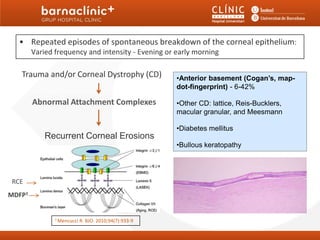
• Repeated episodes of spontaneous breakdown of the corneal epithelium:
         1. Recurrent Erosion Syndromes
        Varied frequency and intensity - Evening or early morning

   Trauma and/or Corneal Dystrophy (CD)                •Anterior basement (Cogan’s, map-
                                                       dot-fingerprint) - 6-42%

        Abnormal Attachment Complexes                  •Other CD: lattice, Reis-Bucklers,
                                                       macular granular, and Meesmann

                                                       •Diabetes mellitus
            Recurrent Corneal Erosions
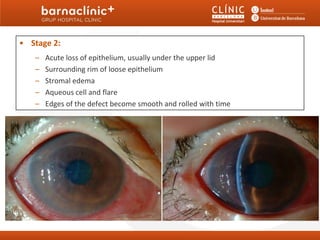
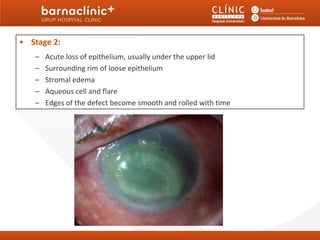
                                                       •Bullous keratopathy


RCE
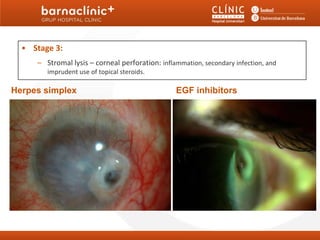
MDFP1


               1 Mencucci   R. BJO. 2010;94(7):933-9
1. RES: Clinical Manifestations
• Symptoms:
   – Mild foreign body sensation (FBS) to abrupt “ripping or tearing”
     sensation followed by abrupt pain
   – Epiphora, photophobia, lid swelling,…
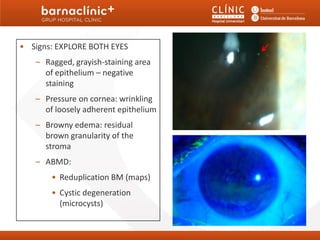
• Signs: EXPLORE BOTH EYES
   – Ragged, grayish-staining area
     of epithelium – negative
     staining
   – Pressure on cornea: wrinkling
     of loosely adherent epithelium
   – Browny edema: residual
     brown granularity of the
     stroma
   – ABMD:
       • Reduplication BM (maps)
       • Cystic degeneration
         (microcysts)
1. RES: Medical Treatment
• Acute phase: topical antibiotics +/- patching
• Bandage contact lens, if abnormalities in lid anatomy –
  increased risk of bacterial keratitis
• Long-term nightly use of hyperosmotic lubricating ointments
  (6-12 months)
• Lubricants/autologous serum
• Treat dry eye and meibomian gland dysfunction
• Avoid topical steroids
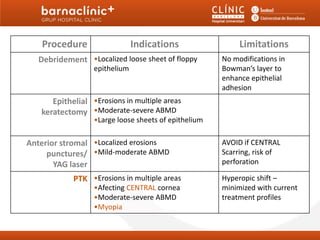
Procedure     Indications
  1. RES: Surgical Treatment                               Limitations
   Debridement •Localized loose sheet of floppy       No modifications in
                  epithelium                          Bowman’s layer to
                                                      enhance epithelial
                                                      adhesion
      Epithelial •Erosions in multiple areas
   keratectomy •Moderate-severe ABMD
                  •Large loose sheets of epithelium

Anterior stromal •Localized erosions                  AVOID if CENTRAL
     punctures/ •Mild-moderate ABMD                   Scarring, risk of
       YAG laser                                      perforation

            PTK •Erosions in multiple areas           Hyperopic shift –
                  •Afecting CENTRAL cornea            minimized with current
                  •Moderate-severe ABMD               treatment profiles
                  •Myopia
2. Filamentary Keratitis
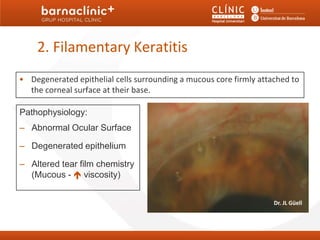
• Degenerated epithelial cells surrounding a mucous core firmly attached to
  the corneal surface at their base.

Pathophysiology:
– Abnormal Ocular Surface

– Degenerated epithelium

– Altered tear film chemistry
  (Mucous -  viscosity)


                                                                    Dr. JL Güell
2. FK: Clinical Manifestations
• Symptoms:
   – FBS, most prominent with blinking
   – Epiphora, photophobia,
     blepharospasm


• Signs:
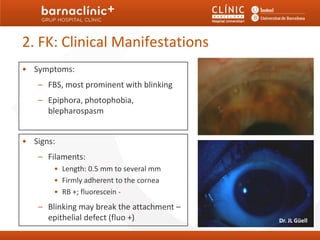
   – Filaments:
       • Length: 0.5 mm to several mm
       • Firmly adherent to the cornea
       • RB +; fluorescein -
   – Blinking may break the attachment –
     epithelial defect (fluo +)            Dr. JL Güell
2. Filamentary Keratitis: Ethiology
• Ophthalmic disorders:
     – Keratoconjunctivitis sicca/Sjögren: most frequent
                                                                           Interpalpebral area
     – Neurotrophic keratopathy (herpetic, V paralysis)
     – Exposure keratopathy
     – Superior limbic keratoconjunctivitis
     – Prolonged patching                              Superior
     – Ptosis
     – Anirida/Ocular albinism

• Ocular trauma/surgery:
     – Erosions
     – Contact lens overwear
     – Cataract Extraction
     – Penetrating keratoplasty                 Graft near sutures or G-H interface

• Systemic disorders: sarcoid, diabetes mellitus, hereditary hemorrhagic telangiectasia,
   ectodermal dysplasia, psoriasis, atopic dermatitis, brain stem injury
•   Identify and treat (if possible) underlying cause
    2. FK: Treatment
•   Mechanical debridement of the filaments (temporary) – try not to disrupt
    underlying epithelium
•   Treat KC Sicca:
     – Preservative-free topical tear substitutes
     – Punctal plugs
     – Topical steroids
     – Botulinum toxin, palpebral surgery – decrease exposure
•   Hyperosmotic lubricating solution and ointment
•   10% N-acetylcysteine – mucolytic agent
•   Soft contact lens
•   0.1% or 1% diclophenac sodium
•   Unproved: eledoisin, beta irradiation, topical heparin, topical dextran, systemic
    mucolytics, topical humanEGF,…
3. The Superficial Punctate Keratitis of Thygeson
 • 1950 – Thygeson1

 • Coarse punctate epithelial keratitis with little or no conjunctival
   hyperemia

 • Unknown cause or associated disease:
       – Viral origin currently not believed

       – Immune process? – association with HLA-DW3 and HLA-DR3

 • Second-third decades (any age), no sex preference


1.   Thygeson P. Superficial punctate keratitis. JAMA 1950;144:1544-1549
3. The Superficial Punctate Keratitis of Thygeson
• Diagnostic features1:
       – Chronic, bilateral, punctate epithelial keratitis

       – Long duration – remissions (months to years) and exacerbations (weeks
         up to 8 months)

       – Healing without scarring

       – Lack of response to topical antibiotics or epithelial debridement

       – Striking symptomatic response to topical corticosteroids

• Spontaneous remissions and exacerbations of FBS, tearing, burning,
  photophobia, occasional blurring of vision

1.    Thygeson P. Superficial punctate keratitis. JAMA 1950;144:1544-1549
3. Thygeson
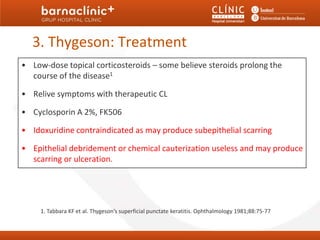
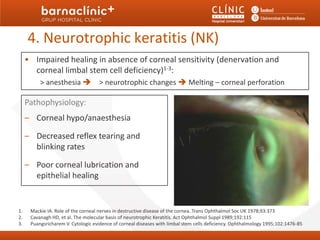
•   15-20 fine granular, white to gray dot-
    like epithelial opacities

•   Stellate appearance (dxd herpes virus)

•   Little epithelial edema, no cellular
    infiltration

•   Evanescent, predominantly in the
    central cornea

•   Exacerbations: raised center breaks
    through the epithelial surface,
    fluorescein and rose bengal staining

•   Remissions: flat and do not stain

                                              Dr. JL Güell
3. Thygeson: Treatment
• Low-dose topical corticosteroids – some believe steroids prolong the
  course of the disease1

• Relive symptoms with therapeutic CL

• Cyclosporin A 2%, FK506

• Idoxuridine contraindicated as may produce subepithelial scarring

• Epithelial debridement or chemical cauterization useless and may produce
  scarring or ulceration.


     1. Tabbara KF et al. Thygeson’s superficial punctate keratitis. Ophthalmology 1981;88:75-77
4. Neurotrophic keratitis (NK)
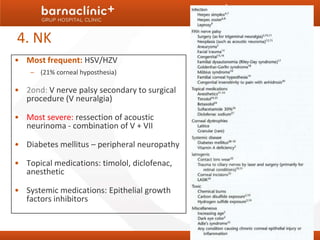
     • Impaired healing in absence of corneal sensitivity (denervation and
       corneal limbal stem cell deficiency)1-3:
          > anesthesia  > neurotrophic changes  Melting – corneal perforation

     Pathophysiology:
     – Corneal hypo/anaesthesia

     – Decreased reflex tearing and
       blinking rates

     – Poor corneal lubrication and
       epithelial healing


1.    Mackie IA. Role of the corneal nerves in destructive disease of the cornea. Trans Ophthalmol Soc UK 1978;93:373
2.    Cavanagh HD, et al. The molecular basis of neurotrophic Keratitis. Act Ophthalmol Suppl 1989;192:115
3.    Puangsricharem V. Cytologic evidence of corneal diseases with limbal stem cells deficiency. Ophthalmology 1995;102:1476-85
4. NK
• Most frequent: HSV/HZV
    – (21% corneal hyposthesia)

• 2ond: V nerve palsy secondary to surgical
  procedure (V neuralgia)

• Most severe: ressection of acoustic
  neurinoma - combination of V + VII

• Diabetes mellitus – peripheral neuropathy

• Topical medications: timolol, diclofenac,
  anesthetic

• Systemic medications: Epithelial growth
  factors inhibitors
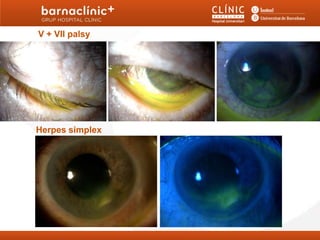
V + VII palsy


Herpes simplex
4. NK: Clinical Evaluation
• Thorough medical and surgical history to determine the cause for corneal
  hypesthesia:
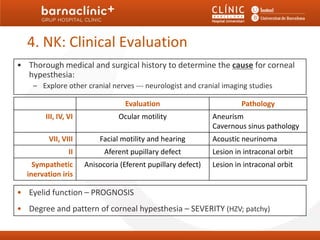
    – Explore other cranial nerves --- neurologist and cranial imaging studies

                                  Evaluation                           Pathology
        III, IV, VI             Ocular motility               Aneurism
                                                              Cavernous sinus pathology
         VII, VIII        Facial motility and hearing         Acoustic neurinoma
                 II         Aferent pupillary defect          Lesion in intraconal orbit
    Sympathetic       Anisocoria (Eferent pupillary defect)   Lesion in intraconal orbit
  inervation iris

• Eyelid function – PROGNOSIS
• Degree and pattern of corneal hypesthesia – SEVERITY (HZV; patchy)
4. NK: Clinical Evaluation
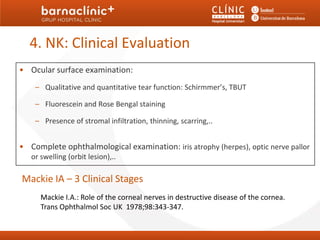
• Ocular surface examination:
    – Qualitative and quantitative tear function: Schirmmer’s, TBUT

    – Fluorescein and Rose Bengal staining

    – Presence of stromal infiltration, thinning, scarring,..


• Complete ophthalmological examination: iris atrophy (herpes), optic nerve pallor
   or swelling (orbit lesion),..

Mackie IA – 3 Clinical Stages
      Mackie I.A.: Role of the corneal nerves in destructive disease of the cornea.
      Trans Ophthalmol Soc UK 1978;98:343-347.
4. Neurotrophic Keratitis: Clinical Stages
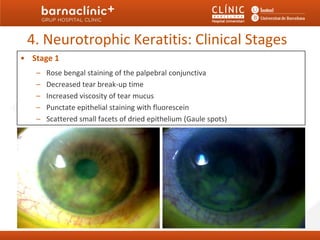
• Stage 1
   –   Rose bengal staining of the palpebral conjunctiva
   –   Decreased tear break-up time
   –   Increased viscosity of tear mucus
   –   Punctate epithelial staining with fluorescein
   –   Scattered small facets of dried epithelium (Gaule spots)
• Stage 2:
    4. Neurotrophic Keratitis: Clinical Stages
   –   Acute loss of epithelium, usually under the upper lid
   –   Surrounding rim of loose epithelium
   –   Stromal edema
   –   Aqueous cell and flare
   –   Edges of the defect become smooth and rolled with time
• Stage 2:
    4. Neurotrophic Keratitis: Clinical Stages
   – Acute loss of epithelium, usually under the upper lid
   –   Surrounding rim of loose epithelium
   –   Stromal edema
   –   Aqueous cell and flare
   –   Edges of the defect become smooth and rolled with time
4. Neurotrophic keratitis: Clinical Stages
  • Stage 3:
     – Stromal lysis – corneal perforation: inflammation, secondary infection, and
        imprudent use of topical steroids.

Herpes simplex                                   EGF inhibitors
4. NK: Treatment
• Treat eyelid disfunction
• Stage 1:
    –   Preservative-free topical lubrication
    –   Therapeutic CL (increases the risk for infectious keratitis)
    –   Punctal silicone plugs
    –   Doxycycline: improves tear quality (MGD) and prevents stromal lysis.

• If severe loss of corneal sensation: lateral tarsorrhaphy, botulinum A toxin
   injection of the levator – decrease exposition and prevent evolution to stage 2 and 3

• If severe dry eye: CsA, Autologous serum (20%-50%), autologous platelet-
  rich plasma drops
• In presence of inflammation: Avoid NSAIDS – cause corneal hypoaesthesia;
   Cautious use of steroids: preservative-free and add topical antibiotic

• Pharmacological adjuncts (research): EGF, topical aldose reductase inhibitors
   (DM), NGF, substance P, thymosin beta4
4. NK: Treatment of Stage 3
•    Amniotic Membrane Transplantation (AMT):
      – Graft in trophic corneal ulceration1,2
      – Patch to cover epithelial defects3

•    Perforation < 2mm: cyanoacrylate glue + bandage CL

•    Perforation > 2mm: Lamellar or penetrating keratoplasty +/- AMT
      –   Increased risk for rejection due to NV, poor wound healing, poor reepithelization of the graft due to
          hypoaesthesia, …

•    Conjunctival flaps:
      – Poor cosmetic and visual results
      – Impairs subsequent PKP

1.    Gris O, et al. Amniotic membrane transplantation for ocular surface pathology: long-term results. Transplantation Proceedings
      2003;35:2031-5
2.    Gris O, et al. Histological findings after amniotic membrane graft in the human cornea. Ophthalmoogy 2002;109:508-12
3.    Gris O, et al. Amniotic membrane implantation as a therapeutic contact lens for the treatment of epihelial disorders. Cornea
      2002;21:22-7
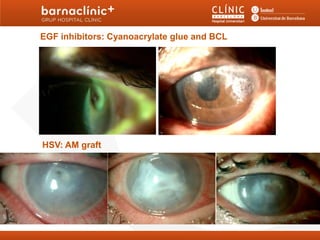
EGF inhibitors: Cyanoacrylate glue and BCL


HSV: AM graft
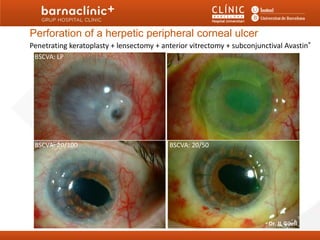
Perforation of a herpetic peripheral corneal ulcer
Penetrating keratoplasty + lensectomy + anterior vitrectomy + subconjunctival Avastin®
 BSCVA: LP


 BSCVA: 20/100                            BSCVA: 20/50


                                                                         Dr. JL Güell
5. Factitious Keratoconjunctivitis
• Factitious disorders: Symptoms or physical findings intentionally produced by
  the patient to assume the sick role in abscence of external incentive
  (Malingering) – Anaesthetic abuse

              – Age: 2nd or 3rd decade
              – Employed in the medical field
              – Deny any history of trauma
              – Multiple recurrent episodes of poorly explained disease
              – Failure to respond to appropriate therapy
              – Improve dramatically when placed on 24-hour watch
              – Display less concern for the presenting problem than
                appropriate: “serene indiference”
Take-home messages
• Always rule out infectious origin

• RES: trauma or corneal epithelial dystrophy – PTK if medical
  treatment not effective

• FK: dry eye and ocular surface abnormalities – lubrication, topical
  steroids, hyperosmotics

• Thygeson: dxd viral keratitis – chronic course (remissions-
  exacerbations) – topical steroids

• Neurotrophic keratitis: IDENTIFY and TREAT the cause that leads to
  corneal hypesthesia – herpes virus and V palsy – aggressive and
  prompt treatment

Noninfectious keratitis barnaclinic

  • 1.
    Noninfectious Keratitis Dr. Merce Morral Institut Clínic d’Oftalmologia, Hospital Clinic i Provincial Dr. Jose L. Guell Instituto de Microcirugia Ocular Barcelona, Spain
  • 2.
    Noninfectious Keratitis I have no financial interest to disclose
  • 3.
    Noninfectious keratitis • RecurrentErosion Syndrome • Filamentary Keratitis • The Superficial Punctate Keratitis Of Thygeson • Neurotrophic Keratitis • Factitious Keratoconjunctivitis
  • 4.
    • Repeated episodesof spontaneous breakdown of the corneal epithelium: 1. Recurrent Erosion Syndromes Varied frequency and intensity - Evening or early morning Trauma and/or Corneal Dystrophy (CD) •Anterior basement (Cogan’s, map- dot-fingerprint) - 6-42% Abnormal Attachment Complexes •Other CD: lattice, Reis-Bucklers, macular granular, and Meesmann •Diabetes mellitus Recurrent Corneal Erosions •Bullous keratopathy RCE MDFP1 1 Mencucci R. BJO. 2010;94(7):933-9
  • 5.
    1. RES: ClinicalManifestations • Symptoms: – Mild foreign body sensation (FBS) to abrupt “ripping or tearing” sensation followed by abrupt pain – Epiphora, photophobia, lid swelling,…
  • 6.
    • Signs: EXPLOREBOTH EYES – Ragged, grayish-staining area of epithelium – negative staining – Pressure on cornea: wrinkling of loosely adherent epithelium – Browny edema: residual brown granularity of the stroma – ABMD: • Reduplication BM (maps) • Cystic degeneration (microcysts)
  • 7.
    1. RES: MedicalTreatment • Acute phase: topical antibiotics +/- patching • Bandage contact lens, if abnormalities in lid anatomy – increased risk of bacterial keratitis • Long-term nightly use of hyperosmotic lubricating ointments (6-12 months) • Lubricants/autologous serum • Treat dry eye and meibomian gland dysfunction • Avoid topical steroids
  • 8.
    Procedure Indications 1. RES: Surgical Treatment Limitations Debridement •Localized loose sheet of floppy No modifications in epithelium Bowman’s layer to enhance epithelial adhesion Epithelial •Erosions in multiple areas keratectomy •Moderate-severe ABMD •Large loose sheets of epithelium Anterior stromal •Localized erosions AVOID if CENTRAL punctures/ •Mild-moderate ABMD Scarring, risk of YAG laser perforation PTK •Erosions in multiple areas Hyperopic shift – •Afecting CENTRAL cornea minimized with current •Moderate-severe ABMD treatment profiles •Myopia
  • 9.
    2. Filamentary Keratitis •Degenerated epithelial cells surrounding a mucous core firmly attached to the corneal surface at their base. Pathophysiology: – Abnormal Ocular Surface – Degenerated epithelium – Altered tear film chemistry (Mucous -  viscosity) Dr. JL Güell
  • 10.
    2. FK: ClinicalManifestations • Symptoms: – FBS, most prominent with blinking – Epiphora, photophobia, blepharospasm • Signs: – Filaments: • Length: 0.5 mm to several mm • Firmly adherent to the cornea • RB +; fluorescein - – Blinking may break the attachment – epithelial defect (fluo +) Dr. JL Güell
  • 11.
    2. Filamentary Keratitis:Ethiology • Ophthalmic disorders: – Keratoconjunctivitis sicca/Sjögren: most frequent Interpalpebral area – Neurotrophic keratopathy (herpetic, V paralysis) – Exposure keratopathy – Superior limbic keratoconjunctivitis – Prolonged patching Superior – Ptosis – Anirida/Ocular albinism • Ocular trauma/surgery: – Erosions – Contact lens overwear – Cataract Extraction – Penetrating keratoplasty Graft near sutures or G-H interface • Systemic disorders: sarcoid, diabetes mellitus, hereditary hemorrhagic telangiectasia, ectodermal dysplasia, psoriasis, atopic dermatitis, brain stem injury
  • 12.
    Identify and treat (if possible) underlying cause 2. FK: Treatment • Mechanical debridement of the filaments (temporary) – try not to disrupt underlying epithelium • Treat KC Sicca: – Preservative-free topical tear substitutes – Punctal plugs – Topical steroids – Botulinum toxin, palpebral surgery – decrease exposure • Hyperosmotic lubricating solution and ointment • 10% N-acetylcysteine – mucolytic agent • Soft contact lens • 0.1% or 1% diclophenac sodium • Unproved: eledoisin, beta irradiation, topical heparin, topical dextran, systemic mucolytics, topical humanEGF,…
  • 13.
    3. The SuperficialPunctate Keratitis of Thygeson • 1950 – Thygeson1 • Coarse punctate epithelial keratitis with little or no conjunctival hyperemia • Unknown cause or associated disease: – Viral origin currently not believed – Immune process? – association with HLA-DW3 and HLA-DR3 • Second-third decades (any age), no sex preference 1. Thygeson P. Superficial punctate keratitis. JAMA 1950;144:1544-1549
  • 14.
    3. The SuperficialPunctate Keratitis of Thygeson • Diagnostic features1: – Chronic, bilateral, punctate epithelial keratitis – Long duration – remissions (months to years) and exacerbations (weeks up to 8 months) – Healing without scarring – Lack of response to topical antibiotics or epithelial debridement – Striking symptomatic response to topical corticosteroids • Spontaneous remissions and exacerbations of FBS, tearing, burning, photophobia, occasional blurring of vision 1. Thygeson P. Superficial punctate keratitis. JAMA 1950;144:1544-1549
  • 15.
    3. Thygeson • 15-20 fine granular, white to gray dot- like epithelial opacities • Stellate appearance (dxd herpes virus) • Little epithelial edema, no cellular infiltration • Evanescent, predominantly in the central cornea • Exacerbations: raised center breaks through the epithelial surface, fluorescein and rose bengal staining • Remissions: flat and do not stain Dr. JL Güell
  • 16.
    3. Thygeson: Treatment •Low-dose topical corticosteroids – some believe steroids prolong the course of the disease1 • Relive symptoms with therapeutic CL • Cyclosporin A 2%, FK506 • Idoxuridine contraindicated as may produce subepithelial scarring • Epithelial debridement or chemical cauterization useless and may produce scarring or ulceration. 1. Tabbara KF et al. Thygeson’s superficial punctate keratitis. Ophthalmology 1981;88:75-77
  • 17.
    4. Neurotrophic keratitis(NK) • Impaired healing in absence of corneal sensitivity (denervation and corneal limbal stem cell deficiency)1-3: > anesthesia  > neurotrophic changes  Melting – corneal perforation Pathophysiology: – Corneal hypo/anaesthesia – Decreased reflex tearing and blinking rates – Poor corneal lubrication and epithelial healing 1. Mackie IA. Role of the corneal nerves in destructive disease of the cornea. Trans Ophthalmol Soc UK 1978;93:373 2. Cavanagh HD, et al. The molecular basis of neurotrophic Keratitis. Act Ophthalmol Suppl 1989;192:115 3. Puangsricharem V. Cytologic evidence of corneal diseases with limbal stem cells deficiency. Ophthalmology 1995;102:1476-85
  • 18.
    4. NK • Mostfrequent: HSV/HZV – (21% corneal hyposthesia) • 2ond: V nerve palsy secondary to surgical procedure (V neuralgia) • Most severe: ressection of acoustic neurinoma - combination of V + VII • Diabetes mellitus – peripheral neuropathy • Topical medications: timolol, diclofenac, anesthetic • Systemic medications: Epithelial growth factors inhibitors
  • 19.
    V + VIIpalsy Herpes simplex
  • 20.
    4. NK: ClinicalEvaluation • Thorough medical and surgical history to determine the cause for corneal hypesthesia: – Explore other cranial nerves --- neurologist and cranial imaging studies Evaluation Pathology III, IV, VI Ocular motility Aneurism Cavernous sinus pathology VII, VIII Facial motility and hearing Acoustic neurinoma II Aferent pupillary defect Lesion in intraconal orbit Sympathetic Anisocoria (Eferent pupillary defect) Lesion in intraconal orbit inervation iris • Eyelid function – PROGNOSIS • Degree and pattern of corneal hypesthesia – SEVERITY (HZV; patchy)
  • 21.
    4. NK: ClinicalEvaluation • Ocular surface examination: – Qualitative and quantitative tear function: Schirmmer’s, TBUT – Fluorescein and Rose Bengal staining – Presence of stromal infiltration, thinning, scarring,.. • Complete ophthalmological examination: iris atrophy (herpes), optic nerve pallor or swelling (orbit lesion),.. Mackie IA – 3 Clinical Stages Mackie I.A.: Role of the corneal nerves in destructive disease of the cornea. Trans Ophthalmol Soc UK 1978;98:343-347.
  • 22.
    4. Neurotrophic Keratitis:Clinical Stages • Stage 1 – Rose bengal staining of the palpebral conjunctiva – Decreased tear break-up time – Increased viscosity of tear mucus – Punctate epithelial staining with fluorescein – Scattered small facets of dried epithelium (Gaule spots)
  • 23.
    • Stage 2: 4. Neurotrophic Keratitis: Clinical Stages – Acute loss of epithelium, usually under the upper lid – Surrounding rim of loose epithelium – Stromal edema – Aqueous cell and flare – Edges of the defect become smooth and rolled with time
  • 24.
    • Stage 2: 4. Neurotrophic Keratitis: Clinical Stages – Acute loss of epithelium, usually under the upper lid – Surrounding rim of loose epithelium – Stromal edema – Aqueous cell and flare – Edges of the defect become smooth and rolled with time
  • 25.
    4. Neurotrophic keratitis:Clinical Stages • Stage 3: – Stromal lysis – corneal perforation: inflammation, secondary infection, and imprudent use of topical steroids. Herpes simplex EGF inhibitors
  • 26.
    4. NK: Treatment •Treat eyelid disfunction • Stage 1: – Preservative-free topical lubrication – Therapeutic CL (increases the risk for infectious keratitis) – Punctal silicone plugs – Doxycycline: improves tear quality (MGD) and prevents stromal lysis. • If severe loss of corneal sensation: lateral tarsorrhaphy, botulinum A toxin injection of the levator – decrease exposition and prevent evolution to stage 2 and 3 • If severe dry eye: CsA, Autologous serum (20%-50%), autologous platelet- rich plasma drops • In presence of inflammation: Avoid NSAIDS – cause corneal hypoaesthesia; Cautious use of steroids: preservative-free and add topical antibiotic • Pharmacological adjuncts (research): EGF, topical aldose reductase inhibitors (DM), NGF, substance P, thymosin beta4
  • 27.
    4. NK: Treatmentof Stage 3 • Amniotic Membrane Transplantation (AMT): – Graft in trophic corneal ulceration1,2 – Patch to cover epithelial defects3 • Perforation < 2mm: cyanoacrylate glue + bandage CL • Perforation > 2mm: Lamellar or penetrating keratoplasty +/- AMT – Increased risk for rejection due to NV, poor wound healing, poor reepithelization of the graft due to hypoaesthesia, … • Conjunctival flaps: – Poor cosmetic and visual results – Impairs subsequent PKP 1. Gris O, et al. Amniotic membrane transplantation for ocular surface pathology: long-term results. Transplantation Proceedings 2003;35:2031-5 2. Gris O, et al. Histological findings after amniotic membrane graft in the human cornea. Ophthalmoogy 2002;109:508-12 3. Gris O, et al. Amniotic membrane implantation as a therapeutic contact lens for the treatment of epihelial disorders. Cornea 2002;21:22-7
  • 28.
    EGF inhibitors: Cyanoacrylateglue and BCL HSV: AM graft
  • 29.
    Perforation of aherpetic peripheral corneal ulcer Penetrating keratoplasty + lensectomy + anterior vitrectomy + subconjunctival Avastin® BSCVA: LP BSCVA: 20/100 BSCVA: 20/50 Dr. JL Güell
  • 30.
    5. Factitious Keratoconjunctivitis •Factitious disorders: Symptoms or physical findings intentionally produced by the patient to assume the sick role in abscence of external incentive (Malingering) – Anaesthetic abuse – Age: 2nd or 3rd decade – Employed in the medical field – Deny any history of trauma – Multiple recurrent episodes of poorly explained disease – Failure to respond to appropriate therapy – Improve dramatically when placed on 24-hour watch – Display less concern for the presenting problem than appropriate: “serene indiference”
  • 31.
    Take-home messages • Alwaysrule out infectious origin • RES: trauma or corneal epithelial dystrophy – PTK if medical treatment not effective • FK: dry eye and ocular surface abnormalities – lubrication, topical steroids, hyperosmotics • Thygeson: dxd viral keratitis – chronic course (remissions- exacerbations) – topical steroids • Neurotrophic keratitis: IDENTIFY and TREAT the cause that leads to corneal hypesthesia – herpes virus and V palsy – aggressive and prompt treatment

Editor's Notes

  • #5 Normal adhesion of the corneal epithelium depends primarily on structures known as attachment complexes, which are composed of elements from the basal epithelial cells, basement membrane, Bowman’s layer, and corneal stroma.After corneal trauma and/or in presence of CD’s this atachment complexes become altered and recurrent episodes of corneal erosions may occur. The most frequent CD leading to RES is ABMD
  • #8 The relative nocturnal hypotonicity of the preocular tear film results in a relative increase in corneal epithelial edema and consequent reduction in epithelial adhesion. The vehicle (petrolatum) also serves to prevent erosions by keeping the eye lubricated during rapid eye movements or while opening the eyes in the morning. Hyperosmotic eyedrops during daytime are sometimes added to this approach in an effort to minimize epithelial edema during walking hours, as well, thus allowing reformation of more normal attachment complexes.
  • #9 Several surgical options have been proposed to enhance epithelial adhesion and prevent further episodes of RCE
  • #10 The damaged basal leads to focal areas of BM detachment that act as a receptor site for mucous and degenerated cells.
  • #11 THE PATIENT usually refers mild to severe foreign body sensation (FBS), which is most prominent with blinking. Epiphora, photophobia, blepharospasmTThe filaments measure from 0.5 to several mm, they are firmly adherent to the cornea and present Rose Bengal staining and negativefluorescein staining. Ocasionally, blinking may break the attachment.
  • #12 Depending on the disposition of the corneal filaments, different ethiologies may be suspected. The most frequent cause for filamentary keratitis is dry eye.
  • #13 Hyperosmotics reduce epithelial edema and promote better adhesion
  • #15 Patients refer spontaneous remissions and exacerbations of FBS
  • #16 oval-round, grouped punctate intraepithelial deposits composed of numerous discrete, fine granular, white to gray dot-like opacities
  • #21 The presence of eyelid defects or the absence of normal lid closure promotes corneal epithelial exposure and drying and hastens the progression to stage 3 keratopathy.
  • #24 Inflammation,… promote stromal lysis and increase the riskfor perforation
  • #25 Inflammation,… promote stromal lysis and increase the riskfor perforation
  • #26 Inflammation,… promote stromal lysis and increase the risk of perforation
  • #29 The left eye of the same patient presented perforated corneal ulcer that was closed with cyanoacryate glue and BCL