NON FERROUS METAL
(Other than iron as a major
constituent)
.
NON FERROUS MATERIALS
• Elements other than iron
(OR)
• Other than iron is a major constituent
• More costly than ferrous materials
CHARACTERISTICS:
1. Lighter in weight
2. Electrical and thermal conductivity
3. Resistance to corrosion
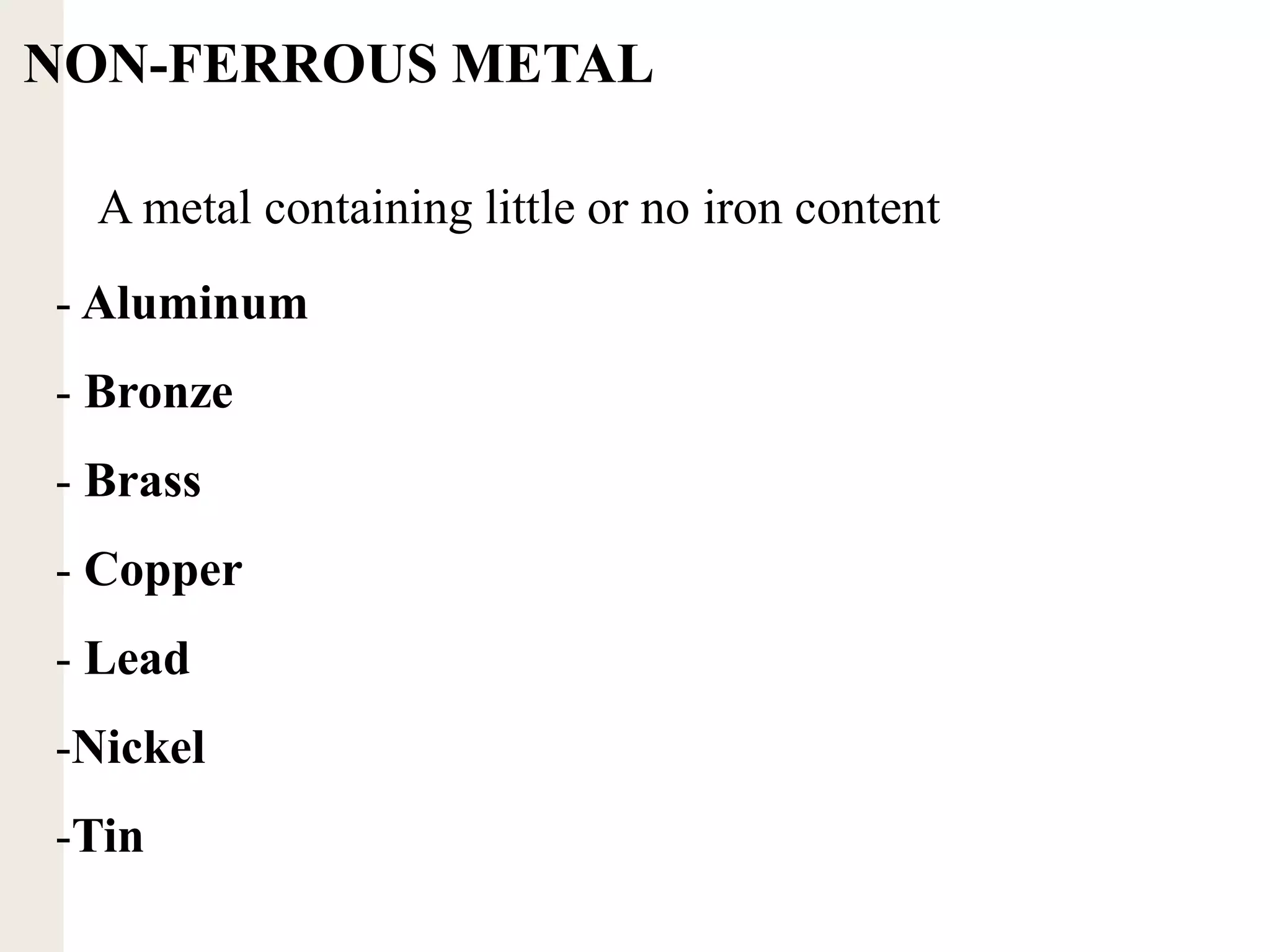
A metal containing little or no iron content
NON-FERROUS METAL
- Aluminum
- Bronze
- Brass
- Copper
- Lead
-Nickel
-Tin
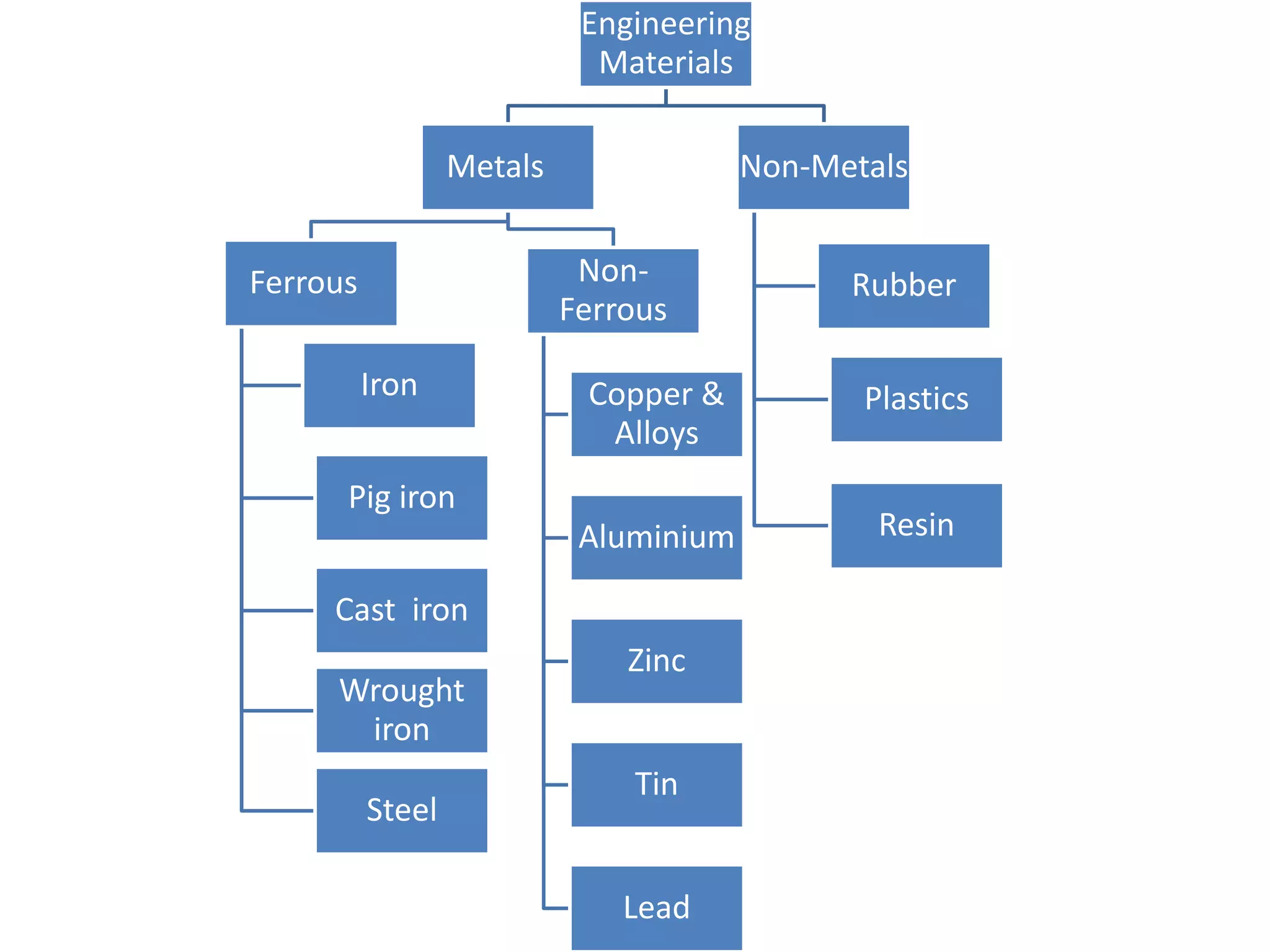
Engineering
Materials
Metals
Ferrous
Iron
Steel
Pig iron
Cast iron
Wrought
iron
Non-
Ferrous
Copper &
Alloys
Aluminium
Zinc
Tin
Lead
Non-Metals
Rubber
Plastics
Resin
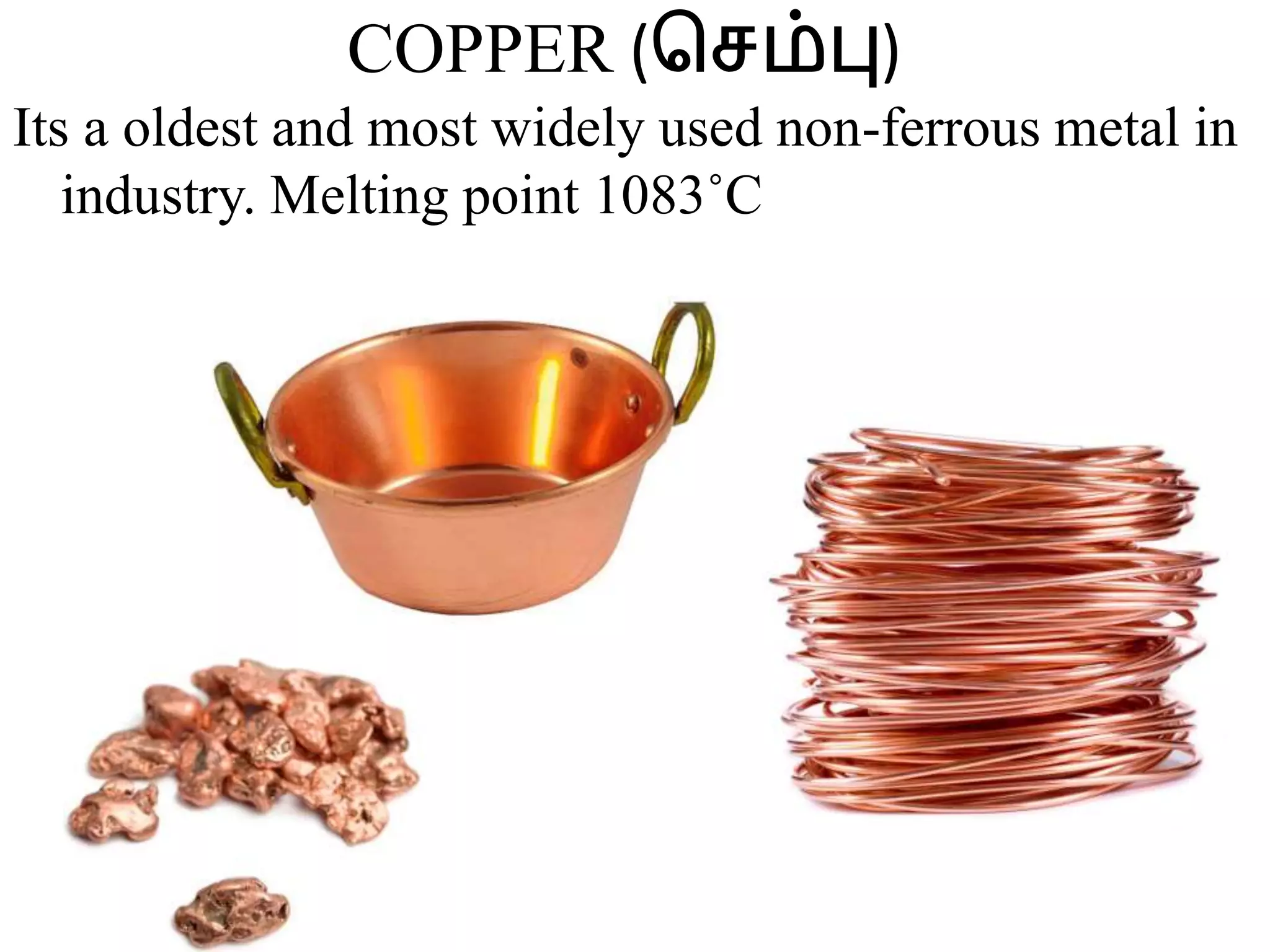
COPPER (செம்பு)
Its a oldest and most widely used non-ferrous metal in
industry. Melting point 1083˚C
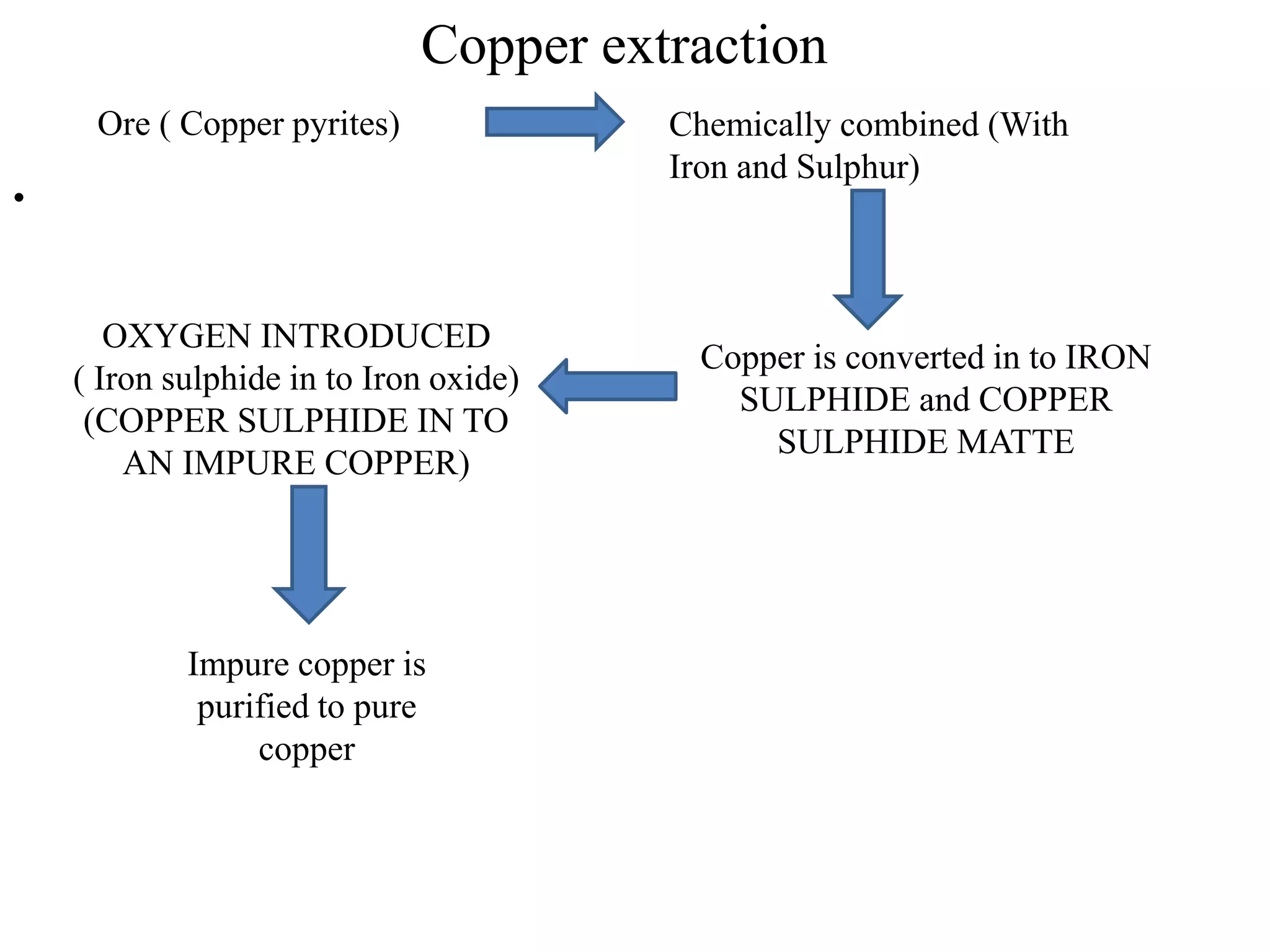
Copper extraction
•
Copper is converted in to IRON
SULPHIDE and COPPER
SULPHIDE MATTE
OXYGEN INTRODUCED
( Iron sulphide in to Iron oxide)
(COPPER SULPHIDE IN TO
AN IMPURE COPPER)
Impure copper is
purified to pure
copper
Ore ( Copper pyrites) Chemically combined (With
Iron and Sulphur)
Properties of copper
• High electrical conductivity
• High thermal conductivity
• Excellent resistance to corrosion
• It’s a soft, ductile and malleable.
• It can be worked in hot and cold condition
• It cannot be welded
• Its become brittle just below its melting
point.
Applications of copper
Mostly used in cable
• telephone cables
• Cables for computer network
• Printed circuit boards
• connectors
• Used in the form of sheets and in agriculture
purposes
• Domestic items like vessels
• Used chemical and food industries
• Used as a tubes in heat exchangers.
• Used mainly in the manufacturing of brass and
bronze alloys
COPPER ALLOYS
• Copper alloyed with number of elements to
provide a range of useful alloys
Characteristics:
high thermal and electrical conductivity
high corrosion resistance
high ductility and formability
Important copper alloys
• Brasses (பித்தளை) ( copper – Zinc alloys)
• Bronze(வெண்கலம்) (copper – Tin alloys)
• Gun Metals ( copper – tin – Zinc alloys )
• Cupro Nickels (copper – nickel alloys)
Other elements results
• Small amount of beryllium or chromium to copper give
high strength alloy
• A small addition of cadmium gives a significant
increases in strength with little loss in electrical
conductivity
• Addition of terrilium gives very good machinability
BRASS
• Its an alloy of copper(cu) and zinc (zn)
sometimes other elements like tin(sn), lead(pb), aluminium(al)
and manganese(mn) may be added.
Upto 36% of zinc, the brass is a single phase α solid solution
----- These alloys are called α brasses
-These are soft, ductile and easily cold worked
More than 36% of zinc have two phases α and β phases at
room temperature
-- these are stronger than α brasses
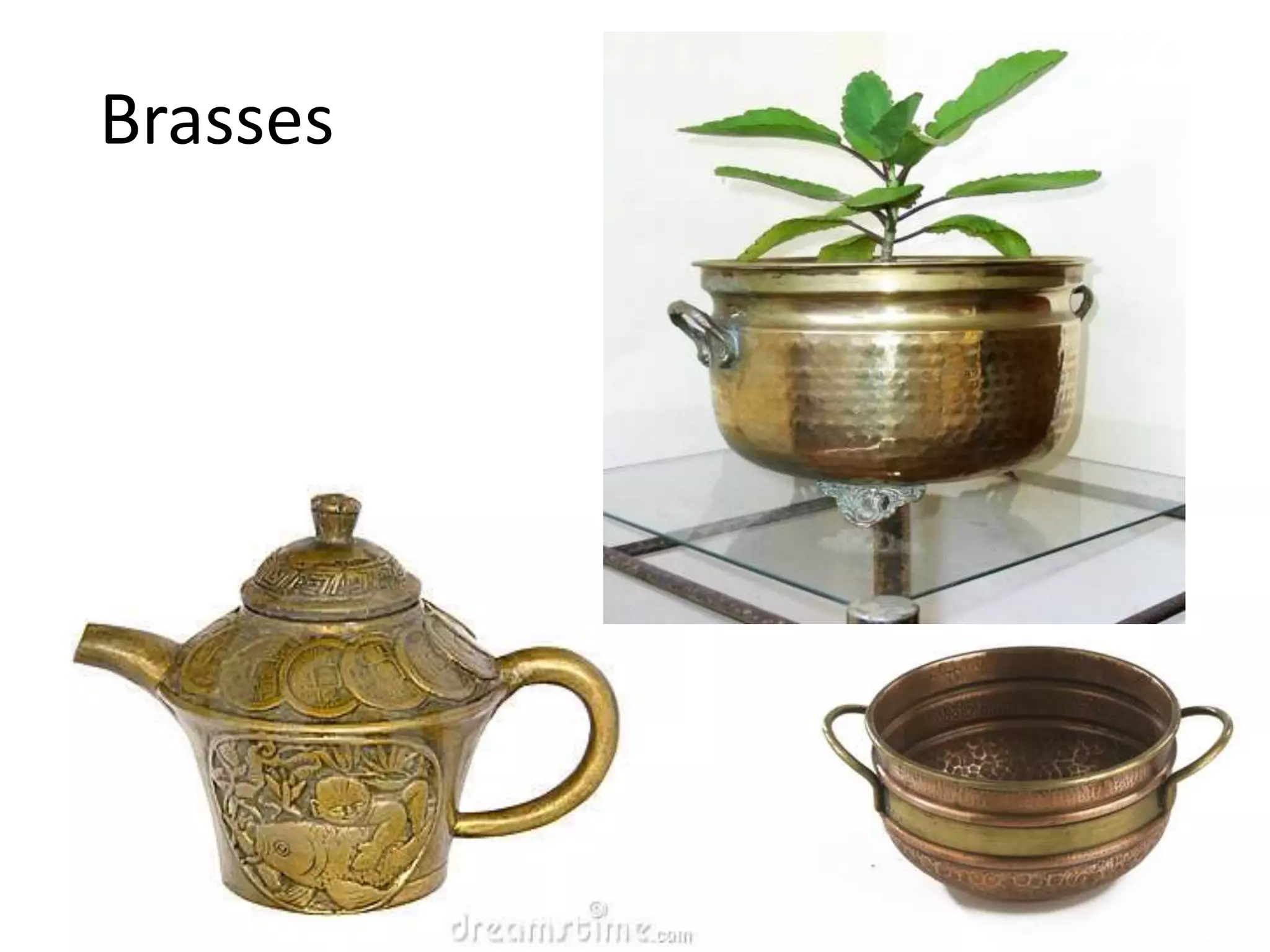
Brasses
Characteristics of brasses
• Its stronger than copper
• Low thermal and electrical conductivity than
copper
• It can be into moulds, drawn into wires, rolled
into sheets and turned into sheets.
• For improving machining property in brass they
are adding 1 – 3% of lead.
• The brass color varies from reddish to white
depend on the amount of zinc present
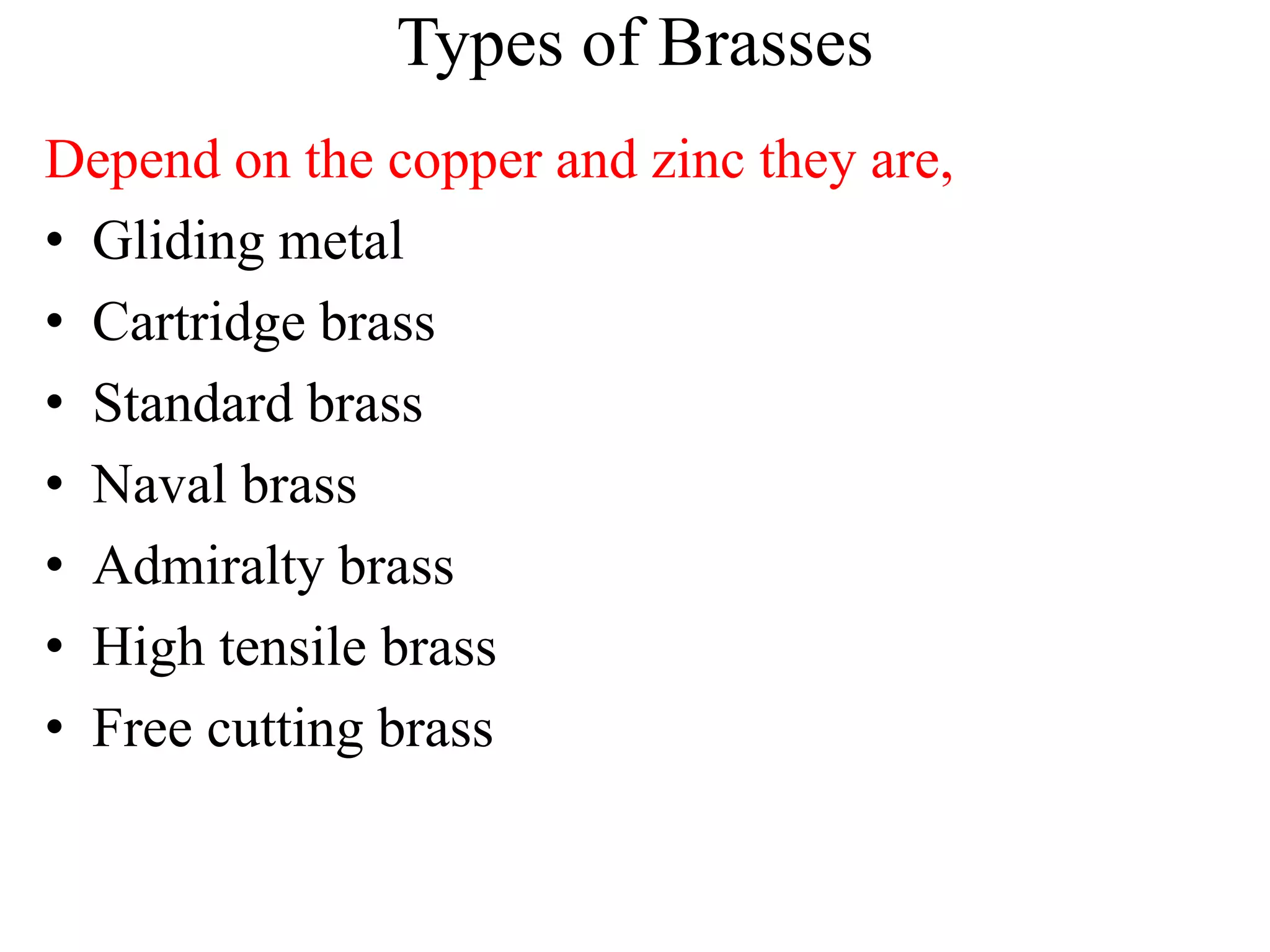
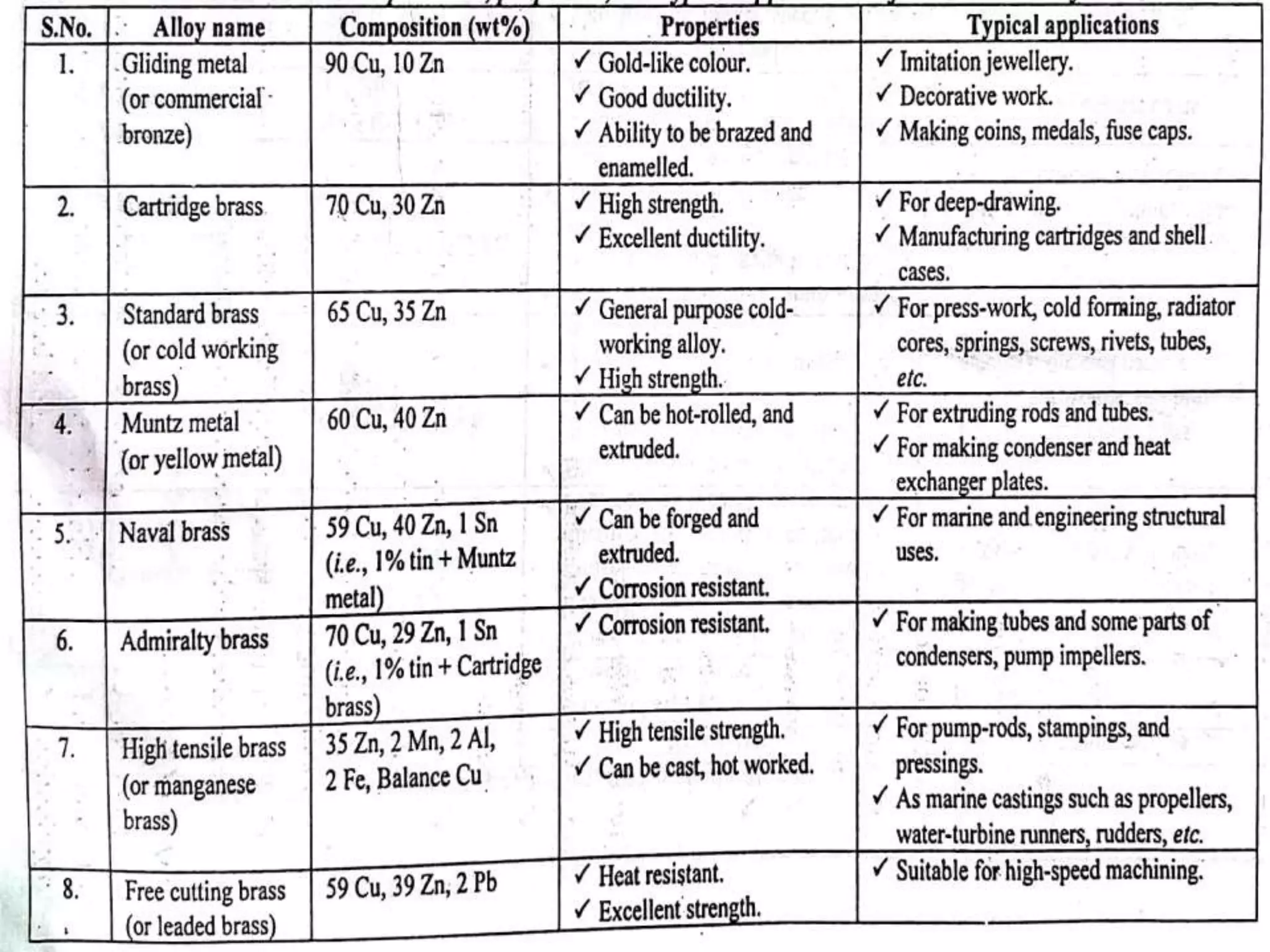
Types of Brasses
Depend on the copper and zinc they are,
• Gliding metal
• Cartridge brass
• Standard brass
• Naval brass
• Admiralty brass
• High tensile brass
• Free cutting brass
Bronze
• Its an alloy of copper(cu) and tin (sn)
• They have high strength with corrosion resistance than brass
• The strength of the bronze increase with the increase of tin
content.
• The tin content should be below 12% because they lead to
be brittle
• Bronze can be shaped or rolled into wires , rods and sheets
Bronze வெண்கலம்
Types of Bronze
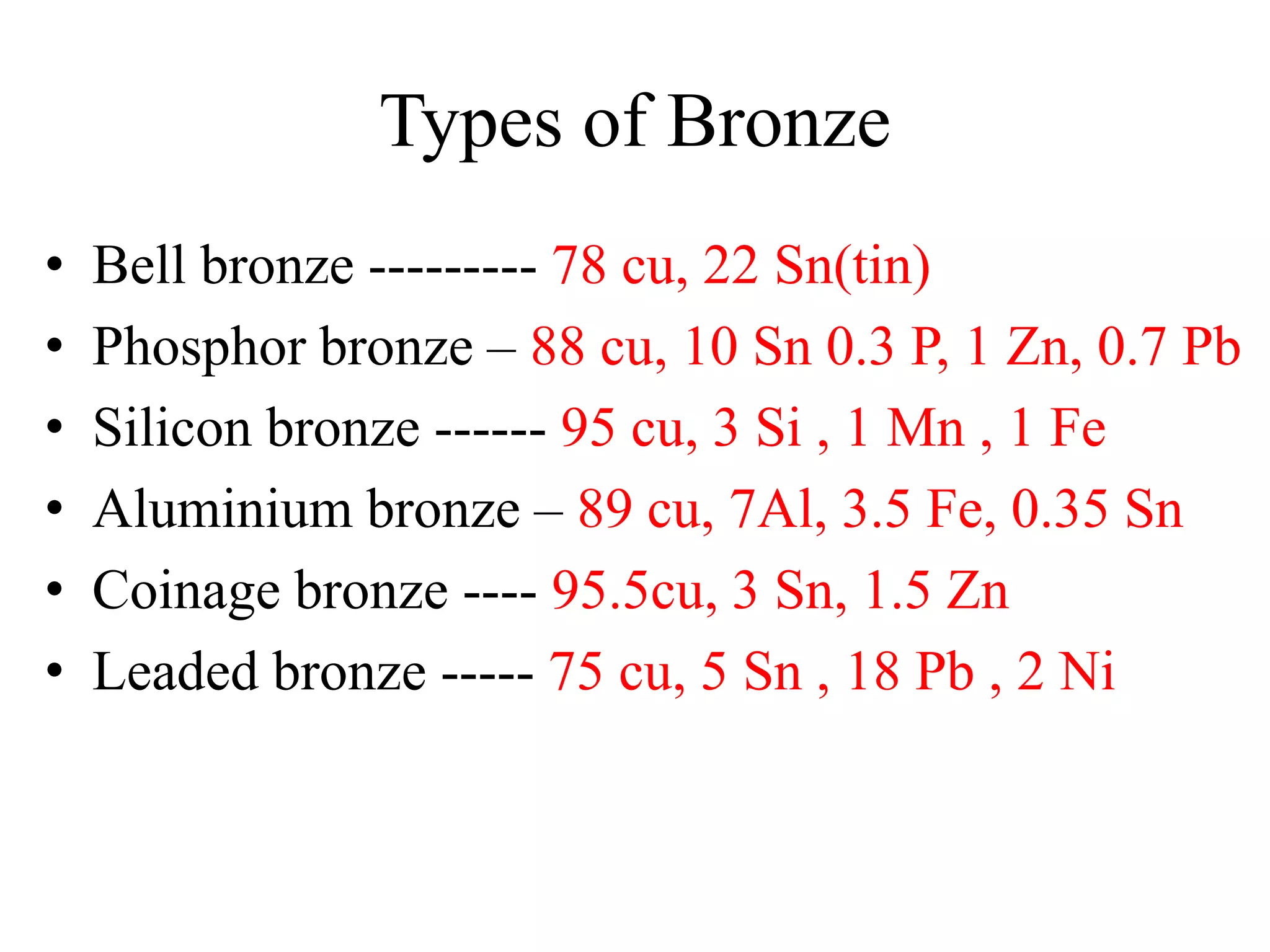
• Bell bronze --------- 78 cu, 22 Sn(tin)
• Phosphor bronze – 88 cu, 10 Sn 0.3 P, 1 Zn, 0.7 Pb
• Silicon bronze ------ 95 cu, 3 Si , 1 Mn , 1 Fe
• Aluminium bronze – 89 cu, 7Al, 3.5 Fe, 0.35 Sn
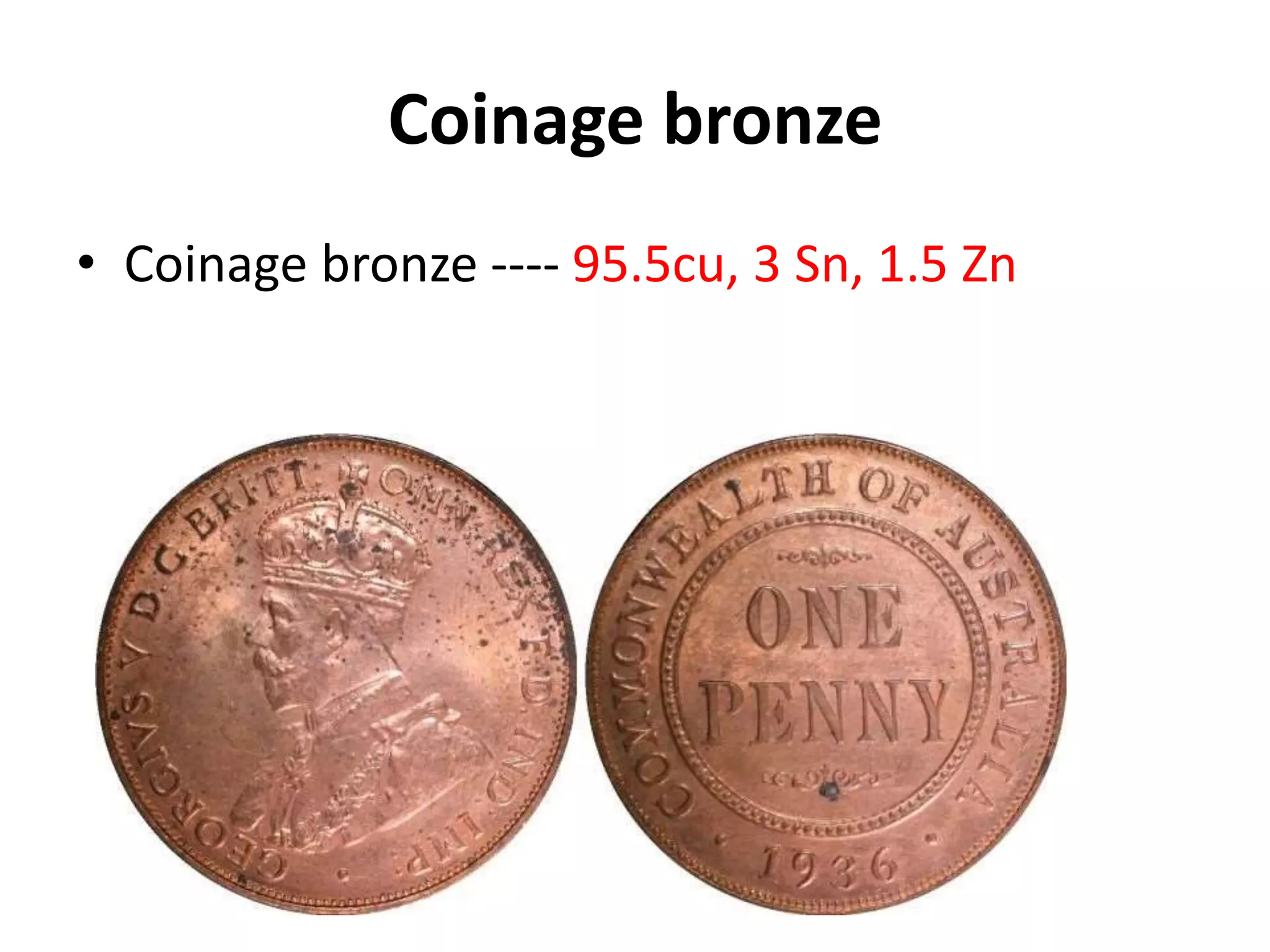
• Coinage bronze ---- 95.5cu, 3 Sn, 1.5 Zn
• Leaded bronze ----- 75 cu, 5 Sn , 18 Pb , 2 Ni
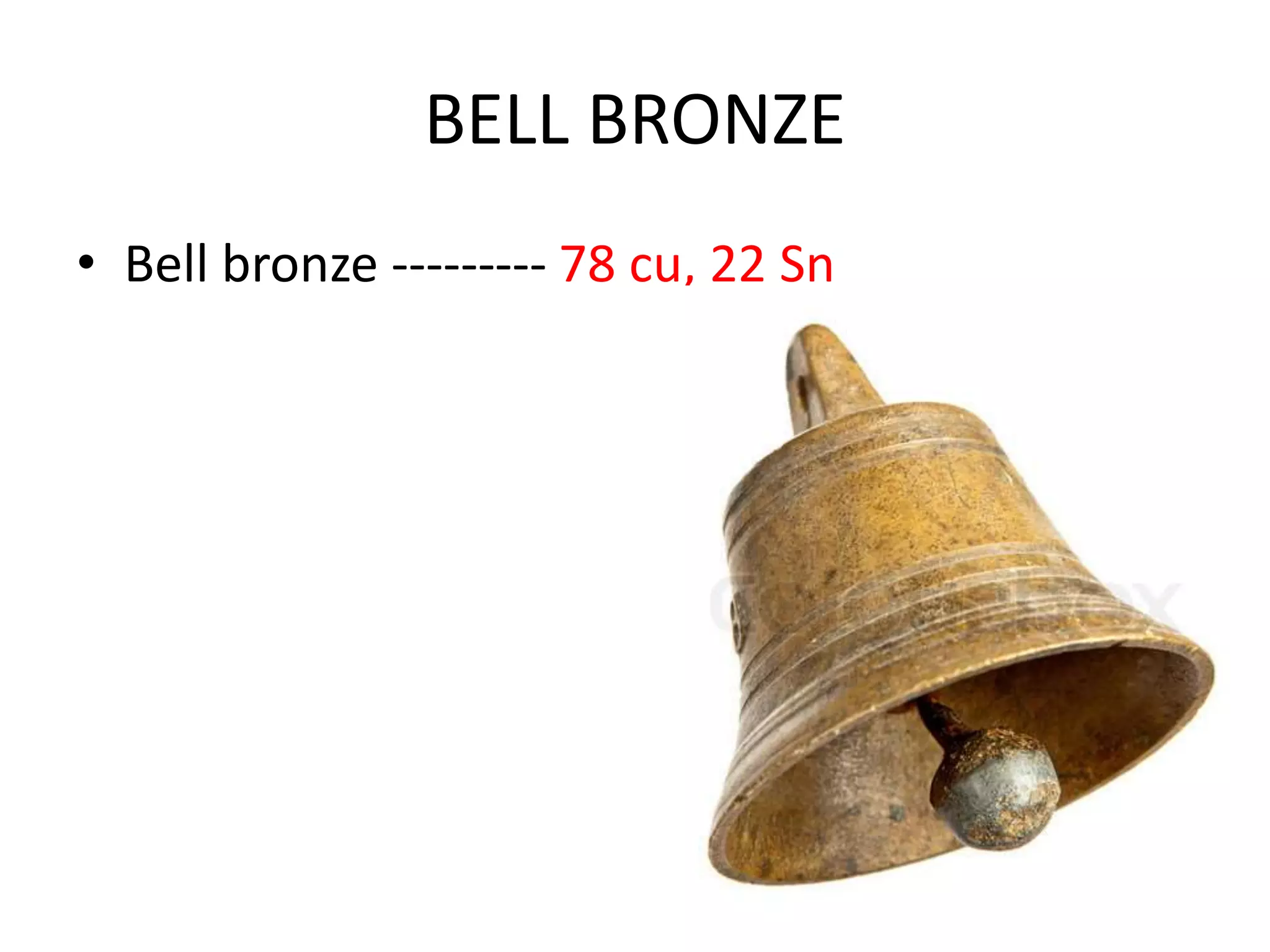
BELL BRONZE
• Bell bronze --------- 78 cu, 22 Sn
Phosphor bronze
• Phosphor bronze – 88 cu, 10 Sn 0.3 P, 1 Zn, 0.7 Pb
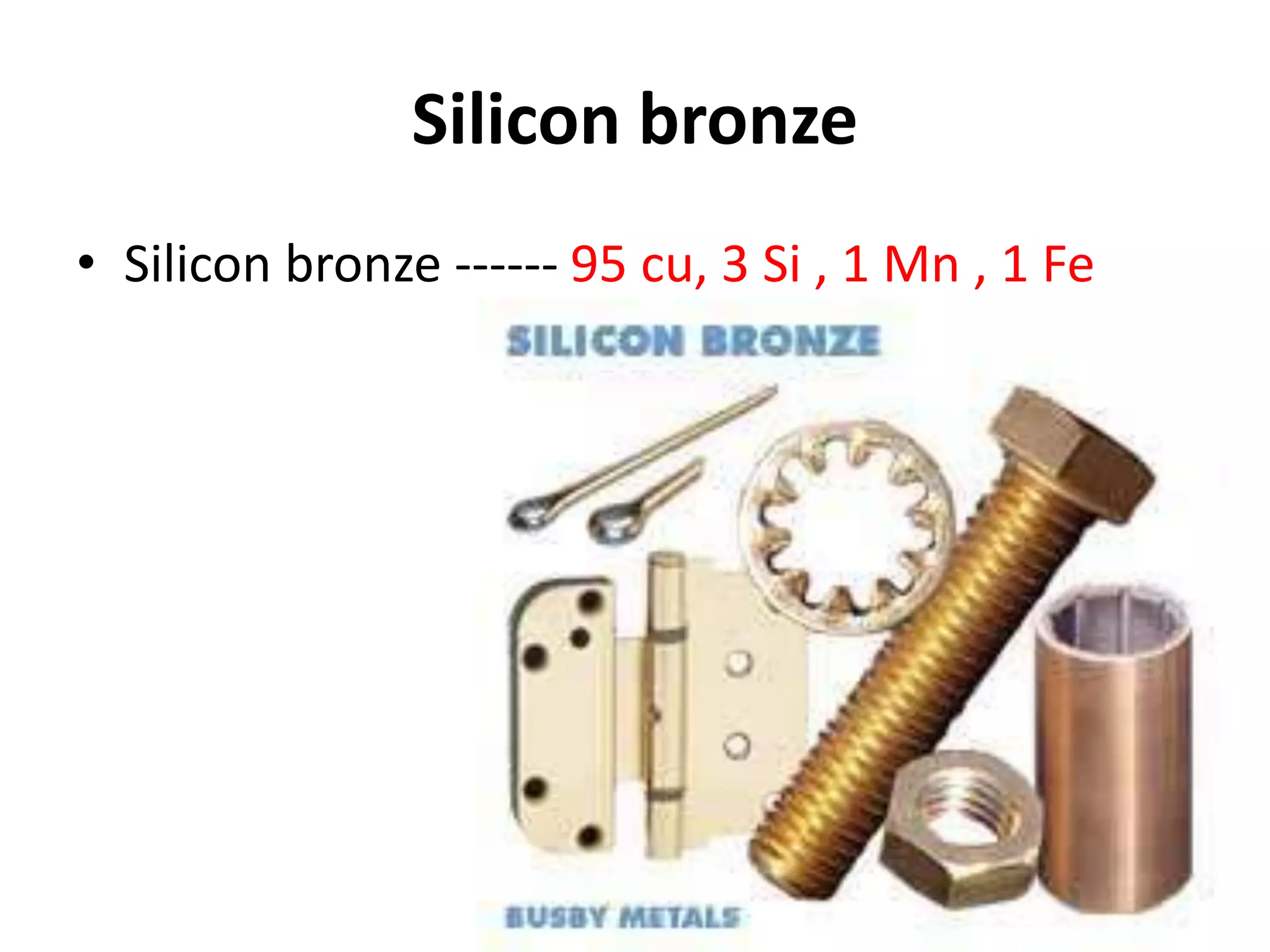
Silicon bronze
• Silicon bronze ------ 95 cu, 3 Si , 1 Mn , 1 Fe
Aluminium bronze
• Aluminium bronze – 89 cu, 7Al, 3.5 Fe, 0.35 Sn
Coinage bronze
• Coinage bronze ---- 95.5cu, 3 Sn, 1.5 Zn
Leaded bronze
• Leaded bronze ----- 75 cu, 5 Sn , 18 Pb , 2 Ni
Gun Metal
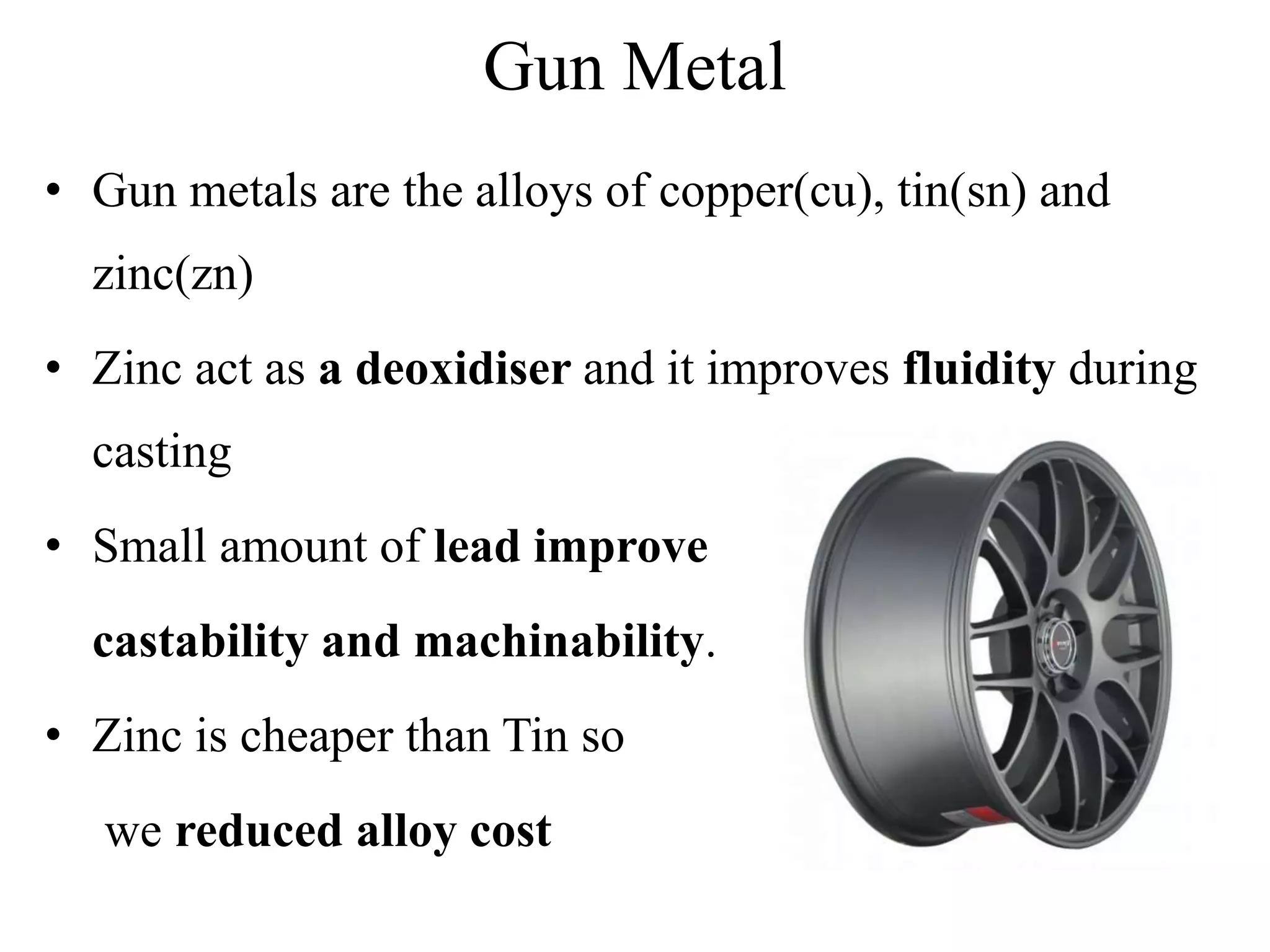
• Gun metals are the alloys of copper(cu), tin(sn) and
zinc(zn)
• Zinc act as a deoxidiser and it improves fluidity during
casting
• Small amount of lead improve
castability and machinability.
• Zinc is cheaper than Tin so
we reduced alloy cost
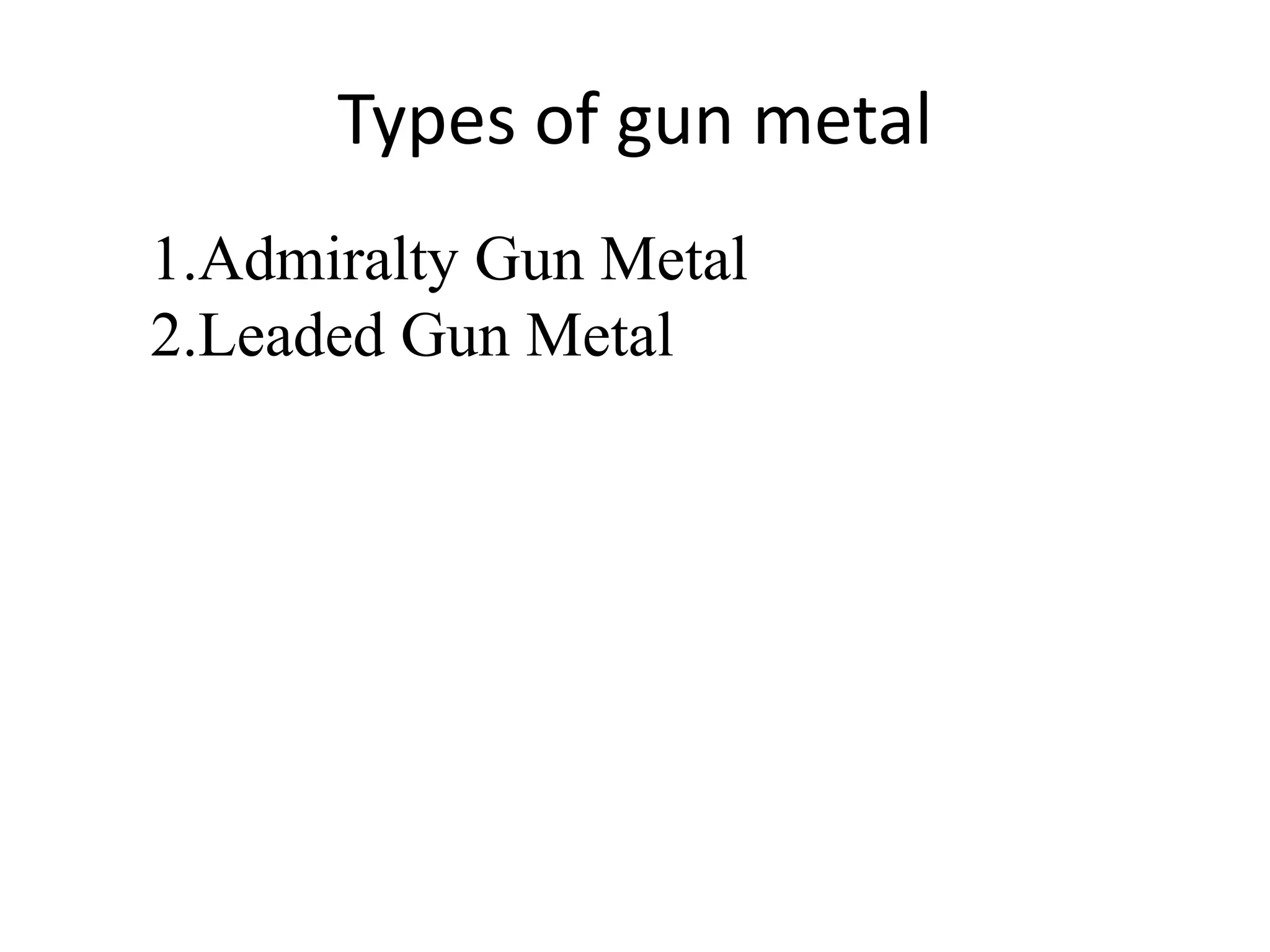
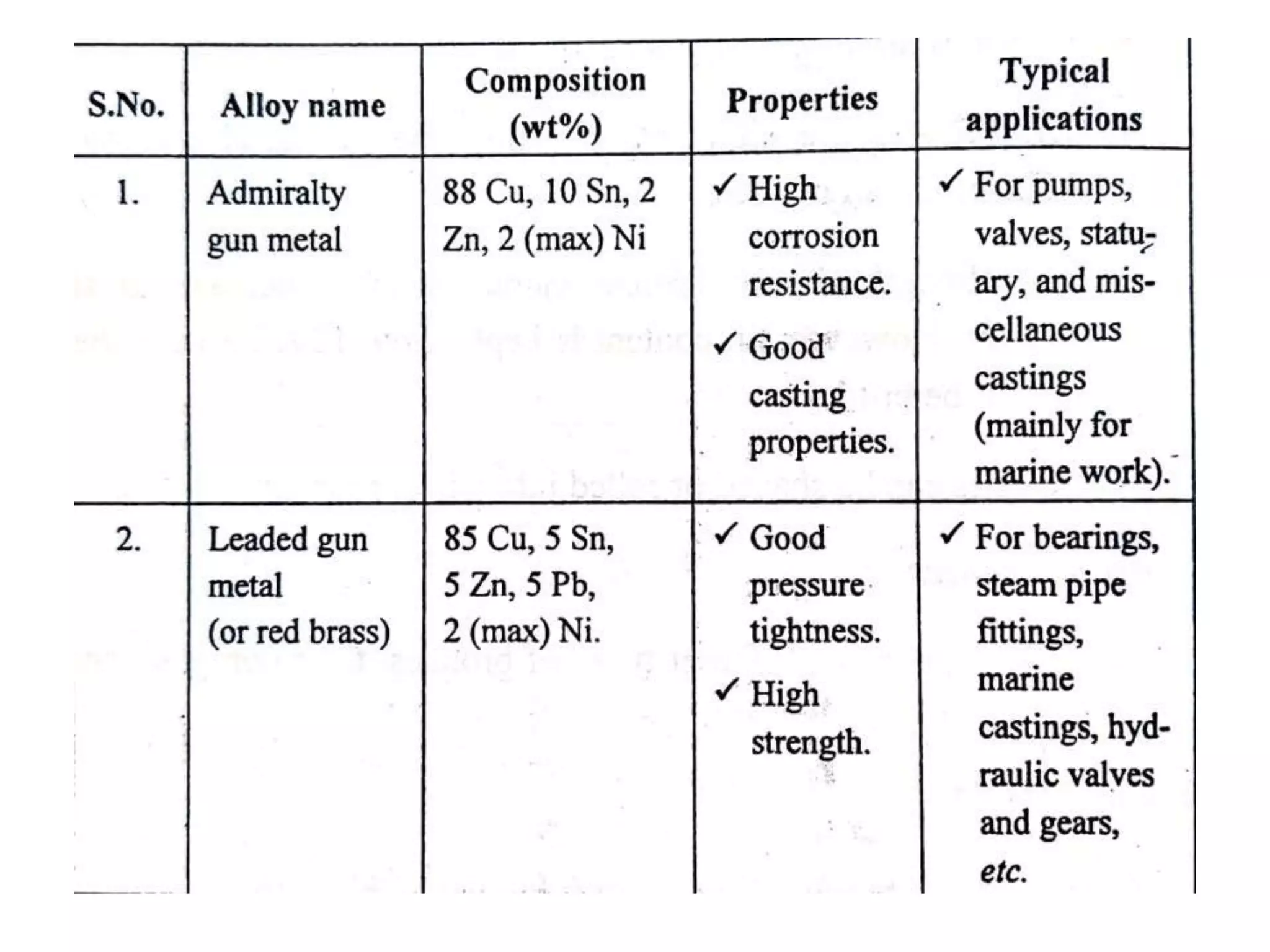
Types of gun metal
1.Admiralty Gun Metal
2.Leaded Gun Metal
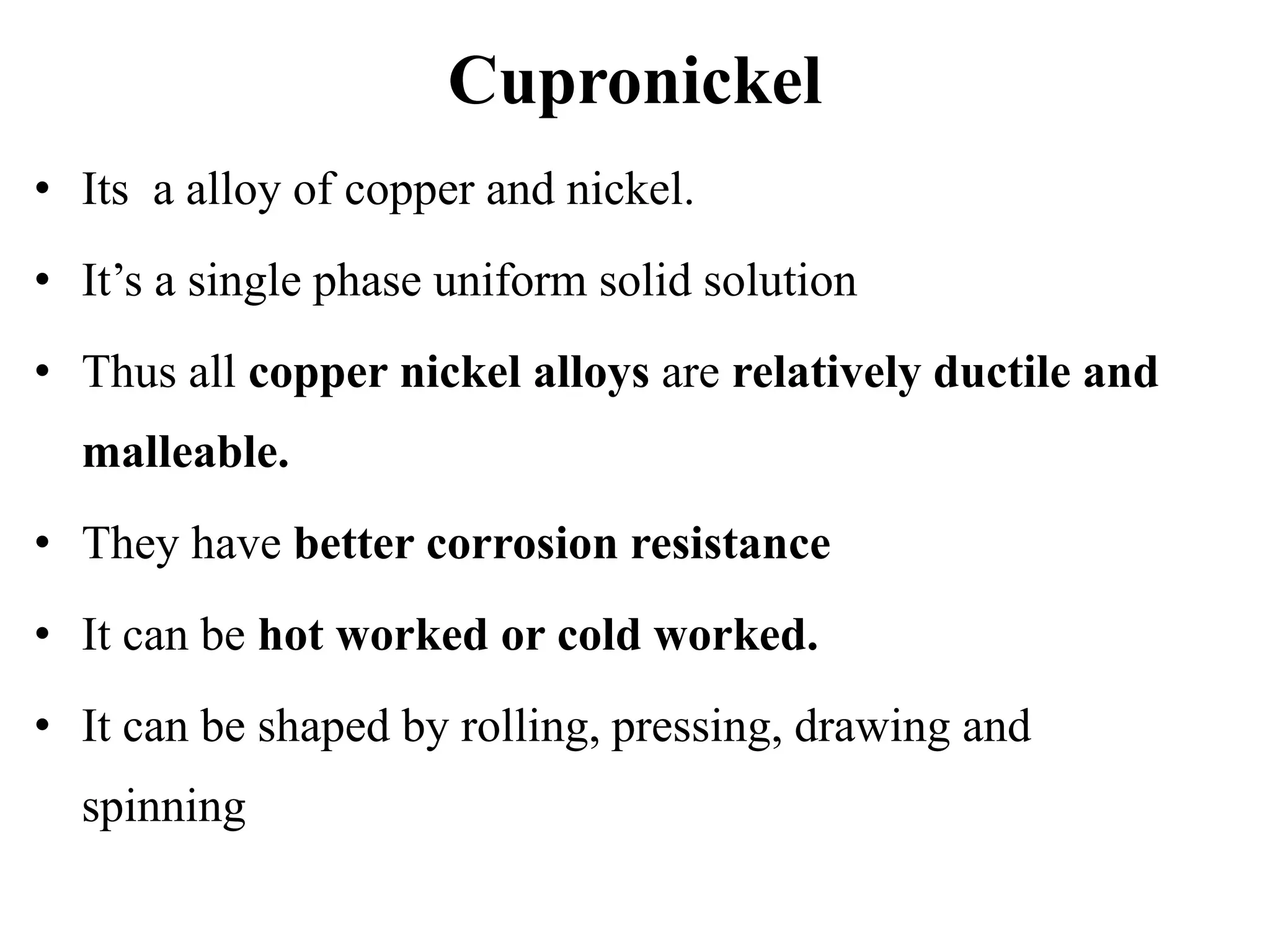
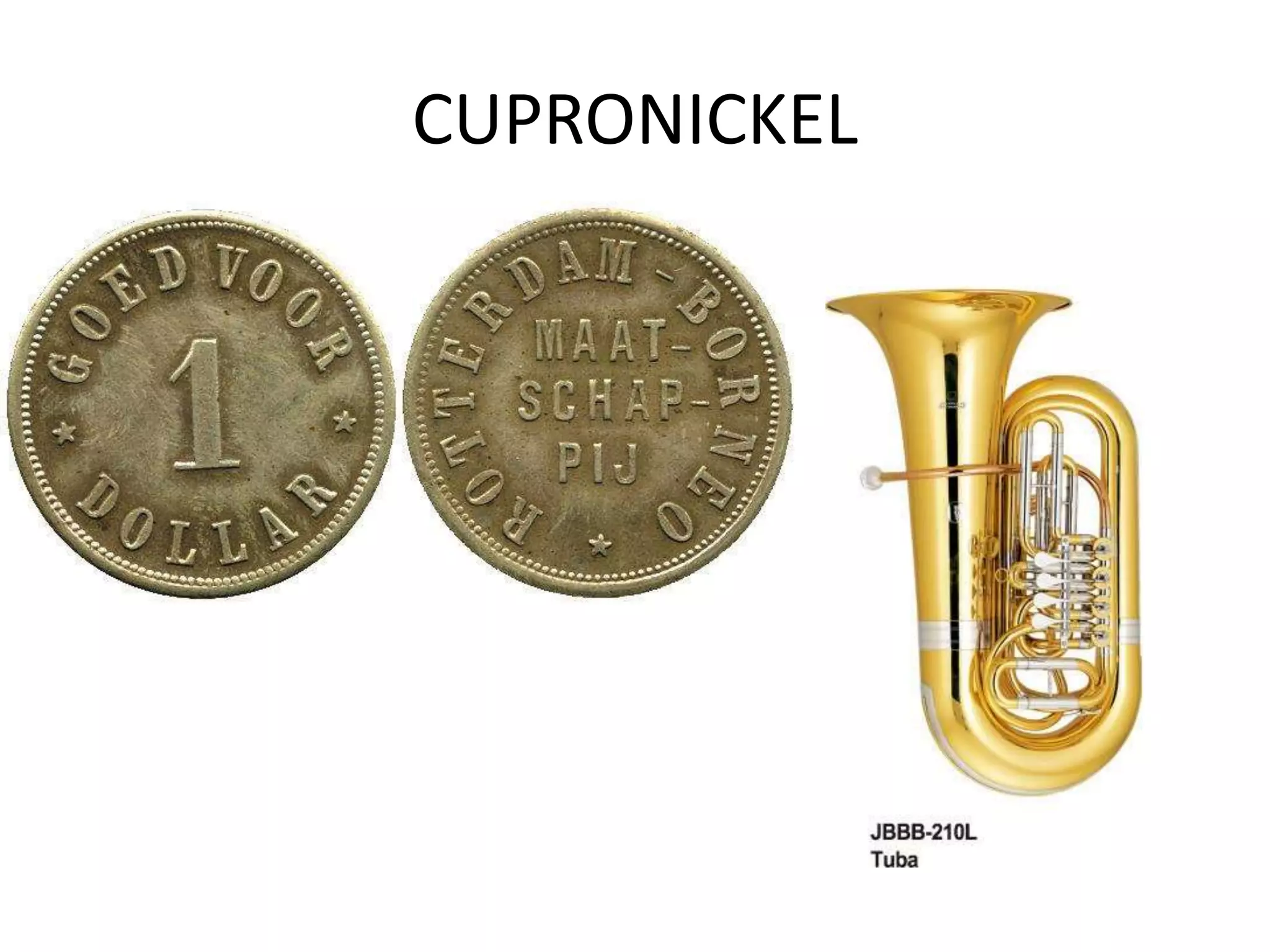
Cupronickel
• Its a alloy of copper and nickel.
• It’s a single phase uniform solid solution
• Thus all copper nickel alloys are relatively ductile and
malleable.
• They have better corrosion resistance
• It can be hot worked or cold worked.
• It can be shaped by rolling, pressing, drawing and
spinning
CUPRONICKEL
Types of cupronickels
S.NO ALLOY
NAME
COMPOSIT
ION
PROPERTIES APPLICATIONS
1 Cupronickel 70 Cu, 30 Ni Good corrosion
resistance
Can be cast into
any forms
Salt water piping's ,
condenser tubings
2 Monel Metal 29 cu , 68 Ni
, 1.25 Fe ,
1.25 Mn
Good corrosion
resistance,
Good mechanical
properties
Propellers, pipe
fittings, condenser
tubes, steam turbine
blades, tanks, food
and chemical
industry plants
3 ‘K’ monel 29 cu , 66 Ni
, 2.75 Al, 0.4
Mn, 0.6 Ti
A heat treated
alloy
Good mechanical
properties
Used in motor boat
propeller shafts
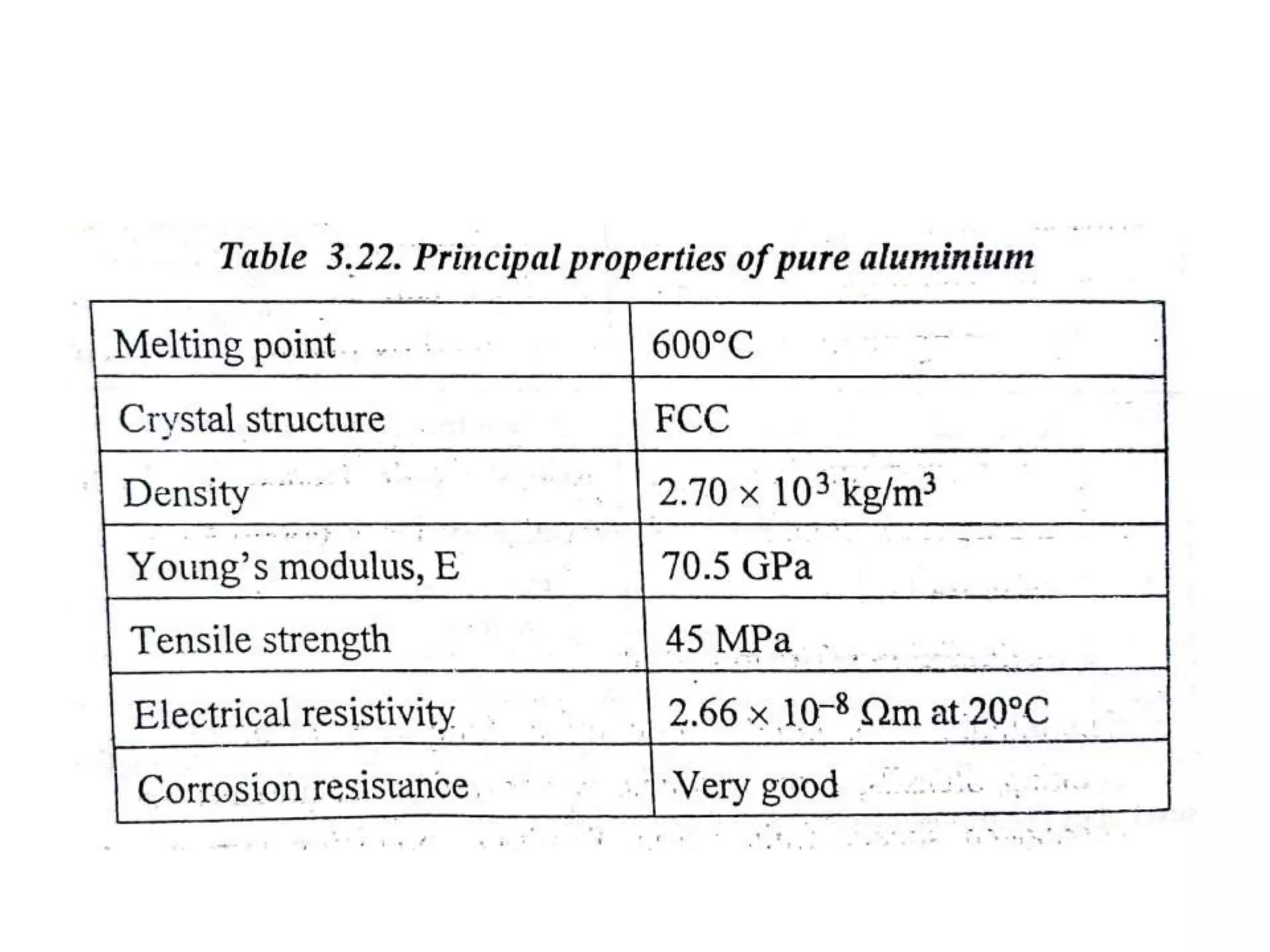
ALUMINIUM
• It’s a most widely used and important
Non-ferrous material
Characteristics of aluminium:
• Light weight ( 1/3 rd of weight of steel)
• High thermal and electrical conductivity
• Excellent corrosion resistance
• Non – toxicity
• Soft and ductile
• Low specific gravity
• High strength to weight ratio
• High reflectivity.
EXTRACTION OF ALUMINIUM
Bauxite
ore
Purification
Dissolved in fused
cryolite(Aluminium and
sodium)
Electrolysis process
Aluminium
Aluminium Vs Copper
• Less cost than copper
• Specific gravity of aluminium 2.7 compared to 8.9
for copper
• Better electrical conductivity (20 % more than
copper)
• But it cannot be welded or soldered.
• To over come this defect they are using tin coating
on aluminium
• Aluminium having low strength, for that its alloyed
with Cu, Ni, Mn, Mg and Si
Aluminium alloys
• Aluminium can be alloyed with one or more elements
like Cu, Ni, Mn, Mg and Si
• These elements convert the soft and weak elements into
strong and hard non metal
CHARACTERISTICS:
1. Properties less than steel,
2. Equal to alloys
3. Superior to manganese alloys
Types of aluminium alloys
• Heat treatable aluminium alloys
• Non – Heat treatable aluminium alloys
Heat treatable aluminium alloys
• Using age or precipitation hardening we cannot
strengthens the aluminum alloy.
• Al – Cu Alloys
• Al – Cu – Ni Alloys
• Al – Mg – Si Alloys
• Al – Li Alloys
• Al – Zn – Cu Alloys
Non – Heat treatable aluminium alloys
• These alloys are strengthened by cold working
operations
• Important Non – Heat treatable aluminium alloys
are
• Al – Mn Alloys
• Al – Mg Alloys
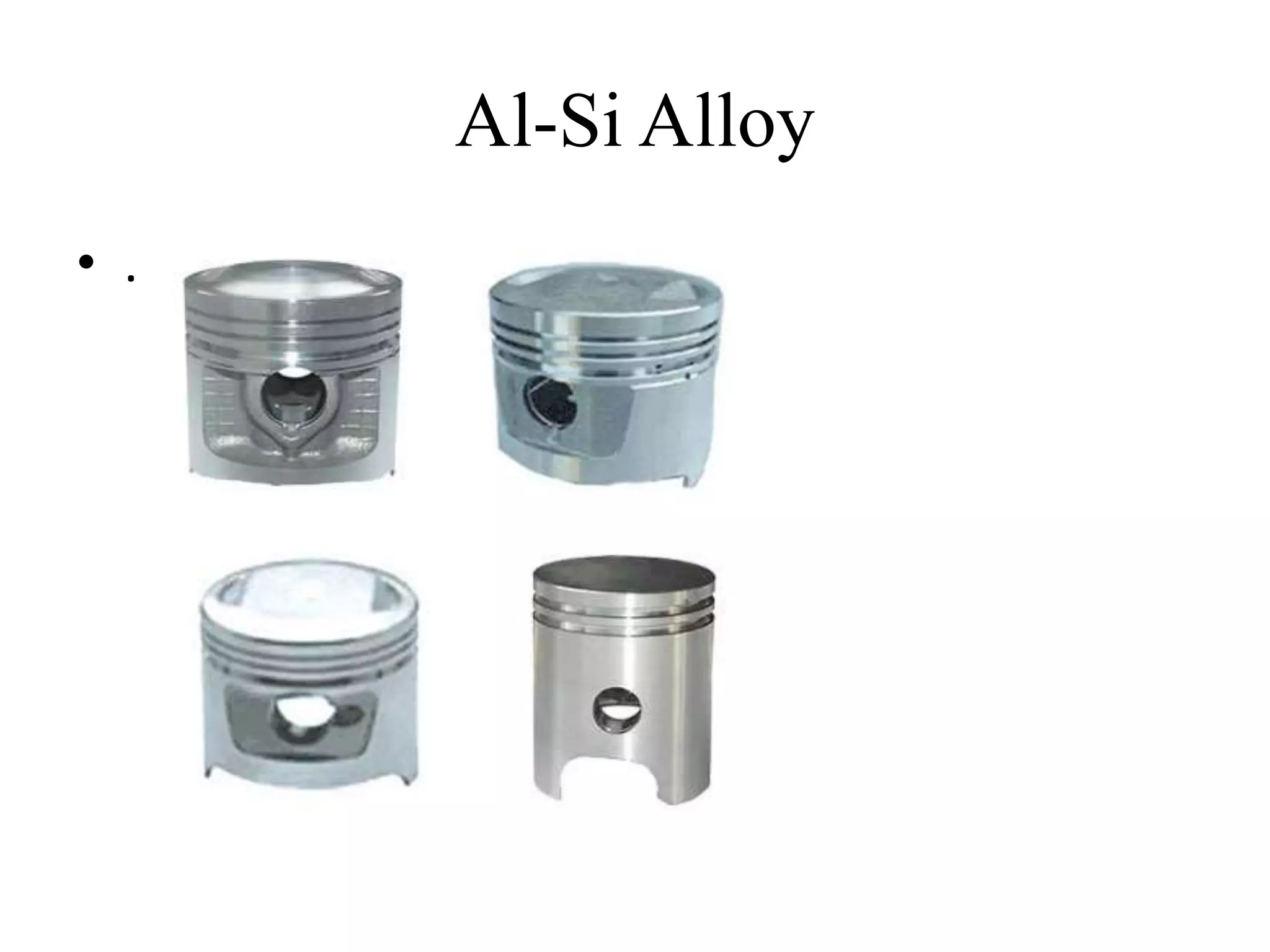
• Al – Si Alloys
Al –mg sheet
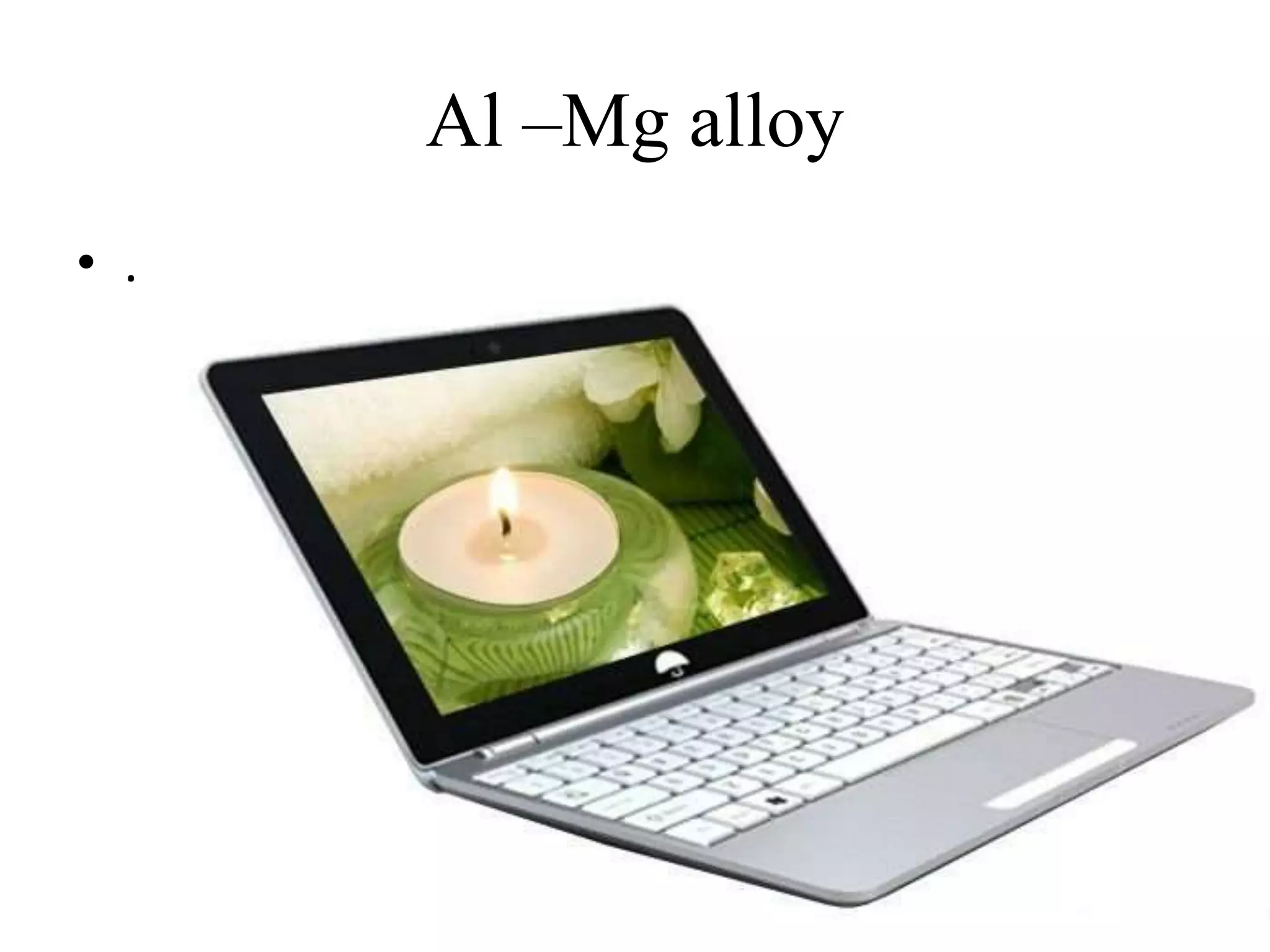
Al –Mg alloy
• .
Al-Si Alloy
• .
Al – Cu Alloys
1.Duralumin
2.Y-alloy
AGE or PRECIPITATION
HARDENING
• It’s a process of increasing the strength of an
alloy ( Al – Cu Alloy)
• Step – 1 ------ solution treatment
• Step – 2 ----- - Quenching process
• Step – 3 ------- Ageing Process
BEARING ALLOYS
For making bearings
Characteristics of a bearing material
• It should have sufficient hardness and wear resistance.
• It should have a low co-efficient of friction.
• It should have a sufficient melting point.
• It should have high thermal conductivity.
• It should have good casting qualities.
• It should have good resistance to corrosion.
• It should be tough , shock resistant and sufficient ductility.
Bearing Materials
Widely used bearing materials:
• White metals
• Copper base alloys
• Aluminium base alloys
• Plastic materials
• Ceramics.
• The selection based on loading, running speed
and service conditions.
1) White bearing metal
• Its either tin based or lead based alloys.
• It contain 10% antimony (Sb).
• Tin(sn) + Antimony ---- form a intermetallic compound
SbSn
This form a small hard cubic crystals, termed cuboids.
cuboid is a hard, low friction substance.
i) Tin based bearing alloys
• They are called babbit metals.
• Sb 10 % , Sn 82 %, cu 4 %, Pb 4 %
• They are high quality high duty bearing
material than lead based alloys.
• They are used in medium and high duty
applications like in automobile industries.
ii)Lead based alloys
• These are cheaper than tin based alloy.
• Sb 13 % , Sn 12 % , Cu 0.75 % , As 0.25% , Pb 74 %
• Used in low pressure low speed applications.
2) COPPER BASED BEARING ALLOYS
• Plain tin bronze -- Cu 85 %, Sn 15 %
• Phosphor bronzes – cu 88%, Sn 10 % P 0.3%, Zn 1%, Pb 0.7%
• Leaded bronzes - Cu 75% ,Sn 5%, Pb 18%, Ni 2%
• Sintered bronzes – Cu powder 90%, Sn powder 10%
• Phosphor bronze gives improved load bearing capacity.
• Leaded bronzes are less strong than other bearing bronzes.
but they will sustain higher loads at higher speeds than white
metal.
Uses of copper base bearing alloys
• Used in aero engines,
• Automobile and diesel crank shaft bearings.
• Vacuum cleaners
• Washing machines,
• Extractor fan
• Audio equipments
3)Aluminium based bearing materials
• It contain alloys of tin , copper and nickel
• The expensive tin is replaced by aluminium base
bearing alloys.
• Sn(tin) 5.5 – 7 % , Cu 0.7 – 1.3 % , Ni 0.7 – 1.3 % ,
remaining aluminium
• Used in automobile big end and main bearings.
4) Plastic bearing materials
• 1. Nylons (polymides)
• 2. poly tetra fluro ethylene (PTFE or Teflon)
• They have very low coefficients of friction
• USES
These bearings used in small load applications
Particularly oil lubrication is impossible or undesirable
5) Ceramic Bearing Materials
• These bearings are used in small precision
instruments like jewel bearings in watch
movements
• Alumina used as a bearings in large speed
precision movements.
Super alloy
• It is a general term used to describe the nickel
base and cobalt base alloys which have been
developed for use at elevated temperatures.
• Super alloys produce a combination of high
strength at elevated temperatures up to
1000°C and resistance to corrosion.
Applications
• Blades for turbine and jet engines
• Heat exchangers, chemical reaction vessel
components and heat treating equipment.

EM-UNIT II -non ferrous metal

  • 1.
    NON FERROUS METAL (Otherthan iron as a major constituent) .
  • 2.
    NON FERROUS MATERIALS •Elements other than iron (OR) • Other than iron is a major constituent • More costly than ferrous materials CHARACTERISTICS: 1. Lighter in weight 2. Electrical and thermal conductivity 3. Resistance to corrosion
  • 3.
    A metal containinglittle or no iron content NON-FERROUS METAL - Aluminum - Bronze - Brass - Copper - Lead -Nickel -Tin
  • 4.
    Engineering Materials Metals Ferrous Iron Steel Pig iron Cast iron Wrought iron Non- Ferrous Copper& Alloys Aluminium Zinc Tin Lead Non-Metals Rubber Plastics Resin
  • 5.
    COPPER (செம்பு) Its aoldest and most widely used non-ferrous metal in industry. Melting point 1083˚C
  • 6.
    Copper extraction • Copper isconverted in to IRON SULPHIDE and COPPER SULPHIDE MATTE OXYGEN INTRODUCED ( Iron sulphide in to Iron oxide) (COPPER SULPHIDE IN TO AN IMPURE COPPER) Impure copper is purified to pure copper Ore ( Copper pyrites) Chemically combined (With Iron and Sulphur)
  • 8.
    Properties of copper •High electrical conductivity • High thermal conductivity • Excellent resistance to corrosion • It’s a soft, ductile and malleable. • It can be worked in hot and cold condition • It cannot be welded • Its become brittle just below its melting point.
  • 9.
    Applications of copper Mostlyused in cable • telephone cables • Cables for computer network • Printed circuit boards • connectors • Used in the form of sheets and in agriculture purposes • Domestic items like vessels • Used chemical and food industries • Used as a tubes in heat exchangers. • Used mainly in the manufacturing of brass and bronze alloys
  • 10.
    COPPER ALLOYS • Copperalloyed with number of elements to provide a range of useful alloys Characteristics: high thermal and electrical conductivity high corrosion resistance high ductility and formability
  • 11.
    Important copper alloys •Brasses (பித்தளை) ( copper – Zinc alloys) • Bronze(வெண்கலம்) (copper – Tin alloys) • Gun Metals ( copper – tin – Zinc alloys ) • Cupro Nickels (copper – nickel alloys)
  • 12.
    Other elements results •Small amount of beryllium or chromium to copper give high strength alloy • A small addition of cadmium gives a significant increases in strength with little loss in electrical conductivity • Addition of terrilium gives very good machinability
  • 13.
    BRASS • Its analloy of copper(cu) and zinc (zn) sometimes other elements like tin(sn), lead(pb), aluminium(al) and manganese(mn) may be added. Upto 36% of zinc, the brass is a single phase α solid solution ----- These alloys are called α brasses -These are soft, ductile and easily cold worked More than 36% of zinc have two phases α and β phases at room temperature -- these are stronger than α brasses
  • 14.
  • 15.
    Characteristics of brasses •Its stronger than copper • Low thermal and electrical conductivity than copper • It can be into moulds, drawn into wires, rolled into sheets and turned into sheets. • For improving machining property in brass they are adding 1 – 3% of lead. • The brass color varies from reddish to white depend on the amount of zinc present
  • 16.
    Types of Brasses Dependon the copper and zinc they are, • Gliding metal • Cartridge brass • Standard brass • Naval brass • Admiralty brass • High tensile brass • Free cutting brass
  • 18.
    Bronze • Its analloy of copper(cu) and tin (sn) • They have high strength with corrosion resistance than brass • The strength of the bronze increase with the increase of tin content. • The tin content should be below 12% because they lead to be brittle • Bronze can be shaped or rolled into wires , rods and sheets
  • 19.
  • 20.
    Types of Bronze •Bell bronze --------- 78 cu, 22 Sn(tin) • Phosphor bronze – 88 cu, 10 Sn 0.3 P, 1 Zn, 0.7 Pb • Silicon bronze ------ 95 cu, 3 Si , 1 Mn , 1 Fe • Aluminium bronze – 89 cu, 7Al, 3.5 Fe, 0.35 Sn • Coinage bronze ---- 95.5cu, 3 Sn, 1.5 Zn • Leaded bronze ----- 75 cu, 5 Sn , 18 Pb , 2 Ni
  • 21.
    BELL BRONZE • Bellbronze --------- 78 cu, 22 Sn
  • 22.
    Phosphor bronze • Phosphorbronze – 88 cu, 10 Sn 0.3 P, 1 Zn, 0.7 Pb
  • 23.
    Silicon bronze • Siliconbronze ------ 95 cu, 3 Si , 1 Mn , 1 Fe
  • 24.
    Aluminium bronze • Aluminiumbronze – 89 cu, 7Al, 3.5 Fe, 0.35 Sn
  • 25.
    Coinage bronze • Coinagebronze ---- 95.5cu, 3 Sn, 1.5 Zn
  • 26.
    Leaded bronze • Leadedbronze ----- 75 cu, 5 Sn , 18 Pb , 2 Ni
  • 28.
    Gun Metal • Gunmetals are the alloys of copper(cu), tin(sn) and zinc(zn) • Zinc act as a deoxidiser and it improves fluidity during casting • Small amount of lead improve castability and machinability. • Zinc is cheaper than Tin so we reduced alloy cost
  • 29.
    Types of gunmetal 1.Admiralty Gun Metal 2.Leaded Gun Metal
  • 31.
    Cupronickel • Its aalloy of copper and nickel. • It’s a single phase uniform solid solution • Thus all copper nickel alloys are relatively ductile and malleable. • They have better corrosion resistance • It can be hot worked or cold worked. • It can be shaped by rolling, pressing, drawing and spinning
  • 32.
  • 33.
    Types of cupronickels S.NOALLOY NAME COMPOSIT ION PROPERTIES APPLICATIONS 1 Cupronickel 70 Cu, 30 Ni Good corrosion resistance Can be cast into any forms Salt water piping's , condenser tubings 2 Monel Metal 29 cu , 68 Ni , 1.25 Fe , 1.25 Mn Good corrosion resistance, Good mechanical properties Propellers, pipe fittings, condenser tubes, steam turbine blades, tanks, food and chemical industry plants 3 ‘K’ monel 29 cu , 66 Ni , 2.75 Al, 0.4 Mn, 0.6 Ti A heat treated alloy Good mechanical properties Used in motor boat propeller shafts
  • 34.
    ALUMINIUM • It’s amost widely used and important Non-ferrous material Characteristics of aluminium: • Light weight ( 1/3 rd of weight of steel) • High thermal and electrical conductivity • Excellent corrosion resistance • Non – toxicity • Soft and ductile • Low specific gravity • High strength to weight ratio • High reflectivity.
  • 36.
    EXTRACTION OF ALUMINIUM Bauxite ore Purification Dissolvedin fused cryolite(Aluminium and sodium) Electrolysis process Aluminium
  • 37.
    Aluminium Vs Copper •Less cost than copper • Specific gravity of aluminium 2.7 compared to 8.9 for copper • Better electrical conductivity (20 % more than copper) • But it cannot be welded or soldered. • To over come this defect they are using tin coating on aluminium • Aluminium having low strength, for that its alloyed with Cu, Ni, Mn, Mg and Si
  • 38.
    Aluminium alloys • Aluminiumcan be alloyed with one or more elements like Cu, Ni, Mn, Mg and Si • These elements convert the soft and weak elements into strong and hard non metal CHARACTERISTICS: 1. Properties less than steel, 2. Equal to alloys 3. Superior to manganese alloys
  • 39.
    Types of aluminiumalloys • Heat treatable aluminium alloys • Non – Heat treatable aluminium alloys
  • 40.
    Heat treatable aluminiumalloys • Using age or precipitation hardening we cannot strengthens the aluminum alloy. • Al – Cu Alloys • Al – Cu – Ni Alloys • Al – Mg – Si Alloys • Al – Li Alloys • Al – Zn – Cu Alloys
  • 41.
    Non – Heattreatable aluminium alloys • These alloys are strengthened by cold working operations • Important Non – Heat treatable aluminium alloys are • Al – Mn Alloys • Al – Mg Alloys • Al – Si Alloys
  • 42.
  • 43.
  • 44.
  • 45.
    Al – CuAlloys 1.Duralumin 2.Y-alloy
  • 46.
    AGE or PRECIPITATION HARDENING •It’s a process of increasing the strength of an alloy ( Al – Cu Alloy) • Step – 1 ------ solution treatment • Step – 2 ----- - Quenching process • Step – 3 ------- Ageing Process
  • 48.
  • 49.
    Characteristics of abearing material • It should have sufficient hardness and wear resistance. • It should have a low co-efficient of friction. • It should have a sufficient melting point. • It should have high thermal conductivity. • It should have good casting qualities. • It should have good resistance to corrosion. • It should be tough , shock resistant and sufficient ductility.
  • 50.
    Bearing Materials Widely usedbearing materials: • White metals • Copper base alloys • Aluminium base alloys • Plastic materials • Ceramics. • The selection based on loading, running speed and service conditions.
  • 51.
    1) White bearingmetal • Its either tin based or lead based alloys. • It contain 10% antimony (Sb). • Tin(sn) + Antimony ---- form a intermetallic compound SbSn This form a small hard cubic crystals, termed cuboids. cuboid is a hard, low friction substance.
  • 52.
    i) Tin basedbearing alloys • They are called babbit metals. • Sb 10 % , Sn 82 %, cu 4 %, Pb 4 % • They are high quality high duty bearing material than lead based alloys. • They are used in medium and high duty applications like in automobile industries.
  • 53.
    ii)Lead based alloys •These are cheaper than tin based alloy. • Sb 13 % , Sn 12 % , Cu 0.75 % , As 0.25% , Pb 74 % • Used in low pressure low speed applications.
  • 54.
    2) COPPER BASEDBEARING ALLOYS • Plain tin bronze -- Cu 85 %, Sn 15 % • Phosphor bronzes – cu 88%, Sn 10 % P 0.3%, Zn 1%, Pb 0.7% • Leaded bronzes - Cu 75% ,Sn 5%, Pb 18%, Ni 2% • Sintered bronzes – Cu powder 90%, Sn powder 10% • Phosphor bronze gives improved load bearing capacity. • Leaded bronzes are less strong than other bearing bronzes. but they will sustain higher loads at higher speeds than white metal.
  • 55.
    Uses of copperbase bearing alloys • Used in aero engines, • Automobile and diesel crank shaft bearings. • Vacuum cleaners • Washing machines, • Extractor fan • Audio equipments
  • 56.
    3)Aluminium based bearingmaterials • It contain alloys of tin , copper and nickel • The expensive tin is replaced by aluminium base bearing alloys. • Sn(tin) 5.5 – 7 % , Cu 0.7 – 1.3 % , Ni 0.7 – 1.3 % , remaining aluminium • Used in automobile big end and main bearings.
  • 57.
    4) Plastic bearingmaterials • 1. Nylons (polymides) • 2. poly tetra fluro ethylene (PTFE or Teflon) • They have very low coefficients of friction • USES These bearings used in small load applications Particularly oil lubrication is impossible or undesirable
  • 58.
    5) Ceramic BearingMaterials • These bearings are used in small precision instruments like jewel bearings in watch movements • Alumina used as a bearings in large speed precision movements.
  • 59.
    Super alloy • Itis a general term used to describe the nickel base and cobalt base alloys which have been developed for use at elevated temperatures. • Super alloys produce a combination of high strength at elevated temperatures up to 1000°C and resistance to corrosion.
  • 60.
    Applications • Blades forturbine and jet engines • Heat exchangers, chemical reaction vessel components and heat treating equipment.