FACULTY OF DAIRY TECHNOLOGY
AGRICULTURE UNIVERSITY
JODHPUR
SUBJECT: MICROBIOLOGY OF FLUID MILK
CODE: DM 121
TOPIC:
NON THERMAL MICROFILTERATION
SUBMITTED TO: SUBMITTED BY:
DR. KRISHNA SAHARAN DEEPANSHA SINGH
URMILA CHOUDARY
VISHAL DHAKED
NON-THERMAL TECHNOLOGICAL
PROCESSES APPLIED TO MILK
Membranes used in milk and dairy products are structures that separate
two different phases from each other. According to the pore diameters,
they are grouped as microfiltration (MF), ultrafiltration (UF), nano
filtration (NF), and reverse osmosis (RO) MF is used to reduce bacterial
content, while UF is used to separate protein molecules from fluid, and RO
is used to concentrate the solutions by removing water and to
demineralize the fluids
WHAT IS MICROFILTERATION?
• Microfiltration is a process which involves the method of membrane
filtration having the same selective types of membrane type. The
purpose of microfiltration is sterilization from microorganisms for
example, viruses, bacteria, clearance of pigment, and elimination of
other impurities in size range of submicron of the particle.
• Microfiltration membranes usually require 500 kPa (5 bar) of
pressure for its operation.
• MF is based on the principles involving retaining molecules of size 0.1 to
20 μm by membranes. MF is used to separate biologically derived
materials such as colloidal particles, casein micelles, serum protein
aggregates and milk fat globules, somatic cells, microorganisms.
• MF is a purification process usually used in the concentration of
suspensions. Along with the changing and developing technology, MF
has a great advantage in the membrane process in terms of reducing the
bacterial content in milk at lower temperatures without damaging its
properties
Compared to bactofugation, MF was generally found to be
better at separating the bacteria and their spores. It has been
reported that MF, applied to increase the content of casein,
increases the quality of functional and sensory properties of
serum proteins.
PROCESS
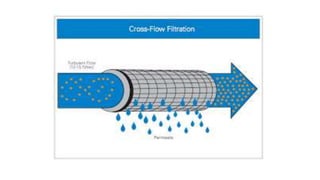
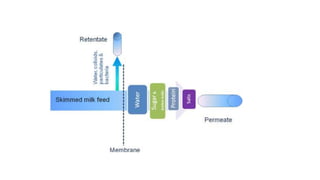
• Liquid is passed through a microfiltration membrane (pore sizes
between 0.1 – 10µm), separating micro organisms and suspended
particles from the process liquid removing all bacteria. Microfiltration
is generally operated in the crossflow as well as the dead end mode.
In cross flow the raw solution flows along the membrane surface with
only a small portion of the liquid passing through the MF membrane
as a permeate. The concentrate is circulated in a loop to reduce
concentration polarisation continuously and is used to clean the
membrane. For this reason, cross flow membrane filtration is
preferably applied for the filtration of liquids with a high solids
concentration.
• In dead-end filtration, the liquid flows perpendicular to the
membrane surface so that the retained particles accumulate at
the membrane surface and form a filter cake. The filter cake
increases in height throughout the filtration period resulting in
a decrease in permeate flux. Therefore the membranes in
dead-end operations have to be cleaned at regular intervals
either by backflushing or possibly by using chemical or
mechanical cleaning methods.
Main applications of MF in the dairy
industry
MF has been developed at industrial scale for two main
applications:
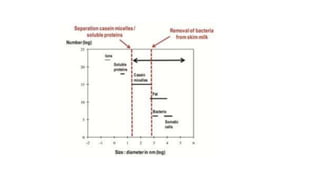
1. Removal of bacteria from milk
2. Selective separation of casein micelles from soluble
proteins.
REMOVAL OF BACTERIA
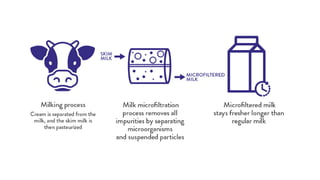
MF consists in removing bacteria from milk in order to minimise
possible health hazards and control bacteria growth during milk
processing. It offers then an interesting alternative to heat-treatment
or centrifugation. At industrial level, milk is generally skimmed before
MF because the size of bacteria overlaps the size of fat globules.
The skimmed milk is then microfiltered, and the cream, classically
treated at about 120°C for four seconds to eliminate bacteria, is added
back to the microfiltered skimmed milk. The micro filtration retentate,
which contains most of the bacteria, can be discharged separately for
other suitable applications or blended continuously with the cream. In
order to reduce the volume of the retentate, a second MF stage can
also be added.
Separation of casein micelles / soluble
proteins
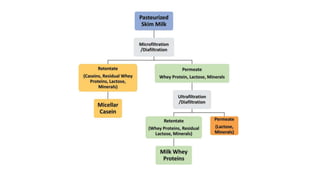
• This operation makes it possible, in one single operation, to separate
milk into a retentate enriched specifically in native casein micelles
(size ~100 – 150 nanometres), and a permeate containing native
soluble proteins (size 2 – 10 nanometres).
• The content of the retentate is similar to the treated milk but with an
increase content in native micellar casein, and consequently a higher
content in dry matter, total nitrogen matter and colloidal calcium. This
operation has encountered fast-growing success in many plants for
making numerous cheese varieties because the retentate is used for
the casein enrichment of cheese milk to improve the rennet
coagulability of casein and cheesemaking process.
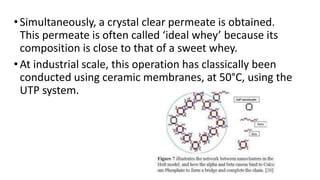
•Simultaneously, a crystal clear permeate is obtained.
This permeate is often called ‘ideal whey’ because its
composition is close to that of a sweet whey.
•At industrial scale, this operation has classically been
conducted using ceramic membranes, at 50°C, using the
UTP system.
OTHER APPLICATIONS
• Numerous applications of MF have currently been
investigated in the dairy sector. Among them, some are
relatively old ideas of fractionation processes, modified and
optimised by taking into account the advantages of the
recent skimmed milk MF operations. Others are new
processes aiming at innovating and creating new products
with targeted functionalities.
OUR GOAL
Our goal is to produce milk with a refrigerated shelf life of 60
to 90 d using minimum pasteurization heat treatment while
retaining the flavor quality of fresh milk. Therefore, the
objectives of our study were to determine the rate of bacterial
growth in commercially pasteurized skim milk as a function of
storage temperature, to determine the efficiency of a process
of microfiltration followed by pasteurization in reducing the
number of total bacteria, spores, and coliforms in skim milk,
and to determine the effect of the process on extending skim
milk shelf life.
THANK YOU

NON THERMAL MICROFILTERATION in microbiology.pptx

  • 1.
    FACULTY OF DAIRYTECHNOLOGY AGRICULTURE UNIVERSITY JODHPUR SUBJECT: MICROBIOLOGY OF FLUID MILK CODE: DM 121 TOPIC: NON THERMAL MICROFILTERATION SUBMITTED TO: SUBMITTED BY: DR. KRISHNA SAHARAN DEEPANSHA SINGH URMILA CHOUDARY VISHAL DHAKED
  • 2.
    NON-THERMAL TECHNOLOGICAL PROCESSES APPLIEDTO MILK Membranes used in milk and dairy products are structures that separate two different phases from each other. According to the pore diameters, they are grouped as microfiltration (MF), ultrafiltration (UF), nano filtration (NF), and reverse osmosis (RO) MF is used to reduce bacterial content, while UF is used to separate protein molecules from fluid, and RO is used to concentrate the solutions by removing water and to demineralize the fluids
  • 3.
    WHAT IS MICROFILTERATION? •Microfiltration is a process which involves the method of membrane filtration having the same selective types of membrane type. The purpose of microfiltration is sterilization from microorganisms for example, viruses, bacteria, clearance of pigment, and elimination of other impurities in size range of submicron of the particle. • Microfiltration membranes usually require 500 kPa (5 bar) of pressure for its operation.
  • 4.
    • MF isbased on the principles involving retaining molecules of size 0.1 to 20 μm by membranes. MF is used to separate biologically derived materials such as colloidal particles, casein micelles, serum protein aggregates and milk fat globules, somatic cells, microorganisms. • MF is a purification process usually used in the concentration of suspensions. Along with the changing and developing technology, MF has a great advantage in the membrane process in terms of reducing the bacterial content in milk at lower temperatures without damaging its properties
  • 5.
    Compared to bactofugation,MF was generally found to be better at separating the bacteria and their spores. It has been reported that MF, applied to increase the content of casein, increases the quality of functional and sensory properties of serum proteins.
  • 6.
    PROCESS • Liquid ispassed through a microfiltration membrane (pore sizes between 0.1 – 10µm), separating micro organisms and suspended particles from the process liquid removing all bacteria. Microfiltration is generally operated in the crossflow as well as the dead end mode. In cross flow the raw solution flows along the membrane surface with only a small portion of the liquid passing through the MF membrane as a permeate. The concentrate is circulated in a loop to reduce concentration polarisation continuously and is used to clean the membrane. For this reason, cross flow membrane filtration is preferably applied for the filtration of liquids with a high solids concentration.
  • 8.
    • In dead-endfiltration, the liquid flows perpendicular to the membrane surface so that the retained particles accumulate at the membrane surface and form a filter cake. The filter cake increases in height throughout the filtration period resulting in a decrease in permeate flux. Therefore the membranes in dead-end operations have to be cleaned at regular intervals either by backflushing or possibly by using chemical or mechanical cleaning methods.
  • 11.
    Main applications ofMF in the dairy industry MF has been developed at industrial scale for two main applications: 1. Removal of bacteria from milk 2. Selective separation of casein micelles from soluble proteins.
  • 12.
    REMOVAL OF BACTERIA MFconsists in removing bacteria from milk in order to minimise possible health hazards and control bacteria growth during milk processing. It offers then an interesting alternative to heat-treatment or centrifugation. At industrial level, milk is generally skimmed before MF because the size of bacteria overlaps the size of fat globules. The skimmed milk is then microfiltered, and the cream, classically treated at about 120°C for four seconds to eliminate bacteria, is added back to the microfiltered skimmed milk. The micro filtration retentate, which contains most of the bacteria, can be discharged separately for other suitable applications or blended continuously with the cream. In order to reduce the volume of the retentate, a second MF stage can also be added.
  • 15.
    Separation of caseinmicelles / soluble proteins • This operation makes it possible, in one single operation, to separate milk into a retentate enriched specifically in native casein micelles (size ~100 – 150 nanometres), and a permeate containing native soluble proteins (size 2 – 10 nanometres). • The content of the retentate is similar to the treated milk but with an increase content in native micellar casein, and consequently a higher content in dry matter, total nitrogen matter and colloidal calcium. This operation has encountered fast-growing success in many plants for making numerous cheese varieties because the retentate is used for the casein enrichment of cheese milk to improve the rennet coagulability of casein and cheesemaking process.
  • 16.
    •Simultaneously, a crystalclear permeate is obtained. This permeate is often called ‘ideal whey’ because its composition is close to that of a sweet whey. •At industrial scale, this operation has classically been conducted using ceramic membranes, at 50°C, using the UTP system.
  • 17.
    OTHER APPLICATIONS • Numerousapplications of MF have currently been investigated in the dairy sector. Among them, some are relatively old ideas of fractionation processes, modified and optimised by taking into account the advantages of the recent skimmed milk MF operations. Others are new processes aiming at innovating and creating new products with targeted functionalities.
  • 18.
    OUR GOAL Our goalis to produce milk with a refrigerated shelf life of 60 to 90 d using minimum pasteurization heat treatment while retaining the flavor quality of fresh milk. Therefore, the objectives of our study were to determine the rate of bacterial growth in commercially pasteurized skim milk as a function of storage temperature, to determine the efficiency of a process of microfiltration followed by pasteurization in reducing the number of total bacteria, spores, and coliforms in skim milk, and to determine the effect of the process on extending skim milk shelf life.
  • 20.