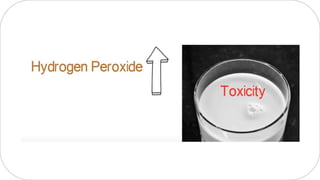

Lactoperoxidase System
Lactoperoxidase/ Thiocyanate /Hydrogen peroxide system
LP- System of Milk Preservation
Lactoperoxidase System
or
or
What is Lactoperoxidase?
• Lactoperoxidase is an enzyme, which is naturally present in fresh raw milk.
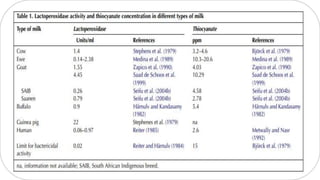
• Bovine milk contains about 30mg/l of Lactoperoxidase and the concentration is fairly constant
throughout the lactation.
• Lactoperoxidase has no antibacterial effect on its own but has the ability to oxidise
the thiocyanate ion (SCN-) in the presence of hydrogen peroxide (H2O2)
(these components also exist naturally in tears, saliva, and gastric juices).
• Resulting chemical compound (OSCN-) has an antibacterial effect in fresh raw milk.
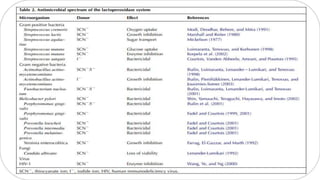
• Against some species of normal gut flora such as streptococci and lactobacilli, the resulting
compound has a bacteriostatic effect (inhibiting bacterial growth) while it has
bactericidal effect (killing bacteria) against some gram-negative bacteria, i.e. Escherichia coli,
pseudomonads.
What is the Lactoperoxidase system & how does it work?
• The Lactoperoxidase system (LP-s) consists of the production of an antibacterial
compound from the thiocyanate ion catalysed by Lactoperoxidase in the
presence of hydrogen peroxide.
• This antibacterial system is naturally found in various body fluids including tears, saliva &
gastric juice.
• The two essential components for the system, namely thiocyanate & hydrogen
peroxide, are naturally present in milk in varying concentrations, depending on the feed
given and on the species/breed of animal.
• In drawn milk the antibacterial activity is quite weak & lasts for up to two hours
because the milk contains only suboptimal levels of the thiocyanate ion & hydrogen peroxide.
• The method of reactivation of the LP-s in milk is to add about 10 parts per million
(PPM) of thiocyanate (preferably in liquid form) to the raw milk to increase the overall level
to 15 PPM (5 PPM naturally present). The solution is thoroughly mixed for 30 seconds and
• then an equimolar amount (8.5 PPM) of hydrogen peroxide is added (generally in the form
of a granulated sodium carbonate peroxyhydrate).
• This treatment reactivates the antibacterial effect of the LP-s in the raw milk &
extends the shelf life of raw milk under tropical conditions for a further 7 to 8 hrs.
What is the Lactoperoxidase system & how does it work?
• This means that producers can transport their milk to the collection point where it is
treated with LP-s and can then be transported by whatever means are available (e.g.,
handcarried, on bicycle, pack animal or motorised transport) for 7 to 8 hours, to a processing
centre, thereby significantly increasing the income generated at farm and producer group
level.
• The LP-s treatment does not function as an end product treatment.
• It is a processing aid, which enhances the naturally occurring antibacterial system in
raw milk.
• It is therefore essential that the quality of the raw milk is good and thus training on milk
production hygiene is complementary to the effective application of the Lactoperoxidase system of
milk preservation.
What is the Lactoperoxidase system & how does it work?
Is it safe for human and animal health?
• 15 years of field experiments in developed and developing countries were conducted and assessed by
the FAO/WHO Joint Experts Committee on Food Additives (JECFA).
• Upon completion of these substantial and in-depth studies a guideline for the use of an alternative milk
preservation method based on the activation of the natural enzymatic antibacterial complex in milk
(Lactoperoxidase system) was approved by the FAO/WHO Expert Committee on Food Additives in 1989 and
by the Codex Alimentarius Commission in 1991 as being safe for use.
• The lactoperoxidase system is a natural component of saliva and gastric juice in humans and
consequently non-toxic when used according to the Guidelines of the Codex Alimentarius
Commission ( See Guidelines for the Preservation of Raw Milk by Use of the Lactoperoxidase
System (CAC/GL 13-1991)).
• Additional sources of information include the Thirty fifth Report of the Joint FAO/WHO Committee on Food
Additives on "Evaluation of certain food additives and contaminants", Technical Report Series 789, WHO,
1990.
• There is no effect on lactating animals as the treatment is carried out only after the milk has been drawn
from the teat.
this method should be utilised when refrigeration of the raw milk is not feasible" and
should be used "when technical, economical and/or practical reasons do not allow the
use of cooling facilities for maintaining the quality of raw milk.
Use of the LP-s system in areas which lack an adequate infrastructure for collection of
liquid milk, would ensure the production of milk as a safe and wholesome food, which
would otherwise be virtually impossible".
Codex Alimentarius Commission
In 1987,
Considered………..
As an acceptable alternative for preservation of milk quality
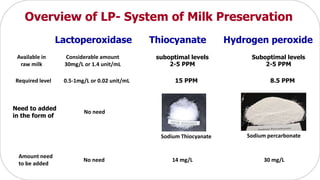
Overview of LP- System of Milk Preservation
Lactoperoxidase Thiocyanate Hydrogen peroxide
Considerable amount
30mg/L or 1.4 unit/mL
suboptimal levels
2-5 PPM
Suboptimal levels
2-5 PPM
Available in
raw milk
0.5-1mg/L or 0.02 unit/mL 15 PPM 8.5 PPM
Required level
Need to added
in the form of
Sodium percarbonate
Sodium Thiocyanate
No need
Amount need
to be added
No need 14 mg/L 30 mg/L
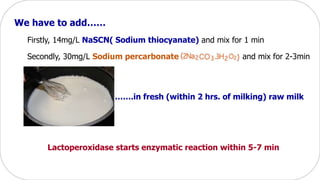
We have to add……
Firstly, 14mg/L NaSCN( Sodium thiocyanate) and mix for 1 min
Secondly, 30mg/L Sodium percarbonate and mix for 2-3min
…….in fresh (within 2 hrs. of milking) raw milk
Lactoperoxidase starts enzymatic reaction within 5-7 min
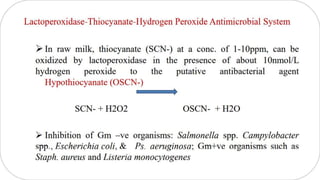
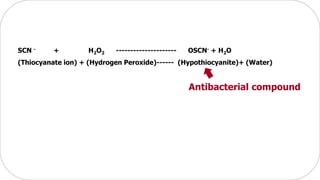
SCN - + H2O2 --------------------- OSCN- + H2O
(Thiocyanate ion) + (Hydrogen Peroxide)------ (Hypothiocyanite)+ (Water)
Antibacterial compound
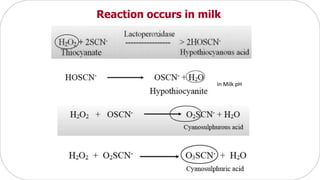
In Milk pH
Reaction occurs in milk
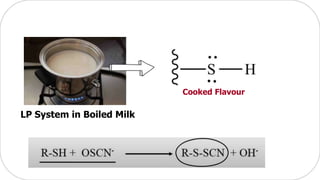
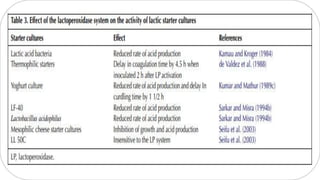
LP System in Boiled Milk
Cooked Flavour
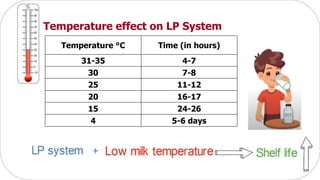
Temperature effect on LP System
Temperature °C Time (in hours)
31-35 4-7
30 7-8
25 11-12
20 16-17
15 24-26
4 5-6 days
Thank You

Lactoperoxidase system

  • 1.
  • 2.
    Lactoperoxidase/ Thiocyanate /Hydrogenperoxide system LP- System of Milk Preservation Lactoperoxidase System or or
  • 3.
    What is Lactoperoxidase? •Lactoperoxidase is an enzyme, which is naturally present in fresh raw milk. • Bovine milk contains about 30mg/l of Lactoperoxidase and the concentration is fairly constant throughout the lactation. • Lactoperoxidase has no antibacterial effect on its own but has the ability to oxidise the thiocyanate ion (SCN-) in the presence of hydrogen peroxide (H2O2) (these components also exist naturally in tears, saliva, and gastric juices). • Resulting chemical compound (OSCN-) has an antibacterial effect in fresh raw milk. • Against some species of normal gut flora such as streptococci and lactobacilli, the resulting compound has a bacteriostatic effect (inhibiting bacterial growth) while it has bactericidal effect (killing bacteria) against some gram-negative bacteria, i.e. Escherichia coli, pseudomonads.
  • 4.
    What is theLactoperoxidase system & how does it work? • The Lactoperoxidase system (LP-s) consists of the production of an antibacterial compound from the thiocyanate ion catalysed by Lactoperoxidase in the presence of hydrogen peroxide. • This antibacterial system is naturally found in various body fluids including tears, saliva & gastric juice. • The two essential components for the system, namely thiocyanate & hydrogen peroxide, are naturally present in milk in varying concentrations, depending on the feed given and on the species/breed of animal. • In drawn milk the antibacterial activity is quite weak & lasts for up to two hours because the milk contains only suboptimal levels of the thiocyanate ion & hydrogen peroxide.
  • 5.
    • The methodof reactivation of the LP-s in milk is to add about 10 parts per million (PPM) of thiocyanate (preferably in liquid form) to the raw milk to increase the overall level to 15 PPM (5 PPM naturally present). The solution is thoroughly mixed for 30 seconds and • then an equimolar amount (8.5 PPM) of hydrogen peroxide is added (generally in the form of a granulated sodium carbonate peroxyhydrate). • This treatment reactivates the antibacterial effect of the LP-s in the raw milk & extends the shelf life of raw milk under tropical conditions for a further 7 to 8 hrs. What is the Lactoperoxidase system & how does it work?
  • 6.
    • This meansthat producers can transport their milk to the collection point where it is treated with LP-s and can then be transported by whatever means are available (e.g., handcarried, on bicycle, pack animal or motorised transport) for 7 to 8 hours, to a processing centre, thereby significantly increasing the income generated at farm and producer group level. • The LP-s treatment does not function as an end product treatment. • It is a processing aid, which enhances the naturally occurring antibacterial system in raw milk. • It is therefore essential that the quality of the raw milk is good and thus training on milk production hygiene is complementary to the effective application of the Lactoperoxidase system of milk preservation. What is the Lactoperoxidase system & how does it work?
  • 7.
    Is it safefor human and animal health? • 15 years of field experiments in developed and developing countries were conducted and assessed by the FAO/WHO Joint Experts Committee on Food Additives (JECFA). • Upon completion of these substantial and in-depth studies a guideline for the use of an alternative milk preservation method based on the activation of the natural enzymatic antibacterial complex in milk (Lactoperoxidase system) was approved by the FAO/WHO Expert Committee on Food Additives in 1989 and by the Codex Alimentarius Commission in 1991 as being safe for use. • The lactoperoxidase system is a natural component of saliva and gastric juice in humans and consequently non-toxic when used according to the Guidelines of the Codex Alimentarius Commission ( See Guidelines for the Preservation of Raw Milk by Use of the Lactoperoxidase System (CAC/GL 13-1991)). • Additional sources of information include the Thirty fifth Report of the Joint FAO/WHO Committee on Food Additives on "Evaluation of certain food additives and contaminants", Technical Report Series 789, WHO, 1990. • There is no effect on lactating animals as the treatment is carried out only after the milk has been drawn from the teat.
  • 8.
    this method shouldbe utilised when refrigeration of the raw milk is not feasible" and should be used "when technical, economical and/or practical reasons do not allow the use of cooling facilities for maintaining the quality of raw milk. Use of the LP-s system in areas which lack an adequate infrastructure for collection of liquid milk, would ensure the production of milk as a safe and wholesome food, which would otherwise be virtually impossible". Codex Alimentarius Commission
  • 10.
    In 1987, Considered……….. As anacceptable alternative for preservation of milk quality
  • 11.
    Overview of LP-System of Milk Preservation Lactoperoxidase Thiocyanate Hydrogen peroxide Considerable amount 30mg/L or 1.4 unit/mL suboptimal levels 2-5 PPM Suboptimal levels 2-5 PPM Available in raw milk 0.5-1mg/L or 0.02 unit/mL 15 PPM 8.5 PPM Required level Need to added in the form of Sodium percarbonate Sodium Thiocyanate No need Amount need to be added No need 14 mg/L 30 mg/L
  • 12.
    We have toadd…… Firstly, 14mg/L NaSCN( Sodium thiocyanate) and mix for 1 min Secondly, 30mg/L Sodium percarbonate and mix for 2-3min …….in fresh (within 2 hrs. of milking) raw milk Lactoperoxidase starts enzymatic reaction within 5-7 min
  • 14.
    SCN - +H2O2 --------------------- OSCN- + H2O (Thiocyanate ion) + (Hydrogen Peroxide)------ (Hypothiocyanite)+ (Water) Antibacterial compound
  • 15.
    In Milk pH Reactionoccurs in milk
  • 16.
    LP System inBoiled Milk Cooked Flavour
  • 17.
    Temperature effect onLP System Temperature °C Time (in hours) 31-35 4-7 30 7-8 25 11-12 20 16-17 15 24-26 4 5-6 days
  • 22.