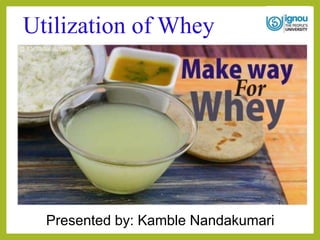
Utilization of Whey
Presented by: Kamble Nandakumari
OUTLINES
Introduction
Composition of whey
Scope and current trend
Nutritional and health benefits
Different food applications of whey
Conclusion
INTRODUCTON
What is Whey?
 Whey is a by-product obtained during the production
of cheese, paneer, Chhana and casein precipitates.
 The watery portion of the milk remaining after milk
coagulation and removal of the curd.
 Whey contains about half of the total solids of milk
and is a source for many nutrients such as Whey
Proteins, Lactose and Minerals.
INTRODUCTION
Whey can be obtained by acid, heat, and rennet
coagulation of milk.
It contains 6-7% solids and one-fifth of the
initial milk proteins present.
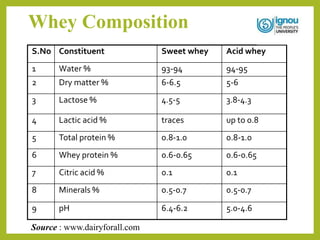
Whey Composition
S.No Constituent Sweet whey Acid whey
1 Water % 93-94 94-95
2 Dry matter % 6-6.5 5-6
3 Lactose % 4.5-5 3.8-4.3
4 Lactic acid % traces up to 0.8
5 Total protein % 0.8-1.0 0.8-1.0
6 Whey protein % 0.6-0.65 0.6-0.65
7 Citric acid % 0.1 0.1
8 Minerals % 0.5-0.7 0.5-0.7
9 pH 6.4-6.2 5.0-4.6
Source : www.dairyforall.com
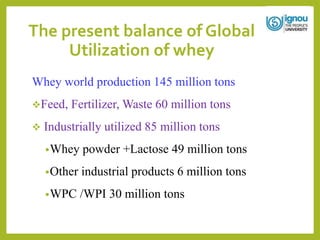
The present balance of Global
Utilization of whey
Whey world production 145 million tons
Feed, Fertilizer, Waste 60 million tons
 Industrially utilized 85 million tons
•Whey powder +Lactose 49 million tons
•Other industrial products 6 million tons
•WPC /WPI 30 million tons
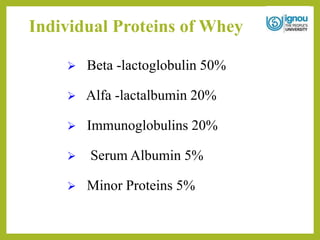
Individual Proteins of Whey
 Beta -lactoglobulin 50%
 Alfa -lactalbumin 20%
 Immunoglobulins 20%
 Serum Albumin 5%
 Minor Proteins 5%
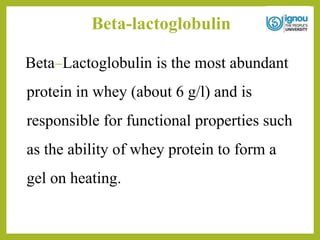
Beta-lactoglobulin
Beta-Lactoglobulin is the most abundant
protein in whey (about 6 g/l) and is
responsible for functional properties such
as the ability of whey protein to form a
gel on heating.
Alpha-lactalbumin
Alpha-lactalbumin is a whey protein high in the amino
acid tryptophan, which the body uses to make the
neurotransmitter serotonin.
Purified alpha-lactalbumin is most readily used in
infant formula manufacturing, as it has the most
structurally similar protein profile compared to breast
milk.
Immunoglobulins
 Immunoglobulin (Ig) is an antibody of whey
fraction. Milk appears to contain a significant
amount of immunoglobulins, approximately 10-
15 percent of total whey proteins.
Nutritional and health effects
Whey contains proteins, albumins and globulins,
which have outstanding nutritional qualities
(Nelson 1969).
The glutathione in whey protein is an antioxidant
reduce the risk of cancer in animals, suggesting
an avenue for future medical research (Parodi
2007).
Nutritional and health effects
Whey contains all the essential amino acids Isoleucine,
Leucine, Lysine, Methionine, Phenylalanine,Threonine,
Tryptophan and Valine. Whey also contains lactose,
and minerals (Kansal 2008)
Biologically active components are exclusively
found in the whey (Fuda et al 2005)
Nutritional and health effects
Reducing the risks heart disease, cancer and
diabetes (Krissansen 2007).
whey proteins have antimicrobial, antiviral and anti-
oxidant properties, can offer a kind of protection
against cancer and heart diseases and assist at the
enhancement of immune- defence( Aspasia and
Stamatis 2012)
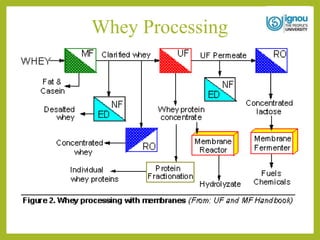
Membrane filtration of Whey
Whey components are fractionated by the use of
membrane filtration techniques
 Ultrafiltration
 Microfiltration
 Nano-filteration
Resulting in
 Whey protein concentrate
 Whey protein isolate
 Lactose Permeate
Whey Processing
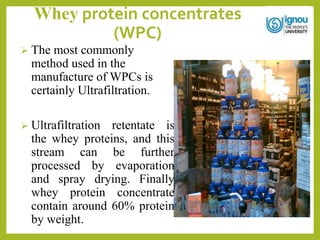
Whey protein concentrates
(WPC)
 The most commonly
method used in the
manufacture of WPCs is
certainly Ultrafiltration.
 Ultrafiltration retentate is
the whey proteins, and this
stream can be further
processed by evaporation
and spray drying. Finally
whey protein concentrate
contain around 60% protein
by weight.
Whey Protein Isolates (WPI)
Commercial WPIs contain between 88-95%
protein.
Microfiltered and demineralized whey further
purified and concentrated and spray dried to
obtained protein isolates(Morr, 1989)
Protein isolates, are high protein products with a
higher ratio of a particular protein than that
present in whey.
Production of Whey powders
Whey is firstly concentrated in 40-70% total
solids and then spray or a roll dryer used to
remove moisture until the final product reaches
5% moisture content
Whey drying is the simplest operation used in
whey utilization
Applications ofWhey Proteins
Chocolates and Confectionery
Ice creams and frozen foods
Bakery foods
Sport foods
Baby foods
Functional foods and food supplements
Value added products such as nutritional
beverage etc.
Biologically active foods
Used in the formulation of animal and poultry
feed
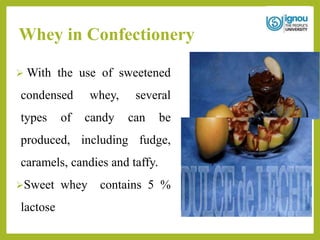
Whey in Confectionery
 With the use of sweetened
condensed whey, several
types of candy can be
produced, including fudge,
caramels, candies and taffy.
Sweet whey contains 5 %
lactose
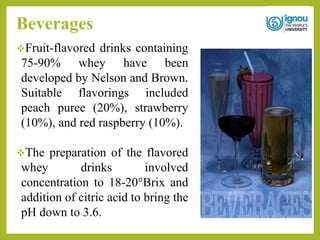
Beverages
Fruit-flavored drinks containing
75-90% whey have been
developed by Nelson and Brown.
Suitable flavorings included
peach puree (20%), strawberry
(10%), and red raspberry (10%).
The preparation of the flavored
whey drinks involved
concentration to 18-20°Brix and
addition of citric acid to bring the
pH down to 3.6.
Whey beverages with a low alcohol
content
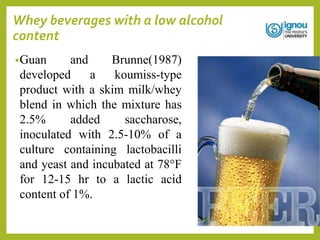
•Guan and Brunne(1987)
developed a koumiss-type
product with a skim milk/whey
blend in which the mixture has
2.5% added saccharose,
inoculated with 2.5-10% of a
culture containing lactobacilli
and yeast and incubated at 78°F
for 12-15 hr to a lactic acid
content of 1%.
Whey Wine
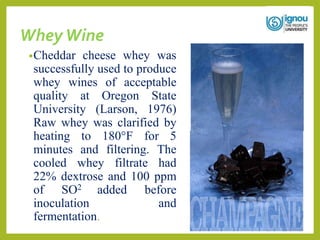
•Cheddar cheese whey was
successfully used to produce
whey wines of acceptable
quality at Oregon State
University (Larson, 1976)
Raw whey was clarified by
heating to 180°F for 5
minutes and filtering. The
cooled whey filtrate had
22% dextrose and 100 ppm
of SO2 added before
inoculation and
fermentation.

Whey in Bakery foods
Use of whey should lead to
better kneading of bread
dough, to better yeast
fermentation, to a lighter
crumb color, and greater
porosity and improvement in
the crust
Sweet whey is used in
confectionery to give brown
color and characteristic
caramel flavor in confections
and bakery products
Whey in Infant foods
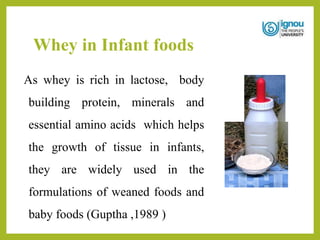
As whey is rich in lactose, body
building protein, minerals and
essential amino acids which helps
the growth of tissue in infants,
they are widely used in the
formulations of weaned foods and
baby foods (Guptha ,1989 )
Whey in sports nutrition
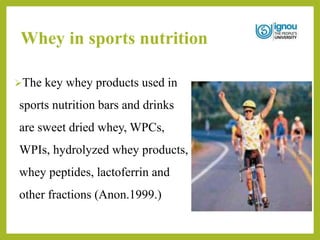
The key whey products used in
sports nutrition bars and drinks
are sweet dried whey, WPCs,
WPIs, hydrolyzed whey products,
whey peptides, lactoferrin and
other fractions (Anon.1999.)
Therapeutic Applications of Whey
Protein
The biological components of whey, including
lactoferrin, betalactoglobulin, alpha-lactalbumin,
glycomacropeptide, and immunoglobulins,
demonstrate a range of immune-enhancing
properties. In addition, whey has the ability to act
as an antioxidant, antihypertensive, antitumor,
hypolipidemic, antiviral, antibacterial, and
chelating agent.
A number of clinical trials have successfully been
performed using whey in the treatment of cancer,
HIV, hepatitis B, cardiovascular disease,
osteoporosis, and as an antimicrobial agent(Keri,
2004)
Probiotic whey
Whey based probiotic product can be prepared
with the addition of Bifidobacterium spp. and
Lactobacillus ssp. at 00.5-1.0% level. Titrable
acidity and pH values as well as sensory
properties did not change storage at 40 C for 40
days (Adrian et al, 2004)
Whey in Animal feeding
Whey is used in
Dairy cattle feed
Beef cattle feed
 swine feed
Poultry feed
Dairy cattle feed
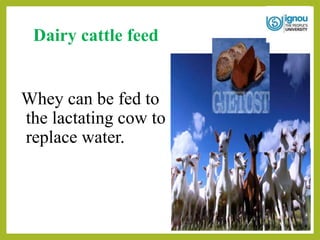
Whey can be fed to
the lactating cow to
replace water.
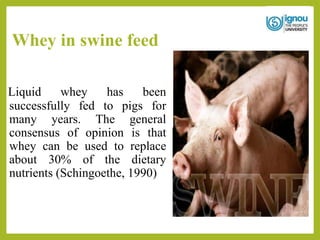
Whey in swine feed
Liquid whey has been
successfully fed to pigs for
many years. The general
consensus of opinion is that
whey can be used to replace
about 30% of the dietary
nutrients (Schingoethe, 1990)
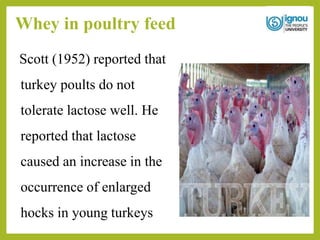
Whey in poultry feed
Scott (1952) reported that
turkey poults do not
tolerate lactose well. He
reported that lactose
caused an increase in the
occurrence of enlarged
hocks in young turkeys
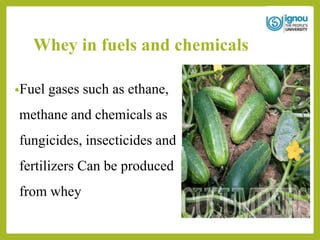
Whey in fuels and chemicals
•Fuel gases such as ethane,
methane and chemicals as
fungicides, insecticides and
fertilizers Can be produced
from whey
Conclusion
•Whey is rich in valuable proteins which can be used as
main ingredient in value added and nutritious products
•Utilization of whey instead of draining can reduce the
environmental pollution
•Essential amino acids of whey protein and minerals are
the nutritious components of milk
•Hence whey can be utilized in different forms as
explained.
THANK YOU

Whey utilization

  • 2.
    Utilization of Whey Presentedby: Kamble Nandakumari
  • 3.
    OUTLINES Introduction Composition of whey Scopeand current trend Nutritional and health benefits Different food applications of whey Conclusion
  • 4.
    INTRODUCTON What is Whey? Whey is a by-product obtained during the production of cheese, paneer, Chhana and casein precipitates.  The watery portion of the milk remaining after milk coagulation and removal of the curd.  Whey contains about half of the total solids of milk and is a source for many nutrients such as Whey Proteins, Lactose and Minerals.
  • 5.
    INTRODUCTION Whey can beobtained by acid, heat, and rennet coagulation of milk. It contains 6-7% solids and one-fifth of the initial milk proteins present.
  • 6.
    Whey Composition S.No ConstituentSweet whey Acid whey 1 Water % 93-94 94-95 2 Dry matter % 6-6.5 5-6 3 Lactose % 4.5-5 3.8-4.3 4 Lactic acid % traces up to 0.8 5 Total protein % 0.8-1.0 0.8-1.0 6 Whey protein % 0.6-0.65 0.6-0.65 7 Citric acid % 0.1 0.1 8 Minerals % 0.5-0.7 0.5-0.7 9 pH 6.4-6.2 5.0-4.6 Source : www.dairyforall.com
  • 7.
    The present balanceof Global Utilization of whey Whey world production 145 million tons Feed, Fertilizer, Waste 60 million tons  Industrially utilized 85 million tons •Whey powder +Lactose 49 million tons •Other industrial products 6 million tons •WPC /WPI 30 million tons
  • 8.
    Individual Proteins ofWhey  Beta -lactoglobulin 50%  Alfa -lactalbumin 20%  Immunoglobulins 20%  Serum Albumin 5%  Minor Proteins 5%
  • 9.
    Beta-lactoglobulin Beta-Lactoglobulin is themost abundant protein in whey (about 6 g/l) and is responsible for functional properties such as the ability of whey protein to form a gel on heating.
  • 10.
    Alpha-lactalbumin Alpha-lactalbumin is awhey protein high in the amino acid tryptophan, which the body uses to make the neurotransmitter serotonin. Purified alpha-lactalbumin is most readily used in infant formula manufacturing, as it has the most structurally similar protein profile compared to breast milk.
  • 11.
    Immunoglobulins  Immunoglobulin (Ig)is an antibody of whey fraction. Milk appears to contain a significant amount of immunoglobulins, approximately 10- 15 percent of total whey proteins.
  • 12.
    Nutritional and healtheffects Whey contains proteins, albumins and globulins, which have outstanding nutritional qualities (Nelson 1969). The glutathione in whey protein is an antioxidant reduce the risk of cancer in animals, suggesting an avenue for future medical research (Parodi 2007).
  • 13.
    Nutritional and healtheffects Whey contains all the essential amino acids Isoleucine, Leucine, Lysine, Methionine, Phenylalanine,Threonine, Tryptophan and Valine. Whey also contains lactose, and minerals (Kansal 2008) Biologically active components are exclusively found in the whey (Fuda et al 2005)
  • 14.
    Nutritional and healtheffects Reducing the risks heart disease, cancer and diabetes (Krissansen 2007). whey proteins have antimicrobial, antiviral and anti- oxidant properties, can offer a kind of protection against cancer and heart diseases and assist at the enhancement of immune- defence( Aspasia and Stamatis 2012)
  • 15.
    Membrane filtration ofWhey Whey components are fractionated by the use of membrane filtration techniques  Ultrafiltration  Microfiltration  Nano-filteration Resulting in  Whey protein concentrate  Whey protein isolate  Lactose Permeate
  • 16.
  • 17.
    Whey protein concentrates (WPC) The most commonly method used in the manufacture of WPCs is certainly Ultrafiltration.  Ultrafiltration retentate is the whey proteins, and this stream can be further processed by evaporation and spray drying. Finally whey protein concentrate contain around 60% protein by weight.
  • 18.
    Whey Protein Isolates(WPI) Commercial WPIs contain between 88-95% protein. Microfiltered and demineralized whey further purified and concentrated and spray dried to obtained protein isolates(Morr, 1989) Protein isolates, are high protein products with a higher ratio of a particular protein than that present in whey.
  • 19.
    Production of Wheypowders Whey is firstly concentrated in 40-70% total solids and then spray or a roll dryer used to remove moisture until the final product reaches 5% moisture content Whey drying is the simplest operation used in whey utilization
  • 20.
    Applications ofWhey Proteins Chocolatesand Confectionery Ice creams and frozen foods Bakery foods Sport foods Baby foods Functional foods and food supplements Value added products such as nutritional beverage etc. Biologically active foods Used in the formulation of animal and poultry feed
  • 21.
    Whey in Confectionery With the use of sweetened condensed whey, several types of candy can be produced, including fudge, caramels, candies and taffy. Sweet whey contains 5 % lactose
  • 22.
    Beverages Fruit-flavored drinks containing 75-90%whey have been developed by Nelson and Brown. Suitable flavorings included peach puree (20%), strawberry (10%), and red raspberry (10%). The preparation of the flavored whey drinks involved concentration to 18-20°Brix and addition of citric acid to bring the pH down to 3.6.
  • 23.
    Whey beverages witha low alcohol content •Guan and Brunne(1987) developed a koumiss-type product with a skim milk/whey blend in which the mixture has 2.5% added saccharose, inoculated with 2.5-10% of a culture containing lactobacilli and yeast and incubated at 78°F for 12-15 hr to a lactic acid content of 1%.
  • 24.
    Whey Wine •Cheddar cheesewhey was successfully used to produce whey wines of acceptable quality at Oregon State University (Larson, 1976) Raw whey was clarified by heating to 180°F for 5 minutes and filtering. The cooled whey filtrate had 22% dextrose and 100 ppm of SO2 added before inoculation and fermentation.
  • 25.
    Whey in Bakeryfoods Use of whey should lead to better kneading of bread dough, to better yeast fermentation, to a lighter crumb color, and greater porosity and improvement in the crust Sweet whey is used in confectionery to give brown color and characteristic caramel flavor in confections and bakery products
  • 26.
    Whey in Infantfoods As whey is rich in lactose, body building protein, minerals and essential amino acids which helps the growth of tissue in infants, they are widely used in the formulations of weaned foods and baby foods (Guptha ,1989 )
  • 27.
    Whey in sportsnutrition The key whey products used in sports nutrition bars and drinks are sweet dried whey, WPCs, WPIs, hydrolyzed whey products, whey peptides, lactoferrin and other fractions (Anon.1999.)
  • 28.
    Therapeutic Applications ofWhey Protein The biological components of whey, including lactoferrin, betalactoglobulin, alpha-lactalbumin, glycomacropeptide, and immunoglobulins, demonstrate a range of immune-enhancing properties. In addition, whey has the ability to act as an antioxidant, antihypertensive, antitumor, hypolipidemic, antiviral, antibacterial, and chelating agent. A number of clinical trials have successfully been performed using whey in the treatment of cancer, HIV, hepatitis B, cardiovascular disease, osteoporosis, and as an antimicrobial agent(Keri, 2004)
  • 29.
    Probiotic whey Whey basedprobiotic product can be prepared with the addition of Bifidobacterium spp. and Lactobacillus ssp. at 00.5-1.0% level. Titrable acidity and pH values as well as sensory properties did not change storage at 40 C for 40 days (Adrian et al, 2004)
  • 30.
    Whey in Animalfeeding Whey is used in Dairy cattle feed Beef cattle feed  swine feed Poultry feed
  • 31.
    Dairy cattle feed Wheycan be fed to the lactating cow to replace water.
  • 32.
    Whey in swinefeed Liquid whey has been successfully fed to pigs for many years. The general consensus of opinion is that whey can be used to replace about 30% of the dietary nutrients (Schingoethe, 1990)
  • 33.
    Whey in poultryfeed Scott (1952) reported that turkey poults do not tolerate lactose well. He reported that lactose caused an increase in the occurrence of enlarged hocks in young turkeys
  • 34.
    Whey in fuelsand chemicals •Fuel gases such as ethane, methane and chemicals as fungicides, insecticides and fertilizers Can be produced from whey
  • 35.
    Conclusion •Whey is richin valuable proteins which can be used as main ingredient in value added and nutritious products •Utilization of whey instead of draining can reduce the environmental pollution •Essential amino acids of whey protein and minerals are the nutritious components of milk •Hence whey can be utilized in different forms as explained.
  • 36.