- Raj Raisinghani
Non Performing Assets - Banks
Introduction
 The business of banking essentially involves
intermediation-acceptance of deposits and channeling
these deposits in to lending activities.
 Since the deposits received from the depositors have to
be repaid to them by the bank, they are known as banks’
‘Liabilities’ and as the loan given to the borrowers are to
be received back from them, they are termed as banks’
‘Assets’ so assets are banks’ loans and advances.
 In the traditional banking business of lending financed
by deposits from customers, Commercial Banks are
faced with the risk of default by the borrower in the
payment of either principal or interest.
 This risk in banking parlance is termed as ‘Credit Risk’
and accounts where payment of interest and /or
Implications of NPA
 The most important business implication of the NPAs
is that it leads to credit risk management assuming
priority over other aspects of bank’s functioning. The
bank’s whole machinery would thus be pre-occupied
with recovery procedures rather than concentrating on
expanding business.
 Other consequences would be reduction in interest
income, high level of provisioning (as banks are
required to keep aside a portion of their operating
profit as provisions, as NPAs increases banks have to
increase the amount kept aside as provisions which
will reduce their net profits) stress on profitability and
capital adequacy, gradual decline in ability to meet
steady increase in cost, increased pressure on Net
Interest Margin (NIM) thereby reducing
competitiveness, steady erosion of capital resources
and increased difficulty in augmenting capital
resources.
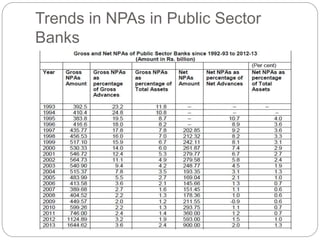
Trends in NPAs in Public Sector
Banks
Reasons for growing NPA
 The rising NPAs in recent period can attributed to
the affects of the global recession coupled with
internal factors like the slowdown in the domestic
economy which had adversely affected the
performance of corporate as well as small and
medium enterprises leading to a negative impact
on credit quality.
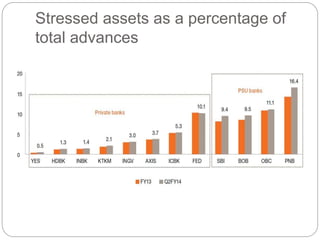
 The asset quality of PSBs aggravated in
comparison to private sector banks as big ticket
corporate loans form a larger share of the credit
portfolio for PSBs. Data available with the
Finance Ministry showed that thirty companies
together owed Rs.16,877 crore as on September
30, 2013 to Public Sector Banks.
Gross NPAs for public sector
Banks
The picture NOW
Stressed assets as a percentage of
total advances
What Next ?
 We will have NPAs for each bank
separately.
 It will help to understand the
outstanding for corresponding bank.
 It will help to compare its NPA
growth with the performance.
Thank You

Non Performing Assets - Banks

  • 1.
    - Raj Raisinghani NonPerforming Assets - Banks
  • 2.
    Introduction  The businessof banking essentially involves intermediation-acceptance of deposits and channeling these deposits in to lending activities.  Since the deposits received from the depositors have to be repaid to them by the bank, they are known as banks’ ‘Liabilities’ and as the loan given to the borrowers are to be received back from them, they are termed as banks’ ‘Assets’ so assets are banks’ loans and advances.  In the traditional banking business of lending financed by deposits from customers, Commercial Banks are faced with the risk of default by the borrower in the payment of either principal or interest.  This risk in banking parlance is termed as ‘Credit Risk’ and accounts where payment of interest and /or
  • 3.
    Implications of NPA The most important business implication of the NPAs is that it leads to credit risk management assuming priority over other aspects of bank’s functioning. The bank’s whole machinery would thus be pre-occupied with recovery procedures rather than concentrating on expanding business.  Other consequences would be reduction in interest income, high level of provisioning (as banks are required to keep aside a portion of their operating profit as provisions, as NPAs increases banks have to increase the amount kept aside as provisions which will reduce their net profits) stress on profitability and capital adequacy, gradual decline in ability to meet steady increase in cost, increased pressure on Net Interest Margin (NIM) thereby reducing competitiveness, steady erosion of capital resources and increased difficulty in augmenting capital resources.
  • 4.
    Trends in NPAsin Public Sector Banks
  • 5.
    Reasons for growingNPA  The rising NPAs in recent period can attributed to the affects of the global recession coupled with internal factors like the slowdown in the domestic economy which had adversely affected the performance of corporate as well as small and medium enterprises leading to a negative impact on credit quality.  The asset quality of PSBs aggravated in comparison to private sector banks as big ticket corporate loans form a larger share of the credit portfolio for PSBs. Data available with the Finance Ministry showed that thirty companies together owed Rs.16,877 crore as on September 30, 2013 to Public Sector Banks.
  • 6.
    Gross NPAs forpublic sector Banks
  • 7.
  • 8.
    Stressed assets asa percentage of total advances
  • 9.
    What Next ? We will have NPAs for each bank separately.  It will help to understand the outstanding for corresponding bank.  It will help to compare its NPA growth with the performance.
  • 10.