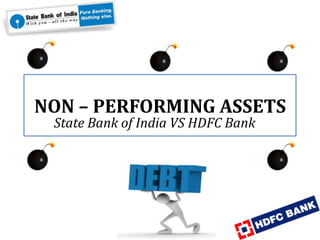
NON – PERFORMING ASSETS
 State Bank of India VS HDFC Bank
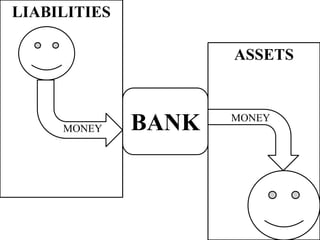
LIABILITIES

                     ASSETS


     MONEY    BANK   MONEY
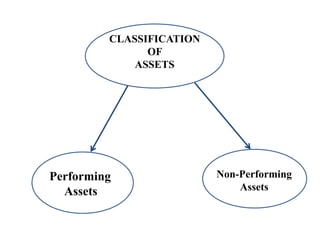
CLASSIFICATION
               OF
             ASSETS


Performing                Non-Performing
  Assets                      Assets
WHAT IS AN ‘NPA’?
A NPA is a loan or an advance where;
    Interest and/ or installment of principal remains
     overdue for a period of more than 90 days in respect
     of a term loan,
    The account remains “out of order” in respect of an
     overdraft/ cash credit.
    The bill remains overdue for a period of more than 90
     days in the case of bills purchased and discounted.
    The installment or interest remains overdue for two
     crop seasons in case of short duration crops and for
     one crop season in case of long duration crops.
CATEGORIES OF NPA
 Substandard Assets – Which has remained
 NPA for a period less than or equal to 12
 months.
 Doubtful Assets – Which has remained in
 the sub-standard category for a period of 12
 months (mainly up to 3 years).
 Loss Assets – where loss has been
 identified by the bank or internal or external
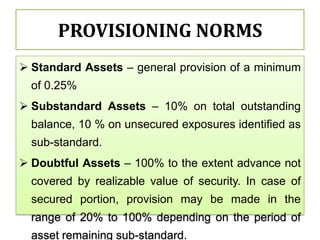
PROVISIONING NORMS
 Standard Assets – general provision of a minimum
  of 0.25%
 Substandard Assets – 10% on total outstanding
  balance, 10 % on unsecured exposures identified as
  sub-standard.
 Doubtful Assets – 100% to the extent advance not
  covered by realizable value of security. In case of
  secured portion, provision may be made in the
  range of 20% to 100% depending on the period of
  asset remaining sub-standard.
IMPACT OF NPA ON BANKS
 They erode current profits through provisioning
  requirements.

 They result in reduced interest income.

 They require higher provisioning requirements
  affecting profits and accretion to capital.

 Bank’s rating gets affected.

 Bad effect on Goodwill & equity value.
REASONS FOR NPA
Internal Factors
 Inefficiency in management.
 Slackness     in   credit   management   and
  monitoring.
 Lack of co-ordination among lenders.
 Problem of bad credit appraisal.
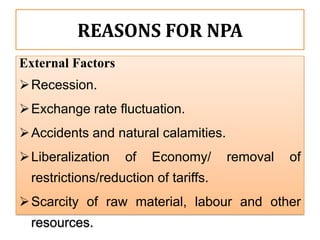
 Poor recovery of receivables.
REASONS FOR NPA
External Factors
 Recession.
 Exchange rate fluctuation.
 Accidents and natural calamities.
 Liberalization    of   Economy/      removal   of
  restrictions/reduction of tariffs.
 Scarcity of raw material, labour and other
  resources.
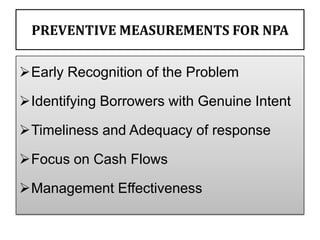
PREVENTIVE MEASUREMENTS FOR NPA

Early Recognition of the Problem

Identifying Borrowers with Genuine Intent

Timeliness and Adequacy of response

Focus on Cash Flows

Management Effectiveness
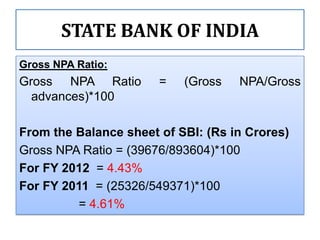
STATE BANK OF INDIA
Gross NPA Ratio:
Gross NPA Ratio        =   (Gross   NPA/Gross
  advances)*100

From the Balance sheet of SBI: (Rs in Crores)
Gross NPA Ratio = (39676/893604)*100
For FY 2012 = 4.43%
For FY 2011 = (25326/549371)*100
         = 4.61%
NET NPA RATIO
Net NPA Ratio:
NET NPA RATIO =
    [(Gross NPA – Provisions)/(Gross Advances –
                   Provisions)]*100

For FY 2012 = [(39676 – 24884)/ (893604 – 24884)]*100
          = 1.82%

For FY 2011= [(25326 – 22060)/ (549371 – 22060)]*100
         = 1.63%
HDFC BANK
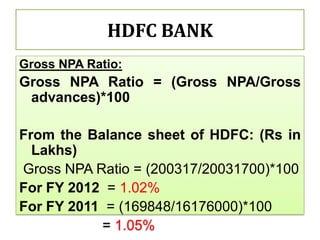
Gross NPA Ratio:
Gross NPA Ratio = (Gross NPA/Gross
 advances)*100

From the Balance sheet of HDFC: (Rs in
  Lakhs)
Gross NPA Ratio = (200317/20031700)*100
For FY 2012 = 1.02%
For FY 2011 = (169848/16176000)*100
           = 1.05%
NET NPA RATIO
Net NPA Ratio:
NET NPA RATIO =
    [(Gross NPA – Provisions)/(Gross Advances –
                   Provisions)]*100

For FY 2012 = [(200317 – 164898)/ (20031700 –
  164898)]*100
         = 0.18%

For FY 2011= [(25326       –139986)/   (16176000   –
  139986)]*100
         = 0.19%
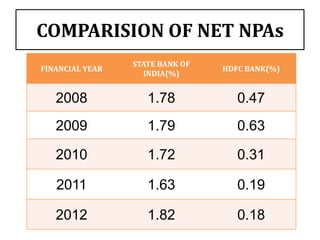
COMPARISION OF NET NPAs
                 STATE BANK OF
FINANCIAL YEAR                   HDFC BANK(%)
                   INDIA(%)


   2008             1.78            0.47
   2009             1.79            0.63

   2010             1.72            0.31

   2011             1.63            0.19

   2012             1.82            0.18
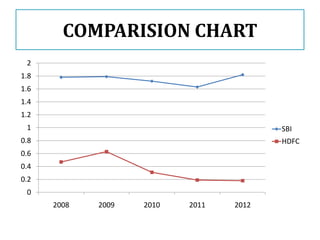
COMPARISION CHART
 2
1.8
1.6
1.4
1.2
 1                                       SBI
0.8                                      HDFC
0.6
0.4
0.2
 0
      2008   2009   2010   2011   2012
Huh! Where am I
supposed to Invest my
    1 Million???
Presented by:
P. S. Krishna Kanth

Non performing assets

  • 1.
    NON – PERFORMINGASSETS State Bank of India VS HDFC Bank
  • 2.
    LIABILITIES ASSETS MONEY BANK MONEY
  • 3.
    CLASSIFICATION OF ASSETS Performing Non-Performing Assets Assets
  • 4.
    WHAT IS AN‘NPA’? A NPA is a loan or an advance where;  Interest and/ or installment of principal remains overdue for a period of more than 90 days in respect of a term loan,  The account remains “out of order” in respect of an overdraft/ cash credit.  The bill remains overdue for a period of more than 90 days in the case of bills purchased and discounted.  The installment or interest remains overdue for two crop seasons in case of short duration crops and for one crop season in case of long duration crops.
  • 5.
    CATEGORIES OF NPA Substandard Assets – Which has remained NPA for a period less than or equal to 12 months.  Doubtful Assets – Which has remained in the sub-standard category for a period of 12 months (mainly up to 3 years).  Loss Assets – where loss has been identified by the bank or internal or external
  • 6.
    PROVISIONING NORMS  StandardAssets – general provision of a minimum of 0.25%  Substandard Assets – 10% on total outstanding balance, 10 % on unsecured exposures identified as sub-standard.  Doubtful Assets – 100% to the extent advance not covered by realizable value of security. In case of secured portion, provision may be made in the range of 20% to 100% depending on the period of asset remaining sub-standard.
  • 7.
    IMPACT OF NPAON BANKS  They erode current profits through provisioning requirements.  They result in reduced interest income.  They require higher provisioning requirements affecting profits and accretion to capital.  Bank’s rating gets affected.  Bad effect on Goodwill & equity value.
  • 8.
    REASONS FOR NPA InternalFactors  Inefficiency in management.  Slackness in credit management and monitoring.  Lack of co-ordination among lenders.  Problem of bad credit appraisal.  Poor recovery of receivables.
  • 9.
    REASONS FOR NPA ExternalFactors  Recession.  Exchange rate fluctuation.  Accidents and natural calamities.  Liberalization of Economy/ removal of restrictions/reduction of tariffs.  Scarcity of raw material, labour and other resources.
  • 10.
    PREVENTIVE MEASUREMENTS FORNPA Early Recognition of the Problem Identifying Borrowers with Genuine Intent Timeliness and Adequacy of response Focus on Cash Flows Management Effectiveness
  • 12.
    STATE BANK OFINDIA Gross NPA Ratio: Gross NPA Ratio = (Gross NPA/Gross advances)*100 From the Balance sheet of SBI: (Rs in Crores) Gross NPA Ratio = (39676/893604)*100 For FY 2012 = 4.43% For FY 2011 = (25326/549371)*100 = 4.61%
  • 13.
    NET NPA RATIO NetNPA Ratio: NET NPA RATIO = [(Gross NPA – Provisions)/(Gross Advances – Provisions)]*100 For FY 2012 = [(39676 – 24884)/ (893604 – 24884)]*100 = 1.82% For FY 2011= [(25326 – 22060)/ (549371 – 22060)]*100 = 1.63%
  • 14.
    HDFC BANK Gross NPARatio: Gross NPA Ratio = (Gross NPA/Gross advances)*100 From the Balance sheet of HDFC: (Rs in Lakhs) Gross NPA Ratio = (200317/20031700)*100 For FY 2012 = 1.02% For FY 2011 = (169848/16176000)*100 = 1.05%
  • 15.
    NET NPA RATIO NetNPA Ratio: NET NPA RATIO = [(Gross NPA – Provisions)/(Gross Advances – Provisions)]*100 For FY 2012 = [(200317 – 164898)/ (20031700 – 164898)]*100 = 0.18% For FY 2011= [(25326 –139986)/ (16176000 – 139986)]*100 = 0.19%
  • 16.
    COMPARISION OF NETNPAs STATE BANK OF FINANCIAL YEAR HDFC BANK(%) INDIA(%) 2008 1.78 0.47 2009 1.79 0.63 2010 1.72 0.31 2011 1.63 0.19 2012 1.82 0.18
  • 17.
    COMPARISION CHART 2 1.8 1.6 1.4 1.2 1 SBI 0.8 HDFC 0.6 0.4 0.2 0 2008 2009 2010 2011 2012
  • 18.
    Huh! Where amI supposed to Invest my 1 Million???
  • 19.
    Presented by: P. S.Krishna Kanth