OPTIONS CALCULATOR
By raj raisinghani
WHAT ARE OPTIONS?
An option is a contract that gives the buyer the right,
but not the obligation, to buy or sell an underlying
asset at a specific price on or before a certain date.
CALLS AND PUTS
 They are types of options.
 A call gives the holder the right to buy an asset at a
certain price within a specific period of time. Calls
are similar to having a long position on a stock.
Buyers of calls hope that the stock will increase
substantially before the option expires.
 A put gives the holder the right to sell an asset at a
certain price within a specific period of time. Puts
are very similar to having a short position on a
stock. Buyers of puts hope that the price of the
stock will fall before the option expires.
STRIKE PRICE
 The price at which an underlying stock can be
purchased or sold is called the strike price.
 This is the price a stock price must go above (for
calls) or go below (for puts) before a position can
be exercised for a profit. All of this must occur
before the expiration date.
 For call options, the option is said to be in-the-
money if the share price is above the strike price. A
put option is in-the-money when the share price is
below the strike price.
 The amount by which an option is in-the-money is
referred to as intrinsic value.
VOLATILITY
 Volatility can either be measured by using the
standard deviation or variance between returns
from that same security or market index.
Commonly, the higher the volatility, the riskier the
security.
 A variable in option pricing formulas showing the
extent to which the return of the underlying asset
will fluctuate between now and the option's
expiration. Volatility, as expressed as a percentage
coefficient within option-pricing formulas, arises
from daily trading activities. How volatility is
measured will affect the value of the coefficient
used.
WHY OPTIONS?
 SPECULATION:
A person who trades with a higher-than-average risk in
return for a higher-than-average profit potential.
Speculators take large risks, especially with respect to
anticipating future price movements, in the hope of
making quick, large gains.
 HEDGING:
Making an investment to reduce the risk of adverse
price movements in an asset. Normally, a hedge
consists of taking an offsetting position in a related
security, such as a futures contract.
TYPES OF OPTIONS:
 AMERICAN OPTIONS:
They can be exercised at any time between the
date of purchase and the expiration date. The
example about Cory's Tequila Co. is an example of
the use of an American option. Most exchange-
traded options are of this type.
 EUROPEAN OPTIONS:
They are different from American options in that
they can only be exercised at the end of their lives.
The distinction between American and European
options has nothing to do with geographic location
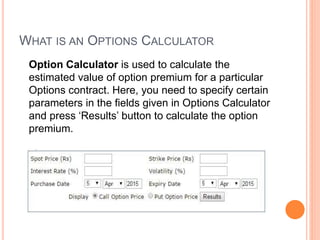
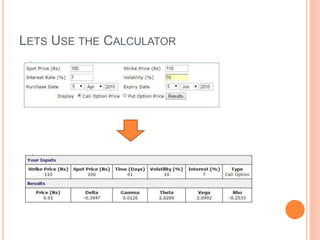
WHAT IS AN OPTIONS CALCULATOR
Option Calculator is used to calculate the
estimated value of option premium for a particular
Options contract. Here, you need to specify certain
parameters in the fields given in Options Calculator
and press ‘Results’ button to calculate the option
premium.
LETS USE THE CALCULATOR
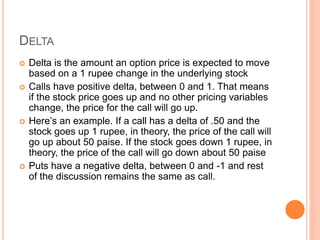
DELTA
 Delta is the amount an option price is expected to move
based on a 1 rupee change in the underlying stock
 Calls have positive delta, between 0 and 1. That means
if the stock price goes up and no other pricing variables
change, the price for the call will go up.
 Here’s an example. If a call has a delta of .50 and the
stock goes up 1 rupee, in theory, the price of the call will
go up about 50 paise. If the stock goes down 1 rupee, in
theory, the price of the call will go down about 50 paise
 Puts have a negative delta, between 0 and -1 and rest
of the discussion remains the same as call.
GAMMA
 Gamma is the rate that delta will change based on a 1 rupee
change in the stock price. So if delta is the “speed” at
which option prices change, you can think of gamma as
the “acceleration.”
 Options with the highest gamma are the most responsive to
changes in the price of the underlying stock.
 If you’re an option buyer, high gamma is good as long as
your forecast is correct. That’s because as your option
moves in-the-money, delta will approach 1 more rapidly. But if
your forecast is wrong, it can come back to bite you by rapidly
lowering your delta.
 If you’re an option seller and your forecast is incorrect, high
gamma is the enemy
THETA
 Time decay, or theta, is enemy number one for
the option buyer. On the other hand, it’s usually
the option seller’s best friend.
 Theta is the amount the price of calls and puts will
decrease (at least in theory) for a one-day change
in the time to expiration
 Each moment that passes causes some of the
option’s time value to “melt away.” Furthermore,
not only does the time value melt away, it does so
at an accelerated rate as expiration approaches.
VEGA
 You can think of vega as the Greek who’s a little shaky
and over-caffeinated.
 Vega is the amount call and put prices will change,
in theory, for a corresponding one-point change
in implied volatility.
 Vega does not have any effect on the intrinsic value of
options; it only affects the “time value” of an option’s
price.
 Typically, as implied volatility increases, the value of
options will increase. That’s because an increase in
implied volatility suggests an increased range of
potential movement for the stock.
RHO
 If you’re a more advanced option trader, you might
have noticed we’re missing a Greek — rho. That’s
the amount an option value will change in
theory based on a one percentage-point change
in interest rates.
 Just keep in mind that if you are trading shorter-
term options, changing interest rates shouldn’t
affect the value of your options too much.
 But if you are trading longer-term options such
as LEAPS, rho can have a much more significant
effect due to greater “cost to carry.”
GREEKS
 Delta - Delta measures the sensitivity of option's theoretical value with
change in the price of underlying asset. Its value varies between (-1) to
(+1).
 Gamma - Gamma measures the rate of change in delta value with one
point increase in the underlying asset. Its value is always positive.
 Theta - Theta is a measure of the rate of change in an option's
theoretical value for a one-unit change in time to the option's expiration
date.
 Vega - Vega is a measure of the rate of change in an option's theoretical
value for a one-unit change in the volatility assumption. It is also known
as Kappa.
 Rho - Rho is a measure of the expected change in an option's
theoretical value for a 1 percent change in interest rates.
ADVANTAGES
 Helps to know the option in a more technical way.
 Trader can decide if it can be a big profit or a big
loss.
 Can derive own values for profit success and check
for options that fall under the category.
 Helps to analyze the option price by keeping a
parameter constant and vary others.
THANK YOU

Options Calculator

  • 1.
  • 2.
    WHAT ARE OPTIONS? Anoption is a contract that gives the buyer the right, but not the obligation, to buy or sell an underlying asset at a specific price on or before a certain date.
  • 3.
    CALLS AND PUTS They are types of options.  A call gives the holder the right to buy an asset at a certain price within a specific period of time. Calls are similar to having a long position on a stock. Buyers of calls hope that the stock will increase substantially before the option expires.  A put gives the holder the right to sell an asset at a certain price within a specific period of time. Puts are very similar to having a short position on a stock. Buyers of puts hope that the price of the stock will fall before the option expires.
  • 4.
    STRIKE PRICE  Theprice at which an underlying stock can be purchased or sold is called the strike price.  This is the price a stock price must go above (for calls) or go below (for puts) before a position can be exercised for a profit. All of this must occur before the expiration date.  For call options, the option is said to be in-the- money if the share price is above the strike price. A put option is in-the-money when the share price is below the strike price.  The amount by which an option is in-the-money is referred to as intrinsic value.
  • 5.
    VOLATILITY  Volatility caneither be measured by using the standard deviation or variance between returns from that same security or market index. Commonly, the higher the volatility, the riskier the security.  A variable in option pricing formulas showing the extent to which the return of the underlying asset will fluctuate between now and the option's expiration. Volatility, as expressed as a percentage coefficient within option-pricing formulas, arises from daily trading activities. How volatility is measured will affect the value of the coefficient used.
  • 6.
    WHY OPTIONS?  SPECULATION: Aperson who trades with a higher-than-average risk in return for a higher-than-average profit potential. Speculators take large risks, especially with respect to anticipating future price movements, in the hope of making quick, large gains.  HEDGING: Making an investment to reduce the risk of adverse price movements in an asset. Normally, a hedge consists of taking an offsetting position in a related security, such as a futures contract.
  • 7.
    TYPES OF OPTIONS: AMERICAN OPTIONS: They can be exercised at any time between the date of purchase and the expiration date. The example about Cory's Tequila Co. is an example of the use of an American option. Most exchange- traded options are of this type.  EUROPEAN OPTIONS: They are different from American options in that they can only be exercised at the end of their lives. The distinction between American and European options has nothing to do with geographic location
  • 8.
    WHAT IS ANOPTIONS CALCULATOR Option Calculator is used to calculate the estimated value of option premium for a particular Options contract. Here, you need to specify certain parameters in the fields given in Options Calculator and press ‘Results’ button to calculate the option premium.
  • 9.
    LETS USE THECALCULATOR
  • 10.
    DELTA  Delta isthe amount an option price is expected to move based on a 1 rupee change in the underlying stock  Calls have positive delta, between 0 and 1. That means if the stock price goes up and no other pricing variables change, the price for the call will go up.  Here’s an example. If a call has a delta of .50 and the stock goes up 1 rupee, in theory, the price of the call will go up about 50 paise. If the stock goes down 1 rupee, in theory, the price of the call will go down about 50 paise  Puts have a negative delta, between 0 and -1 and rest of the discussion remains the same as call.
  • 11.
    GAMMA  Gamma isthe rate that delta will change based on a 1 rupee change in the stock price. So if delta is the “speed” at which option prices change, you can think of gamma as the “acceleration.”  Options with the highest gamma are the most responsive to changes in the price of the underlying stock.  If you’re an option buyer, high gamma is good as long as your forecast is correct. That’s because as your option moves in-the-money, delta will approach 1 more rapidly. But if your forecast is wrong, it can come back to bite you by rapidly lowering your delta.  If you’re an option seller and your forecast is incorrect, high gamma is the enemy
  • 12.
    THETA  Time decay,or theta, is enemy number one for the option buyer. On the other hand, it’s usually the option seller’s best friend.  Theta is the amount the price of calls and puts will decrease (at least in theory) for a one-day change in the time to expiration  Each moment that passes causes some of the option’s time value to “melt away.” Furthermore, not only does the time value melt away, it does so at an accelerated rate as expiration approaches.
  • 13.
    VEGA  You canthink of vega as the Greek who’s a little shaky and over-caffeinated.  Vega is the amount call and put prices will change, in theory, for a corresponding one-point change in implied volatility.  Vega does not have any effect on the intrinsic value of options; it only affects the “time value” of an option’s price.  Typically, as implied volatility increases, the value of options will increase. That’s because an increase in implied volatility suggests an increased range of potential movement for the stock.
  • 14.
    RHO  If you’rea more advanced option trader, you might have noticed we’re missing a Greek — rho. That’s the amount an option value will change in theory based on a one percentage-point change in interest rates.  Just keep in mind that if you are trading shorter- term options, changing interest rates shouldn’t affect the value of your options too much.  But if you are trading longer-term options such as LEAPS, rho can have a much more significant effect due to greater “cost to carry.”
  • 15.
    GREEKS  Delta -Delta measures the sensitivity of option's theoretical value with change in the price of underlying asset. Its value varies between (-1) to (+1).  Gamma - Gamma measures the rate of change in delta value with one point increase in the underlying asset. Its value is always positive.  Theta - Theta is a measure of the rate of change in an option's theoretical value for a one-unit change in time to the option's expiration date.  Vega - Vega is a measure of the rate of change in an option's theoretical value for a one-unit change in the volatility assumption. It is also known as Kappa.  Rho - Rho is a measure of the expected change in an option's theoretical value for a 1 percent change in interest rates.
  • 16.
    ADVANTAGES  Helps toknow the option in a more technical way.  Trader can decide if it can be a big profit or a big loss.  Can derive own values for profit success and check for options that fall under the category.  Helps to analyze the option price by keeping a parameter constant and vary others.
  • 17.