WEST AFRICAN COLLEGE OF SURGEONS
COLLEGE OUEST AFRICAN DES CHIRURGIENS
Diploma in Anaesthesia Update Course
PRESENTER
DR IBRAHIM SALIM ABDULLAHI
CONSULTANT ANAESTHETIST ATBUTH,BAUCHI
COURSE OUTLINE
• INTRODUCTION
• MORBIDITY AND MORTALITY
• PROCEDURES DONE OUTSIDE THE
OPERATING ROOM
• PLACES WHERE THE PROCEDURES ARE DONE
• CHALLENGES
• ANAESTHESIA TECHNIQUES
• CHOICE OF DRUGS
• MONITORING
• DISCHARGE CRITERIA
• SPECIFIC PROCEDURE ANAESTHESIA
• TAKE HOME MESSAGE
SYNONYMS
• NON OPERATING ROOM ANAESTHESIA
(NORA)
• ANAESTHESIA AT REMOTE LOCATION
INTRODUCTION
• NORA refers to administering sedation, analgesia, or anesthesia
outside the OR to patients with pre-op anxiety or undergoing
painful and/or uncomfortable procedures
• Medical technologies enable physicians to treat patients through
minimally invasive means outside of the OR
• NORA represents a growing field of medicine with an increasing
trend in the number of cases performed over the previous
decade
• According to a recently published article, NORA comprises about
50% of all anesthesia services provided at Mayo Clinics3
INTRODUCTION
• This rise in NORA procedures can be attributed to
• Advent of less invasive procedures
• An aging population with a more significant co-morbidity
burden
• Increased proficiency of interventionists
• It is the responsibility of the Anaesthetist to ensure safety & the
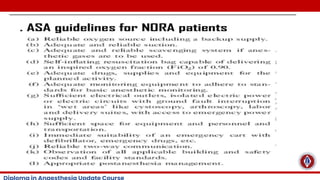
location meets the ASA guideline for safety
MORBIDITY AND MORTALITY
• There is limited data on the risk and outcomes of NORA cases
• Report based on data from the National Anaesthesia Clinical
Outcomes Registry (NACOR) suggest that NORA cases have a lower
rate of mortality (0.02%) compared to traditional OR procedures
(0.04%)
• The most common minor adverse outcome from NORA cases were
PONV, inadequate pain control and hemodynamic instability
• The most common major adverse outcomes were serious
hemodynamic instability and upgrade of care
PROCEDURES DONE OUTSIDE THE OR
• Diagnostic & Interventional Radiology
• Cardiac catheterisation, Coronary angiography, Stent replacements
• Cardioversions
• ECT
• Radiotherapy
• Bone Marrow Aspiration & LP
• Emergency airway management
• Transport of critically ill patients
• Removal of patients from rubble or accident vehicles
PLACES WHERE PROCEDURES ARE DONE
• Radiology Suite: CT Scan, MRI
• Cardiac Cath Lab
• Psychiatry
• Cancer wards
• Paediatric wards
• Burns Unit
• Endoscopy Suite
• Dental Clinic
• Renal Unit
• Gynaecology Unit
• Field situations
• Transport vehicles – road/air.
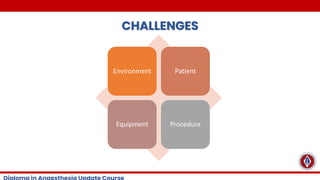
CHALLENGES
Environment Patient
Equipment Procedure
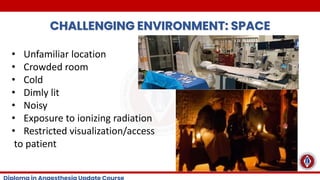
CHALLENGING ENVIRONMENT: SPACE
• Unfamiliar location
• Crowded room
• Cold
• Dimly lit
• Noisy
• Exposure to ionizing radiation
• Restricted visualization/access
to patient
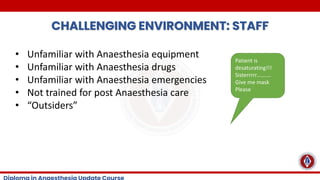
CHALLENGING ENVIRONMENT: STAFF
• Unfamiliar with Anaesthesia equipment
• Unfamiliar with Anaesthesia drugs
• Unfamiliar with Anaesthesia emergencies
• Not trained for post Anaesthesia care
• “Outsiders”
Patient is
desaturating!!!
Sisterrrrr……….
Give me mask
Please
CHALLENGING PATIENTS
• Outpatient
• Not prepared
• Fasting status
• All age groups
• Sicker
• Comorbidities
• Consent issues
• Awkward Positioning
• Complex anomalies
CHALLENGING PROCEDURE
• Novel
• Inexperience
• Inadequate understanding
• Unpredictable duration
• Mid procedure rescue calls: a very nice trap
• MAC to GA
• Availability of an ICU bed: aneurysm coiling
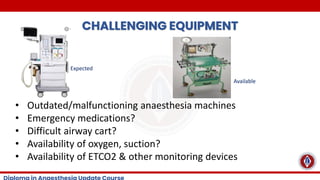
CHALLENGING EQUIPMENT
Expected
Available
• Outdated/malfunctioning anaesthesia machines
• Emergency medications?
• Difficult airway cart?
• Availability of oxygen, suction?
• Availability of ETCO2 & other monitoring devices
Addressing Environmental Challenges
• Reach in advance
• Locate everything
Space
• Ensure availability (check emergency and airway cart)
• Learn to say NO
Equipment
• Training Training Training
• Bring your anaesthesia technician with you
Staff
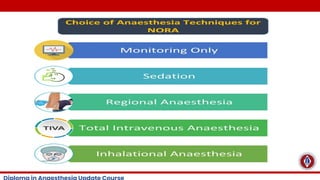
ANAESTHETIC TECHNIQUE
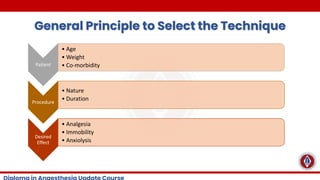
General Principle to Select the Technique
Patient
• Age
• Weight
• Co-morbidity
Procedure
• Nature
• Duration
Desired
Effect
• Analgesia
• Immobility
• Anxiolysis
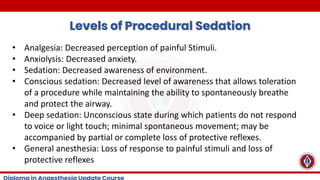
Levels of Procedural Sedation
• Analgesia: Decreased perception of painful Stimuli.
• Anxiolysis: Decreased anxiety.
• Sedation: Decreased awareness of environment.
• Conscious sedation: Decreased level of awareness that allows toleration
of a procedure while maintaining the ability to spontaneously breathe
and protect the airway.
• Deep sedation: Unconscious state during which patients do not respond
to voice or light touch; minimal spontaneous movement; may be
accompanied by partial or complete loss of protective reflexes.
• General anesthesia: Loss of response to painful stimuli and loss of
protective reflexes
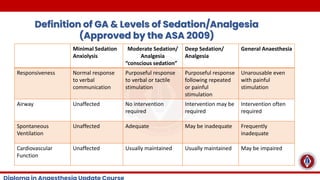
Definition of GA & Levels of Sedation/Analgesia
(Approved by the ASA 2009)
Minimal Sedation
Anxiolysis
Moderate Sedation/
Analgesia
“conscious sedation”
Deep Sedation/
Analgesia
General Anaesthesia
Responsiveness Normal response
to verbal
communication
Purposeful response
to verbal or tactile
stimulation
Purposeful response
following repeated
or painful
stimulation
Unarousable even
with painful
stimulation
Airway Unaffected No intervention
required
Intervention may be
required
Intervention often
required
Spontaneous
Ventilation
Unaffected Adequate May be inadequate Frequently
inadequate
Cardiovascular
Function
Unaffected Usually maintained Usually maintained May be impaired
Maintain the Balance
• The degree of safety in conscious sedation is much
higher than deep sedation
• The patient can easily drift from a state of conscious
sedation to deep sedation
• Titration and dose adjustment of sedative agents
requires skill and experience
Aims of the Anaesthesiologist
• Safety of the patient is the overriding goal of anaesthesia in remote
locations
• The standard of care should not differ from that offered in the operating
theatre.
• Rapid recovery from anaestheisa or sedation is beneficial.
• The particular goals to consider when sedating patients are to:
1. Guard the patient’s safety and welfare
2. Minimise physical discomfort and pain
3. Control anxiety, minimise psychological trauma & maximize the potential for
amnesia
4. Control movement to allow safe completion of the procedure
5. Return the patient to a state in which safe discharge from medical supervision is
possible
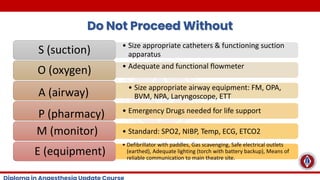
Do Not Proceed Without
• Size appropriate catheters & functioning suction
apparatus
S (suction)
• Adequate and functional flowmeter
O (oxygen)
• Size appropriate airway equipment: FM, OPA,
BVM, NPA, Laryngoscope, ETT
• Emergency Drugs needed for life support
• Standard: SPO2, NIBP, Temp, ECG, ETCO2
M (monitor)
• Defibrillator with paddles, Gas scavenging, Safe electrical outlets
(earthed), Adequate lighting (torch with battery backup), Means of
reliable communication to main theatre site.
E (equipment)
A (airway)
P (pharmacy)
MONITORING
• Presence of a trained vigilant Anaesthetist at all times
• Accordingly, patients are monitored both by:
• clinical observation (“look, listen, feel”)
• using specialized monitoring equipment
• Continuous monitoring various parameters such as level of
consciousness, oxygenation, ventilation & haemodynamics.
• Minimum monitoring includes pulse oximetry, ECG, NIBP and
endtidal CO2
Documentation of Anaesthesia
A time-based anaesthesia flow sheet should be available to record the
following:
• Drugs administered – time and dose
• SpO2
• Heart rate
• Respiratory rate
• NIBP – can omit if minimal sedation, e.g. during MRI/CT
• Level of sedation
Observations should be performed at 15 minute intervals for
conscious sedation and 5 minute intervals for deep sedation & GA
Choice of Drugs
This depends on the procedure being performed: (e.g. MRI
scan compared to endoscopy compared to a change of
burns dressings)
• Is the procedure painless?
• Is the procedure painful?
• What is the duration of procedure?
• Patient needs to be motionless?
Choice of Drugs
Examples of commonly used agents include:
❑ Benzodiazepines: Midazolam -0.01mg/kg
• Can be given by all routes
• Sedative, anxiolytic, anticonvulsant, amnesia
• Minimal hemodynamic effects
• Not an analgesic
❑ Propofol: An ideal choice 1-2 mg/kg.
• Shorter duration of action
• Complete recovery
• Early apnea & hypotension
• Pain during injection
Choice of Drugs Cont.
❑ketamine: commonly used in children 1-2 mg/kg i.v, 2-4 mg/kg i.m
-Perfect analgesia
-Reflexes retained
❑Fentanyl:0.25-0.5 mcg/Kg is usually sufficient
❑Ketofol:provides good haemodynamic stability
❑Remifentanil:an ideal drug but not available in Nigeria
Post Procedure Care
• Patients who had procedure under GA should be
transferred to PACU with monitors along with the
Anaesthetist
• Transport with oxygen
• Availability of an ICU bed has to be confirmed prior to the
procedure for patients who require elective post
procedure ventilation
Discharge Criteria
1. Stable C.V.S function
2. Satisfactory airway patency
3. Patient easily arousable.
4. Protective reflexes intact
5. Patient can talk, can sit up
6. Patient can void urine
7. Young & handicapped – preanesthetic level
8. Hydration must be adequate
Specific Problems
CT SCAN:
• Widely used in neuro-radiological procedures
• Non-invasive & painless, requires no sedation or anaesthesia in
most adults
• Needs immobile patient for 20-40 mins
• Its noisy & pts occasionally frightened/claustropobic
• Children, unconscious, non-cooperative, head injury, convulsions,
communication problems – requires sedation/anesthesia.
- airway obstruction
- kinking of tube
• Apnoea, cyanosis, cardiac arrest
• Anaphylaxis: contrast injection
• Radiation to Anaesthetist
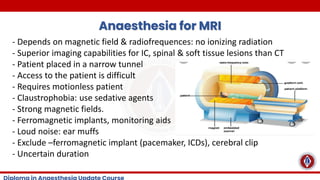
Anaesthesia for MRI
- Depends on magnetic field & radiofrequences: no ionizing radiation
- Superior imaging capabilities for IC, spinal & soft tissue lesions than CT
- Patient placed in a narrow tunnel
- Access to the patient is difficult
- Requires motionless patient
- Claustrophobia: use sedative agents
- Strong magnetic fields.
- Ferromagnetic implants, monitoring aids
- Loud noise: ear muffs
- Exclude –ferromagnetic implant (pacemaker, ICDs), cerebral clip
- Uncertain duration
MRI Cont.
• Ensure use compatible monitors, anaesthesia machine, ECG,
Pulse oximeter
• Modified anesthesia machine & monitors
- No coil cables use straight instead
- Piped gases or use special aluminum cylinders
- Plastic laryngoscope with batteries which are wrapped with plastic
covers
- Utilize tubings/breathing circuit extensions
- Drip stand and syringe pump behind the yellow line
• Induce the patient in the holding area on the MRI-safe cart, and
then transport the patient to the MRI.
Electroconvulsive Therapy (ECT)
• Used for patients with severe depression not controlled by the drugs
• Typically performed twice weekly until there is lack of further improvement
(6-12 Rxs over 2-4/52)
• Initial vagal discharge (5-15 secs), later sympathetic discharge (5-15 min.
• ECG – prolonged PR & QT intervals, T wave inversion
• ECT Anaesthetic goals:
• Amnesia & rapid recovery
• Prevent damage
• Control haemodynamic response
• Avoid interference with induced seizure
• All currently available induction agents are suitable except Ketamine
• Bite block protects the patient’s teeth, lips and tongue
• Increase intraocular & intra gastric pressures
• Need to modify the motor effects of the seizure to protect the patient:
Sux 0.5mg/kg
Contraindication
- Intracranial HTN
- Aneurysms: Aortic/cerebral
- recent MI, CCF
- untreated glaucoma
- Pheochromocytoma
- Recent CVA
- Cardiovascular conduction defects
- High risk pregnancy
- Major bone fractures
- Thrombophlebitis
- Retinal detachment
CARDIOVERSION
-Painful procedure usually done in the ICU
-Use of synchronized discharge to convert haemodynamically
unstable rhythm e.g. AF
-Standard monitoring, ECG, BP, Oximeter attached to the
patient
-Must be unconscious: Midazolam or Propofol can be use with
Fentanyl
-Consider RSI with ETT if high risk for aspiration
-Others should not touch the patient during shock
-Patient is ventilated with 100% O2 till recovery
ENDOSCOPY
• Common procedures: Esophagogastroduodenoscopy (EGD) and Endoscopic
Retrograde Cholangiopancreatography (ERCP)
• Patient must be evaluated
• Ideal fasting guidelines
• Glyco + Topical LA + Benzodiazepine/Propofol.
Contraindications: Achalasia, Oesophageal stricture, Corrosive oesophagitis,
Intestinal obstruction, Oesophageal discoordination
• When to intubate?
-Active bleed – RSI
-Unstable/critical patient
• Anaesthetic considerations:
-Strong vagal nerve stimulation as result of stimulation to colon
-Most patients tolerate these procedures well
RADIOTHERAPY
• High dose X-ray administered: painless procedure
• Children often require sedation/GA to remain motionless
• 3-4 times a week for 4 - 6 weeks
• Repeated anaesthesia is necessary
• Standard monitoring with CCTV
• Procedure typically lasts 10 minutes
• TIVA: ketamine with atropine/propofol can be employed
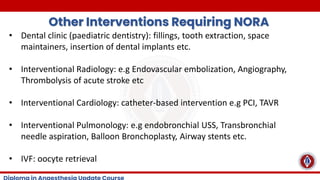
Other Interventions Requiring NORA
• Dental clinic (paediatric dentistry): fillings, tooth extraction, space
maintainers, insertion of dental implants etc.
• Interventional Radiology: e.g Endovascular embolization, Angiography,
Thrombolysis of acute stroke etc
• Interventional Cardiology: catheter-based intervention e.g PCI, TAVR
• Interventional Pulmonology: e.g endobronchial USS, Transbronchial
needle aspiration, Balloon Bronchoplasty, Airway stents etc.
• IVF: oocyte retrieval
INSERT TEXT HERE
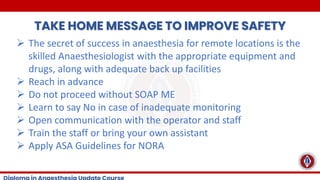
TAKE HOME MESSAGE TO IMPROVE SAFETY
➢ The secret of success in anaesthesia for remote locations is the
skilled Anaesthesiologist with the appropriate equipment and
drugs, along with adequate back up facilities
➢ Reach in advance
➢ Do not proceed without SOAP ME
➢ Learn to say No in case of inadequate monitoring
➢ Open communication with the operator and staff
➢ Train the staff or bring your own assistant
➢ Apply ASA Guidelines for NORA
1. Metzner J, Domino KB. Risks of anesthesia or sedation outside the operating room: the
role of the anesthesia care provider. Curr Opin Anaesthesiol. 2010; 23: 523–31
2. Warner ME, Martin DP. Scheduling the non-operating room anesthesia suite. Curr Opin
Anaesthesiol. 2018; 31(4): 492-7.
3. Non-Operating Room Anesthesia During Covid-19 Pandemic Era
(www.wfsahq.org/resources/update-in-anaesthesia) doi: 10.1029/WFSA-D-20-00021
4. Killic Y. Non-operating room anaesthesia: An overview. Cyprus J Med Sci 2020;5(2): 171-5
5. A.R Aithkenhead, G. Smith. D.J Rowbotham. Anaesthesia outside the operating theatre
environment. Textbook of Anaesthesia. 5th edition. Churchill Livingstone Elsevier, London
2007; 605-616.
6. J.D Walls, M.S Weiss. Safety in non-operating room anaesthesia (NORA). APSF Newsletter
2019; 34(1): 3-4

Anaesthesia Outside the Operating Room DA Update Course.pdf

  • 1.
    WEST AFRICAN COLLEGEOF SURGEONS COLLEGE OUEST AFRICAN DES CHIRURGIENS Diploma in Anaesthesia Update Course
  • 2.
    PRESENTER DR IBRAHIM SALIMABDULLAHI CONSULTANT ANAESTHETIST ATBUTH,BAUCHI
  • 3.
    COURSE OUTLINE • INTRODUCTION •MORBIDITY AND MORTALITY • PROCEDURES DONE OUTSIDE THE OPERATING ROOM • PLACES WHERE THE PROCEDURES ARE DONE • CHALLENGES • ANAESTHESIA TECHNIQUES • CHOICE OF DRUGS • MONITORING • DISCHARGE CRITERIA • SPECIFIC PROCEDURE ANAESTHESIA • TAKE HOME MESSAGE
  • 4.
    SYNONYMS • NON OPERATINGROOM ANAESTHESIA (NORA) • ANAESTHESIA AT REMOTE LOCATION
  • 5.
    INTRODUCTION • NORA refersto administering sedation, analgesia, or anesthesia outside the OR to patients with pre-op anxiety or undergoing painful and/or uncomfortable procedures • Medical technologies enable physicians to treat patients through minimally invasive means outside of the OR • NORA represents a growing field of medicine with an increasing trend in the number of cases performed over the previous decade • According to a recently published article, NORA comprises about 50% of all anesthesia services provided at Mayo Clinics3
  • 6.
    INTRODUCTION • This risein NORA procedures can be attributed to • Advent of less invasive procedures • An aging population with a more significant co-morbidity burden • Increased proficiency of interventionists • It is the responsibility of the Anaesthetist to ensure safety & the location meets the ASA guideline for safety
  • 7.
    MORBIDITY AND MORTALITY •There is limited data on the risk and outcomes of NORA cases • Report based on data from the National Anaesthesia Clinical Outcomes Registry (NACOR) suggest that NORA cases have a lower rate of mortality (0.02%) compared to traditional OR procedures (0.04%) • The most common minor adverse outcome from NORA cases were PONV, inadequate pain control and hemodynamic instability • The most common major adverse outcomes were serious hemodynamic instability and upgrade of care
  • 8.
    PROCEDURES DONE OUTSIDETHE OR • Diagnostic & Interventional Radiology • Cardiac catheterisation, Coronary angiography, Stent replacements • Cardioversions • ECT • Radiotherapy • Bone Marrow Aspiration & LP • Emergency airway management • Transport of critically ill patients • Removal of patients from rubble or accident vehicles
  • 9.
    PLACES WHERE PROCEDURESARE DONE • Radiology Suite: CT Scan, MRI • Cardiac Cath Lab • Psychiatry • Cancer wards • Paediatric wards • Burns Unit • Endoscopy Suite • Dental Clinic • Renal Unit • Gynaecology Unit • Field situations • Transport vehicles – road/air.
  • 10.
  • 11.
    CHALLENGING ENVIRONMENT: SPACE •Unfamiliar location • Crowded room • Cold • Dimly lit • Noisy • Exposure to ionizing radiation • Restricted visualization/access to patient
  • 12.
    CHALLENGING ENVIRONMENT: STAFF •Unfamiliar with Anaesthesia equipment • Unfamiliar with Anaesthesia drugs • Unfamiliar with Anaesthesia emergencies • Not trained for post Anaesthesia care • “Outsiders” Patient is desaturating!!! Sisterrrrr………. Give me mask Please
  • 13.
    CHALLENGING PATIENTS • Outpatient •Not prepared • Fasting status • All age groups • Sicker • Comorbidities • Consent issues • Awkward Positioning • Complex anomalies
  • 14.
    CHALLENGING PROCEDURE • Novel •Inexperience • Inadequate understanding • Unpredictable duration • Mid procedure rescue calls: a very nice trap • MAC to GA • Availability of an ICU bed: aneurysm coiling
  • 15.
    CHALLENGING EQUIPMENT Expected Available • Outdated/malfunctioninganaesthesia machines • Emergency medications? • Difficult airway cart? • Availability of oxygen, suction? • Availability of ETCO2 & other monitoring devices
  • 16.
    Addressing Environmental Challenges •Reach in advance • Locate everything Space • Ensure availability (check emergency and airway cart) • Learn to say NO Equipment • Training Training Training • Bring your anaesthesia technician with you Staff
  • 17.
  • 18.
    General Principle toSelect the Technique Patient • Age • Weight • Co-morbidity Procedure • Nature • Duration Desired Effect • Analgesia • Immobility • Anxiolysis
  • 19.
    Levels of ProceduralSedation • Analgesia: Decreased perception of painful Stimuli. • Anxiolysis: Decreased anxiety. • Sedation: Decreased awareness of environment. • Conscious sedation: Decreased level of awareness that allows toleration of a procedure while maintaining the ability to spontaneously breathe and protect the airway. • Deep sedation: Unconscious state during which patients do not respond to voice or light touch; minimal spontaneous movement; may be accompanied by partial or complete loss of protective reflexes. • General anesthesia: Loss of response to painful stimuli and loss of protective reflexes
  • 20.
    Definition of GA& Levels of Sedation/Analgesia (Approved by the ASA 2009) Minimal Sedation Anxiolysis Moderate Sedation/ Analgesia “conscious sedation” Deep Sedation/ Analgesia General Anaesthesia Responsiveness Normal response to verbal communication Purposeful response to verbal or tactile stimulation Purposeful response following repeated or painful stimulation Unarousable even with painful stimulation Airway Unaffected No intervention required Intervention may be required Intervention often required Spontaneous Ventilation Unaffected Adequate May be inadequate Frequently inadequate Cardiovascular Function Unaffected Usually maintained Usually maintained May be impaired
  • 21.
    Maintain the Balance •The degree of safety in conscious sedation is much higher than deep sedation • The patient can easily drift from a state of conscious sedation to deep sedation • Titration and dose adjustment of sedative agents requires skill and experience
  • 22.
    Aims of theAnaesthesiologist • Safety of the patient is the overriding goal of anaesthesia in remote locations • The standard of care should not differ from that offered in the operating theatre. • Rapid recovery from anaestheisa or sedation is beneficial. • The particular goals to consider when sedating patients are to: 1. Guard the patient’s safety and welfare 2. Minimise physical discomfort and pain 3. Control anxiety, minimise psychological trauma & maximize the potential for amnesia 4. Control movement to allow safe completion of the procedure 5. Return the patient to a state in which safe discharge from medical supervision is possible
  • 23.
    Do Not ProceedWithout • Size appropriate catheters & functioning suction apparatus S (suction) • Adequate and functional flowmeter O (oxygen) • Size appropriate airway equipment: FM, OPA, BVM, NPA, Laryngoscope, ETT • Emergency Drugs needed for life support • Standard: SPO2, NIBP, Temp, ECG, ETCO2 M (monitor) • Defibrillator with paddles, Gas scavenging, Safe electrical outlets (earthed), Adequate lighting (torch with battery backup), Means of reliable communication to main theatre site. E (equipment) A (airway) P (pharmacy)
  • 24.
    MONITORING • Presence ofa trained vigilant Anaesthetist at all times • Accordingly, patients are monitored both by: • clinical observation (“look, listen, feel”) • using specialized monitoring equipment • Continuous monitoring various parameters such as level of consciousness, oxygenation, ventilation & haemodynamics. • Minimum monitoring includes pulse oximetry, ECG, NIBP and endtidal CO2
  • 25.
    Documentation of Anaesthesia Atime-based anaesthesia flow sheet should be available to record the following: • Drugs administered – time and dose • SpO2 • Heart rate • Respiratory rate • NIBP – can omit if minimal sedation, e.g. during MRI/CT • Level of sedation Observations should be performed at 15 minute intervals for conscious sedation and 5 minute intervals for deep sedation & GA
  • 26.
    Choice of Drugs Thisdepends on the procedure being performed: (e.g. MRI scan compared to endoscopy compared to a change of burns dressings) • Is the procedure painless? • Is the procedure painful? • What is the duration of procedure? • Patient needs to be motionless?
  • 27.
    Choice of Drugs Examplesof commonly used agents include: ❑ Benzodiazepines: Midazolam -0.01mg/kg • Can be given by all routes • Sedative, anxiolytic, anticonvulsant, amnesia • Minimal hemodynamic effects • Not an analgesic ❑ Propofol: An ideal choice 1-2 mg/kg. • Shorter duration of action • Complete recovery • Early apnea & hypotension • Pain during injection
  • 28.
    Choice of DrugsCont. ❑ketamine: commonly used in children 1-2 mg/kg i.v, 2-4 mg/kg i.m -Perfect analgesia -Reflexes retained ❑Fentanyl:0.25-0.5 mcg/Kg is usually sufficient ❑Ketofol:provides good haemodynamic stability ❑Remifentanil:an ideal drug but not available in Nigeria
  • 29.
    Post Procedure Care •Patients who had procedure under GA should be transferred to PACU with monitors along with the Anaesthetist • Transport with oxygen • Availability of an ICU bed has to be confirmed prior to the procedure for patients who require elective post procedure ventilation
  • 30.
    Discharge Criteria 1. StableC.V.S function 2. Satisfactory airway patency 3. Patient easily arousable. 4. Protective reflexes intact 5. Patient can talk, can sit up 6. Patient can void urine 7. Young & handicapped – preanesthetic level 8. Hydration must be adequate
  • 31.
    Specific Problems CT SCAN: •Widely used in neuro-radiological procedures • Non-invasive & painless, requires no sedation or anaesthesia in most adults • Needs immobile patient for 20-40 mins • Its noisy & pts occasionally frightened/claustropobic • Children, unconscious, non-cooperative, head injury, convulsions, communication problems – requires sedation/anesthesia. - airway obstruction - kinking of tube • Apnoea, cyanosis, cardiac arrest • Anaphylaxis: contrast injection • Radiation to Anaesthetist
  • 32.
    Anaesthesia for MRI -Depends on magnetic field & radiofrequences: no ionizing radiation - Superior imaging capabilities for IC, spinal & soft tissue lesions than CT - Patient placed in a narrow tunnel - Access to the patient is difficult - Requires motionless patient - Claustrophobia: use sedative agents - Strong magnetic fields. - Ferromagnetic implants, monitoring aids - Loud noise: ear muffs - Exclude –ferromagnetic implant (pacemaker, ICDs), cerebral clip - Uncertain duration
  • 33.
    MRI Cont. • Ensureuse compatible monitors, anaesthesia machine, ECG, Pulse oximeter • Modified anesthesia machine & monitors - No coil cables use straight instead - Piped gases or use special aluminum cylinders - Plastic laryngoscope with batteries which are wrapped with plastic covers - Utilize tubings/breathing circuit extensions - Drip stand and syringe pump behind the yellow line • Induce the patient in the holding area on the MRI-safe cart, and then transport the patient to the MRI.
  • 34.
    Electroconvulsive Therapy (ECT) •Used for patients with severe depression not controlled by the drugs • Typically performed twice weekly until there is lack of further improvement (6-12 Rxs over 2-4/52) • Initial vagal discharge (5-15 secs), later sympathetic discharge (5-15 min. • ECG – prolonged PR & QT intervals, T wave inversion • ECT Anaesthetic goals: • Amnesia & rapid recovery • Prevent damage • Control haemodynamic response • Avoid interference with induced seizure • All currently available induction agents are suitable except Ketamine • Bite block protects the patient’s teeth, lips and tongue • Increase intraocular & intra gastric pressures • Need to modify the motor effects of the seizure to protect the patient: Sux 0.5mg/kg
  • 35.
    Contraindication - Intracranial HTN -Aneurysms: Aortic/cerebral - recent MI, CCF - untreated glaucoma - Pheochromocytoma - Recent CVA - Cardiovascular conduction defects - High risk pregnancy - Major bone fractures - Thrombophlebitis - Retinal detachment
  • 36.
    CARDIOVERSION -Painful procedure usuallydone in the ICU -Use of synchronized discharge to convert haemodynamically unstable rhythm e.g. AF -Standard monitoring, ECG, BP, Oximeter attached to the patient -Must be unconscious: Midazolam or Propofol can be use with Fentanyl -Consider RSI with ETT if high risk for aspiration -Others should not touch the patient during shock -Patient is ventilated with 100% O2 till recovery
  • 37.
    ENDOSCOPY • Common procedures:Esophagogastroduodenoscopy (EGD) and Endoscopic Retrograde Cholangiopancreatography (ERCP) • Patient must be evaluated • Ideal fasting guidelines • Glyco + Topical LA + Benzodiazepine/Propofol. Contraindications: Achalasia, Oesophageal stricture, Corrosive oesophagitis, Intestinal obstruction, Oesophageal discoordination • When to intubate? -Active bleed – RSI -Unstable/critical patient • Anaesthetic considerations: -Strong vagal nerve stimulation as result of stimulation to colon -Most patients tolerate these procedures well
  • 38.
    RADIOTHERAPY • High doseX-ray administered: painless procedure • Children often require sedation/GA to remain motionless • 3-4 times a week for 4 - 6 weeks • Repeated anaesthesia is necessary • Standard monitoring with CCTV • Procedure typically lasts 10 minutes • TIVA: ketamine with atropine/propofol can be employed
  • 39.
    Other Interventions RequiringNORA • Dental clinic (paediatric dentistry): fillings, tooth extraction, space maintainers, insertion of dental implants etc. • Interventional Radiology: e.g Endovascular embolization, Angiography, Thrombolysis of acute stroke etc • Interventional Cardiology: catheter-based intervention e.g PCI, TAVR • Interventional Pulmonology: e.g endobronchial USS, Transbronchial needle aspiration, Balloon Bronchoplasty, Airway stents etc. • IVF: oocyte retrieval
  • 40.
  • 41.
    TAKE HOME MESSAGETO IMPROVE SAFETY ➢ The secret of success in anaesthesia for remote locations is the skilled Anaesthesiologist with the appropriate equipment and drugs, along with adequate back up facilities ➢ Reach in advance ➢ Do not proceed without SOAP ME ➢ Learn to say No in case of inadequate monitoring ➢ Open communication with the operator and staff ➢ Train the staff or bring your own assistant ➢ Apply ASA Guidelines for NORA
  • 43.
    1. Metzner J,Domino KB. Risks of anesthesia or sedation outside the operating room: the role of the anesthesia care provider. Curr Opin Anaesthesiol. 2010; 23: 523–31 2. Warner ME, Martin DP. Scheduling the non-operating room anesthesia suite. Curr Opin Anaesthesiol. 2018; 31(4): 492-7. 3. Non-Operating Room Anesthesia During Covid-19 Pandemic Era (www.wfsahq.org/resources/update-in-anaesthesia) doi: 10.1029/WFSA-D-20-00021 4. Killic Y. Non-operating room anaesthesia: An overview. Cyprus J Med Sci 2020;5(2): 171-5 5. A.R Aithkenhead, G. Smith. D.J Rowbotham. Anaesthesia outside the operating theatre environment. Textbook of Anaesthesia. 5th edition. Churchill Livingstone Elsevier, London 2007; 605-616. 6. J.D Walls, M.S Weiss. Safety in non-operating room anaesthesia (NORA). APSF Newsletter 2019; 34(1): 3-4