Non-Intrusive Load Monitoring
Center for Energy and Environment, MNIT
Submitted by
Sai Goutham Golive
2014pcv5192
Submitted to
Prof. Jyotirmay Mathur
1
Contents
 Background
 Introduction
 General Frame Work Of NILM
 Data Acquisition
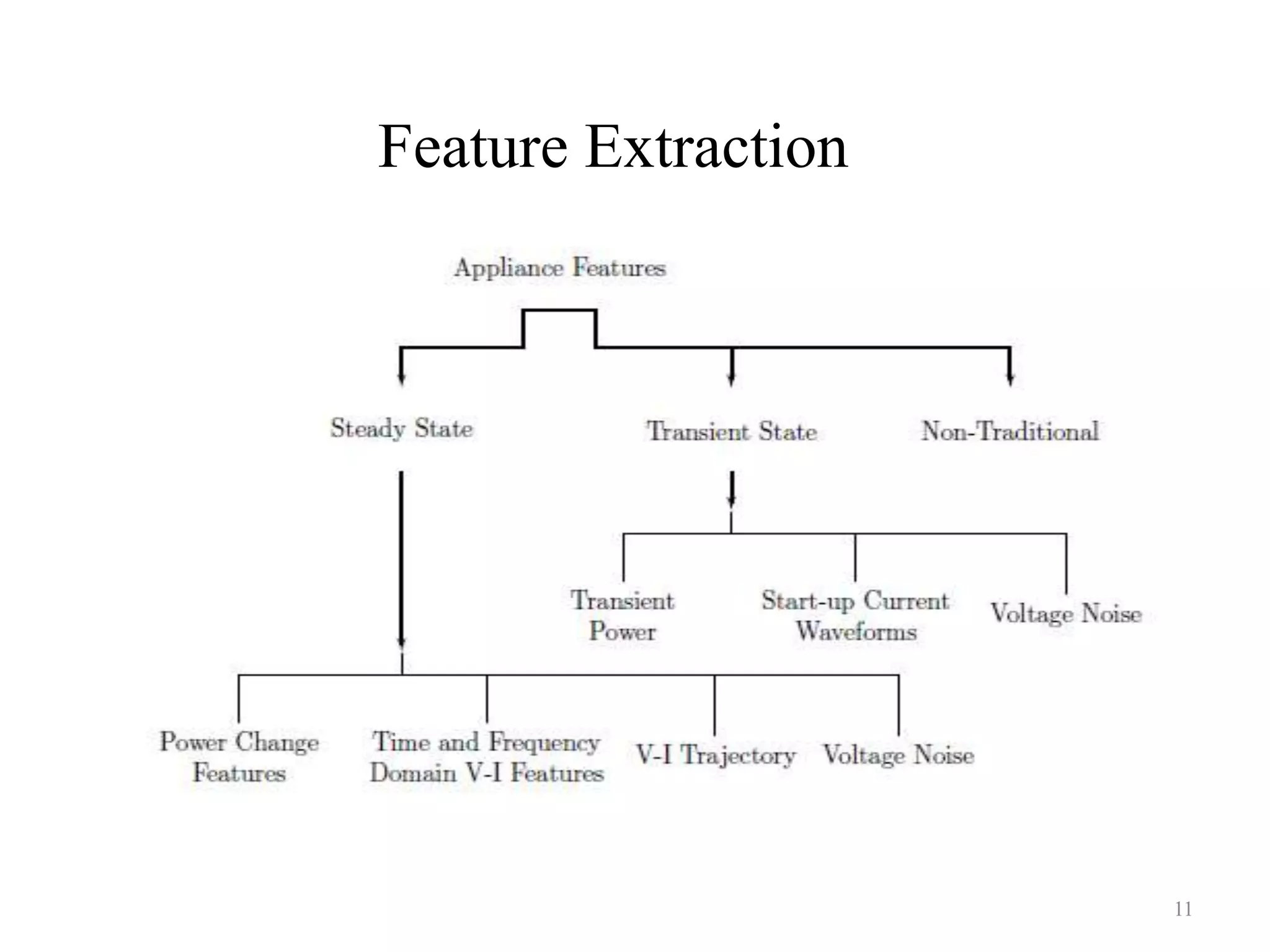
 Feature Extraction
 Load Identification
 System Training
 Challenges
 Conclusions
 References
2
Background
 Energy conservation is a challenging issue
 Global energy demands double by end of 2030 with negative impacts on the
environment
 Energy crisis, climate change and the overall economy of a country affected
by the growth in energy consumption
 Reduction in energy wastage can be achieved through monitoring of energy
consumption and relaying of this information back to the consumers
 Goal of ALM (Appliance Load Monitoring) is to perform detailed energy
sensing and to provide information on the energy spent
 ALM leads to identification of high energy consuming appliances
- peak to off-peak
3
Why does it matter?
 Improve relationships with customers
.
 Understand customer behavior to
improve capacity planning
 Identify appliances that could
participate in Demand Response
 Understand your bill
 Plan your monthly budget
 Be able to make a financial
decision for when to use an
appliance
4
Utilities Customers
Introduction
 Two major approaches to ALM
- Intrusive Load Monitoring (ILM)
- Non-Intrusive Load Monitoring (NILM)
 ILM require one or more than one sensor per appliance to perform ALM
 NILM just requires only a single meter per house
 The ILM method is more accurate compared with NILM
 The ILM method has practical disadvantages
- High costs, multiple sensor configuration, installation complexity
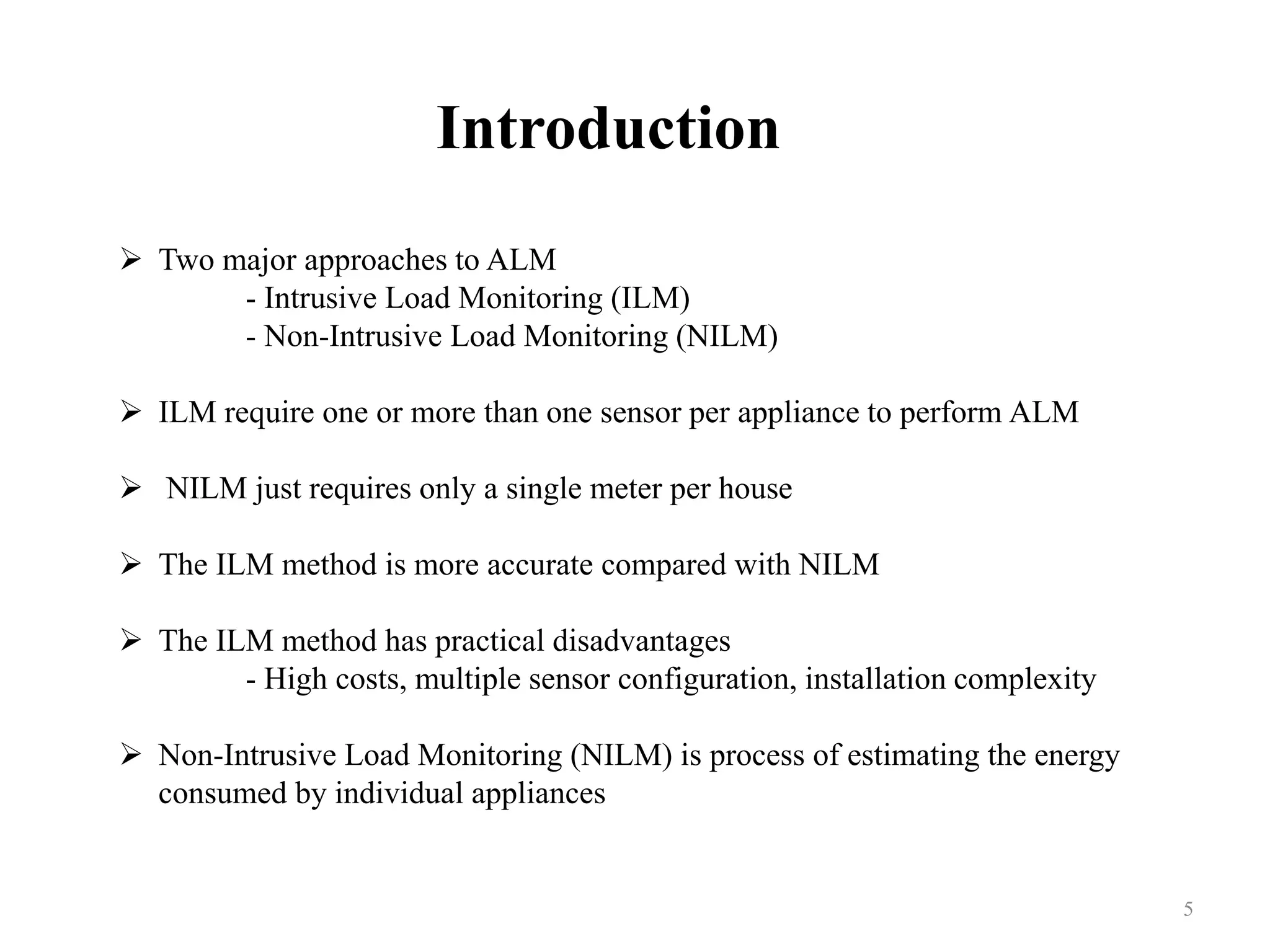
 Non-Intrusive Load Monitoring (NILM) is process of estimating the energy
consumed by individual appliances
5
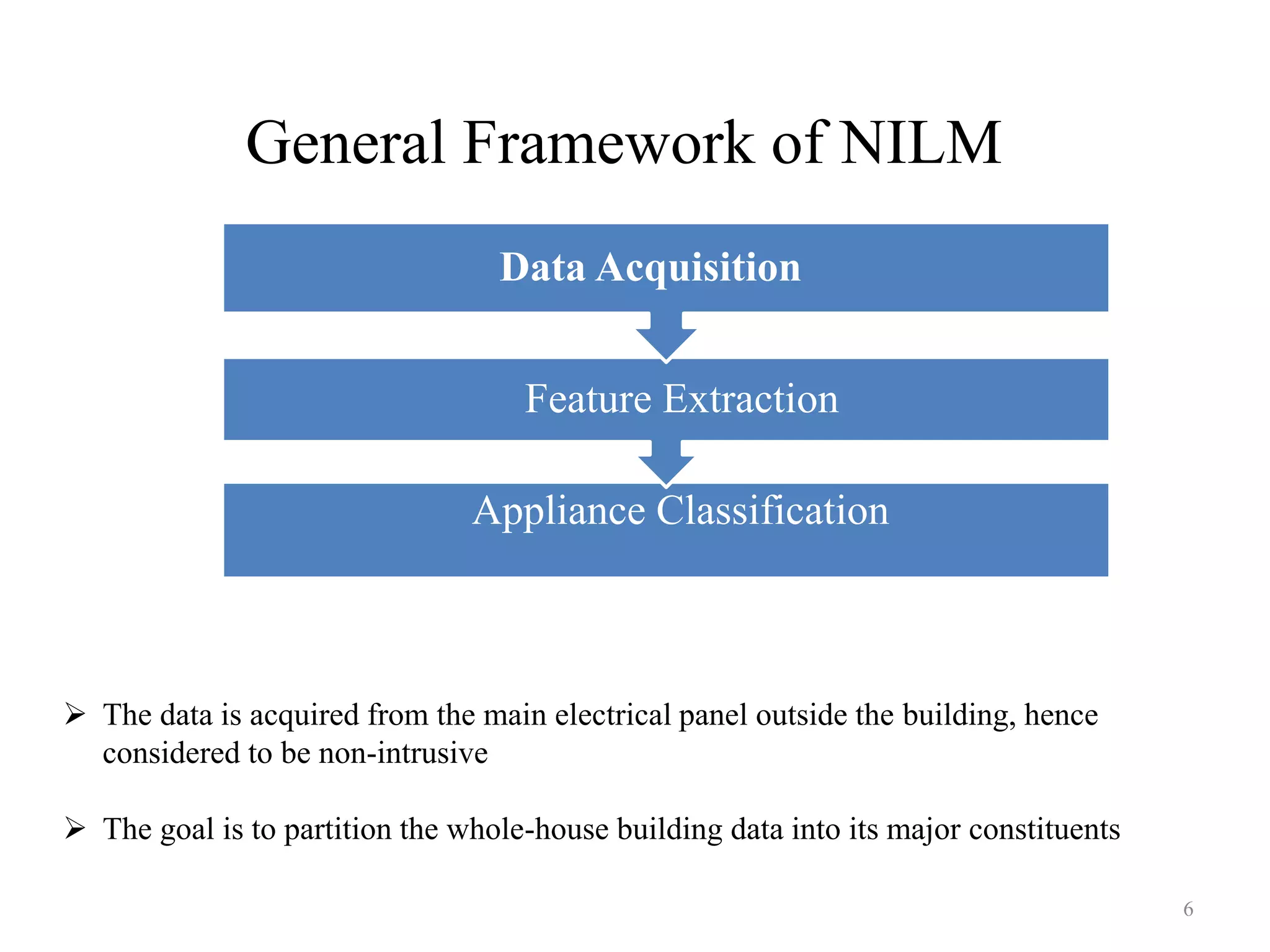
Appliance Classification
Feature Extraction
Data Acquisition
General Framework of NILM
 The data is acquired from the main electrical panel outside the building, hence
considered to be non-intrusive
 The goal is to partition the whole-house building data into its major constituents
6
 Segregation of total loads into individual appliance load and can be
formulated as:
P(t) = 𝑖=1
𝑛
𝑃𝑖(𝑡)
P(t) total power
Pi(t) power consumption of individual appliances
n is the total no. of active appliances.
Fig1: An aggregated load data obtained using single point of measurement [1]
7
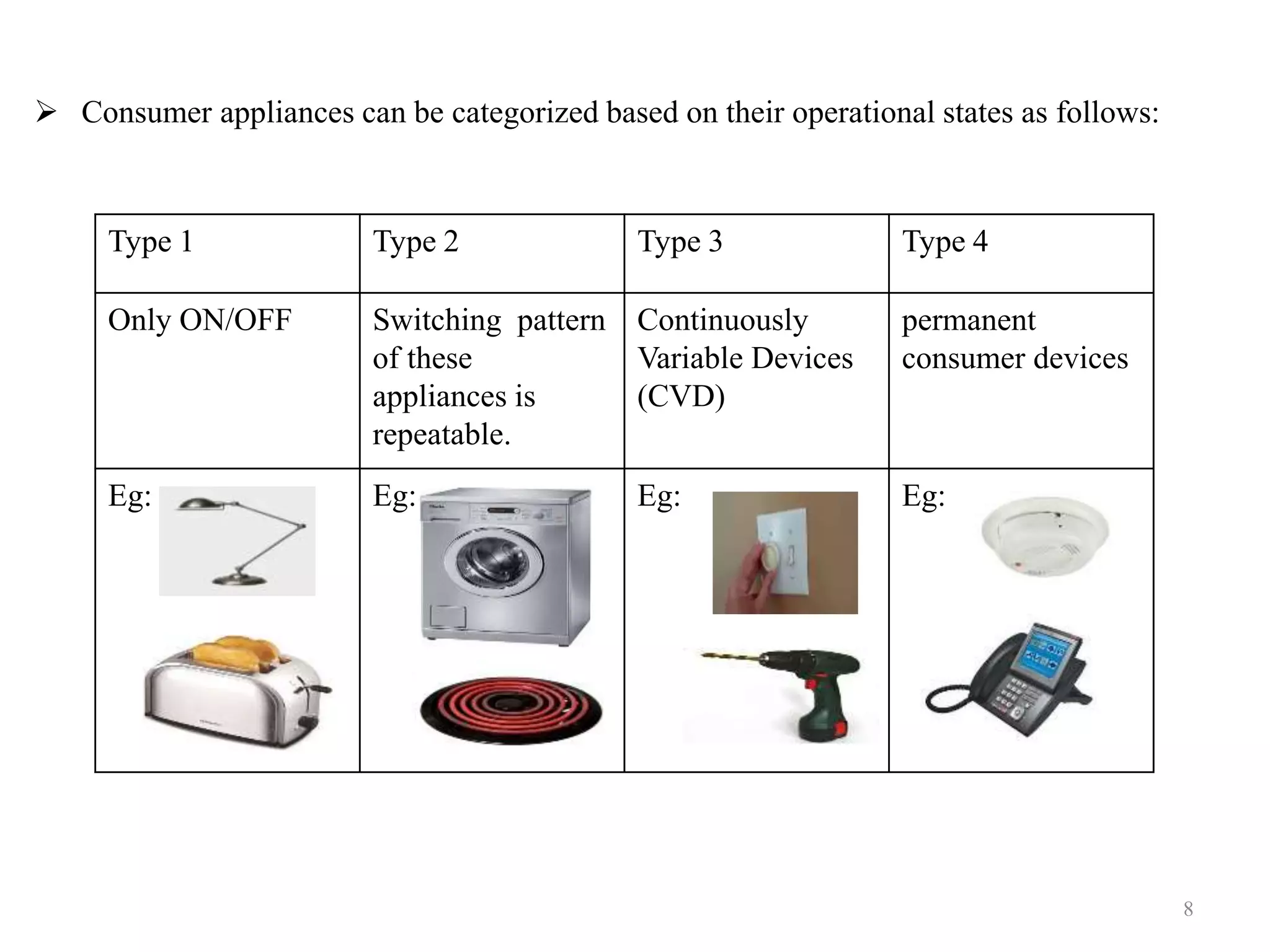
 Consumer appliances can be categorized based on their operational states as follows:
Type 1 Type 2 Type 3 Type 4
Only ON/OFF Switching pattern
of these
appliances is
repeatable.
Continuously
Variable Devices
(CVD)
permanent
consumer devices
Eg: Eg: Eg: Eg:
8
Fig2: Different load types based on their energy consumption pattern [1]
9
Data Acquisition Module
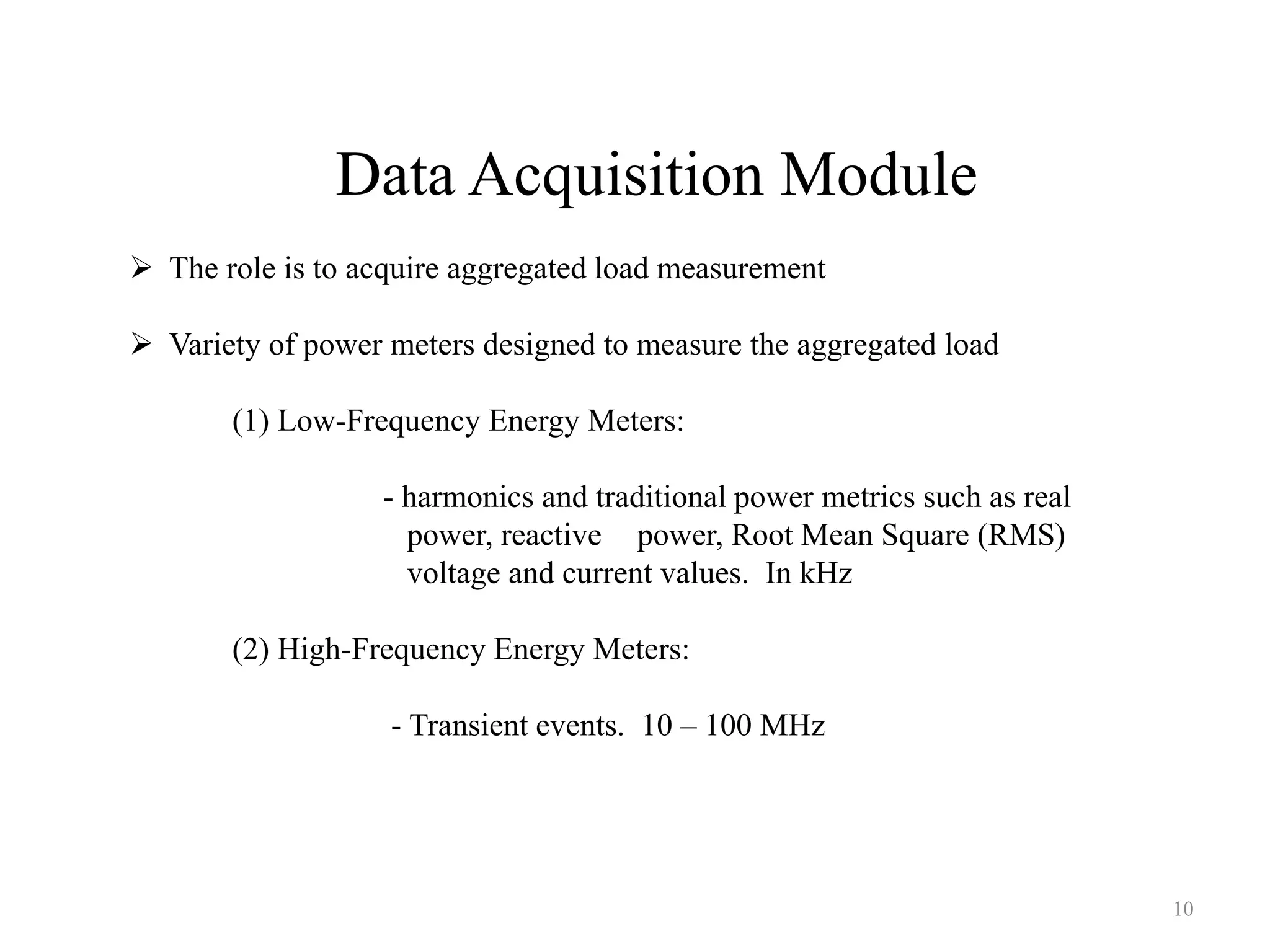
 The role is to acquire aggregated load measurement
 Variety of power meters designed to measure the aggregated load
(1) Low-Frequency Energy Meters:
- harmonics and traditional power metrics such as real
power, reactive power, Root Mean Square (RMS)
voltage and current values. In kHz
(2) High-Frequency Energy Meters:
- Transient events. 10 – 100 MHz
10
Feature Extraction
11
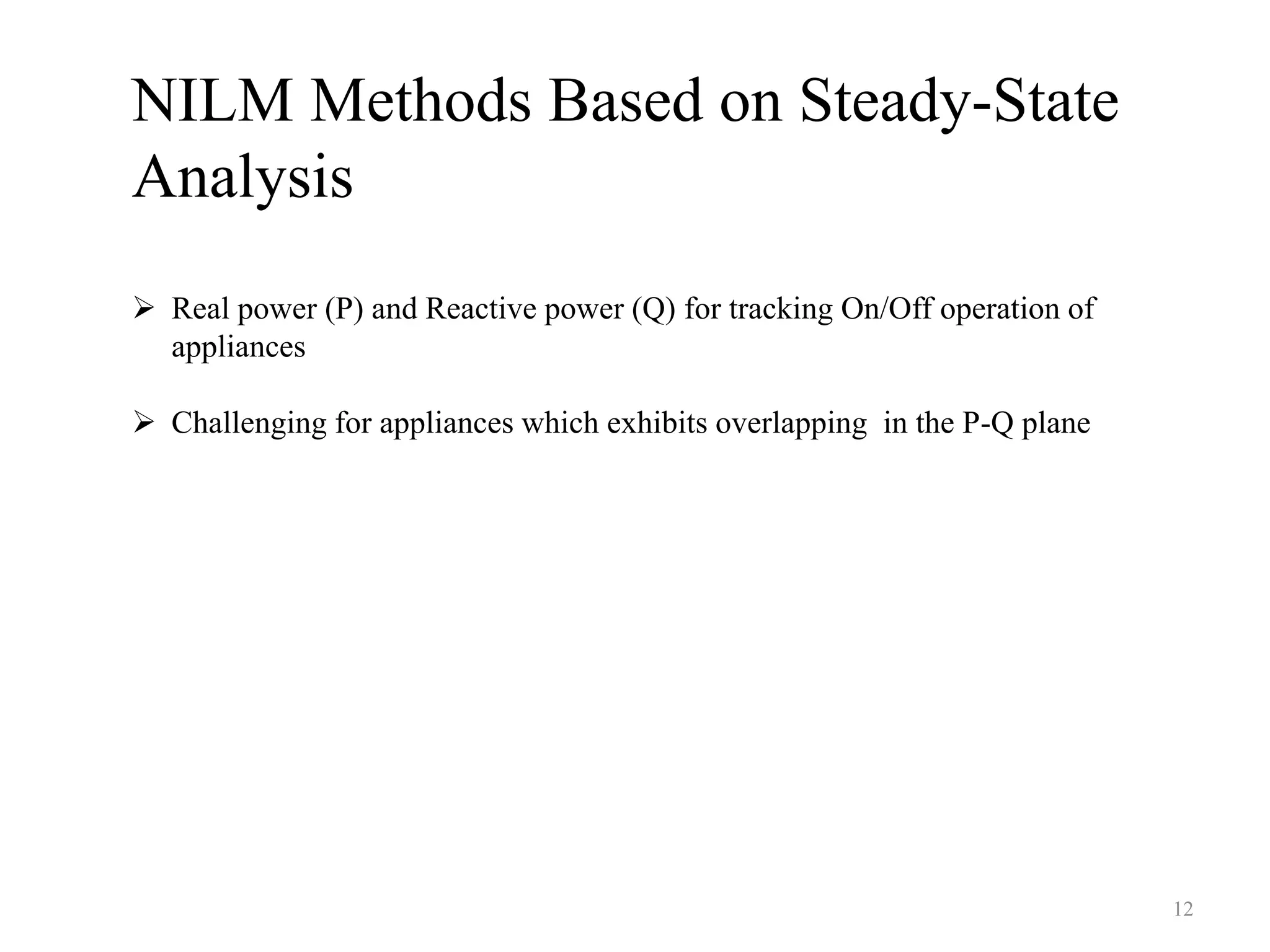
NILM Methods Based on Steady-State
Analysis
 Real power (P) and Reactive power (Q) for tracking On/Off operation of
appliances
 Challenging for appliances which exhibits overlapping in the P-Q plane
12
Fig3: Load distribution in P-Q Plane [10]
13
 Constant power and constant impedance loads are characterized by their
steady state current harmonics
 Non linear loads ------ > non sinusoidal current
linear loads ------ > sinusoidal current
Fig4: Current draw of linear vs non-linear loads [9]
14
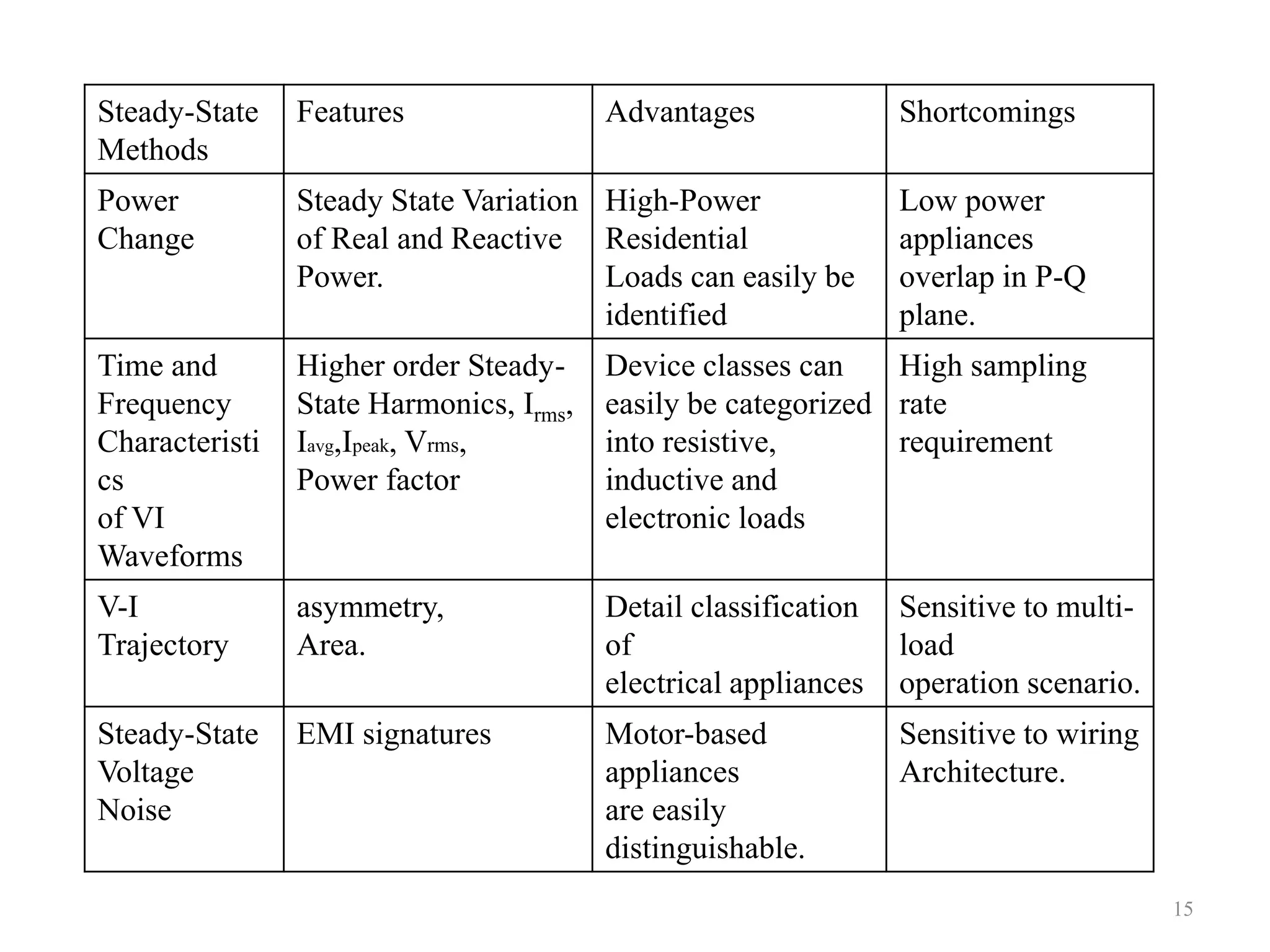
Steady-State
Methods
Features Advantages Shortcomings
Power
Change
Steady State Variation
of Real and Reactive
Power.
High-Power
Residential
Loads can easily be
identified
Low power
appliances
overlap in P-Q
plane.
Time and
Frequency
Characteristi
cs
of VI
Waveforms
Higher order Steady-
State Harmonics, Irms,
Iavg,Ipeak, Vrms,
Power factor
Device classes can
easily be categorized
into resistive,
inductive and
electronic loads
High sampling
rate
requirement
V-I
Trajectory
asymmetry,
Area.
Detail classification
of
electrical appliances
Sensitive to multi-
load
operation scenario.
Steady-State
Voltage
Noise
EMI signatures Motor-based
appliances
are easily
distinguishable.
Sensitive to wiring
Architecture.
15
NILM Methods Based on Transient-
State Analysis
16
Transients
methods
Features Advantages Shortcomings
Transient power Repeatable transient
power profile
Same power draw
characteristics can
be easily
differentiated
Continuous
monitoring, high
sampling rate
Requirement
Start up current
transients
Current spikes, size,
duration, shape of
switching transients,
transient response
Time
distinct
transient behavior
in multiple load
operation Scenario
Poor detection of
simultaneous
activation
deactivation of
Sequences
High frequency
sampling of
voltage noise
Noise Multi-state devices Expensive.
17
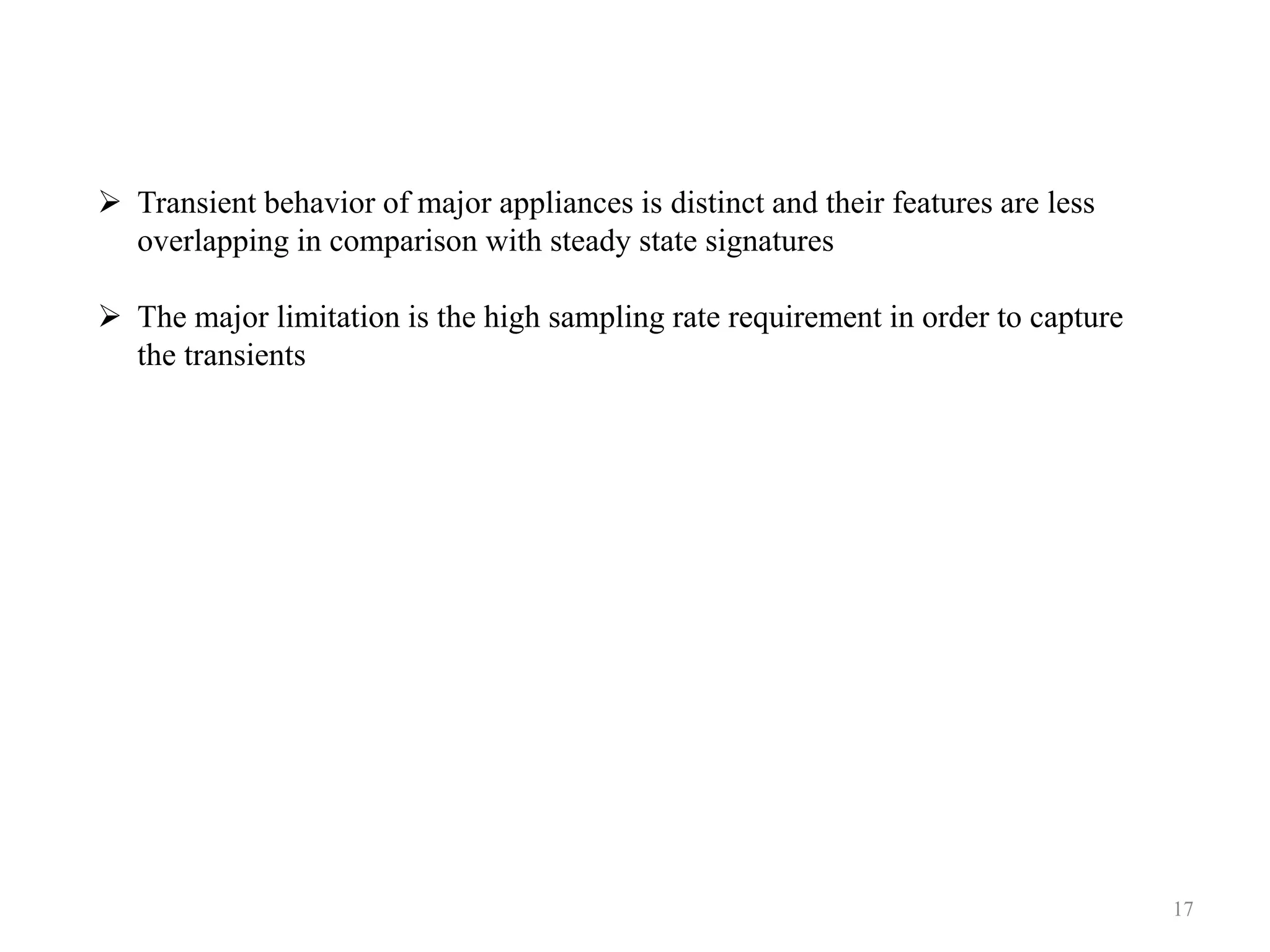
 Transient behavior of major appliances is distinct and their features are less
overlapping in comparison with steady state signatures
 The major limitation is the high sampling rate requirement in order to capture
the transients
Non-Traditional Appliance Features
Fig5: Schematic diagram of two unit graph [11]
18
19
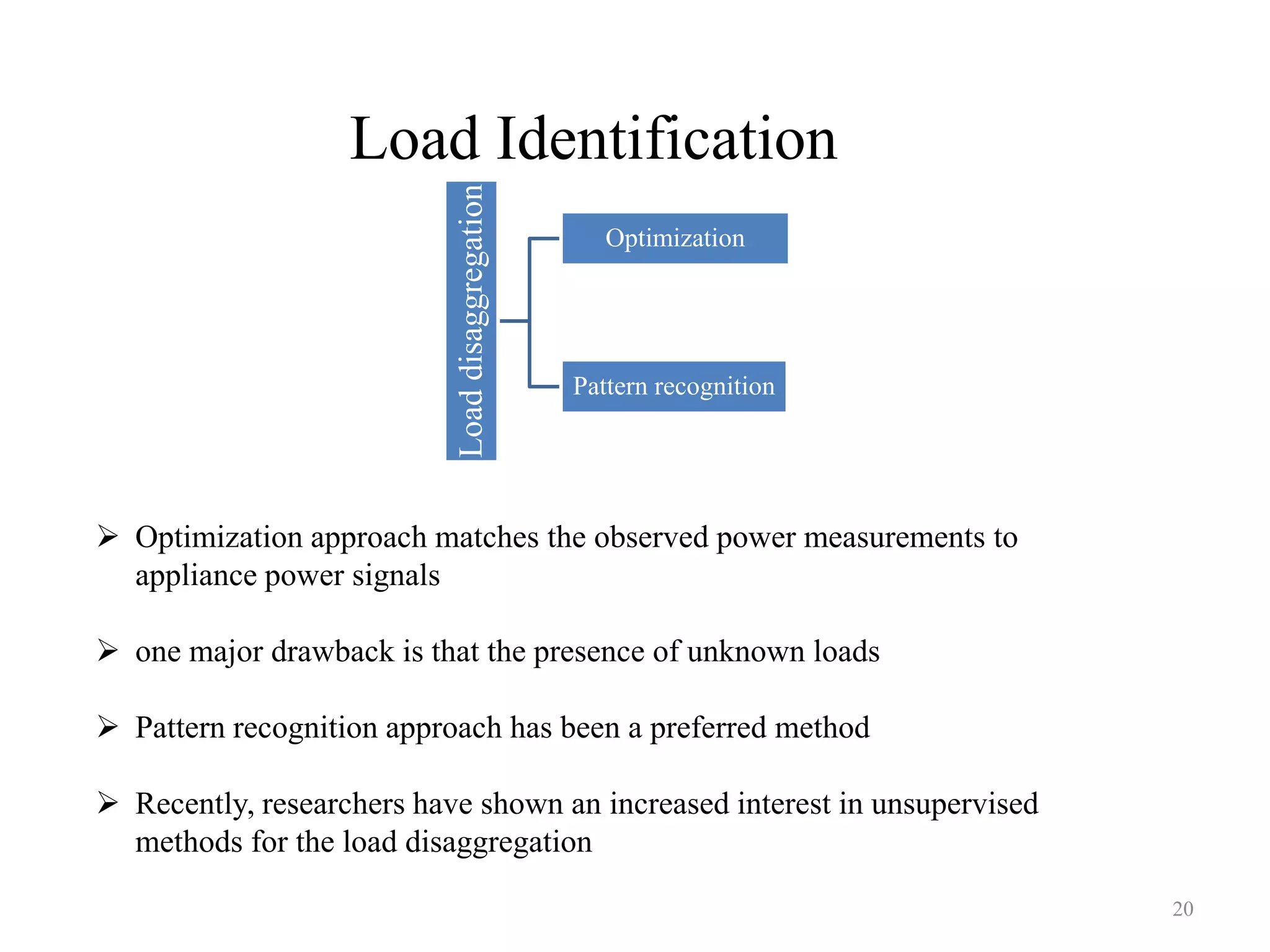
Load Identification
 Optimization approach matches the observed power measurements to
appliance power signals
 one major drawback is that the presence of unknown loads
 Pattern recognition approach has been a preferred method
 Recently, researchers have shown an increased interest in unsupervised
methods for the load disaggregation
Loaddisaggregation
Optimization
Pattern recognition
20
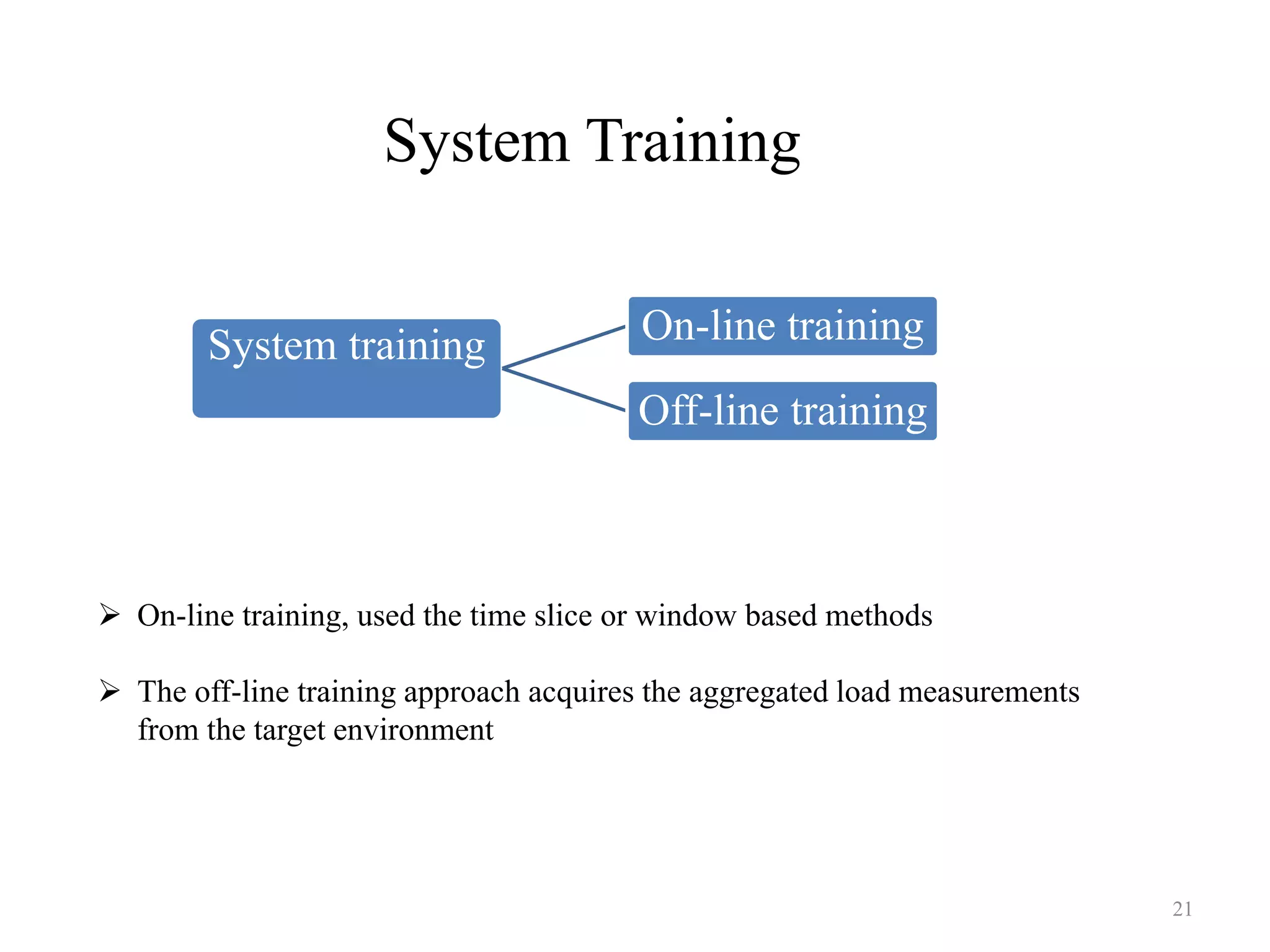
System Training
 On-line training, used the time slice or window based methods
 The off-line training approach acquires the aggregated load measurements
from the target environment
System training On-line training
Off-line training
21
22
Fig 6:Example graphical user interface (GUI) for training the classifier [5]
 To ease the data annotation process, sub-metering approach utilized
 Requires installation of one energy meter per appliance
 It includes extra cost, complex installation of sensors on every device
 Requires human interference and supervision
 Currently there are no standard automated solutions
 This is one of the limiting factor for delay the widespread success of NILM
solutions
23
Challenges
 Due to the lack of reference datasets
 Low power consumer appliances exhibit similar power consumption
characteristics
 Update of the appliance signature database
 How to identify new devices that are not included in signature database
24
Conclusion
 High cost and intrusive nature of ILM, research is more focused towards non-
intrusive approaches
 No set of appliance features as well as load disaggregation algorithms are
suitable
 Combining transient and steady-state signatures to improve recognition
accuracy
 Research in the future should focus on unsupervised learning methods
25
References
1. Zoha, A.; Gluhak, A.; Imran, M.A.; Rajasegarar, S. , “ Non-Intrusive Load Monitoring
Approaches for Disaggregated Energy Sensing: A Survey.” Sensors 2012, vol.12, 16838-
16866.
2. G. Hart, “Nonintrusive appliance load monitoring,” Proceedings of IEEE,1992, vol. 80,
no. 12, pp. ,1870–1891.
3. Basu, K.; Debusschere, V.; Bacha, S.; Maulik, U.; Bondyopadhyay, S. , “Non Intrusive
Load Monitoring: A Temporal Multi-Label Classification Approach”. IEEE Trans. on
Industrial Informatics, 2015, vol.11, no.1 , pp.,262-270.
4. Laughman, C.; Lee, K.; Cox, R.; Shaw, S.; Leeb, S.; Norford, L.; Armstrong, P., “ Power
signature analysis.” IEEE Power Energ. Mag. 2003, vol.1, 56–63.
5. Berges, M.; Goldman, E.; Matthews, H.S.; Soibelman, L.; Anderson, K., “ User-centered
non-intrusive electricity load monitoring for residential buildings.” J. Comput. Civil Eng.
2011, 25, 471–480.
6. Norford, L.K.; Leeb, S.B., “ Non-intrusive electrical load monitoring in commercial
buildings based on steady-state and transient load-detection algorithms.” Energ. Build.
1996, 24, 51–64.
26
7. Jin, Y.; Tebekaemi, E.; Berges, M.; Soibelman, L., “ Robust Adaptive Event Detection
in Non-Intrusive Load Monitoring for Energy Aware Smart Facilities.” In Proceedings
of IEEE International Conference on Acoustics, Speech and Signal Processing, Prague,
Czech Republic, 22–27 May 2011; pp. 4340–4343.
8. Zeifman, M.; Roth, K., “ Nonintrusive appliance load monitoring: Review and
outlook.” IEEE Trans. Consum. Electron. 2011, 57, 76–84.
9. Liang, J.; Ng, S.K.K.; Kendall, G.; Cheng, J.W.M., “ Load signature study Part I: Basic
concept, structure, and methodology.” IEEE Trans. Power Del. 2010, 25, 551–560.
10. Hazas, M.; Friday, A.; Scott, J. “Look back before leaping forward: Four decades of
domestic energy inquiry.” IEEE Pervas. Comput. 2011, 10, 13–19.
11. Wang, Z.; Zheng, G., “ Residential appliances identification and monitoring by a
nonintrusive method.” IEEE Trans. Smart Grid 2012, 3, 80–92.
27

NON INTRUSIVE LOAD MONITORING

  • 1.
    Non-Intrusive Load Monitoring Centerfor Energy and Environment, MNIT Submitted by Sai Goutham Golive 2014pcv5192 Submitted to Prof. Jyotirmay Mathur 1
  • 2.
    Contents  Background  Introduction General Frame Work Of NILM  Data Acquisition  Feature Extraction  Load Identification  System Training  Challenges  Conclusions  References 2
  • 3.
    Background  Energy conservationis a challenging issue  Global energy demands double by end of 2030 with negative impacts on the environment  Energy crisis, climate change and the overall economy of a country affected by the growth in energy consumption  Reduction in energy wastage can be achieved through monitoring of energy consumption and relaying of this information back to the consumers  Goal of ALM (Appliance Load Monitoring) is to perform detailed energy sensing and to provide information on the energy spent  ALM leads to identification of high energy consuming appliances - peak to off-peak 3
  • 4.
    Why does itmatter?  Improve relationships with customers .  Understand customer behavior to improve capacity planning  Identify appliances that could participate in Demand Response  Understand your bill  Plan your monthly budget  Be able to make a financial decision for when to use an appliance 4 Utilities Customers
  • 5.
    Introduction  Two majorapproaches to ALM - Intrusive Load Monitoring (ILM) - Non-Intrusive Load Monitoring (NILM)  ILM require one or more than one sensor per appliance to perform ALM  NILM just requires only a single meter per house  The ILM method is more accurate compared with NILM  The ILM method has practical disadvantages - High costs, multiple sensor configuration, installation complexity  Non-Intrusive Load Monitoring (NILM) is process of estimating the energy consumed by individual appliances 5
  • 6.
    Appliance Classification Feature Extraction DataAcquisition General Framework of NILM  The data is acquired from the main electrical panel outside the building, hence considered to be non-intrusive  The goal is to partition the whole-house building data into its major constituents 6
  • 7.
     Segregation oftotal loads into individual appliance load and can be formulated as: P(t) = 𝑖=1 𝑛 𝑃𝑖(𝑡) P(t) total power Pi(t) power consumption of individual appliances n is the total no. of active appliances. Fig1: An aggregated load data obtained using single point of measurement [1] 7
  • 8.
     Consumer appliancescan be categorized based on their operational states as follows: Type 1 Type 2 Type 3 Type 4 Only ON/OFF Switching pattern of these appliances is repeatable. Continuously Variable Devices (CVD) permanent consumer devices Eg: Eg: Eg: Eg: 8
  • 9.
    Fig2: Different loadtypes based on their energy consumption pattern [1] 9
  • 10.
    Data Acquisition Module The role is to acquire aggregated load measurement  Variety of power meters designed to measure the aggregated load (1) Low-Frequency Energy Meters: - harmonics and traditional power metrics such as real power, reactive power, Root Mean Square (RMS) voltage and current values. In kHz (2) High-Frequency Energy Meters: - Transient events. 10 – 100 MHz 10
  • 11.
  • 12.
    NILM Methods Basedon Steady-State Analysis  Real power (P) and Reactive power (Q) for tracking On/Off operation of appliances  Challenging for appliances which exhibits overlapping in the P-Q plane 12
  • 13.
    Fig3: Load distributionin P-Q Plane [10] 13
  • 14.
     Constant powerand constant impedance loads are characterized by their steady state current harmonics  Non linear loads ------ > non sinusoidal current linear loads ------ > sinusoidal current Fig4: Current draw of linear vs non-linear loads [9] 14
  • 15.
    Steady-State Methods Features Advantages Shortcomings Power Change SteadyState Variation of Real and Reactive Power. High-Power Residential Loads can easily be identified Low power appliances overlap in P-Q plane. Time and Frequency Characteristi cs of VI Waveforms Higher order Steady- State Harmonics, Irms, Iavg,Ipeak, Vrms, Power factor Device classes can easily be categorized into resistive, inductive and electronic loads High sampling rate requirement V-I Trajectory asymmetry, Area. Detail classification of electrical appliances Sensitive to multi- load operation scenario. Steady-State Voltage Noise EMI signatures Motor-based appliances are easily distinguishable. Sensitive to wiring Architecture. 15
  • 16.
    NILM Methods Basedon Transient- State Analysis 16 Transients methods Features Advantages Shortcomings Transient power Repeatable transient power profile Same power draw characteristics can be easily differentiated Continuous monitoring, high sampling rate Requirement Start up current transients Current spikes, size, duration, shape of switching transients, transient response Time distinct transient behavior in multiple load operation Scenario Poor detection of simultaneous activation deactivation of Sequences High frequency sampling of voltage noise Noise Multi-state devices Expensive.
  • 17.
    17  Transient behaviorof major appliances is distinct and their features are less overlapping in comparison with steady state signatures  The major limitation is the high sampling rate requirement in order to capture the transients
  • 18.
    Non-Traditional Appliance Features Fig5:Schematic diagram of two unit graph [11] 18
  • 19.
  • 20.
    Load Identification  Optimizationapproach matches the observed power measurements to appliance power signals  one major drawback is that the presence of unknown loads  Pattern recognition approach has been a preferred method  Recently, researchers have shown an increased interest in unsupervised methods for the load disaggregation Loaddisaggregation Optimization Pattern recognition 20
  • 21.
    System Training  On-linetraining, used the time slice or window based methods  The off-line training approach acquires the aggregated load measurements from the target environment System training On-line training Off-line training 21
  • 22.
    22 Fig 6:Example graphicaluser interface (GUI) for training the classifier [5]
  • 23.
     To easethe data annotation process, sub-metering approach utilized  Requires installation of one energy meter per appliance  It includes extra cost, complex installation of sensors on every device  Requires human interference and supervision  Currently there are no standard automated solutions  This is one of the limiting factor for delay the widespread success of NILM solutions 23
  • 24.
    Challenges  Due tothe lack of reference datasets  Low power consumer appliances exhibit similar power consumption characteristics  Update of the appliance signature database  How to identify new devices that are not included in signature database 24
  • 25.
    Conclusion  High costand intrusive nature of ILM, research is more focused towards non- intrusive approaches  No set of appliance features as well as load disaggregation algorithms are suitable  Combining transient and steady-state signatures to improve recognition accuracy  Research in the future should focus on unsupervised learning methods 25
  • 26.
    References 1. Zoha, A.;Gluhak, A.; Imran, M.A.; Rajasegarar, S. , “ Non-Intrusive Load Monitoring Approaches for Disaggregated Energy Sensing: A Survey.” Sensors 2012, vol.12, 16838- 16866. 2. G. Hart, “Nonintrusive appliance load monitoring,” Proceedings of IEEE,1992, vol. 80, no. 12, pp. ,1870–1891. 3. Basu, K.; Debusschere, V.; Bacha, S.; Maulik, U.; Bondyopadhyay, S. , “Non Intrusive Load Monitoring: A Temporal Multi-Label Classification Approach”. IEEE Trans. on Industrial Informatics, 2015, vol.11, no.1 , pp.,262-270. 4. Laughman, C.; Lee, K.; Cox, R.; Shaw, S.; Leeb, S.; Norford, L.; Armstrong, P., “ Power signature analysis.” IEEE Power Energ. Mag. 2003, vol.1, 56–63. 5. Berges, M.; Goldman, E.; Matthews, H.S.; Soibelman, L.; Anderson, K., “ User-centered non-intrusive electricity load monitoring for residential buildings.” J. Comput. Civil Eng. 2011, 25, 471–480. 6. Norford, L.K.; Leeb, S.B., “ Non-intrusive electrical load monitoring in commercial buildings based on steady-state and transient load-detection algorithms.” Energ. Build. 1996, 24, 51–64. 26
  • 27.
    7. Jin, Y.;Tebekaemi, E.; Berges, M.; Soibelman, L., “ Robust Adaptive Event Detection in Non-Intrusive Load Monitoring for Energy Aware Smart Facilities.” In Proceedings of IEEE International Conference on Acoustics, Speech and Signal Processing, Prague, Czech Republic, 22–27 May 2011; pp. 4340–4343. 8. Zeifman, M.; Roth, K., “ Nonintrusive appliance load monitoring: Review and outlook.” IEEE Trans. Consum. Electron. 2011, 57, 76–84. 9. Liang, J.; Ng, S.K.K.; Kendall, G.; Cheng, J.W.M., “ Load signature study Part I: Basic concept, structure, and methodology.” IEEE Trans. Power Del. 2010, 25, 551–560. 10. Hazas, M.; Friday, A.; Scott, J. “Look back before leaping forward: Four decades of domestic energy inquiry.” IEEE Pervas. Comput. 2011, 10, 13–19. 11. Wang, Z.; Zheng, G., “ Residential appliances identification and monitoring by a nonintrusive method.” IEEE Trans. Smart Grid 2012, 3, 80–92. 27