UNIVERSITY OF GUYANA
DEPARTMENT OF CHEMISTRY
INORGANIC CHEMISTRY (CHM 3201)
END OF SEMESTER PRESENTATION
TOPIC
METALS, NON – METALS, NOBLE GASES:
OCCURRENCE & EXTRACTION
STUDENT : JOYLYN CONWAY
LECTURER: …….
OBJECTIVES
Metals
• Definition
• Physical & Chemical Properties
• Occurrence
• Extraction
OBJECTIVES
 Non Metals
• Definition
• Physical & Chemical Properties
• Occurrence
• Extraction
 Gases
• Extraction (Separation/Isolation)
METALS
A metal is basically a solid material, that is usually hard, shiny, malleable, fusible,
and ductile. It is a good thermal (heat) and electrical conductor.
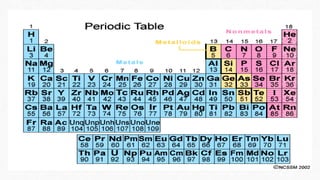
On the periodic table as shown earlier, there is a distinct region where metallic
elements can be found. Examples:
Aluminum (Al) Silver (Ag) Titanium (Ti)
Gold (Au) Manganese (Mn) Lead (Pb)
Sodium (Na) Uranium (U) Mo (Molybdenum)
Iron (Fe) Cobalt (Co) W (Tungsten)
METALS – PHYSICAL PROPERTIES
• Good ELECTRICAL CONDUCTORS and HEAT
CONDUCTORS.
• Malleable - can be beaten into thin sheets.
• Ductile - can be stretched into wire.
• Possess metallic luster.
• Opaque as thin sheet.
• Solid at room temperature (EXCEPT Hg -Mercury).
METALS – CHEMICAL PROPERTIES
• Usually have 1-3 electrons in their outer shell.
• Lose their valence electrons easily, thus low ionization
energies. (they are commonly oxidized)
• Form oxides that are BASIC.
• Are good REDUCING AGENTS.
• Have lower ELECTRONEGATIVITIES.
METALS – CHEMICAL PROPERTIES
• Alkali metals are always 1+ (lose the electron in s
subshell)
• Alkaline earth metals are always 2+ (lose both electrons
in s subshell)
• Transition metal ions do not follow an obvious pattern,
2+ is common, and 1+ and 3+ are also observed
METALS – OCCURRENCE
• As stated under chemical properties they are good
reducing agents, as a consequence it is expected that
they are easily oxidized, thus yielding a compound that
is not the metal in its pure form. For this reason metals
are rarely found in their native form. Only some of
those that are less reactive are found in their free state in
the earth’s crust
E.g. Platinum (Pl), Copper(Cu) and Gold (Au),
Silver (Ag).
Metals commonly occur, as sulphide, oxide, halide and carbonates.
All the forms in which metals naturally occur whether in their natural
state or not, are as follows:
• Minerals – this is whereby metals occur in their free state in
the earth’s crust.
• Ores – This is a for of mineral which allows for the extraction
of metals
• Gangue – within ores there are impurities and rocks, and
surrounding clay and sand. These are referred to as Gangue.
METALS – OCCURRENCE CONT’D
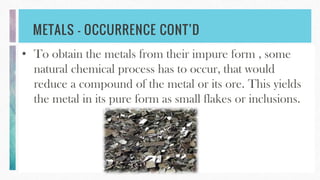
• To obtain the metals from their impure form , some
natural chemical process has to occur, that would
reduce a compound of the metal or its ore. This yields
the metal in its pure form as small flakes or inclusions.
METALS – OCCURRENCE CONT’D
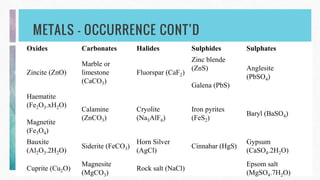
Oxides Carbonates Halides Sulphides Sulphates
Zincite (ZnO)
Marble or
limestone
(CaCO3)
Fluorspar (CaF2)
Zinc blende
(ZnS)
Galena (PbS)
Anglesite
(PbSO4)
Haematite
(Fe2O3.xH2O)
Magnetite
(Fe3O4)
Calamine
(ZnCO3)
Cryolite
(Na3AlF6)
Iron pyrites
(FeS2)
Baryl (BaSO4)
Bauxite
(Al2O3.2H2O)
Siderite (FeCO3)
Horn Silver
(AgCl)
Cinnabar (HgS)
Gypsum
(CaSO4.2H2O)
Cuprite (Cu2O)
Magnesite
(MgCO3)
Rock salt (NaCl)
Epsom salt
(MgSO4.7H2O)
METALS – EXTRACTION
Metals can be extracted by two methods:
• Electrolytic Reduction
• Reduction
The choice of method depends on the reactivity of the metal.
Reactive metals are usually extracted by means of electrolytic
reduction, while those that are less reactive are extracted by
means of reduction with the use of C (carbon) and CO (carbon
monoxide)
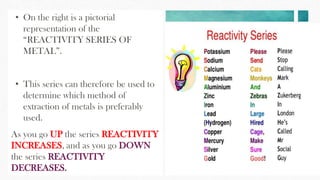
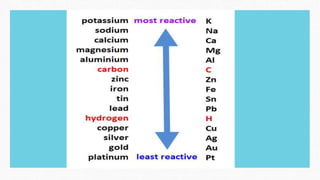
• On the right is a pictorial
representation of the
“REACTIVITY SERIES OF
METAL”.
• This series can therefore be used to
determine which method of
extraction of metals is preferably
used.
As you go UP the series REACTIVITY
INCREASES, and as you go DOWN
the series REACTIVITY
DECREASES.
METALS – EXTRACTION
• Extraction of metal from its ore process, entail three
major steps:
• Concentration/Purification of Ore
• Reduction of metal
• Refining (Purification)
METAL - EXTRACTION (CONCENTRATION OF ORE)
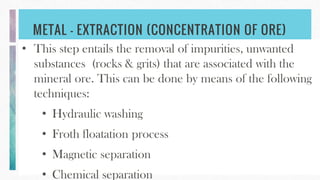
• This step entails the removal of impurities, unwanted
substances (rocks & grits) that are associated with the
mineral ore. This can be done by means of the following
techniques:
• Hydraulic washing
• Froth floatation process
• Magnetic separation
• Chemical separation
METAL - EXTRACTION (CONCENTRATION OF ORE)
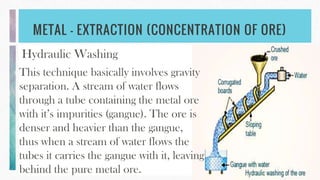
Hydraulic Washing
This technique basically involves gravity
separation. A stream of water flows
through a tube containing the metal ore
with it’s impurities (gangue). The ore is
denser and heavier than the gangue,
thus when a stream of water flows the
tubes it carries the gangue with it, leaving
behind the pure metal ore.
METAL - EXTRACTION (CONCENTRATION OF ORE)
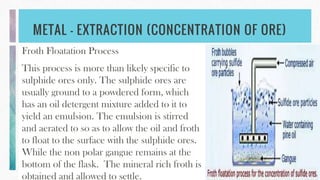
Froth Floatation Process
This process is more than likely specific to
sulphide ores only. The sulphide ores are
usually ground to a powdered form, which
has an oil detergent mixture added to it to
yield an emulsion. The emulsion is stirred
and aerated to so as to allow the oil and froth
to float to the surface with the sulphide ores.
While the non polar gangue remains at the
bottom of the flask. The mineral rich froth is
obtained and allowed to settle.
METAL - EXTRACTION (CONCENTRATION OF ORE)
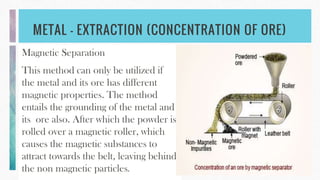
Magnetic Separation
This method can only be utilized if
the metal and its ore has different
magnetic properties. The method
entails the grounding of the metal and
its ore also. After which the powder is
rolled over a magnetic roller, which
causes the magnetic substances to
attract towards the belt, leaving behind
the non magnetic particles.
METAL – EXTRACTION (REDUCTION OF METAL)
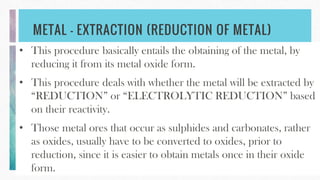
• This procedure basically entails the obtaining of the metal, by
reducing it from its metal oxide form.
• This procedure deals with whether the metal will be extracted by
“REDUCTION” or “ELECTROLYTIC REDUCTION” based
on their reactivity.
• Those metal ores that occur as sulphides and carbonates, rather
as oxides, usually have to be converted to oxides, prior to
reduction, since it is easier to obtain metals once in their oxide
form.
METAL – EXTRACTION (REDUCTION OF METAL)
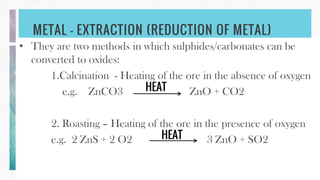
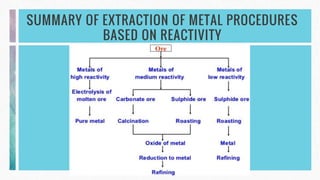
• They are two methods in which sulphides/carbonates can be
converted to oxides:
1.Calcination - Heating of the ore in the absence of oxygen
e.g. ZnCO3 ZnO + CO2
2. Roasting – Heating of the ore in the presence of oxygen
e.g. 2 ZnS + 2 O2 3 ZnO + SO2HEAT
HEAT
METAL – EXTRACTION (REDUCTION OF METAL)
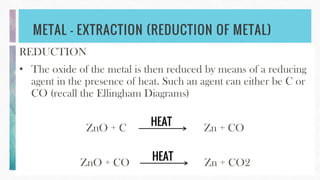
REDUCTION
• The oxide of the metal is then reduced by means of a reducing
agent in the presence of heat. Such an agent can either be C or
CO (recall the Ellingham Diagrams)
ZnO + C Zn + CO
ZnO + CO Zn + CO2
HEAT
HEAT
METAL – EXTRACTION (REDUCTION OF METAL)
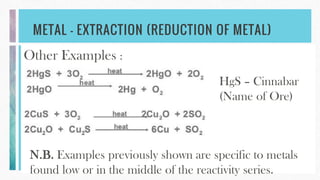
Other Examples :
HgS – Cinnabar
(Name of Ore)
N.B. Examples previously shown are specific to metals
found low or in the middle of the reactivity series.
METAL – EXTRACTION (REDUCTION OF METAL)
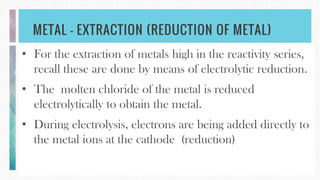
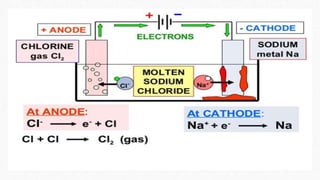
• For the extraction of metals high in the reactivity series,
recall these are done by means of electrolytic reduction.
• The molten chloride of the metal is reduced
electrolytically to obtain the metal.
• During electrolysis, electrons are being added directly to
the metal ions at the cathode (reduction)
METALS – EXTRACTION (REFINING (PURIFICATION))
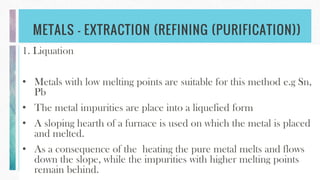
1. Liquation
• Metals with low melting points are suitable for this method e.g Sn,
Pb
• The metal impurities are place into a liquefied form
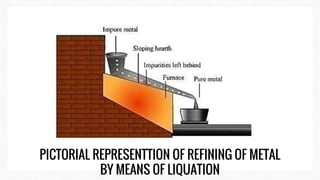
• A sloping hearth of a furnace is used on which the metal is placed
and melted.
• As a consequence of the heating the pure metal melts and flows
down the slope, while the impurities with higher melting points
remain behind.
PICTORIAL REPRESENTTION OF REFINING OF METAL
BY MEANS OF LIQUATION
METALS – EXTRACTION (REFINING (PURIFICATION))
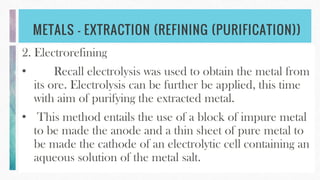
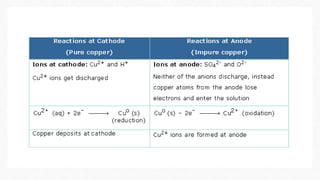
2. Electrorefining
• Recall electrolysis was used to obtain the metal from
its ore. Electrolysis can be further be applied, this time
with aim of purifying the extracted metal.
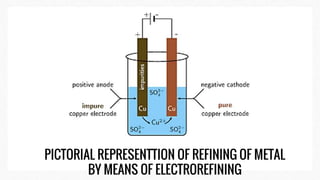
• This method entails the use of a block of impure metal
to be made the anode and a thin sheet of pure metal to
be made the cathode of an electrolytic cell containing an
aqueous solution of the metal salt.
PICTORIAL REPRESENTTION OF REFINING OF METAL
BY MEANS OF ELECTROREFINING
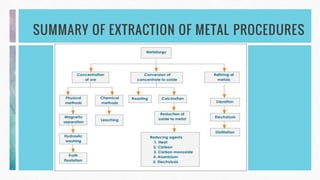
SUMMARY OF EXTRACTION OF METAL PROCEDURES
BASED ON REACTIVITY
NON METALS
• The are naturally occurring elements that do not portray
the same chemical and physical properties as those of
metals. Non metals are not good thermal or electrical
conductors . They are non – lustrous, brittle and range
from hard to soft.
• Seventeen elements on the periodic tale are generally
classified as being non metals, of which each of them falls
under at least one state of matter (solid, gas, liquid)
NON METALS
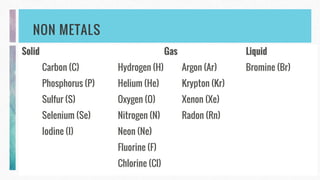
Solid Gas Liquid
Carbon (C) Hydrogen (H) Argon (Ar) Bromine (Br)
Phosphorus (P) Helium (He) Krypton (Kr)
Sulfur (S) Oxygen (O) Xenon (Xe)
Selenium (Se) Nitrogen (N) Radon (Rn)
Iodine (I) Neon (Ne)
Fluorine (F)
Chlorine (Cl)
NON-METALS – PHYSICAL PROPERTIES
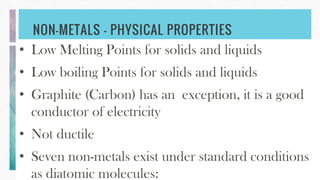
• Low Melting Points for solids and liquids
• Low boiling Points for solids and liquids
• Graphite (Carbon) has an exception, it is a good
conductor of electricity
• Not ductile
• Seven non-metals exist under standard conditions
as diatomic molecules:
NON-METALS – PHYSICAL PROPERTIES
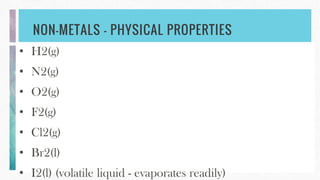
• H2(g)
• N2(g)
• O2(g)
• F2(g)
• Cl2(g)
• Br2(l)
• I2(l) (volatile liquid - evaporates readily)
NON-METALS – PHYSICAL PROPERTIES
• In terms of their electronic configuration, the
outermost electron shells of most nonmetals
are incomplete. These elements therefore
attempt to gain electrons. The exceptions are
the noble gases, which are unreactive
because their outermost electron shells are
complete.
NON-METALS – CHEMICAL PROPERTIES
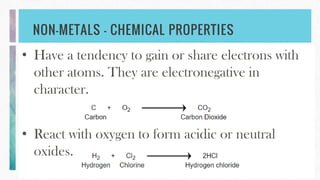
• Have a tendency to gain or share electrons with
other atoms. They are electronegative in
character.
• React with oxygen to form acidic or neutral
oxides.
NON-METALS – CHEMICAL PROPERTIES
• Non-metals do not react with water.
• Non-metals react with chlorine to form
covalent chlorides.
NON-METALS – CHEMICAL PROPERTIES
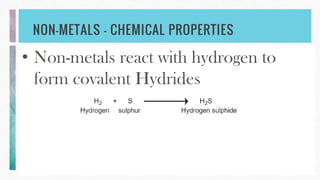
• Non-metals react with hydrogen to
form covalent Hydrides
NON –METALS – OCCURRENCE
• Hydrogen, carbon, nitrogen, oxygen, sulfur, and the noble gases
can be found in the form of free (uncombined) elements as well
as compounds in nature.
• The remaining non metals are found as compounds in nature.
Similar to that of metals they occur as:
Carbonates (CO32− ) Halides (RX) Phosphates(PO43− )
Sulfides (S2− ) Nitrates (NO3–)
Sulfates (SO42-) Oxides (O2–)
NON METAL – EXTRACTION
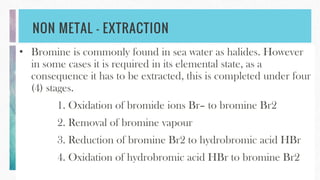
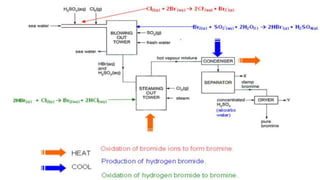
• Bromine is commonly found in sea water as halides. However
in some cases it is required in its elemental state, as a
consequence it has to be extracted, this is completed under four
(4) stages.
1. Oxidation of bromide ions Br– to bromine Br2
2. Removal of bromine vapour
3. Reduction of bromine Br2 to hydrobromic acid HBr
4. Oxidation of hydrobromic acid HBr to bromine Br2
NON METAL – EXTRACTION
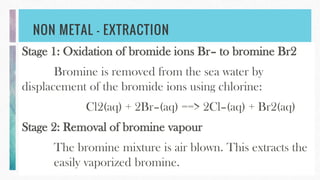
Stage 1: Oxidation of bromide ions Br– to bromine Br2
Bromine is removed from the sea water by
displacement of the bromide ions using chlorine:
Cl2(aq) + 2Br–(aq) ==> 2Cl–(aq) + Br2(aq)
Stage 2: Removal of bromine vapour
The bromine mixture is air blown. This extracts the
easily vaporized bromine.
NON METAL – EXTRACTION
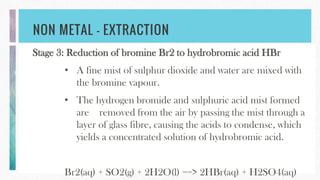
Stage 3: Reduction of bromine Br2 to hydrobromic acid HBr
• A fine mist of sulphur dioxide and water are mixed with
the bromine vapour.
• The hydrogen bromide and sulphuric acid mist formed
are removed from the air by passing the mist through a
layer of glass fibre, causing the acids to condense, which
yields a concentrated solution of hydrobromic acid.
Br2(aq) + SO2(g) + 2H2O(l) ==> 2HBr(aq) + H2SO4(aq)
NON METAL – EXTRACTION
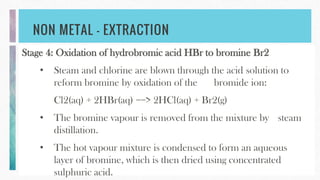
Stage 4: Oxidation of hydrobromic acid HBr to bromine Br2
• Steam and chlorine are blown through the acid solution to
reform bromine by oxidation of the bromide ion:
Cl2(aq) + 2HBr(aq) ==> 2HCl(aq) + Br2(g)
• The bromine vapour is removed from the mixture by steam
distillation.
• The hot vapour mixture is condensed to form an aqueous
layer of bromine, which is then dried using concentrated
sulphuric acid.
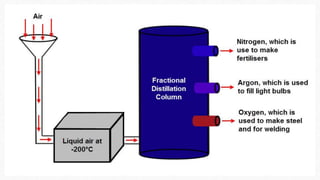
EXTRACTION OF OXYGEN & NITROGEN GAS
• The atmosphere comprises of approximately 78% N2 ,
21% O2 , 0.9% Ar and 0.04% CO2.
• These three gases are separated into their individual
components by means of fractional distillation.
• In order for this to be done the air must be
LIQUEFIED.
EXTRACTION OF N2 & O2 - FRACTIONAL DISTILLATION
• Air is filtered to remove dust, and then cooled in stages until it reaches –200°C.
At this temperature it is a liquid. The air has been liquefied.
• water vapour condenses, and is removed using absorbent filters
• carbon dioxide freezes at -79°C, and is removed
• Oxygen liquefies at -183°C
• Argon liquefies at -186°C
• Nitrogen liquefies at -196°C
• The Ar, N2 and O2 gases are then separated by means of fractional
distillation, on the basis of the temperatures at which they liquefy.
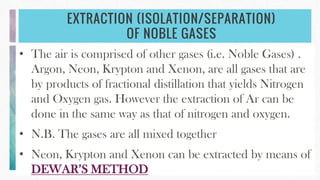
EXTRACTION (ISOLATION/SEPARATION)
OF NOBLE GASES
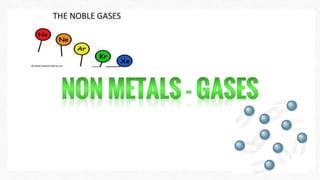
• The air is comprised of other gases (i.e. Noble Gases) .
Argon, Neon, Krypton and Xenon, are all gases that are
by products of fractional distillation that yields Nitrogen
and Oxygen gas. However the extraction of Ar can be
done in the same way as that of nitrogen and oxygen.
• N.B. The gases are all mixed together
• Neon, Krypton and Xenon can be extracted by means of
DEWAR’S METHOD
EXTRACTION OF NOBLE GASES – DEWAR’S METHOD
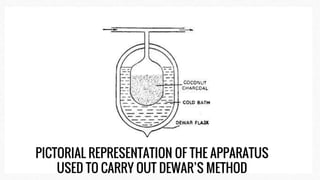
• The mixture of noble gases is separated into individual
constituents by the use of coconut charcoal which adsorbs
different gases at different temperatures.
• Argon, Krypton and Neon – After ½ hour at 173K, only
these noble gases are adsorbed by the charcoal, while helium
and neon remain unabsorbed.
• The mixture of helium and neon is kept in contact with the
coconut charcoal at 93K which completely adsorbs neon
leaving free helium.
EXTRACTION OF NOBLE GASES – DEWAR’S METHOD
• The charcoal at 173K containing argon, krypton and
xenon is placed in contact with another charcoal at
the temperature of the liquid air when argon diffuse
into the other charcoal.
• The temperature of the first charcoal (temp.173K)
still containing krypton and xenon is raised to 183K
when krypton is set free while xenon remain
adsorbed in the charcoal. When it is heated, xenon
is recovered.
PICTORIAL REPRESENTATION OF THE APPARATUS
USED TO CARRY OUT DEWAR’S METHOD
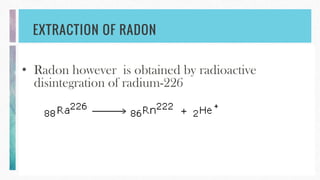
EXTRACTION OF RADON
• Radon however is obtained by radioactive
disintegration of radium-226
REFERENCES
> Blaber , M. (1996). Metals, Nonmetals and Metalloids. Retrieved April 12, 2017, from
http://www.mikeblaber.org/oldwine/chm1045/notes/Periodic/Metals/Period06.htm
> abhinandanram. (2012, August 8 ). Metals and non metals . Retrieved April 12, 2017 , from
https://www.slideshare.net/abhinandanram/metals-and-non-metals-13911695
> BBC.com . (2017 ). Fractional distillation of air. Retrieved April 12, 2017 , from
http://www.bbc.co.uk/education/guides/zt6g87h/revision/2
> Clark , J. (2015, July ). THE EXTRACTION OF METALS - AN INTRODUCTION. Retrieved April 12, 2017, from
http://www.chemguide.co.uk/inorganic/extraction/introduction.html
> Doc Brown's Chemistry . (2017 ). Advanced Level Inorganic Chemistry Periodic Table Revision Notes Part 9. Group 7/17 The
Halogens. Retrieved April 12, 2017 , from http://www.docbrown.info/page07/ASA2group7c.htm
> Nave, R. (2016 ). Metals and Nonmetals. Retrieved April 12, 2017, from http://hyperphysics.phy-
astr.gsu.edu/hbase/pertab/metal.html
> QSStudy.com. (2017 ). Separation of Noble Gases in Dewar’s Method. Retrieved April 12, 2017 , from
http://www.qsstudy.com/chemistry/separation-noble-gases-dewars-method.html
REFERENCES
> Rajan Gupta, Rahul Jindal. (n.d.). METALS. Retrieved April 12, 2017, from
http://www.funscience.in/study-zone/Chemistry/Metals/ChemicalPropertiesOfMetals.php
> Rajan Gupta, Rahul Jindal. (n.d.). NON - METALS. Retrieved April 12, 2017 , from
http://www.funscience.in/study-
zone/Chemistry/NonMetals/ChemicalPropertiesOfNonMetals.php
> Salter's Chemistry . (n.d.). Extracting Bromine from sea water. Retrieved April 12, 2017 , from
http://www.4college.co.uk/as/min/bromine.php
> TutorVista.com. (2017 ). Electrorefining of Metals. Retrieved April 12, 2017, from
http://www.tutorvista.com/content/chemistry/chemistry-ii/electrolysis/electrorefining-
metals.php
> TutorVista.com. (2017 ). Isolation Of Noble Gases. Retrieved April 12, 2017 , from
http://www.tutorvista.com/content/chemistry/chemistry-iv/p-block-elements/noble-gases-
isolation.php
REFERENCES
> TutorVista.com. (2017 ). Occurence State of Metals. Retrieved April 12, 2017 , from
http://www.tutorvista.com/content/science/science-ii/metals-non-metals/occurrence-
metals.php
> University of California . (2016 , October 25 ). Metals, Nonmetals, and Metalloids.
Retrieved April 12, 2017 , from
https://chem.libretexts.org/Textbook_Maps/General_Chemistry_Textbook_Maps/Map%
3A_Chemistry%3A_The_Central_Science_(Brown_et_al.)/07._Periodic_Properties_of_the_
Elements/7.6%3A_Metals%2C_Nonmetals%2C_and_Metalloids
> Wonder WhizKids. (n.d.). Concentration of Ore . Retrieved April 12, 2017 , from
https://www.wonderwhizkids.com/conceptmaps/concentration_ore.html
> writers, N. W. (2015 , January 22). Nonmetal. Retrieved April 12, 2017 , from
http://www.newworldencyclopedia.org/entry/Nonmetal

Metals, Non metals & gases

  • 1.
    UNIVERSITY OF GUYANA DEPARTMENTOF CHEMISTRY INORGANIC CHEMISTRY (CHM 3201) END OF SEMESTER PRESENTATION TOPIC METALS, NON – METALS, NOBLE GASES: OCCURRENCE & EXTRACTION STUDENT : JOYLYN CONWAY LECTURER: …….
  • 2.
    OBJECTIVES Metals • Definition • Physical& Chemical Properties • Occurrence • Extraction
  • 3.
    OBJECTIVES  Non Metals •Definition • Physical & Chemical Properties • Occurrence • Extraction  Gases • Extraction (Separation/Isolation)
  • 6.
    METALS A metal isbasically a solid material, that is usually hard, shiny, malleable, fusible, and ductile. It is a good thermal (heat) and electrical conductor. On the periodic table as shown earlier, there is a distinct region where metallic elements can be found. Examples: Aluminum (Al) Silver (Ag) Titanium (Ti) Gold (Au) Manganese (Mn) Lead (Pb) Sodium (Na) Uranium (U) Mo (Molybdenum) Iron (Fe) Cobalt (Co) W (Tungsten)
  • 7.
    METALS – PHYSICALPROPERTIES • Good ELECTRICAL CONDUCTORS and HEAT CONDUCTORS. • Malleable - can be beaten into thin sheets. • Ductile - can be stretched into wire. • Possess metallic luster. • Opaque as thin sheet. • Solid at room temperature (EXCEPT Hg -Mercury).
  • 8.
    METALS – CHEMICALPROPERTIES • Usually have 1-3 electrons in their outer shell. • Lose their valence electrons easily, thus low ionization energies. (they are commonly oxidized) • Form oxides that are BASIC. • Are good REDUCING AGENTS. • Have lower ELECTRONEGATIVITIES.
  • 9.
    METALS – CHEMICALPROPERTIES • Alkali metals are always 1+ (lose the electron in s subshell) • Alkaline earth metals are always 2+ (lose both electrons in s subshell) • Transition metal ions do not follow an obvious pattern, 2+ is common, and 1+ and 3+ are also observed
  • 10.
    METALS – OCCURRENCE •As stated under chemical properties they are good reducing agents, as a consequence it is expected that they are easily oxidized, thus yielding a compound that is not the metal in its pure form. For this reason metals are rarely found in their native form. Only some of those that are less reactive are found in their free state in the earth’s crust E.g. Platinum (Pl), Copper(Cu) and Gold (Au), Silver (Ag).
  • 11.
    Metals commonly occur,as sulphide, oxide, halide and carbonates. All the forms in which metals naturally occur whether in their natural state or not, are as follows: • Minerals – this is whereby metals occur in their free state in the earth’s crust. • Ores – This is a for of mineral which allows for the extraction of metals • Gangue – within ores there are impurities and rocks, and surrounding clay and sand. These are referred to as Gangue.
  • 12.
    METALS – OCCURRENCECONT’D • To obtain the metals from their impure form , some natural chemical process has to occur, that would reduce a compound of the metal or its ore. This yields the metal in its pure form as small flakes or inclusions.
  • 13.
    METALS – OCCURRENCECONT’D Oxides Carbonates Halides Sulphides Sulphates Zincite (ZnO) Marble or limestone (CaCO3) Fluorspar (CaF2) Zinc blende (ZnS) Galena (PbS) Anglesite (PbSO4) Haematite (Fe2O3.xH2O) Magnetite (Fe3O4) Calamine (ZnCO3) Cryolite (Na3AlF6) Iron pyrites (FeS2) Baryl (BaSO4) Bauxite (Al2O3.2H2O) Siderite (FeCO3) Horn Silver (AgCl) Cinnabar (HgS) Gypsum (CaSO4.2H2O) Cuprite (Cu2O) Magnesite (MgCO3) Rock salt (NaCl) Epsom salt (MgSO4.7H2O)
  • 14.
    METALS – EXTRACTION Metalscan be extracted by two methods: • Electrolytic Reduction • Reduction The choice of method depends on the reactivity of the metal. Reactive metals are usually extracted by means of electrolytic reduction, while those that are less reactive are extracted by means of reduction with the use of C (carbon) and CO (carbon monoxide)
  • 15.
    • On theright is a pictorial representation of the “REACTIVITY SERIES OF METAL”. • This series can therefore be used to determine which method of extraction of metals is preferably used. As you go UP the series REACTIVITY INCREASES, and as you go DOWN the series REACTIVITY DECREASES.
  • 17.
    METALS – EXTRACTION •Extraction of metal from its ore process, entail three major steps: • Concentration/Purification of Ore • Reduction of metal • Refining (Purification)
  • 18.
    METAL - EXTRACTION(CONCENTRATION OF ORE) • This step entails the removal of impurities, unwanted substances (rocks & grits) that are associated with the mineral ore. This can be done by means of the following techniques: • Hydraulic washing • Froth floatation process • Magnetic separation • Chemical separation
  • 19.
    METAL - EXTRACTION(CONCENTRATION OF ORE) Hydraulic Washing This technique basically involves gravity separation. A stream of water flows through a tube containing the metal ore with it’s impurities (gangue). The ore is denser and heavier than the gangue, thus when a stream of water flows the tubes it carries the gangue with it, leaving behind the pure metal ore.
  • 20.
    METAL - EXTRACTION(CONCENTRATION OF ORE) Froth Floatation Process This process is more than likely specific to sulphide ores only. The sulphide ores are usually ground to a powdered form, which has an oil detergent mixture added to it to yield an emulsion. The emulsion is stirred and aerated to so as to allow the oil and froth to float to the surface with the sulphide ores. While the non polar gangue remains at the bottom of the flask. The mineral rich froth is obtained and allowed to settle.
  • 21.
    METAL - EXTRACTION(CONCENTRATION OF ORE) Magnetic Separation This method can only be utilized if the metal and its ore has different magnetic properties. The method entails the grounding of the metal and its ore also. After which the powder is rolled over a magnetic roller, which causes the magnetic substances to attract towards the belt, leaving behind the non magnetic particles.
  • 22.
    METAL – EXTRACTION(REDUCTION OF METAL) • This procedure basically entails the obtaining of the metal, by reducing it from its metal oxide form. • This procedure deals with whether the metal will be extracted by “REDUCTION” or “ELECTROLYTIC REDUCTION” based on their reactivity. • Those metal ores that occur as sulphides and carbonates, rather as oxides, usually have to be converted to oxides, prior to reduction, since it is easier to obtain metals once in their oxide form.
  • 23.
    METAL – EXTRACTION(REDUCTION OF METAL) • They are two methods in which sulphides/carbonates can be converted to oxides: 1.Calcination - Heating of the ore in the absence of oxygen e.g. ZnCO3 ZnO + CO2 2. Roasting – Heating of the ore in the presence of oxygen e.g. 2 ZnS + 2 O2 3 ZnO + SO2HEAT HEAT
  • 24.
    METAL – EXTRACTION(REDUCTION OF METAL) REDUCTION • The oxide of the metal is then reduced by means of a reducing agent in the presence of heat. Such an agent can either be C or CO (recall the Ellingham Diagrams) ZnO + C Zn + CO ZnO + CO Zn + CO2 HEAT HEAT
  • 25.
    METAL – EXTRACTION(REDUCTION OF METAL) Other Examples : HgS – Cinnabar (Name of Ore) N.B. Examples previously shown are specific to metals found low or in the middle of the reactivity series.
  • 26.
    METAL – EXTRACTION(REDUCTION OF METAL) • For the extraction of metals high in the reactivity series, recall these are done by means of electrolytic reduction. • The molten chloride of the metal is reduced electrolytically to obtain the metal. • During electrolysis, electrons are being added directly to the metal ions at the cathode (reduction)
  • 28.
    METALS – EXTRACTION(REFINING (PURIFICATION)) 1. Liquation • Metals with low melting points are suitable for this method e.g Sn, Pb • The metal impurities are place into a liquefied form • A sloping hearth of a furnace is used on which the metal is placed and melted. • As a consequence of the heating the pure metal melts and flows down the slope, while the impurities with higher melting points remain behind.
  • 29.
    PICTORIAL REPRESENTTION OFREFINING OF METAL BY MEANS OF LIQUATION
  • 30.
    METALS – EXTRACTION(REFINING (PURIFICATION)) 2. Electrorefining • Recall electrolysis was used to obtain the metal from its ore. Electrolysis can be further be applied, this time with aim of purifying the extracted metal. • This method entails the use of a block of impure metal to be made the anode and a thin sheet of pure metal to be made the cathode of an electrolytic cell containing an aqueous solution of the metal salt.
  • 31.
    PICTORIAL REPRESENTTION OFREFINING OF METAL BY MEANS OF ELECTROREFINING
  • 33.
    SUMMARY OF EXTRACTIONOF METAL PROCEDURES
  • 34.
    SUMMARY OF EXTRACTIONOF METAL PROCEDURES BASED ON REACTIVITY
  • 36.
    NON METALS • Theare naturally occurring elements that do not portray the same chemical and physical properties as those of metals. Non metals are not good thermal or electrical conductors . They are non – lustrous, brittle and range from hard to soft. • Seventeen elements on the periodic tale are generally classified as being non metals, of which each of them falls under at least one state of matter (solid, gas, liquid)
  • 37.
    NON METALS Solid GasLiquid Carbon (C) Hydrogen (H) Argon (Ar) Bromine (Br) Phosphorus (P) Helium (He) Krypton (Kr) Sulfur (S) Oxygen (O) Xenon (Xe) Selenium (Se) Nitrogen (N) Radon (Rn) Iodine (I) Neon (Ne) Fluorine (F) Chlorine (Cl)
  • 38.
    NON-METALS – PHYSICALPROPERTIES • Low Melting Points for solids and liquids • Low boiling Points for solids and liquids • Graphite (Carbon) has an exception, it is a good conductor of electricity • Not ductile • Seven non-metals exist under standard conditions as diatomic molecules:
  • 39.
    NON-METALS – PHYSICALPROPERTIES • H2(g) • N2(g) • O2(g) • F2(g) • Cl2(g) • Br2(l) • I2(l) (volatile liquid - evaporates readily)
  • 40.
    NON-METALS – PHYSICALPROPERTIES • In terms of their electronic configuration, the outermost electron shells of most nonmetals are incomplete. These elements therefore attempt to gain electrons. The exceptions are the noble gases, which are unreactive because their outermost electron shells are complete.
  • 41.
    NON-METALS – CHEMICALPROPERTIES • Have a tendency to gain or share electrons with other atoms. They are electronegative in character. • React with oxygen to form acidic or neutral oxides.
  • 42.
    NON-METALS – CHEMICALPROPERTIES • Non-metals do not react with water. • Non-metals react with chlorine to form covalent chlorides.
  • 43.
    NON-METALS – CHEMICALPROPERTIES • Non-metals react with hydrogen to form covalent Hydrides
  • 44.
    NON –METALS –OCCURRENCE • Hydrogen, carbon, nitrogen, oxygen, sulfur, and the noble gases can be found in the form of free (uncombined) elements as well as compounds in nature. • The remaining non metals are found as compounds in nature. Similar to that of metals they occur as: Carbonates (CO32− ) Halides (RX) Phosphates(PO43− ) Sulfides (S2− ) Nitrates (NO3–) Sulfates (SO42-) Oxides (O2–)
  • 45.
    NON METAL –EXTRACTION • Bromine is commonly found in sea water as halides. However in some cases it is required in its elemental state, as a consequence it has to be extracted, this is completed under four (4) stages. 1. Oxidation of bromide ions Br– to bromine Br2 2. Removal of bromine vapour 3. Reduction of bromine Br2 to hydrobromic acid HBr 4. Oxidation of hydrobromic acid HBr to bromine Br2
  • 46.
    NON METAL –EXTRACTION Stage 1: Oxidation of bromide ions Br– to bromine Br2 Bromine is removed from the sea water by displacement of the bromide ions using chlorine: Cl2(aq) + 2Br–(aq) ==> 2Cl–(aq) + Br2(aq) Stage 2: Removal of bromine vapour The bromine mixture is air blown. This extracts the easily vaporized bromine.
  • 47.
    NON METAL –EXTRACTION Stage 3: Reduction of bromine Br2 to hydrobromic acid HBr • A fine mist of sulphur dioxide and water are mixed with the bromine vapour. • The hydrogen bromide and sulphuric acid mist formed are removed from the air by passing the mist through a layer of glass fibre, causing the acids to condense, which yields a concentrated solution of hydrobromic acid. Br2(aq) + SO2(g) + 2H2O(l) ==> 2HBr(aq) + H2SO4(aq)
  • 48.
    NON METAL –EXTRACTION Stage 4: Oxidation of hydrobromic acid HBr to bromine Br2 • Steam and chlorine are blown through the acid solution to reform bromine by oxidation of the bromide ion: Cl2(aq) + 2HBr(aq) ==> 2HCl(aq) + Br2(g) • The bromine vapour is removed from the mixture by steam distillation. • The hot vapour mixture is condensed to form an aqueous layer of bromine, which is then dried using concentrated sulphuric acid.
  • 51.
    EXTRACTION OF OXYGEN& NITROGEN GAS • The atmosphere comprises of approximately 78% N2 , 21% O2 , 0.9% Ar and 0.04% CO2. • These three gases are separated into their individual components by means of fractional distillation. • In order for this to be done the air must be LIQUEFIED.
  • 52.
    EXTRACTION OF N2& O2 - FRACTIONAL DISTILLATION • Air is filtered to remove dust, and then cooled in stages until it reaches –200°C. At this temperature it is a liquid. The air has been liquefied. • water vapour condenses, and is removed using absorbent filters • carbon dioxide freezes at -79°C, and is removed • Oxygen liquefies at -183°C • Argon liquefies at -186°C • Nitrogen liquefies at -196°C • The Ar, N2 and O2 gases are then separated by means of fractional distillation, on the basis of the temperatures at which they liquefy.
  • 54.
    EXTRACTION (ISOLATION/SEPARATION) OF NOBLEGASES • The air is comprised of other gases (i.e. Noble Gases) . Argon, Neon, Krypton and Xenon, are all gases that are by products of fractional distillation that yields Nitrogen and Oxygen gas. However the extraction of Ar can be done in the same way as that of nitrogen and oxygen. • N.B. The gases are all mixed together • Neon, Krypton and Xenon can be extracted by means of DEWAR’S METHOD
  • 55.
    EXTRACTION OF NOBLEGASES – DEWAR’S METHOD • The mixture of noble gases is separated into individual constituents by the use of coconut charcoal which adsorbs different gases at different temperatures. • Argon, Krypton and Neon – After ½ hour at 173K, only these noble gases are adsorbed by the charcoal, while helium and neon remain unabsorbed. • The mixture of helium and neon is kept in contact with the coconut charcoal at 93K which completely adsorbs neon leaving free helium.
  • 56.
    EXTRACTION OF NOBLEGASES – DEWAR’S METHOD • The charcoal at 173K containing argon, krypton and xenon is placed in contact with another charcoal at the temperature of the liquid air when argon diffuse into the other charcoal. • The temperature of the first charcoal (temp.173K) still containing krypton and xenon is raised to 183K when krypton is set free while xenon remain adsorbed in the charcoal. When it is heated, xenon is recovered.
  • 57.
    PICTORIAL REPRESENTATION OFTHE APPARATUS USED TO CARRY OUT DEWAR’S METHOD
  • 58.
    EXTRACTION OF RADON •Radon however is obtained by radioactive disintegration of radium-226
  • 60.
    REFERENCES > Blaber ,M. (1996). Metals, Nonmetals and Metalloids. Retrieved April 12, 2017, from http://www.mikeblaber.org/oldwine/chm1045/notes/Periodic/Metals/Period06.htm > abhinandanram. (2012, August 8 ). Metals and non metals . Retrieved April 12, 2017 , from https://www.slideshare.net/abhinandanram/metals-and-non-metals-13911695 > BBC.com . (2017 ). Fractional distillation of air. Retrieved April 12, 2017 , from http://www.bbc.co.uk/education/guides/zt6g87h/revision/2 > Clark , J. (2015, July ). THE EXTRACTION OF METALS - AN INTRODUCTION. Retrieved April 12, 2017, from http://www.chemguide.co.uk/inorganic/extraction/introduction.html > Doc Brown's Chemistry . (2017 ). Advanced Level Inorganic Chemistry Periodic Table Revision Notes Part 9. Group 7/17 The Halogens. Retrieved April 12, 2017 , from http://www.docbrown.info/page07/ASA2group7c.htm > Nave, R. (2016 ). Metals and Nonmetals. Retrieved April 12, 2017, from http://hyperphysics.phy- astr.gsu.edu/hbase/pertab/metal.html > QSStudy.com. (2017 ). Separation of Noble Gases in Dewar’s Method. Retrieved April 12, 2017 , from http://www.qsstudy.com/chemistry/separation-noble-gases-dewars-method.html
  • 61.
    REFERENCES > Rajan Gupta,Rahul Jindal. (n.d.). METALS. Retrieved April 12, 2017, from http://www.funscience.in/study-zone/Chemistry/Metals/ChemicalPropertiesOfMetals.php > Rajan Gupta, Rahul Jindal. (n.d.). NON - METALS. Retrieved April 12, 2017 , from http://www.funscience.in/study- zone/Chemistry/NonMetals/ChemicalPropertiesOfNonMetals.php > Salter's Chemistry . (n.d.). Extracting Bromine from sea water. Retrieved April 12, 2017 , from http://www.4college.co.uk/as/min/bromine.php > TutorVista.com. (2017 ). Electrorefining of Metals. Retrieved April 12, 2017, from http://www.tutorvista.com/content/chemistry/chemistry-ii/electrolysis/electrorefining- metals.php > TutorVista.com. (2017 ). Isolation Of Noble Gases. Retrieved April 12, 2017 , from http://www.tutorvista.com/content/chemistry/chemistry-iv/p-block-elements/noble-gases- isolation.php
  • 62.
    REFERENCES > TutorVista.com. (2017). Occurence State of Metals. Retrieved April 12, 2017 , from http://www.tutorvista.com/content/science/science-ii/metals-non-metals/occurrence- metals.php > University of California . (2016 , October 25 ). Metals, Nonmetals, and Metalloids. Retrieved April 12, 2017 , from https://chem.libretexts.org/Textbook_Maps/General_Chemistry_Textbook_Maps/Map% 3A_Chemistry%3A_The_Central_Science_(Brown_et_al.)/07._Periodic_Properties_of_the_ Elements/7.6%3A_Metals%2C_Nonmetals%2C_and_Metalloids > Wonder WhizKids. (n.d.). Concentration of Ore . Retrieved April 12, 2017 , from https://www.wonderwhizkids.com/conceptmaps/concentration_ore.html > writers, N. W. (2015 , January 22). Nonmetal. Retrieved April 12, 2017 , from http://www.newworldencyclopedia.org/entry/Nonmetal