Noise Pollution
B.Tech. I (CE) Semester – I
ENVIRONMENTAL POLLUTION AND MANAGEMENT
CE105
Dr Smaranika Panda, MS (IIT Madras), PhD (IIT Madras)
Assistant Professor
Environmental Engineering Division
Department of Civil Engineer
S.V. National Institute of Technology
Noise Pollution
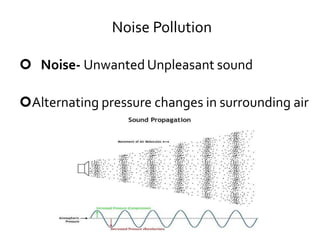
 Noise- Unwanted Unpleasant sound
Alternating pressure changes in surrounding air
Noise can be defined as an unpleasant and
unwanted sound that interferes significantly with the
comfort, health or welfare of persons, or with the full
use of enjoyment of property.
It has been recognized as a significant health
problem related to hearing damage.
Environmental noise may be defined as unwanted
sound that is caused by emissions from traffic (roads,
air or railways), industrial sites and recreational
infrastructures.
Whether or not a sound is undesired by a person will
depend on a number of factors, e.g.
(a) Loudness
(b) Frequency
(c) Continuity
(d) Variation with time
(e) Time of occurrence
(f) Origin of the sound
(g) Recipient’s state of mind and temperament
(h) Background noise level
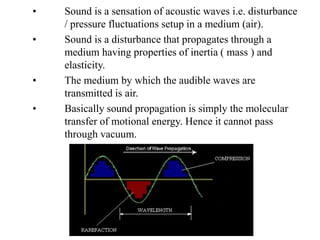
• Sound is a sensation of acoustic waves i.e. disturbance
/ pressure fluctuations setup in a medium (air).
• Sound is a disturbance that propagates through a
medium having properties of inertia ( mass ) and
elasticity.
• The medium by which the audible waves are
transmitted is air.
• Basically sound propagation is simply the molecular
transfer of motional energy. Hence it cannot pass
through vacuum.
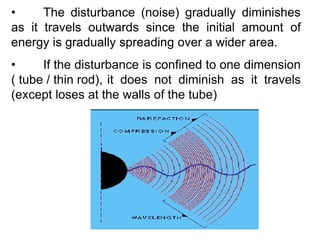
• The disturbance (noise) gradually diminishes
as it travels outwards since the initial amount of
energy is gradually spreading over a wider area.
• If the disturbance is confined to one dimension
( tube / thin rod), it does not diminish as it travels
(except loses at the walls of the tube)
Dr. Smaranika Panda, DoCE, SV NIT
Noise- Representation
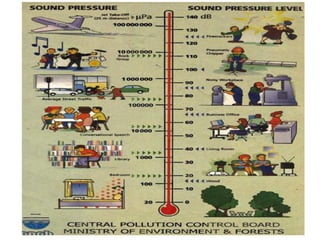
• Audible pressure range – 20 µpa to 200pa
• Minimum pressure to hear –20 µpa – Threshold of hearing
• SPL (Sound pressure level) - Pressure that cause a particular
sound
• SPL = 20 log10 [P/Pref] (Pref- 20 µpa)
(SPL- dB)
• Intensity of sound is measured in decible (dB)
Dr. Smaranika Panda, DoCE, SV NIT
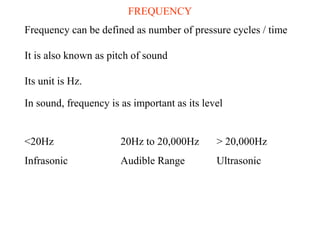
FREQUENCY
In sound, frequency is as important as its level
<20Hz 20Hz to 20,000Hz > 20,000Hz
Infrasonic Audible Range Ultrasonic
Frequency can be defined as number of pressure cycles / time
It is also known as pitch of sound
Its unit is Hz.
• Leq: Equivalent noise level at an area
Dr. Smaranika Panda, DoCE, SV NIT
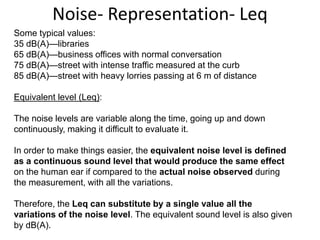
Some typical values:
35 dB(A)—libraries
65 dB(A)—business offices with normal conversation
75 dB(A)—street with intense traffic measured at the curb
85 dB(A)—street with heavy lorries passing at 6 m of distance
Equivalent level (Leq):
The noise levels are variable along the time, going up and down
continuously, making it difficult to evaluate it.
In order to make things easier, the equivalent noise level is defined
as a continuous sound level that would produce the same effect
on the human ear if compared to the actual noise observed during
the measurement, with all the variations.
Therefore, the Leq can substitute by a single value all the
variations of the noise level. The equivalent sound level is also given
by dB(A).
Noise- Representation- Leq
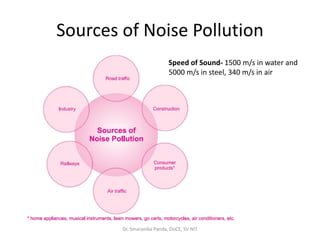
Sources of Noise Pollution
Dr. Smaranika Panda, DoCE, SV NIT
Speed of Sound- 1500 m/s in water and
5000 m/s in steel, 340 m/s in air
SOURCES: (1) Industrial (2) Non-industrial
(1) Industrial:
Various industries contributing to noise pollution:
 Textile
 Iron and steel
 Pulp & paper
 Chemicals
 Thermal power stations
In industrial cities like Surat, Kolkata, Ludhiana, Kanpur etc.
often the industrial zones are not separated from the residential
zones of the city, especially in the case of small scale
industries.
Sources of Noise Pollution
(2) Non-Industrial:
 Domestic Noise (Household)
 Entertainment devices, musical instruments, air
conditioners, kitchen appliances.
 Loudspeakers during festivals and religious rituals.
(Public Address System)
 Construction & demolition work.
 Transportation noise viz. road, rail and air.
 Crowded markets and commercial areas.
 Places near airports-noise due to take off and landing of
aircrafts.
Sources of Noise Pollution
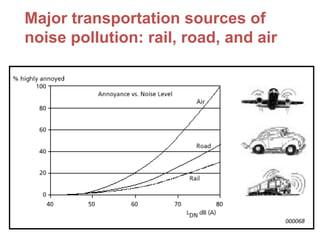
• Transportation systems are the main source of noise
pollution in urban areas.
• Construction of buildings, highways, and streets cause a
lot of noise, due to the usage of air compressors,
bulldozers, loaders, dump trucks, and pavement
breakers.
• Loud speakers, plumbing, boilers, generators, air
conditioners, fans, and vacuum cleaners add to the
existing noise pollution.
Sources of Noise Pollution
SIGNIFICANCE OF ROAD TRAFFIC NOISE:
 Traffic related noise pollution accounts for
nearly ⅔ (67%) of the total noise pollution in an
urban area.
 Traffic noise on existing urban road-ways
lowers the quality of life and property values for
person residing in vicinity of these urban corridors.
Major transportation sources of
noise pollution: rail, road, and air
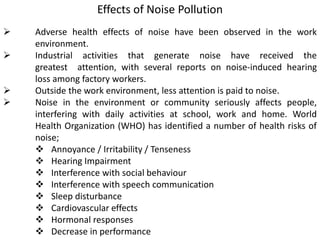
Effects of Noise Pollution
 Adverse health effects of noise have been observed in the work
environment.
 Industrial activities that generate noise have received the
greatest attention, with several reports on noise-induced hearing
loss among factory workers.
 Outside the work environment, less attention is paid to noise.
 Noise in the environment or community seriously affects people,
interfering with daily activities at school, work and home. World
Health Organization (WHO) has identified a number of health risks of
noise;
 Annoyance / Irritability / Tenseness
 Hearing Impairment
 Interference with social behaviour
 Interference with speech communication
 Sleep disturbance
 Cardiovascular effects
 Hormonal responses
 Decrease in performance
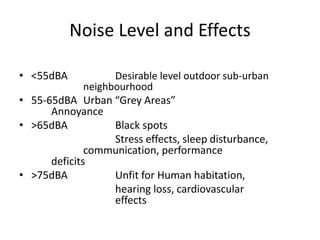
Noise Level and Effects
• <55dBA Desirable level outdoor sub-urban
neighbourhood
• 55-65dBA Urban “Grey Areas”
Annoyance
• >65dBA Black spots
Stress effects, sleep disturbance,
communication, performance
deficits
• >75dBA Unfit for Human habitation,
hearing loss, cardiovascular
effects
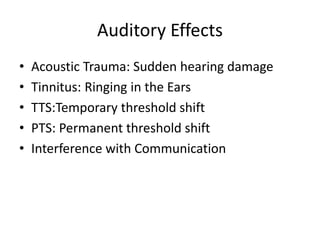
Auditory Effects
• Acoustic Trauma: Sudden hearing damage
• Tinnitus: Ringing in the Ears
• TTS:Temporary threshold shift
• PTS: Permanent threshold shift
• Interference with Communication
Non-Auditory Effects
• Annoyance
• Sleep Disturbance
• Attention
• Motivation
• Stress reactions
• Cardiovascular problems
• Endocrine problems
NOISE POLLUTION: Effects on human beings:
(1) Auditory effects:
Hearing loss
There are two types of hearing loss caused by
noise.
(a) Acoustic trauma
It consists of instantaneous damage to
the ear from a sharply rising wave front,
such as occurs in an explosion and may
produce rupture of the ear drum.
(b) Noise induced hearing loss
• It results from long term exposure to intense
sound.
• The effect usually occurs slowly.
• Its severity depends on the intensity, frequency
and duration of noise exposure.
• The absence of comfort makes noise
induced hearing loss especially treacherous
since the loss of hearing appears only after
significant permanent loss has occurred.
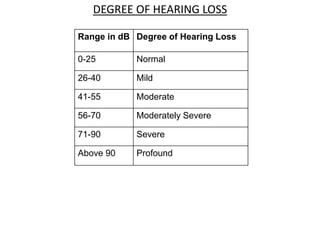
DEGREE OF HEARING LOSS
Range in dB Degree of Hearing Loss
0-25 Normal
26-40 Mild
41-55 Moderate
56-70 Moderately Severe
71-90 Severe
Above 90 Profound
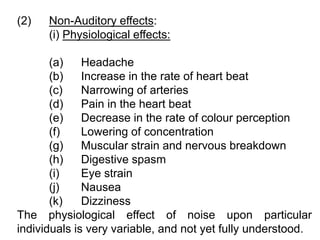
(2) Non-Auditory effects:
(i) Physiological effects:
(a) Headache
(b) Increase in the rate of heart beat
(c) Narrowing of arteries
(d) Pain in the heart beat
(e) Decrease in the rate of colour perception
(f) Lowering of concentration
(g) Muscular strain and nervous breakdown
(h) Digestive spasm
(i) Eye strain
(j) Nausea
(k) Dizziness
The physiological effect of noise upon particular
individuals is very variable, and not yet fully understood.
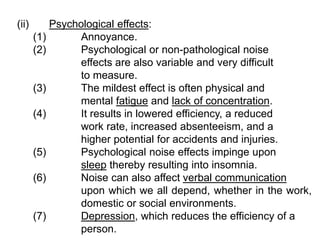
(ii) Psychological effects:
(1) Annoyance.
(2) Psychological or non-pathological noise
effects are also variable and very difficult
to measure.
(3) The mildest effect is often physical and
mental fatigue and lack of concentration.
(4) It results in lowered efficiency, a reduced
work rate, increased absenteeism, and a
higher potential for accidents and injuries.
(5) Psychological noise effects impinge upon
sleep thereby resulting into insomnia.
(6) Noise can also affect verbal communication
upon which we all depend, whether in the work,
domestic or social environments.
(7) Depression, which reduces the efficiency of a
person.
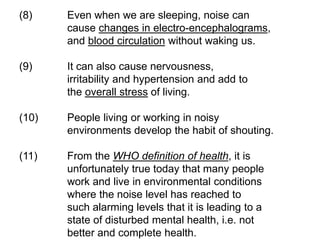
(8) Even when we are sleeping, noise can
cause changes in electro-encephalograms,
and blood circulation without waking us.
(9) It can also cause nervousness,
irritability and hypertension and add to
the overall stress of living.
(10) People living or working in noisy
environments develop the habit of shouting.
(11) From the WHO definition of health, it is
unfortunately true today that many people
work and live in environmental conditions
where the noise level has reached to
such alarming levels that it is leading to a
state of disturbed mental health, i.e. not
better and complete health.
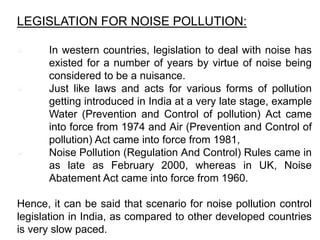
LEGISLATION FOR NOISE POLLUTION:
 In western countries, legislation to deal with noise has
existed for a number of years by virtue of noise being
considered to be a nuisance.
 Just like laws and acts for various forms of pollution
getting introduced in India at a very late stage, example
Water (Prevention and Control of pollution) Act came
into force from 1974 and Air (Prevention and Control of
pollution) Act came into force from 1981,
 Noise Pollution (Regulation And Control) Rules came in
as late as February 2000, whereas in UK, Noise
Abatement Act came into force from 1960.
Hence, it can be said that scenario for noise pollution control
legislation in India, as compared to other developed countries
is very slow paced.
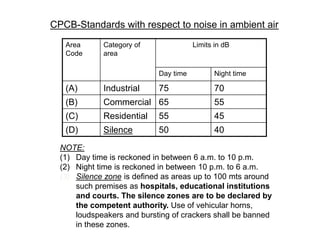
Area
Code
Category of
area
Limits in dB
Day time Night time
(A) Industrial 75 70
(B) Commercial 65 55
(C) Residential 55 45
(D) Silence 50 40
CPCB-Standards with respect to noise in ambient air
NOTE:
(1) Day time is reckoned in between 6 a.m. to 10 p.m.
(2) Night time is reckoned in between 10 p.m. to 6 a.m.
(3) Silence zone is defined as areas up to 100 mts around
such premises as hospitals, educational institutions
and courts. The silence zones are to be declared by
the competent authority. Use of vehicular horns,
loudspeakers and bursting of crackers shall be banned
in these zones.
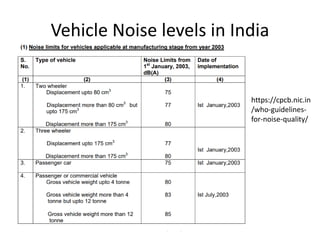
Vehicle Noise levels in India
Dr. Smaranika Panda, DoCE, SV NIT
https://cpcb.nic.in
/who-guidelines-
for-noise-quality/
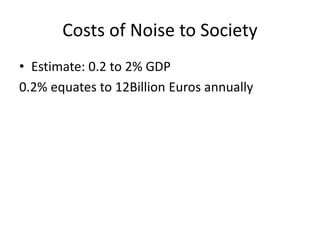
Costs of Noise to Society
• Estimate: 0.2 to 2% GDP
0.2% equates to 12Billion Euros annually
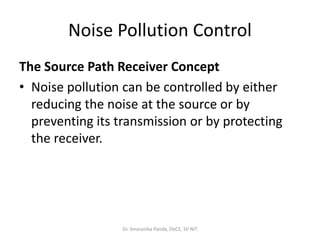
Noise Pollution Control
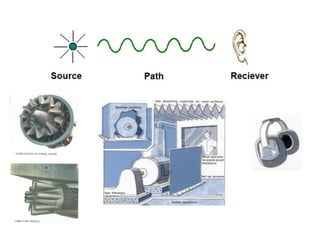
The Source Path Receiver Concept
• Noise pollution can be controlled by either
reducing the noise at the source or by
preventing its transmission or by protecting
the receiver.
Dr. Smaranika Panda, DoCE, SV NIT
NOISE POLLUTION – CONTROL MEASURES:
 Occupational noise is present in the working
environment of many thousands of people for up to
1900 hours per year, and for 30 to 40 years of
their lives.
 Noise should no longer be regarded as
inescapable and inevitable, whether it is hazardous
or disturbance noise.
 However, it must be accepted that noise cannot be
eliminated entirely from our modern technological
environment. While noise cannot of course be
totally eliminated, much can be done to reduce it.
 The benefits of noise reduction are very worth
while considering.
 The benefits of noise reduction are very worth while
considering.
(1) Thousands of people would no longer suffer
progressive hearing damage.
(2) Verbal communication between workers would be
enhanced.
(3) Improved efficiency.
(4) Reduction of accidents.
(5) General all round improvement in working
conditions.
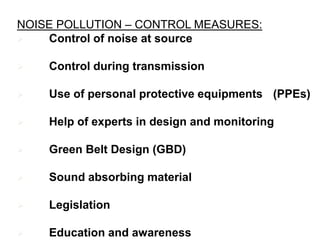
NOISE POLLUTION – CONTROL MEASURES:
 Control of noise at source
 Control during transmission
 Use of personal protective equipments (PPEs)
 Help of experts in design and monitoring
 Green Belt Design (GBD)
 Sound absorbing material
 Legislation
 Education and awareness
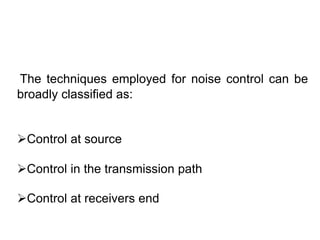
The techniques employed for noise control can be
broadly classified as:
Control at source
Control in the transmission path
Control at receivers end
Control at Source
Reducing the noise levels from domestic sectors:
 Buildings can be designed with suitable noise absorbing
material for the walls, windows, and ceilings.
 The domestic noise coming from radio, tape recorders,
television sets, mixers, washing machines, cooking
operations can be minimized by their selective and judicious
operation.
 By usage of carpets or any absorbing material, the noise
generated from felling of items in house can be minimized.
Maintenance of automobiles:
Regular servicing and tuning of vehicles will reduce the
noise levels.
 Fixing of silencers to automobiles, two wheelers etc., will
reduce the noise levels.
Control over vibrations:
The vibrations of materials may be controlled using proper
foundations, rubber padding etc. to reduce the noise levels
caused by vibrations.
Low voice speaking: Speaking at low voices enough for
communication reduces the excess noise levels.
Prohibition on usage of loud speakers:
 By not permitting the usage of loudspeakers in the habitant
zones except for important meetings / functions.
Selection of machinery:
Optimum selection of machinery tools or equipment reduces
excess noise levels.
Maintenance of machines:
Proper lubrication and maintenance of machines, vehicles
etc. will reduce noise levels.
For example, it is a common experience that, many parts of a
vehicle will become loose while on a rugged path of journey.
If these loose parts are not properly fitted, they will generate
noise and cause annoyance to the driver/passenger.
Similarly is the case of machines. Proper handling and
regular maintenance is essential not only for noise control but
also to improve the life of machine.
Control in the transmission path
The change in the transmission path will increase the length
of travel for the wave and get absorbed/refracted/radiated in
the surrounding environment.
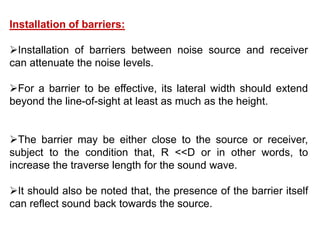
Installation of barriers:
Installation of barriers between noise source and receiver
can attenuate the noise levels.
For a barrier to be effective, its lateral width should extend
beyond the line-of-sight at least as much as the height.
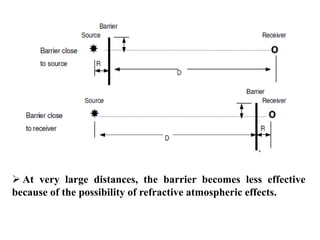
The barrier may be either close to the source or receiver,
subject to the condition that, R <<D or in other words, to
increase the traverse length for the sound wave.
It should also be noted that, the presence of the barrier itself
can reflect sound back towards the source.
 At very large distances, the barrier becomes less effective
because of the possibility of refractive atmospheric effects.
Barriers
•Buffer zones
•Earth berms/wooden fences/concrete walls
•Vegetation (if dense enough)
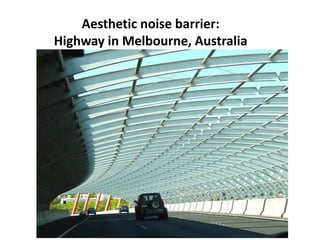
Aesthetic noise barrier:
Highway in Melbourne, Australia
Design of building:
The design of the building incorporating the use of suitable noise
absorbing material for wall/door/window/ceiling will reduce the noise
levels.
Green belt development:
 Planting bushes and trees in and around sound generating sources is
an effective solution for noise pollution.
 The degree of attenuation varies with species of greenbelt.
 The statutory regulations direct the industry to develop greenbelt
four times the built-up area for attenuation of various atmospheric
pollutants, including noise.
Control at receivers end
Use of personal protective equipments (PPEs)
Protective equipment usage is the ultimate step in noise
control technology, i.e. after noise reduction at source
and/or after the diversion or engineered control of
transmission path of noise.
The first step in the technique of using protective equipment is
to gauge the intensity of the problem, identification of the
sufferer and his exposure to the noise levels.
The usage of protective equipment and the worker's exposure
to the high noise levels can be minimized by:
Job rotation: By rotating the job between the workers
working at a particular noise source or isolating a person, the
adverse impacts can be reduced.
Exposure reduction:
Regulations prescribe that, noise level of 90 dB (A) for more than 8
hr continuous exposure is prohibited.
 Persons who are working under such conditions will be exposed to
occupational health hazards.
 The schedule of the workers should be planned in such a way that,
they should not be over exposed to the high noise levels.
Hearing protection:
 Workers should be provided with equipments such as ear plugs and
earmuffs for hearing protection.
 Equipment like earmuffs, ear plugs etc. are the commonly used
devices for hearing protection.
 Attenuation provided by ear-muffs vary widely in respect to their
size, shape, seal material etc.
 Literature survey shows that, an average noise attenuation up to 32
dB can be achieved using earmuffs.
Traffic Control Measures
Reducing road traffic noise at source:
(a) imposing permissible noise emission limits;
(b) promoting the use of public transport; and
(c) cracking down illegal vehicle modifications such as
muffler alterations
Land use planning:
(a) zoning land and planning urban projects with the
consideration of the noise factor;
(b) building bypasses and ring roads; and
(c) establishing buffer zones on each side of a road.
 Resurfacing roads with low-noise materials:
 Resurfacing roads with low-noise materials to reduce noise from
tire friction.
 Generally speaking, low-noise pavement can attain a reduction of
noise from 3 dB(A) to 5 dB(A).
 Installing double-glazed windows and air-conditioning for the
affected residents
 Adopting advanced construction methods
 employing a jointless construction method for elevated roads and
bridges; and
 installing sound-absorbing panels on the underside of elevated
roads.
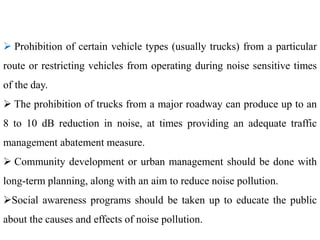
 Prohibition of certain vehicle types (usually trucks) from a particular
route or restricting vehicles from operating during noise sensitive times
of the day.
 The prohibition of trucks from a major roadway can produce up to an
8 to 10 dB reduction in noise, at times providing an adequate traffic
management abatement measure.
 Community development or urban management should be done with
long-term planning, along with an aim to reduce noise pollution.
Social awareness programs should be taken up to educate the public
about the causes and effects of noise pollution.
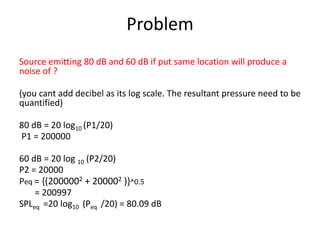
Problem
Source emitting 80 dB and 60 dB if put same location will produce a
noise of ?
(you cant add decibel as its log scale. The resultant pressure need to be
quantified)
80 dB = 20 log10 (P1/20)
P1 = 200000
60 dB = 20 log 10 (P2/20)
P2 = 20000
Peq = {(2000002 + 200002 )}^0.5
= 200997
SPLeq =20 log10 (Peq /20) = 80.09 dB
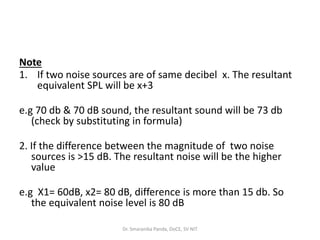
Note
1. If two noise sources are of same decibel x. The resultant
equivalent SPL will be x+3
e.g 70 db & 70 dB sound, the resultant sound will be 73 db
(check by substituting in formula)
2. If the difference between the magnitude of two noise
sources is >15 dB. The resultant noise will be the higher
value
e.g X1= 60dB, x2= 80 dB, difference is more than 15 db. So
the equivalent noise level is 80 dB
Dr. Smaranika Panda, DoCE, SV NIT
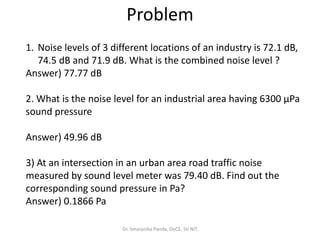
1. Noise levels of 3 different locations of an industry is 72.1 dB,
74.5 dB and 71.9 dB. What is the combined noise level ?
Answer) 77.77 dB
2. What is the noise level for an industrial area having 6300 µPa
sound pressure
Answer) 49.96 dB
3) At an intersection in an urban area road traffic noise
measured by sound level meter was 79.40 dB. Find out the
corresponding sound pressure in Pa?
Answer) 0.1866 Pa
Problem

EPM - Module 4_Noise Pollution.pdf

  • 1.
    Noise Pollution B.Tech. I(CE) Semester – I ENVIRONMENTAL POLLUTION AND MANAGEMENT CE105 Dr Smaranika Panda, MS (IIT Madras), PhD (IIT Madras) Assistant Professor Environmental Engineering Division Department of Civil Engineer S.V. National Institute of Technology
  • 2.
    Noise Pollution  Noise-Unwanted Unpleasant sound Alternating pressure changes in surrounding air
  • 3.
    Noise can bedefined as an unpleasant and unwanted sound that interferes significantly with the comfort, health or welfare of persons, or with the full use of enjoyment of property. It has been recognized as a significant health problem related to hearing damage. Environmental noise may be defined as unwanted sound that is caused by emissions from traffic (roads, air or railways), industrial sites and recreational infrastructures.
  • 4.
    Whether or nota sound is undesired by a person will depend on a number of factors, e.g. (a) Loudness (b) Frequency (c) Continuity (d) Variation with time (e) Time of occurrence (f) Origin of the sound (g) Recipient’s state of mind and temperament (h) Background noise level
  • 5.
    • Sound isa sensation of acoustic waves i.e. disturbance / pressure fluctuations setup in a medium (air). • Sound is a disturbance that propagates through a medium having properties of inertia ( mass ) and elasticity. • The medium by which the audible waves are transmitted is air. • Basically sound propagation is simply the molecular transfer of motional energy. Hence it cannot pass through vacuum.
  • 6.
    • The disturbance(noise) gradually diminishes as it travels outwards since the initial amount of energy is gradually spreading over a wider area. • If the disturbance is confined to one dimension ( tube / thin rod), it does not diminish as it travels (except loses at the walls of the tube)
  • 8.
  • 9.
    Noise- Representation • Audiblepressure range – 20 µpa to 200pa • Minimum pressure to hear –20 µpa – Threshold of hearing • SPL (Sound pressure level) - Pressure that cause a particular sound • SPL = 20 log10 [P/Pref] (Pref- 20 µpa) (SPL- dB) • Intensity of sound is measured in decible (dB) Dr. Smaranika Panda, DoCE, SV NIT
  • 10.
    FREQUENCY In sound, frequencyis as important as its level <20Hz 20Hz to 20,000Hz > 20,000Hz Infrasonic Audible Range Ultrasonic Frequency can be defined as number of pressure cycles / time It is also known as pitch of sound Its unit is Hz.
  • 11.
    • Leq: Equivalentnoise level at an area Dr. Smaranika Panda, DoCE, SV NIT
  • 12.
    Some typical values: 35dB(A)—libraries 65 dB(A)—business offices with normal conversation 75 dB(A)—street with intense traffic measured at the curb 85 dB(A)—street with heavy lorries passing at 6 m of distance Equivalent level (Leq): The noise levels are variable along the time, going up and down continuously, making it difficult to evaluate it. In order to make things easier, the equivalent noise level is defined as a continuous sound level that would produce the same effect on the human ear if compared to the actual noise observed during the measurement, with all the variations. Therefore, the Leq can substitute by a single value all the variations of the noise level. The equivalent sound level is also given by dB(A). Noise- Representation- Leq
  • 13.
    Sources of NoisePollution Dr. Smaranika Panda, DoCE, SV NIT Speed of Sound- 1500 m/s in water and 5000 m/s in steel, 340 m/s in air
  • 14.
    SOURCES: (1) Industrial(2) Non-industrial (1) Industrial: Various industries contributing to noise pollution:  Textile  Iron and steel  Pulp & paper  Chemicals  Thermal power stations In industrial cities like Surat, Kolkata, Ludhiana, Kanpur etc. often the industrial zones are not separated from the residential zones of the city, especially in the case of small scale industries. Sources of Noise Pollution
  • 15.
    (2) Non-Industrial:  DomesticNoise (Household)  Entertainment devices, musical instruments, air conditioners, kitchen appliances.  Loudspeakers during festivals and religious rituals. (Public Address System)  Construction & demolition work.  Transportation noise viz. road, rail and air.  Crowded markets and commercial areas.  Places near airports-noise due to take off and landing of aircrafts. Sources of Noise Pollution
  • 16.
    • Transportation systemsare the main source of noise pollution in urban areas. • Construction of buildings, highways, and streets cause a lot of noise, due to the usage of air compressors, bulldozers, loaders, dump trucks, and pavement breakers. • Loud speakers, plumbing, boilers, generators, air conditioners, fans, and vacuum cleaners add to the existing noise pollution. Sources of Noise Pollution
  • 17.
    SIGNIFICANCE OF ROADTRAFFIC NOISE:  Traffic related noise pollution accounts for nearly ⅔ (67%) of the total noise pollution in an urban area.  Traffic noise on existing urban road-ways lowers the quality of life and property values for person residing in vicinity of these urban corridors.
  • 18.
    Major transportation sourcesof noise pollution: rail, road, and air
  • 19.
    Effects of NoisePollution  Adverse health effects of noise have been observed in the work environment.  Industrial activities that generate noise have received the greatest attention, with several reports on noise-induced hearing loss among factory workers.  Outside the work environment, less attention is paid to noise.  Noise in the environment or community seriously affects people, interfering with daily activities at school, work and home. World Health Organization (WHO) has identified a number of health risks of noise;  Annoyance / Irritability / Tenseness  Hearing Impairment  Interference with social behaviour  Interference with speech communication  Sleep disturbance  Cardiovascular effects  Hormonal responses  Decrease in performance
  • 20.
    Noise Level andEffects • <55dBA Desirable level outdoor sub-urban neighbourhood • 55-65dBA Urban “Grey Areas” Annoyance • >65dBA Black spots Stress effects, sleep disturbance, communication, performance deficits • >75dBA Unfit for Human habitation, hearing loss, cardiovascular effects
  • 21.
    Auditory Effects • AcousticTrauma: Sudden hearing damage • Tinnitus: Ringing in the Ears • TTS:Temporary threshold shift • PTS: Permanent threshold shift • Interference with Communication
  • 22.
    Non-Auditory Effects • Annoyance •Sleep Disturbance • Attention • Motivation • Stress reactions • Cardiovascular problems • Endocrine problems
  • 23.
    NOISE POLLUTION: Effectson human beings: (1) Auditory effects: Hearing loss There are two types of hearing loss caused by noise. (a) Acoustic trauma It consists of instantaneous damage to the ear from a sharply rising wave front, such as occurs in an explosion and may produce rupture of the ear drum.
  • 24.
    (b) Noise inducedhearing loss • It results from long term exposure to intense sound. • The effect usually occurs slowly. • Its severity depends on the intensity, frequency and duration of noise exposure. • The absence of comfort makes noise induced hearing loss especially treacherous since the loss of hearing appears only after significant permanent loss has occurred.
  • 25.
    DEGREE OF HEARINGLOSS Range in dB Degree of Hearing Loss 0-25 Normal 26-40 Mild 41-55 Moderate 56-70 Moderately Severe 71-90 Severe Above 90 Profound
  • 26.
    (2) Non-Auditory effects: (i)Physiological effects: (a) Headache (b) Increase in the rate of heart beat (c) Narrowing of arteries (d) Pain in the heart beat (e) Decrease in the rate of colour perception (f) Lowering of concentration (g) Muscular strain and nervous breakdown (h) Digestive spasm (i) Eye strain (j) Nausea (k) Dizziness The physiological effect of noise upon particular individuals is very variable, and not yet fully understood.
  • 27.
    (ii) Psychological effects: (1)Annoyance. (2) Psychological or non-pathological noise effects are also variable and very difficult to measure. (3) The mildest effect is often physical and mental fatigue and lack of concentration. (4) It results in lowered efficiency, a reduced work rate, increased absenteeism, and a higher potential for accidents and injuries. (5) Psychological noise effects impinge upon sleep thereby resulting into insomnia. (6) Noise can also affect verbal communication upon which we all depend, whether in the work, domestic or social environments. (7) Depression, which reduces the efficiency of a person.
  • 28.
    (8) Even whenwe are sleeping, noise can cause changes in electro-encephalograms, and blood circulation without waking us. (9) It can also cause nervousness, irritability and hypertension and add to the overall stress of living. (10) People living or working in noisy environments develop the habit of shouting. (11) From the WHO definition of health, it is unfortunately true today that many people work and live in environmental conditions where the noise level has reached to such alarming levels that it is leading to a state of disturbed mental health, i.e. not better and complete health.
  • 29.
    LEGISLATION FOR NOISEPOLLUTION:  In western countries, legislation to deal with noise has existed for a number of years by virtue of noise being considered to be a nuisance.  Just like laws and acts for various forms of pollution getting introduced in India at a very late stage, example Water (Prevention and Control of pollution) Act came into force from 1974 and Air (Prevention and Control of pollution) Act came into force from 1981,  Noise Pollution (Regulation And Control) Rules came in as late as February 2000, whereas in UK, Noise Abatement Act came into force from 1960. Hence, it can be said that scenario for noise pollution control legislation in India, as compared to other developed countries is very slow paced.
  • 30.
    Area Code Category of area Limits indB Day time Night time (A) Industrial 75 70 (B) Commercial 65 55 (C) Residential 55 45 (D) Silence 50 40 CPCB-Standards with respect to noise in ambient air NOTE: (1) Day time is reckoned in between 6 a.m. to 10 p.m. (2) Night time is reckoned in between 10 p.m. to 6 a.m. (3) Silence zone is defined as areas up to 100 mts around such premises as hospitals, educational institutions and courts. The silence zones are to be declared by the competent authority. Use of vehicular horns, loudspeakers and bursting of crackers shall be banned in these zones.
  • 31.
    Vehicle Noise levelsin India Dr. Smaranika Panda, DoCE, SV NIT https://cpcb.nic.in /who-guidelines- for-noise-quality/
  • 32.
    Costs of Noiseto Society • Estimate: 0.2 to 2% GDP 0.2% equates to 12Billion Euros annually
  • 33.
    Noise Pollution Control TheSource Path Receiver Concept • Noise pollution can be controlled by either reducing the noise at the source or by preventing its transmission or by protecting the receiver. Dr. Smaranika Panda, DoCE, SV NIT
  • 34.
    NOISE POLLUTION –CONTROL MEASURES:  Occupational noise is present in the working environment of many thousands of people for up to 1900 hours per year, and for 30 to 40 years of their lives.  Noise should no longer be regarded as inescapable and inevitable, whether it is hazardous or disturbance noise.  However, it must be accepted that noise cannot be eliminated entirely from our modern technological environment. While noise cannot of course be totally eliminated, much can be done to reduce it.  The benefits of noise reduction are very worth while considering.
  • 35.
     The benefitsof noise reduction are very worth while considering. (1) Thousands of people would no longer suffer progressive hearing damage. (2) Verbal communication between workers would be enhanced. (3) Improved efficiency. (4) Reduction of accidents. (5) General all round improvement in working conditions.
  • 36.
    NOISE POLLUTION –CONTROL MEASURES:  Control of noise at source  Control during transmission  Use of personal protective equipments (PPEs)  Help of experts in design and monitoring  Green Belt Design (GBD)  Sound absorbing material  Legislation  Education and awareness
  • 37.
    The techniques employedfor noise control can be broadly classified as: Control at source Control in the transmission path Control at receivers end
  • 38.
    Control at Source Reducingthe noise levels from domestic sectors:  Buildings can be designed with suitable noise absorbing material for the walls, windows, and ceilings.  The domestic noise coming from radio, tape recorders, television sets, mixers, washing machines, cooking operations can be minimized by their selective and judicious operation.  By usage of carpets or any absorbing material, the noise generated from felling of items in house can be minimized.
  • 39.
    Maintenance of automobiles: Regularservicing and tuning of vehicles will reduce the noise levels.  Fixing of silencers to automobiles, two wheelers etc., will reduce the noise levels. Control over vibrations: The vibrations of materials may be controlled using proper foundations, rubber padding etc. to reduce the noise levels caused by vibrations. Low voice speaking: Speaking at low voices enough for communication reduces the excess noise levels.
  • 40.
    Prohibition on usageof loud speakers:  By not permitting the usage of loudspeakers in the habitant zones except for important meetings / functions. Selection of machinery: Optimum selection of machinery tools or equipment reduces excess noise levels. Maintenance of machines: Proper lubrication and maintenance of machines, vehicles etc. will reduce noise levels. For example, it is a common experience that, many parts of a vehicle will become loose while on a rugged path of journey.
  • 41.
    If these looseparts are not properly fitted, they will generate noise and cause annoyance to the driver/passenger. Similarly is the case of machines. Proper handling and regular maintenance is essential not only for noise control but also to improve the life of machine.
  • 42.
    Control in thetransmission path The change in the transmission path will increase the length of travel for the wave and get absorbed/refracted/radiated in the surrounding environment.
  • 43.
    Installation of barriers: Installationof barriers between noise source and receiver can attenuate the noise levels. For a barrier to be effective, its lateral width should extend beyond the line-of-sight at least as much as the height. The barrier may be either close to the source or receiver, subject to the condition that, R <<D or in other words, to increase the traverse length for the sound wave. It should also be noted that, the presence of the barrier itself can reflect sound back towards the source.
  • 44.
     At verylarge distances, the barrier becomes less effective because of the possibility of refractive atmospheric effects.
  • 45.
    Barriers •Buffer zones •Earth berms/woodenfences/concrete walls •Vegetation (if dense enough)
  • 46.
    Aesthetic noise barrier: Highwayin Melbourne, Australia
  • 47.
    Design of building: Thedesign of the building incorporating the use of suitable noise absorbing material for wall/door/window/ceiling will reduce the noise levels. Green belt development:  Planting bushes and trees in and around sound generating sources is an effective solution for noise pollution.  The degree of attenuation varies with species of greenbelt.  The statutory regulations direct the industry to develop greenbelt four times the built-up area for attenuation of various atmospheric pollutants, including noise.
  • 48.
    Control at receiversend Use of personal protective equipments (PPEs) Protective equipment usage is the ultimate step in noise control technology, i.e. after noise reduction at source and/or after the diversion or engineered control of transmission path of noise. The first step in the technique of using protective equipment is to gauge the intensity of the problem, identification of the sufferer and his exposure to the noise levels. The usage of protective equipment and the worker's exposure to the high noise levels can be minimized by: Job rotation: By rotating the job between the workers working at a particular noise source or isolating a person, the adverse impacts can be reduced.
  • 49.
    Exposure reduction: Regulations prescribethat, noise level of 90 dB (A) for more than 8 hr continuous exposure is prohibited.  Persons who are working under such conditions will be exposed to occupational health hazards.  The schedule of the workers should be planned in such a way that, they should not be over exposed to the high noise levels. Hearing protection:  Workers should be provided with equipments such as ear plugs and earmuffs for hearing protection.  Equipment like earmuffs, ear plugs etc. are the commonly used devices for hearing protection.  Attenuation provided by ear-muffs vary widely in respect to their size, shape, seal material etc.  Literature survey shows that, an average noise attenuation up to 32 dB can be achieved using earmuffs.
  • 50.
    Traffic Control Measures Reducingroad traffic noise at source: (a) imposing permissible noise emission limits; (b) promoting the use of public transport; and (c) cracking down illegal vehicle modifications such as muffler alterations Land use planning: (a) zoning land and planning urban projects with the consideration of the noise factor; (b) building bypasses and ring roads; and (c) establishing buffer zones on each side of a road.
  • 51.
     Resurfacing roadswith low-noise materials:  Resurfacing roads with low-noise materials to reduce noise from tire friction.  Generally speaking, low-noise pavement can attain a reduction of noise from 3 dB(A) to 5 dB(A).  Installing double-glazed windows and air-conditioning for the affected residents  Adopting advanced construction methods  employing a jointless construction method for elevated roads and bridges; and  installing sound-absorbing panels on the underside of elevated roads.
  • 52.
     Prohibition ofcertain vehicle types (usually trucks) from a particular route or restricting vehicles from operating during noise sensitive times of the day.  The prohibition of trucks from a major roadway can produce up to an 8 to 10 dB reduction in noise, at times providing an adequate traffic management abatement measure.  Community development or urban management should be done with long-term planning, along with an aim to reduce noise pollution. Social awareness programs should be taken up to educate the public about the causes and effects of noise pollution.
  • 53.
    Problem Source emitting 80dB and 60 dB if put same location will produce a noise of ? (you cant add decibel as its log scale. The resultant pressure need to be quantified) 80 dB = 20 log10 (P1/20) P1 = 200000 60 dB = 20 log 10 (P2/20) P2 = 20000 Peq = {(2000002 + 200002 )}^0.5 = 200997 SPLeq =20 log10 (Peq /20) = 80.09 dB
  • 54.
    Note 1. If twonoise sources are of same decibel x. The resultant equivalent SPL will be x+3 e.g 70 db & 70 dB sound, the resultant sound will be 73 db (check by substituting in formula) 2. If the difference between the magnitude of two noise sources is >15 dB. The resultant noise will be the higher value e.g X1= 60dB, x2= 80 dB, difference is more than 15 db. So the equivalent noise level is 80 dB Dr. Smaranika Panda, DoCE, SV NIT
  • 55.
    Dr. Smaranika Panda,DoCE, SV NIT 1. Noise levels of 3 different locations of an industry is 72.1 dB, 74.5 dB and 71.9 dB. What is the combined noise level ? Answer) 77.77 dB 2. What is the noise level for an industrial area having 6300 µPa sound pressure Answer) 49.96 dB 3) At an intersection in an urban area road traffic noise measured by sound level meter was 79.40 dB. Find out the corresponding sound pressure in Pa? Answer) 0.1866 Pa Problem