3GPP LTE-A Standardisation in
Release 12 and Beyond
January 2013
Eiko Seidel, Chief Technical Officer
Nomor Research GmbH, Munich, Germany
Summary
Quite some time ago major improvements have
been made to LTE with LTE-Advanced as part of
3GPP Release 10. Unquestionably, LTE-A will be
the leading global 4G standard fulfilling the
defined ITU-R requirements [1] on IMTAdvanced such as peak data rates beyond
1Gbps. While further enhancements to LTEAdvanced have just been completed in 3GPP
Release 11, the new technology trends become
visible to serve the continuously growing traffic
demand. This White Paper, based on Nomor’s
attendance of 3GPP, provides an outlook on
3GPP standardisation for the forthcoming years.
Besides a summary of general trends and a
projected release schedule, it includes an
overview of the work and study items of Release
12 in the Radio Working Groups. New key
technologies that Release 12 will address are:
Small Cell Enhancements, a New Carrier Type,
3D-MIMO
Beamforming,
Machine-TypeCommunication, LTE-WiFi Integration at radio
level and Public Safety incl. Device-to-Device
communication. While the completion of Release
12 is expected mid of 2014, deployments might
be seen around the end of 2015 and later.
NoMoR is active in different related research
projects and offers consultancy services for
related research, standardisation, simulation,
early prototyping and technology training.
Workshop on LTE Release 12 and Beyond
In June 2012 a 3GPP workshop [2] was held to
get an overview of the priorities within the
industry concerning future standardisation work.
There was a very large interest in the workshop
with about 250 participants attending in

Ljubljana, Slovenia. Although no decisions or
binding conclusions were drawn, the workshop
provided quite a good picture of the ideas of the
companies for future releases.
Traffic is increasing further and even with
technology improvements it appears to be clear
that the traffic demand cannot be satisfied with
the proposed technologies.
Technology enhancements can roughly
clustered into
Improvements of Spectral Efficiency
Bandwidth Expansion
Cell Densification
Minor Issues or Enhancements

be

Improvement of spectral efficiency is hard to
achieve given the maturity of this field, especially
gains that are transferable to noticeable systemlevel gains. Furthermore, such improvements
often require major changes to the standard.
Possible technological enhancements are the
introduction of OFDMA in the uplink that will
provide gain in not power limited situations, the
introduction of 256QAM in the downlink, the
support for flexible downlink power control,
advanced receivers with interference cancellation
and also enhancements of Cooperative MultiPoint techniques (CoMP) for real-life scenarios
(e.g. non ideal backhaul).
Spectrum availability will grow in the future,
mostly in higher frequency bands, and future
LTE systems need to support this. Bandwidth
extensions will be done continuously in every

Nomor Research GmbH / info@nomor.de / www.nomor.de / T +49 89 9789 8000

1/9
release
according
to
market
demand.
Frequencies in the range of 3.5 GHz will need to
be supported soon. Local access assisted by
wide area macro cells providing basic coverage
have been mentioned by many key companies.
Very high frequencies (>10 GHz) might be
allocated in the World Radio conference 2015
and might be served with a completely new
access scheme potentially standardized as part
of Rel.-14. Access technologies making extensive
use of beam forming will be candidates since the
beam forming gain might compensate for the
increased pathloss at higher frequencies.
Although an increase in available and useful
spectrum is expected to be at least threefold
until 2020 this is by far not sufficient to keep
pace with the expected growth of traffic.
One of the key areas for improvement of the
next releases is surely the full integration of
small cells into Heterogeneous Networks. Cell
splitting provides the only way to have
significant capacity increase at the cost of higher
deployment costs. High SINR regions are
generated by the introduction of small cells
(possibly on a separate frequency layer) and
might offer a further increase in peak data rates.
This goes hand in hand with advanced
interference management between macro and
pico layer or the extension of Carrier
Aggregation (CA) to support multi-site CA or
multi-RAT CA (FDD/TDD or LTE/HSPA). Mobility
management will have to be enhanced and the
network should assist the UEs in discovering low
power nodes with minimum power consumption.
Wireless backhaul was often mentioned by
operators as one of the requirements. They also
proposed to use higher frequency bands for the
backhaul.
Other issues and enhancements are interworking
with WiFi (e.g. tight integration at RAN level)
and the support of Device to Device
communication. Work is also likely to be split
into two fields: proximity or device detection and
direct transmission. Continuous enhancements
for Machine Type Communication, SelfOrganizing Networks and Minimization of Drive

Test will happen, but will not cause major
changes to specification.
Once again it is emphasized that this only
represents company views during the 3GPP
workshop. No actual conclusions have been
drawn or decisions have been made.
Potential 3GPP Release Timing
Standardisation work and release timing in 3GPP
is split into three stages.
Stage 1: Requirements and Service Aspects
Stage 2: Architecture and Technical Design
Stage 3: Detailed Specification
Release 12
Stage-1 of Release 12 work already started in
2011. Nevertheless in the radio groups little time
was spent on it due to a 3 month delay of
Release 11 completion. The following are the
official completion dates of Release 12 as of
today:
Stage 1: March 2013 RAN
Stage 2: December 2013 RAN
Stage 3: June 2014 RAN
ASN.1 freeze likely in September 2014
First products should not be expected sooner
than 15 to 18 months after ASN.1 freeze.
Therefore actual deployment could be expected
end of 2015 and later.
Release 13
From the workshop it can be deduced there will
be another release to further enhance LTE-A
technology, a Release 13. Dates of Release 13
are still hypothetical and not official, yet.
Start: June 2014 RAN
Completion: December 2015
Surely the content and timing of Release 13 will
depend on progress in Release 12.
Release 14/15
The timing of Release 14/15 is likely to be
influenced by the World Radio Conference (WRC)
2015 scheduled to take place in September

Nomor Research GmbH / info@nomor.de / www.nomor.de / T +49 89 9789 8000

2/9
2015. Potential candidate bands allocated at
WRC 2015 might include:
1427-1525 MHz
3.4-3.6 GHz
3800-4200 MHz

coding Matrix Indicator (PMI) codebook
enhancements might allow for a finer spatial
domain granularity and might support different
eNB antenna configurations. New CSI feedback
modes might also be introduced.

As consequence a completely new access
technology might be defined in the Rel.14/15
time frame for commercial deployment at the
end of this decade. Up to today most companies
call this technology Beyond 4G.

There is also a Rel.12 study item [7] that will
standardise a new 3D channel model to allow for
accurate system-level simulations of such
antenna technologies.

Release 12 Work and Study Items
At 3GPP RAN Plenary#58 in December 2012 in
Barcelona [3] major decisions concerning the
content of Release 12 where made. In this
section the respective decisions are summarized
and the technology proposals are explained in
detail.
MIMO DL Enhancements / 3D-MIMO [4]
By continued progress of antenna technologies,
enhancements of the macro cell eNBs can be
realized mostly by exploiting an increased
frequency reuse and reduced interference in the
spatial domain.

Low Cost Machine Type Communication [5]
A massive growth of Machine to Machine (M2M)
communication, devices and traffic is expected
to support smart grid, transport, logistics, ehealth, energy, safety applications etc. Therefore
the LTE radio interface shall be prepared to
efficiently support the massive transfer of small,
infrequent packets using very low cost, low
complexity and low power devices. Quite some
work on Machine Type Communication (MTC)
was already standardized in Release 11. The
work covers service requirements, architecture
and security issues. Among others, a MTC
Interworking Function and Service Capability
Server [14] are defined in Release 11.

Figure 1: 3D MIMO Beam Forming

Significant link budget enhancements are
targeted in this work to improve indoor
penetration. The use case is that some MTC UEs
are installed in the basements of residential
buildings or locations shielded by foil-backed
insulation, metalized windows or traditional
thick-walled building construction, and these UEs
would
experience
significantly
greater
penetration losses on the radio interface than
normal LTE devices. Most promising and simple
techniques are around adding time diversity (e.g.
TTI bundling), extensive use of HARQ repetition
as well as power boosting.

Due to the reuse of the existing cell sites and
transport network, operators are provided
attractive means of capacity enhancements at
reasonable costs. Potential changes to the
specifications will mostly impact Channel State
Information (CSI) feedback. Amongst others Pre-

New Carrier Type (NCT) [6]
So far LTE-A standardisation has always been
restricted to backward-compatible carriers only.
On the one hand, this enables a smooth
transition to new releases; on the other hand,
there are limitations to the introduction of new

Nomor Research GmbH / info@nomor.de / www.nomor.de / T +49 89 9789 8000

3/9
technologies. One of the consequences of
backward compatibility is the need to
continuously transmit Common Reference
Symbols in every subframe across the bandwidth
as shown in Figure 2.

Figure 2: LTE/LTE-A Carrier with Common
Reference Symbols

This precludes switching off a cell temporarily
and
represents
unnecessary
overhead
particularly in case of non-codebook based beam
forming using dedicated reference symbols.
A new carrier type allows switching off cells, at
least temporarily, and will reduce the overhead
and interference from Common Reference
Symbols by maximizing the use of dedicated
Demodulation Reference Symbols required for
advanced antenna technologies.

The New Carrier Type might be operated as a
kind of extension carrier along with another
LTE/LTE-A carrier or alternatively as standalone
non-backward compatible carrier.
Small Cell Enhancements [8], [9]
Further network densification is seen as one of
the key elements to increase spectrum
efficiency. Although initially started as a study
item, this work is expected to get the largest
attention in Release 12. By bringing the UEs
closer to the network nodes the SINR improves,
increasing overall performance by use of
adaptive coding/modulation and MIMO. Similarly
to 3D beam forming system performance can be
increased through the reuse of frequency
resource, so-called cell splitting. The impact of
Heterogeneous Networks on operation is
manifold e.g. large traffic and user variations in
the cells are expected, larger SINR dynamics,
increased handover rate etc.
As illustrated in Figure 4 two scenarios can be
envisioned in this work. The first is a frequency
separated local access, where different
frequency layers are being used for the small
cells. And secondly, a frequency-integrated local
access might be feasible, where macro and pico
cells are using the same frequency and where
the small cells are fully integrated into the
network.
F1

F1

F2

F1

F2 >> F1

Figure 4: Scenarios of Network Densification

Figure 3: New Carrier Type with Discontinuous
Transmission

Furthermore new bandwidth formats might be
introduced to support all kinds of bandwidths.

Depending on the scenario, different methods
are required to assign cell identities and to
support the UEs in finding and using the
respective small cells. For the small cells,
particularly when using higher frequencies, new
regulatory requirements will be required and coexistence studies need to be conducted. The use

Nomor Research GmbH / info@nomor.de / www.nomor.de / T +49 89 9789 8000

4/9
of different TDD based duplex schemes can also
become
beneficial.
A
more
dynamic
uplink/downlink subframe allocation in isolated
cell clusters could match the instantaneous, local
traffic situation. Advanced sensing and resource
reservation might be required to avoid severe
interference scenarios.
Surely, the fully integrated local access of the
second scenario looks like a very promising
method for performance enhancements. The
small cells just extend the macro cell with the
same physical layer identification or with
dynamically assigned virtual cell identities that
are reused in spatial domain. Previously defined
enhanced Inter-Cell Interference Coordination
(eICIC) techniques are replaced by dynamic
creation of such “virtual” cells or “soft” cells.
Extensive traffic offload with any offset of cell
range expansion (CRE) will be possible in such
scenario.
Radio Resource Control

System Information

marco cells and small cells in the same
geographical area.
LTE Device to Device Communication [10]
Device to device communication allows direct
communication between UEs that are in
proximity to each other. Besides its potential to
save energy, reduce interference and extend
coverage, the key driver for this work is to
ensure that 3GPP LTE meets the needs of Public
Safety. Until today different technologies are
used for public cellular networks and for
dedicated public safety networks. LTE is already
globally promoted as future public safety system.
Once D2D is standardised the market might also
see new proximity-based applications and
services. Focus is mostly given to network
controlled D2D communication as shown in
Figure 6. In this case the control signalling (e.g.
initial access, authentication, connection control)
as well as resource reservation is handled by the
network.

Zzz..

Figure 5: Split of User and Control Plane for
Frequency Integrated Local Access

The small cells simply provide a fast data pipe
with a largely improved link budget due to the
close proximity of the network node. The macro
cell on the other hand will provide cell wide
system information as well as radio resource
control including traffic steering, carrier selection
and supporting the UE to detect a small cell
close by (see Figure 5). Other benefits are that
mobility in such HetNet scenarios will become
more robust and that the operation of small cells
might even be transparent to the UE, so the UE
need not even be aware of the local access.
On the other hand, this architecture requires a
tight integration of the small cells into the
network by ultra-fast interfaces or preferable by
a central baseband processing unit. This might
prevent the selection of multiple vendors for

Figure 6: Network Controlled Device to Device
Communication

This way Quality of Service can be guaranteed
and the network operator still remains in control
of the transmission. Although standardisation did
not start yet, it can be assumed that schemes
that are transparent to the user equipment will
be preferred. Although not shown in Figure 6, it
is also likely that a radio bearer for potential data
transmission to the network is being maintained
all the time.
Nevertheless
there
might
be
opposing
requirements from the public safety area such as
a disaster use case, where the network might be

Nomor Research GmbH / info@nomor.de / www.nomor.de / T +49 89 9789 8000

5/9
down and communication between security
forces must still be possible. This might require
that a new specification also supports an
autonomous control by the UEs or a hybrid
approach with a distributed control between
network and UEs.
3GPP/WiFi Radio Interworking [11]
Base stations also supporting WiFi have been
seen on the market for some time now, but
interworking is mostly limited to core network
functionality
like
user
authentication
/
authorization and accounting. Although the
specification also supports mobility, further
optimization is seen as beneficial to improve load
balancing, Quality of Service provisioning and an
improved UE battery consumption when using
WiFi technology in tight cooperation with cellular
networks. In a first phase of this study item
interworking at radio level will be studied and
requirements will be defined to derive respective
solutions. Today’s WiFi network detection and
selection functions are mostly UE based and
future solutions might be operator controlled.
This will allow for implementing more intelligent
networks that consider cell load or transport
network load, user Quality of Service or radio
link quality for the different links during that
operation.
HetNet Mobility Enhancements [12]
This work item has been created as a result of
an ongoing study item in Release 11. The results
of the study item have been captured in a
technical report TR36.839 [13]. From simulation
results it was concluded that handover
performance of Heterogeneous Networks is not
as good as for pure marco network deployments.
Furthermore, it was shown that the UE speed
has significant impact on the handover
performance and that careful DRX settings are
required to avoid negative impact on handover
performance. The objective is thus to enhance
handover performance in HetNet environments
(e.g. failure rate, minimize ping-pong effects,
recovery from radio link failure) also supporting
UE mobility and longer DRX cycles. Small-cell
enhancements related to mobility will also be

discussed with the focus on inter-frequency
scenarios.
RAN WG3 Work and Study Items with Impact on
Network Architecture
RAN3 will continue to work on solutions that
involve S1 and X2 signalling. In Release 12 the
following related work and study items have
been approved:
Study on Next Generation Self-Organizing
Networks (SON)
Further Energy Saving Study
Work item on X2-GW support for H(e)NB
mobility (left over from Rel.11)
Study on RAN Enhancements for UMTS/LTE
Interworking
Theses work and study items are mostly
enhancements of already existing technologies
for specific scenarios or for better interworking
between existing features. Surely the integrated
support of a large number of small cells in
HetNets will pose new requirements SON
operation (e.g. load balancing, mobility
robustness optimization) or to enable more
efficient power saving on the network side.
RAN WG4 and WG5 Work and Study Items
concerning RF and Testing
Please note that there is quite some work
ongoing on radio frequency aspects and testing
in Release 12 which are not within the scope of
this white paper. Amongst others there are a
large number of spectrum related work items to
enable new frequency combinations for Carrier
Aggregation.

Nomor Research GmbH / info@nomor.de / www.nomor.de / T +49 89 9789 8000

6/9
References
[1]
Report ITU-R M.2134 - Requirements
related to technical performance for IMTAdvanced radio interface(s)
[2]
RWS-120052, Report of 3GPP TSG RAN
Workshop on Release 12 and onwards,
Ljubljana, Slovenia, June 2012
[3]
RP-13xxxx, Draft Report of 3GPP TSG
RAN meeting#58, Barcelona, Spain, Dec.
2012
[4]
RP-121416, Further Downlink MIMO
Enhancement for LTE-Advanced
[5]
RP-121648, Study on Provision of low-cost
MTC UEs based on LTE
[6]
RP-122028, Updated WI proposal: New
Carrier Type for LTE
[7]
RP-121788, Study on 3D-channel model
for Elevation Beamforming and Massive
MIMO studies for LTE
[8]
RP-122005, New Study Item Proposal for
Small Cell Enhancements for E-UTRA and
E-UTRAN – Physical-layer Aspects
[9]
RP-122033, New Study Item Description:
Small Cell enhancements for E-UTRA and
E-UTRAN – Higher-layer aspects
[10] RP-121699,
Background
on
“LTE
D2D
Proximity
Services”
Study Item proposal
[11] RP-122038, New Study Item Proposal on
WLAN/3GPP Radio Interworking
[12] RP-122007, New WI proposal: Hetnet
Mobility Enhancements for LTE
[13] 3GPP TR 36.839 V11.1.0 (2012-12), (EUTRA);
Mobility
enhancements
in
heterogeneous networks (Release 11)
[14] 3GPP
TS23.682
“Architecture
enhancements
to
facilitate
communications
with
packet
data
networks and applications (Release 11)”

Note: This newsletter is provided to you by
Nomor Research GmbH. Similar documents can
be obtained from www.nomor.de. Feel free to
forward this issue in electronic format. Please
contact us in case you are interested in
collaboration on related subjects.

Disclaimer: This information, partly obtained from
official 3GPP meeting reports, is assumed to be
reliable, but does not necessarily reflect the view of
Nomor Research GmbH. The report is provided for
informational purpose only. We do not accept any
responsibility for the content of this newsletter. Nomor
Research GmbH has no obligation to update, modify
or amend or to otherwise notify the reader thereof in
the event that any matter stated herein, or any opinion,
projection, forecast or estimate set forth herein,
changes or subsequently becomes inaccurate.

Nomor Research GmbH / info@nomor.de / www.nomor.de / T +49 89 9789 8000

7/9
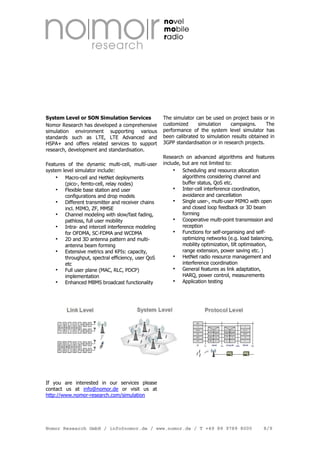
System Level or SON Simulation Services
Nomor Research has developed a comprehensive
simulation environment supporting various
standards such as LTE, LTE Advanced and
HSPA+ and offers related services to support
research, development and standardisation.
Features of the dynamic multi-cell, multi-user
system level simulator include:
Macro-cell and HetNet deployments
(pico-, femto-cell, relay nodes)
Flexible base station and user
configurations and drop models
Different transmitter and receiver chains
incl. MIMO, ZF, MMSE
Channel modeling with slow/fast fading,
pathloss, full user mobility
Intra- and intercell interference modeling
for OFDMA, SC-FDMA and WCDMA
2D and 3D antenna pattern and multiantenna beam forming
Extensive metrics and KPIs: capacity,
throughput, spectral efficiency, user QoS
etc
Full user plane (MAC, RLC, PDCP)
implementation
Enhanced MBMS broadcast functionality

The simulator can be used on project basis or in
customized
simulation
campaigns.
The
performance of the system level simulator has
been calibrated to simulation results obtained in
3GPP standardisation or in research projects.
Research on advanced algorithms and features
include, but are not limited to:
Scheduling and resource allocation
algorithms considering channel and
buffer status, QoS etc.
Inter-cell interference coordination,
avoidance and cancellation
Single user-, multi-user MIMO with open
and closed loop feedback or 3D beam
forming
Cooperative multi-point transmission and
reception
Functions for self-organising and selfoptimizing networks (e.g. load balancing,
mobility optimization, tilt optimisation,
range extension, power saving etc. )
HetNet radio resource management and
interference coordination
General features as link adaptation,
HARQ, power control, measurements
Application testing

If you are interested in our services please
contact us at info@nomor.de or visit us at
http://www.nomor-research.com/simulation

Nomor Research GmbH / info@nomor.de / www.nomor.de / T +49 89 9789 8000

8/9
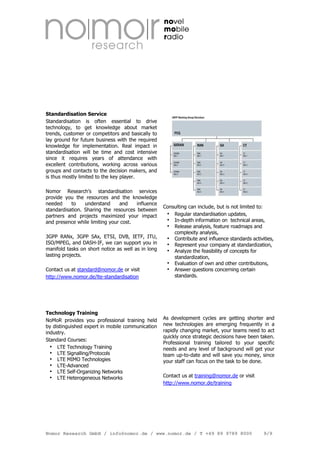
Standardisation Service
Standardisation is often essential to drive
technology, to get knowledge about market
trends, customer or competitors and basically to
lay ground for future business with the required
knowledge for implementation. Real impact in
standardisation will be time and cost intensive
since it requires years of attendance with
excellent contributions, working across various
groups and contacts to the decision makers, and
is thus mostly limited to the key player.
Nomor Research's standardisation services
provide you the resources and the knowledge
needed
to
understand
and
influence
standardisation. Sharing the resources between
partners and projects maximized your impact
and presence while limiting your cost.
3GPP RANx, 3GPP SAx, ETSI, DVB, IETF, ITU,
ISO/MPEG, and DASH-IF, we can support you in
manifold tasks on short notice as well as in long
lasting projects.
Contact us at standard@nomor.de or visit
http://www.nomor.de/lte-standardisation

Technology Training
NoMoR provides you professional training held
by distinguished expert in mobile communication
industry.
Standard Courses:
LTE Technology Training
LTE Signalling/Protocols
LTE MIMO Technologies
LTE-Advanced
LTE Self-Organizing Networks
LTE Heterogeneous Networks

Consulting can include, but is not limited to:
Regular standardisation updates,
In-depth information on technical areas,
Release analysis, feature roadmaps and
complexity analysis,
Contribute and influence standards activities,
Represent your company at standardization,
Analyze the feasibility of concepts for
standardization,
Evaluation of own and other contributions,
Answer questions concerning certain
standards.

As development cycles are getting shorter and
new technologies are emerging frequently in a
rapidly changing market, your teams need to act
quickly once strategic decisions have been taken.
Professional training tailored to your specific
needs and any level of background will get your
team up-to-date and will save you money, since
your staff can focus on the task to be done.
Contact us at training@nomor.de or visit
http://www.nomor.de/training

Nomor Research GmbH / info@nomor.de / www.nomor.de / T +49 89 9789 8000

9/9

3GPP LTE-A Standardisation in Release 12 and Beyond - Jan 2013 Eiko Seidel, Chief Technical Officer Nomor Research GmbH, Munich, Germany

  • 1.
    3GPP LTE-A Standardisationin Release 12 and Beyond January 2013 Eiko Seidel, Chief Technical Officer Nomor Research GmbH, Munich, Germany Summary Quite some time ago major improvements have been made to LTE with LTE-Advanced as part of 3GPP Release 10. Unquestionably, LTE-A will be the leading global 4G standard fulfilling the defined ITU-R requirements [1] on IMTAdvanced such as peak data rates beyond 1Gbps. While further enhancements to LTEAdvanced have just been completed in 3GPP Release 11, the new technology trends become visible to serve the continuously growing traffic demand. This White Paper, based on Nomor’s attendance of 3GPP, provides an outlook on 3GPP standardisation for the forthcoming years. Besides a summary of general trends and a projected release schedule, it includes an overview of the work and study items of Release 12 in the Radio Working Groups. New key technologies that Release 12 will address are: Small Cell Enhancements, a New Carrier Type, 3D-MIMO Beamforming, Machine-TypeCommunication, LTE-WiFi Integration at radio level and Public Safety incl. Device-to-Device communication. While the completion of Release 12 is expected mid of 2014, deployments might be seen around the end of 2015 and later. NoMoR is active in different related research projects and offers consultancy services for related research, standardisation, simulation, early prototyping and technology training. Workshop on LTE Release 12 and Beyond In June 2012 a 3GPP workshop [2] was held to get an overview of the priorities within the industry concerning future standardisation work. There was a very large interest in the workshop with about 250 participants attending in Ljubljana, Slovenia. Although no decisions or binding conclusions were drawn, the workshop provided quite a good picture of the ideas of the companies for future releases. Traffic is increasing further and even with technology improvements it appears to be clear that the traffic demand cannot be satisfied with the proposed technologies. Technology enhancements can roughly clustered into Improvements of Spectral Efficiency Bandwidth Expansion Cell Densification Minor Issues or Enhancements be Improvement of spectral efficiency is hard to achieve given the maturity of this field, especially gains that are transferable to noticeable systemlevel gains. Furthermore, such improvements often require major changes to the standard. Possible technological enhancements are the introduction of OFDMA in the uplink that will provide gain in not power limited situations, the introduction of 256QAM in the downlink, the support for flexible downlink power control, advanced receivers with interference cancellation and also enhancements of Cooperative MultiPoint techniques (CoMP) for real-life scenarios (e.g. non ideal backhaul). Spectrum availability will grow in the future, mostly in higher frequency bands, and future LTE systems need to support this. Bandwidth extensions will be done continuously in every Nomor Research GmbH / info@nomor.de / www.nomor.de / T +49 89 9789 8000 1/9
  • 2.
    release according to market demand. Frequencies in therange of 3.5 GHz will need to be supported soon. Local access assisted by wide area macro cells providing basic coverage have been mentioned by many key companies. Very high frequencies (>10 GHz) might be allocated in the World Radio conference 2015 and might be served with a completely new access scheme potentially standardized as part of Rel.-14. Access technologies making extensive use of beam forming will be candidates since the beam forming gain might compensate for the increased pathloss at higher frequencies. Although an increase in available and useful spectrum is expected to be at least threefold until 2020 this is by far not sufficient to keep pace with the expected growth of traffic. One of the key areas for improvement of the next releases is surely the full integration of small cells into Heterogeneous Networks. Cell splitting provides the only way to have significant capacity increase at the cost of higher deployment costs. High SINR regions are generated by the introduction of small cells (possibly on a separate frequency layer) and might offer a further increase in peak data rates. This goes hand in hand with advanced interference management between macro and pico layer or the extension of Carrier Aggregation (CA) to support multi-site CA or multi-RAT CA (FDD/TDD or LTE/HSPA). Mobility management will have to be enhanced and the network should assist the UEs in discovering low power nodes with minimum power consumption. Wireless backhaul was often mentioned by operators as one of the requirements. They also proposed to use higher frequency bands for the backhaul. Other issues and enhancements are interworking with WiFi (e.g. tight integration at RAN level) and the support of Device to Device communication. Work is also likely to be split into two fields: proximity or device detection and direct transmission. Continuous enhancements for Machine Type Communication, SelfOrganizing Networks and Minimization of Drive Test will happen, but will not cause major changes to specification. Once again it is emphasized that this only represents company views during the 3GPP workshop. No actual conclusions have been drawn or decisions have been made. Potential 3GPP Release Timing Standardisation work and release timing in 3GPP is split into three stages. Stage 1: Requirements and Service Aspects Stage 2: Architecture and Technical Design Stage 3: Detailed Specification Release 12 Stage-1 of Release 12 work already started in 2011. Nevertheless in the radio groups little time was spent on it due to a 3 month delay of Release 11 completion. The following are the official completion dates of Release 12 as of today: Stage 1: March 2013 RAN Stage 2: December 2013 RAN Stage 3: June 2014 RAN ASN.1 freeze likely in September 2014 First products should not be expected sooner than 15 to 18 months after ASN.1 freeze. Therefore actual deployment could be expected end of 2015 and later. Release 13 From the workshop it can be deduced there will be another release to further enhance LTE-A technology, a Release 13. Dates of Release 13 are still hypothetical and not official, yet. Start: June 2014 RAN Completion: December 2015 Surely the content and timing of Release 13 will depend on progress in Release 12. Release 14/15 The timing of Release 14/15 is likely to be influenced by the World Radio Conference (WRC) 2015 scheduled to take place in September Nomor Research GmbH / info@nomor.de / www.nomor.de / T +49 89 9789 8000 2/9
  • 3.
    2015. Potential candidatebands allocated at WRC 2015 might include: 1427-1525 MHz 3.4-3.6 GHz 3800-4200 MHz coding Matrix Indicator (PMI) codebook enhancements might allow for a finer spatial domain granularity and might support different eNB antenna configurations. New CSI feedback modes might also be introduced. As consequence a completely new access technology might be defined in the Rel.14/15 time frame for commercial deployment at the end of this decade. Up to today most companies call this technology Beyond 4G. There is also a Rel.12 study item [7] that will standardise a new 3D channel model to allow for accurate system-level simulations of such antenna technologies. Release 12 Work and Study Items At 3GPP RAN Plenary#58 in December 2012 in Barcelona [3] major decisions concerning the content of Release 12 where made. In this section the respective decisions are summarized and the technology proposals are explained in detail. MIMO DL Enhancements / 3D-MIMO [4] By continued progress of antenna technologies, enhancements of the macro cell eNBs can be realized mostly by exploiting an increased frequency reuse and reduced interference in the spatial domain. Low Cost Machine Type Communication [5] A massive growth of Machine to Machine (M2M) communication, devices and traffic is expected to support smart grid, transport, logistics, ehealth, energy, safety applications etc. Therefore the LTE radio interface shall be prepared to efficiently support the massive transfer of small, infrequent packets using very low cost, low complexity and low power devices. Quite some work on Machine Type Communication (MTC) was already standardized in Release 11. The work covers service requirements, architecture and security issues. Among others, a MTC Interworking Function and Service Capability Server [14] are defined in Release 11. Figure 1: 3D MIMO Beam Forming Significant link budget enhancements are targeted in this work to improve indoor penetration. The use case is that some MTC UEs are installed in the basements of residential buildings or locations shielded by foil-backed insulation, metalized windows or traditional thick-walled building construction, and these UEs would experience significantly greater penetration losses on the radio interface than normal LTE devices. Most promising and simple techniques are around adding time diversity (e.g. TTI bundling), extensive use of HARQ repetition as well as power boosting. Due to the reuse of the existing cell sites and transport network, operators are provided attractive means of capacity enhancements at reasonable costs. Potential changes to the specifications will mostly impact Channel State Information (CSI) feedback. Amongst others Pre- New Carrier Type (NCT) [6] So far LTE-A standardisation has always been restricted to backward-compatible carriers only. On the one hand, this enables a smooth transition to new releases; on the other hand, there are limitations to the introduction of new Nomor Research GmbH / info@nomor.de / www.nomor.de / T +49 89 9789 8000 3/9
  • 4.
    technologies. One ofthe consequences of backward compatibility is the need to continuously transmit Common Reference Symbols in every subframe across the bandwidth as shown in Figure 2. Figure 2: LTE/LTE-A Carrier with Common Reference Symbols This precludes switching off a cell temporarily and represents unnecessary overhead particularly in case of non-codebook based beam forming using dedicated reference symbols. A new carrier type allows switching off cells, at least temporarily, and will reduce the overhead and interference from Common Reference Symbols by maximizing the use of dedicated Demodulation Reference Symbols required for advanced antenna technologies. The New Carrier Type might be operated as a kind of extension carrier along with another LTE/LTE-A carrier or alternatively as standalone non-backward compatible carrier. Small Cell Enhancements [8], [9] Further network densification is seen as one of the key elements to increase spectrum efficiency. Although initially started as a study item, this work is expected to get the largest attention in Release 12. By bringing the UEs closer to the network nodes the SINR improves, increasing overall performance by use of adaptive coding/modulation and MIMO. Similarly to 3D beam forming system performance can be increased through the reuse of frequency resource, so-called cell splitting. The impact of Heterogeneous Networks on operation is manifold e.g. large traffic and user variations in the cells are expected, larger SINR dynamics, increased handover rate etc. As illustrated in Figure 4 two scenarios can be envisioned in this work. The first is a frequency separated local access, where different frequency layers are being used for the small cells. And secondly, a frequency-integrated local access might be feasible, where macro and pico cells are using the same frequency and where the small cells are fully integrated into the network. F1 F1 F2 F1 F2 >> F1 Figure 4: Scenarios of Network Densification Figure 3: New Carrier Type with Discontinuous Transmission Furthermore new bandwidth formats might be introduced to support all kinds of bandwidths. Depending on the scenario, different methods are required to assign cell identities and to support the UEs in finding and using the respective small cells. For the small cells, particularly when using higher frequencies, new regulatory requirements will be required and coexistence studies need to be conducted. The use Nomor Research GmbH / info@nomor.de / www.nomor.de / T +49 89 9789 8000 4/9
  • 5.
    of different TDDbased duplex schemes can also become beneficial. A more dynamic uplink/downlink subframe allocation in isolated cell clusters could match the instantaneous, local traffic situation. Advanced sensing and resource reservation might be required to avoid severe interference scenarios. Surely, the fully integrated local access of the second scenario looks like a very promising method for performance enhancements. The small cells just extend the macro cell with the same physical layer identification or with dynamically assigned virtual cell identities that are reused in spatial domain. Previously defined enhanced Inter-Cell Interference Coordination (eICIC) techniques are replaced by dynamic creation of such “virtual” cells or “soft” cells. Extensive traffic offload with any offset of cell range expansion (CRE) will be possible in such scenario. Radio Resource Control System Information marco cells and small cells in the same geographical area. LTE Device to Device Communication [10] Device to device communication allows direct communication between UEs that are in proximity to each other. Besides its potential to save energy, reduce interference and extend coverage, the key driver for this work is to ensure that 3GPP LTE meets the needs of Public Safety. Until today different technologies are used for public cellular networks and for dedicated public safety networks. LTE is already globally promoted as future public safety system. Once D2D is standardised the market might also see new proximity-based applications and services. Focus is mostly given to network controlled D2D communication as shown in Figure 6. In this case the control signalling (e.g. initial access, authentication, connection control) as well as resource reservation is handled by the network. Zzz.. Figure 5: Split of User and Control Plane for Frequency Integrated Local Access The small cells simply provide a fast data pipe with a largely improved link budget due to the close proximity of the network node. The macro cell on the other hand will provide cell wide system information as well as radio resource control including traffic steering, carrier selection and supporting the UE to detect a small cell close by (see Figure 5). Other benefits are that mobility in such HetNet scenarios will become more robust and that the operation of small cells might even be transparent to the UE, so the UE need not even be aware of the local access. On the other hand, this architecture requires a tight integration of the small cells into the network by ultra-fast interfaces or preferable by a central baseband processing unit. This might prevent the selection of multiple vendors for Figure 6: Network Controlled Device to Device Communication This way Quality of Service can be guaranteed and the network operator still remains in control of the transmission. Although standardisation did not start yet, it can be assumed that schemes that are transparent to the user equipment will be preferred. Although not shown in Figure 6, it is also likely that a radio bearer for potential data transmission to the network is being maintained all the time. Nevertheless there might be opposing requirements from the public safety area such as a disaster use case, where the network might be Nomor Research GmbH / info@nomor.de / www.nomor.de / T +49 89 9789 8000 5/9
  • 6.
    down and communicationbetween security forces must still be possible. This might require that a new specification also supports an autonomous control by the UEs or a hybrid approach with a distributed control between network and UEs. 3GPP/WiFi Radio Interworking [11] Base stations also supporting WiFi have been seen on the market for some time now, but interworking is mostly limited to core network functionality like user authentication / authorization and accounting. Although the specification also supports mobility, further optimization is seen as beneficial to improve load balancing, Quality of Service provisioning and an improved UE battery consumption when using WiFi technology in tight cooperation with cellular networks. In a first phase of this study item interworking at radio level will be studied and requirements will be defined to derive respective solutions. Today’s WiFi network detection and selection functions are mostly UE based and future solutions might be operator controlled. This will allow for implementing more intelligent networks that consider cell load or transport network load, user Quality of Service or radio link quality for the different links during that operation. HetNet Mobility Enhancements [12] This work item has been created as a result of an ongoing study item in Release 11. The results of the study item have been captured in a technical report TR36.839 [13]. From simulation results it was concluded that handover performance of Heterogeneous Networks is not as good as for pure marco network deployments. Furthermore, it was shown that the UE speed has significant impact on the handover performance and that careful DRX settings are required to avoid negative impact on handover performance. The objective is thus to enhance handover performance in HetNet environments (e.g. failure rate, minimize ping-pong effects, recovery from radio link failure) also supporting UE mobility and longer DRX cycles. Small-cell enhancements related to mobility will also be discussed with the focus on inter-frequency scenarios. RAN WG3 Work and Study Items with Impact on Network Architecture RAN3 will continue to work on solutions that involve S1 and X2 signalling. In Release 12 the following related work and study items have been approved: Study on Next Generation Self-Organizing Networks (SON) Further Energy Saving Study Work item on X2-GW support for H(e)NB mobility (left over from Rel.11) Study on RAN Enhancements for UMTS/LTE Interworking Theses work and study items are mostly enhancements of already existing technologies for specific scenarios or for better interworking between existing features. Surely the integrated support of a large number of small cells in HetNets will pose new requirements SON operation (e.g. load balancing, mobility robustness optimization) or to enable more efficient power saving on the network side. RAN WG4 and WG5 Work and Study Items concerning RF and Testing Please note that there is quite some work ongoing on radio frequency aspects and testing in Release 12 which are not within the scope of this white paper. Amongst others there are a large number of spectrum related work items to enable new frequency combinations for Carrier Aggregation. Nomor Research GmbH / info@nomor.de / www.nomor.de / T +49 89 9789 8000 6/9
  • 7.
    References [1] Report ITU-R M.2134- Requirements related to technical performance for IMTAdvanced radio interface(s) [2] RWS-120052, Report of 3GPP TSG RAN Workshop on Release 12 and onwards, Ljubljana, Slovenia, June 2012 [3] RP-13xxxx, Draft Report of 3GPP TSG RAN meeting#58, Barcelona, Spain, Dec. 2012 [4] RP-121416, Further Downlink MIMO Enhancement for LTE-Advanced [5] RP-121648, Study on Provision of low-cost MTC UEs based on LTE [6] RP-122028, Updated WI proposal: New Carrier Type for LTE [7] RP-121788, Study on 3D-channel model for Elevation Beamforming and Massive MIMO studies for LTE [8] RP-122005, New Study Item Proposal for Small Cell Enhancements for E-UTRA and E-UTRAN – Physical-layer Aspects [9] RP-122033, New Study Item Description: Small Cell enhancements for E-UTRA and E-UTRAN – Higher-layer aspects [10] RP-121699, Background on “LTE D2D Proximity Services” Study Item proposal [11] RP-122038, New Study Item Proposal on WLAN/3GPP Radio Interworking [12] RP-122007, New WI proposal: Hetnet Mobility Enhancements for LTE [13] 3GPP TR 36.839 V11.1.0 (2012-12), (EUTRA); Mobility enhancements in heterogeneous networks (Release 11) [14] 3GPP TS23.682 “Architecture enhancements to facilitate communications with packet data networks and applications (Release 11)” Note: This newsletter is provided to you by Nomor Research GmbH. Similar documents can be obtained from www.nomor.de. Feel free to forward this issue in electronic format. Please contact us in case you are interested in collaboration on related subjects. Disclaimer: This information, partly obtained from official 3GPP meeting reports, is assumed to be reliable, but does not necessarily reflect the view of Nomor Research GmbH. The report is provided for informational purpose only. We do not accept any responsibility for the content of this newsletter. Nomor Research GmbH has no obligation to update, modify or amend or to otherwise notify the reader thereof in the event that any matter stated herein, or any opinion, projection, forecast or estimate set forth herein, changes or subsequently becomes inaccurate. Nomor Research GmbH / info@nomor.de / www.nomor.de / T +49 89 9789 8000 7/9
  • 8.
    System Level orSON Simulation Services Nomor Research has developed a comprehensive simulation environment supporting various standards such as LTE, LTE Advanced and HSPA+ and offers related services to support research, development and standardisation. Features of the dynamic multi-cell, multi-user system level simulator include: Macro-cell and HetNet deployments (pico-, femto-cell, relay nodes) Flexible base station and user configurations and drop models Different transmitter and receiver chains incl. MIMO, ZF, MMSE Channel modeling with slow/fast fading, pathloss, full user mobility Intra- and intercell interference modeling for OFDMA, SC-FDMA and WCDMA 2D and 3D antenna pattern and multiantenna beam forming Extensive metrics and KPIs: capacity, throughput, spectral efficiency, user QoS etc Full user plane (MAC, RLC, PDCP) implementation Enhanced MBMS broadcast functionality The simulator can be used on project basis or in customized simulation campaigns. The performance of the system level simulator has been calibrated to simulation results obtained in 3GPP standardisation or in research projects. Research on advanced algorithms and features include, but are not limited to: Scheduling and resource allocation algorithms considering channel and buffer status, QoS etc. Inter-cell interference coordination, avoidance and cancellation Single user-, multi-user MIMO with open and closed loop feedback or 3D beam forming Cooperative multi-point transmission and reception Functions for self-organising and selfoptimizing networks (e.g. load balancing, mobility optimization, tilt optimisation, range extension, power saving etc. ) HetNet radio resource management and interference coordination General features as link adaptation, HARQ, power control, measurements Application testing If you are interested in our services please contact us at info@nomor.de or visit us at http://www.nomor-research.com/simulation Nomor Research GmbH / info@nomor.de / www.nomor.de / T +49 89 9789 8000 8/9
  • 9.
    Standardisation Service Standardisation isoften essential to drive technology, to get knowledge about market trends, customer or competitors and basically to lay ground for future business with the required knowledge for implementation. Real impact in standardisation will be time and cost intensive since it requires years of attendance with excellent contributions, working across various groups and contacts to the decision makers, and is thus mostly limited to the key player. Nomor Research's standardisation services provide you the resources and the knowledge needed to understand and influence standardisation. Sharing the resources between partners and projects maximized your impact and presence while limiting your cost. 3GPP RANx, 3GPP SAx, ETSI, DVB, IETF, ITU, ISO/MPEG, and DASH-IF, we can support you in manifold tasks on short notice as well as in long lasting projects. Contact us at standard@nomor.de or visit http://www.nomor.de/lte-standardisation Technology Training NoMoR provides you professional training held by distinguished expert in mobile communication industry. Standard Courses: LTE Technology Training LTE Signalling/Protocols LTE MIMO Technologies LTE-Advanced LTE Self-Organizing Networks LTE Heterogeneous Networks Consulting can include, but is not limited to: Regular standardisation updates, In-depth information on technical areas, Release analysis, feature roadmaps and complexity analysis, Contribute and influence standards activities, Represent your company at standardization, Analyze the feasibility of concepts for standardization, Evaluation of own and other contributions, Answer questions concerning certain standards. As development cycles are getting shorter and new technologies are emerging frequently in a rapidly changing market, your teams need to act quickly once strategic decisions have been taken. Professional training tailored to your specific needs and any level of background will get your team up-to-date and will save you money, since your staff can focus on the task to be done. Contact us at training@nomor.de or visit http://www.nomor.de/training Nomor Research GmbH / info@nomor.de / www.nomor.de / T +49 89 9789 8000 9/9