A Topical Approach to   LIFE-SPAN DEVELOPMENT John W. Santrock Chapter Five: Motor, Sensory, and Perceptual Development
Dynamic Systems View Dynamic systems theory Infants assemble motor skills for perceiving and acting (perceptions and actions are coupled) Motivation creates new behaviors Perceptions “fine tunes” movements with repetitive actions Infants explore and select possible solutions of new task; assembles adaptive patterns
Dynamic Systems View Dynamic systems theory Constraints of possible actions and skills Infants body/mind maturation Environmental support Not a passive process Genes do not dictate unfolding sequence of skills
Reflexes Built-in reactions to stimuli Govern newborn’s movements Genetically carried survival mechanisms Allow adaptation to environment Provides opportunity to learn Some disappear (e.g., grasping), some last throughout life (e.g., coughing)
Reflexes Reflexes Description Sucking Automatic sucking object placed in newborn’s mouth Rooting Reaction when infant’s cheek is stroked or side of mouth touched Moro Startle response in reaction to sudden, intense noise or movement Grasping Occurs when something touches infant’s palms; infant response is to grasp tightly
Gross Motor Skills Involve large-muscle activities Foundations for development Posture; linked to sensory information for Regulating balance/equilibrium Vision and hearing Self-control increases with infant age Linked to neural pathway development Improved by repetitive movements
Gross Motor Skills Infancy  Development of posture Locomotion and crawling  Learning to walk Caregivers important Safety of child and environment during efforts First year: developmental milestones Timing of onset varies
Gross Motor Skills Second year  More accomplishments; increased independence Initiates more interaction with others Still need safety restrictions on movements Parent/caregiver involvement Encourage/guide child’s development  Structured exercise not recommended Cultural variations exist
Fig. 5.3 Milestones in Gross Motor Development
Gross Motor Skills Childhood Improved movements; more mastery, confidence Boys usually outperform girls Extended periods of paying attention, sitting still More fatigued from extended inactivity Benefit more from exercise breaks Organized sports best for development Positive and negatives consequences
Gross Motor Skills Childhood Organized sports best for development Provide opportunities to learn  how  to compete Improves self-esteem Opportunities for peer relations/friendships Reduces risk of becoming obese Three or more hours per week beyond school
Gross Motor Skills Childhood Organized sports can have negative experiences Pressure to win or achieve Risk of physical injuries Distraction from academic work Unrealistic expectations for success Impacted by professional sports and media Dangers of exploitation
Guidelines for Parents and Coaches  of Children in Sports Do Don’t Make sports fun Yell or scream at child Mistakes are okay Continue condemning Allow questions Point out errors in front of others Show calm manner Expect instant learning Respect child’s participation Expect child to be a pro Be positive role model Make fun of the child Be supportive Compare child to others Make sports all work
Gross Motor Skills Adolescence Skills continue to improve Adulthood  Peak physical performance before age 30 Often between ages 19 and 26 After age 30; biological functions decline Not uniform; organ decline varies
Gross Motor Skills Late Adulthood  Decreased activity level linked to biological and psychological health Natural aging leads to gradual deterioration Lifestyle habits/patterns have impact Physical activity has more positive effects than educational intervention
Fig. 5.4 Movement and Aging
Fine Motor Skills Infancy Involves more finely tuned movements, such as finger dexterity  Reaching and grasping Size, shape, and texture of object matter Experience affects vision, perceptions, skills Exercising of skills, safety are important Palmar grasp, pincer grip at end of first year
Fine Motor Skills Childhood and adolescence By age 3; ability to stack/balance objects Precision increases with age; show desire to build projects — needs adult guidance to complete Linked to increased myelination of CNS Hands, coordination improve Begin to show manipulative skills of adults by age 12 Musical instruments, fine quality crafts
Fine Motor Skills Adult development Skills may decline in middle and late adulthood Dexterity decreases  In healthy adults, functional skills are good Pathological conditions may result in weakness of paralysis of hands Competent handwriting into old age
Fine Motor Skills Older Adult development Slowed movements due to  Neural noise:  interference with incoming stimuli  Strategy:  ability to perform as usual Compensation by engaging in other  strategies Capable of learning new motor tasks; usually perform slower than young adults
Sensory and Perceptual Sensation Information (stimuli) processed by sensory receptors Eyes ( retina, optic nerve ), ears ( cochlea, auditory nerve ), tongue, nose, skin Perception What is perceived (interpreted) from stimuli
Sensory and Perceptual Ecological view Perceptual system selects which information to process from environment Guides active/interactive behaviors Affordances   Opportunities to interact with objects within one’s capabilities Adaptation: combining of perceptions and actions
Sensory and Perceptual Infant perception testing Visual preference method To determine if infants can distinguish between various stimuli Habituation : decreased response to stimuli Dishabituation : recovery of habituated response High-amplitude sucking: nipple sucking rate indicates preferences/discriminatory abilities
Sensory and Perceptual Infant perception testing Orienting response Tracking  by moving head or eyes to follow moving object or sounds  Use of  startle response  — reaction to noise Equipment used Video recorders, computers, recorders of bodily functions (heart rate, etc.)
Sensory and Perceptual Visual perception Variances due to differences in how eyes function over time (colors, distances, light presence) Infancy: world is “blooming, buzzing confusion” Visual acuity increases with age Preference for human faces soon after birth Discriminates female from male at 3 months
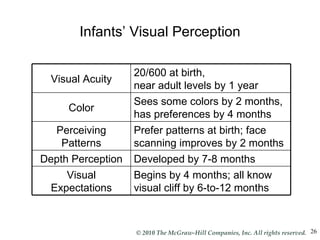
Infants’ Visual Perception Visual Acuity 20/600 at birth,  near adult levels by 1 year Color Sees some colors by 2 months, has preferences by 4 months Perceiving Patterns Prefer patterns at birth; face scanning improves by 2 months Depth Perception Developed by 7-8 months Visual Expectations Begins by 4 months; all know visual cliff by 6-to-12 months
Sensory and Perceptual Visual perception Perceptual constancy Physical world perceptions remain constant Size constancy Recognition that object remains the same even though the retinal image changes Shape constancy Recognition that object remains the same even though its orientation changes
Sensory and Perceptual Visual perception Depth perception Visual cliff  experiments Perceptions affected by experiences Debate over affect of nature versus nurture
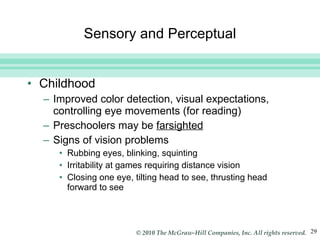
Sensory and Perceptual Childhood Improved color detection, visual expectations, controlling eye movements (for reading) Preschoolers may be  farsighted Signs of vision problems Rubbing eyes, blinking, squinting Irritability at games requiring distance vision Closing one eye, tilting head to see, thrusting head forward to see
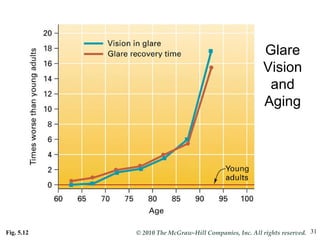
Sensory and Perceptual Adulthood and aging Loss of Accommodation  —   presbyopia Decreased blood supply to eye  —  smaller visual field, increased  blind spot Slower  dark adaptation , decline in motion sensitivity Declining color vision: green-blue-violet Declining depth perception  —  problems with steps or curbs
Fig. 5.12 Glare Vision and Aging
Sensory and Perceptual Diseases of the eyes Cataracts : thickening eye lens that causes vision to become cloudy, opaque, distorted Glaucoma : damage to optic nerve because of pressure created by buildup of fluid in eye Macular degeneration : involves deterioration of retina
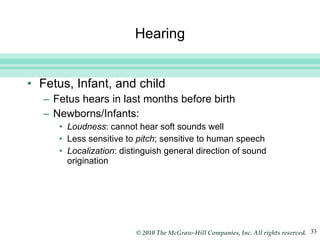
Hearing Fetus, Infant, and child Fetus hears in last months before birth Newborns/Infants:  Loudness : cannot hear soft sounds well Less sensitive to  pitch ; sensitive to human speech Localization : distinguish general direction of sound origination
Hearing Fetus, Infant, and child Most children’s hearing is adequate Early screening in infancy for problems Hearing loss corrections:  Surgery, hearing aids, cochlear implants Otitis media: middle ear infection Unattended results in hearing loss, language development, socialization Treatments: antibiotics, tubes in ears
Hearing Adolescence Most have excellent hearing Risks for loss: loud/maximum volume music Adulthood Decline begins about age 40; other factors impact Males lose sensitivity to high-pitched sounds sooner than females Gender differences: due to occupation? Treatments: hearing aids, cochlear implants
Other Senses Touch and pain Newborns: sensitivity to pain, touch Circumcision of boys; amazing resiliency Use of anesthesia in surgery is controversial Adulthood: most research on old age Touch sensitivity: decreases in old age Smell:  Decline can start in 20s; declines with age/health Affects satisfaction with life, food
Other Senses Taste Fetus: sensitivity present before birth Newborns: facial reactions to various tastes Infants: reference for “salty” tastes at 4 mos. Older adults: decline in ability to distinguish sour, sweet, and bitter solutions Severity affected by medications and health Seasoned food preferences lead to junk food
Other Senses Intermodal perception Ability to relate and integrate information about two or more sensory modalities, such as vision and hearing Exists in newborns; sharpens with experience in first year
Perceptual-Motor Coupling Distinction between perceiving and doing? Controversial for some researchers Explores how people assemble motor behaviors for perceiving and acting Babies coordinate movements with perceptual information to maintain balance, reach for objects, etc. Driving a car is coupling; declines in late adulthood
The End

Dev Psych.ch5.keynote

  • 1.
    A Topical Approachto LIFE-SPAN DEVELOPMENT John W. Santrock Chapter Five: Motor, Sensory, and Perceptual Development
  • 2.
    Dynamic Systems ViewDynamic systems theory Infants assemble motor skills for perceiving and acting (perceptions and actions are coupled) Motivation creates new behaviors Perceptions “fine tunes” movements with repetitive actions Infants explore and select possible solutions of new task; assembles adaptive patterns
  • 3.
    Dynamic Systems ViewDynamic systems theory Constraints of possible actions and skills Infants body/mind maturation Environmental support Not a passive process Genes do not dictate unfolding sequence of skills
  • 4.
    Reflexes Built-in reactionsto stimuli Govern newborn’s movements Genetically carried survival mechanisms Allow adaptation to environment Provides opportunity to learn Some disappear (e.g., grasping), some last throughout life (e.g., coughing)
  • 5.
    Reflexes Reflexes DescriptionSucking Automatic sucking object placed in newborn’s mouth Rooting Reaction when infant’s cheek is stroked or side of mouth touched Moro Startle response in reaction to sudden, intense noise or movement Grasping Occurs when something touches infant’s palms; infant response is to grasp tightly
  • 6.
    Gross Motor SkillsInvolve large-muscle activities Foundations for development Posture; linked to sensory information for Regulating balance/equilibrium Vision and hearing Self-control increases with infant age Linked to neural pathway development Improved by repetitive movements
  • 7.
    Gross Motor SkillsInfancy Development of posture Locomotion and crawling Learning to walk Caregivers important Safety of child and environment during efforts First year: developmental milestones Timing of onset varies
  • 8.
    Gross Motor SkillsSecond year More accomplishments; increased independence Initiates more interaction with others Still need safety restrictions on movements Parent/caregiver involvement Encourage/guide child’s development Structured exercise not recommended Cultural variations exist
  • 9.
    Fig. 5.3 Milestonesin Gross Motor Development
  • 10.
    Gross Motor SkillsChildhood Improved movements; more mastery, confidence Boys usually outperform girls Extended periods of paying attention, sitting still More fatigued from extended inactivity Benefit more from exercise breaks Organized sports best for development Positive and negatives consequences
  • 11.
    Gross Motor SkillsChildhood Organized sports best for development Provide opportunities to learn how to compete Improves self-esteem Opportunities for peer relations/friendships Reduces risk of becoming obese Three or more hours per week beyond school
  • 12.
    Gross Motor SkillsChildhood Organized sports can have negative experiences Pressure to win or achieve Risk of physical injuries Distraction from academic work Unrealistic expectations for success Impacted by professional sports and media Dangers of exploitation
  • 13.
    Guidelines for Parentsand Coaches of Children in Sports Do Don’t Make sports fun Yell or scream at child Mistakes are okay Continue condemning Allow questions Point out errors in front of others Show calm manner Expect instant learning Respect child’s participation Expect child to be a pro Be positive role model Make fun of the child Be supportive Compare child to others Make sports all work
  • 14.
    Gross Motor SkillsAdolescence Skills continue to improve Adulthood Peak physical performance before age 30 Often between ages 19 and 26 After age 30; biological functions decline Not uniform; organ decline varies
  • 15.
    Gross Motor SkillsLate Adulthood Decreased activity level linked to biological and psychological health Natural aging leads to gradual deterioration Lifestyle habits/patterns have impact Physical activity has more positive effects than educational intervention
  • 16.
  • 17.
    Fine Motor SkillsInfancy Involves more finely tuned movements, such as finger dexterity Reaching and grasping Size, shape, and texture of object matter Experience affects vision, perceptions, skills Exercising of skills, safety are important Palmar grasp, pincer grip at end of first year
  • 18.
    Fine Motor SkillsChildhood and adolescence By age 3; ability to stack/balance objects Precision increases with age; show desire to build projects — needs adult guidance to complete Linked to increased myelination of CNS Hands, coordination improve Begin to show manipulative skills of adults by age 12 Musical instruments, fine quality crafts
  • 19.
    Fine Motor SkillsAdult development Skills may decline in middle and late adulthood Dexterity decreases In healthy adults, functional skills are good Pathological conditions may result in weakness of paralysis of hands Competent handwriting into old age
  • 20.
    Fine Motor SkillsOlder Adult development Slowed movements due to Neural noise: interference with incoming stimuli Strategy: ability to perform as usual Compensation by engaging in other strategies Capable of learning new motor tasks; usually perform slower than young adults
  • 21.
    Sensory and PerceptualSensation Information (stimuli) processed by sensory receptors Eyes ( retina, optic nerve ), ears ( cochlea, auditory nerve ), tongue, nose, skin Perception What is perceived (interpreted) from stimuli
  • 22.
    Sensory and PerceptualEcological view Perceptual system selects which information to process from environment Guides active/interactive behaviors Affordances Opportunities to interact with objects within one’s capabilities Adaptation: combining of perceptions and actions
  • 23.
    Sensory and PerceptualInfant perception testing Visual preference method To determine if infants can distinguish between various stimuli Habituation : decreased response to stimuli Dishabituation : recovery of habituated response High-amplitude sucking: nipple sucking rate indicates preferences/discriminatory abilities
  • 24.
    Sensory and PerceptualInfant perception testing Orienting response Tracking by moving head or eyes to follow moving object or sounds Use of startle response — reaction to noise Equipment used Video recorders, computers, recorders of bodily functions (heart rate, etc.)
  • 25.
    Sensory and PerceptualVisual perception Variances due to differences in how eyes function over time (colors, distances, light presence) Infancy: world is “blooming, buzzing confusion” Visual acuity increases with age Preference for human faces soon after birth Discriminates female from male at 3 months
  • 26.
    Infants’ Visual PerceptionVisual Acuity 20/600 at birth, near adult levels by 1 year Color Sees some colors by 2 months, has preferences by 4 months Perceiving Patterns Prefer patterns at birth; face scanning improves by 2 months Depth Perception Developed by 7-8 months Visual Expectations Begins by 4 months; all know visual cliff by 6-to-12 months
  • 27.
    Sensory and PerceptualVisual perception Perceptual constancy Physical world perceptions remain constant Size constancy Recognition that object remains the same even though the retinal image changes Shape constancy Recognition that object remains the same even though its orientation changes
  • 28.
    Sensory and PerceptualVisual perception Depth perception Visual cliff experiments Perceptions affected by experiences Debate over affect of nature versus nurture
  • 29.
    Sensory and PerceptualChildhood Improved color detection, visual expectations, controlling eye movements (for reading) Preschoolers may be farsighted Signs of vision problems Rubbing eyes, blinking, squinting Irritability at games requiring distance vision Closing one eye, tilting head to see, thrusting head forward to see
  • 30.
    Sensory and PerceptualAdulthood and aging Loss of Accommodation — presbyopia Decreased blood supply to eye — smaller visual field, increased blind spot Slower dark adaptation , decline in motion sensitivity Declining color vision: green-blue-violet Declining depth perception — problems with steps or curbs
  • 31.
    Fig. 5.12 GlareVision and Aging
  • 32.
    Sensory and PerceptualDiseases of the eyes Cataracts : thickening eye lens that causes vision to become cloudy, opaque, distorted Glaucoma : damage to optic nerve because of pressure created by buildup of fluid in eye Macular degeneration : involves deterioration of retina
  • 33.
    Hearing Fetus, Infant,and child Fetus hears in last months before birth Newborns/Infants: Loudness : cannot hear soft sounds well Less sensitive to pitch ; sensitive to human speech Localization : distinguish general direction of sound origination
  • 34.
    Hearing Fetus, Infant,and child Most children’s hearing is adequate Early screening in infancy for problems Hearing loss corrections: Surgery, hearing aids, cochlear implants Otitis media: middle ear infection Unattended results in hearing loss, language development, socialization Treatments: antibiotics, tubes in ears
  • 35.
    Hearing Adolescence Mosthave excellent hearing Risks for loss: loud/maximum volume music Adulthood Decline begins about age 40; other factors impact Males lose sensitivity to high-pitched sounds sooner than females Gender differences: due to occupation? Treatments: hearing aids, cochlear implants
  • 36.
    Other Senses Touchand pain Newborns: sensitivity to pain, touch Circumcision of boys; amazing resiliency Use of anesthesia in surgery is controversial Adulthood: most research on old age Touch sensitivity: decreases in old age Smell: Decline can start in 20s; declines with age/health Affects satisfaction with life, food
  • 37.
    Other Senses TasteFetus: sensitivity present before birth Newborns: facial reactions to various tastes Infants: reference for “salty” tastes at 4 mos. Older adults: decline in ability to distinguish sour, sweet, and bitter solutions Severity affected by medications and health Seasoned food preferences lead to junk food
  • 38.
    Other Senses Intermodalperception Ability to relate and integrate information about two or more sensory modalities, such as vision and hearing Exists in newborns; sharpens with experience in first year
  • 39.
    Perceptual-Motor Coupling Distinctionbetween perceiving and doing? Controversial for some researchers Explores how people assemble motor behaviors for perceiving and acting Babies coordinate movements with perceptual information to maintain balance, reach for objects, etc. Driving a car is coupling; declines in late adulthood
  • 40.