www.huawei.comHUAWEI TECHNOLOGIES CO., LTD.
LTE-V: A Cellular-Assisted V2X
Communication Technology
ITU Workshop, July 28-29th 2015, Beijing, China
Yi Shi
Research Engineer,
Wireless Research Department
wn.shiyi@huawei.com
Page 2 HUAWEI TECHNOLOGIES CO., LTD.
1.ITS stages and the role of LTE V2X
2.What is LTE V2X, benefits
3.Standardization status
4.Conclusion
Contents
Why Connected Vehicle Technologies Are Needed
Page 3
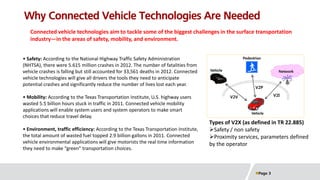
Connected vehicle technologies aim to tackle some of the biggest challenges in the surface transportation
industry—in the areas of safety, mobility, and environment.
• Safety: According to the National Highway Traffic Safety Administration
(NHTSA), there were 5.615 million crashes in 2012. The number of fatalities from
vehicle crashes is falling but still accounted for 33,561 deaths in 2012. Connected
vehicle technologies will give all drivers the tools they need to anticipate
potential crashes and significantly reduce the number of lives lost each year.
• Mobility: According to the Texas Transportation Institute, U.S. highway users
wasted 5.5 billion hours stuck in traffic in 2011. Connected vehicle mobility
applications will enable system users and system operators to make smart
choices that reduce travel delay.
• Environment, traffic efficiency: According to the Texas Transportation Institute,
the total amount of wasted fuel topped 2.9 billion gallons in 2011. Connected
vehicle environmental applications will give motorists the real time information
they need to make “green” transportation choices.
V2V
V2P
V2I
Pedestrian
Vehicle
Vehicle
Network
Types of V2X (as defined in TR 22.885)
Safety / non safety
Proximity services, parameters defined
by the operator
Page 4 HUAWEI TECHNOLOGIES CO., LTD.
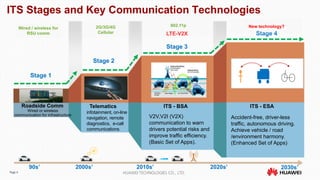
ITS Stages and Key Communication Technologies
Accident-free, driver-less
traffic, autonomous driving.
Achieve vehicle / road
/environment harmony.
(Enhanced Set of Apps)
ITS - ESAITS - BSA
Stage 1
Stage 2
Stage 3
Stage 4
TelematicsRoadside Comm
infotainment, on-line
navigation, remote
diagnostics, e-call
communications
V2V,V2I (V2X)
communication to warn
drivers potential risks and
improve traffic efficiency.
(Basic Set of Apps).
Wired or wireless
communication for infrastructure
Wired / wireless for
RSU comm
2G/3G/4G
Cellular
802.11p New technology?
LTE-V2X
90s’ 2000s’ 2010s’ 2020s’ 2030s’
Page 5 HUAWEI TECHNOLOGIES CO., LTD.
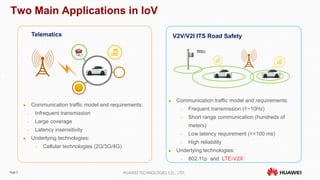
Two Main Applications in IoV
Telematics
 Communication traffic model and requirements:
− Infrequent transmission
− Large coverage
− Latency insensitivity
 Underlying technologies:
− Cellular technologies (2G/3G/4G)
 Communication traffic model and requirements:
− Frequent transmission (1~10Hz)
− Short range communication (hundreds of
meters)
− Low latency requirement (<=100 ms)
− High reliability
 Underlying technologies:
− 802.11p and LTE-V2X
V2V/V2I ITS Road Safety
RSU
Page 6 HUAWEI TECHNOLOGIES CO., LTD.
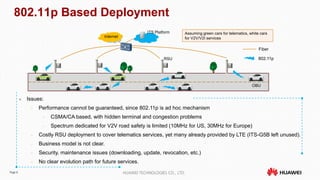
802.11p Based Deployment
Internet
ITS Platform
Fiber
802.11p
Assuming green cars for telematics, white cars
for V2V/V2I services
 Issues:
− Performance cannot be guaranteed, since 802.11p is ad hoc mechanism
− CSMA/CA based, with hidden terminal and congestion problems
− Spectrum dedicated for V2V road safety is limited (10MHz for US, 30MHz for Europe)
− Costly RSU deployment to cover telematics services, yet many already provided by LTE (ITS-G5B left unused).
− Business model is not clear.
− Security, maintenance issues (downloading, update, revocation, etc.)
− No clear evolution path for future services.
RSU
OBU
Page 7 HUAWEI TECHNOLOGIES CO., LTD.
3GPP SA1 Agreed 18 Use Cases in TR 22.885
V2V message transfer under operator control
[TR 22.885, 5.11]
eNB
V2V message
V2X in areas outside network coverage
[TR 22.885, 5.13]
LTE Coverage LTE Coverage
V2V Safety
[5.1-5.4, 5.7, 5.10, 5.12]
V2I Road Safety
[5.6, 5.8, 5.14, 5.16]
V2P Road Safety
[5.17, 5.18]
V2V/V2I Traffic Efficiency
[5.5, 5.9, 5.15]
Emergency vehicle warning Curve
Speed Warning
Vulnerable Road
User Warning
Page 8 HUAWEI TECHNOLOGIES CO., LTD.
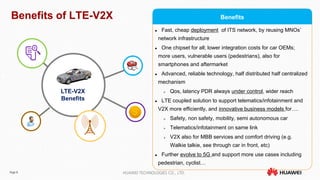
Benefits of LTE-V2X
 Fast, cheap deployment of ITS network, by reusing MNOs’
network infrastructure
 One chipset for all; lower integration costs for car OEMs;
more users, vulnerable users (pedestrians), also for
smartphones and aftermarket
 Advanced, reliable technology, half distributed half centralized
mechanism
 Qos, latency PDR always under control, wider reach
 LTE coupled solution to support telematics/infotainment and
V2X more efficiently, and innovative business models for….
 Safety, non safety, mobility, semi autonomous car
 Telematics/infotainment on same link
 V2X also for MBB services and comfort driving (e.g.
Walkie talkie, see through car in front, etc)
 Further evolve to 5G and support more use cases including
pedestrian, cyclist…
LTE-V2X
Benefits
Benefits
Page 9 HUAWEI TECHNOLOGIES CO., LTD.
Critical factors follow for a succesful LTE V2X Strategy
Page 9
Prove the technology, comparing with 11p in field
Spectrum:
industry agreement, then lobbying. Dedicated? harmonized?
Discuss business case among stakeholders
Improved safety with simple LTE V integration is already a business case for car
maker?
Monetization opportunities for MNO when entering in ITS market
Benefits/cost analysis (e.g. Liabilities Vs revenues Vs other advantages)
Time to integrate new technology into cars (lifecycles misalignment)
Industry/standards discussions, take market window, promotion:
3GPP, ETSI, GSMA, ERTICO, C2C comm. consortium, etc.
Ecosystem, interoperability
Page 10 HUAWEI TECHNOLOGIES CO., LTD.
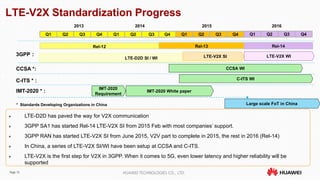
LTE-V2X Standardization Progress
Rel-12 Rel-13 Rel-14
LTE-V2X WI
2014 2015
Q1 Q2 Q3 Q4 Q1 Q2 Q3 Q4 Q1 Q2 Q3 Q4
2016
3GPP:
CCSA *: CCSA WI
IMT-2020
Requirement
C-ITS * :
2013
Q1 Q2 Q3 Q4
IMT-2020 White paper
* Standards Developing Organizations in China
LTE-D2D SI / WI
IMT-2020 * :
C-ITS WI
 LTE-D2D has paved the way for V2X communication
 3GPP SA1 has started Rel-14 LTE-V2X SI from 2015 Feb with most companies’ support.
 3GPP RAN has started LTE-V2X SI from June 2015, V2V part to complete in 2015, the rest in 2016 (Rel-14)
 In China, a series of LTE-V2X SI/WI have been setup at CCSA and C-ITS.
 LTE-V2X is the first step for V2X in 3GPP. When it comes to 5G, even lower latency and higher reliability will be
supported
LTE-V2X SI
Large scale FoT in China
Page 11 HUAWEI TECHNOLOGIES CO., LTD.
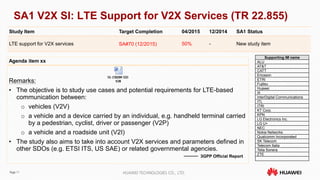
SA1 V2X SI: LTE Support for V2X Services (TR 22.855)
Study Item Target Completion 04/2015 12/2014 SA1 Status
LTE support for V2X services SA#70 (12/2015) 50% - New study item
Agenda item xx
Remarks:
• The objective is to study use cases and potential requirements for LTE-based
communication between:
o vehicles (V2V)
o a vehicle and a device carried by an individual, e.g. handheld terminal carried
by a pedestrian, cyclist, driver or passenger (V2P)
o a vehicle and a roadside unit (V2I)
• The study also aims to take into account V2X services and parameters defined in
other SDOs (e.g. ETSI ITS, US SAE) or related governmental agencies.
Supporting IM name
ALU
AT&T
CATT
Ericsson
ETRI
Fujitsu
Huawei
III
InterDigital Communications
ITL
ITRI
KT Corp.
KPN
LG Electronics Inc.
LG U+
NEC
Nokia Networks
Qualcomm Incorporated
SK Telecom
Telecom Italia
Telia Sonera
ZTE
3GPP Official Report
Page 12 HUAWEI TECHNOLOGIES CO., LTD.
3GPP SA1 V2X Highlights
 V2V, V2I and V2P use cases were included with associated potential requirements. Study of V2V use cases
was prioritized during discussions.
 Several important agreements reached:
 MNO in control of V2V communication (e.g. authorization, session establishment, resource allocation,
etc).
 Out of coverage V2V communication use cases.
 Performances values to support V2V messages were agreed, many apply to V2I as well. Some values
are informative
 The Roadside Unit (RSU) entity is implemented either in an eNodeB or a stationary UE.
 A liaison statement (LS) is sent back to RAN#68 (June 15-18), with the current V2X technical report (TR)
attached
Page 13 HUAWEI TECHNOLOGIES CO., LTD.
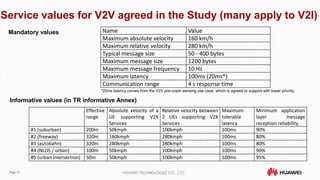
Service values for V2V agreed in the Study (many apply to V2I)
Name Value
Maximum absolute velocity 160 km/h
Maximum relative velocity 280 km/h
Typical message size 50 - 400 bytes
Maximum message size 1200 bytes
Maximum message frequency 10 Hz
Maximum latency 100ms (20ms*)
Communication range 4 s response time
Effective
range
Absolute velocity of a
UE supporting V2X
Services
Relative velocity between
2 UEs supporting V2X
Services
Maximum
tolerable
latency
Minimum application
layer message
reception reliability
#1 (suburban) 200m 50kmph 100kmph 100ms 90%
#2 (freeway) 320m 160kmph 280kmph 100ms 80%
#3 (autobahn) 320m 280kmph 280kmph 100ms 80%
#4 (NLOS / urban) 100m 50kmph 100kmph 100ms 90%
#5 (urban intersection) 50m 50kmph 100kmph 100ms 95%
Mandatory values
Informative values (in TR informative Annex)
*20ms latency comes from the V2V pre-crash sensing use case, which is agreed to support with lower priority.
Page 14 HUAWEI TECHNOLOGIES CO., LTD.
RAN V2X Study Item (approved RAN#68, June 2015)
 Includes V2X operation in coverage, out-of-coverage, in dedicated LTE-based V2X spectrum, and in licensed
spectrum which is also used for normal LTE.
 Will use SA1 requirements, and external information from e.g. ETSI ITS, SAE, CCSA
 Three main objectives to prepare for potential normative work in 2016:
1. Evaluation methodology: deployment scenarios, vehicle density and mobility, data traffic models, and performance metrics.
V2V over D2D sidelink to target Sept 2015, but objective continues for other parts.
2. V2V over D2D sidelink enhancements study to complete first, by Dec. 2015.
– D2D resource allocation enhancements to be identified
– D2D support in high Doppler environments: up to 280kph at around 5.9 GHz, and GNSS-based synchronization.
3. V2V over cellular, and D2D sidelink and cellular enhancements studies for V2I/N and V2P to complete by Jun. 2016.
Jun ‘15 Sep Dec Mar ‘16 Jun Sep Dec
V2X SIV2V aspects
V2V work item?
[V2I?V2P+other? WI]
Possible 3GPP RAN timeline for V2X
(based on RP-151082)
Page 15 HUAWEI TECHNOLOGIES CO., LTD.
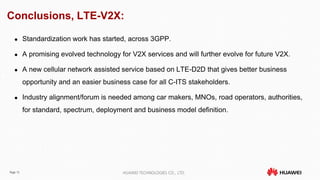
Conclusions, LTE-V2X:
 Standardization work has started, across 3GPP.
 A promising evolved technology for V2X services and will further evolve for future V2X.
 A new cellular network assisted service based on LTE-D2D that gives better business
opportunity and an easier business case for all C-ITS stakeholders.
 Industry alignment/forum is needed among car makers, MNOs, road operators, authorities,
for standard, spectrum, deployment and business model definition.
Thank you
www.huawei.com
Copyright© 2014 Huawei Technologies Co., Ltd. All Rights Reserved.
The information in this document may contain predictive statements including, without limitation, statements regarding the future
financial and operating results, future product portfolio, new technology, etc. There are a number of factors that could cause actual
results and developments to differ materially from those expressed or implied in the predictive statements. Therefore, such
information is provided for reference purpose only and constitutes neither an offer nor an acceptance. Huawei may change the
information at any time without notice.
Page 16 HUAWEI TECHNOLOGIES CO., LTD.

Huawei about LTE V2X Standardisation in 3GPP

  • 1.
    www.huawei.comHUAWEI TECHNOLOGIES CO.,LTD. LTE-V: A Cellular-Assisted V2X Communication Technology ITU Workshop, July 28-29th 2015, Beijing, China Yi Shi Research Engineer, Wireless Research Department wn.shiyi@huawei.com
  • 2.
    Page 2 HUAWEITECHNOLOGIES CO., LTD. 1.ITS stages and the role of LTE V2X 2.What is LTE V2X, benefits 3.Standardization status 4.Conclusion Contents
  • 3.
    Why Connected VehicleTechnologies Are Needed Page 3 Connected vehicle technologies aim to tackle some of the biggest challenges in the surface transportation industry—in the areas of safety, mobility, and environment. • Safety: According to the National Highway Traffic Safety Administration (NHTSA), there were 5.615 million crashes in 2012. The number of fatalities from vehicle crashes is falling but still accounted for 33,561 deaths in 2012. Connected vehicle technologies will give all drivers the tools they need to anticipate potential crashes and significantly reduce the number of lives lost each year. • Mobility: According to the Texas Transportation Institute, U.S. highway users wasted 5.5 billion hours stuck in traffic in 2011. Connected vehicle mobility applications will enable system users and system operators to make smart choices that reduce travel delay. • Environment, traffic efficiency: According to the Texas Transportation Institute, the total amount of wasted fuel topped 2.9 billion gallons in 2011. Connected vehicle environmental applications will give motorists the real time information they need to make “green” transportation choices. V2V V2P V2I Pedestrian Vehicle Vehicle Network Types of V2X (as defined in TR 22.885) Safety / non safety Proximity services, parameters defined by the operator
  • 4.
    Page 4 HUAWEITECHNOLOGIES CO., LTD. ITS Stages and Key Communication Technologies Accident-free, driver-less traffic, autonomous driving. Achieve vehicle / road /environment harmony. (Enhanced Set of Apps) ITS - ESAITS - BSA Stage 1 Stage 2 Stage 3 Stage 4 TelematicsRoadside Comm infotainment, on-line navigation, remote diagnostics, e-call communications V2V,V2I (V2X) communication to warn drivers potential risks and improve traffic efficiency. (Basic Set of Apps). Wired or wireless communication for infrastructure Wired / wireless for RSU comm 2G/3G/4G Cellular 802.11p New technology? LTE-V2X 90s’ 2000s’ 2010s’ 2020s’ 2030s’
  • 5.
    Page 5 HUAWEITECHNOLOGIES CO., LTD. Two Main Applications in IoV Telematics  Communication traffic model and requirements: − Infrequent transmission − Large coverage − Latency insensitivity  Underlying technologies: − Cellular technologies (2G/3G/4G)  Communication traffic model and requirements: − Frequent transmission (1~10Hz) − Short range communication (hundreds of meters) − Low latency requirement (<=100 ms) − High reliability  Underlying technologies: − 802.11p and LTE-V2X V2V/V2I ITS Road Safety RSU
  • 6.
    Page 6 HUAWEITECHNOLOGIES CO., LTD. 802.11p Based Deployment Internet ITS Platform Fiber 802.11p Assuming green cars for telematics, white cars for V2V/V2I services  Issues: − Performance cannot be guaranteed, since 802.11p is ad hoc mechanism − CSMA/CA based, with hidden terminal and congestion problems − Spectrum dedicated for V2V road safety is limited (10MHz for US, 30MHz for Europe) − Costly RSU deployment to cover telematics services, yet many already provided by LTE (ITS-G5B left unused). − Business model is not clear. − Security, maintenance issues (downloading, update, revocation, etc.) − No clear evolution path for future services. RSU OBU
  • 7.
    Page 7 HUAWEITECHNOLOGIES CO., LTD. 3GPP SA1 Agreed 18 Use Cases in TR 22.885 V2V message transfer under operator control [TR 22.885, 5.11] eNB V2V message V2X in areas outside network coverage [TR 22.885, 5.13] LTE Coverage LTE Coverage V2V Safety [5.1-5.4, 5.7, 5.10, 5.12] V2I Road Safety [5.6, 5.8, 5.14, 5.16] V2P Road Safety [5.17, 5.18] V2V/V2I Traffic Efficiency [5.5, 5.9, 5.15] Emergency vehicle warning Curve Speed Warning Vulnerable Road User Warning
  • 8.
    Page 8 HUAWEITECHNOLOGIES CO., LTD. Benefits of LTE-V2X  Fast, cheap deployment of ITS network, by reusing MNOs’ network infrastructure  One chipset for all; lower integration costs for car OEMs; more users, vulnerable users (pedestrians), also for smartphones and aftermarket  Advanced, reliable technology, half distributed half centralized mechanism  Qos, latency PDR always under control, wider reach  LTE coupled solution to support telematics/infotainment and V2X more efficiently, and innovative business models for….  Safety, non safety, mobility, semi autonomous car  Telematics/infotainment on same link  V2X also for MBB services and comfort driving (e.g. Walkie talkie, see through car in front, etc)  Further evolve to 5G and support more use cases including pedestrian, cyclist… LTE-V2X Benefits Benefits
  • 9.
    Page 9 HUAWEITECHNOLOGIES CO., LTD. Critical factors follow for a succesful LTE V2X Strategy Page 9 Prove the technology, comparing with 11p in field Spectrum: industry agreement, then lobbying. Dedicated? harmonized? Discuss business case among stakeholders Improved safety with simple LTE V integration is already a business case for car maker? Monetization opportunities for MNO when entering in ITS market Benefits/cost analysis (e.g. Liabilities Vs revenues Vs other advantages) Time to integrate new technology into cars (lifecycles misalignment) Industry/standards discussions, take market window, promotion: 3GPP, ETSI, GSMA, ERTICO, C2C comm. consortium, etc. Ecosystem, interoperability
  • 10.
    Page 10 HUAWEITECHNOLOGIES CO., LTD. LTE-V2X Standardization Progress Rel-12 Rel-13 Rel-14 LTE-V2X WI 2014 2015 Q1 Q2 Q3 Q4 Q1 Q2 Q3 Q4 Q1 Q2 Q3 Q4 2016 3GPP: CCSA *: CCSA WI IMT-2020 Requirement C-ITS * : 2013 Q1 Q2 Q3 Q4 IMT-2020 White paper * Standards Developing Organizations in China LTE-D2D SI / WI IMT-2020 * : C-ITS WI  LTE-D2D has paved the way for V2X communication  3GPP SA1 has started Rel-14 LTE-V2X SI from 2015 Feb with most companies’ support.  3GPP RAN has started LTE-V2X SI from June 2015, V2V part to complete in 2015, the rest in 2016 (Rel-14)  In China, a series of LTE-V2X SI/WI have been setup at CCSA and C-ITS.  LTE-V2X is the first step for V2X in 3GPP. When it comes to 5G, even lower latency and higher reliability will be supported LTE-V2X SI Large scale FoT in China
  • 11.
    Page 11 HUAWEITECHNOLOGIES CO., LTD. SA1 V2X SI: LTE Support for V2X Services (TR 22.855) Study Item Target Completion 04/2015 12/2014 SA1 Status LTE support for V2X services SA#70 (12/2015) 50% - New study item Agenda item xx Remarks: • The objective is to study use cases and potential requirements for LTE-based communication between: o vehicles (V2V) o a vehicle and a device carried by an individual, e.g. handheld terminal carried by a pedestrian, cyclist, driver or passenger (V2P) o a vehicle and a roadside unit (V2I) • The study also aims to take into account V2X services and parameters defined in other SDOs (e.g. ETSI ITS, US SAE) or related governmental agencies. Supporting IM name ALU AT&T CATT Ericsson ETRI Fujitsu Huawei III InterDigital Communications ITL ITRI KT Corp. KPN LG Electronics Inc. LG U+ NEC Nokia Networks Qualcomm Incorporated SK Telecom Telecom Italia Telia Sonera ZTE 3GPP Official Report
  • 12.
    Page 12 HUAWEITECHNOLOGIES CO., LTD. 3GPP SA1 V2X Highlights  V2V, V2I and V2P use cases were included with associated potential requirements. Study of V2V use cases was prioritized during discussions.  Several important agreements reached:  MNO in control of V2V communication (e.g. authorization, session establishment, resource allocation, etc).  Out of coverage V2V communication use cases.  Performances values to support V2V messages were agreed, many apply to V2I as well. Some values are informative  The Roadside Unit (RSU) entity is implemented either in an eNodeB or a stationary UE.  A liaison statement (LS) is sent back to RAN#68 (June 15-18), with the current V2X technical report (TR) attached
  • 13.
    Page 13 HUAWEITECHNOLOGIES CO., LTD. Service values for V2V agreed in the Study (many apply to V2I) Name Value Maximum absolute velocity 160 km/h Maximum relative velocity 280 km/h Typical message size 50 - 400 bytes Maximum message size 1200 bytes Maximum message frequency 10 Hz Maximum latency 100ms (20ms*) Communication range 4 s response time Effective range Absolute velocity of a UE supporting V2X Services Relative velocity between 2 UEs supporting V2X Services Maximum tolerable latency Minimum application layer message reception reliability #1 (suburban) 200m 50kmph 100kmph 100ms 90% #2 (freeway) 320m 160kmph 280kmph 100ms 80% #3 (autobahn) 320m 280kmph 280kmph 100ms 80% #4 (NLOS / urban) 100m 50kmph 100kmph 100ms 90% #5 (urban intersection) 50m 50kmph 100kmph 100ms 95% Mandatory values Informative values (in TR informative Annex) *20ms latency comes from the V2V pre-crash sensing use case, which is agreed to support with lower priority.
  • 14.
    Page 14 HUAWEITECHNOLOGIES CO., LTD. RAN V2X Study Item (approved RAN#68, June 2015)  Includes V2X operation in coverage, out-of-coverage, in dedicated LTE-based V2X spectrum, and in licensed spectrum which is also used for normal LTE.  Will use SA1 requirements, and external information from e.g. ETSI ITS, SAE, CCSA  Three main objectives to prepare for potential normative work in 2016: 1. Evaluation methodology: deployment scenarios, vehicle density and mobility, data traffic models, and performance metrics. V2V over D2D sidelink to target Sept 2015, but objective continues for other parts. 2. V2V over D2D sidelink enhancements study to complete first, by Dec. 2015. – D2D resource allocation enhancements to be identified – D2D support in high Doppler environments: up to 280kph at around 5.9 GHz, and GNSS-based synchronization. 3. V2V over cellular, and D2D sidelink and cellular enhancements studies for V2I/N and V2P to complete by Jun. 2016. Jun ‘15 Sep Dec Mar ‘16 Jun Sep Dec V2X SIV2V aspects V2V work item? [V2I?V2P+other? WI] Possible 3GPP RAN timeline for V2X (based on RP-151082)
  • 15.
    Page 15 HUAWEITECHNOLOGIES CO., LTD. Conclusions, LTE-V2X:  Standardization work has started, across 3GPP.  A promising evolved technology for V2X services and will further evolve for future V2X.  A new cellular network assisted service based on LTE-D2D that gives better business opportunity and an easier business case for all C-ITS stakeholders.  Industry alignment/forum is needed among car makers, MNOs, road operators, authorities, for standard, spectrum, deployment and business model definition.
  • 16.
    Thank you www.huawei.com Copyright© 2014Huawei Technologies Co., Ltd. All Rights Reserved. The information in this document may contain predictive statements including, without limitation, statements regarding the future financial and operating results, future product portfolio, new technology, etc. There are a number of factors that could cause actual results and developments to differ materially from those expressed or implied in the predictive statements. Therefore, such information is provided for reference purpose only and constitutes neither an offer nor an acceptance. Huawei may change the information at any time without notice. Page 16 HUAWEI TECHNOLOGIES CO., LTD.