NLMS Algorithm for adaptive
           filter
       DSP lab-Mini Project


                              Chintan Joshi
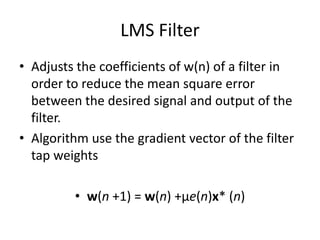
LMS Filter
• Adjusts the coefficients of w(n) of a filter in
  order to reduce the mean square error
  between the desired signal and output of the
  filter.
• Algorithm use the gradient vector of the filter
  tap weights

         • w(n +1) = w(n) +μe(n)x* (n)
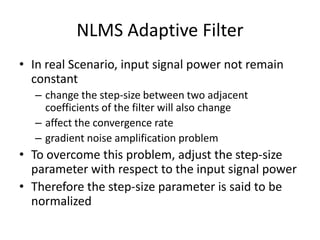
NLMS Adaptive Filter
• In real Scenario, input signal power not remain
  constant
  – change the step-size between two adjacent
    coefficients of the filter will also change
  – affect the convergence rate
  – gradient noise amplification problem
• To overcome this problem, adjust the step-size
  parameter with respect to the input signal power
• Therefore the step-size parameter is said to be
  normalized
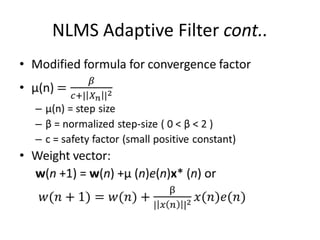
NLMS Adaptive Filter cont..
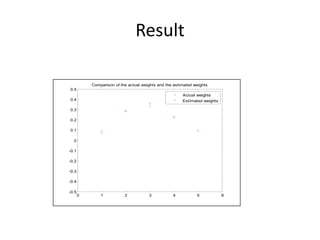
Result

           Comparison of the actual weights and the estimated weights
0.5
                                                        Actual weights
0.4                                                     Estimated weights

0.3

0.2

0.1

  0

-0.1

-0.2

-0.3

-0.4

-0.5
       0       1           2           3           4           5            6
Nlms algorithm for adaptive filter

Nlms algorithm for adaptive filter

  • 1.
    NLMS Algorithm foradaptive filter DSP lab-Mini Project Chintan Joshi
  • 2.
    LMS Filter • Adjuststhe coefficients of w(n) of a filter in order to reduce the mean square error between the desired signal and output of the filter. • Algorithm use the gradient vector of the filter tap weights • w(n +1) = w(n) +μe(n)x* (n)
  • 3.
    NLMS Adaptive Filter •In real Scenario, input signal power not remain constant – change the step-size between two adjacent coefficients of the filter will also change – affect the convergence rate – gradient noise amplification problem • To overcome this problem, adjust the step-size parameter with respect to the input signal power • Therefore the step-size parameter is said to be normalized
  • 4.
  • 5.
    Result Comparison of the actual weights and the estimated weights 0.5 Actual weights 0.4 Estimated weights 0.3 0.2 0.1 0 -0.1 -0.2 -0.3 -0.4 -0.5 0 1 2 3 4 5 6