Acoustic Echo CancellationAcoustic Echo Cancellation
Using NLMS Adaptive AlgorithmUsing NLMS Adaptive Algorithm
Presented byPresented by
Ranbeer TyagiRanbeer Tyagi
10.10.2010
ContentIntroduction
Acoustic Echo Problem and Solution
Working of Acoustic Echo Canceller
Adaptive Filtering Algorithm
Necessity For Better Performance of AEC
Simulation Results
Conclusion
Future Work
References
10.10.2010
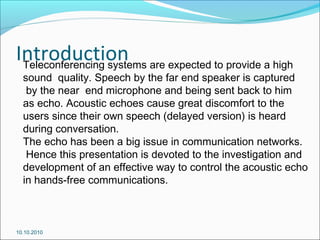
IntroductionTeleconferencing systems are expected to provide a high
sound quality. Speech by the far end speaker is captured
by the near end microphone and being sent back to him
as echo. Acoustic echoes cause great discomfort to the
users since their own speech (delayed version) is heard
during conversation.
The echo has been a big issue in communication networks.
Hence this presentation is devoted to the investigation and
development of an effective way to control the acoustic echo
in hands-free communications.
10.10.2010
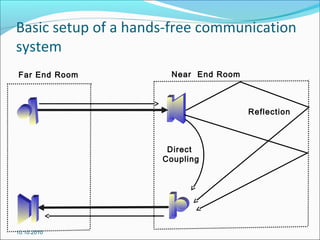
Basic setup of a hands-free communication
system
Near End Room
Direct
Coupling
Reflection
Far End Room
10.10.2010
Acoustic Echo Problem and Solution
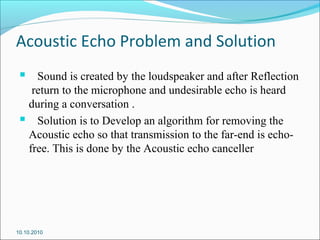
 Sound is created by the loudspeaker and after Reflection
return to the microphone and undesirable echo is heard
during a conversation .
 Solution is to Develop an algorithm for removing the
Acoustic echo so that transmission to the far-end is echo-
free. This is done by the Acoustic echo canceller
10.10.2010
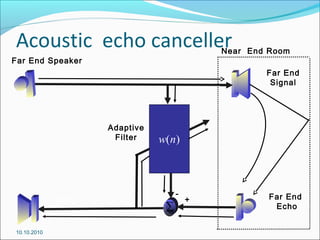
Acoustic echo canceller
( )x n
( )y n
( )d n
∑
Far End
Signal
-
+ Far End
Echo
Adaptive
Filter
Far End Speaker
Near End Room
( )e n
( )w n
10.10.2010
Working of Acoustic Echo Canceller
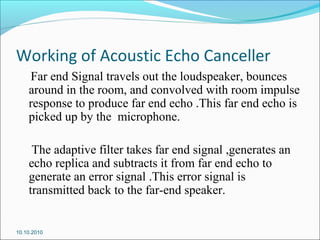
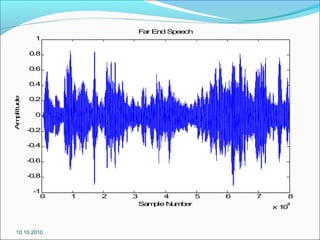
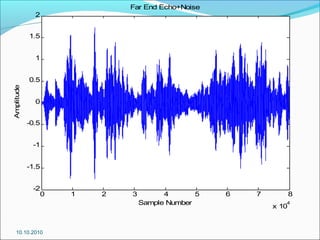
Far end Signal travels out the loudspeaker, bounces
around in the room, and convolved with room impulse
response to produce far end echo .This far end echo is
picked up by the microphone.
The adaptive filter takes far end signal ,generates an
echo replica and subtracts it from far end echo to
generate an error signal .This error signal is
transmitted back to the far-end speaker.
10.10.2010
NLMS AlgorithmNLMS Algorithm
( ) ( )
( 1) ( )
( ) ( )T
x n e n
w n w n
x n x n
µ
δ
+ = +
+
( ) ( )
( 1) ( )
( ) ( )T
x n e n
w n w n
x n x n
µ
+ = +
x (n) can be very small due to random behavior and can causes
stability problem hence include a small correction term to avoid
stability problems
( ) ( ) ( )
( ) ( ) ( )
T
y n w n x n
e n d n y n
=
= −
0 1 1
( ) [ ( ), ( 1),..., ( 1)]
( ) [ ( ), ( ),......, ( )]
T
T
M
x n x n x n x n M
w n w n w n w n−
= − − +
=
is a step size parameter for stability 0 2µ< <µ
10.10.2010
Necessity for Better Performance of AEC
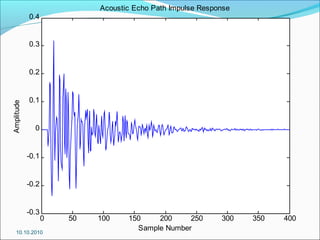
The selection of step size should be done carefully to
achieve Faster convergence and less steady state error.
The number of Taps in the filter should be large enough
to cover the echo path.
10.10.2010
0 50 100 150 200 250 300 350 400
-0.3
-0.2
-0.1
0
0.1
0.2
0.3
0.4Amplitude
Sample Number
Acoustic Echo Path Impulse Response
10.10.2010
0 1 2 3 4 5 6 7 8
x 10
4
-1
-0.8
-0.6
-0.4
-0.2
0
0.2
0.4
0.6
0.8
1
Amplitude
Sample Number
Far End Speech
10.10.2010
0 1 2 3 4 5 6 7 8
x 10
4
-2
-1.5
-1
-0.5
0
0.5
1
1.5
2Amplitude
Sample Number
Far End Echo+Noise
10.10.2010
0 1 2 3 4 5 6 7 8
x 10
4
-0.2
-0.15
-0.1
-0.05
0
0.05
0.1
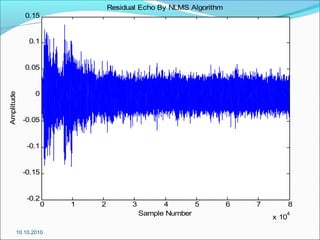
0.15Amplitude
Sample Number
Residual Echo By NLMS Algorithm
10.10.2010
0 1 2 3 4 5 6 7 8
x 10
4
-2
-1.5
-1
-0.5
0
0.5
1
1.5
2
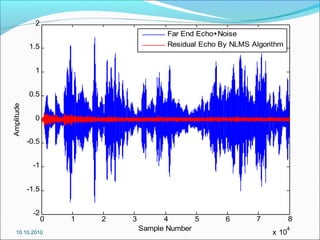
Amplitude
Sample Number
Far End Echo+Noise
Residual Echo By NLMS Algorithm
10.10.2010
0 1 2 3 4 5 6 7 8
x 10
4
-90
-80
-70
-60
-50
-40
-30
-20
MSE of NLMS Algorithm
MSE[dB]
sample number10.10.2010
Conclusion
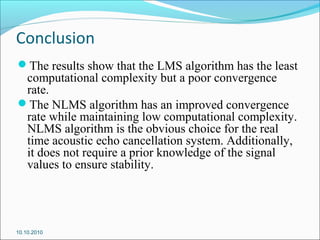
The results show that the LMS algorithm has the least
computational complexity but a poor convergence
rate.
The NLMS algorithm has an improved convergence
rate while maintaining low computational complexity.
NLMS algorithm is the obvious choice for the real
time acoustic echo cancellation system. Additionally,
it does not require a prior knowledge of the signal
values to ensure stability.
10.10.2010
Future Work
The high background noise level is annoying to the
listener’s side during a conversation and will affect
the performance of the algorithm.
The acoustic echo canceller assumes that the near end
speaker is silent. So further work can be made to
consider the double talk situation.
10.10.2010
Reference
S.Haykin and T.Kailath “Adaptive Filter Theory ” Fourth Edition.
Prentice Hall, Pearson Education 2002.
“Adaptive Filters” Douglas L. Jones , CONNEXIONS Rice
University ,Houston, Texas.
J.G.Proakis,“ Digital Communications” ,Fourth Edition. New
York, McGraw Hill,2001.
Oppenheim, A. V. & Schafer, R. W. 1999, “Discrete Time Signal
Processing”, 2nd edition,Prentice Hall, United States of
America.
S.M.Kuo, B.H.Lee and W.Tian, ”Real Time Digital Signal
Processing”, John Wily & sons Ltd,2006.
10.10.2010
Thank You
10.10.2010

Acoustic echo cancellation using nlms adaptive algorithm ranbeer

  • 1.
    Acoustic Echo CancellationAcousticEcho Cancellation Using NLMS Adaptive AlgorithmUsing NLMS Adaptive Algorithm Presented byPresented by Ranbeer TyagiRanbeer Tyagi 10.10.2010
  • 2.
    ContentIntroduction Acoustic Echo Problemand Solution Working of Acoustic Echo Canceller Adaptive Filtering Algorithm Necessity For Better Performance of AEC Simulation Results Conclusion Future Work References 10.10.2010
  • 3.
    IntroductionTeleconferencing systems areexpected to provide a high sound quality. Speech by the far end speaker is captured by the near end microphone and being sent back to him as echo. Acoustic echoes cause great discomfort to the users since their own speech (delayed version) is heard during conversation. The echo has been a big issue in communication networks. Hence this presentation is devoted to the investigation and development of an effective way to control the acoustic echo in hands-free communications. 10.10.2010
  • 4.
    Basic setup ofa hands-free communication system Near End Room Direct Coupling Reflection Far End Room 10.10.2010
  • 5.
    Acoustic Echo Problemand Solution  Sound is created by the loudspeaker and after Reflection return to the microphone and undesirable echo is heard during a conversation .  Solution is to Develop an algorithm for removing the Acoustic echo so that transmission to the far-end is echo- free. This is done by the Acoustic echo canceller 10.10.2010
  • 6.
    Acoustic echo canceller ()x n ( )y n ( )d n ∑ Far End Signal - + Far End Echo Adaptive Filter Far End Speaker Near End Room ( )e n ( )w n 10.10.2010
  • 7.
    Working of AcousticEcho Canceller Far end Signal travels out the loudspeaker, bounces around in the room, and convolved with room impulse response to produce far end echo .This far end echo is picked up by the microphone. The adaptive filter takes far end signal ,generates an echo replica and subtracts it from far end echo to generate an error signal .This error signal is transmitted back to the far-end speaker. 10.10.2010
  • 8.
    NLMS AlgorithmNLMS Algorithm () ( ) ( 1) ( ) ( ) ( )T x n e n w n w n x n x n µ δ + = + + ( ) ( ) ( 1) ( ) ( ) ( )T x n e n w n w n x n x n µ + = + x (n) can be very small due to random behavior and can causes stability problem hence include a small correction term to avoid stability problems ( ) ( ) ( ) ( ) ( ) ( ) T y n w n x n e n d n y n = = − 0 1 1 ( ) [ ( ), ( 1),..., ( 1)] ( ) [ ( ), ( ),......, ( )] T T M x n x n x n x n M w n w n w n w n− = − − + = is a step size parameter for stability 0 2µ< <µ 10.10.2010
  • 9.
    Necessity for BetterPerformance of AEC The selection of step size should be done carefully to achieve Faster convergence and less steady state error. The number of Taps in the filter should be large enough to cover the echo path. 10.10.2010
  • 10.
    0 50 100150 200 250 300 350 400 -0.3 -0.2 -0.1 0 0.1 0.2 0.3 0.4Amplitude Sample Number Acoustic Echo Path Impulse Response 10.10.2010
  • 11.
    0 1 23 4 5 6 7 8 x 10 4 -1 -0.8 -0.6 -0.4 -0.2 0 0.2 0.4 0.6 0.8 1 Amplitude Sample Number Far End Speech 10.10.2010
  • 12.
    0 1 23 4 5 6 7 8 x 10 4 -2 -1.5 -1 -0.5 0 0.5 1 1.5 2Amplitude Sample Number Far End Echo+Noise 10.10.2010
  • 13.
    0 1 23 4 5 6 7 8 x 10 4 -0.2 -0.15 -0.1 -0.05 0 0.05 0.1 0.15Amplitude Sample Number Residual Echo By NLMS Algorithm 10.10.2010
  • 14.
    0 1 23 4 5 6 7 8 x 10 4 -2 -1.5 -1 -0.5 0 0.5 1 1.5 2 Amplitude Sample Number Far End Echo+Noise Residual Echo By NLMS Algorithm 10.10.2010
  • 15.
    0 1 23 4 5 6 7 8 x 10 4 -90 -80 -70 -60 -50 -40 -30 -20 MSE of NLMS Algorithm MSE[dB] sample number10.10.2010
  • 16.
    Conclusion The results showthat the LMS algorithm has the least computational complexity but a poor convergence rate. The NLMS algorithm has an improved convergence rate while maintaining low computational complexity. NLMS algorithm is the obvious choice for the real time acoustic echo cancellation system. Additionally, it does not require a prior knowledge of the signal values to ensure stability. 10.10.2010
  • 17.
    Future Work The highbackground noise level is annoying to the listener’s side during a conversation and will affect the performance of the algorithm. The acoustic echo canceller assumes that the near end speaker is silent. So further work can be made to consider the double talk situation. 10.10.2010
  • 18.
    Reference S.Haykin and T.Kailath“Adaptive Filter Theory ” Fourth Edition. Prentice Hall, Pearson Education 2002. “Adaptive Filters” Douglas L. Jones , CONNEXIONS Rice University ,Houston, Texas. J.G.Proakis,“ Digital Communications” ,Fourth Edition. New York, McGraw Hill,2001. Oppenheim, A. V. & Schafer, R. W. 1999, “Discrete Time Signal Processing”, 2nd edition,Prentice Hall, United States of America. S.M.Kuo, B.H.Lee and W.Tian, ”Real Time Digital Signal Processing”, John Wily & sons Ltd,2006. 10.10.2010
  • 19.